I’m back home and this story has been sitting on the back burner for a few months, waiting for some more to be written.
The trouble is, there are also other stories to write, and I’m not very good at prioritizing.
But, here we are, a few minutes opened up and it didn’t take long to get back into the groove.
Chasing leads, maybe
Needing to know more about Severin, aka David Westcott trumped talking to Jan. As it stood, it was difficult to know where her allegiances lay, with Dobbin, her handler, or someone else.
I hailed a cab and headed back to the office. I wanted to spend some time on the computer, hoping I had enough clearance to poke around in the departmental records, in particular personnel.
Just as the taxi dropped me outside the anonymous sandstone building, my phone rang. I doubt it would be Severin again.
“Where are you?”
Jan.
“I do actually have a life, despite what you or Dobbin might think. I’m not sure I really want to have anything to do with you after what I saw you people do to Maury. Aside from the fact that you told me he had found the tracker and disposed of it. Once you start telling lies, there’s no going back.”
“I had nothing to do with that.”
“You were holding him for the interrogation squad. That makes you complicit. It also makes me very wary about what Dobbin will do to me if he thinks I know anything, which I don’t.”
“As far as I’m aware, all we have to do is find O’Connell.”
“And what? Torture him too if he doesn’t fess up? I know he doesn’t have it. I had him under surveillance the whole time. I frisked him after he was shot. What do you know that I don’t?”
“No more than you.”
“Not if you’re suggesting that he’s alive.” This was an interesting conversation, especially after O’Connell himself told me that Dobbin’s cleaners had come and rescued him, which meant Dobbin definitely knew he was still alive.
The question was, how many lies was she going to tell me.
“You know where O’Connell had his real residence. When were you going to share that piece in information?”
Silence, then, “How?”
“I saw you there.”
“But…”
I knew what she was going to say, when was I going to share. When I came back, not intending to find a dead body in the hotel room.
“Had you been in the room when I got back, we were going to have a frank conversation about who you’re working for, but I’ve just had that conversation with Dobbin himself. No doubt he called you right after he dropped me off.
“He’s not happy.”
“Then that’s on him not trusting people. You want to have a good hard look at what your options are when we next meet. I’ll admit I haven’t been doing this very long, but one thing I have learned, is not to trust anyone.
“I suggest we meet up later tonight. Bear in mind that it will be in an open space for obvious reasons, and quite frankly, I’m not sure how Dobbin thinks this collaboration is going to work. I’ll text you the place and time.”
It might have been a little unfair to take my concerns about Dobbin out on her. I’m not sure what I had expected would happen when I took this job on, certainly, the instructors had emphasized that being an agent was very dangerous to our health and that we could, ultimately, trust no one, even those closest to us. Our world by its very nature was one of mistrust, lies, and deceit, that we would eventually not know who we really were and be doing things we never thought we could.
O’Connell was in the same situation, most likely because people were trying to kill him. It was a small detail that stuck in the back of my mind.
If Severin and Maury wanted O’Connell alive, and that definitely was the end result of the surveillance operation, to allow the drop then to corral him, why would they have sanctioned his execution in the alley?
In fact, how could they know he would end up in that alley.
The only conclusion I could come up with, Dobbin had put a tracker on him, one that he didn’t know about, and also had surveillance on O’Connell. It made sense because I was sure there were people in that area that didn’t look like they belonged.
So, a tracker on the USB was being tacked by an unidentified as yet party who no doubt wanted the information themselves, not Severin, and not Dobbin.
I shrugged. I’m sure there would be more questions before the day was out.
It could be said that of all the women one could meet, whether contrived or by sheer luck, what are the odds it would turn out to be the woman who was being paid a very large sum to kill you?
John Pennington is a man who may be lucky in business, but not so lucky in love. He has just broken up with Phillipa Sternhaven, the woman he thought was the one, but relatives and circumstances, and perhaps because she was a ‘princess’, may also have contributed to the end result.
So, what do you do when you are heartbroken?
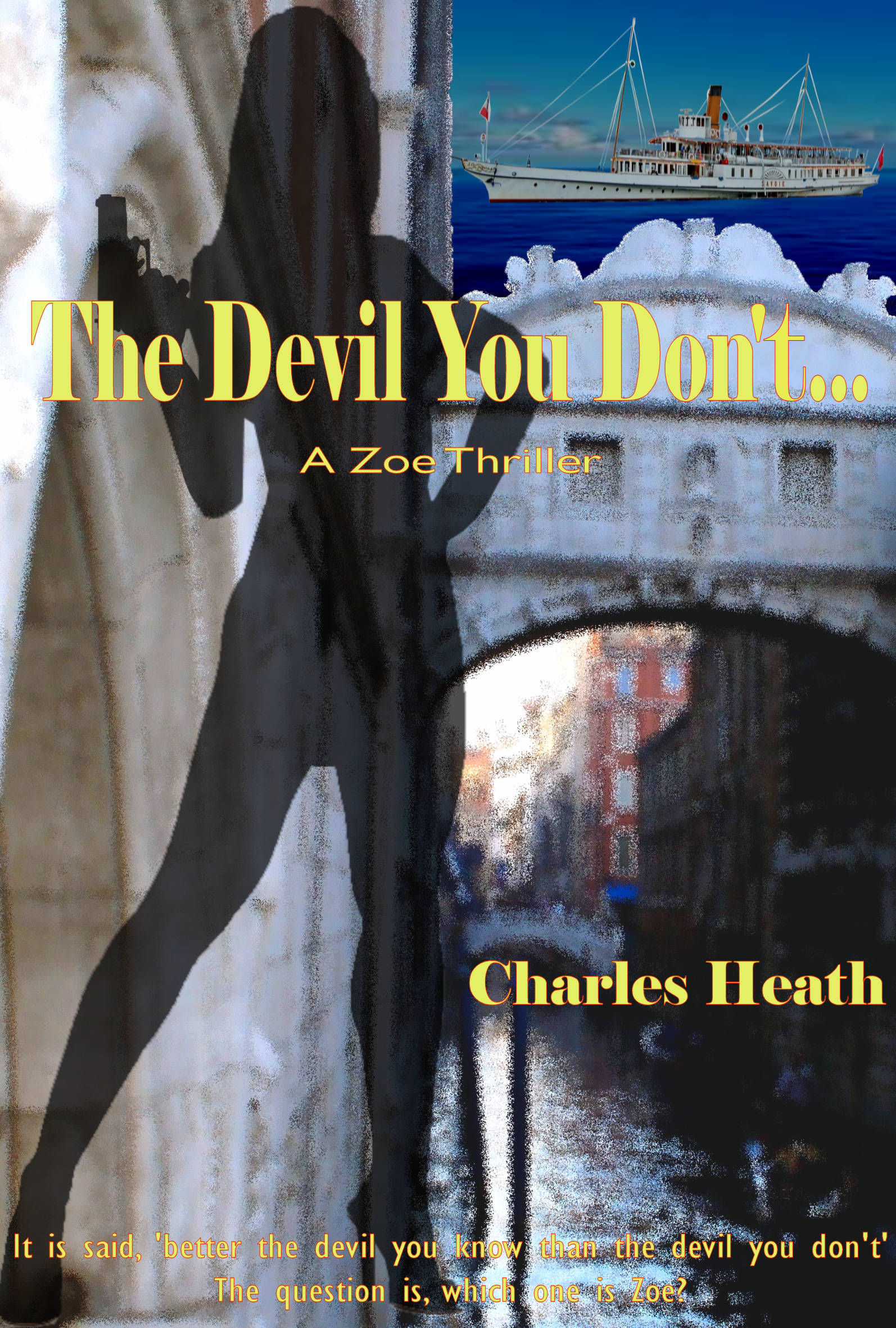
That is a story that slowly unfolds, from the first meeting with his nemesis on Lake Geneva, all the way to a hotel room in Sorrento, where he learns the shattering truth.
What should have been solace after disappointment turns out to be something else entirely, and from that point, everything goes to hell in a handbasket.
He suddenly realises his so-called friend Sebastian has not exactly told him the truth about a small job he asked him to do, the woman he is falling in love with is not quite who she says she is, and he is caught in the middle of a war between two men who consider people becoming collateral damage as part of their business.
The story paints the characters, cleverly displaying all their flaws and weaknesses. The locations add to the story at times, taking me back down memory lane, especially to Venice, where, in those back streets, I confess it’s not all that hard to get lost.
All in all, a thoroughly entertaining story with, for once, a satisfying end.
Televison is a great recorder of the past, and most channels, and especially cable tv have great libraries of films that go back more than a hundred years.
And, whilst it’s possible that modern day films and television series can try to recapture the past, the English as an exception being very good at it, often it is impossible to capture it correctly.
But, if you have a film shot in the moment, then you have a visual record of what life, and what was once part of our world before you in all it’s dated glory. The pity of it is that, then, we never appreciated it.
After all, in those particular times, who had the time to figuratively stop and smell the roses. Back then as life was going on, we were all tied up with just trying to get through each day.
Years later, often on reflection, we try to remember the old days, and, maybe, remember some of what it was like, but the chances are that change came far too rapidly, and often too radical, that it erases what we thought we knew existed before.
My grandmothers house is a case in point. In it’s place is a multi lane super highway, and there’s nothing left to remind us, or anyone of it, just some old sepia photographs.
I was reminded of how volatile history really is when watching an old documentary, in black and white, and how the city I grew up in used to look.
Then, even though it seemed large to me then, it was a smaller city, with suburbs that stretched about ten or so miles in every direction, and the outer suburbs were where people moved to get a larger block, and countrified atmosphere.
Now, those outer suburbs are no longer spacious properties, the acreage subdivided and the old owners now much richer for a decision made with profit not being the motivator, and the current suburban sprawl is now out to forty or fifty miles.
The reason for the distance is no longer the thought of open spaces and cleaner air, the reason for moving now is that land further out is cheaper, and can make buying that first house more affordable.
This is where I tip my hat to the writers of historical fiction. I myself am writing a story based in the 1970s, and its difficult to find what is and isn’t time specific.
If only I had a dollar for every time I went to write the character pulling out his or her mobile phone.
What I’ve found is the necessity to research, and this has amounted to finding old films, documentaries of the day, and a more fascinating source of information, the newspapers of the day.
The latter especially has provoked a lot of memories and a lot of stuff I thought I’d forgotten, some of it by choice, but others that were poignant.
Yes, and don’t get me started on the distractions.
Kingsley Amis (1922‑1995) was a British novelist, poet, and essayist best known for his razor‑sharp wit and satirical eye. He won the Booker Prize for The Old Devils (1986) and penned the cult classic Lucky Jim (1954). Amis was a self‑described “pessimist” who delighted in challenging literary conventions and poking fun at social pretensions.
“I think a lot of people are trying to be too nice. If you can’t annoy somebody with what you write, I think there’s little point in writing.”
The quote sums up his belief that writing’s purpose isn’t comfort—it’s confrontation.
2. The Quote in Context – What Did He Really Mean?
Amis made this remark during a 1962 interview for The Spectator while discussing the role of the modern novelist. He wasn’t encouraging petty irritation; he was championing intellectual provocation—the act of shaking readers out of complacency.
Key takeaways from the original context
Aspect
Explanation
Literary Tradition
Amis aligned himself with authors like Oscar Wilde, George Orwell and James Joyce—writers who deliberately sparked debate.
Audience Expectation
He argued that readers expect to be challenged, not lulled.
Creative Courage
A writer must risk criticism to stay authentic.
In short, Amis believed the value of writing lies in its ability to stir thought, even if it ruffles feathers.
3. Why “Annoying” Can Be a Good Thing in Writing
3.1 The Power of Provocation
Provocation is a deliberate literary technique used to:
Highlight contradictions – A provocative statement forces the reader to confront hidden biases.
Create memorable moments – Controversial lines stay with readers longer than bland prose.
Catalyze cultural conversation – Think of how Harper Lee’sTo Kill a Mockingbird or Margaret Atwood’sThe Handmaid’s Tale sparked nationwide dialogue.
SEO Insight: Articles that explore “how to provoke readers” rank highly for keywords like “provocative writing tips” and “controversial writing examples”.
3.2 Annoyance vs. Engagement
Factor
Annoyance (Negative)
Engagement (Positive)
Reader Reaction
Irritation, dismissal
Curiosity, deeper analysis
Longevity
Forgettable, quickly skimmed
Re‑read, quoted, shared
SEO Impact
High bounce rate
Increased dwell time & backlinks
The sweet spot is controlled annoyance—enough to provoke, but not so much that readers abandon the piece.
4. When Annoyance Becomes Counter‑Productive
Provocation has limits. Below are red flags that indicate you’ve crossed from “thought‑provoking” into “offensive”:
Red Flag
Why It Hurts
How to Fix It
Sweeping Generalisations
Alienates large audiences; looks lazy.
Ground statements in evidence; add nuance.
Personal Attacks
Turns discussion into a fight.
Focus criticism on ideas, not identities.
Misleading “Shock for Shock’s Sake”
Damages credibility; Google penalises low‑quality content.
Keep the shock tied to a clear argument or purpose.
Ignoring Reader Context
Your audience may lack the background needed to understand the provocation.
Provide brief context or a “quick‑read guide.”
Bottom line: Annoyance that adds value ≠ annoyance that creates noise.
5. Real‑World Examples: Writers Who Mastered the Art of Annoyance
Writer
Work
How They Annoy (Productively)
George Orwell
1984
Exposes totalitarian absurdities, disturbing readers with a bleak warning.
Toni Morrison
Beloved
Confronts the trauma of slavery, forcing readers to feel uncomfortable truths.
Brett Easton Ellis
American Psycho
Graphic violence pushes readers to question consumerist culture.
Add a counter‑argument—show you understand the other side.
Explain the “why” after each provocative claim.
6.4 Word‑Level Tactics
Tactic
Why It Works
Sample
Rhetorical Questions
Forces readers to answer internally.
“If we accept this, what’s left for the next generation?”
Parallelism
Creates rhythm, making the message stick.
“We’re told to listen, we’re told to obey, we’re told to forget.”
Contrast
Highlights disparity, amplifying irritation.
“The richest 1% own more than the bottom 50%, yet they claim meritocracy.”
6.5 Edit for Balance
Read aloud – Does the line sound like a thoughtful jab or a tantrum?
Apply the “5‑Second Rule.” If a reader can skip the sentence within five seconds, consider re‑working it.
Seek a Beta Reader—preferably someone with an opposing perspective.
6.6 SEO Checklist (For Blog Posts)
Primary keyword: Kingsley Amis writing quote (use 2–3 times in headings, intro, and conclusion).
LSI keywords: provocative writing, annoying readers purpose, controversial literature examples, how to write to provoke.
Meta tags (title ≤ 60 chars; description ≤ 155 chars).
Alt text for images – e.g., alt="Kingsley Amis portrait, British novelist" for a photo.
Internal links – Point to related posts: “5 Ways to Write a Strong Argument” and “Why Bad Writing Isn’t Always Bad.”
7. Frequently Asked Questions (FAQ)
Q1. Does “annoying” mean being rude or hateful? No. Amis’s concept is about intellectual irritation—challenging ideas, not attacking individuals.
Q2. Can I apply this principle to non‑fiction, like business copy? Absolutely. Even a marketing email can use a slight edge: “Most CEOs think they’re unstoppable. The data says otherwise.”
Q3. How do I measure if my provocative writing works?
Engagement metrics: longer dwell time, comments, social shares.
Qualitative feedback: readers citing “thought‑provoking” in reviews.
Q4. What if I offend a protected group unintentionally? Do a quick sensitivity check: research cultural context, use inclusive language, and consider a content warning if needed.
Q5. Should I always aim to annoy? No. Use annoyance strategically—when the goal is to spark dialogue or highlight injustice. Not every piece needs a shock factor.
8. Final Takeaway: Embrace the Edge, Not the Offence
Kingsley Amis wasn’t encouraging writers to be jerks. He was reminding us that the purpose of good writing is to make readers think, feel, and sometimes squirm. When you master the art of controlled annoyance, you:
Break complacency – Readers stop scrolling and start reflecting.
Boost SEO – Higher dwell time & more backlinks from discussions.
Leave a cultural imprint – Your words join the conversation that shapes society.
Bottom line: If your prose can’t stir at least one mind, ask yourself why you’re writing at all.
Ready to Write Something That Pops?
Pick a controversial stance that aligns with your niche.
Stack it with hard‑data and vivid storytelling.
Polish with the editor’s eye for balance.
Your next post could be the one that annoys—in the best, most purposeful way—making you a writer worth remembering.
“If you can’t annoy somebody with what you write, I think there’s little point in writing.” – Kingsley Amis
Take this as a challenge, not a threat. Start provoking today.
One‑Day Stopover in Prague? Spend It All at Prague Castle
If you’ve only got a single day to soak up the magic of the Czech capital, there’s one place that will give you a crash‑course in history, architecture, and breathtaking views—all in one unforgettable stop.
Why Prague Castle is the Ultimate One‑Day Highlight
What you get
How it fits a tight schedule
A panoramic cityscape – From the castle’s highest towers you can see the Vltava River snaking through the red‑tiled roofs, the spires of St. Vitus, and the iconic Charles Bridge.
Compact “must‑see” circuit – The main attractions (St. Vitus Cathedral, Old Royal Palace, Golden Lane) are within a 15‑minute walk of each other.
Layers of history – From a 9th‑century wooden fort to Habsburg‑era palaces, you’ll walk through more than a thousand years of Czech story in a couple of hours.
Flexible timing – Even a 2‑hour “quick tour” feels complete; a deeper dive can stretch to 4‑5 hours if you have the time.
Iconic photo‑ops – Sunset over the city, the gilded Saint George statue, the winding golden lane – Instagram‑ready moments at every turn.
Easy access – A short tram ride (or a 20‑minute walk from the Old Town) drops you right at the main gate; the castle is free to explore the courtyards, and ticketed sections are clearly marked.
Café culture – The castle grounds host charming cafés where you can sip a Czech “kafe” while the city bustles below.
No language barrier – Audio guides in English (and many other languages) are available at the ticket windows, so you won’t miss a thing.
How to Make the Most of Your Castle Visit
1. Start Early – Get the Tram (Line 22) to “Pražský hrad”
The first tram out of Old Town Square (stop “Staroměstská”) arrives at the castle gates by 9 am. Beat the tourist crowds and the midday heat, and you’ll have the terrace of St. Vitus Cathedral all to yourself for that perfect sunrise shot.
2. Grab a Fast‑Pass Ticket (or Skip‑the‑Line App)
If you’re travelling in peak season (May‑September), buy a “Castle Pass” online before you land. It gives you priority entry to the St. Vitus Cathedral, Old Royal Palace, and Golden Lane—the three “must‑see” interiors. The pass costs about €12 and saves you 30‑45 minutes of waiting.
3. Follow the “Three‑Spot Circuit”
Spot
Time Needed
What to Spot
St. Vitus Cathedral
30–45 min
Gothic spires, the stunning Astronomical Clock (different from the one in the Old Town), the royal tombs.
Old Royal Palace & Vladislav Hall
30 min
The grand hall where coronations once took place; a glimpse of medieval frescoes.
Golden Lane
20 min
Colorful tiny houses that once housed castle guards and later Alphonse Mucha’s studio.
Tip: Walk the circuit clockwise. It follows the natural flow of the historic layout and keeps you moving forward without backtracking.
4. Take a Break at Café Mlejnice (or the Castle’s “Cafe Kavárna”)
Around noon, let the castle’s own café treat you to a warm bowl of goulash with dumplings or a simple Czech pastry. Pair it with a mug of locally roasted coffee while you watch the city spread out below.
5. **Don’t Miss the Sunset from Rudolfinum Tower
If your schedule allows, stay until the late afternoon. The Rudolfinum Tower (a short 10‑minute walk from the main gate) offers a 360° view that transforms the city into a golden‑glow canvas—ideal for that final, memory‑making photo.
Free for the courtyards; €10–€12 for the “combined ticket.”
Getting There
Tram 22 (or 20) from Old Town → “Pražský hrad.” Walking distance from the Charles Bridge (≈20 min).
What to Wear
Comfortable shoes (cobblestones), light rain jacket (prague weather is unpredictable), a small day‑pack (no large bags allowed in some interiors).
Nearby Toilets
Public WC at the “Růžový palác” (Rose Palace) near the main entrance – free with ticket.
Kid‑Friendly
The Golden Lane feels like a storybook; there’s a small kids’ treasure hunt map at the ticket office (free).
The One‑Day Itinerary (All Clock‑Times Approximate)
Time
Activity
08:30
Arrive in Prague (airport or train). Grab a coffee and a quick bite at a bakery near the main station.
09:15
Tram 22 to “Pražský hrad.”
09:45
Enter castle gates, start the Three‑Spot Circuit (St. Vitus → Old Royal Palace → Golden Lane).
12:15
Lunch break at the castle café (or a nearby traditional Czech restaurant in Malá Strana).
13:30
Walk down the historic Lobkowicz Palace gardens (optional, free) toward the Charles Bridge.
14:30
Stroll across the Charles Bridge, snap photos of the statues, and explore the Old Town Square if time permits.
16:00
Return to the castle’s Rudolfinum Tower for sunset views.
17:30
Head back to the airport/train station via tram 22 (or a taxi if you’re in a hurry).
Pro tip: If your flight departs late in the evening, you can swap the sunset view for a twilight walk along the Vltava’s embankment, enjoying the city lights reflecting on the water.
Wrap‑Up: Why One Spot Beats Ten
A bustling city like Prague tempts you to “see it all,” but a single, well‑chosen landmark can give you the essence of the place without the stress of a rushed checklist. Prague Castle packs history, culture, panoramic scenery, and that palpable sense of being at the heart of Europe—all in one compact, walkable area.
So, when your itinerary shrinks to a single day, set your compass for the castle walls, and let the city’s story unfold beneath your feet.
Ready to make your stopover unforgettable? Book your tram ticket, snag a fast‑pass, and let Prague Castle be the unforgettable centrepiece of your Czech adventure.
Happy travels—and don’t forget to tag your sunrise castle photos with #PragueInADay!
One‑Day Stopover in Ankara? Make It Unforgettable With a Single Stop at Anıtkabir
If your flight itinerary or a road‑trip detour leaves you with just 24 hours in Turkey’s capital, you’ll quickly realise that Ankara isn’t a “quick‑look‑and‑leave” city. Its blend of modern governance, Ottoman‑era streets, and ancient history can feel overwhelming when the clock is ticking.
So, what’s the one place you must visit to turn a fleeting layover into a lasting memory?
The answer: Anıtkabir – the Mausoleum of Mustafa Kemal Atatürk
The monumental complex dedicated to Turkey’s founding father is more than a tomb; it’s a masterclass in architecture, a museum of the Republic’s birth, and a panoramic viewpoint over the city’s heart. In a single, well‑planned visit, you’ll:
Feel the pulse of modern Turkish identity – Atatürk’s legacy is woven into every corner of contemporary Turkey, and Anıtkabir is the physical embodiment of that narrative.
Enjoy a compact, self‑contained experience – The site fits comfortably into a 2‑hour window, leaving you time to sip Turkish tea, wander a nearby market, or catch a late‑night flight.
Capture iconic photographs – From the grand staircases to the sprawling lawn framed by the Bosphorus‑blue sky, every angle screams “travel‑worthy.”
Below is a practical guide to make that single stop truly unforgettable.
Where Is Anıtkabir?
Address: Anıtkabir, Çankaya, 06570 Ankara, Turkey
Coordinates: 39.9250° N, 32.8624° E
Getting There:
By Taxi / Ride‑Share: 15‑20 min from Ankara Airport (ESB) or the city centre; cost ≈ 30‑40 TL.
By Public Transport: Take the EGO bus 301 from the airport to Ulus and then a short 10‑minute walk. The Metro (M1 line) to Kızılay, followed by a 20‑minute bus ride (bus 302) also works.
Pro tip: Purchase a “Anıtkabir 1‑Day Pass” (≈ 25 TL) which includes entry to the mausoleum, the museum, and the Atatürk and War of Independence Hall—all in one ticket.
When to Go?
Season
Weather
Best Time of Day
Spring (Mar‑May)
Mild, blossoms in the nearby Gençlik Park
Early morning – fewer crowds, sunrise light on the columns
Summer (Jun‑Aug)
Hot, but the lawns are shaded by large trees
Late afternoon – cooler temps, dramatic sunset silhouettes
Autumn (Sep‑Nov)
Crisp, golden foliage
Mid‑day – perfect for museum photography
Winter (Dec‑Feb)
Cold, occasional snow – magical on the staircase
Late morning – sunlight hits the marble beautifully
The site opens at 9:00 AM and closes at 7:00 PM (last entry at 6:30 PM). Plan to arrive early to beat the peak tourist wave (typically 11:00 AM‑1:00 PM).
What You’ll See – A Quick Walk‑Through
Section
Highlights
Time Needed
Ceremonial Plaza
33‑meter high towers representing the 33 years of the Turkish War of Independence.
15 min
Road of Lions
A marble avenue lined with 24 lion statues, each symbolising virtues like courage and justice.
10 min
Mausoleum Hall
The sarcophagus of Atatürk rests under a 19-metre-high copper dome; a solemn, reverent atmosphere.
10 min
Museum of Atatürk
Personal items, letters, photographs, and a timeline of his life.
30 min
War of Independence Hall
Weapons, maps, and flags displayed in a dramatic, dim‑lit space.
20 min
Terrace & Views
Panoramic sweep of Ankara’s skyline and the verdant Gençlik Park beyond.
15 min
Total: Roughly 1.5‑2 hours. Add a short coffee break at the on‑site café for a traditional Turkish tea and a bite of simit (sesame‑seed bagel).
Why Anıtkabir Beats All Other Options for a One‑Day Stop
Factor
Anıtkabir
Other Popular Spots (e.g., Museum of Anatolian Civilizations, Ankara Castle)
Time Efficiency
All‑in‑one complex; minimal transit between sections
Requires separate trips, more walking, and potentially longer queues
Cultural Significance
Central to modern Turkish identity; revered national monument
Important, but more niche to archaeology or medieval history
Scenic Value
Grand architecture + sweeping city views
Scenic, but generally lower‑profile backdrops
Accessibility
Wheelchair‑friendly ramps, audio guides in multiple languages
Some areas (castle walls) are steep and less wheelchair‑friendly
Memorability
Iconic photo‑ops (dome, lion road, burial chamber) that instantly signal “Ankara”
Beautiful, yet less instantly recognizable to a global audience
In short, Anıtkabir delivers history, architecture, and visual impact in a compact, visitor‑friendly package—exactly what a short stopover demands.
Snap‑Shot Checklist
“The Lions” Walk – Capture the line of stone lions with the sunrise or sunset casting long shadows.
Dome Detail – A low‑angle shot of the copper dome framed by the marble columns.
Atatürk’s Sarcophagus – Respectful close‑up (no flash) of the simple, dignified stone coffin.
Panorama from the Terrace – Use a wide‑angle lens for the cityscape; the park in the foreground adds depth.
Museum Artifact – A candid of you (or your travel companion) reading Atatürk’s handwritten note.
Tip: Free Wi‑Fi is available in the museum—upload instantly to your travel blog or social feed!
Practical Tips for a Smooth Visit
Tip
Details
Dress Code
Modest attire is required (no shorts, miniskirts, or sleeveless tops). A light scarf can be useful.
Security
Expect metal detectors; large bags are not allowed inside the mausoleum.
Audio Guide
Available in English, Arabic, Russian, and French; rent for 10 TL.
Photography
Allowed in the exterior areas; flash prohibited inside the mausoleum hall.
Food & Drink
No eating inside the complex; there’s a small café just outside offering tea, fresh juice, and light snacks.
Nearby Quick Bite
Walk 5 minutes to Beypazarı Şarküteri for a traditional Turkish kebab or Baklava if you have extra time.
After Your Visit – Making the Most of the Rest of the Day
If you have a few hours left: Stroll through Gençlik Park (just south of Anıtkabir). The lake, flower beds, and mini‑cable car offer a pleasant breather.
For a taste of local life: Head to Kızılay Square (the city’s bustling hub) for a quick coffee at Café Diyar, then browse the nearby boutiques for souvenirs.
Last‑minute transport: Return to the airport via the EGO bus 302 (direct to Esenboğa). The ride takes about 30 minutes and runs every 20‑30 minutes.
Wrap‑Up: One Stop, One Memory
When the clock is ticking, you need a destination that summarises the soul of the city while staying logistically friendly. Anıtkabir does exactly that. It offers a profound glimpse into Turkey’s modern birth, striking architectural grandeur, and photo‑ready vistas—all within a compact venue that respects your limited schedule.
So next time your itinerary hands you a single day in Ankara, skip the maze of museums and head straight for the lion‑lined road. Walk the steps, stand beneath the dome, and let the spirit of Atatürk’s vision linger long after you’ve boarded your next flight.
Enjoy the journey, and may your stopover become a story you’ll share for years to come!
This story has been ongoing since I was seventeen, and just to let you know, I’m 72 this year.
Yes, it’s taken a long time to get it done.
Why, you might ask.
Well, I never gave it much interest because I started writing it after a small incident when I was 17, and working as a book packer for a book distributor in Melbourne
At the end of my first year, at Christmas, the employer had a Christmas party, and that year, it was at a venue in St Kilda.
I wasn’t going to go because at that age, I was an ordinary boy who was very introverted and basically scared of his own shadow and terrified by girls.
Back then, I would cross the street to avoid them
Also, other members of the staff in the shipping department were rough and ready types who were not backwards in telling me what happened, and being naive, perhaps they knew I’d be either shocked or intrigued.
I was both adamant I wasn’t coming and then got roped in on a dare.
Damn!
So, back then, in the early 70s, people looked the other way when it came to drinking, and of course, Dutch courage always takes away the concerns, especially when normally you wouldn’t do half the stuff you wouldn’t in a million years
I made it to the end, not as drunk and stupid as I thought I might be, and St Kilda being a salacious place if you knew where to look, my new friends decided to give me a surprise.
It didn’t take long to realise these men were ‘men about town’ as they kept saying, and we went on an odyssey. Yes, those backstreet brothels where one could, I was told, have anything they could imagine.
Let me tell you, large quantities of alcohol and imagination were a very bad mix.
So, the odyssey in ‘The things we do’ was based on that, and then the encounter with Diana. Well, let’s just say I learned a great deal about girls that night.
Firstly, not all girls are nasty and spiteful, which seemed to be the case whenever I met one. There was a way to approach, greet, talk to, and behave.
It was also true that I could have had anything I wanted, but I decided what was in my imagination could stay there. She was amused that all I wanted was to talk, but it was my money, and I could spend it how I liked.
And like any 17-year-old naive fool, I fell in love with her and had all these foolish notions. Months later, I went back, but she had moved on, to where no one was saying or knew.
Needless to say, I was heartbroken and had to get over that first loss, which, like any 17-year-old, was like the end of the world.
But it was the best hour I’d ever spent in my life and would remain so until I met the woman I have been married to for the last 48 years.
As Henry, he was in part based on a rebel, the son of rich parents who despised them and their wealth, and he used to regale anyone who would listen about how they had messed up his life
If only I’d come from such a background!
And yes, I was only a run away from climbing up the stairs to get on board a ship, acting as a purser.
I worked for a shipping company and they gave their junior staff members an opportunity to spend a year at sea working as a purser on a cargo ship that sailed between Melbourne, Sydney and Hobart in Australia.
One of the other junior staff members’ turn came, and I would visit him on board when he would tell me stories about life on board, the officers, the crew, and other events. These stories, which sounded incredible to someone so impressionable, were a delight to hear.
Alas, by that time, I had tired of office work and moved on to be a tradesman at the place where my father worked.
It proved to be the right move, as that is where I met my wife. Diana had been right; love would find me when I least expected it.
Kingsley Amis (1922‑1995) was a British novelist, poet, and essayist best known for his razor‑sharp wit and satirical eye. He won the Booker Prize for The Old Devils (1986) and penned the cult classic Lucky Jim (1954). Amis was a self‑described “pessimist” who delighted in challenging literary conventions and poking fun at social pretensions.
“I think a lot of people are trying to be too nice. If you can’t annoy somebody with what you write, I think there’s little point in writing.”
The quote sums up his belief that writing’s purpose isn’t comfort—it’s confrontation.
2. The Quote in Context – What Did He Really Mean?
Amis made this remark during a 1962 interview for The Spectator while discussing the role of the modern novelist. He wasn’t encouraging petty irritation; he was championing intellectual provocation—the act of shaking readers out of complacency.
Key takeaways from the original context
Aspect
Explanation
Literary Tradition
Amis aligned himself with authors like Oscar Wilde, George Orwell and James Joyce—writers who deliberately sparked debate.
Audience Expectation
He argued that readers expect to be challenged, not lulled.
Creative Courage
A writer must risk criticism to stay authentic.
In short, Amis believed the value of writing lies in its ability to stir thought, even if it ruffles feathers.
3. Why “Annoying” Can Be a Good Thing in Writing
3.1 The Power of Provocation
Provocation is a deliberate literary technique used to:
Highlight contradictions – A provocative statement forces the reader to confront hidden biases.
Create memorable moments – Controversial lines stay with readers longer than bland prose.
Catalyze cultural conversation – Think of how Harper Lee’sTo Kill a Mockingbird or Margaret Atwood’sThe Handmaid’s Tale sparked nationwide dialogue.
SEO Insight: Articles that explore “how to provoke readers” rank highly for keywords like “provocative writing tips” and “controversial writing examples”.
3.2 Annoyance vs. Engagement
Factor
Annoyance (Negative)
Engagement (Positive)
Reader Reaction
Irritation, dismissal
Curiosity, deeper analysis
Longevity
Forgettable, quickly skimmed
Re‑read, quoted, shared
SEO Impact
High bounce rate
Increased dwell time & backlinks
The sweet spot is controlled annoyance—enough to provoke, but not so much that readers abandon the piece.
4. When Annoyance Becomes Counter‑Productive
Provocation has limits. Below are red flags that indicate you’ve crossed from “thought‑provoking” into “offensive”:
Red Flag
Why It Hurts
How to Fix It
Sweeping Generalisations
Alienates large audiences; looks lazy.
Ground statements in evidence; add nuance.
Personal Attacks
Turns discussion into a fight.
Focus criticism on ideas, not identities.
Misleading “Shock for Shock’s Sake”
Damages credibility; Google penalises low‑quality content.
Keep the shock tied to a clear argument or purpose.
Ignoring Reader Context
Your audience may lack the background needed to understand the provocation.
Provide brief context or a “quick‑read guide.”
Bottom line: Annoyance that adds value ≠ annoyance that creates noise.
5. Real‑World Examples: Writers Who Mastered the Art of Annoyance
Writer
Work
How They Annoy (Productively)
George Orwell
1984
Exposes totalitarian absurdities, disturbing readers with a bleak warning.
Toni Morrison
Beloved
Confronts the trauma of slavery, forcing readers to feel uncomfortable truths.
Brett Easton Ellis
American Psycho
Graphic violence pushes readers to question consumerist culture.
Add a counter‑argument—show you understand the other side.
Explain the “why” after each provocative claim.
6.4 Word‑Level Tactics
Tactic
Why It Works
Sample
Rhetorical Questions
Forces readers to answer internally.
“If we accept this, what’s left for the next generation?”
Parallelism
Creates rhythm, making the message stick.
“We’re told to listen, we’re told to obey, we’re told to forget.”
Contrast
Highlights disparity, amplifying irritation.
“The richest 1% own more than the bottom 50%, yet they claim meritocracy.”
6.5 Edit for Balance
Read aloud – Does the line sound like a thoughtful jab or a tantrum?
Apply the “5‑Second Rule.” If a reader can skip the sentence within five seconds, consider re‑working it.
Seek a Beta Reader—preferably someone with an opposing perspective.
6.6 SEO Checklist (For Blog Posts)
Primary keyword: Kingsley Amis writing quote (use 2–3 times in headings, intro, and conclusion).
LSI keywords: provocative writing, annoying readers purpose, controversial literature examples, how to write to provoke.
Meta tags (title ≤ 60 chars; description ≤ 155 chars).
Alt text for images – e.g., alt="Kingsley Amis portrait, British novelist" for a photo.
Internal links – Point to related posts: “5 Ways to Write a Strong Argument” and “Why Bad Writing Isn’t Always Bad.”
7. Frequently Asked Questions (FAQ)
Q1. Does “annoying” mean being rude or hateful? No. Amis’s concept is about intellectual irritation—challenging ideas, not attacking individuals.
Q2. Can I apply this principle to non‑fiction, like business copy? Absolutely. Even a marketing email can use a slight edge: “Most CEOs think they’re unstoppable. The data says otherwise.”
Q3. How do I measure if my provocative writing works?
Engagement metrics: longer dwell time, comments, social shares.
Qualitative feedback: readers citing “thought‑provoking” in reviews.
Q4. What if I offend a protected group unintentionally? Do a quick sensitivity check: research cultural context, use inclusive language, and consider a content warning if needed.
Q5. Should I always aim to annoy? No. Use annoyance strategically—when the goal is to spark dialogue or highlight injustice. Not every piece needs a shock factor.
8. Final Takeaway: Embrace the Edge, Not the Offence
Kingsley Amis wasn’t encouraging writers to be jerks. He was reminding us that the purpose of good writing is to make readers think, feel, and sometimes squirm. When you master the art of controlled annoyance, you:
Break complacency – Readers stop scrolling and start reflecting.
Boost SEO – Higher dwell time & more backlinks from discussions.
Leave a cultural imprint – Your words join the conversation that shapes society.
Bottom line: If your prose can’t stir at least one mind, ask yourself why you’re writing at all.
Ready to Write Something That Pops?
Pick a controversial stance that aligns with your niche.
Stack it with hard‑data and vivid storytelling.
Polish with the editor’s eye for balance.
Your next post could be the one that annoys—in the best, most purposeful way—making you a writer worth remembering.
“If you can’t annoy somebody with what you write, I think there’s little point in writing.” – Kingsley Amis
Take this as a challenge, not a threat. Start provoking today.
Williams’ Restaurant, East 65th Street, New York, Saturday, 8:00 p.m.
We met the Blaines at Williams’, a rather upmarket restaurant that the Blaines frequently visited and had recommended.
Of course, during the taxi ride there, Alison reminded me that with my new job, we would be able to go to many more places like Williams’. It was, at worst, more emotional blackmail, because as far as Alison was concerned, we were well on our way to posh restaurants, the Trump Tower Apartments, and the trappings of the ‘executive set’.
It would be a miracle if I didn’t strangle Elaine before the night was over. It was she who had filled Alison’s head with all this stuff and nonsense.
Aside from the half-frown, half-smile, Alison was looking stunning. It had been months since she had last dressed up, and she was especially wearing the dress I’d bought her for our 5th anniversary that cost a month’s salary. On her, it was worth it, and I would have paid more if I had to. She had adored it and me, for a week or so after.
For tonight, I think I was close to getting back on that pedestal.
She had the looks and figure to draw attention, the sort movie stars get on the red carpet, and when we walked into the restaurant, I swear there were at least five seconds of silence, and many more gasps.
I even had a sudden loss of breath earlier in the evening when she came out of the dressing room. Once more, I was reminded of how lucky I was that she had agreed to marry me. Amid all those self-doubts, I couldn’t believe she had loved me when there were so many others out there who were more appealing.
Elaine was out of her seat and came over just as the Head Waiter hovered into sight. She personally escorted Alison to the table, allowing me to follow like the Queen’s consort, while she and Alison basked in the admiring glances of the other patrons.
More than once, I heard the muted question, “Who is she?”
Jimmy stood, we shook hands, and then we sat together. It was not the usual boy, girl, boy, girl seating arrangement. Jimmy and I on one side and Elaine and Alison on the other.
The battle lines were drawn.
Jimmy was looking fashionable, with a permanent blade one beard, unkempt hair, and a designer dinner suit that looked like he’d slept in it. Alison insisted I wear a tuxedo, and I looked like the proverbial penguin or just a thinner version of Alfred Hitchcock.
The bow tie had been slightly crooked, but just before we stepped out, she had straightened it. And took the moment to look deeply into my soul. It was one of those moments when words were not necessary.
Then it was gone.
I relived it briefly as I sat and she looked at me. A penetrating look that told me to ‘behave’.
When we were settled, Elaine said, in that breathless, enthusiastic manner of hers when she was excited, “So, Harry, you are finally moving up.” It was not a question, but a statement.
I was not sure what she meant by ‘finally’, but I accepted it with good grace. Sometimes, Elaine was prone to using figures of speech I didn’t understand. I guessed she was talking about the new job. “It was supposed to be a secret.”
She smiled widely. “There are no secrets between Al and me, are there, Al?”
I looked at ‘Al’ and saw a brief look of consternation.
I was not sure Alison liked the idea of being called Al. I tried it once and was admonished. But it was interesting that her ‘best friend forever’ was allowed that distinction when I was not. It was, perhaps, another indicator of how far I’d slipped in her estimation.
Perhaps, I thought, it was a necessary evil. As I understood it, the Blaines were our mentors at the Trump Tower, because they didn’t just let ‘anyone’ in. I didn’t ask if the Blaines thought we were just ‘anyone’ before I got the job offer.
And then there was that look between Alison and Elaine, quickly stolen before Alison realised I was looking at both of them. I was out of my depth, in a place I didn’t belong, with people I didn’t understand. And yet, apparently, Alison did. I must have missed the memo.
“No,” Alison said softly, stealing a glance in my direction, “No secrets between friends.”
No secrets. Her look conveyed something else entirely.
The waiter brought champagne, Krug, and poured glasses for each of us. It was not the cheap stuff, and I was glad I brought a couple of thousand dollars with me. We were going to need it.
Then, a toast.
To a new job and a new life.
“When did you decide?” Elaine was effusive at the best of times, but with the champagne, it was worse.
Alison had a strange expression on her face. It was obvious she had told Elaine it was a done deal, even before I’d made up my mind. Perhaps she’d assumed I might be ‘refreshingly honest’ in front of Elaine, but it could also mean she didn’t really care what I might say or do.
Instead of consternation, she looked happy, and I realised it would be churlish, even silly, if I made a scene. I knew what I wanted to say. I also knew that it would serve little purpose provoking Elaine or upsetting Alison. This was not the time or the place. Alison had been looking forward to coming here, and I was not going to spoil it.
Instead, I said, smiling, “When I woke up this morning and found Alison missing. If she had been there, I would not have noticed the water stain on the roof above our bed, and decided there and then how much I hated the place.” I used my reassuring smile, the one I used with the customers when all hell was breaking loose, and the forest fire was out of control. “It’s the little things. They all add up until one day …” I shrugged. “I guess that one day was today.”
I saw an incredulous look pass between Elaine and Alison, a non-verbal question; perhaps, is he for real? Or, I told you he’d come around.
I had no idea the two were so close.
“How quaint,” Elaine said, which just about summed up her feelings towards me. I think, at that moment, I lost some brownie points. It was all I could come up with at short notice.
“Yes,” I added, with a little more emphasis than I wanted. “Alison was off to get some studying in with one of her friends.”
“Weren’t the two of you off to the Hamptons, a weekend with some friends?” Jimmy piped up and immediately got the ‘shut up, you fool’ look that cut that line of conversation dead. Someone forgot to feed Jimmy his lines.
It was followed by the condescending smile from Elaine, and “I need to powder my nose. Care to join me, Al?”
A frown, then a forced smile for her new best friend. “Yes.”
I watched them leave the table and head in the direction of the restroom, looking like they were in earnest conversation. I thought ‘Al’ looked annoyed, but I could be wrong.
I had to say Jimmy looked more surprised than I did.
There was that odd moment of silence between us, Jimmy still smarting from his death stare, and for me, the Alison and Elaine show. I was quite literally gob-smacked.
I drained my champagne glass, gathering some courage and turned to him. “By the way, we were going to have a weekend away, but this legal tutorial thing came up. You know Alison is doing her law degree.”
He looked startled when he realised I had spoken. He was looking intently at a woman several tables over from us, one who’d obviously forgotten some basic garments when getting dressed. Or perhaps it was deliberate. She’d definitely had some enhancements done.
He dragged his eyes back to me. “Yes. Elaine said something or other about it. But I thought she said the tutor was out of town and it had been postponed until next week. Perhaps I got it wrong. I usually do.”
“Perhaps I’ve got it wrong.” I shrugged as the dark thoughts started swirling in my head again. “This week or next, what does it matter?”
Of course, it mattered to me, and I digested what he said with a sinking heart. It showed there was another problem between Alison and me; she might have been telling me lies. If what he said was true and I had no reason to doubt him, where was she going tomorrow morning, and had she really been with a friend studying today?
We poured some more champagne, had a drink, then he asked, “This promotion thing, what’s it worth?”
“Trouble, I suspect. Definitely more money, but less time at home.”
“Oh,” raised eyebrows. Obviously, the women had not talked about the job in front of him, or, at least, not all the details. “You sure you want to do that?”
At last, the voice of reason. “Me? No.”
“Yet you accepted the job.”
I sucked in a breath or two while I considered whether I could trust him. Even if I couldn’t, I could see my ship was sinking, so it wouldn’t matter what I told him, or what Elaine might find out from him. “Jimmy, between you and me, I haven’t as yet decided one way or another. To be honest, I won’t know until I go up to Barclay’s office and he asks me the question.”
“Barclay?”
“My boss.”
“Elaine’s doing a job for a Barclay who recently moved into the tower a block down from us. I thought I recognised the name.”
“How did Elaine get the job?”
“Oh, Alison put him onto her.”
“When?”
“A couple of months ago. Why?”
I shrugged and tried to keep a straight face, while my insides were churning up like the wake of a supertanker. I felt sick, faint, and wanted to die all at the same moment. “Perhaps she said something about it, but it didn’t connect at the time. Too busy with work, I expect. I think I seriously need to get away for a while.”
I could hardly breathe, my throat was constricted, and I knew I had to keep it together. I could see Elaine and Alison coming back, so I had to calm down. I sucked in some deep breaths and put my ‘manage a complete and utter disaster’ look on my face.
And I had to change the subject, quickly, so I said, “Jimmy, Elaine told Alison, who told me, you were something of a guru of the cause and effects of the global economic meltdown. Now, I have a couple of friends who have been expounding this theory …”
Like flicking a switch, I launched into the well-worn practice of ‘running a distraction’, like at work when we needed to keep the customer from discovering the truth. It was one of the things I was good at, taking over a conversation and pushing it in a different direction. It was salvaging a good result from an utter disaster, and if ever there was a time that it was required, it was right here, right now.
When Alison sat down and looked at me, she knew something had happened between Jimmy and me. I might have looked pale or red-faced, or angry or disappointed, but it didn’t matter. If that didn’t seal the deal for her, the fact that I took over the dining engagement did. She knew well enough that the only time I did that was when everything was about to go to hell in a handbasket. She’d seen me in action before and had been suitably astonished.
But I got into gear, kept the champagne flowing and steered the conversation, as much as one could from a seasoned professional like Elaine, and, I think, in Jimmy’s eyes, he saw the battle lines and knew who took the crown on points. Neither Elaine nor Jimmy suspected anything, and if the truth be told, I had improved my stocks with Elaine. She was at times both surprised and interested, even willing to take a back seat.
Alison, on the other hand, tried poking around the edges, and, once when Elaine and Jimmy had got up to have a cigarette outside, questioned me directly. I chose to ignore her and pretend nothing had happened, rather than tell her how much I was enjoying the evening.
She had her ‘secrets’. I had mine.
At the end of the evening, when I got up to go to the bathroom, I was physically sick from the pent-up tension and the implications of what Jimmy had told me. It took a while for me to pull myself together; so long, in fact, that Jimmy came looking for me. I told him I’d drunk too much champagne, and he seemed satisfied with that excuse. When I returned, both Alison and Elaine noticed how pale I was, but neither made any comment.
It was a sad way to end what was supposed to be a delightful evening, which, to a large degree, it was for the other three. But I had achieved what I set out to do: to play them at their own game, watching the deception once I knew there was one, as warily as a cat watches its prey.
I had also discovered Jimmy’s real calling; a professor of economics at the same University Alison was doing her law degree. It was no surprise in the end, on a night where surprises abounded, that the world could really be that small.
We parted in the early hours of the morning, a taxi whisking us back to the Lower East Side, another taking the Blaines back to the Upper West Side. But, in our case, as Alison reminded me, it would not be for much longer. She showed concern for my health and asked me what was wrong. It took all the courage I could muster to tell her it was most likely something I ate and the champagne, and that I would be fine in the morning.
She could see quite plainly it was anything other than what I told her, but she didn’t pursue it. Perhaps she just didn’t care what I was playing at.
And yet, after everything that had happened, once inside our ‘palace’, the events of the evening were discarded, like her clothing, and she again reminded me of what we had together in the early years before the problems had set in.
It left me confused and lost.
I couldn’t sleep because my mind had now gone down that irreversible path that told me I was losing her, that she had found someone else, and that our marriage was in its last death throes.
And now I knew it had something to do with Barclay.
I’m back home and this story has been sitting on the back burner for a few months, waiting for some more to be written.
The trouble is, there are also other stories to write, and I’m not very good at prioritizing.
But, here we are, a few minutes opened up and it didn’t take long to get back into the groove.
Chasing leads, maybe
“You haven’t been truthful with me, have you?”
That was Dobbin’s opening shot once we were in the car and out in traffic. It was as if he was worried someone would be listening in on our conversation.
“Says the spider to the fly. Isn’t it the nature of this business not to play all your cards at once?”
“You’ve been in this business all of five minutes. You don’t get the right to play cards.”
“I’m still alive, no thanks to anyone but my own skill.”
I could see the disdain in his expression, and the annoyance in his eyes. Perhaps he was a man used to getting his own way. I was expecting a retort, but he said nothing.
“How many different organizations do you work for, or is it none, and you just have fake IDs to get you in the door?”
“Need to know. Have you found O’Connell yet?”
“He’s dead. I saw him killed in an alley. I’m sure Maury and Severin had him shot, no coincidence they turned up just after he hit the ground. I searched the body, there was nothing on it. Before he was shot, he told me to speak to you. I did. Anything else I’m doing is for my own protection. Assigning Jan to befriend me, then play me would have been a good plan if I hadn’t found out. I know she found O’Connell’s other residence, but I’m willing to bet she found as much as I did nothing. Your people do that to Maury?”
“In a manner of speaking. He wasn’t going to talk, and we couldn’t let him back on the street.”
“And knowing that I would go back to the hotel, what were you hoping for, that I would get arrested for his murder?”
“We were hoping you would glean information from her handler, or the police. Seems both are either tight-lipped, or they know nothing. Her handler is an incompetent fool.”
“Where is she?”
“Waiting for you at her apartment. I want the pair of you to find O’Connell. He either has the information, or he knows where it is. They found the charred remains of a body in the cafe where the explosion was, a freelance reporter, who, according to his editor, had the story of the century. No other details, though.”
“That either means military or industrial secrets. Why would the reporter want to meet with O’Connell?”
“That’s not your concern.”
“Well, you’re wrong if you think O’Connell had the USB. He didn’t get inside the cafe before it blew up, I know, I was there, and witness the whole event. You know the drill, he goes past, checking to see if the target is in place, then makes sure the location is clear, then goes back and facilitates the handover. He only just got past the front when the bomb went off. I’m sure you’ve seen the CCTV footage.”
Yes, his expression told me he had.
“So how do you come to the conclusion he still has it?”
Never cite logical arguments to a man who lives in a fantasy world.
“Law of averages tells me there is a copy, and O’Connell would have made sure there was a backup plan, and location.”
It then struck me, after having talked to O’Connell, and knowing Dobbin knew O’Connell was still alive because he had rescued him from the alley and Severin’s cleaners. It was not just a matter of getting him to admit it, and the fact O’Connell had done a runner on him.
“You seem convinced O’Connell is still alive.”
He glared at me. Truth or dare?
“Because he is. The trouble is, he’s gone to ground and I can’t raise him. He was supposed to wait a few days in a safe place while we hunted down Severin and Maury. We had one, but not the other. I doubt he’ll surface before he gets word that Severin has been neutralized. Every hour that information is still out there, is the chance it will fall into the wrong hands, so we need him and the information found.”
“You think he’s gone rogue.”
“I don’t think anything.
The car stopped outside O’Connell’s apartment block.
“Place nice with Jan, and find him and the information.
I got out of the car and watched it rejoin the traffic.
Before heading to the front entrance, my phone rang. Odd, because only two people knew my number, and it was neither of those two.
Curiosity overcame reluctance to answer. “Yes.”
“I’m texting a meeting point. Be there at six.” The line went dead before I could say anything. Four hours.
No doubting the voice. Severin. And he sounded scared.
I wondered if he knew what had happened to his partner in crime.
 Where Is Anıtkabir?
 When to Go?
 What You’ll See – A Quick Walk‑Through
 Why Anıtkabir Beats All Other Options for a One‑Day Stop
 Snap‑Shot Checklist
 Practical Tips for a Smooth Visit
 After Your Visit – Making the Most of the Rest of the Day
 Wrap‑Up: One Stop, One Memory


