NaNoWriMo – April – 2026 – Day 7

After the cat dragged me out of bed simply because he wanted me to refill the food containers, he did the usual trick of sitting there, watching patiently until I walked off, then went over to the bowl, sniffed, and walked off.

OK, he didn’t need to wake me up if he was going to do that.

Stern words are spoken, but it’s water off a duck’s back (or cat’s back if you like).

I’m annoyed, and he’s, well, he’s just a pain in the neck.

So…

Now that I’m up, I might as well get some work done.  I think about breakfast for about a minute, and decide it’s too hard to make toast.  Yes, it’s that kind of morning.

Coffee?

Maybe.  I put the kettle on as a token gesture of doing something, and go out to the writing room.

I’m calling it that for now, because we’re at the end of the first week of NaNoWriMo, and it’s proceeding well, which means, of course, that something is going to happen, and the wheels are going to come off.

I turn on the laptop, and after waiting the usual five minutes, I have the logon screen and no mouse.  It’s been acting erratically for a few days, but that’s Windows anyway.

So, I have a dead mouse.

Should I give it to Chester to play with?

I changed the batteries, usually the problem, but to no avail.

Good thing then we have a few spares because when the granddaughters are over, they are prone to dropping them on the ground and breaking them.  I have a drawer full of dead mice.

One day, Chester will be happy, or not.  It’s hard to tell what he’s thinking.

New mouse, wait for it to install, back to work.

Kettle’s boiled, new distraction, might as well get coffee.

Maybe I’ll get back to work later.

A to Z – April – 2026 – F

F is for – Five Words

I’d heard about the show, one with a funny title that when people asked, they couldn’t quite get it exactly right, but close enough to “This was your life”.

I thought it was about dead people, odd, because I knew it was impossible to interview dead people, though those days, someone told me, anything was possible on television.

Then I thought it was about people almost at the end of their life, as a celebration of a celebrity, or someone famous.

It was a surprise to learn it was about ordinary people.

Like me.  You couldn’t find anyone more ordinary, or as several people told me, utterly forgettable.

That hurt, but in a sense, they were right.

Which made me wonder just how it was that I received a letter in the mail telling me I had been selected for an episode.

Of course, I thought someone was playing a hoax, and rang them, expecting to be laughed at, but no.  I was being asked to go on the show.

I have no idea why I agreed.

When I arrived at the studio, I was taken to an office where the executive producer told me what was going to happen: sign some papers to say I was not going to divulge details of the show before it was broadcast, and what my five words were.

They were different for each participant.

Today, they were recording five episodes.  I was going to be the last.

My words were Good, Afraid, Trouble, Look and Quiet.  I had plenty of time to think about them in relation to my story.

And that was the odd thing … I actually had a story.

“So,” the host said, in that mesmerising voice of hers that had both the audience and the participants entranced, “Tell us what the word Good means to you.”

Of course, it wasn’t just the word good, it was a better word that meant the same thing.

“It wasn’t just a good day, it was a fantastic, unbelievable day.”

I remembered it well, that last day of high school, when it was, in a lot of cases, the last time I would see my fellow classmates.

Most of them I never wanted to see again, because that final year had been marked by more lows than highs, culminating in my date for the Prom falling ill, and so I didn’t go.  Then I discovered she lied, went with my so-called best friend, and made last week unbearable.

So much so, I headed straight for the railway station and intended to hide at my grandmother’s house on the other side of the country.

The day started badly, arguing with my parents, arguing with my siblings, getting into three separate scuffles at school, then coming home and throwing a few things into a backpack and leaving before I saw anyone at home.

Every step from the house to the railway depot was a reminder of each betrayal, so by the time I sat in the waiting room, an hour before the train was due, I was mentally and physically exhausted.

I expected someone from home would come and try to persuade me to stay.

They didn’t.

Perhaps that was the final betrayal.  The fact that not one of my own family cared whether I stayed or left.

Very few people took the train.  Most people leaving town went to the airport and got a plane.  There was a bus, but it took forever to get anywhere, and the train was an acceptable alternative.

I was the only one leaving town by train.

Until I wasn’t.

Five students in that final year shared my disposition, in that we preferred to study, get good grades and then go to college.  The other three left a week before, gaining admission to an Ivy League university.

I hadn’t applied.

The other person was Alison Breton. 

She was one of those people who no one gave a second look at, or so much as a first.  She was clever, and all the boys didn’t like girls who were smarter than they.

She was also plain, or so it appeared, which caused most of the boys to point out her faults, such as how she presented herself.  Unlike the other girls who dressed to impress, wore make-up and looked stunning, even if it was an objectifying description, she preferred to be different.

I thought she was brave.

We barely spoke, though we were in the same study group with the three Ivy Leaguers.  Two of them were keen on her, but she was not the dating sort.  Or so they said.

Ten minutes before the train arrived, another person came and sat in the waiting room.

Alison Breton.

I ignored her for five whole minutes.  I mean, what could I say to her?

It was when the host mentioned the second word, “afraid.”

It was part of the truth and summed up how I felt about her.  I was afraid of her.  Afraid, or more to the point, literally terrified.

I had imagined many times what I would say to her, fabricating long, I thought, interesting conversations.

And if I let my imagination stretch a little further, I might have to admit I liked her, perhaps more than I should, but could and would never admit it.  One humiliation by a girl in a lifetime was enough, and my completely shattered ego couldn’t take another rejection.

Five whole minutes before she said, “So you’re leaving this dump too?”

It was obvious I was, though the dump was harsh.

And then words came out that were not my own.  “What’s your excuse?”

I knew the moment I tried to speak to her that it would be over.  Maryanne, the betrayer, was different.  I could speak to her, and because of that, I thought she was the one.

She smiled.  “Probably the same as yours.  James told me he loved me, but he didn’t.  Apparently, I’m the subject of a bet.”

I’d heard a rumour and couldn’t believe it.  Or perhaps I could.  Small town, small-minded boys, one ambition, to have what they couldn’t.

“Best get out of town then.”  My solution to the problem wasn’t a one-size-fits-all all.

But it was a response to the host dropping the word trouble.  And then looked and was quiet.  It seemed they were all intertwining in the narrative that was unfolding.

“That doesn’t explain your desire to leave, other than the Maryanne humiliation.  I guess a month away from here might make it go away.”

“It won’t.  I have brothers who will never let me forget.  You grow up in this place, no one forgets the trouble, or more appropriately, your legacy.”

“It’s always us quiet kids, eh, the ones who don’t make a fuss, who are studious and respectful, who don’t want to be noticed.  No matter how we look or feel.  I tried to be invisible.”

“It made you stand out more than the Maryannes.  I was just fodder for girls like her, pandering to the mores of the football team, and you know what they were like.”

Being smart didn’t make us immune to being hurt or hoping against hope that we had a chance.

We both heard the sound of the horn in the distance, a warning that the train was approaching the railway crossing, about two or three miles outside of town.

The train, like always, was running late.

She stood.  “Where are you going?”

“San Francisco.  My grandmother.  She has a large house and many unusual friends.  She was an actress once, when Hollywood was going through its black and white phase.”

“I’m going there too.  My mother’s sister, though I suspect she isn’t.  Maybe we can pretend we’re brother and sister, to be safe.”

I shrugged.  Why not?  Once we got there, I’d probably never see her again.

“Except,” Alison said, holding my hand, and talking to the host with that whimsical expression she had when telling others the story of how we met, “we talked and talked and fell in love, got married, have five amazing children, twelve equally amazing grandchildren, and just lived our lives.  Nothing special, and yet to us, very, very special.”

And then, surprisingly, our time was up.  I had expected it would take half the time allotted.  Instead, it was two hours later, and no one, not any of us, had noticed.

©  Charles Heath  2025-2026

365 Days of writing, 2026 – My Second Story 12

More about my second novel

I’ve been looking back at what’s been written, something you shouldn’t do when trying to get 50,000 words written in 30 days, but I’m ahead of the count, and a little checking is needed, just to make sure everything is running smoothly.

Not that any book written on the fly like this runs smoothly.

There are three themes to this story:

1 – Worthington, now head of the Intelligence agency, is seeking revenge for Zoe killing his brother by mistake, a mistake that he caused

2 – Alistair’s mother is deploying a collection of agents, some of whom were once Zoe’s colleagues, to assassinate the woman who assassinated her son

3 – John’s ever-growing fear that Zoe is tired of him, and, after she leaves, and even though she promised to come back, he doesn’t want to wait to find out he’s been dumped.

4 – Sebastian is always lurking in the background, ostensibly to recruit her as an assassin, but really because he’s jealous of John’s good fortune.

Our two intrepid heroes go off to save her in Marseilles, where she learns of the identity of who is ostensibly looking for her, and sets her off on a lone hunt for him.

We then deploy two new characters, Rupert and Isobel, who, along with John, will create a private detective agency that John uses to locate Zoe by any and all means.

Isobel soon finds out that searching for Zoe on the internet brings risks, both at home and abroad, bringing her in contact with another hacker who seems to know where Zoe’s past is hiding. But can they be trusted?

John heads off to Vienna, after being supplied a file on Zoe, full of information he had not known about her. What he learns in Vienna leads him to Bratislava, when a photo identifying where she suddenly arrives on his phone.

John locates her, she realises he is being used as bait, and they leave, but not before the hit team almost completes their mission, leaving behind a trail of bodies as they get away, but not without injury.

John gets the answers he is seeking, that if he wants a life of looking over his shoulder, by all means, tag along. She is quite pleased to see him, not so much that he brought ‘friends’, but she might yet get to train him.

Sebastian, feeling left out, grills Isobel and Rupert, gets sidelined by Worthington because anywhere Sebastian goes, trouble follows, and then convinces Isobel that John is in over his head and needs their help.

He’s not wrong because Worthington has dispatched another hit team to the main railway stations in Vienna, where John and Zoe are looking to escape, but another shootout occurs as they once again escape when all the station’s exits are covered.

The story has now reached a point where everyone is converging on Vienna.

Along with another person whom John knows, and whom he will least expect to arrive on his doorstep.

Searching for locations – Gold Coast, Queensland, Australia – 3

Quite often on holidays, we train ourselves to get up early because when you’re away in a different place, you don’t want to waste the day.

I’d like to think that since we can’t do a lot of the usual touristy activities we can sleep in and take a more leisurely approach to the day.

Not this morning.

Not yesterday, either, but for different reasons.

Today, it was the shooting pains down my leg from the bad back. Perhaps that walk to the coffee shop aggravated it, but since when did exercise harm you?

Anyway, finally giving up the notion of sleeping, I bounded out of bed, sorry slowly climbed out of bed with care, at 6:40 a.m. Unless you’re going on a tour that is the greatest thing since sliced bread, who, on holidays, gets out of bed at that hour.

Me, apparently.

Just four minutes after sunrise, which I missed.

I managed to get yesterday’s and was hoping to go one better and catch the sun coming over the horizon. Maybe tomorrow.

So, what do you do in such a hideous hour of the morning?

With the beach just 50 meters away, it was beckoning me to take a walk. When I looked, there were probably a half dozen people with their dogs taking a walk. And another three or four out for a power walk.

For me, it was going to be a leisurely stroll after picking my way across the loose sand to where it was a lot more solid.

The tide was on the way in, so every now and then, the water came up the beach near where most people walked.

By the time I started the foot traffic on the path had increased exponentially as had that on the shoreline along with the number of dogs exercising their owners, and a number of fishermen perhaps trying to land a fish for breakfast.

I had time to keep an eye on the cloud formations, and the waves came in, some a lot higher than others. That meant there were also a small number of die-hard surfers hoping to catch a big one.

You could see the rain out to sea, and with the forecast for rain later I entered of it was sitting out there waiting to arrive at the appointed time. I was just hoping it didn’t rain while I was out.

All in all, it was a pleasant hour or so up the beach and back. The hardest part, trudging over the loose sand, particularly after walking for the hour.

The fishermen had caught nothing.

The number of dogs had increased, but the power walkers had been replaced by families, visitors, and older people. I think if I lived here, I would be one more of the old people, out getting my daily exercise, and then stopping off at the coffee shop for a flat white and a cake.

And the best thing about it. It was still only half past eight in the morning and just in time for breakfast.

Pity I was the designated chef.

Inspiration, maybe – Volume 1

50 photographs, 50 stories, of which there is one of the 50 below.

They all start with –

A picture paints … well, as many words as you like.  For instance:

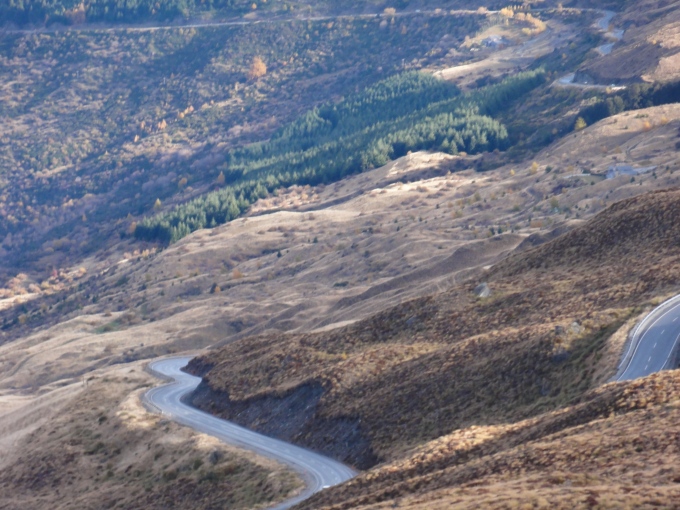
lookingdownfromcoronetpeak

And the story:

It was once said that a desperate man has everything to lose.

The man I was chasing was desperate, but I, on the other hand, was more desperate to catch him.

He’d left a trail of dead people from one end of the island to the other.

The team had put in a lot of effort to locate him, and now his capture was imminent.  We were following the car he was in, from a discreet distance, and, at the appropriate time, we would catch up, pull him over, and make the arrest.

There was nowhere for him to go.

The road led to a dead-end, and the only way off the mountain was back down the road we were now on.  Which was why I was somewhat surprised when we discovered where he was.

Where was he going?

“Damn,” I heard Alan mutter.  He was driving, being careful not to get too close, but not far enough away to lose sight of him.

“What?”

“I think he’s made us.”

“How?”

“Dumb bad luck, I’m guessing.  Or he expected we’d follow him up the mountain.  He’s just sped up.”

“How far away?”

“A half-mile.  We should see him higher up when we turn the next corner.”

It took an eternity to get there, and when we did, Alan was right, only he was further on than we thought.”

“Step on it.  Let’s catch him up before he gets to the top.”

Easy to say, not so easy to do.  The road was treacherous, and in places, just gravel, and there were no guard rails to stop a three-thousand-foot fall down the mountainside.

Good thing then, I had the foresight to have three agents on the hill for just such a scenario.

Ten minutes later, we were in sight of the car, still moving quickly, but we were going slightly faster.  We’d catch up just short of the summit car park.

Or so we thought.

Coming quickly around another corner, we almost slammed into the car we’d been chasing.

“What the hell…” Aland muttered.

I was out of the car and over to see if he was in it, but I knew that it was only a slender possibility.  The car was empty, and no indication of where he had gone.

Certainly not up the road.  It was relatively straightforward for the next mile, at which we would have reached the summit.  Up the mountainside from here, or down.

I looked up.  Nothing.

Alan yelled out, “He’s not going down, not that I can see, but if he did, there’s hardly a foothold and that’s a long fall.”

Then where did he go?

Then a man looking very much like our quarry came out from behind a rock embedded just a short distance up the hill.

“Sorry,” he said quite calmly.  “Had to go if you know what I mean.”

I’d lost him.

It was as simple as that.

I had been led a merry chase up the hill, and all the time he was getting away in a different direction.

I’d fallen for the oldest trick in the book, letting my desperation blind me to the disguise that anyone else would see through in an instant.

It was a lonely sight, looking down that road, knowing that I had to go all that way down again, only this time, without having to throw caution to the wind.

“Maybe next time,” Alan said.

“We’ll get him.  It’s just a matter of time.”

© Charles Heath 2019-2026

Find this and other stories in “Inspiration, maybe”, available soon.

InspirationMaybe1v1

A to Z – April – 2026 – F

F is for – Five Words

I’d heard about the show, one with a funny title that when people asked, they couldn’t quite get it exactly right, but close enough to “This was your life”.

I thought it was about dead people, odd, because I knew it was impossible to interview dead people, though those days, someone told me, anything was possible on television.

Then I thought it was about people almost at the end of their life, as a celebration of a celebrity, or someone famous.

It was a surprise to learn it was about ordinary people.

Like me.  You couldn’t find anyone more ordinary, or as several people told me, utterly forgettable.

That hurt, but in a sense, they were right.

Which made me wonder just how it was that I received a letter in the mail telling me I had been selected for an episode.

Of course, I thought someone was playing a hoax, and rang them, expecting to be laughed at, but no.  I was being asked to go on the show.

I have no idea why I agreed.

When I arrived at the studio, I was taken to an office where the executive producer told me what was going to happen: sign some papers to say I was not going to divulge details of the show before it was broadcast, and what my five words were.

They were different for each participant.

Today, they were recording five episodes.  I was going to be the last.

My words were Good, Afraid, Trouble, Look and Quiet.  I had plenty of time to think about them in relation to my story.

And that was the odd thing … I actually had a story.

“So,” the host said, in that mesmerising voice of hers that had both the audience and the participants entranced, “Tell us what the word Good means to you.”

Of course, it wasn’t just the word good, it was a better word that meant the same thing.

“It wasn’t just a good day, it was a fantastic, unbelievable day.”

I remembered it well, that last day of high school, when it was, in a lot of cases, the last time I would see my fellow classmates.

Most of them I never wanted to see again, because that final year had been marked by more lows than highs, culminating in my date for the Prom falling ill, and so I didn’t go.  Then I discovered she lied, went with my so-called best friend, and made last week unbearable.

So much so, I headed straight for the railway station and intended to hide at my grandmother’s house on the other side of the country.

The day started badly, arguing with my parents, arguing with my siblings, getting into three separate scuffles at school, then coming home and throwing a few things into a backpack and leaving before I saw anyone at home.

Every step from the house to the railway depot was a reminder of each betrayal, so by the time I sat in the waiting room, an hour before the train was due, I was mentally and physically exhausted.

I expected someone from home would come and try to persuade me to stay.

They didn’t.

Perhaps that was the final betrayal.  The fact that not one of my own family cared whether I stayed or left.

Very few people took the train.  Most people leaving town went to the airport and got a plane.  There was a bus, but it took forever to get anywhere, and the train was an acceptable alternative.

I was the only one leaving town by train.

Until I wasn’t.

Five students in that final year shared my disposition, in that we preferred to study, get good grades and then go to college.  The other three left a week before, gaining admission to an Ivy League university.

I hadn’t applied.

The other person was Alison Breton. 

She was one of those people who no one gave a second look at, or so much as a first.  She was clever, and all the boys didn’t like girls who were smarter than they.

She was also plain, or so it appeared, which caused most of the boys to point out her faults, such as how she presented herself.  Unlike the other girls who dressed to impress, wore make-up and looked stunning, even if it was an objectifying description, she preferred to be different.

I thought she was brave.

We barely spoke, though we were in the same study group with the three Ivy Leaguers.  Two of them were keen on her, but she was not the dating sort.  Or so they said.

Ten minutes before the train arrived, another person came and sat in the waiting room.

Alison Breton.

I ignored her for five whole minutes.  I mean, what could I say to her?

It was when the host mentioned the second word, “afraid.”

It was part of the truth and summed up how I felt about her.  I was afraid of her.  Afraid, or more to the point, literally terrified.

I had imagined many times what I would say to her, fabricating long, I thought, interesting conversations.

And if I let my imagination stretch a little further, I might have to admit I liked her, perhaps more than I should, but could and would never admit it.  One humiliation by a girl in a lifetime was enough, and my completely shattered ego couldn’t take another rejection.

Five whole minutes before she said, “So you’re leaving this dump too?”

It was obvious I was, though the dump was harsh.

And then words came out that were not my own.  “What’s your excuse?”

I knew the moment I tried to speak to her that it would be over.  Maryanne, the betrayer, was different.  I could speak to her, and because of that, I thought she was the one.

She smiled.  “Probably the same as yours.  James told me he loved me, but he didn’t.  Apparently, I’m the subject of a bet.”

I’d heard a rumour and couldn’t believe it.  Or perhaps I could.  Small town, small-minded boys, one ambition, to have what they couldn’t.

“Best get out of town then.”  My solution to the problem wasn’t a one-size-fits-all all.

But it was a response to the host dropping the word trouble.  And then looked and was quiet.  It seemed they were all intertwining in the narrative that was unfolding.

“That doesn’t explain your desire to leave, other than the Maryanne humiliation.  I guess a month away from here might make it go away.”

“It won’t.  I have brothers who will never let me forget.  You grow up in this place, no one forgets the trouble, or more appropriately, your legacy.”

“It’s always us quiet kids, eh, the ones who don’t make a fuss, who are studious and respectful, who don’t want to be noticed.  No matter how we look or feel.  I tried to be invisible.”

“It made you stand out more than the Maryannes.  I was just fodder for girls like her, pandering to the mores of the football team, and you know what they were like.”

Being smart didn’t make us immune to being hurt or hoping against hope that we had a chance.

We both heard the sound of the horn in the distance, a warning that the train was approaching the railway crossing, about two or three miles outside of town.

The train, like always, was running late.

She stood.  “Where are you going?”

“San Francisco.  My grandmother.  She has a large house and many unusual friends.  She was an actress once, when Hollywood was going through its black and white phase.”

“I’m going there too.  My mother’s sister, though I suspect she isn’t.  Maybe we can pretend we’re brother and sister, to be safe.”

I shrugged.  Why not?  Once we got there, I’d probably never see her again.

“Except,” Alison said, holding my hand, and talking to the host with that whimsical expression she had when telling others the story of how we met, “we talked and talked and fell in love, got married, have five amazing children, twelve equally amazing grandchildren, and just lived our lives.  Nothing special, and yet to us, very, very special.”

And then, surprisingly, our time was up.  I had expected it would take half the time allotted.  Instead, it was two hours later, and no one, not any of us, had noticed.

©  Charles Heath  2025-2026

First Dig Two Graves

A sequel to “The Devil You Don’t”

Revenge is a dish best served cold – or preferably so when everything goes right

Of course, it rarely does, as Alistair, Zoe’s handler, discovers to his peril. Enter a wildcard, John, and whatever Alistair’s plan for dealing with Zoe was dies with him.

It leaves Zoe in completely unfamiliar territory.

John’s idyllic romance with a woman who is utterly out of his comfort zone is on borrowed time. She is still trying to reconcile her ambivalence after being so indifferent for so long.

They agree to take a break, during which she disappears. John, thinking she has left without saying goodbye, refuses to accept the inevitable and calls on an old friend for help in finding her.

After the mayhem and being briefly reunited, she recognises an inevitable truth: there is a price to pay for taking out Alistair; she must leave and find them first, and he would be wise to keep a low profile.

But keeping a low profile just isn’t possible, and enlisting another friend, a private detective and his sister, a deft computer hacker, they track her to the border between Austria and Hungary.

What John doesn’t realise is that another enemy is tracking him to find her too. It could have been a grand tour of Europe. Instead, it becomes a race against time before enemies old and new converge for what will be an inevitable showdown.

365 Days of writing, 2026 – My Second Story 12

More about my second novel

I’ve been looking back at what’s been written, something you shouldn’t do when trying to get 50,000 words written in 30 days, but I’m ahead of the count, and a little checking is needed, just to make sure everything is running smoothly.

Not that any book written on the fly like this runs smoothly.

There are three themes to this story:

1 – Worthington, now head of the Intelligence agency, is seeking revenge for Zoe killing his brother by mistake, a mistake that he caused

2 – Alistair’s mother is deploying a collection of agents, some of whom were once Zoe’s colleagues, to assassinate the woman who assassinated her son

3 – John’s ever-growing fear that Zoe is tired of him, and, after she leaves, and even though she promised to come back, he doesn’t want to wait to find out he’s been dumped.

4 – Sebastian is always lurking in the background, ostensibly to recruit her as an assassin, but really because he’s jealous of John’s good fortune.

Our two intrepid heroes go off to save her in Marseilles, where she learns of the identity of who is ostensibly looking for her, and sets her off on a lone hunt for him.

We then deploy two new characters, Rupert and Isobel, who, along with John, will create a private detective agency that John uses to locate Zoe by any and all means.

Isobel soon finds out that searching for Zoe on the internet brings risks, both at home and abroad, bringing her in contact with another hacker who seems to know where Zoe’s past is hiding. But can they be trusted?

John heads off to Vienna, after being supplied a file on Zoe, full of information he had not known about her. What he learns in Vienna leads him to Bratislava, when a photo identifying where she suddenly arrives on his phone.

John locates her, she realises he is being used as bait, and they leave, but not before the hit team almost completes their mission, leaving behind a trail of bodies as they get away, but not without injury.

John gets the answers he is seeking, that if he wants a life of looking over his shoulder, by all means, tag along. She is quite pleased to see him, not so much that he brought ‘friends’, but she might yet get to train him.

Sebastian, feeling left out, grills Isobel and Rupert, gets sidelined by Worthington because anywhere Sebastian goes, trouble follows, and then convinces Isobel that John is in over his head and needs their help.

He’s not wrong because Worthington has dispatched another hit team to the main railway stations in Vienna, where John and Zoe are looking to escape, but another shootout occurs as they once again escape when all the station’s exits are covered.

The story has now reached a point where everyone is converging on Vienna.

Along with another person whom John knows, and whom he will least expect to arrive on his doorstep.

An excerpt from “Strangers We’ve Become” – Coming Soon

I wandered back to my villa.

It was in darkness.  I was sure I had left several lights on, especially over the door so I could see to unlock it.

I looked up and saw the globe was broken.

Instant alert.

I went to the first hiding spot for the gun, and it wasn’t there.  I went to the backup and it wasn’t there either.  Someone had found my carefully hidden stash of weapons and removed them.

Who?

There were four hiding spots and all were empty.  Someone had removed the weapons.  That could only mean one possibility.

I had a visitor, not necessarily here for a social call.

But, of course, being the well-trained agent I’d once been and not one to be caught unawares, I crossed over to my neighbor and relieved him of a weapon that, if found, would require a lot of explaining.

Suitably armed, it was time to return the surprise.

There were three entrances to the villa, the front door, the back door, and a rather strange escape hatch.  One of the more interesting attractions of the villa I’d rented was its heritage.  It was built in the late 1700s, by a man who was, by all accounts, a thief.  It had a hidden underground room which had been in the past a vault but was now a wine cellar, and it had an escape hatch by which the man could come and go undetected, particularly if there was a mob outside the door baying for his blood.

It now gave me the means to enter the villa without my visitors being alerted, unless, of course, they were near the vicinity of the doorway inside the villa, but that possibility was unlikely.  It was not where anyone could anticipate or expect a doorway to be.

The secret entrance was at the rear of the villa behind a large copse, two camouflaged wooden doors built into the ground.  I move aside some of the branches that covered them and lifted one side.  After I’d discovered the doors and rusty hinges, I’d oiled and cleaned them, and cleared the passageway of cobwebs and fallen rocks.  It had a mildew smell, but nothing would get rid of that.  I’d left torches at either end so I could see.

I closed the door after me, and went quietly down the steps, enveloped in darkness till I switched on the torch.  I traversed the short passage which turned ninety degrees about halfway to the door at the other end.  I carried the key to this door on the keyring, found it and opened the door.  It too had been oiled and swung open soundlessly.

I stepped in the darkness and closed the door.

I was on the lower level under the kitchen, now the wine cellar, the ‘door’ doubling as a set of shelves which had very little on them, less to fall and alert anyone in the villa.

Silence, an eerie silence.

I took the steps up to the kitchen, stopping when my head was level with the floor, checking to see if anyone was waiting.  There wasn’t.  It seemed to me to be an unlikely spot for an ambush.

I’d already considered the possibility of someone coming after me, especially because it had been Bespalov I’d killed, and I was sure he had friends, all equally as mad as he was.  Equally, I’d also considered it nigh on impossible for anyone to find out it was me who killed him because the only people who knew that were Prendergast, Alisha, a few others in the Department, and Susan.

That raised the question of who told them where I was.

If I was the man I used to be, my first suspect would be Susan.  The departure this morning, and now this was too coincidental.  But I was not that man.

Or was I?

I reached the start of the passageway that led from the kitchen to the front door and peered into the semi-darkness.  My eyes had got used to the dark, and it was no longer an inky void.  Fragments of light leaked in around the door from outside and through the edge of the window curtains where they didn’t fit properly.  A bone of contention upstairs in the morning, when first light shone and invariably woke me up hours before I wanted to.

Still nothing.

I took a moment to consider how I would approach the visitor’s job.  I would get a plan of the villa in my head, all entrances, where a target could be led to or attacked where there would be no escape.

Coming in the front door.  If I was not expecting anything, I’d just open the door and walk-in.  One shot would be all that was required.

Contract complete.

I sidled quietly up the passage staying close to the wall, edging closer to the front door.  There was an alcove where the shooter could be waiting.  It was an ideal spot to wait.

Crunch.

I stepped on some nutshells.

Not my nutshells.

I felt it before I heard it.  The bullet with my name on it.

And how the shooter missed, from point-blank range, and hit me in the arm, I had no idea.  I fired off two shots before a second shot from the shooter went wide and hit the door with a loud thwack.

I saw a red dot wavering as it honed in on me and I fell to the floor, stretching out, looking up where the origin of the light was coming and pulled the trigger three times, evenly spaced, and a second later I heard the sound of a body falling down the stairs and stopping at the bottom, not very far from me.

Two assassins.

I’d not expected that.

The assassin by the door was dead, a lucky shot on my part.  The second was still breathing.

I checked the body for any weapons and found a second gun and two knives.  Armed to the teeth!

I pulled off the balaclava; a man, early thirties, definitely Italian.  I was expecting a Russian.

I slapped his face, waking him up.  Blood was leaking from several slashes on his face when his head had hit the stairs on the way down.  The awkward angle of his arms and legs told me there were broken bones, probably a lot worse internally.  He was not long for this earth.

“Who employed you?”

He looked at me with dead eyes, a pursed mouth, perhaps a smile.  “Not today my friend.  You have made a very bad enemy.”  He coughed and blood poured out of his mouth.  “There will be more …”

Friends of Bespalov, no doubt.

I would have to leave.  Two unexplainable bodies, I’d have a hard time explaining my way out of this mess.  I dragged the two bodies into the lounge, clearing the passageway just in case someone had heard anything.

Just in case anyone was outside at the time, I sat in the dark, at the foot of the stairs, and tried to breathe normally.  I was trying not to connect dots that led back to Susan, but the coincidence was worrying me.

A half-hour passed and I hadn’t moved.  Deep in thought, I’d forgotten about being shot, unaware that blood was running down my arm and dripping onto the floor.

Until I heard a knock on my front door.

Two thoughts, it was either the police, alerted by the neighbors, or it was the second wave, though why would they be knocking on the door?

I stood, and immediately felt a stabbing pain in my arm.  I took out a handkerchief and turned it into a makeshift tourniquet, then wrapped a kitchen towel around the wound.

If it was the police, this was going to be a difficult situation.  Holding the gun behind my back, I opened the door a fraction and looked out.

No police, just Maria.  I hoped she was not part of the next ‘wave’.

“You left your phone behind on the table.  I thought you might be looking for it.”  She held it out in front of her.

When I didn’t open the door any further, she looked at me quizzically, and then asked, “Is anything wrong?”

I was going to thank her for returning the phone, but I heard her breathe in sharply, and add, breathlessly, “You’re bleeding.”

I looked at my arm and realized it was visible through the door, and not only that, the towel was soaked in blood.

“You need to go away now.”

Should I tell her the truth?  It was probably too late, and if she was any sort of law-abiding citizen she would go straight to the police.

She showed no signs of leaving, just an unnerving curiosity.  “What happened?”

I ran through several explanations, but none seemed plausible.  I went with the truth.  “My past caught up with me.”

“You need someone to fix that before you pass out from blood loss.  It doesn’t look good.”

“I can fix it.  You need to leave.  It is not safe to be here with me.”

The pain in my arm was not getting any better, and the blood was starting to run down my arm again as the tourniquet loosened.  She was right, I needed it fixed sooner rather than later.

I opened the door and let her in.  It was a mistake, a huge mistake, and I would have to deal with the consequences.  Once inside, she turned on the light and saw the pool of blood just inside the door and the trail leading to the lounge.  She followed the trail and turned into the lounge, turned on the light, and no doubt saw the two dead men.

I expected her to scream.  She didn’t.

She gave me a good hard look, perhaps trying to see if I was dangerous.  Killing people wasn’t something you looked the other way about.  She would have to go to the police.

“What happened here?”

“I came home from the cafe and two men were waiting for me.  I used to work for the Government, but no longer.  I suspect these men were here to repay a debt.  I was lucky.”

“Not so much, looking at your arm.”

She came closer and inspected it.

“Sit down.”

She found another towel and wrapped it around the wound, retightening the tourniquet to stem the bleeding.

“Do you have medical supplies?”

I nodded.  “Upstairs.”  I had a medical kit, and on the road, I usually made my own running repairs.  Another old habit I hadn’t quite shaken off yet.

She went upstairs, rummaged, and then came back.  I wondered briefly what she would think of the unmade bed though I was not sure why it might interest her.

She helped me remove my shirt, and then cleaned the wound.  Fortunately, she didn’t have to remove a bullet.  It was a clean wound but it would require stitches.

When she’d finished she said, “Your friend said one day this might happen.”

No prizes for guessing who that friend was, and it didn’t please me that she had involved Maria.

“Alisha?”

“She didn’t tell me her name, but I think she cares a lot about you.  She said trouble has a way of finding you, gave me a phone and said to call her if something like this happened.”

“That was wrong of her to do that.”

“Perhaps, perhaps not.  Will you call her?”

“Yes.  I can’t stay here now.  You should go now.  Hopefully, by the time I leave in the morning, no one will ever know what happened here, especially you.”

She smiled.  “As you say, I was never here.”

© Charles Heath 2018-2022

strangerscover9

NaNoWriMo – April – 2026 – Day 7

After the cat dragged me out of bed simply because he wanted me to refill the food containers, he did the usual trick of sitting there, watching patiently until I walked off, then went over to the bowl, sniffed, and walked off.

OK, he didn’t need to wake me up if he was going to do that.

Stern words are spoken, but it’s water off a duck’s back (or cat’s back if you like).

I’m annoyed, and he’s, well, he’s just a pain in the neck.

So…

Now that I’m up, I might as well get some work done.  I think about breakfast for about a minute, and decide it’s too hard to make toast.  Yes, it’s that kind of morning.

Coffee?

Maybe.  I put the kettle on as a token gesture of doing something, and go out to the writing room.

I’m calling it that for now, because we’re at the end of the first week of NaNoWriMo, and it’s proceeding well, which means, of course, that something is going to happen, and the wheels are going to come off.

I turn on the laptop, and after waiting the usual five minutes, I have the logon screen and no mouse.  It’s been acting erratically for a few days, but that’s Windows anyway.

So, I have a dead mouse.

Should I give it to Chester to play with?

I changed the batteries, usually the problem, but to no avail.

Good thing then we have a few spares because when the granddaughters are over, they are prone to dropping them on the ground and breaking them.  I have a drawer full of dead mice.

One day, Chester will be happy, or not.  It’s hard to tell what he’s thinking.

New mouse, wait for it to install, back to work.

Kettle’s boiled, new distraction, might as well get coffee.

Maybe I’ll get back to work later.