The 2AM Rant: On the other end of medical mumbo jumbo

Who could imagine that one visit to the local hospital could fuel a medical nightmare?

Aside from the original suspicion I was having heart problems, doctors started lining up appointments for an endoscopy and colonoscopy, though I suspect these were for a different malady, and the main event, an angiogram.

I didn’t have heart problems though it was possible I had angina, the reason for the angiogram, but I did have acute kidney failure which was interesting, to say the least, and possibly attributed to ipBrufen, though it was impossible to say if the medication for psoriatic arthritis, a venomous little pill called methotrexate, was or was not a contributing factor.

But is was great to learn that my psioratic arthritis could lead to heart attack, and lung issues, a few problems my original arthritis consultant conveniently forgot to tell me about.

No sooner than I was released from the hospital after this first set of maladies, I was back three or four days later with hospital-acquired pneumonia, a devil of a problem that requires some very invasive searches for the type of bug so it could be treated properly.

It led to five days of antibiotics, a considerable inability to breathe without help from an oxygen mask, and several CT scans with and without dye to get a better look at the problem.

If only that was all that was wrong with me.

The CT scan showed up a lump or lesion on my right thyroid which led to further investigation, an ultrasound, a biopsy, and a visit to the surgeon to be told it had to come out.

But that’s not all.  No, I didn’t get a set of steak knives for being one the first ten this week to be diagnosed with anything, I was told my PSA reading was twice the average for my age, a clear indication I might have prostate cancer.

Wow.  Just to sort of news you need to hear before the weekend.  Worse perhaps than a rainstorm when camping in a floorless tent.  I had to now wait for the results of a new blood test.

Ok.  I get it that things are bound to go wrong when you get older, but what I object to is everything going wrong at once.

Perhaps when we stop the aging process a lot of these issues will go away, but I fear not.  The human body is surprisingly robust for quite a long time despite our attempts to test it to the limits of endurance.

It is advice too late for me to make sure my misspent youth is not wasted on being stupid or believing I’m indestructible.  The plain truth is, we are not, and I didn’t get the memo.

Now, I guess, it is time to actually do everything, or as much as I can, before I start to deteriorating further and not be able to do anything.  I have a few good years before arthritis sets in and makes life more difficult than it already is.

I’m not going to waste them.

What I learned about writing – The “Practice Makes Perfect” Myth

(and Why It Still Works—for Writing)

The “Practice Makes Perfect” Myth (and Why It Still Works—for Writing)

“If you do anything seriously long enough, you’ll get better.”

That sentence feels like an old‑school mantra you might have heard from a coach, a music teacher, or a parent. It’s comforting, almost inevitable—just keep at it and the results will follow.

But does the rule hold true for writers? And what does it mean when we say “good writing is contagious”?

In this post I’ll unpack the science behind long‑term practice, show why writing is a uniquely contagious skill, and give you a toolbox of concrete, battle‑tested tips to turn “doing it longer” into real, measurable improvement.


1. The Core Truth: Time + Deliberate Practice = Skill Growth

FactWhat It Means for Writers
Neuroplasticity – The brain rewires itself with repeated activity.The more you write, the stronger the neural pathways that support storytelling, grammar, and voice.
Deliberate Practice – Not just “doing the thing,” but practicing with feedback and specific goals.Writing a 500‑word blog post isn’t enough; you must target weak spots (e.g., pacing, dialogue) and refine them deliberately.
Deliberate Practice – Not just “doing the thing,” but practising with feedback and specific goals.10,000 hours of mindless typing won’t help. Ten hours of focused revision, critique, and study can trump 100 hours of “just writing.”
Plateaus Are Normal – Skill acquisition follows a sigmoid curve: rapid early gains, a plateau, then a second surge after a breakthrough.Expect periods where progress feels stagnant. Use them to experiment, read, or rest—don’t quit.

Bottom line: Time alone isn’t enough. You need deliberate, feedback‑rich practice to convert hours into mastery.


2. Good Writing Is Contagious – Why It Spreads

  1. Social Proof: Readers (and fellow writers) gravitate toward high‑quality prose. When a piece shines, it sets a new benchmark in its community.
  2. Mirror Neurons: We neurologically mimic the style and tone we consume, especially when we admire the source. Reading great sentences trains our own “inner ear.”
  3. Collective Learning: Writing groups, workshops, and online forums create a feedback loop where one person’s improvement lifts the entire cohort.
  4. Cultural Momentum: Think of the “New Journalism” wave of the ’60s or the rise of flash fiction on Twitter—once a few voices cracked the code, the style proliferated.

In short, exposure to excellent writing accelerates your own growth—if you allow it to.


3. The Pitfalls of “Just Writing More”

Common MisconceptionWhy It FailsHow to Fix It
“I write 2,000 words a day, so I’m improving.”Quantity without reflection reinforces bad habits.After each session, flag 1–2 things you’d change (e.g., redundancy, weak verb).
“I’ll get better after I finish my novel.”Long‑term projects can hide small‑scale weaknesses.Break the novel into bite‑size “skill drills” (e.g., one chapter focused on dialogue).
“Feedback is optional; I trust my gut.”Our internal editor is notoriously biased.Schedule regular external reviews—beta readers, editors, or a critique partner.
“I’ll read only what I like.”Comfort zones limit exposure to new structures, vocab, and perspectives.Add a “genre‑stretch” reading slot each week (e.g., poetry if you write nonfiction).

4. Actionable Blueprint: Turn Hours Into Better Writing

Below is a step‑by‑step system you can adopt today. It’s modular—pick what fits your schedule and skill level, then iterate.

A. Build a Structured Writing Routine

ComponentFrequencyTip
Micro‑Write (10–15 min)Daily, first thing in the morningWrite a single sentence, a vivid description, or a quick dialogue exchange. No editing, just raw output.
Focused Session (45–90 min)3–4× per weekChoose a skill goal (e.g., “show, don’t tell”). Work on a specific piece that targets that goal.
Review & Revise (30 min)Immediately after each focused sessionHighlight 2–3 improvement points; rewrite the same passage with those in mind.
Reading Sprint (30 min)Daily or every other dayRead a passage from a writer you admire and take notes on what makes it work (sentence rhythm, word choice, structure).
Feedback Loop (1 hr)WeeklySend your work to a critique partner or post in a writing forum. Write a response to each piece of feedback, outlining what you’ll try next.

Why it works: The routine mixes production, analysis, and external input—the three pillars of deliberate practice.

B. “Contagion” Tactics – Let Good Writing Infect You

  1. Curated Reading Lists
    • Classic craft: “The Elements of Style,” “On Writing” (King).
    • Genre deep‑dive: 5 seminal works from each genre you write.
    • Modern bite‑size: Follow Twitter accounts that tweet micro‑essays or haiku.
  2. Imitation Exercises
    • Pick a paragraph you love. Rewrite it in your own voice while preserving the structure and rhythm.
    • Swap the genre (turn a news article into a short story).
  3. Community Immersion
    • Join a weekly critique circle (online or local).
    • Participate in writing challenges (NaNoWriMo, 30‑day flash fiction).
    • Comment thoughtfully on other writers’ blogs—explaining what you liked forces you to articulate good writing principles.
  4. Mentor‑Mode Writing
    • Write as if you’re teaching a class. Draft a short guide on a writing technique; the act of explaining refines your own understanding.

C. Metric‑Based Progress Tracking

MetricToolHow to Interpret
Word‑per‑hour outputTimer + word countAim for a stable range; spikes may indicate “flow” days, drops may signal fatigue.
Revision Ratio (original words ÷ final words)Drafts in Google DocsA decreasing ratio (e.g., 1.3 → 1.1) often signals tighter prose.
Feedback Score (e.g., 1‑5 rating from beta readers)Survey FormTrend upward? If flat, examine recurring criticism.
Reading Diversity Index (genres read per month)SpreadsheetHigher diversity correlates with more varied sentence structures.

Review these numbers every month and adjust your routine accordingly.


5. Real‑World Case Study: From “Stuck” to “Spitting Fire”

Writer: Maya, 34, freelance tech copywriter.

ProblemInterventionResult (3 months)
Drafts flooded with jargon; readers complained of “dry” tone.1️⃣ Daily 10‑min “show, don’t tell” micro‑write.
2️⃣ Weekly 30‑min reading of narrative non‑fiction (e.g., The Immortal Life of Henrietta Lacks).
3️⃣ Joined a local critique group focused on voice.
• Reduced average sentence length by 15 %.
• Client satisfaction score rose from 3.2 → 4.6/5.
• Secured a new contract for a storytelling‑heavy whitepaper series.

Maya’s story illustrates that structured, feedback‑rich practice beats sheer volume—and that reading narrative work made her own prose “contagiously” richer.


6. Quick‑Start Checklist (Print & Pin)

  •  Write a 10‑minute “seed” piece every morning (no edits).
  •  Pick one skill goal per week (e.g., stronger verbs).
  •  Read a 5‑minute passage from a master writer daily and annotate.
  •  Submit a draft for critique at least once a week.
  •  Imitate a favourite paragraph once a month, then rewrite it in a new genre.
  •  Log your metrics (output, revision ratio, feedback rating) every Friday.

7. The Bottom Line

Yes—if you do something seriously long enough, you will improve. But the quality of that “serious” effort is what determines how much you improve.

Good writing spreads like a good meme: you absorb it through reading, imitation, and community, and you amplify it by giving feedback and teaching.

By marrying deliberate practice with contagious exposure, you turn the simple mantra “write more” into a powerful, measurable growth engine.

Your next step? Choose one of the tactics above, commit to it for the next 30 days, and watch your prose evolve from “just getting longer” to “getting better.”

Happy writing—and may the contagion be ever in your favour!


If you found this post helpful, share it with fellow writers, and let us know which of the strategies you tried in the comments.

365 Days of Writing, 2026 – 218

Day 218 – The author’s imaginary world

Building the Invisible Architecture: Why Every Novelist Must First Create a World They Believe In

“Every novelist must begin by creating himself a world, great or little, in which he can honestly believe.” — Joseph Conrad

When we open a novel, we aren’t just looking for a sequence of events. We are looking for a portal. We want to step out of the mundane architecture of our daily lives and inhabit somewhere else—whether that somewhere else is the misty decks of a 19th-century trading ship, the neon-lit alleys of a cyberpunk dystopia, or the quiet, devastating emotional landscape of a suburban kitchen.

But before a reader can ever step foot into that fictional realm, the author must build it, brick by invisible brick. And as Joseph Conrad famously noted, that process begins with belief.

If the writer doesn’t buy the reality of the world they are constructing, why should the reader?

Let’s explore what Conrad’s timeless wisdom means for modern novelists, world-building, and the psychological heavy lifting required to write fiction that resonates.


The Anatomy of Belief: What Does It Mean to “Believe” in Your World?

Belief in writing is not about magic systems, historical accuracy, or encyclopedic lore (though those things can help). It is about internal coherence and emotional truth.

When Conrad spoke of creating a world “great or little,” he wasn’t just talking about epic fantasy maps. A “little” world might be a single boarding house in Dublin, a courtroom during a three-day trial, or the strained silence across a breakfast table.

To believe in your world, you must know its gravity. You must understand:

  • The sensory reality: What does it smell like after a heavy rain? What is the quality of the light at 4:00 PM?
  • The unspoken rules: What do the inhabitants take for granted? What are the cultural taboos, economic pressures, and quiet griefs that shape their daily choices?
  • The moral pulse: Even if the author is entirely objective, the world must operate on a set of internal cause-and-effect dynamics where actions have real, believable consequences.

If you are writing a scene and you feel a twinge of artificiality—a sense that you are moving characters around like chess pieces just to get to the next plot point—you have stopped believing in your world. And the moment the author stops believing, the reader’s suspension of disbelief shatters like cheap glass.


World-Building is Self-Discovery

Notice the phrasing in Conrad’s quote: “creating himself a world.”

Before a novelist creates a world for the reader, they must create it for themselves. Writing a novel is an act of self-interrogation. The world you build often becomes a mirror for your own obsessions, fears, questions, and philosophies.

  • Tolkien didn’t just invent Middle-earth for the sake of an adventure; he built it out of a profound love for lost mythologies and philology, creating languages that necessitated a world to speak them.
  • Austen mapped the rigid, polite, and deeply economic marriage market of 19th-century England because she was keenly interested in the intersection of female autonomy, social survival, and genuine affection.

When you sit down to write, your fictional world is your testing ground. It is the ecosystem where you explore what you actually believe about human nature, power, love, and betrayal. If your heart isn’t invested in the truths of that ecosystem, your prose will lack the pulse of life.


The Danger of the “Cardboard Set”

We have all read books that feel like movie sets made of painted cardboard. The dialogue is snappy, the plot moves fast, but the moment a character leans against a wall, you feel like the whole thing might tip over.

This happens when a writer focuses entirely on mechanics rather than immersion. They outline the plot beats, design the twists, but fail to inhabit the space.

To avoid the cardboard set trap, adopt Conrad’s mindset:

  1. Dig deeper than the surface details. Don’t just invent a futuristic city; figure out where the garbage goes, who cleans the streets, and what people sing when they’re drunk.
  2. Let the world talk back. A believable world has momentum. When your characters make a choice, the world should react in ways that aren’t always convenient for your outline.
  3. Write for the senses, not just the intellect. Bring your scenes to life through texture, temperature, and tone.

How to Cultivate Radical Belief in Your Writing

If you are struggling to connect with your story-world, how do you bridge the gap? How do you reach that state of honest belief?

  • Write toward the unknown: Don’t plan every single square inch before you start. Leave room for discovery. Sometimes, believing in your world means exploring it alongside your characters, letting it surprise you.
  • Anchor the fantastical in the visceral: If you are writing high fantasy or hard sci-fi, ground the extraordinary in ordinary human experiences. A dragon rider still gets a sore back; a starship captain still worries about aging or estranged children.
  • Interrogate your own cynicism: If you find yourself rolling your eyes at your own plot developments, stop. Figure out why. Fix the underlying logic until you can nod to yourself and say, Yes, that is how this world works.

Final Thoughts: The Invitation to the Reader

Writing a novel is an act of supreme audacity. You are essentially asking a complete stranger to sit in a quiet room, look at a series of black symbols on a white page, and hallucinate an entire reality for several hours.

The only way that magic trick works is if your own conviction is absolute.

When you create a world—whether it spans galaxies or exists entirely within the confines of a single room—you must believe in it first. Pour your curiosity, your empathy, and your attention into its soil. Because when you honestly believe in the world you’ve made, the reader won’t just visit it—they will live in it.


Are you currently building a fictional world? What is the hardest part of making it feel real to you—the physical details, the emotional stakes, or the internal logic? Let us know in the comments below!

Top 5 sights on the road less travelled – Quito

Quito, the capital of Ecuador, is located in the northern Andes Mountains, nestled in a valley on the slopes of the Pichincha volcano, about 25 miles south of the equator, making it one of the world’s highest capital cities at roughly 9,350 feet in elevation. 

  • Region: Sierra (Highlands) of Ecuador, part of the Andes mountain range.
  • Key Landmark: Situated on the Pichincha volcano‘s eastern slopes.
  • Equator: Very close to the Equator, with a monument marking the line just outside the city. 

Beyond Quito’s major landmarks, there are many unique, local experiences and attractions to explore. These include visiting bohemian neighbourhoods, a renowned pre-Columbian art museum, and local food markets. 

Alternative Cultural Experiences

  • Explore La Floresta: This bohemian neighbourhood is known for its vibrant street art, independent galleries, and hip cafes and restaurants. A popular spot is the indie cinema, Ocho y Medio, which screens avant-garde and foreign films.
  • Wander through La Ronda: This charming, narrow cobblestone street in the historic centre truly comes alive at sunset with local art galleries, artisan workshops (like coppersmiths and traditional hat makers), cafes, and live music.
  • Visit Museo Casa del Alabado: Located in the Old Town, this private museum houses an impressive and well-curated collection of pre-Columbian art and archaeological pieces, providing deep insight into Ecuador’s ancestral heritage.
  • Check out the street art: The La Floresta and La Mariscal neighbourhoods feature an evolving outdoor gallery of murals and graffiti that reflect contemporary social and political themes.
  • Experience local markets: For an authentic slice of daily life, visit the Mercado Central or Mercado Artesanal La Mariscal. The Central Market offers inexpensive, traditional Ecuadorian food (try the locro de papa or horno) and fresh juices, while the Artisan Market is perfect for shopping for handicrafts, textiles, and jewellery. 

In a word: Leg

Aside from the fact it is one of those necessary items to walk with, and the fact we can have two or four for most humans and animals, there are a few other uses for the word ‘leg’.

Like…

‘You haven’t got a leg to stand on’, doesn’t necessarily mean you have no legs, but that you are in a precarious position.

“the table had ornate legs’, yes, even non-living objects can have legs, like tables and chairs.

“It was the fifth leg of the race’, meaning it can be a stage of a race.

“He was legless’, meaning that he was too drunk to stand up.  Some might think being legless is a badge of honour, but I suspect those people have been drinking a long time and the alcohol has destroyed most of their brain cells.

“leg it!’, meaning get the hell out of here before you’re caught.

Then, finally, ‘he’s on his last legs’, meaning that he’s exhausted, or about to die.

I’m sure there’s more but that’ll do for now.

I have to use my legs to get some exercise, of which the first leg is to the tripod to check if its legs are stable, and the second leg is to come back to the table and replace one of the legs which is broken.  Then I’ll leg it to the pub where hopefully I won’t become legless.

Hmm…

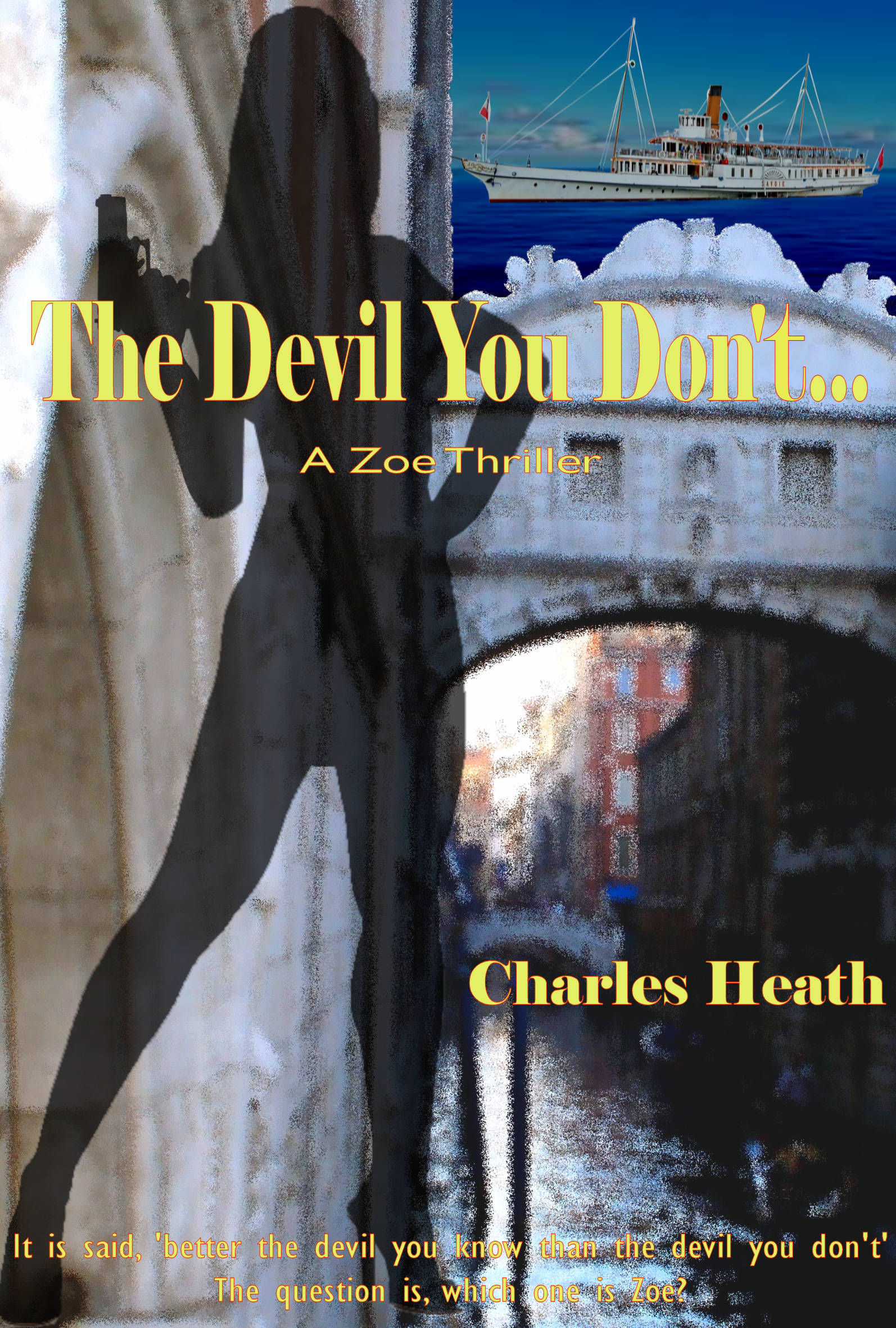
‘The Devil You Don’t’ – A beta reader’s view

It could be said that of all the women one could meet, whether contrived or by sheer luck, what are the odds it would turn out to be the woman who was being paid a very large sum to kill you?

John Pennington is a man who may be lucky in business, but not so lucky in love. He has just broken up with Phillipa Sternhaven, the woman he thought was the one, but relatives and circumstances, and perhaps because she was a ‘princess’, may also have contributed to the end result.

So, what do you do when you are heartbroken?

That is a story that slowly unfolds, from the first meeting with his nemesis on Lake Geneva, all the way to a hotel room in Sorrento, where he learns the shattering truth.

What should have been solace after disappointment turns out to be something else entirely, and from that point, everything goes to hell in a handbasket.

He suddenly realises his so-called friend Sebastian has not exactly told him the truth about a small job he asked him to do, the woman he is falling in love with is not quite who she says she is, and he is caught in the middle of a war between two men who consider people becoming collateral damage as part of their business.

The story paints the characters, cleverly displaying all their flaws and weaknesses. The locations add to the story at times, taking me back down memory lane, especially to Venice, where, in those back streets, I confess it’s not all that hard to get lost.

All in all, a thoroughly entertaining story with, for once, a satisfying end.

Available on Amazon here: https://amzn.to/2Xyh1ow

Top 5 sights on the road less travelled – La Paz

Discovering La Paz: Five Hidden Gems Off the Beaten Path

Introduction
Nestled amidst the towering peaks of the Andes, La Paz is a city of vibrant cultures and breathtaking landscapes. While many travellers flock to its iconic Witches Market and the Death Road, the Bolivian capital holds countless secrets for the curious. For those seeking an authentic, less-travelled journey, here are five extraordinary experiences that redefine what La Paz has to offer.


1. Cholitas Licking: A Celebration of Andean Identity
Step into the striking world of the cholitas, traditional Aymara women, and immerse yourself in their fearless blend of style, resilience, and heritage. This unique cultural encounter, often described as “Cholitas Licking,” features fashion shows, workshops, and artisan markets where cholitas showcase their vibrant polleras (dresses) and colonial-era masks. More than a spectacle, this experience challenges stereotypes and honours indigenous identity. Visit their community centres in El Alto for a deeper understanding of their role as cultural ambassadors.

Tip: Respect cultural significance—ask for permission before photographing participants.


2. Kallawaya School of Traditional Healing: Ancient Wisdom in Modern Medicine
Journey to the outskirts of La Paz to explore the Kallawaya School of Traditional Healing, a living archive of pre-Columbian medicinal knowledge. The Kallawaya people, renowned for their healing practices, offer workshops on herbal remedies, music therapy, and shamanic rituals. Wander their medicinal garden, where over 200 plant species are catalogued, and learn how to craft teas or tinctures for common ailments. This is a rare chance to connect with Bolivia’s spiritual and ecological heritage.

Tip: Book workshops in advance—offerings (regalos) to the mountain (apacheta) are customary.


3. Wuli Qhapaq Cable Car to Chimehua: Sky-High Serenity
Traverse the urban sprawl of La Paz aboard the Wuli Qhapaq (Red) cable car network. While most travellers stick to the main routes, venture to the Chimehua line, a golden cable car that extends into the Illimani Valley. This lesser-known route offers panoramic views of the Illimani volcano and descends into the lush, remote countryside. Alight at a local farm for a chicha (corn beer) tasting or a guided hike through cloud forests teeming with orchids.

Tip: Bring a reusable bottle for coca tea from the local market—perfect for altitude adjustment.


4. Sopocachi Caves: Earth’s Hidden Art Gallery
Just 20 minutes from downtown La Paz, the Sopocachi Cave System reveals a subterranean wonderland of stalactites, stalagmites, and ancient rock art. These caves, once inhabited by pre-Columbian communities, are adorned with mysterious symbols and animal carvings. The self-guided tour is affordable (£16-£20) and led by local guides who share tales of the caves’ role in ancestral rituals.

Tip: Visit early in the day to avoid crowds and bring a headlamp for optimal visibility.


5. Trek to the Valley of the Moon: A Martian Landscape
While Salar de Uyuni is Bolivia’s most famous attraction, venture toward the Valley of the Moon (Valle de la Luna) for a quieter, equally dramatic experience. Located near Salar de Cotapata, this surreal red and orange badlands, sculpted by wind and erosion, feels like another planet. Guided day tours from La Paz (lasting 8-10 hours) include a detour to this hidden gem, where photography and hiking are unspoiled by crowds.

Tip: Visit during dry seasons (April–September) for the best colour contrasts without mud.


Conclusion: La Paz, Redefined
La Paz is more than its skyline—it’s a gateway to the extraordinary. By stepping beyond the cobbled streets of the city, travellers can uncover traditions, landscapes, and communities that epitomise Bolivia’s soul. Whether you’re sipping chicha at a cloud forest farm or tracing your fingers along ancient rock art, these hidden adventures promise memories that linger long after your boots return to solid ground. So, pack your sense of curiosity and let La Paz surprise you.

Final Tip: Learn a few Aymara phrases—Suma qhapaq kama (Beautiful is the life well lived) is a poetic way to end your journey. 🌄

365 Days of Writing, 2026 – 218

Day 218 – The author’s imaginary world

Building the Invisible Architecture: Why Every Novelist Must First Create a World They Believe In

“Every novelist must begin by creating himself a world, great or little, in which he can honestly believe.” — Joseph Conrad

When we open a novel, we aren’t just looking for a sequence of events. We are looking for a portal. We want to step out of the mundane architecture of our daily lives and inhabit somewhere else—whether that somewhere else is the misty decks of a 19th-century trading ship, the neon-lit alleys of a cyberpunk dystopia, or the quiet, devastating emotional landscape of a suburban kitchen.

But before a reader can ever step foot into that fictional realm, the author must build it, brick by invisible brick. And as Joseph Conrad famously noted, that process begins with belief.

If the writer doesn’t buy the reality of the world they are constructing, why should the reader?

Let’s explore what Conrad’s timeless wisdom means for modern novelists, world-building, and the psychological heavy lifting required to write fiction that resonates.


The Anatomy of Belief: What Does It Mean to “Believe” in Your World?

Belief in writing is not about magic systems, historical accuracy, or encyclopedic lore (though those things can help). It is about internal coherence and emotional truth.

When Conrad spoke of creating a world “great or little,” he wasn’t just talking about epic fantasy maps. A “little” world might be a single boarding house in Dublin, a courtroom during a three-day trial, or the strained silence across a breakfast table.

To believe in your world, you must know its gravity. You must understand:

  • The sensory reality: What does it smell like after a heavy rain? What is the quality of the light at 4:00 PM?
  • The unspoken rules: What do the inhabitants take for granted? What are the cultural taboos, economic pressures, and quiet griefs that shape their daily choices?
  • The moral pulse: Even if the author is entirely objective, the world must operate on a set of internal cause-and-effect dynamics where actions have real, believable consequences.

If you are writing a scene and you feel a twinge of artificiality—a sense that you are moving characters around like chess pieces just to get to the next plot point—you have stopped believing in your world. And the moment the author stops believing, the reader’s suspension of disbelief shatters like cheap glass.


World-Building is Self-Discovery

Notice the phrasing in Conrad’s quote: “creating himself a world.”

Before a novelist creates a world for the reader, they must create it for themselves. Writing a novel is an act of self-interrogation. The world you build often becomes a mirror for your own obsessions, fears, questions, and philosophies.

  • Tolkien didn’t just invent Middle-earth for the sake of an adventure; he built it out of a profound love for lost mythologies and philology, creating languages that necessitated a world to speak them.
  • Austen mapped the rigid, polite, and deeply economic marriage market of 19th-century England because she was keenly interested in the intersection of female autonomy, social survival, and genuine affection.

When you sit down to write, your fictional world is your testing ground. It is the ecosystem where you explore what you actually believe about human nature, power, love, and betrayal. If your heart isn’t invested in the truths of that ecosystem, your prose will lack the pulse of life.


The Danger of the “Cardboard Set”

We have all read books that feel like movie sets made of painted cardboard. The dialogue is snappy, the plot moves fast, but the moment a character leans against a wall, you feel like the whole thing might tip over.

This happens when a writer focuses entirely on mechanics rather than immersion. They outline the plot beats, design the twists, but fail to inhabit the space.

To avoid the cardboard set trap, adopt Conrad’s mindset:

  1. Dig deeper than the surface details. Don’t just invent a futuristic city; figure out where the garbage goes, who cleans the streets, and what people sing when they’re drunk.
  2. Let the world talk back. A believable world has momentum. When your characters make a choice, the world should react in ways that aren’t always convenient for your outline.
  3. Write for the senses, not just the intellect. Bring your scenes to life through texture, temperature, and tone.

How to Cultivate Radical Belief in Your Writing

If you are struggling to connect with your story-world, how do you bridge the gap? How do you reach that state of honest belief?

  • Write toward the unknown: Don’t plan every single square inch before you start. Leave room for discovery. Sometimes, believing in your world means exploring it alongside your characters, letting it surprise you.
  • Anchor the fantastical in the visceral: If you are writing high fantasy or hard sci-fi, ground the extraordinary in ordinary human experiences. A dragon rider still gets a sore back; a starship captain still worries about aging or estranged children.
  • Interrogate your own cynicism: If you find yourself rolling your eyes at your own plot developments, stop. Figure out why. Fix the underlying logic until you can nod to yourself and say, Yes, that is how this world works.

Final Thoughts: The Invitation to the Reader

Writing a novel is an act of supreme audacity. You are essentially asking a complete stranger to sit in a quiet room, look at a series of black symbols on a white page, and hallucinate an entire reality for several hours.

The only way that magic trick works is if your own conviction is absolute.

When you create a world—whether it spans galaxies or exists entirely within the confines of a single room—you must believe in it first. Pour your curiosity, your empathy, and your attention into its soil. Because when you honestly believe in the world you’ve made, the reader won’t just visit it—they will live in it.


Are you currently building a fictional world? What is the hardest part of making it feel real to you—the physical details, the emotional stakes, or the internal logic? Let us know in the comments below!

“The Things we do for Love”, the story behind the story

This story has been ongoing since I was seventeen, and just to let you know, I’m 72 this year.

Yes, it’s taken a long time to get it done.

Why, you might ask.

Well, I never gave it much interest because I started writing it after a small incident when I was 17, and working as a book packer for a book distributor in Melbourne

At the end of my first year, at Christmas, the employer had a Christmas party, and that year, it was at a venue in St Kilda.

I wasn’t going to go because at that age, I was an ordinary boy who was very introverted and basically scared of his own shadow and terrified by girls.

Back then, I would cross the street to avoid them

Also, other members of the staff in the shipping department were rough and ready types who were not backwards in telling me what happened, and being naive, perhaps they knew I’d be either shocked or intrigued.

I was both adamant I wasn’t coming and then got roped in on a dare.

Damn!

So, back then, in the early 70s, people looked the other way when it came to drinking, and of course, Dutch courage always takes away the concerns, especially when normally you wouldn’t do half the stuff you wouldn’t in a million years

I made it to the end, not as drunk and stupid as I thought I might be, and St Kilda being a salacious place if you knew where to look, my new friends decided to give me a surprise.

It didn’t take long to realise these men were ‘men about town’ as they kept saying, and we went on an odyssey.  Yes, those backstreet brothels where one could, I was told, have anything they could imagine.

Let me tell you, large quantities of alcohol and imagination were a very bad mix.

So, the odyssey in ‘The things we do’ was based on that, and then the encounter with Diana. Well, let’s just say I learned a great deal about girls that night.

Firstly, not all girls are nasty and spiteful, which seemed to be the case whenever I met one. There was a way to approach, greet, talk to, and behave.

It was also true that I could have had anything I wanted, but I decided what was in my imagination could stay there.  She was amused that all I wanted was to talk, but it was my money, and I could spend it how I liked.

And like any 17-year-old naive fool, I fell in love with her and had all these foolish notions.  Months later, I went back, but she had moved on, to where no one was saying or knew.

Needless to say, I was heartbroken and had to get over that first loss, which, like any 17-year-old, was like the end of the world.

But it was the best hour I’d ever spent in my life and would remain so until I met the woman I have been married to for the last 48 years.

As Henry, he was in part based on a rebel, the son of rich parents who despised them and their wealth, and he used to regale anyone who would listen about how they had messed up his life

If only I’d come from such a background!

And yes, I was only a run away from climbing up the stairs to get on board a ship, acting as a purser.

I worked for a shipping company and they gave their junior staff members an opportunity to spend a year at sea working as a purser on a cargo ship that sailed between Melbourne, Sydney and Hobart in Australia.

One of the other junior staff members’ turn came, and I would visit him on board when he would tell me stories about life on board, the officers, the crew, and other events. These stories, which sounded incredible to someone so impressionable, were a delight to hear.

Alas, by that time, I had tired of office work and moved on to be a tradesman at the place where my father worked.

It proved to be the right move, as that is where I met my wife.  Diana had been right; love would find me when I least expected it.

lovecoverfinal1

The cinema of my dreams – Was it just another surveillance job? – Episode 7

I’m back home and this story has been sitting on a back burner for a few months, waiting for some more to be written.

The trouble is, there are also other stories to write, and I’m not very good at prioritising.

But, here we are, a few minutes opened up and it didn’t take long to get back into the groove.

A body and a whole bunch of questions.

A full minute passed, with only one car passing, the rest of the time there was a strange sort of silence.

The man on the ground didn’t move.  Whoever shot him had shot to kill.  I took the few steps to stand beside him and could see the hole and the bloodstain of the wound.  Shot in the heart, instant death.

Usually, if it was a sniper, it was a head shot.  Less chance of missing a vital organ and leaving the target alive.

Odd too that it was just before he told me where some ‘evidence’ was located.  And who the hell was this Alfred Nobbin?

I heard a car turn into the alley and come towards me.  Halfway, it stopped, the engine switched off, and the doors opened.

Two men.  Maury, my handler, and Severin, the instructor.  Neither was carrying a gun, so neither had shot him.  That meant someone else was still in play.

I said, “I had him, but someone shot him.”

Stating the obvious, Maury’s expression told me.

“You’re not dead.”

“Perhaps I wasn’t a target.”

“Today.  Did he say who he was?”

“No.”

No hesitation or they’ll think I’m lying, which I am.  I was not sure why, but was it because I detected a note of sincerity in the target’s tone?

“Checked for identification yet?”

“Just about to.”  I knelt down and went through his pockets.  Nothing.  I told Maury that.

“Pity.”  He hadn’t moved from where he stopped.  Severin had been looking back up the alley, no doubt looking for where the bullet came from.

Had he reached the same conclusion I had, a balcony on the third floor of the left-hand building?  The shooter would be long gone by now.

A white van pulled into the lane and pulled up behind Maury’s car.  The cleaners.

It raided questions.  How did Maury know we’d be here, and that the target would be shot dead?  Or had he assumed I’d all but kill him in revenge for what had happened to the others.

What had happened to the others?

“The rest of the team,” I asked.

“Two dead, one critical.  One safe.  Let’s go.  We need to have a debriefing.”

I took a last look at the body, the joined Maury and Severin in the car.  I had questions of my own.

“A bad day’s work,” Severin muttered, as he drove off.

“But conclusive proof we have a traitor, the last thing we need right now.”

I was surprised they were discussing high-level matters that I considered above my pay grade.  And, I had to say, it worried me.

© Charles Heath 2019-2025