In a word: Cell

For those who break the law, they will be very familiar with the meaning of the word cell.  It’s a room a jail, not very big, with an uncomfortable bed, and no sharp edges.

And I’m sure the prisoners are not supplied with knives so they can dig through the mortar and remove bricks on their way to the great escape.  That, I’m sure only happens at the movies.

A cell can also be a building block in the creation of humans, animals, fish, and plants.  No doubt there are a million other things that require cells.

Perhaps the most interesting aspect of this cellular activity is whether or not there is life, and therefore cells, on Mars.  I’m guessing we’ll have to wait a little longer to find out.

We can have a cell phone, which in some parts of the world is also the name of a mobile phone.

Don’t get me started on what I think of cell phones, or how intrusive they are on our everyday lives, the number of people who seem to be continually glued to the screen, or how many near misses there are in the street and crossing the road.

On the other hand cell phones in the hands of a writer are very useful because when we get flashes of story or plotlines in one of those once awkward moments, we can now jot it down on a cell phone scribbling pad.

A cell can also be used to describe a smaller unit within a larger organisation, or, if you are a thriller writer who dabbles in espionage, you will be very familiar with the concept of a sleeper cell.

Who knows, in reality, there might be some living next door to us and we would never know.  Oops, been watching too much television again.

Digging deeper into the more obscure definitions of the word cell, we come up with a single transparent sheet that has a single drawing on it, one of many that make up an animated film, or film.  If a film runs at 32 frames per second, that means there are 32 cells.

There are fuel cells

There are dry cell batteries

And as a general warning, don’t go too near cell towers or you will be a victim of radiation that might be extremely harmful to your health.

An excerpt from “Betrayal” – a work in progress

It could have been anywhere in the world, she thought, but it wasn’t.  It was in a city where if anything were to go wrong…

She sighed and came away from the window and looked around the room.  It was quite large and expensively furnished.  It was one of several she had been visiting in the last three months.

Quite elegant too, as the hotel had its origins dating back to before the revolution in 1917.  At least, currently, there would not be a team of KGB agents somewhere in the basement monitoring everything that happened in the room.

There was no such thing as the KGB anymore, though there was an FSB, but such organisations were of no interest to her.

She was here to meet with Vladimir.

She smiled to herself when she thought of him, such an interesting man whose command of English was as good as her command of Russian, though she had not told him of that ability.

All he knew of her was that she was American, worked in the Embassy as a clerk, nothing important, whose life both at work and at home was boring.  Not that she had blurted that out the first they met, or even the second.

That first time, at a function in the Embassy, was a chance meeting, a catching of his eye as he looked around the room, looking, as he had told her later, for someone who might not be as boring as the function itself.

It was a celebration, honouring one of the Embassy officials on his service in Moscow, and the fact he was returning home after 10 years.  She had been there once, and still hadn’t met all the staff.

They had talked, Vladimir knew a great deal about England, having been stationed there for a year or two, and had politely asked questions about where she lived, her family, and of course what her role was, all questions she fended off with an air of disinterested interest.

It fascinated him, as she knew it would, a sort of mental sparring as one would do with swords if this was a fencing match.

They had said they might or might not meet again when the party was over, but she suspected there would be another opportunity.  She knew the signs of a man who was interested in her, and Vladimir was interested.

The second time came in the form of an invitation to an art gallery, and a viewing of the works of a prominent Russian artist, an invitation she politely declined.  After all, invitations issued to Embassy staff held all sorts of connotations, or so she was told by the Security officer when she told him.

Then, it went quiet for a month.  There was a party at the American embassy and along with several other staff members, she was invited.  She had not expected to meet Vladimir, but it was a pleasant surprise when she saw him, on the other side of the room, talking to several military men.

A pleasant afternoon ensued.

And it was no surprise that they kept running into each other at the various events on the diplomatic schedule.

By the fifth meeting, they were like old friends.  She had broached the subject of being involved in a plutonic relationship with him with the head of security at the embassy.  Normally for a member of her rank, it would not be allowed, but in this instance it was.

She did not work in any sensitive areas, and, as the security officer had said, she might just happen upon something that might be useful.  In that regard, she was to keep her eyes and ears open and file a report each time she met him.

After that discussion, she got the impression her superiors considered Vladimir more than just a casual visitor on the diplomatic circuit.  She also formed the impression that he might consider her an ‘asset’, a word that had been used at the meeting with security and the ambassador.

It was where the word ‘spy’ popped into her head and sent a tingle down her spine.  She was not a spy, but the thought of it, well, it would be fascinating to see what happened.

A Russian friend.  That’s what she would call him.

And over time, that relationship blossomed, until, after a visit to the ballet, late and snowing, he invited her to his apartment not far from the ballet venue.  It was like treading on thin ice, but after champagne and an introduction to caviar, she felt like a giddy schoolgirl.

Even so, she had made him promise that he remain on his best behaviour.  It could have been very easy to fall under the spell of a perfect evening, but he promised, showed her to a separate bedroom, and after a brief kiss, their first, she did not see him until the next morning.

So, it began.

It was an interesting report she filed after that encounter, one where she had expected to be reprimanded.

She wasn’t.

It wasn’t until six weeks had passed when he asked her if she would like to take a trip to the country.  It would involve staying in a hotel, that they would have separate rooms.  When she reported the invitation, no objection was raised, only a caution; keep her wits about her.

Perhaps, she had thought, they were looking forward to a more extensive report.  After all, her reports on the places, and the people, and the conversations she overheard, were no doubt entertaining reading for some.

But this visit was where the nature of the relationship changed, and it was one that she did not immediately report.  She had realised at some point before the weekend away, that she had feelings for him, and it was not that he was pushing her in that direction or manipulating her in any way.

It was just one of those moments where, after a grand dinner, a lot of champagne, and delightful company, things happen.  Standing at the door to her room, a lingering kiss, not intentional on her part, and it just happened.

And for not one moment did she believe she had been compromised, but for some reason she had not reported that subtle change in the relationship to the powers that be, and so far, no one had any inkling.

She took off her coat and placed it carefully of the back of one of the ornate chairs in the room.  She stopped for a moment to look at a framed photograph on the wall, one representing Red Square.

Then, after a minute or two, she went to the mini bar and took out the bottle of champagne that had been left there for them, a treat arranged by Vladimir for each encounter.

There were two champagne flutes set aside on the bar, next to a bowl of fruit.  She picked up the apple and thought how Eve must have felt in the garden of Eden, and the temptation.

Later perhaps, after…

She smiled at the thought and put the apple back.

A glance at her watch told her it was time for his arrival.  It was if anything, the one trait she didn’t like, and that was his punctuality.  A glance at the clock on the room wall was a minute slow.

The doorbell to the room rang, right on the appointed time.

She put the bottle down and walked over to the door.

A smile on her face, she opened the door.

It was not Vladimir.  It was her worst nightmare.

…

© Charles Heath 2020
“Knowledge can be dangerous…” – A short story

It was, perhaps, the saddest week of my life.

It started with a phone call, and then a visit by two police officers.  It was about my parents, but the news could not be imparted over the phone, only in person.  That statement alone told me it was very bad news, so I assumed the worst.

The two police officers, standing at the front door, with grim expressions on their faces, completed the picture.  The news, my parents were dead, killed in a freak car accident.

At first, it didn’t sink in.  They were on their way back from another of their extensive holidays, one of many since my father had retired.  I’d seen them probably six months out of the last five years, and the only reason they were returning this time was that my mother needed an operation.

They hadn’t told me why, not that they ever told me very much any time since the day I’d been born, but that was who they were.  I thought them eccentric, being older when I’d come along, and others thought them, well, eccentric.

And being an only child, they packed me off to boarding school, then university, and then found me a job in London, and set me up so that I would only see them weekends if they were home.

I had once wondered if they ever cared about me, keeping me at arm’s length, but my mother some time ago had taken me aside and explained why.  It was my father’s family tradition.  The only part I’d missed was a nanny.

It most likely explained why I didn’t feel their passing as much as I should.

A week later, after a strange funeral where a great many people I’d never met before, and oddly who knew about me, I found myself sitting in the sunroom, a glass of scotch in one hand, and an envelope with my name on it, in the other.

The solicitor, a man I’d never met before, had given it to me at the funeral.   We had, as far as I knew an elderly fellow, one of my father’s old school friends, as the family solicitor, but he hadn’t shown at the funeral and wasn’t at home when I called in on my way home.

It was all very odd.

I refilled the glass and took another look at the envelope.  It was not new, in fact, it had the yellow tinge of age, with discolouration where the flap was.  The writing was almost a scrawl, but identifiable as my father’s handwriting, perhaps an early version as it was now definitely an illegible scrawl.

I’d compared it with the note he’d left me before they had embarked on their last adventure, everything I had to do while caretaking their house.  The last paragraph was the most interesting, instructing me to be present when the cleaning lady came, he’d all but accused her of stealing the candlesticks.

To be honest, I hadn’t realized there were candlesticks to steal, but there they were, on the mantlepiece over the fire in the dining room.  The whole house was almost like being in an adventure park, with stairs going up to an array of rooms, mostly no longer used, and a staircase to the attic, and then another going down to the cellar.  The attic was locked and had been for as long as I could remember, and the cellar was dank and draughty.

Much like the whole house, but not surprisingly, it was over 200 years old.

And perhaps it was now mine.  The solicitor, a man by the name of Sir Percival Algernon Bridgewater, had intimated that it might be the last will and testament and had asked me to tell him if it was.  I was surprised that Sir Percival didn’t have the document in question.

And equally. so that the man I knew as his solicitor, Lawerence Wellingham, didn’t have a copy of my father’s last will and testament either.

I finished the drink, picked up the envelope, and opened it.

It contained two sheets of paper, the will, and a letter.  A very short letter.

“If you are reading this I have died before my time.  You will need to find Albert Stritching, and ask him to help you find the murderer.”

Even the tenor of that letter didn’t faze me as it should have, because at this point nothing would surprise me.  In fact, as I  unfolded the document that proclaimed it was the will, I was ready for it to say that the whole of his estate and belongings were to be left to some charity, and I would get an annual stipend of a thousand pounds.

In fact, it didn’t.  The whole of his estate was left to my mother should she outlive him, or in the event of her prior decease, to me.

I had to put all of those surprises on hold to answer a knock on the door.

Lawerence Wellingham.

I stood to one side, let him pass, closed the door, and followed him into the front room, the one my mother called the ‘drawing room’ though I never knew why.

He sat in one of the large, comfortable lounge chairs.  I sat in the other.

I showed him the will.  I kept the other back, not knowing what to make of it.

“No surprise there,” Wellingham said.

“Did you have any idea what my father used to do, beyond being, as he put it, a freelance diplomat?”

I thought it a rather odd description but it was better than one he once proffered, ‘I do odd jobs for the government’.

“I didn’t ask.  Knowledge can be dangerous, particularly when associated with your father.  Most of us prefer not to know, but one thing I can tell you.  If anyone tries to tell you what happened to your parents was not an accident, ignore them.  Go live your life, and keep those memories you have of them in the past, and don’t look back.  They were good people, Ken, remember them as such.”

We reminisced for the next hour, making a dent in the scotch, one of my father’s favourite, and he left.

Alone again, the thoughts went back to the second note from my father.  That’s when the house phone rang.

Before I could answer it, a voice said, “My name is Stritching.  Your father might have mentioned me?  We need to talk.”

—-

© Charles Heath 2020-2021

The cinema of my dreams – I always wanted to go on a treasure hunt – Episode 39

Here’s the thing…

Every time I close my eyes, I see something different.

I’d like to think the cinema of my dreams is playing a double feature but it’s a bit like a comedy cartoon night on Fox.

But these dreams are nothing to laugh about.

Once again there’s a new installment of an old feature, and we’re back on the treasure hunt.


A shiver went down my spine, and I took it for the omen it was.

Nothing good came of being in a place where you were not supposed to be.

I shook it off.

“Does that look like someone we knew, once?”

He looked at the mannequin, then shook his head.  “No, should it?”

“Seems odd they didn’t come back to collect their stock.  I’m sure it wasn’t as bad as this when the cracks first appeared.”

“Here it was.  Walls crumbled, and in places the roof collapsed.  Two shop staff got hit by a falling beam.  One later died.  There was a long court battle over that.”

I did not remember much of what happened.  My mother said it was just another tragedy brought on by greed.  It was probably why I had such contempt for the rich.

Boggs did a rotation with his light, and in the direction of the marina, there was a central square over which was a skylight, only it was dirty and little light was getting through.  It was just enough to see that the plants had all overgrown and taken over, and it was strange to see pylons covered in creeper, and shrubs growing through seats.

There had been a pond in the middle of that square, but it was probably empty now, and if it had water, it would be contributing to the smell.

In the other direction, there was darkness, the mall heading towards the front entrance.

Boggs started walking towards the square.

That was when I realized he had brought an old map of the shopping center and had been looking at it when I joined him.

From the square, there were elevators and steps up to the second level where there were restaurants and entertainment areas, as well as the entrance to the multiplex cinemas.  The stairs went down to the carpark.

There were two levels of carpark under the main building, and it was the lower car park that had occasionally flooded.

When we reached the square, it seemed lighter than I first thought, but that had to do with the fact my eyes had adjusted to the semi-darkness, making objects clearer.  We had to brush past some of the tree branches to reach the pond.

I was wrong.  There was water in it, and it was reasonably clear.  I guess without man to pollute it, nature had taken over.  Here the aroma was more like a park after the lawns had been mowed.

Boggs had turned off his light as we approached the pond, and it was fortunate he had.  We both heard the sound of a brick, or rock hitting the floor, and a moment later, the faint glow of torchlight.

Other people exploring the wilderness.

“How many people know about that entrance?”

It sounded to me like they were coming back from the marina.

“I don’t know.  I wasn’t expecting anyone to be here if that’s what you’re thinking.”

It wasn’t.  Not my first thought, anyway.

He headed towards the stairs next to the elevator lobby, remarkably clear of rubble and undergrowth, and started walking down the stairs, into the darkness. I followed, reluctantly, and inwardly sighed in relief when he stopped on the first landing.  There was a rumor there were ghosts down on the car park levels.

We went just far enough down to be hidden from the other visitors.  Unless they decided to use this particular staircase.

The light was less intense as it approached the square, and then we saw two figures.

At least one was a male, tall, and smoking a cigarette.

“God knows why the boss wanted us to check this hell hole.  There’s no one here but us.”  It was the tall man speaking.

He waved his torch around, including once in our direction.  At the distance they were from us, the light had no effect.

“You know the boss, he has an active imagination.  Perhaps if he hadn’t buried the bodies down here, it wouldn’t be an issue.  Come on, this place gives me the creeps.”

Another man, and, now, I could see they were dressed in what looked like security guards’ clothes.  Why on earth would anyone want to keep an eye on this place?  And who was their boss?

Another wave of the torches and they continued their way towards the front of the mall.

“So,” Boggs said with a curious inflection in his tone, “there are bodies buried down here.”

“A figure of speech,” I said.  “No one would be that stupid to bury bodies down here.”

“Why not.  No one comes here, except adventurers like us, so it’s a perfect place for either the Cossatino’s or the Benderby’s to hide stuff down here.  How many people do you think either of them has killed over the years?”

Allegedly quite a few.  It was, when I thought about it, quite a good place to hide a body.  I just hoped we didn’t find one.

We waited another five minutes, just in case they came back, but they didn.t.  I followed Boggs up the stairs and we headed towards the center of the square.

“Where are we going?”

“To the Marina.  Got to check something first.”

© Charles Heath 2020

“Strangers We’ve Become” – The final countdown to publishing in 15 Days

A new edition of the Spanish inquisition

…

At what point do you stop ignoring the signs and start considering the possibility that:

  1.  Susan is no longer the woman he married, or
  2.  Susan has undergone such a transformation after the traumatising time her father put her through that she has completely changed, or
  3. The demands of running the Featherington commercial empire are such that there is no time left for David and Susan to spend time together in a meaningful way, or
  4. Susan is not his Susan, but another of the clones.

David certainly doesn’t want to believe the last option was the case.  There is enough from their current interactions to convince him that his Susan is in there somewhere, but those photographs he received in Moscow before the assassination attempt convinced him that it was possible the damage done by her father had changed her.

He never expected she would have an affair.

The thing is, did he know here all that well given the little time they had spent together?

Still reeling from the assassination attempt in Yaroslavl, and the fact it nearly cost Alisha her life, David decides it’s time to do a little investigating into the woman that is his wife.

For now.

And being on the inside, that surveillance job was going to be easy.

Except…

He just has to get past the new security detail Susan has hired.

…

Searching for locations: From X’ian to Zhengzhou dong by bullet train, China

Lunch and then off on another high-speed train

We walked another umpteen miles from the exhibition to a Chinese restaurant that is going to serve us Chinese food again with a beer and a rather potent pomegranate wine that has a real kick.  It was definitely value for money at 60 yuan per person.

But perhaps the biggest thrill, if it could be called that, was discovering downstairs, the man who discovered the original pieces of a terracotta soldier when digging a well.  He was signing books bought in the souvenir store, but not those that had been bought elsewhere.

Some of is even got photographed with him.  Fifteen minutes of fame moment?  Maybe.

After lunch, it was off to the station for another high-speed train ride, this time for about two and a half hours, from X’ian to Zhangzhou dong.

It’s the standard high-speed train ride and the usual seat switching because of weird allocation issues, so a little confusion reigns until the train departs at 5:59.

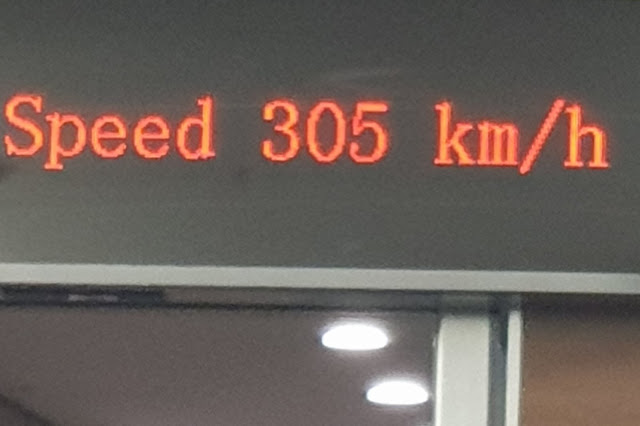
Once we were underway it didn’t take long before we hit the maximum speed

Twenty minutes before arrival, and knowing we only have three minutes to get off everyone is heading for the exit clogging up the passageway.  It wasn’t panic but with the three-minute limit, perhaps organized panic would be a better description.

As it turned out, with all the cases near the door, the moment to door opened one of our group got off, and the other just started putting cases on the platform, and in doing so we were all off in 42 seconds with time to spare.

And this was despite the fact there were about twenty passengers just about up against the door trying to get in.  I don’t think they expected to have cases flying off the train in their direction.

We find our way to the exit and our tour guide Dannie.  It was another long walk to the bus, somewhat shabbier from the previous day, no leg room, no pocket, no USB charging point like the day before.  Disappointing.

On the way from the station to the hotel, the tour guide usually gives us a short spiel on the next day’s activities, but instead, I think we got her life history and a song, delivered in high pitched and rapid Chinglish that was hard to understand.

Not at this hour of the night to an almost exhausted busload of people who’d had enough from the train.  Oh, did I forgot the singing, no, it was an interesting rendition of ‘you are my sunshine’.

The drive was interesting in that it mostly in the dark.  There was no street lighting and in comparison to X’ian which was very bright and cheerful, this was dark and gloomy.

Then close to the hotel our guide said that if we had any problems with the room, she would be in the lobby for half an hour.

That spoke volumes about the hotel they put us in.

NANOWRIMO November 2023 – Day 21

“Opposites Attract”

…

It’s one thing to propose …

…

It was another thing entirely to try to apply the brakes on a runaway train.

That whole proposal, saying yes, and finally breathing again thing was probably the second most momentous event in his life, when taken in order.

The first, graduating with the best possible scores was the first, the reward for a lot of hard work, even if he still didn’t know what he wanted to do.

The second, sharing that life with Emily had come to fruition, against all hopes.

He didn’t think he would be able to top it.  Yet.

there’s the wedding, and everything that goes with it, except in this instance, there was not going to be enough time to plan the Hollywood-style wedding that befitted the billionaires that would be attending.

Certainly, it would be the social event of the calendar back home.

So, there was going to be a small event at the hospital for the grandmother to attend, then a later big bash for everyone else.

It was just a matter of keeping it a secret until then.

And we all know about secrets, don’t we?

…

Today’s words:  2.045, for a total of 39,795

The Cinema of My Dreams – It ended in Sorrento – Episode 63

Time to find a missing person

…

I turned slowly, wondering just what the hell her game was, when I realised it was not her, but another man holding a shotgun and looking very aggravated.

“What do you think you’re doing?”  At least that’s what I translated his Italian version into.

And I put my hands out where he could see them, noting at the same time that not only was Juliet missing, so was my gun.

“No Italian, I’m sorry.  Should you be brandishing that gun?”

As I turned, he moved back.  He correctly interpreted that I was going to disarm him, if /I could distract him with my not understanding Italian.  He was smarter than that.

“Move.”

He had a word of English.  The motioning of the gun in the direction of the back door was all he needed.  It was not the first time he’d approached an intruder.

I moved slowly towards the door, opened it, and went in.

The grisly scene of the woman on the floor with blood everywhere was confronting.  The man with the gun swore.

“What the hell have you done?”  Not an exact translation but near enough.  He was shocked.

And distracted.

But I think there was no threat from either of them.  Dicostini was almost in shock, kneeling beside the woman, trying to shake her awake.

The other man put down the gun and went over to check for any sign of life.  First a finger at her neck, then her writ, then hear if she was still breathing.

The gunman looked at Dicostini, “How did this happen?”

Dicostini shrugged.

“He hit her,” I said.  “I saw it happen through the window.  They were arguing.”

That’s when Dicostini saw me.  “Who are you?”

“A private investigator hired to find the real countess.  The thing is, I’m not overly worried about her, it’s the woman you took with her that’s your biggest problem?”

“What woman?”

“The countess’s sister.  You snatched the two of them if you didn’t, the clowns you employed to do the job did.  Her sister is the wife of the Chief of British Intelligence, and he’s about to unleash the wrath of the Gods on you.  I came here to do you a favour.  Tell me where they are, and I’ll walk away.  No questions asked, no interest in what happened here.  This is a one-time offer, and it’s about to expire.”

“What are you talking about?  This is the countess’s sister.”

It was certainly not Mrs Robdy, but now in the pale light shining on that lifeless face, I could see the resemblance to the countess.  It was definitely the woman I’d gone to the opera with, and later taken back to the hotel.

I could see how easily it would be to mistake the fake for the real countess … they must be twins.  The thing was, no one had picked up on it, and I thought our researchers were supposed to be the best.

“How is that possible?” I had to ask. 

“They were twins, separated at birth, and the mother was never told.  Angelina was sent north to stay with a distant aunt who treated her as her own child, and she was never told of her true mother.  I would not have known either unless my own mother told me of the deception on her deathbed.”

“So, what was this charade supposed to prove?”

“That she gets some recognition, and some of the Von Burkehardt spoils.  That cow that is the countess, she has no interest in anyone but herself.  Not for the traditions of this country, the people, the area, the vineyards, the wine, anything.”

“Where is she?”

“Dead, I hope. I told them I didn’t want to see her again.  They did not tell me they had taken anyone else with her.  It is done, over.  I have no idea where they were being held.  Now go.  I have enough to deal with.”

I had to agree with him.  How was he going to explain any of this?

I waited until I was some distance from the house, then pulled out my phone and dialled Anthony’s number.

He answered after the seventh ring.  I was worried he might not.

“Two urgent matters.  Tell Rodby to take the woman who’s with him into custody.  Don’t ask why, just do it, now.  Second, how quickly can you flood the Italian media with a missing person poster?”

“Quickly.  Why?”

“Get a wanted poster together with Mrs Rodby’s face on it and a finder’s fee of a million Euros, more if you like.  And put my phone number on it.  Mrs Rody still carries Rodby’s VC in her handbag for good luck still?”

“How do you know that?”

“I’m good at my job.  Do both those requests, then call me back in an hour or so.  It’s imperative you get the missing persons poster out as soon as possible but only to two people.  The lawyer fellow in Rome, I’ll send you his details if you don’t already have them, and to the Burkehardt’.  All of them.”

“Only those people?”

“Yes.  If I’m wrong, you’re going to find me a hiding spot somewhere in the middle of the north pole, preferably a mile or more under the ice.”

© Charles Heath 2023

Inspiration, maybe – Volume 1

50 photographs, 50 stories, of which there is one of the 50 below.

They all start with –

A picture paints … well, as many words as you like.  For instance:

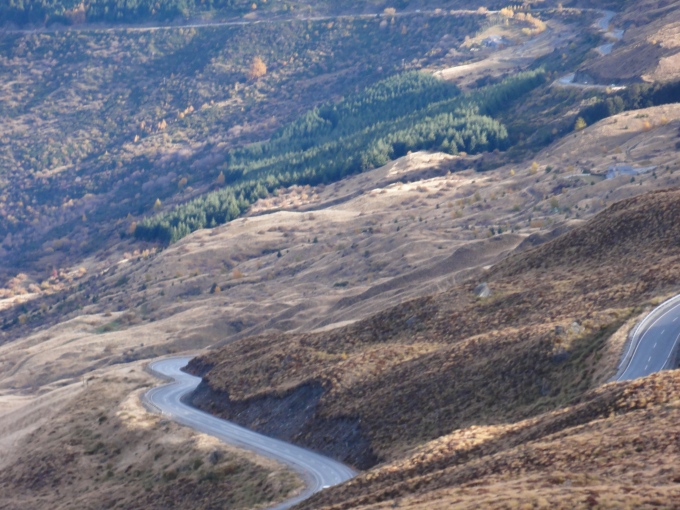
lookingdownfromcoronetpeak

And the story:

It was once said that a desperate man has everything to lose.

The man I was chasing was desperate, but I, on the other hand, was more desperate to catch him.

He’d left a trail of dead people from one end of the island to the other.

The team had put in a lot of effort to locate him, and now his capture was imminent.  We were following the car he was in, from a discrete distance, and, at the appropriate time, we would catch up, pull him over, and make the arrest.

There was nowhere for him to go.

The road led to a dead-end, and the only way off the mountain was back down the road were now on.  Which was why I was somewhat surprised when we discovered where he was.

Where was he going?

“Damn,” I heard Alan mutter.  He was driving, being careful not to get too close, but not far enough away to lose sight of him.

“What?”

“I think he’s made us.”

“How?”

“Dumb bad luck, I’m guessing.  Or he expected we’d follow him up the mountain.  He’s just sped up.”

“How far away?”

“A half-mile.  We should see him higher up when we turn the next corner.”

It took an eternity to get there, and when we did, Alan was right, only he was further on than we thought.”

“Step on it.  Let’s catch him up before he gets to the top.”

Easy to say, not so easy to do.  The road was treacherous, and in places just gravel, and there were no guard rails to stop a three thousand footfall down the mountainside.

Good thing then I had the foresight to have three agents on the hill for just such a scenario.

Ten minutes later, we were in sight of the car, still moving quickly, but we were going slightly faster.  We’d catch up just short of the summit car park.

Or so we thought.

Coming quickly around another corner we almost slammed into the car we’d been chasing.

“What the hell…” Aland muttered.

I was out of the car, and over to see if he was in it, but I knew that it was only a slender possibility.  The car was empty, and no indication where he went.

Certainly not up the road.  It was relatively straightforward for the next mile, at which we would have reached the summit.  Up the mountainside from here, or down.

I looked up.  Nothing.

Alan yelled out, “He’s not going down, not that I can see, but if he did, there’s hardly a foothold and that’s a long fall.”

Then where did he go?

Then a man looking very much like our quarry came out from behind a rock embedded just a short distance up the hill.

“Sorry,” he said quite calmly.  “Had to go if you know what I mean.”

I’d lost him.

It was as simple as that.

I had been led a merry chase up the hill, and all the time he was getting away in a different direction.

I’d fallen for the oldest trick in the book, letting my desperation blind me to the disguise that anyone else would see through in an instant.

It was a lonely sight, looking down that road, knowing that I had to go all that way down again, only this time, without having to throw caution to the wind.

“Maybe next time,” Alan said.

“We’ll get him.  It’s just a matter of time.”

© Charles Heath 2019-2021

Find this and other stories in “Inspiration, maybe”  available soon.

InspirationMaybe1v1

Searching for locations: Terracotta Warriors and Horses Museum, X’ian, China

Terracotta Warriors and Horses Museum

A little history, and anecdotal advice first:

In 1974 a 26-year-old farmer, Yang Jide, was drilling a well and found fragments of the terracotta soldiers and bronze weapons.

What was discovered later was one of the biggest attended burial pits of China’s first feudal Emperor, Qin Shi Huang.  In the following years remains had been found in 3 pits, yielding at least 8,000 soldiers and horses, and over 100 chariots.  The soldiers were infantry, cavalry, and others.

Emperor Qin was born in 259 BC and died in 210 BC.  He began building a mausoleum for himself at the foot of Mount Li when he was 13.  Construction took 38 years, from 247 BC to 208 BC.  It was divided into 3 stages and involved 720,000 conscripts.

The pits of pottery figures are 1.5 km east of Emperor Qin’s mausoleum.  Pit 1 has about 6,000 terracotta armored warriors and horses and 40 wooden chariots.  Pit 2 is estimated to have over 900 terracotta warriors and 350 terracotta horses with about 90 wooden chariots.  Pit 3 had so far yielded only 66 pottery figures and one chariot drawn by four horses.

Official records say it was discovered later that it was likely Xiang Yu, a rebel, intentionally damaged the Mausoleum and the soldiers in the pits, by setting fire to the wooden roof rafters, and these fell on and broke the warriors into pieces.

However, we were told that after the terracotta warriors were completed, the Emperor ordered the builders to be killed so that they would not tell anyone about the warriors, and then of those that remained alive deliberately smashed all of the artifacts.

The thing is, all of the terracotta figures that have been found are in pieces, and they need computers to piece them back together again.

The visit:
The first impression is the size of the car park and the number of buses parked in the lot, and a hell of a lot more outside up the road an off on side streets.  Obviously, it costs money to park in the parking lot.

The other first impressions; the numbers waiting to get in were not as many as yesterday outside the forbidden city, in fact, a lot less.

Be warned there’s a long walk from the entrance gate where your bags are scanned and a body scan as well, before admittance.  This walk is through a landscaped area which it is expect might sometime in the future reveal more soldiers, or other artifacts.

At the end of the walk that takes about ten minutes, you can get a one-way ride to the second checkpoint, but we opted not to as no one else in our group did.

That walk is the warm-up exercise to an organized viewing of the exhibits after going through a second ticket checkpoint.  On the other side, we had to hand our tickets back to the tour guide which was disappointing not to end up with a memento of actually having been there.

So, on the other side in the courtyard, the guide told us the most important parts of the exhibition, that we should spend most of the time looking at pit 1, and then spent a little time in 2 which is only there in the first stages of excavation.  Then move onto the museum if only to see the replica chariots.

We do.

The chariots were small but interesting

The horses were better and intricately detailed

These are soldiers, perhaps complete examples of those types found in the end pit.

This is one of the archers.  You can tell by the way he wears his hair.

Pit 2

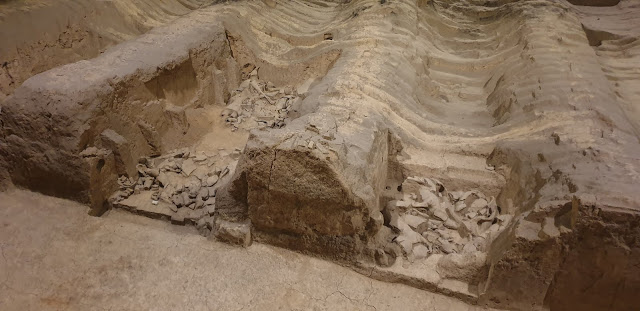
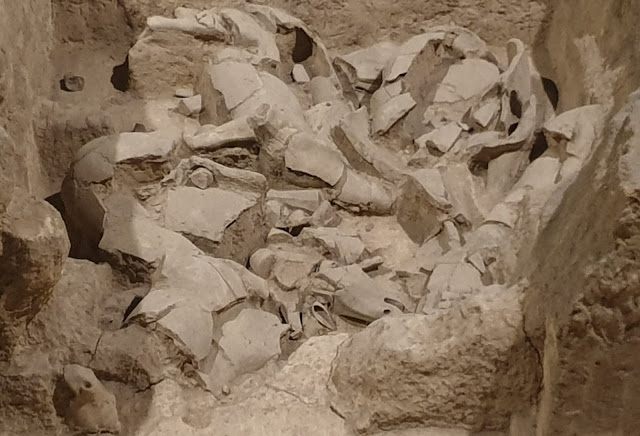
The excavation of this pit has only just begun, so it is possible to see where they have carefully removed the top cover, and you can see the broken parts of the warriors lying in a heap.

Some parts of the warriors are more discernible closer up

These parts are carefully extracted and taken to the ‘hospital’ where they are digitised and the computer will match each part with the warrior it belongs to.

Pit 1

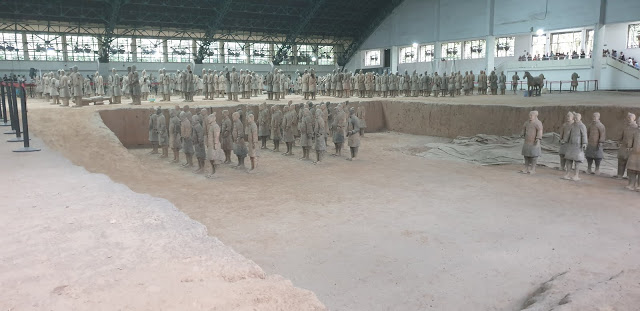
This has quite a number of standing soldiers that have been glued back together, but not necessarily complete and I notice a number if the statues were incomplete. And if they cannot find the missing pieces, then they are not added to or filled in.

The scale of the pit is enormous, and they have hardly scratched the surface in the restoration process.

What is there is a number of horses as well.

That’s at the front of the pit, a long line of statues, and what is clear is the location of the well where the first fragments were found by a farmer.

There are about eight lines of soldiers, and some lining the sides.

Midway down there is a large area currently under excavation

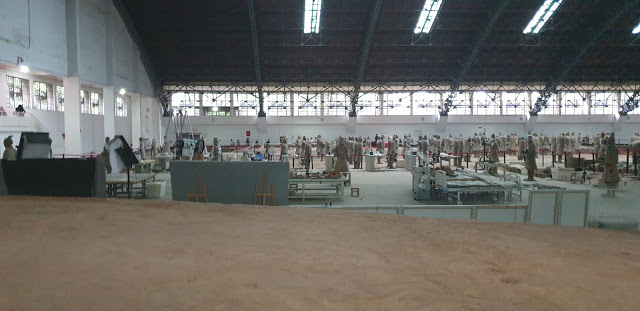
At the back is the hospital where the soldiers are reassembled.  There’s nearly a hundred in the various stages of rebuilding.  These days the soldiers are rebuilt using computer imaging.

The hospital area is where they are put back together

And these are some of the statues in various stages of reconstruction

Another two views of the size and scale of the reconstruction project

The coffee shop is also a sales centre, but there are too many people waiting for coffee and too few places to sit down.