Inspiration, maybe – Volume 1

50 photographs, 50 stories, of which there is one of the 50 below.

They all start with –

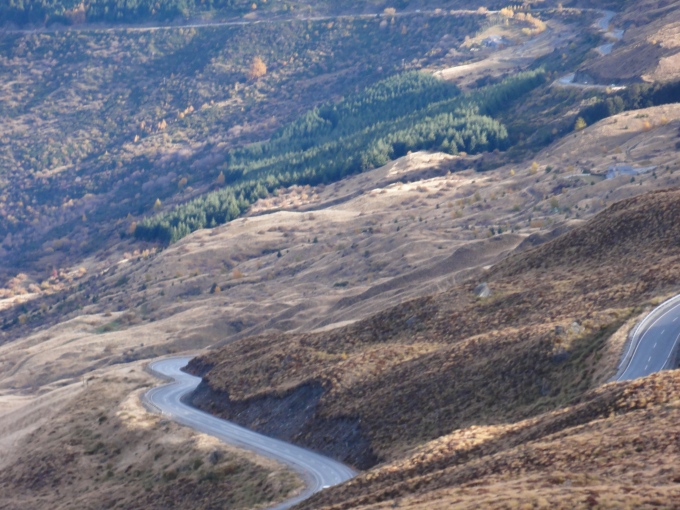
A picture paints … well, as many words as you like.  For instance:

lookingdownfromcoronetpeak

And the story:

It was once said that a desperate man has everything to lose.

The man I was chasing was desperate, but I, on the other hand, was more desperate to catch him.

He’d left a trail of dead people from one end of the island to the other.

The team had put in a lot of effort to locate him, and now his capture was imminent.  We were following the car he was in, from a discrete distance, and, at the appropriate time, we would catch up, pull him over, and make the arrest.

There was nowhere for him to go.

The road led to a dead-end, and the only way off the mountain was back down the road were now on.  Which was why I was somewhat surprised when we discovered where he was.

Where was he going?

“Damn,” I heard Alan mutter.  He was driving, being careful not to get too close, but not far enough away to lose sight of him.

“What?”

“I think he’s made us.”

“How?”

“Dumb bad luck, I’m guessing.  Or he expected we’d follow him up the mountain.  He’s just sped up.”

“How far away?”

“A half-mile.  We should see him higher up when we turn the next corner.”

It took an eternity to get there, and when we did, Alan was right, only he was further on than we thought.”

“Step on it.  Let’s catch him up before he gets to the top.”

Easy to say, not so easy to do.  The road was treacherous, and in places just gravel, and there were no guard rails to stop a three thousand footfall down the mountainside.

Good thing then I had the foresight to have three agents on the hill for just such a scenario.

Ten minutes later, we were in sight of the car, still moving quickly, but we were going slightly faster.  We’d catch up just short of the summit car park.

Or so we thought.

Coming quickly around another corner we almost slammed into the car we’d been chasing.

“What the hell…” Aland muttered.

I was out of the car, and over to see if he was in it, but I knew that it was only a slender possibility.  The car was empty, and no indication where he went.

Certainly not up the road.  It was relatively straightforward for the next mile, at which we would have reached the summit.  Up the mountainside from here, or down.

I looked up.  Nothing.

Alan yelled out, “He’s not going down, not that I can see, but if he did, there’s hardly a foothold and that’s a long fall.”

Then where did he go?

Then a man looking very much like our quarry came out from behind a rock embedded just a short distance up the hill.

“Sorry,” he said quite calmly.  “Had to go if you know what I mean.”

I’d lost him.

It was as simple as that.

I had been led a merry chase up the hill, and all the time he was getting away in a different direction.

I’d fallen for the oldest trick in the book, letting my desperation blind me to the disguise that anyone else would see through in an instant.

It was a lonely sight, looking down that road, knowing that I had to go all that way down again, only this time, without having to throw caution to the wind.

“Maybe next time,” Alan said.

“We’ll get him.  It’s just a matter of time.”

© Charles Heath 2019-2021

Find this and other stories in “Inspiration, maybe”  available soon.

InspirationMaybe1v1

Searching for locations: Kaikoura, New Zealand, and, of course, the whales

I’m sure a lot of people have considered the prospect of whale watching.  I’m not sure how the subject came up on one of our visits to New Zealand, but I suspect it was one of those tourist activity leaflets you find in the foyer of motels, hotels, and guesthouses.

Needless to say, it was only a short detour to go to Kaikoura and check out the prospect.

Yes, the ocean at the time seemed manageable.  My wife has a bad time with sea sickness, but she was prepared to make the trip, after some necessary preparations.  Seasickness tablets and special bands to wear on her wrist were recommended and used.

The boat was large and had two decks, and mostly enclosed.  There were a lot of people on board, and we sat inside for the beginning of the voyage.  The sea wasn’t rough, but there was about a meter and a half swell, easily managed by the boat while it was moving.

It took about a half hour or so to reach the spot where the boat stopped and a member of the crew used a listening device to see if there were any whales.

That led to the first wave of sickness.

We stopped for about ten minutes, and the boat moved up and down on the waves.  It was enough to start the queasy stomachs of a number of passengers.  Myself, it was a matter of going out on deck and taking in the sea air.  Fortunately, I don’t get seasick.

Another longish journey to the next prospective site settled a number of the queasy stomachs, but when we stopped again, the swell had increased, along with the boat’s motion.  Seasick bags were made available for the few that had succumbed.

By the time we reached the site where there was a whale, over half the passengers had been sick, and I was hoping they had enough seasick bags, and then enough bin space for them.

The whale, of course, put on a show for us, and those that could went out on deck to get their photos.

DSCN1026.JPG
DSCN1028.JPG
DSCN1029.JPG

By the end of the voyage, nearly everyone on board was sick, and I was helping to hand out seasick bags.

Despite the anti sickness preparations, my wife had also succumbed.  When we returned and she was asked if the device had worked, she said no.

But perhaps it had because within half an hour we were at a cafe eating lunch, fish and chips of course.

This activity has been crossed off the bucket list, and there’s no more whale watching in our traveling future.  Nor, it seems, will we be going of ocean liners.

Perhaps a cruise down the Rhine might be on the cards.  I don’t think that river, wide as it is in places, will ever have any sort of swell.

An excerpt from “Strangers We’ve Become” – Coming Soon

I wandered back to my villa.

It was in darkness.  I was sure I had left several lights on, especially over the door so I could see to unlock it.

I looked up and saw the globe was broken.

Instant alert.

I went to the first hiding spot for the gun, and it wasn’t there.  I went to the backup and it wasn’t there either.  Someone had found my carefully hidden stash of weapons and removed them.

Who?

There were four hiding spots and all were empty.  Someone had removed the weapons.  That could only mean one possibility.

I had a visitor, not necessarily here for a social call.

But, of course, being the well-trained agent I’d once been and not one to be caught unawares, I crossed over to my neighbor and relieved him of a weapon that, if found, would require a lot of explaining.

Suitably armed, it was time to return the surprise.

There were three entrances to the villa, the front door, the back door, and a rather strange escape hatch.  One of the more interesting attractions of the villa I’d rented was its heritage.  It was built in the late 1700s, by a man who was, by all accounts, a thief.  It had a hidden underground room which had been in the past a vault but was now a wine cellar, and it had an escape hatch by which the man could come and go undetected, particularly if there was a mob outside the door baying for his blood.

It now gave me the means to enter the villa without my visitors being alerted, unless, of course, they were near the vicinity of the doorway inside the villa, but that possibility was unlikely.  It was not where anyone could anticipate or expect a doorway to be.

The secret entrance was at the rear of the villa behind a large copse, two camouflaged wooden doors built into the ground.  I move aside some of the branches that covered them and lifted one side.  After I’d discovered the doors and rusty hinges, I’d oiled and cleaned them, and cleared the passageway of cobwebs and fallen rocks.  It had a mildew smell, but nothing would get rid of that.  I’d left torches at either end so I could see.

I closed the door after me, and went quietly down the steps, enveloped in darkness till I switched on the torch.  I traversed the short passage which turned ninety degrees about halfway to the door at the other end.  I carried the key to this door on the keyring, found it and opened the door.  It too had been oiled and swung open soundlessly.

I stepped in the darkness and closed the door.

I was on the lower level under the kitchen, now the wine cellar, the ‘door’ doubling as a set of shelves which had very little on them, less to fall and alert anyone in the villa.

Silence, an eerie silence.

I took the steps up to the kitchen, stopping when my head was level with the floor, checking to see if anyone was waiting.  There wasn’t.  It seemed to me to be an unlikely spot for an ambush.

I’d already considered the possibility of someone coming after me, especially because it had been Bespalov I’d killed, and I was sure he had friends, all equally as mad as he was.  Equally, I’d also considered it nigh on impossible for anyone to find out it was me who killed him because the only people who knew that were Prendergast, Alisha, a few others in the Department, and Susan.

That raised the question of who told them where I was.

If I was the man I used to be, my first suspect would be Susan.  The departure this morning, and now this was too coincidental.  But I was not that man.

Or was I?

I reached the start of the passageway that led from the kitchen to the front door and peered into the semi-darkness.  My eyes had got used to the dark, and it was no longer an inky void.  Fragments of light leaked in around the door from outside and through the edge of the window curtains where they didn’t fit properly.  A bone of contention upstairs in the morning, when first light shone and invariably woke me up hours before I wanted to.

Still nothing.

I took a moment to consider how I would approach the visitor’s job.  I would get a plan of the villa in my head, all entrances, where a target could be led to or attacked where there would be no escape.

Coming in the front door.  If I was not expecting anything, I’d just open the door and walk-in.  One shot would be all that was required.

Contract complete.

I sidled quietly up the passage staying close to the wall, edging closer to the front door.  There was an alcove where the shooter could be waiting.  It was an ideal spot to wait.

Crunch.

I stepped on some nutshells.

Not my nutshells.

I felt it before I heard it.  The bullet with my name on it.

And how the shooter missed, from point-blank range, and hit me in the arm, I had no idea.  I fired off two shots before a second shot from the shooter went wide and hit the door with a loud thwack.

I saw a red dot wavering as it honed in on me and I fell to the floor, stretching out, looking up where the origin of the light was coming and pulled the trigger three times, evenly spaced, and a second later I heard the sound of a body falling down the stairs and stopping at the bottom, not very far from me.

Two assassins.

I’d not expected that.

The assassin by the door was dead, a lucky shot on my part.  The second was still breathing.

I checked the body for any weapons and found a second gun and two knives.  Armed to the teeth!

I pulled off the balaclava; a man, early thirties, definitely Italian.  I was expecting a Russian.

I slapped his face, waking him up.  Blood was leaking from several slashes on his face when his head had hit the stairs on the way down.  The awkward angle of his arms and legs told me there were broken bones, probably a lot worse internally.  He was not long for this earth.

“Who employed you?”

He looked at me with dead eyes, a pursed mouth, perhaps a smile.  “Not today my friend.  You have made a very bad enemy.”  He coughed and blood poured out of his mouth.  “There will be more …”

Friends of Bespalov, no doubt.

I would have to leave.  Two unexplainable bodies, I’d have a hard time explaining my way out of this mess.  I dragged the two bodies into the lounge, clearing the passageway just in case someone had heard anything.

Just in case anyone was outside at the time, I sat in the dark, at the foot of the stairs, and tried to breathe normally.  I was trying not to connect dots that led back to Susan, but the coincidence was worrying me.

A half-hour passed and I hadn’t moved.  Deep in thought, I’d forgotten about being shot, unaware that blood was running down my arm and dripping onto the floor.

Until I heard a knock on my front door.

Two thoughts, it was either the police, alerted by the neighbors, or it was the second wave, though why would they be knocking on the door?

I stood, and immediately felt a stabbing pain in my arm.  I took out a handkerchief and turned it into a makeshift tourniquet, then wrapped a kitchen towel around the wound.

If it was the police, this was going to be a difficult situation.  Holding the gun behind my back, I opened the door a fraction and looked out.

No police, just Maria.  I hoped she was not part of the next ‘wave’.

“You left your phone behind on the table.  I thought you might be looking for it.”  She held it out in front of her.

When I didn’t open the door any further, she looked at me quizzically, and then asked, “Is anything wrong?”

I was going to thank her for returning the phone, but I heard her breathe in sharply, and add, breathlessly, “You’re bleeding.”

I looked at my arm and realized it was visible through the door, and not only that, the towel was soaked in blood.

“You need to go away now.”

Should I tell her the truth?  It was probably too late, and if she was any sort of law-abiding citizen she would go straight to the police.

She showed no signs of leaving, just an unnerving curiosity.  “What happened?”

I ran through several explanations, but none seemed plausible.  I went with the truth.  “My past caught up with me.”

“You need someone to fix that before you pass out from blood loss.  It doesn’t look good.”

“I can fix it.  You need to leave.  It is not safe to be here with me.”

The pain in my arm was not getting any better, and the blood was starting to run down my arm again as the tourniquet loosened.  She was right, I needed it fixed sooner rather than later.

I opened the door and let her in.  It was a mistake, a huge mistake, and I would have to deal with the consequences.  Once inside, she turned on the light and saw the pool of blood just inside the door and the trail leading to the lounge.  She followed the trail and turned into the lounge, turned on the light, and no doubt saw the two dead men.

I expected her to scream.  She didn’t.

She gave me a good hard look, perhaps trying to see if I was dangerous.  Killing people wasn’t something you looked the other way about.  She would have to go to the police.

“What happened here?”

“I came home from the cafe and two men were waiting for me.  I used to work for the Government, but no longer.  I suspect these men were here to repay a debt.  I was lucky.”

“Not so much, looking at your arm.”

She came closer and inspected it.

“Sit down.”

She found another towel and wrapped it around the wound, retightening the tourniquet to stem the bleeding.

“Do you have medical supplies?”

I nodded.  “Upstairs.”  I had a medical kit, and on the road, I usually made my own running repairs.  Another old habit I hadn’t quite shaken off yet.

She went upstairs, rummaged, and then came back.  I wondered briefly what she would think of the unmade bed though I was not sure why it might interest her.

She helped me remove my shirt, and then cleaned the wound.  Fortunately, she didn’t have to remove a bullet.  It was a clean wound but it would require stitches.

When she’d finished she said, “Your friend said one day this might happen.”

No prizes for guessing who that friend was, and it didn’t please me that she had involved Maria.

“Alisha?”

“She didn’t tell me her name, but I think she cares a lot about you.  She said trouble has a way of finding you, gave me a phone and said to call her if something like this happened.”

“That was wrong of her to do that.”

“Perhaps, perhaps not.  Will you call her?”

“Yes.  I can’t stay here now.  You should go now.  Hopefully, by the time I leave in the morning, no one will ever know what happened here, especially you.”

She smiled.  “As you say, I was never here.”

…

© Charles Heath 2018-2022

strangerscover9

The Things We Do For Love – The final editor’s draft – Day 12

…

This is just not going to work

I had in mind right about now to find all the reasons why this romance would not work.

Michelle is not telling him the truth about her situation.  We want to believe she had found the love of her life, but is it that she has found something that she’s not had before, and it’s too late?

Her path was chosen for her, perhaps, when she allowed others to lead her down a path that eventually led to self-destruction.  Yes, she has tried to escape, twice, but inevitably she finds her way back, thinking the city is large enough she can make a new start.

She is wrong.  Why didn’t she move to the other side of the country, or even overseas?  Perhaps it was an obligation she felt to help those who had helped her escape.

The big question here is whether we let our past define us.  Do we try and find a way out of the wreckage, and try to get back on track?  It seems the situation is hopeless, or so we are led to believe.

However, the last date was when she was supposed to tell Henry it was over, that she could not be his girlfriend., but couldn’t.  He had to hear that from another source.

And, what he hears, leads him to believe there is no future for them.

Ships are great places to hide away from the rest of the world.

Henry has to endure a short period when he cannot bring himself to tell anyone what had happened, and then, at the end of the tour he takes a position on another ship, roaming the ocean for at least three months, island hopping.

He needs a sojourn, time to think, and any letters she sends, for what reason he cannot fathom, are consigned to the bottom drawer, unopened.  He is, he tells himself, done with her.

But never far from his thoughts, he decided to learn as much about her as he can, and turns to the newspaper archives, and the reporter who wrote most of the articles, none very flattering about her, and then talks to her about Michelle.

High flying model, absolute success, met the wrong man, got into drugs, and spiralled downwards from there.  She ended up addicted, and eventually a prostitute.  Not exactly what he wanted to hear, but it explained everything.

And yet, the person he met, the girl he fell in love with, was so far removed from that description, he could not understand anything.

Meanwhile, Michelle, oblivious to the fact he had overheard her conversation, cannot understand why he does not communicate with her, and cannot be found.

Time passes, and she cannot keep the man who runs her life now at bay for much longer, and then, it’s back to the snake pit with her friends; and the drugs, sitting on the kitchen bench, are a strong reminder of how she used to shut it all out.

Will the temptation get the better of her?

It’s a pivotal part of the story, and in the traditional romance, it’s the ‘boy loses the girl’ usually to a misunderstanding.

…

“Sunday in New York”, a romantic adventure that’s not a walk in the park!

“Sunday in New York” is ultimately a story about trust, and what happens when a marriage is stretched to its limits.

When Harry Steele attends a lunch with his manager, Barclay, to discuss a promotion that any junior executive would accept in a heartbeat, it is the fact his wife, Alison, who previously professed her reservations about Barclay, also agreed to attend, that casts a small element of doubt in his mind.

From that moment, his life, in the company, in deciding what to do, his marriage, his very life, spirals out of control.

There is no one big factor that can prove Harry’s worst fears, that his marriage is over, just a number of small, interconnecting events, when piled on top of each other, points to a cataclysmic end to everything he had believed in.

Trust is lost firstly in his best friend and mentor, Andy, who only hints of impending disaster, Sasha, a woman whom he saved, and who appears to have motives of her own, and then in his wife, Alison, as he discovered piece by piece damning evidence she is about to leave him for another man.

Can we trust what we see with our eyes or trust what we hear?

Haven’t we all jumped to conclusions at least once in our lives?

Can Alison, a woman whose self-belief and confidence is about to be put to the ultimate test, find a way of proving their relationship is as strong as it has ever been?

As they say in the classics, read on!

Purchase:

http://tinyurl.com/Amazon-SundayInNewYork

“Echoes From The Past”, the past doesn’t necessarily stay there


What happens when your past finally catches up with you?

…

Christmas is just around the corner, a time to be with family. For Will Mason, an orphan since he was fourteen, it is a time for reflection on what his life could have been, and what it could be.

Until a chance encounter brings back to life the reasons for his twenty years of self-imposed exile from a life only normal people could have. From that moment Will’s life slowly starts to unravel and it’s obvious to him it’s time to move on.

This time, however, there is more at stake.

Will has broken his number one rule, don’t get involved.

With his nemesis, Eddie Jamieson, suddenly within reach, and a blossoming relationship with an office colleague, Maria, about to change everything, Will has to make a choice. Quietly leave, or finally, make a stand.

But as Will soon discovers, when other people are involved there is going to be terrible consequences no matter what choice he makes.

https://amzn.to/2CYKxu4

newechocover5rs

Writing about writing a book – Day 4

Of course, by this time, a lot has changed and what I had discussed before now needs a few changes, so I have made the necessary amendments where required to the narrative, but that doesn’t mean I won’t revisit it sometime in the future.


It was a late night last night, reading and rereading, considering plot lines, new characters, and demolishing a six-pack.

It’s debatable if it is helping the creative process.  It has left me with a slight headache.

I drag myself out of bed and look out the window.  Bright sunshine, blue sky, slight breeze.

11:00 am.  Half the day is gone.

My stomach rumbles, I need something to eat.  I stagger out to the kitchen and look in the fridge.  OK, too busy to go shopping, time to make time.  A writer has to eat!


Three hours have passed and it’s mid-afternoon.  A new plan is required.  I need to make sure I don’t waste the day and write a certain number of words, otherwise, this book will never get written.

Bed: midnight

Rise: 7:00 am, go for a run to clear the head

Breakfast: 8:00 am

Writing: 9:00 am to ??

Let’s just see if that works tomorrow.


I sit down and stare at the pad.

Plotting:  Our main character is an IT department manager, whose main responsibility from the start, and at that time, he was alone and not the manager of anything, was setting up and keeping the network running.  These were the early days of Ethernet, token ring, and 3-Com, in moving from mainframes to desktops and servers.

I remember it well, and my first client/server network was 3-Com and Ethernet.

In the story scenario, Bill literally is indispensable because the job he performs is single point sensitive, even though Benton refuses to act on employing another network engineer.  This is art imitating life because so many places have similar situations.

So the reason why Benton is calling Bill; there is a crisis.

Some accountant is found shot dead at his desk, novel but not unheard of.  I know a few accountants who deserve just that.

That’s not the problem though, it’s the fact the network is down, and Benton is almost hysterical (after he makes a promise to his superiors that he can’t keep!).  Nothing unusual there with the sort of person he is, and like many in similar situations.


Scribble, scribble …


Another five minutes, then the phone began its shrill insistence again.  Before it rang again, I’d moved it from the floor to the bed.  I counted the rings, to ten, and then picked up the receiver.

“Bill?  Don’t hang up.”  Almost pleading.

“Why?  You said I should go, away from work, away from the phones, away to recharge my batteries, I believe you said.”

“That was Friday.  This is Monday. You’re needed.  Richardson has been found shot dead by his desk.  All hell has broken loose!”  Benton rarely used adjectives, so I assumed when he said all hell had broken loose, it meant something had happened he couldn’t fix.  His flowery language and telegram style had momentarily distracted my attention from Richardson’s fate.

Harold Richardson was an accountant, rather stuffy, but good at his job.  I’d spoken to him probably twice in as many years, and he didn’t strike me as the sort who would kill himself.  So why did I think that?  Benton had only said he was shot.

Benton’s voice went up an octave, a sure sign he was going into meltdown.  “It’s a circus down here.  Jennifer is missing, Giles is not in yet, the network is down, and that bunch of nincompoops you call support staff are running around the office like headless chooks.”

It all came out in a nonstop sentence, followed by a gasp for air.  It gave me time to sift the facts.  Jennifer, the Assistant Manager, and responsible for data entry and accounts maintenance, was not there, which in itself was unusual, because she kept longer hours than me, Peter Giles, my youthful assistant, just out of university and still being beaten into shape was also not in, and that was usual, so it could only mean one thing.

The network was down.

It was my responsibility since I’d recommended it and then won the support of management over his objections, and following that it had become a point of continual contention, a petty war neither of us was going to win.

I tried to keep the joy out of my voice. 

He’d also vetoed my recommendation for an extra full-time network engineer as my alternative, and in doing so Benton had made my job become single point sensitive.  There was no one to replace me if anything went wrong.


Richardson has nothing to do with the plot, he just happened to be in the wrong place at the wrong time, but someone else further up the chain of command will be.  That’s something to look forward to, though I’ve yet to decide what happens.

As for Benton, he will linger around for a while, but has no real part to play, except perhaps as the comic light relief.  He will get a rude awakening at the end.

Try not to make it too technical, no one really wants to know about computer systems, just the machinations of the people who are creating the problems and why.


© Charles Heath 2016 – 2020

Mistaken Identity – The Third Editor’s Draft – Day 7

I have been working on the story, the editor is asking for a second draft after making suggested changes – and I’m now working on it

…

What’s the best way to recover from being shot by the police? Go on an all-expenses paid holiday.

Within reason, of course.

Of course, he was on holiday, not quite all expenses paid, but for the duration of the conference. Getting shot and having a prolonged stay in hospital put paid to that, but there is an upside.

The police, in exchange for silence and an indemnity, are happy to send our intrepid conference goer on a tour of Italy. There are benefits on either side, the police don’t get a lawsuit, and he gets to spend a few days touring.

Of course, Maryanne decided to tag along. She had been filling in for him at the conference, unbeknownst to him, and lined up a couple of free venues. In exchange for favourable reviews.

But what is the real reason Maryanne is along for the ride, or she might put it, ‘carry the bags’?

That saying ‘if it’s too good to be true, it probably is’ sticks in the back of his mind, but he doesn’t discourage her from coming with him.

Is he lucky, or is he cursed?

More tomorrow.

The cinema of my dreams – I always wanted to go on a treasure hunt – Episode 65

Here’s the thing…

Every time I close my eyes, I see something different.

I’d like to think the cinema of my dreams is playing a double feature but it’s a bit like a comedy cartoon night on Fox.

But these dreams are nothing to laugh about.

Once again there’s a new installment of an old feature, and we’re back on the treasure hunt.

…

The Ormiston’s from the papers

…

It was a question of what was I looking for.  It would be easy to say I wanted a piece of paper that definitively said where the treasure was or finding a map that led straight to it.

Instead, there was, in one box, a dozen journals filled with the ramblings of a madman.

Searching for treasure had sent Ormiston senior mad.  For an hour, perhaps longer, I tried to decipher the spidery writing, and then gave up when it switched to German.

I assembled the journals in order of his expeditions and found the first easy to follow because it was a time of excitement and expectation, that he would find the treasure.  There were pages on exactly what he thought the treasure was worth, the sort of pieces they would find, and what he would do with the proceeds.

There were drawings of items off the map and his interpretation of what they represented.  It was a rather good description of the coastline and its anomalies as they related to map landmarks.  They were, almost all, the same as the Boggs interpretations.

When the discovery didn’t happen, when the first euphoria wore off and the search became bogged down in acrimony and arguments, and the realization the map they were using was not as clear as first believed, that was where it all began to fall apart.

Reading the words, feeling the disappointment seeping off the page, it must have been quite a blow.

The second expedition didn’t start off with the same fanfare, but almost as if they were expected to fail.  Too little time had been spent analyzing what went wrong and reidentifying the coastal landmarks.

And, when it did fail, the last comment in the diary was fairly succinct.  “What if there is no treasure?”

In another, scrawled heavily on several pages at the back, “look for the big A” was repeated several times, and much underlined.

There were five other boxes with papers, charts, notebooks, and books that belonged on a shelf but instead were neatly stacked.  They’d been in the boxes for some time, and had that aroma books got when left in the damp too long, and, in fact, when I tried to open some, the pages had stuck together.

A lot of the books were about pirates, reference texts, and fiction.  Part of one box was set aside for our particular pirate, and, reading through what could be read, a lot of the information was contradictory.  One book postulated that the said pirate wasn’t a pirate at all, casting doubt on whether he ever existed at all.

The maps were a different story, and, yes, they were all similar except for small details an observation I had made before.  None had what I would have called ‘new’ features, just a rehash of all the others.  Some were old, but most had the appearance of being made to look old.

Then, at the bottom of a box of books, were copies of newspaper articles, aged, stained, and some in various stages of disintegration.  The Bahama Argus, The Barbadian, The Antigua Herald and Gazette, The Bermuda Colonist, and the Dominica Chronicle.  All had references to Captain Johannsson, and his vessel, the Sea Serpent.

There was such a Captain, and there was such a ship, and there were reports of a vessel roving the seas, looking for prey.  And those reports covered a great deal of plunder, definitely the sort that would find its way into a number of sea chests.

But, was this the treasure that Ormiston believed was hidden somewhere in The Grove?

Something caught my attention on the first diary, the way it sat and the light reflected off it, and picking it up and looking at it showed no anomaly in the surface, not until it sat on a certain angle and in the sunlight.

A slight ripple down one edge of the spine, and with careful probing, there was a split in the material of the cover pasted back down, but in the time since it had been glued back, the glue had dissolved and the simple act of picking the book up and parted the split.

Lifting it gently, I could see a piece of paper tucked in and gently coaxed it out.

It was very thin and fragile, but the writing was clear.  Entries from what might have been a logbook.  I knew this only because I had been out of a sailing boat once when at school, and had seen the boat’s logbook, noting where the boat had been.

This page had only a few entries, the location of its departure, in latitude and longitude, a number of the daily distances traveled, and conditions, and the last, another latitude and longitude.

When I put the first coordinates into my GPS, it was near the island of Antigua, and then the destination, just up the coast near the old mall.  The name of the vessel, in almost illegible writing, the Sea Serpent.

So, there was a logbook, although it might not exist now, it did at some point in the past, and Ormiston had either found it or seen it.  The writing on the piece of paper was his. It proved, if it was authentic, there was a ship, and it did come to this coast.

I carefully folded it and hid it in my wallet, then replaced everything where I found it.  Enough research for today.  I tried not to look guilty when I left.

…

© Charles Heath 2020-2022

The Things We Do For Love – The final editor’s draft – Day 11

…

Absence is supposed to make the heart grow stronger.

But…

This is no ordinary romance.  There’s a great big ocean between them, in more ways than one.  Getting off that ocean, getting to the port, and getting to the girl is proving a very hard task indeed.

Ships have a mind of their own.

Then the planets align…

This date starts out badly.  Henry is running behind time, and, the meeting place is, well, far from being private.  It’s like he’s in the middle of a spy novel, finding himself surveilling the crowded public square …. For what?

She’s there but hardly acknowledging his presence.

Then he feels the presence of another, hiding in plain sight.

Something is amiss.  Michelle is on edge, and from the, the date goes downhill.

They get some time ‘alone’, and words are spoken, but they’re not anywhere near what he had hoped to hear.  There’s fallout from the last date, and we learn a little more about who and what Michelle is, and why she is acting this way.

In a desperate attempt to win her over, Henry proposes marriage.

It doesn’t work.

They part, but not before that old adage ‘eavesdroppers never hear anything good about themselves’ which sends him into a deeper spiral of despair.

…