An excerpt from “The Devil You Don’t”

Available on Amazon Kindle here:  https://amzn.to/2Xyh1ow

…

By the time I returned to the Savoie, the rain had finally stopped, and there was a streak of blue sky to offer some hope the day would improve.

The ship was not crowded, the possibility of bad weather perhaps holding back potential passengers.  Of those I saw, a number of them would be aboard for the lunch by Phillippe Chevrier.  I thought about it, but the Concierge had told me about several restaurants in Yvoire and had given me a hand-drawn map of the village.  I think he came from the area because he spoke with the pride and knowledge of a resident.

I was looking down from the upper deck observing the last of the boarding passengers when I saw a woman, notable for her red coat and matching shoes, making a last-minute dash to get on board just before the gangway was removed.  In fact, her ungainly manner of boarding had also captured a few of the other passenger’s attention.  Now they would have something else to talk about, other than the possibility of further rain.

I saw her smile at the deckhand, but he did not smile back.  He was not impressed with her bravado, perhaps because of possible injury.  He looked at her ticket then nodded dismissively, and went back to his duties in getting the ship underway.  I was going to check the departure time, but I, like the other passengers, had my attention diverted to the woman in red.

From what I could see there was something about her.  It struck me when the light caught her as she turned to look down the deck, giving me a perfect profile.  I was going to say she looked foreign, but here, as in almost anywhere in Europe, that described just about everyone.  Perhaps I was just comparing her to Phillipa, so definitively British, whereas this woman was very definitely not.

She was perhaps in her 30’s, slim or perhaps the word I’d use was lissom, and had the look and manner of a model.  I say that because Phillipa had dragged me to most of the showings, whether in Milan, Rome, New York, London, or Paris.  The clothes were familiar, and in the back of my mind, I had a feeling I’d seen her before.

Or perhaps, to me, all models looked the same.

She looked up in my direction, and before I could divert my eyes, she locked on.  I could feel her gaze boring into me, and then it was gone as if she had been looking straight through me.  I remained out on deck as the ship got underway, watching her disappear inside the cabin.  My curiosity was piqued, so I decided to keep an eye out for her.

I could feel the coolness of the air as the ship picked up speed, not that it was going to be very fast.  With stops, the trip would take nearly two hours to get to my destination.  It would turn back almost immediately, but I was going to stay until the evening when it returned at about half eight.  It would give me enough time to sample the local fare, and take a tour of the medieval village.

Few other passengers ventured out on the deck, most staying inside or going to lunch.  After a short time, I came back down to the main deck and headed forward.  I wanted to clear my head by concentrating on the movement of the vessel through the water, breathing in the crisp, clean air, and let the peacefulness of the surroundings envelope me.

It didn’t work.

I knew it wouldn’t be long before I started thinking about why things hadn’t worked, and what part I played in it.  And the usual question that came to mind when something didn’t work out.  What was wrong with me?

I usually blamed it on my upbringing.

I had one of those so-called privileged lives, a nanny till I was old enough to go to boarding school, then sent to the best schools in the land.  There I learned everything I needed to be the son of a Duke, or, as my father called it in one of his lighter moments, nobility in waiting.

Had this been five or six hundred years ago, I would need to have sword and jousting skills, or if it had been a few hundred years later a keen military mind.  If nothing else I could ride a horse, and go on hunts, or did until they became not the thing to do.

I learned six languages, and everything I needed to become a diplomat in the far-flung British Empire, except the Empire had become the Commonwealth, and then, when no-one was looking, Britain’s influence in the world finally disappeared.  I was a man without a cause, without a vocation, and no place to go.

Computers were the new vogue and I had an aptitude for programming.  I guess that went hand in hand with mathematics, which although I hated the subject, I excelled in.  Both I and another noble outcast used to toss ideas around in school, but when it came to the end of our education, he chose to enter the public service, and I took a few of those ideas we had mulled over and turned them into a company.

About a year ago, I was made an offer I couldn’t refuse.  There were so many zeroes on the end of it I just said yes, put the money into a very grateful bank, and was still trying to come to terms with it.

Sadly, I still had no idea what I was going to do with the rest of my life.  My parents had asked me to come back home and help manage the estate, and I did for a few weeks.  It was as long as it took for my parents to drive me insane.

Back in the city, I spent a few months looking for a mundane job, but there were very few that suited the qualifications I had, and the rest, I think I intimidated the interviewer simply because of who I was.  In that time I’d also featured on the cover of the Economist, and through my well-meaning accountant, started involving myself with various charities, earning the title ‘philanthropist’.

And despite all of this exposure, even making one of those ubiquitous ‘eligible bachelor’ lists, I still could not find ‘the one’, the woman I wanted to spend the rest of my life with.  Phillipa seemed to fit the bill, but in time she proved to be a troubled soul with ‘Daddy’ issues.  I knew that in building a relationship compromise was necessary, but with her, in the end, everything was a compromise and what had happened was always going to be the end result.

It was perhaps a by-product of the whole nobility thing.  There was a certain expectation I had to fulfill, to my peers, contemporaries, parents and family, and those who either liked or hated what it represented.  The problem was, I didn’t feel like I belonged.  Not like my friend from schooldays, and now obscure acquaintance, Sebastian.  He had been elevated to his Dukedom early when his father died when he was in his twenties.  He had managed to fade from the limelight and was rarely mentioned either in the papers or the gossip columns.  He was one of the lucky ones.

I had managed to keep a similarly low profile until I met Phillipa.  From that moment, my obscurity disappeared.  It was, I could see now, part of a plan put in place by Phillipa’s father, a man who hogged the limelight with his daughter, to raise the profile of the family name and through it their businesses.  He was nothing if not the consummate self-advertisement.

Perhaps I was supposed to be the last piece of the puzzle, the attachment to the establishment, that link with a class of people he would not normally get in the front door.  There was nothing refined about him or his family, and more than once I’d noticed my contemporaries cringe at the mention of his name, or any reference of my association with him.

Yet could I truthfully say I really wanted to go back to the obscurity I had before Phillipa?  For all her faults, there were times when she had been fun to be with, particularly when I first met her when she had a certain air of unpredictability.  That had slowly disappeared as she became part of her father’s plan for the future.  She just failed to see how much he was using her.

Or perhaps, over time, I had become cynical.

I thought about calling her.  It was one of those moments of weakness when I felt alone, more alone than usual.

I diverted my attention back to my surroundings and the shoreline.  Out of the corner of my eye, I could see the woman in the red coat, making a move.  The red coat was like a beacon, a sort of fire engine red.  It was not the sort of coat most of the women I knew would wear, but on her, it looked terrific.  In fact, her sublime beauty was the one other attribute that was distinctly noticeable, along with the fact her hair was short, rather than long, and jet black.

I had to wrench my attention away from her.

A few minutes later several other passengers came out of the cabin for a walk around the deck, perhaps to get some exercise, perhaps checking up on me, or perhaps I was being paranoid.  I waited till they passed on their way forward, and I turned and headed aft.

I watched the wake sluicing out from under the stern for a few minutes, before retracing my steps to the front of the ship and there I stood against the railing, watching the bow carve its way through the water.  It was almost mesmerizing.  There, I emptied my mind of thoughts about Phillipa, and thoughts about the woman in the red coat.

Until a female voice behind me said, “Having a bad day?”

I started, caught by surprise, and slowly turned.  The woman in the red coat had somehow got very close me without my realizing it.  How did she do that?  I was so surprised I couldn’t answer immediately.

“I do hope you are not contemplating jumping.  I hear the water is very cold.”

Closer up, I could see what I’d missed when I saw her on the main deck.  There was a slight hint of Chinese, or Oriental, in her particularly around the eyes, and of her hair which was jet black.  An ancestor twice or more removed had left their mark, not in a dominant way, but more subtle, and easily missed except from a very short distance away, like now.

Other than that, she was quite possibly Eastern European, perhaps Russian, though that covered a lot of territory.  The incongruity of it was that she spoke with an American accent, and fluent enough for me to believe English was her first language.

Usually, I could ‘read’ people, but she was a clean slate.  Her expression was one of amusement, but with cold eyes.  My first thought, then, was to be careful.

“No.  Not yet.”  I coughed to clear my throat because I could hardly speak.  And blushed, because that was what I did when confronted by a woman, beautiful or otherwise.

The amusement gave way to a hint of a smile that brightened her demeanor as a little warmth reached her eyes.  “So that’s a maybe.  Should I change into my lifesaving gear, just in case?”

It conjured up a rather interesting image in my mind until I reluctantly dismissed it.

“Perhaps I should move away from the edge,” I said, moving sideways until I was back on the main deck, a few feet further away.  Her eyes had followed me, and when I stopped she turned to face me again.  She did not move closer.

I realized then she had removed her beret and it was in her left side coat pocket.  “Thanks for your concern …?”

“Zoe.”

“Thanks for your concern, Zoe.  By the way, my name is John.”

She smiled again, perhaps in an attempt to put me at ease.  “I saw you earlier, you looked so sad, I thought …”

“I might throw myself overboard?”

“An idiotic notion I admit, but it is better to be safe than sorry.”

Then she tilted her head to one side then the other, looking intently at me.  “You seem to be familiar.  Do I know you?”

I tried to think of where I may have seen her before, but all I could remember was what I’d thought earlier when I first saw her; she was a model and had been at one of the showings.  If she was, it would be more likely she would remember Phillipa, not me.  Phillipa always had to sit in the front row.

“Probably not.”  I also didn’t mention the fact she may have seen my picture in the society pages of several tabloid newspapers because she didn’t look the sort of woman who needed a daily dose of the comings and goings, and, more often than not, scandal associated with so-called celebrities.

She gave me a look, one that told me she had just realized who I was.  “Yes, I remember now.  You made the front cover of the Economist.  You sold your company for a small fortune.”

Of course.  She was not the first who had recognized me from that cover.  It had raised my profile considerably, but not the Sternhaven’s.  That article had not mentioned Phillipa or her family.  I suspect Grandmother had something to do with that, and it was, now I thought about it, another nail in the coffin that was my relationship with Phillipa.

“I wouldn’t say it was a fortune, small or otherwise, just fortunate.”  Each time, I found myself playing down the wealth aspect of the business deal.

“Perhaps then, as the journalist wrote, you were lucky.  It is not, I think, a good time for internet-based companies.”

The latter statement was an interesting fact, one she read in the Financial Times which had made that exact comment recently.

“But I am boring you.”  She smiled again.  “I should be minding my own business and leaving you to your thoughts.  I am sorry.”

She turned to leave and took a few steps towards the main cabin.

“You’re not boring me,” I said, thinking I was letting my paranoia get the better of me.  It had been Sebastian on learning of my good fortune, who had warned me against ‘a certain element here and abroad’ whose sole aim would be to separate me from my money.  He was not very subtle when he described their methods.

But I knew he was right.  I should have let her walk away.

She stopped and turned around.  “You seem nothing like the man I read about in the Economist.”

A sudden and awful thought popped into my head.  Those words were part of a very familiar opening gambit.  “Are you a reporter?”

I was not sure if she looked surprised, or amused.  “Do I look like one?”

I silently cursed myself for speaking before thinking, and then immediately ignored my own admonishment.  “People rarely look like what they are.”

I saw the subtle shake of the head and expected her to take her leave.  Instead she astonished me.

“I fear we have got off on the wrong foot.  To be honest, I’m not usually this forward, but you seemed like you needed cheering up when probably the opposite is true.  Aside from the fact this excursion was probably a bad idea.  And,” she added with a little shrug, “perhaps I talk too much.”

I was not sure what I thought of her after that extraordinary admission. It was not something I would do, but it was an interesting way to approach someone and have them ignoring their natural instinct.  I would let Sebastian whisper in my ear for a little longer and see where this was going.

“Oddly enough, I was thinking the same thing.  I was supposed to be traveling with my prospective bride.  I think you can imagine how that turned out.”

“She’s not here?”

“No.”

“She’s in the cabin?”  Her eyes strayed in that direction for a moment then came back to me.  She seemed surprised I might be traveling with someone.

“No.  She is back in England, and the wedding is off.  So is the relationship.  She dumped me by text.”

OK, why was I sharing this humiliating piece of information with her?  I still couldn’t be sure she was not a reporter.

She motioned to an empty seat, back from the edge.  No walking the plank today.  She moved towards it and sat down.  She showed no signs of being cold, nor interested in the breeze upsetting her hair.  Phillipa would be having a tantrum about now, being kept outside, and freaking out over what the breeze might be doing to her appearance.

I wondered, if only for a few seconds if she used this approach with anyone else.  I guess I was a little different, a seemingly rich businessman alone on a ferry on Lake Geneva, contemplating the way his life had gone so completely off track.

She watched as I sat at the other end of the bench, leaving about a yard between us.  After I leaned back and made myself as comfortable as I could, she said, “I have also experienced something similar, though not by text message.  It is difficult, the first few days.”

“I saw it coming.”

“I did not.”  She frowned, a sort of lifeless expression taking over, perhaps brought on by the memory of what had happened to her.  “But it is done, and I moved on.  Was she the love of your life?”

OK, that was unexpected.

When I didn’t answer, she said, “I am sorry.  Sometimes I ask personal questions without realizing what I’m doing.  It is none of my business.”  She shivered.  “Perhaps we should go back inside.”

She stood, and held out her hand.  Should I take it and be drawn into her web?  I thought of Sebastian.  What would he do in this situation?

I took her hand in mine and let her pull me gently to my feet.  “Wise choice,” she said, looking up at the sky.

It just started to rain.

…

© Charles Heath 2015-2023

newdevilcvr6

In a word: Minor

It’s, on the one hand, the opposite of major, and not the military rank, but the lesser of two evils.

It was a minor misdemeanor, so you won’t be going to jail for life, just 20 years, maybe.

Or perhaps you’re referring to a child who is also known as a minor.

And, once upon a time, there was a car called a Morris Minor. I know, my father owned one.

And one of my uncles owned a Morris Major, yea, the Morris car company didn’t have much imagination.

Music-wise it is having intervals of a semitone between the second and third degrees, and others.

It is also qualifying in a subsidiary subject in college in America.

And while we’re still in America, there are the minors, a rather interesting description for the minor baseball league.

Something I remember when reading books about children in British private schools, was where there were two boys in different grades, one would have minor attached to his name, e.g. Smith minor.

The Billy Bunter books spring to mind, but the discrimination police would have them banned these days.

Of course, there’s another word that sounds somewhat similar, miner.

We all know that a miner digs ore out of the ground, a name given to a single man, or a huge corporation.

A computer program could be called a data miner.

A miner is a South American bird, and it’s also an Australian bird.

It also describes a person who obtains units of cryptocurrency using a specific computer program.

There is another variation, mynah, but that used to describe a bird.

“What Sets Us Apart”, a mystery with a twist

David is a man troubled by a past he is trying to forget.

Susan is rebelling against a life of privilege and an exasperated mother who holds a secret that will determine her daughter’s destiny.

They are two people brought together by chance. Or was it?

When Susan discovers her mother’s secret, she goes in search of the truth that has been hidden from her since the day she was born.

When David realizes her absence is more than the usual cooling off after another heated argument, he finds himself being slowly drawn back into his former world of deceit and lies.

Then, back with his former employers, David quickly discovers nothing is what it seems as he embarks on a dangerous mission to find Susan before he loses her forever.

Find the kindle version on Amazon here:  http://amzn.to/2Eryfth

whatsetscover

The cinema of my dreams – I always wanted to go on a treasure hunt – Episode 76

Here’s the thing…

Every time I close my eyes, I see something different.

I’d like to think the cinema of my dreams is playing a double feature but it’s a bit like a comedy cartoon night on Fox.

But these dreams are nothing to laugh about.

Once again there’s a new installment of an old feature, and we’re back on the treasure hunt.

…

Boggs is not a happy man

…

I could feel the waves of hate emanating from Boggs as he was staring at Nadia, who was doing her best to ignore him.

The previous evening when I made the suggestion to her that we should do whatever we could to aid in his search, on the Cossatino’s beach head without involving the Cossatinos, and in an attempt to have a backup plan if they caught up with us, met the same stony silence as it had when I told Boggs.

Her response was a stony, ‘don’t expect me to go up against my father and Vince, I’m not that brave.”

All Cossatino’s were tarred with the same brush, he said, just short of telling me he was convinced she was working with them, trying to find out what he knew via me.  He didn’t believe me when I told him she had done anything but interrogate me.

I wanted to believe she was not on their side, but just in case he might be right, my idea was to keep the enemy, if she was playing me, close.  Certainly, if the family turned up to thwart us, then I’d be convinced she was against us.

But, at least we’d then know, and it would make little difference in the end.  What Boggs was planning, with or without me, was basically suicide.

And she had voiced exactly the arguments that I’d already expected, although stopping short of saying she would not be part of it.

What had surprised me, Boggs had actually come, knowing Nadia would be there.

I let the silence reign for a minute or so, then dived in.

“Right.”

Both heads turned towards me, and I could feel the temperature rise about 10 degrees.

“I had imagined this would go so much better when I planned it in my head, but I can see quite plainly there are trust issues on either side.  The point is, Boggs, you can’t do this on your own.  You tried once and failed.  You might get lucky a second time, but I suspect the Cossatinos know now what you’re trying to do, and will be waiting.”

“They tried to kill me,” he muttered.

That might be putting it a bit strongly, because he had said as much to the sheriff, and the Cossatino’s denied it, as expected, but the evidence was quite clear, Boggs’s rope had been severed with a knife, located when the sheriff had visited the site and found the rope still attached to the top of the cliff.

The Cossatinos had been sloppy in covering their tracks, and the excuse they had been rock climbing hadn’t been taken seriously since no equipment had been found at the house, and none of them could provide any details of doing so elsewhere.

Evidence or not, no charges had been laid yet, nor had the Cossatinos proceeded with a trespass charge, perhaps fearing a more detailed investigation might be too intrusive or prove Boggs’s case.  In turn,  Boggs had been forced to agree not to go back, but simple words on the paper he signed, meant nothing.

“Deter you, I’d say,” Nadia said, “because killing you would bring unwanted attention to their activities.” 

Nadia was probably right because Boggs’s quest was too well known, as was the theory that the treasure was still on The Grove.  Already, the story was on the front page of the local paper, and Lenny was trying to get interviews.

And it was attracting attention from other media.  If anything, the Cossatinos would want to hose it down, not throw fuel on the fire.

“Well, you’re not dead,” I said, “fortuitously we found you, and now if you are going to persist with this quest, there has to be a plan, and Nadia has to be part of it.”

“I’ve already told you I don’t need anyone’s help.”

“OK.  Then I’ll start my own quest, with Nadia’s help, and we’ll see who gets to the treasure first.  I told you I believe I know where it is, and I think you believe you know too.  Your problem will be getting back there, whereas, I have no such problem.  So,” I pointed to the door, “you can leave any time, but don’t call me again.  We’re done.”

I glared back at him, and while not exactly squirming in his seat, he appeared to be mulling over the ultimatum.  I hadn’t planned to give him one, but he was pushing all the wrong buttons.

It also elicited an interesting look from Nadia, because it was the first time she was hearing that I knew where the treasure was.  It was a calculated risk telling her, but I’d know soon enough whose side she was on.

“If you sign a document forfeiting any rights over the treasure you have a deal.  Both of you.”

So, it came down to the money, pure and simple.  I thought I’d made it clear long ago that I wasn’t interested in anything to do with the treasure because it was cursed.  “No problem.”

I looked at Nadia.

“God no, I want nothing to do with it.  I’ve seen what the obsession with wealth can do to people, and families, and it’s why I left.  I’m happy to sign anything you want.”

He pulled what looked to be sheets of folded paper from his pocket, unfolded them, and gave one to each of us.

“Call me when they’re notarized.”  With a final glare, he left.

That left Nadia looking at me with a curious expression.  “You know where the treasure is?”

“Maybe.  I just wanted to put the wind up him because I think he does.  There are clues that Boggs doesn’t know about, and I haven’t told him about.  I believe according to some of the information I’ve found, that he was in the right place when we found him.”

“I didn’t see any caves or tunnels, or any sort of hiding place, just rocks.”

“There are a few factors involved that make that area a likely spot and the reasons that spot was chosen.  One is that there doesn’t seem to be apparent access by land, other than the way we came, across the rocks, but at the time the pirates might not have had the time or the know-how to get there by anything other than the sea.”

“So, you’re saying they came by sea.  How did they get past the reefs?  And how the hell could they see a cave or tunnel in that rockface?”

“It’s been a couple of hundred years, and I think back then that shoreline would have been a lot different.  I’m not a geologist but that cliff face shows signs of rockfalls and slippage, so it’s possible it’s now concealed.  From what I’ve read, just in the newspaper archives alone, there’s been seismic activity occurring for the last seventy-odd years and maybe even during the last few centuries, just look at the fact there used to be a lake further inland.  Then, I suspect they came ashore by an abnormally high tide.  For an experienced seafarer, it has the pluses, and precise navigation through the reef, and it’s the hardest to get to spot on the Grove’s coastline.  An ideal spot that is to everyone other than a master mariner, an unlikely place to get to.

She looked like she was weighing up the pros and cons of what I’d told her.

“I’m surprised you’re telling me this.”

“The chances of the treasure still being there or that I’m right about the location is quite remote, so it doesn’t really matter.  Anyway, up to now, you haven’t given me a reason not to trust you, so if there’s anything you want to tell me, now would be the time.”

So, she had considered how it might look to me, the family name and reputation she had inherited.

“I’ve told you what my situation is.  To be honest, I don’t think there’s any treasure to be found either.  I once heard a discussion between family members, when I was very young and didn’t understand what they were talking about, involving putting a story out there that there was a treasure, and if they sold it well enough, people would pay plenty for maps.  In my opinion, the treasure story is a Cossatino special money-making scheme built off Ormiston’s and layer, Boggs’s obsession.  The myth has been perpetuated by articles in papers, and new maps surfacing from time to time.  I’d be surprised if you did find anything, but for Boggs’s sake, it’s better he learn the truth than hang on to false hope.”

“So you know it’s all a hoax?”

“On the face of it, you would think so, but Vince, not the sharpest of people, bought into it, especially when Boggs’s father came on board to draw the maps.  He was a cartographer you know, and worked for the county authorities in mapping the area.  I’m guessing that’s how he got started on this treasure thing.  That was another story my father liked to tell us, how Boggs had found a cave that was a pirates lair, only to see it destroyed not long after in one of the recent earthquakes.  That discovery turned him into a true believer and was happy to help the Cossatino’s so he could muddy the water while he searched for it.  There have always been rumors of treasure along this coastline.  It might be possible there was treasure somewhere, but don’t you think it’d be found by now?”

“Logic dictates that it would be, but anything’s possible.  Why did you take me on that coin-seeking exercise?”

“The truth Sam?  I heard Vince talking about Boggs snooping around, and I was hoping we’d find nothing.  Vince can be an ass most of the time, and I want to believe he wouldn’t do anything to seriously hurt Boggs, just put the wind up him.  Thankfully nothing happened, and it’s the best I could do in the circumstances.  I’m sorry.”

Was she by definition somewhere between a rock and a hard place?

“This time we were lucky.  Next time it might be a very different story.  I’ll understand if you want to quit now, because you may have to pick a side.”

“Let’s hope then it doesn’t come to that.”

…

© Charles Heath 2020-2022

The cinema of my dreams – I always wanted to see the planets – Episode 4

After having to take another leap of faith…

…

And, getting out of the elevator, this time no erratic behaviour but still not filling me with confidence, I step onto the bridge.

The forward screen has changed.

It seems we are going to Neptune via the moon, or we were going to be passing by on our way to someplace else.

The Captain was on the bridge, obviously coming out of his day room on the news that the Chief Engineer had fixed everything.

“Ah, number one, we’ve hung around here long enough.”

He walked back to his chair and sat.

I decided to remain behind the navigator. I could see that the co-ordinates to our destination had been entered and it was Neptune, so the moon was not going to be a stop off.

The Chief engineer’s voice came over the speaker. “Ready when you are, Captain.”

I forgot, for a moment, that the Chief and the Captain had served before, and someone had mentioned the fact the captain had asked for him to be assigned to this ship.

“Mr Jacobs, take us out, slowly, and try not to bump into anything this time.”

Mr Jacobs was the second officer.

In a rather sheepish tone, Mr Jacobs said, “Taking the ship out carefully, sir.”

It was hard to tell if the ship was moving, but the tell tale sign was the movement of the objects on screen. And the fact I could see through the side windows as we moved forwards, leaving the dock superstructure behind.

Also, on the screen I could see the movements of other vessels, several freighters waiting to leave, and one coming in, but standing off until we departed.

Then, suddenly, we were in clear space.

Jacobs turned to the captain, expecting the next order.

“Let’s take it easy. Level one, when you’re ready.”

Jacobs was ready, even eager to get this ship under way. It had performed faultlessly in trials, now we were going to put it through it’s paces.

“Level one, as you wish.”

He pushed the button, there was a moment when nothing happened, then with just the slightest movement inside the bridge, we were under way.

Next stop, Neptune.

…

© Charles Heath 2021

“The End of the Road”, a short story

The man who had said that we would never make the distance was right.

It had been my idea to go ‘troppo’, forsake everything, hop on a motorbike and go around Australia.  I was, at that stage fed up with everything and, catching Harry in one of his low spots, he decided there and then he would join me.

For the first few days, we believed we were stark staring mad and talked about calling it quits, but perseverance made all the difference.  After two months we were glad we had the resolve to keep going, and in that time we had managed to see more of the Australian countryside than we’d seen all our lives.

That was until this particular morning when we arrived in Berrigum, what could have been called a one-horse town.  It consisted of one hotel, one general store (that sold everything from toothpicks to petrol) and an agricultural machinery depot.  It also had a station and some wheat silos, and this appeared to be the only reason for a town in this particular spot in the middle of nowhere.

And it was the railway station that interested Harry, who was, by this time, getting a little homesick and fed up with his motorbike.

After coughing and spluttering for the last week it had finally died, and the five-mile walk to Berrigum had not helped either his temper, or his disposition, and had only served to firm his resolve to return home.

It was hot but not unbearably so, unlike a hot summer’s day in the city, and even worse still in public transport.  For miles around as we tramped those five miles all we could see was acres and acres of wheat, but no sign of life.  It was the same when we reached the town.  It appeared all the people were either hiding or had left.  Harry suspected the latter given the state of the road, and the buildings, more or less the epitome of a ghost town.

Standing at the end of what could have been called the main street with only our own dust for company, one look took in the whole town.  In a car, one wouldn’t have given it a second look, if one had time to give it a first.  I didn’t remember seeing neither any speed restriction signs nor signpost advertising a town ahead.

And since no amount of argument could sway him from his resolve, the first objective was to get a train timetable, if such a thing existed, and make arrangements for Harry’s return.

The station was as deserted as the town itself, and a quick glance in the stationmaster’s office showed no sign of life.

Leaving the bikes on the platform outside the office, we headed for the hotel for both a drink and make enquiries about rail services.  Being a hot day and the morning’s tramp somewhat hot and dusty, we were looking forward to a cold glass (or two) of beer.

The hotel looked as though it was a hundred years old though there was no doubting a few relentless summers would reduce it to the same state.  It was as bad inside as out, though the temperature was several degrees lower, and we could sit down in what appeared to be the main bar.  We were the only occupants and still to find any sign of life.  Overhead, two fans were struggling to move the hot air around.

More than once Harry reckoned it was a ghost town and I was beginning to believe him when, after five minutes, no one arrived.

After ten, we stood, ready to leave, only to stop halfway out of our chairs when a voice behind us said, “Surely you’re not going back out there without refreshment?”

“I was beginning to think the town was deserted,” I said.

“It is during the day, but when the sun goes down…”

I didn’t ask.  We followed him to the bar where he had stationed himself behind the counter.  “The name is Jack.”  He stretched out his hand towards us.  “We don’t bother with last names here.”

“Bill,” I said, shaking it, and nodding to Harry, “Harry.”

Harry nodded and shook his hand too.

“The first one’s on the house.”  He poured three glasses and put ours in front of us.  “Cheers.”

In all cases, it went down without touching the sides (as they say) and he poured a second, at the same time asking, “What brings you to our little corner of the earth?”

“Just passing through,” I said, “Or at least for me.”

“And you?”  Jack looked at Harry.

“I can’t hack the pace.  I can truthfully say I have thoroughly enjoyed the trip so far, except for a few mishaps, but for me, it’s time to get back to the big smoke.  My ‘do your own thing’ has run out of momentum.  Do you know if there is a train that goes anywhere important?”

The publican looked at him almost pityingly.  “Important, eh?”  He rubbed his chin feigning thought.  “You make it sound like you are in purgatory.”

“Aren’t we?”

I suppose one could hardly blame Harry for his attitude.  After all, at the beginning, he had numerous accidents, caught a virus that stayed with him (and a couple of torrential downpours had done little to help it), and now his motorbike had finally died.  No wonder his humour was at an all-time low.

For a moment I thought the publican was going to tell Harry what he thought of him, but then he smiled and the tension passed.  “Perhaps to a city fellow like you it might be,” he said.  “The mail train which has a passenger carriage comes through once a week, and, my good man, you’re in luck.  Today’s the day.”

“Good.  How do I get a ticket?”

“You’d have to see the Station Master.”

“And where might he be at the moment?  We were at the station a while back and there was no sign of life.”

“Nor will there be until the train comes.  Meanwhile, there’s time enough for lunch.  I’m sure you will stay?”  He looked questioningly at us.

I looked at Harry, who nodded.

“Why not.”

Over lunch, we talked.

I remember not so long ago when I had to attend a large number of lunches where the talk was of business, or, if anything, mostly about subjects that I had no interest in.  It was always some posh restaurant, time seemed important, the atmosphere never really relaxed, and to get into a relaxed state it took a large amount of alcohol to deaden the despair and distaste of that one had to fete in order to secure their business.

How different it was here.

We talked about the country, and, after seeing as much of it, and worked on it as we had to fund our odyssey, we could talk about it authoritatively.  And, most of all, it was interesting.

The atmosphere too was entirely different than it had been in the city.  Out here the people were always friendly, people always willing to stop and talk, particularly farmers; share a drink or some food.

There was none of this carefree purposefulness in the city, and more than once I’d thought of the fact one could travel in the same train with the same people for year after year and still not know any of them.  It was the same at work.  Even after five years I still hadn’t known three-quarters of the office staff, and most of them probably didn’t want to know me.  Harry was virtually the only real friend I’d had at work.

But here, in ‘the middle of nowhere’ as Harry had called it, I felt as though I’d known the publican all of my life instead of the few short hours.

Some hours later and after much argument, where Jack and I tried to talk Harry into staying (Jack said he knew someone who could fix anything including Harry’s bike), Harry remained unconvinced and resolute.  Jack, to round off the occasion (we were the first real guests from outside he had had in a week) provided another on-the-house ale and then saw us to the station.  “After all”, he had said, “I’ve nothing else to do at the moment.”

By that time the station was showing a little more life than it had before.  A station assistant, moving several parcels with a hand trolley, slowly ambled towards the end of the platform.

And whether it could be called a platform was a debatable point.  It was a gravel and grass affair that looked more like part of cutting through a hill than a station.

At the station, Jack portentously announced he was also the stationmaster and would be only too happy to take care of Harry’s requirements.  It would be, he added, “the first passenger ticket sold for several months.”  Certainly, the ticket he handed Harry bore witness to that.  It had yellowed with age.

One would have thought with the imminent arrival of the train there would be more people, but no.  The only event had been the station assistant’s stroll to the end of the platform and back.  Now both he and Jack had disappeared into the office and we were left alone on the platform.  Very little in the whole town stirred, nor had it the whole time we’d been there.

“Well,” I said to break the silence.  “I’m sorry to see you going through with it.  I thought I might have been able to talk you out of it…”  I shrugged, leaving the sentence unfinished.

“I’m sorry to be going too, but a body can take only so much bad luck, and God knows that’s all I’ve had.”

“Yes.”  I couldn’t think of much else to say.  “But it’s been good to have your company these last few months.”

“And you.  When do you think you’ll get back?”

“When I get sick of it I suppose.”

“Look us up then when you get back.”

“I will.”

Thankfully the appearance of the train in the distance broke off the conversation.  I had begun to think of what it was going to be like out on the road with no one to talk to but myself.  The thought was a little depressing and I tried not to let it show.

We said little else until the train pulled in, three flat cars, seven enclosed wagons, a passenger carriage and the guard’s van.  The train stopped with only part of the passenger carriage and the guard’s van at the station.

The guard took aboard the parcels the station assistant had left for him earlier, and then put those that were for Berrigum on the trolley.

I shook Harry’s hand and said I’d see him around.  Then he, the motorbike, and the guard were aboard and the train was off, disappearing slowly into the afternoon haze.

The station assistant then repeated his amble to the end of the platform to collect the hand trolley.

“Staying or moving on.”  Jack had come up behind me and gave me a bit of a start.

“Staying I guess, until tomorrow or maybe later.”

“I had heard one of the farm hands is leaving tomorrow heading back to Sydney.  There could be a vacancy.”

“Sounds like a plan,” I said.

“I could put in a word for you.”

“Thanks.”

Jack just grinned and we headed for the hotel.

© Charles Heath 2016-2019

NANOWRIMO – 2024 – Day 9

Behind the Green Door

…

Among the revelations Michael learned in the process of trying to find missing persons, was one that was astonishing.

People were not missing, they were going outside. That is, through a doorway out of the underground city, outside into what management was consistently telling the people was uninhabitable.

No, it was not common knowledge.

However, in his travels across the city looking for these missing people, Michael discovers there is a secret network of people who will assist anyone who wants to avoid Rule 71. He has known for some time such a network exists but was not going to formally report it, or investigate who is behind it.

Until he gets a case involving a missing person.

In fact, over the years there has been a significant number of people who seem to go missing and are never found. Not all though, because there is the odd accidental death, and very rarely, a murder.

While not familiar with the layout and structure of the underground city, and how the people originally got inside, there is always folklore and supposition about a grand archway and revolving doors, and a wall of windows where you could gaze out upon the landscape that once supported a much larger population.

And other exits dispersed around the perimeter of the structure. It was no surprise to Michael that people might have stumbled over them. He certainly believed management knew all about these entrances and exits, and had the ability to go outside to check on the status of the world.

As the investigation progresses, he finds one of the network, the fact there is an exit, and is taken outside. And, yes, the outside world is habitable, a place where those who want to leave the facility can, in a settlement some distance away.

What is more shocking is that Michael is shown photographs of another settlement, one where management go for so-called rest and relaxation, and worse still, one of those management people is Elsie, his wife.

He is offered the chance to leave and live in the settlement but he declines. Michael going missing would only rouse the suspicion of the other police and would lead to the discovery of those outside.

Nor does he want to avoid Rule 71.

But it does highlight the fact he knew very little about the woman he had married. Or more to the point, he had made a conscious decision to not want to know anything other than to be grateful she had chosen him.

Until she died.

…

Word written today 1,768, making a total of 15,151 words

Searching for locations: Aratiatia Dam, Taupo, New Zealand

Aratiatia Dam water release, Taupo

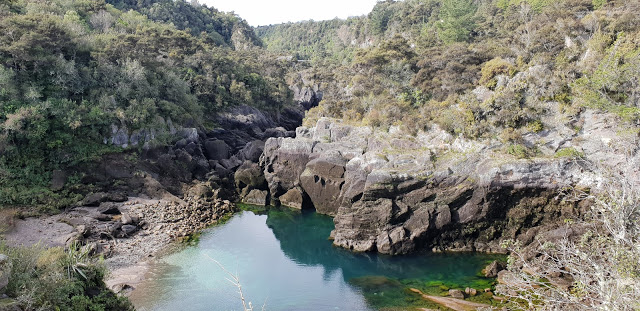
The Aratiatia Dam, rapids, and hydroelectric power station are located on the Waikato River, New Zealand’s longest river.  It is about 16km from Taupo, and 6km from Huka falls, and there is a walking track, for the fit, of course, between the two water attractions.

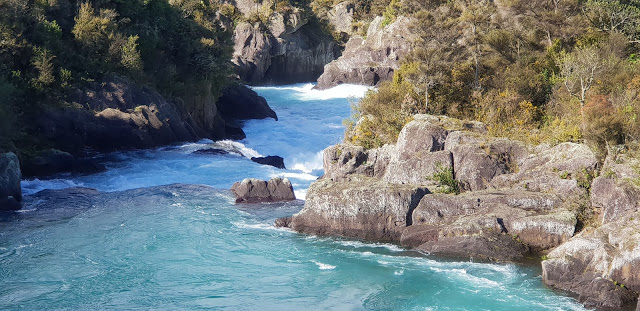
This happens three or four times every day, depending on the season, and lasts about 15 minutes.  Water is released at the rate of about 80,000 liters a second, so it is quite a lot of water being sent through the rapids.

There are a number of viewing points, the most popular being from the bridge, where I took these photos, and 5 minutes down the walking track to the ridgeline where you can get an overview of the river.

This is looking towards the rapids, as the catchment leading to the rapids starts to fill

The pool is almost full and the excess is starting its journey towards the rapids

Now full, the rapids are at capacity as up to 80,000 liters a second are heading down a 28-meter drop heading towards the hydroelectric power station.

And once full at the bottom, there is a jet boat ride available for a closer view of the water, and a few thrills to go with it.

Ideas come from everywhere

I have an electronic note book on my smart phone and writing pads at the ready at home in my office/writing room/library.

As soon as one hits, I get it down, either on paper, or on the phone app. I use SomNote as it’s easy to export the text to an email, or have a version of the app running on my computer and just copy and paste. SomNote is great because I can used it anywhere.

Of course, it doesn’t work so well in the shower, so I’m still waiting for a waterproof phone. Or perhaps it can wait for a few minutes until I’m finished.

But, the trouble with that it, these ideas come so quickly and are sometimes so vivid that they need to be put down as quickly as possible. I have come up with the perfect dialogue for a tricky scene, and played it all out in my head, and by the time I got to the paper, it was almost gone.

Perhaps a whiteboard and a permanent marker on the wall.

Or is that going to far?

A long time ago, I received a portable tape recorder for a present, you know, the one you can hold in your hand, and the tapes so small you wonder how much will fit on it. The gifter said that when ideas came to me, all I had to do was speak. It was also voice activated.

Needless to say that conjured up a few ideas right there.

But, I used it, but I found it quite weird to be talking, ostensibly to myself, in the car whilst driving home, or go to, work, and the curious looks I’d get from others. One thing it did teach me was that when a conversation was repkayed, it would sound ok or like most of the time, hardly what one expected a conversation would really be like.

So, because of that device, I learned to read out all conversations, and if they sounded stupid, they were.

SO, ideas come in the shower, ideas come while driving, ideas come when reading the newspaper, ideas even come when reading books.

Which leads me to another point that I learned early on. Writers must read. Not only novels of their chosen genre, but any reference books that go with it. Research was, a friend and more successful author than I told me, was mandatory.

So too was the reading to the classics, old English, and sometimes American, literature, to gain an appreciation for the written word. We might not follow those styles, but we can learn the majesty of the English language.

That author taught me a lot, though at the time I didn;t realise it. Perhaps I thpought I was already smart enough to write, but I’m guessing that it took a long time before I felt my writing was worth reading before publishing it.

I don’t profess to have a fully understanding of the language. I might have loved that school subject called English, and later in University, creative writing and literature, but not all of it soaked in. But writing is one of those odd things, that it can take many forms and styles, but at the end of the day, if the reader understands where the story is going, and when at the end, is satisfied that it was ‘a good read’, then the author’s work is done.

The only trouble is, getting the next idea, and then the were withal to write a second book, or third. It is said everyone as one book in them. For those who can write more, well, that might be what might be called, a gift.

My trouble is, I have too many ideas, too many starts and brief outlines to work with, I don’t know which story to start on next. I guess being spoinlt for choice is a good thing, yes?

The story behind the story – Echoes from the Past

The novel ‘Echoes from the past’ started out as a short story I wrote about 30 years ago, titled ‘The birthday’.

My idea was to take a normal person out of their comfort zone and led on a short but very frightening journey to a place where a surprise birthday party had been arranged.

Thus the very large man with a scar and a red tie was created.

So was the friend with the limousine who worked as a pilot.

So were the two women, Wendy and Angelina, who were Flight Attendants that the pilot friend asked to join the conspiracy.

I was going to rework the short story, then about ten pages long, into something a little more.

And like all re-writes, especially those I have anything to do with, it turned into a novel.

There was motivation.  I had told some colleagues at the place where I worked at the time that I liked writing, and they wanted a sample.  I was going to give them the re-worked short story.  Instead, I gave them ‘Echoes from the past’

Originally it was not set anywhere in particular.

But when considering a location, I had, at the time, recently been to New York in December, and visited Brooklyn and Queens, as well as a lot of New York itself.  We were there for New Years, and it was an experience I’ll never forget.

One evening we were out late, and finished up in Brooklyn Heights, near the waterfront, and there was rain and snow, it was cold and wet, and there were apartment buildings shimmering in the street light, and I thought, this is the place where my main character will live.

It had a very spooky atmosphere, the sort where ghosts would not be unexpected.  I felt more than one shiver go up and down my spine in the few minutes I was there.

I had taken notes, as I always do, of everywhere we went so I had a ready supply of locations I could use, changing the names in some cases.

Fifth Avenue near the Rockefeller center is amazing at first light, and late at night with the Seasonal decorations and lights.

The original main character was a shy and man of few friends, hence not expecting the surprise party.  I enhanced that shyness into purposely lonely because of an issue from his past that leaves him always looking over his shoulder and ready to move on at the slightest hint of trouble.  No friends, no relationships, just a very low profile.

Then I thought, what if he breaks the cardinal rule, and begins a relationship?

But it is also as much an exploration of a damaged soul, as it is the search for a normal life, without having any idea what normal was, and how the understanding of one person can sometimes make all the difference in what we may think or feel.

And, of course, I wanted a happy ending.

Except for the bad guys.

Get it here:  https://amzn.to/2CYKxu4

newechocover5rs