Searching for locations: Central Park, New York. USA

It’s a place to go and spot the movie stars, or perhaps their dogs.

It’s a place to go for long walks on idyllic spring or autumn days

It’s a place to go to look at a zoo, though I didn’t realize there was one until I made a wrong turn.

It’s a place to go for a horse and carriage ride, although it does not last that long

It’s a place to go to look at statues, fountains, architecture, and in winter, an ice skating rink

I’m sure there’s a whole lot more there that I don’t know about.

I have to say I’ve only visited in winter, and the first time there was snow, the second, none.

Both times it was cold, but this didn’t seem to deter people.

But…

We decided to go visit another part of the park, this time walking to West 67th Street before crossing Central Park West and into the park where Sheep Meadow is.

Once upon a time sheep did graze on the meadow, but these days it is designated a quiet area inspiring calm and refreshing thoughts, except for a period in the 1960s where there was more than one counter-culture protest, or love in, going on.

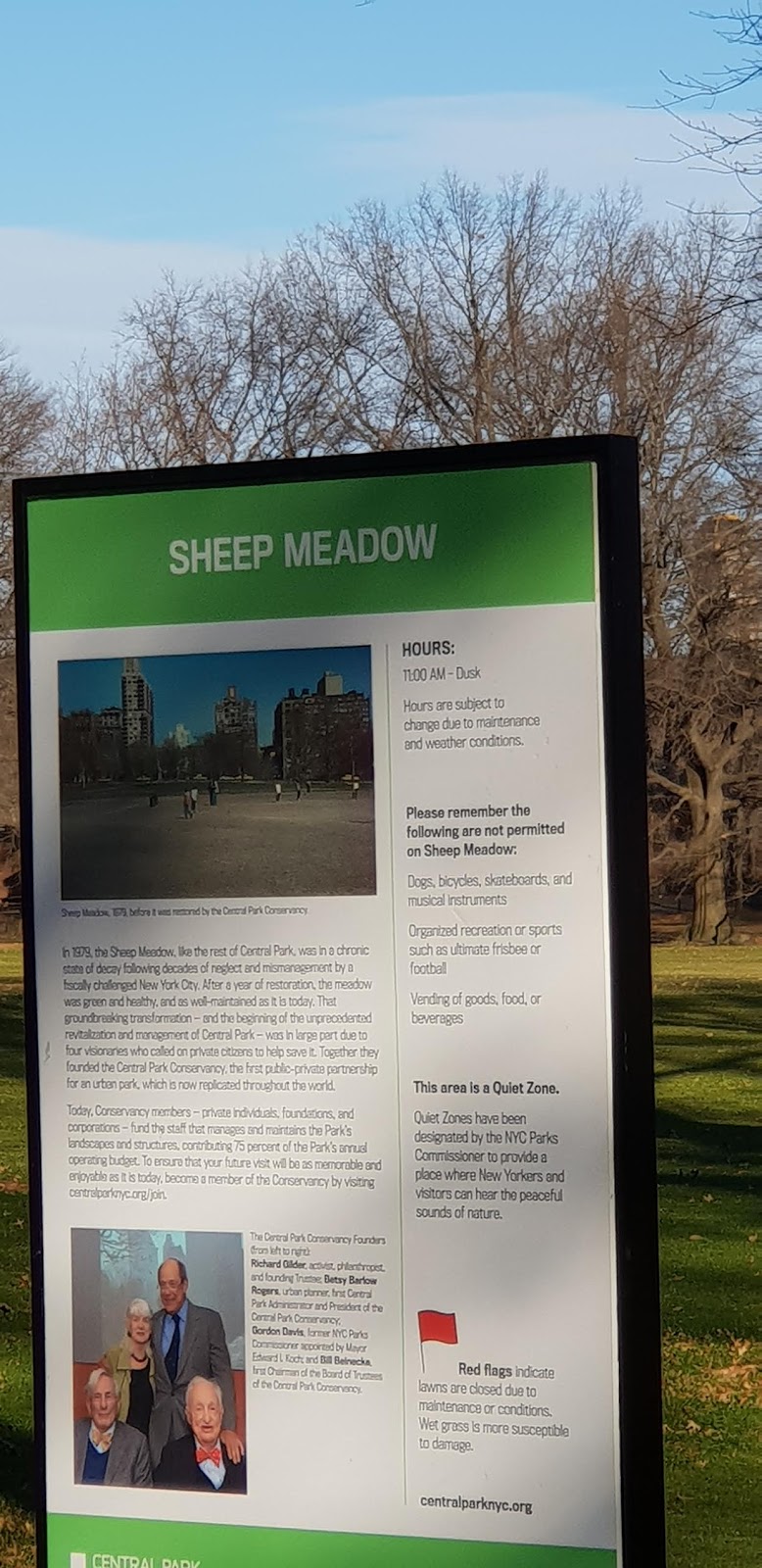
And, there’s the sign to say it was Sheep Meadow,

and that’s the meadow behind the sign,

Well, I don’t see any sheep, but of course, that’s not why the meadow is named or should there be any sheep on it.  That greenery that can be seen, restoring for the spring, was a very expensive addition to the park.

As a matter of fact, there is nothing was on it, because signs were up to say the meadow was closed for the winter, a new and interesting variation on the ‘Don’t Walk On The Grass’ signs.

I’m sure I could climb the fence, or, maybe not.  I’m a bit old to be climbing fences.

So, unable to walk on the grass, we tossed an imaginary coin, should we go towards West 110th Street, or back to West 59th Street.

West 59th Street won.

and, just in case we had any strange ideas about walking on the grass, the fence was there to deter us.  Perhaps if we had more determination…

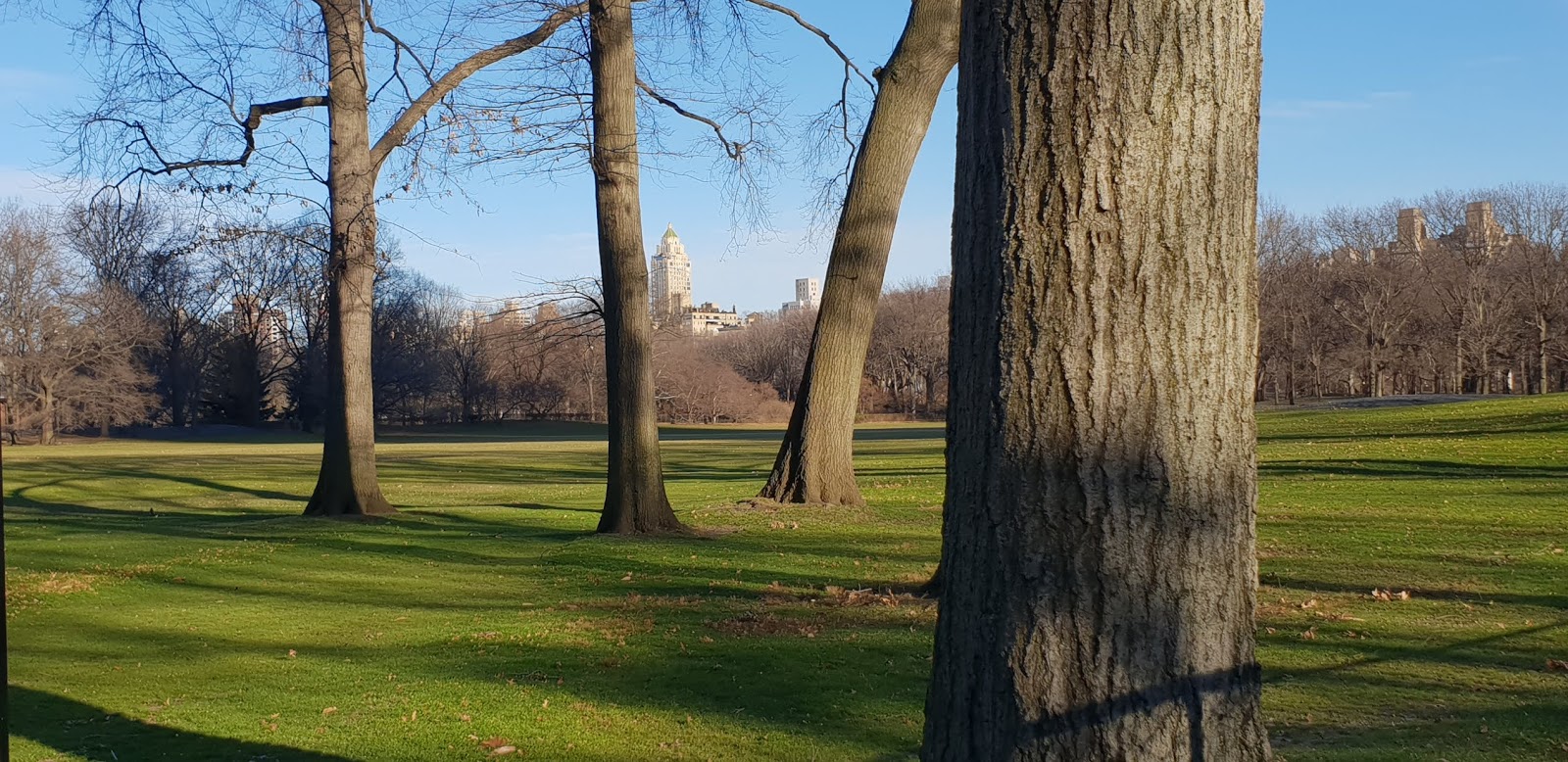
One positive aspect of the park is that you could never get lost, and the tall buildings surrounding the park are nearly always visible through the trees, more so in winter because there is no foliage, maybe less so later in the year.

There is also a lot of very large rocky type hills, or outcrops where people seem to stand on, king of the mountain style, or sit to have a picnic lunch, quickly before it freezes.

Yes, it is cold outside and seems more so in the park.

I wondered briefly if it ever got foggy, then this place would be very spooky, particularly after the sun goes down.

“What Sets Us Apart”, a mystery with a twist

David is a man troubled by a past he is trying to forget.

Susan is rebelling against a life of privilege and an exasperated mother who holds a secret that will determine her daughter’s destiny.

They are two people brought together by chance. Or was it?

When Susan discovers her mother’s secret, she goes in search of the truth that has been hidden from her since the day she was born.

When David realizes her absence is more than the usual cooling off after another heated argument, he finds himself being slowly drawn back into his former world of deceit and lies.

Then, back with his former employers, David quickly discovers nothing is what it seems as he embarks on a dangerous mission to find Susan before he loses her forever.

Find the kindle version on Amazon here:  http://amzn.to/2Eryfth

whatsetscover

“The Things We Do For Love”

Would you give up everything to be with the one you love?

…

Is love the metaphorical equivalent to ‘walking the plank’; a dive into uncharted waters?

For Henry, the only romance he was interested in was a life at sea, and when away from it, he strived to find sanctuary from his family and perhaps life itself.  It takes him to a small village by the sea, a place he never expected to find another just like him, Michelle, whom he soon discovers is as mysterious as she is beautiful.

Henry had long since given up the notion of finding romance, and Michelle couldn’t get involved for reasons she could never explain, but in the end, both acknowledge that something happened the moment they first met.  

Plans were made, plans were revised, and hopes were shattered.

A chance encounter causes Michelle’s past to catch up with her, and whatever hope she had of having a normal life with Henry, or anyone else, is gone.  To keep him alive she has to destroy her blossoming relationship, an act that breaks her heart and shatters his.

But can love conquer all?

It takes a few words of encouragement from an unlikely source to send Henry and his friend Radly on an odyssey into the darkest corners of the red-light district in a race against time to find and rescue the woman he finally realizes is the love of his life.

The cover, at the moment, looks like this:

lovecoverfinal1

Is love the metaphorical equivalent to ‘walking the plank’; a dive into uncharted waters?

For Henry, the only romance he was interested in was a life at sea, and when away from it, he strived to find sanctuary from his family and perhaps life itself.  It takes him to a small village by the sea, s place he never expected to find another just like him, Michelle, whom he soon discovers is as mysterious as she is beautiful.

Henry had long since given up the notion of finding romance, and Michelle couldn’t get involved for reasons she could never explain, but in the end, both acknowledge that something happened the moment they first met.  

Plans were made, plans were revised, and hopes were shattered.

A chance encounter causes Michelle’s past to catch up with her, and whatever hope she had of having a normal life with Henry, or anyone else, is gone.  To keep him alive she has to destroy her blossoming relationship, an act that breaks her heart and shatters his.

But can love conquer all?

It takes a few words of encouragement from an unlikely source to send Henry and his friend Radly on an odyssey into the darkest corners of the red-light district in a race against time to find and rescue the woman he finally realizes is the love of his life.

The cover, at the moment, looks like this:

lovecoverfinal1

In a word: cue

Another small and sometimes confusing word.

The first meaning that comes to mind is a cue is a prompt, often from someone standing behind the camera in a television studio.

That is to say that a cue is some form of signal, a wave, a nod, or verbal.

A cue can also be where a tape or recording is set to a certain place, ready to play.  One could assume, if playing tracks off an album of songs, and you wanted to play the fourth track, then you would cue it up, ready to go on, of course, the moment you got a, yes, cue to play it.

Then there is a cue used in a game of pool or snooker, that is a long thin tapered piece of wood with a felt tip.  

Not exactly my favourite game, but it’s always the cues fault, not mine.

This is not to be considered with Que which is a shortened form for Quebec, in Canada.

Or que, which for some reason, only in California, is short for barbecue.

Or Queue, as in a long line, or a short one, of people waiting to get on a bus, or waiting to get tickets  

In my experience every queue I get in is always a long one, and then suffer the frustration of waiting hours only to be told the tickets have all been sold.

Almost as bad as being stuck in a traffic jam, which is technically a queue of cars, never to get through the first set of lights, and sometimes not the second.

And don’t get me started on phone queues.  

Queues are for people who have a lot of time on the hands.

“One Last Look”, nothing is what it seems

A single event can have enormous consequences.

A single event driven by fate, after Ben told his wife Charlotte he would be late home one night, he left early, and by chance discovers his wife having dinner in their favourite restaurant with another man.

A single event where it could be said Ben was in the wrong place at the wrong time.

Who was this man? Why was she having dinner with him?

A simple truth to explain the single event was all Ben required. Instead, Charlotte told him a lie.

A single event that forces Ben to question everything he thought he knew about his wife, and the people who are around her.

After a near-death experience and forced retirement into a world he is unfamiliar with, Ben finds himself once again drawn back into that life of lies, violence, and intrigue.

From London to a small village in Tuscany, little by little Ben discovers who the woman he married is, and the real reason why fate had brought them together.

It is available on Amazon here:  http://amzn.to/2CqUBcz

The cinema of my dreams – I never wanted to go to Africa – Episode 1

There’s hanging around, and there’s hanging around

…

So, there I was, hanging half out of the helicopter, shooting a handgun at a truck speeding along a dirt track.

I know, what’s the effective range of a handgun?

The sound of the rotors was still deafening even with the earphones on and as I run out of bullets and was reaching for another clip, I heard a voice crackle in my ears.

“Some fool’s got a rocket launcher.”

That fool was trying to lean out the passenger side of the truck and aim the launcher at the helicopter.

The bucking and swaying of the vehicle nearly tipped him out onto the roadside, but something managed to anchor him, and he was taking aim.

“Now would be the time to peel away,” I said, not knowing if the pilot could hear me.

Our course didn’t deviate, so perhaps he hadn’t.

I calculated the distance between the helicopter and the ground, and the speed we were traveling.  Fast.  Short drop.  Quick landing.  Very painful.

In that moment I saw the rocket leave the launcher, I let go.

There was that instant where you feel disembodied and floating on air.  The same as that few seconds in free fall, just before pulling the rip cord of a parachute.

I hit the ground a rolled, not that I thought it would do much good, and the stopped, just before I lost consciousness.  Somewhere in front of me, there was a huge explosion, and then nothing.

Last thought, I hope the helicopter didn’t land on me.

…

© Charles Heath 2018 – 2023

The cinema of my dreams – I always wanted to write a war story – Episode 1

It’s the story that was inspired by the Castello di Briolio, which had small aspirations when first conceived, but now it’s reached a point where we need to fill in a few blanks at the start.

Thus, a revised Episode One


“You have got the guards set up on the back wall,” I asked Jackerby, the officer in charge of the rearguards.

“Can you see them?” he said in a tone that dripped sarcasm.

I didn’t like Jackerby, he seemed far too sure of himself and his men, and so far, we hadn’t had to rely on them.

But I expected that time was coming, and sooner than both of us wanted to believe.

“No.”

“Then no one else will either.  Trust me; no one will be coming over the back wall.”

That was a matter of opinion, and, in my assessment of the fortifications, and the security precautions, about the only way the enemy could attack us, was from the sky.

And that was, given the current situation the enemy were in, practically impossible.  But, as my old commander used to say, ‘This is war, anything is possible, and when you least expect it.’

I’d survived four years of it, and didn’t want to be one of those who didn’t make it to the end.  For that reason, I trusted no one, and particularly people who said ‘trust me’.

I glanced along the back wall again, just to make sure, but it didn’t make me feel any safer.

“I’ll be in the command post if you need me, and it has a clear view of anything coming.”

“Excellent,” I said, trying to sound more confident that I felt.


We were in an old castle, though not strictly speaking a real castle, built only a few hundred years ago.  It was an enemy stronghold up until a month ago when, acting on advice from the local resistance that the enemy strength had dropped as they had begun to retreat, a strike force came and liberated it.

And, given its strategic position between the front line and the sea it became a gateway for anyone who wanted to escape the Germans and what was left of the Italians.

That also included departing boffins from the Reich, looking to bargain their way to a new home in England or the US.

To oversee that operation was a Colonel called Johansson, along with a dozen or so specialist soldiers, and the operation had been running smoothly.

Then came an attempted incursion, where a group of enemy soldiers who were fighting to the end, made a brave attempt to take the castle back.,  They failed, because of a twelfth-hour arrival of a Major called Jackerby, and a small motley crew of men.

When I read the report after the battle, it seemed odd.

As a result of his help, Jackerby was recruited by Johansson, in circumstances that seemed a little too coincidental for my liking.  Johansson was too easy going for me, and although he had not made a mistake, yet, I felt sure one was going to happen on my watch.

I came later, sent by Command to ‘lend assistance where possible’ to the operation, assistance the good Colonel took no pains to tell command he didn’t need.  But they didn’t give him a choice.

Except…

On my way there, my driver and I had almost reached the castle when we were caught in a roadside bomb.  The driver was killed, and I’d been saved by a dog, one we had found on the side of the road, badly in need of water, and food.

I had brought him with me.  The thought of doing so, at the time, had been on the end of a single idea, a dog could not betray me, men and women could.  And the fact its name was Jack seemed to me to be rather poetic, if not somewhat ironic in the circumstances.


There was a communication in my pocket, one I’d received earlier in the afternoon, sent in a onetime code no one but I could decode.

A warning of a second attempt on the castle by the enemy, but for reasons unknown.

Tonight.


Jack and I were in the guard tower at the south-western corner of the castle.  It overlooked the valley and gave a clear view of anyone or anything coming from that quadrant.  If I was going to retake the castle, that’s where I’d launch an attack from.

Of course, if it came by air, you’d expect to hear it.

I didn’t, but Jack did.  He suddenly stood and made a small moaning noise, as if he knew quiet communication was needed.  The stiffness in his body told me it was danger.

Then I saw it, just as I came out of the guardhouse onto the gravel path, the moonlight shining of very large wings, and for a moment it didn’t make sense until I realized it was a glider.

Silent.  It passed, and behind I could see parachutes, then the sound of boots on the gravel walkways just down from the tower.  A precision flight and precision landing of a dozen stormtroopers.

And Jackerby’s guards were nowhere to be seen.


© Charles Heath 2018-2019

“The End of the Road”, a short story

The man who had said that we would never make the distance was right.

It had been my idea to go ‘troppo’, forsake everything, hop on a motorbike and go around Australia.  I was, at that stage fed up with everything and, catching Harry in one of his low spots, he decided there and then he would join me.

For the first few days, we believed we were stark staring mad and talked about calling it quits, but perseverance made all the difference.  After two months we were glad we had the resolve to keep going, and in that time we had managed to see more of the Australian countryside than we’d seen all our lives.

That was until this particular morning when we arrived in Berrigum, what could have been called a one-horse town.  It consisted of one hotel, one general store (that sold everything from toothpicks to petrol) and an agricultural machinery depot.  It also had a station and some wheat silos, and this appeared to be the only reason for a town in this particular spot in the middle of nowhere.

And it was the railway station that interested Harry, who was, by this time, getting a little homesick and fed up with his motorbike.

After coughing and spluttering for the last week it had finally died, and the five-mile walk to Berrigum had not helped either his temper, or his disposition, and had only served to firm his resolve to return home.

It was hot but not unbearably so, unlike a hot summer’s day in the city, and even worse still in public transport.  For miles around as we tramped those five miles all we could see was acres and acres of wheat, but no sign of life.  It was the same when we reached the town.  It appeared all the people were either hiding or had left.  Harry suspected the latter given the state of the road, and the buildings, more or less the epitome of a ghost town.

Standing at the end of what could have been called the main street with only our own dust for company, one look took in the whole town.  In a car, one wouldn’t have given it a second look, if one had time to give it a first.  I didn’t remember seeing neither any speed restriction signs nor signpost advertising a town ahead.

And since no amount of argument could sway him from his resolve, the first objective was to get a train timetable, if such a thing existed, and make arrangements for Harry’s return.

The station was as deserted as the town itself, and a quick glance in the stationmaster’s office showed no sign of life.

Leaving the bikes on the platform outside the office, we headed for the hotel for both a drink and make enquiries about rail services.  Being a hot day and the morning’s tramp somewhat hot and dusty, we were looking forward to a cold glass (or two) of beer.

The hotel looked as though it was a hundred years old though there was no doubting a few relentless summers would reduce it to the same state.  It was as bad inside as out, though the temperature was several degrees lower, and we could sit down in what appeared to be the main bar.  We were the only occupants and still to find any sign of life.  Overhead, two fans were struggling to move the hot air around.

More than once Harry reckoned it was a ghost town and I was beginning to believe him when, after five minutes, no one arrived.

After ten, we stood, ready to leave, only to stop halfway out of our chairs when a voice behind us said, “Surely you’re not going back out there without refreshment?”

“I was beginning to think the town was deserted,” I said.

“It is during the day, but when the sun goes down…”

I didn’t ask.  We followed him to the bar where he had stationed himself behind the counter.  “The name is Jack.”  He stretched out his hand towards us.  “We don’t bother with last names here.”

“Bill,” I said, shaking it, and nodding to Harry, “Harry.”

Harry nodded and shook his hand too.

“The first one’s on the house.”  He poured three glasses and put ours in front of us.  “Cheers.”

In all cases, it went down without touching the sides (as they say) and he poured a second, at the same time asking, “What brings you to our little corner of the earth?”

“Just passing through,” I said, “Or at least for me.”

“And you?”  Jack looked at Harry.

“I can’t hack the pace.  I can truthfully say I have thoroughly enjoyed the trip so far, except for a few mishaps, but for me, it’s time to get back to the big smoke.  My ‘do your own thing’ has run out of momentum.  Do you know if there is a train that goes anywhere important?”

The publican looked at him almost pityingly.  “Important, eh?”  He rubbed his chin feigning thought.  “You make it sound like you are in purgatory.”

“Aren’t we?”

I suppose one could hardly blame Harry for his attitude.  After all, at the beginning, he had numerous accidents, caught a virus that stayed with him (and a couple of torrential downpours had done little to help it), and now his motorbike had finally died.  No wonder his humour was at an all-time low.

For a moment I thought the publican was going to tell Harry what he thought of him, but then he smiled and the tension passed.  “Perhaps to a city fellow like you it might be,” he said.  “The mail train which has a passenger carriage comes through once a week, and, my good man, you’re in luck.  Today’s the day.”

“Good.  How do I get a ticket?”

“You’d have to see the Station Master.”

“And where might he be at the moment?  We were at the station a while back and there was no sign of life.”

“Nor will there be until the train comes.  Meanwhile, there’s time enough for lunch.  I’m sure you will stay?”  He looked questioningly at us.

I looked at Harry, who nodded.

“Why not.”

Over lunch, we talked.

I remember not so long ago when I had to attend a large number of lunches where the talk was of business, or, if anything, mostly about subjects that I had no interest in.  It was always some posh restaurant, time seemed important, the atmosphere never really relaxed, and to get into a relaxed state it took a large amount of alcohol to deaden the despair and distaste of that one had to fete in order to secure their business.

How different it was here.

We talked about the country, and, after seeing as much of it, and worked on it as we had to fund our odyssey, we could talk about it authoritatively.  And, most of all, it was interesting.

The atmosphere too was entirely different than it had been in the city.  Out here the people were always friendly, people always willing to stop and talk, particularly farmers; share a drink or some food.

There was none of this carefree purposefulness in the city, and more than once I’d thought of the fact one could travel in the same train with the same people for year after year and still not know any of them.  It was the same at work.  Even after five years I still hadn’t known three-quarters of the office staff, and most of them probably didn’t want to know me.  Harry was virtually the only real friend I’d had at work.

But here, in ‘the middle of nowhere’ as Harry had called it, I felt as though I’d known the publican all of my life instead of the few short hours.

Some hours later and after much argument, where Jack and I tried to talk Harry into staying (Jack said he knew someone who could fix anything including Harry’s bike), Harry remained unconvinced and resolute.  Jack, to round off the occasion (we were the first real guests from outside he had had in a week) provided another on-the-house ale and then saw us to the station.  “After all”, he had said, “I’ve nothing else to do at the moment.”

By that time the station was showing a little more life than it had before.  A station assistant, moving several parcels with a hand trolley, slowly ambled towards the end of the platform.

And whether it could be called a platform was a debatable point.  It was a gravel and grass affair that looked more like part of cutting through a hill than a station.

At the station, Jack portentously announced he was also the stationmaster and would be only too happy to take care of Harry’s requirements.  It would be, he added, “the first passenger ticket sold for several months.”  Certainly, the ticket he handed Harry bore witness to that.  It had yellowed with age.

One would have thought with the imminent arrival of the train there would be more people, but no.  The only event had been the station assistant’s stroll to the end of the platform and back.  Now both he and Jack had disappeared into the office and we were left alone on the platform.  Very little in the whole town stirred, nor had it the whole time we’d been there.

“Well,” I said to break the silence.  “I’m sorry to see you going through with it.  I thought I might have been able to talk you out of it…”  I shrugged, leaving the sentence unfinished.

“I’m sorry to be going too, but a body can take only so much bad luck, and God knows that’s all I’ve had.”

“Yes.”  I couldn’t think of much else to say.  “But it’s been good to have your company these last few months.”

“And you.  When do you think you’ll get back?”

“When I get sick of it I suppose.”

“Look us up then when you get back.”

“I will.”

Thankfully the appearance of the train in the distance broke off the conversation.  I had begun to think of what it was going to be like out on the road with no one to talk to but myself.  The thought was a little depressing and I tried not to let it show.

We said little else until the train pulled in, three flat cars, seven enclosed wagons, a passenger carriage and the guard’s van.  The train stopped with only part of the passenger carriage and the guard’s van at the station.

The guard took aboard the parcels the station assistant had left for him earlier, and then put those that were for Berrigum on the trolley.

I shook Harry’s hand and said I’d see him around.  Then he, the motorbike, and the guard were aboard and the train was off, disappearing slowly into the afternoon haze.

The station assistant then repeated his amble to the end of the platform to collect the hand trolley.

“Staying or moving on.”  Jack had come up behind me and gave me a bit of a start.

“Staying I guess, until tomorrow or maybe later.”

“I had heard one of the farm hands is leaving tomorrow heading back to Sydney.  There could be a vacancy.”

“Sounds like a plan,” I said.

“I could put in a word for you.”

“Thanks.”

Jack just grinned and we headed for the hotel.

© Charles Heath 2016-2019
Writing a book in 365 days – My story 6

Day 53a

More about the story I’m writing

…

So, we have gotten past waking up in a strange place, the fact it is hot, and the effect of looking at the slow-moving blades of the fan swirling that hot regurgitated air, and momentarily panicking when there’s a knock on the door (yes, even I was hoping it was a genie with an air conditioner) we can move on.

Where are we? Somewhere in Africa, where there seemed to be a predominance of French, Belgian and English colonies, each speaking the language of its conqueror, and each still with a lasting reminder of those people who had been vanquished in that period after the Second World War when granting independence seemed the right thing to do.

In place of High Commissioners and District Officers, came the propped-up dictators who swore allegiance to the former coloniser in return for large sums of money and lots of guns and uniforms for their military.

Nothing much changed, the wealth was still in the few hands and the people still had nothing. Well, in those days of transition to the dictatorship they had plenty, but what could be given in abundance could quite easily be taken away. The Conlonisers army was replaced by police, and something more insidious, the secret police. The Coloniser tended to loan the police service senior officers to train and supervise.

Until of course, if the military decided it no longer liked the dictator there was a military coup.

Not yet, for this little country.

Increasingly accused of human rights abuses and secret activities against its citizens by the secret police, and negotiations for the next tranche of financial and other support, the country is, well, let’s call it what it is, blackmailed into holding a Human Rights Conference.

Let’s also throw into the mix a leader of the rebels, or no, freedom fighters, who is as slippery as an eel. He reminds me of the Scarlet Pimpernel, hiding in plain sight. Let’s add a world-class Human Rights activist as the keynote speaker, someone respected everywhere but inside this country, and dangle a red rag in front of the bull.

We have our world-weary recovering fix-it man, and now we know why he’s there.

He’s the ‘invisible’ bodyguard.

But, like the proverbial steak knives, there’s more. Twenty years and a name change, his instructions are to watch over the keynote speaker, but doesn’t realise it is the same woman he almost married, and had he, his life would be so very different.

That’s going to be some reunion.

…

©  Charles Heath  2025

Searching for locations: Central Park, New York. USA

It’s a place to go and spot the movie stars, or perhaps their dogs.

It’s a place to go for long walks on idyllic spring or autumn days

It’s a place to go to look at a zoo, though I didn’t realize there was one until I made a wrong turn.

It’s a place to go for a horse and carriage ride, although it does not last that long

It’s a place to go to look at statues, fountains, architecture, and in winter, an ice skating rink

I’m sure there’s a whole lot more there that I don’t know about.

I have to say I’ve only visited in winter, and the first time there was snow, the second, none.

Both times it was cold, but this didn’t seem to deter people.

But…

We decided to go visit another part of the park, this time walking to West 67th Street before crossing Central Park West and into the park where Sheep Meadow is.

Once upon a time sheep did graze on the meadow, but these days it is designated a quiet area inspiring calm and refreshing thoughts, except for a period in the 1960s where there was more than one counter-culture protest, or love in, going on.

And, there’s the sign to say it was Sheep Meadow,

and that’s the meadow behind the sign,

Well, I don’t see any sheep, but of course, that’s not why the meadow is named or should there be any sheep on it.  That greenery that can be seen, restoring for the spring, was a very expensive addition to the park.

As a matter of fact, there is nothing was on it, because signs were up to say the meadow was closed for the winter, a new and interesting variation on the ‘Don’t Walk On The Grass’ signs.

I’m sure I could climb the fence, or, maybe not.  I’m a bit old to be climbing fences.

So, unable to walk on the grass, we tossed an imaginary coin, should we go towards West 110th Street, or back to West 59th Street.

West 59th Street won.

and, just in case we had any strange ideas about walking on the grass, the fence was there to deter us.  Perhaps if we had more determination…

One positive aspect of the park is that you could never get lost, and the tall buildings surrounding the park are nearly always visible through the trees, more so in winter because there is no foliage, maybe less so later in the year.

There is also a lot of very large rocky type hills, or outcrops where people seem to stand on, king of the mountain style, or sit to have a picnic lunch, quickly before it freezes.

Yes, it is cold outside and seems more so in the park.

I wondered briefly if it ever got foggy, then this place would be very spooky, particularly after the sun goes down.