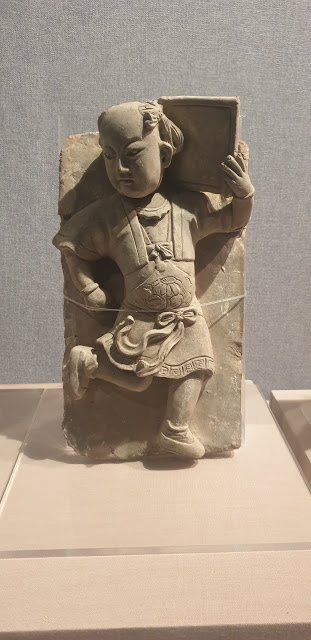
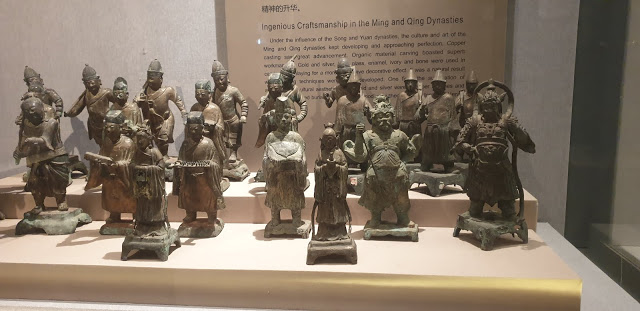
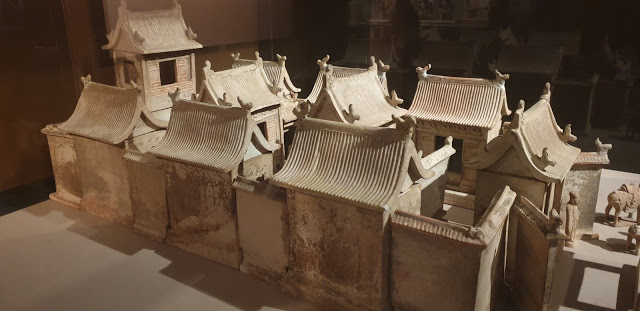
The Henan Museum is one of the oldest museums in China. In June 1927, General Feng Yuxiang proposed that a museum be built, and it was completed the next year. In 1961, along with the move of the provincial capital, Henan Museum moved from Kaifeng to Zhengzhou.
It currently holds about 130,000 individual pieces, more of which are mostly cultural relics, bronze vessels of the Shang and Zhou Dynasties, and pottery and porcelain wares of the various dynasties.
Eventually, we arrive at the museum and get off the bus adjacent to a scooter track and despite the efforts of the guide, there’s no stopping them from nearly running us over.
We arrive to find the museum has been moved to a different and somewhat smaller building nearby as the existing, and rather distinctively designed, building is being renovated.
While we are waiting for the tickets to enter, we are given another view of industrial life in that there is nothing that resembles proper health and safety on worksites in this country, and the workers are basically standing on what looks to be a flimsy bamboo ladder with nothing to stop them from falling off.
The museum itself has exhibits dating back a few thousand years and consist of bronze and ceramic items. One of the highlights was a tortoiseshell with reportedly the oldest know writing ever found.
Other than that it was a series of cooking utensils, a table, and ceramic pots, some in very good condition considering their age.
“Sunday in New York” is ultimately a story about trust, and what happens when a marriage is stretched to its limits.
When Harry Steele attends a lunch with his manager, Barclay, to discuss a promotion that any junior executive would accept in a heartbeat, it is the fact his wife, Alison, who previously professed her reservations about Barclay, also agreed to attend, that casts a small element of doubt in his mind.
From that moment, his life, in the company, in deciding what to do, his marriage, his very life, spirals out of control.
There is no one big factor that can prove Harry’s worst fears, that his marriage is over, just a number of small, interconnecting events, when piled on top of each other, points to a cataclysmic end to everything he had believed in.
Trust is lost firstly in his best friend and mentor, Andy, who only hints of impending disaster, Sasha, a woman whom he saved, and who appears to have motives of her own, and then in his wife, Alison, as he discovered piece by piece damning evidence she is about to leave him for another man.
Can we trust what we see with our eyes or trust what we hear?
Haven’t we all jumped to conclusions at least once in our lives?
Can Alison, a woman whose self-belief and confidence is about to be put to the ultimate test, find a way of proving their relationship is as strong as it has ever been?
So, here’s the thing. If I thought I could get James Patterson’s opinion on one of my novels, I would try, but I don’t think, given the prolific output he maintains, that he would have the time to put an amateur like me on the straight and narrow.
But…
Who’s to say that if I found another struggling author like me who was of a mind to offer an opinion, I wouldn’t take it?
I would have to say the best critic would be someone who writes similar genre stories to yours.
So…
Here’s the deal, minus the steak knives.
Join a writing group, a bunch of fellow writers who write the same stuff, and take on board contemporary reviews.
Something else that might help, in the absence of those great authors who probably have no time to look over our work, is to get the opinions of beta readers. I’ve been looking, but it seems a lot of them want payment. I guess there’s a good living out there, but they would have to be both reputable and good at it.
Other than that, there’s always a possibility that one day…
What happens when your past finally catches up with you?
…
Christmas is just around the corner, a time to be with family. For Will Mason, an orphan since he was fourteen, it is a time for reflection on what his life could have been, and what it could be.
Until a chance encounter brings back to life the reasons for his twenty years of self-imposed exile from a life only normal people could have. From that moment Will’s life slowly starts to unravel and it’s obvious to him it’s time to move on.
This time, however, there is more at stake.
Will has broken his number one rule, don’t get involved.
With his nemesis, Eddie Jamieson, suddenly within reach, and a blossoming relationship with an office colleague, Maria, about to change everything, Will has to make a choice. Quietly leave, or finally, make a stand.
But as Will soon discovers, when other people are involved there is going to be terrible consequences no matter what choice he makes.
Of course, prior means gone before, as in past history, or perhaps only a few moments ago; it happened prior to my arrival on the scene.
But it can also mean, quite confusingly, to something in the future, when trying to get out of a meeting by saying I’ve got a prior appointment.
If you are an aficionado of American police dramas then you will be well acquainted with the prior, meaning a previous criminal conviction.
And for something quite different, a prior is a priest of sorts, who to me were named as such in the middle ages. A prior is below an Abbot and is head of a house of friars. By the way, the most notable friar I know is Friar Tuck
A prior could also be a magistrate in the medieval republic of Florence.
It is not to be doubly confused with Pryer or Prier
Someone who pries into another’s business, the most notable prier, the woman across the road from Samantha, in Bewitched.
McCallister was old school, a man who would most likely fit in perfectly campaigning on the battlefields of Europe during the Second World War. He’d been like a fish out of water in the army, post-Falklands, and while he retired a hero, he still felt he’d more to give.
He’d applied and was accepted as head of a SWAT team, and, watching him now as he and his men disembarked from the truck in almost military precision, a look passed between Annette, the police liaison officer, and I that said she’d seen it all before. I know I had.
There was a one in four chance his team would be selected for this operation, and she had been hoping it would be one of the other three. While waiting for them to arrive she filled me in on the various teams. His was the least co-operative, and the more likely to make ad-hoc decisions rather than adhere to the plan, or any orders that may come from the officer in charge.
This, she said quite bluntly, was going to end badly.
I still had no idea why Prendergast instructed me to attend the scene of what looked to be a normal domestic operation, but as the nominated expert in the field in these types of situations, it was fairly clear he wasn’t taking any chances. It was always a matter of opinion between us, and generally I lost.
In this case, it was an anonymous report identifying what the authorities believed were explosives in one of the dockside sheds where explosives were not supposed to be.
The only reason why the report was given any credence was the man, while not identifying himself by name, said he’d been an explosive expert once and recognized the boxes. That could mean anything, but the Chief Constable was a cautious man.
With his men settled and preparing their weapons, McCallister came over to the command post, not much more than the SUV my liaison and I arrived in, with weapons, bulletproof vests, and rolls of tape to cordon off the area afterward. We both had coffee, steaming in the cold early morning air. Dawn was slowly approaching and although rain had been forecast it had yet to arrive.
A man by the name of Benson was in charge. He too had groaned when he saw McCallister.
“A fine morning for it.” McCallister was the only enthusiastic one here.
He didn’t say what ‘it’ was, but I thought it might eventually be mayhem.
“Let’s hope the rain stays away. It’s going to be difficult enough without it,” Benson said, rubbing his hands together. We had been waiting for the SWAT team to arrive, and another team to take up their position under the wharf, and who was in the final stages of securing their position.
While we were waiting we drew up the plan. I’d go in first to check on what we were dealing with, and what type of explosives. The SWAT team, in the meantime, were to ensure all the exits to the shed were covered. When I gave the signal, they were to enter and secure the building. We were not expecting anyone inside or out, and no movement had been detected in the last hour since our arrival and deployment.
“What’s the current situation?”
“I’ve got eyes on the building, and a team coming in from the waterside, underneath. Its slow progress, but they’re nearly there. Once they’re in place, we’re sending McKenzie in.”
He looked in my direction.
“With due respect sir, shouldn’t it be one of us?” McCallister glared at me with the contempt that only a decorated military officer could.
“No. I have orders from above, much higher than I care to argue with, so, McCallister, no gung-ho heroics for the moment. Just be ready to move on my command, and make sure you have three teams at the exit points, ready to secure the building.”
McCallister opened his mouth, no doubt to question those orders, but instead closed it again. “Yes sir,” he muttered and turned away heading back to his men.
“You’re not going to have much time before he storms the battlements,” Benson quietly said to me, a hint of exasperation in his tone. “I’m dreading the paperwork.”
It was exactly what my liaison officer said when she saw McCallister arriving.
The water team sent their ‘in position’ signal, and we were ready to go.
In the hour or so we’d been on site nothing had stirred, no arrivals, no departures, and no sign anyone was inside, but that didn’t mean we were alone. Nor did it mean I was going to walk in and see immediately what was going on. If it was a cache of explosives then it was possible the building was booby-trapped in any number of ways, there could be sentries or guards, and they had eyes on us, or it might be a false alarm.
I was hoping for the latter.
I put on the bulletproof vest, thinking it was a poor substitute for full battle armor against an exploding bomb, but we were still treating this as a ‘suspected’ case. I noticed my liaison officer was pulling on her bulletproof vest too.
“You don’t have to go. This is my party, not yours,” I said.
“The Chief Constable told me to stick to you like glue, sir.”
I looked at Benson. “Talk some sense into her please, this is not a kindergarten outing.”
He shrugged. Seeing McCallister had taken all the fight out of him. “Orders are orders. If that’s what the Chief Constable requested …”
Madness. I glared at her, and she gave me a wan smile. “Stay behind me then, and don’t do anything stupid.”
“Believe me, I won’t be.” She pulled out and checked her weapon, chambering the first round. It made a reassuring sound.
Suited up, weapons readied, a last sip of the coffee in a stomach that was already churning from nerves and tension, I looked at the target, one hundred yards distant and thought it was going to be the longest hundred yards I’d ever traversed. At least for this week.
A swirling mist rolled in and caused a slight change in plans.
Because the front of the buildings was constantly illuminated by large overhead arc lamps, my intention had been to approach the building from the rear where there was less light and more cover. Despite the lack of movement, if there were explosives in that building, there’d be ‘enemy’ surveillance somewhere, and, after making that assumption, I believed it was going to be easier and less noticeable to use the darkness as a cover.
It was a result of the consultation, and studying the plans of the warehouse, plans that showed three entrances, the main front hangar type doors, a side entrance for truck entry and exit and a small door in the rear, at the end of an internal passage leading to several offices. I also assumed it was the exit used when smokers needed a break. Our entry would be by the rear door or failing that, the side entrance where a door was built into the larger sliding doors. In both cases, the locks would not present a problem.
The change in the weather made the approach shorter, and given the density of the mist now turning into a fog, we were able to approach by the front, hugging the walls, and moving quickly while there was cover. I could feel the dampness of the mist and shivered more than once.
It was nerves more than the cold.
I could also feel rather than see the presence of Annette behind me, and once felt her breath on my neck when we stopped for a quick reconnaissance.
It was the same for McCallister’s men. I could feel them following us, quickly and quietly, and expected, if I turned around, to see him breathing down my neck too.
It added to the tension.
My plan was still to enter by the back door.
We slipped up the alley between the two sheds to the rear corner and stopped. I heard a noise coming from the rear of the building, and the light tap on the shoulder told me Annette had heard it too. I put my hand up to signal her to wait, and as a swirl of mist rolled in, I slipped around the corner heading towards where I’d last seen the glow of a cigarette.
The mist cleared, and we saw each other at the same time. He was a bearded man in battle fatigues, not the average dockside security guard.
He was quick, but my slight element of surprise was his undoing, and he was down and unconscious in less than a few seconds with barely a sound beyond the body hitting the ground. Zip ties secured his hands and legs, and tape his mouth. Annette joined me a minute after securing him.
A glance at the body then me, “I can see why they, whoever they are, sent you.”
She’d asked who I worked for, and I didn’t answer. It was best she didn’t know.
“Stay behind me,” I said, more urgency in my tone. If there was one, there’d be another.
Luck was with us so far. A man outside smoking meant no booby traps on the back door, and quite possibly there’d be none inside. But it indicated there were more men inside, and if so, it appeared they were very well trained. If that were the case, they would be formidable opponents.
The fear factor increased exponentially.
I slowly opened the door and looked in. A pale light shone from within the warehouse itself, one that was not bright enough to be detected from outside. None of the offices had lights on, so it was possible they were vacant. I realized then they had blacked out the windows. Why hadn’t someone checked this?
Once inside, the door closed behind us, progress was slow and careful. She remained directly behind me, gun ready to shoot anything that moved. I had a momentary thought for McCallister and his men, securing the perimeter.
At the end of the corridor, the extent of the warehouse stretched before us. The pale lighting made it seem like a vast empty cavern, except for a long trestle table along one side, and, behind it, stacks of wooden crates, some opened. It looked like a production line.
To get to the table from where we were was a ten-yard walk in the open. There was no cover. If we stuck to the walls, there was equally no cover and a longer walk.
We needed a distraction.
As if on cue, the two main entrances disintegrated into flying shrapnel accompanied by a deafening explosion that momentarily disoriented both Annette and I. Through the smoke and dust kicked up I saw three men appear from behind the wooden crates, each with what looked like machine guns, spraying bullets in the direction of the incoming SWAT members.
They never had a chance, cut down before they made ten steps into the building.
By the time I’d recovered, my head heavy, eyes watering and ears still ringing, I took several steps towards them, managing to take down two of the gunmen but not the third.
I heard a voice, Annette’s I think, yell out, “Oh, God, he’s got a trigger,” just before another explosion, though all I remember in that split second was a bright flash, the intense heat, something very heavy smashing into my chest knocking the wind out of me, and then the sensation of flying, just before I hit the wall.
I spent four weeks in an induced coma, three months being stitched back together and another six learning to do all those basic actions everyone took for granted. It was twelve months almost to the day when I was released from the hospital, physically, except for a few alterations required after being hit by shrapnel, looking the same as I always had.
But mentally? The document I’d signed on release said it all, ‘not fit for active duty; discharged’.
It was in the name of David Cheney. For all intents and purposes, Alistair McKenzie was killed in that warehouse, and for the first time ever, an agent left the Department, the first to retire alive.
I was not sure I liked the idea of making history.
The problem is, there are familiar faces and a question of who is a friend and who is foe made all the more difficult because of the enemy, if it was the enemy, simply because it didn’t look or sound or act like the enemy.
Now, it appears, his problems stem from another operation he participated in, and because of it, he has now been roped into what might be called a suicide mission.
We flew out of an unnamed base in an unmarked aircraft, heading for Africa. It would be my second visit. The first didn’t quite go as expected, but there was a chance of redemption this time around.
I was the only one who had been there before, other than our two-faced guide, Jacobi, who by now would be working out how he could double-cross us and save his skin. I had no illusions about a man who would turn in his own mother if he had to.
We were going to need a plan b and a plan c going in with him because I had no doubt plan a had already been sent to the relevant people, who were awaiting our imminent arrival with bated breath. Pity we would not be landing anywhere near that location.
In fact, none of us would know where we would be dropped, until minutes before it happened. Security, this time, was going to be formidable. Lallo explained why it was a matter of need to know, and all I had to say was, I didn’t need to know. I suspect Monroe knew, but she was the sort who could keep a secret.
As for the rest of the team, they were a motley crew, but within the group, there was an odd sort of camaraderie between them. Perhaps Lallo had told them that if they stepped out of line, Monroe would shoot them.
Aside from the passengers in the C47 transport, there was a pack for each of us, and enough weapons to start a war. Since we would not be calling at any recognisable airport, I doubted we would be having any customs or immigration problems. No one was travelling with any identification papers. It was that sort of mission.
Bamfield met me at the airport before we took off. Monroe had come over and told me there was a visitor in one of the rooms, the one with Operations crookedly glued to the door. She opened the door, ushered me in, then stepped back out closing the door after her.
Mental note: the door to that room would not withstand a good kick.
There was a table, two chairs, and one of them had Bamfield sitting, looking up expectantly when I entered the room. His eyes beckoned me to the other chair, so, after a look around the room, nothing else other than the table and chairs were in the room I casually made my way to the chair and sat.
We glared at each other over the tabletop.
”I’m guessing this is the last place you expected to be?”
“You have a funny way of issuing invitations?”
“Would you have come along if I asked you politely.”
“Probably not.”
Another minute’s silence while he looked for the words that would be anything other than an apology for coercing me into a corner. I’d come to realise that Bamfield was far from the sort of officer I’d first thought him to be.
An excuse could be made that because he needed to find people to do a particularly dangerous and covert operation, nothing was off the table, including blackmail, in order to get the job done. How he was justifying it using armed services personnel was anyone’s guess, but it would have been kicked higher up the food chain before approval was given.
These operations weren’t just conceived by military commanders, just the CIA on a good day, allowing the armed services to tag along. But make no mistake, this would be a CIA operation, and the CIA to take the credit if it worked out, and the army would take a hit if it didn’t. Either way, it would never reach the newspapers.
“You don’t need me to tell you how important this is, and that we’ve only got one shot at it. If you get caught, any of you, we cannot acknowledge you, so you will be on your own. Your team will obey orders. Monroe is there to maintain discipline if it’s needed.”
“So she’ll be shooting first and asking questions later?”
“Something like that. She’s a tough officer, and worthy of your respect.”
“And the rest?”
“Good soldiers who just got into trouble. They’re being given an opportunity for redemption, and this mission will count towards lessening their sentences. At any rate, Monroe will have your back.”
Good to know.
“You’ll be going to a new destination, after stopping over in northern Uganda. We’ve arranged for the plane to land at a disused airstrip when you’ll be met by Colonel Chiswick. He’ll be arranging you and your teams travel arrangements from there. I can’t tell you any more at this time for security reasons.”
“I have only one question.”
“Only one?”
“There is another 999 but I figure none of those will get answered. It was the same question I asked the last time, who are these people we’re supposed to be rescuing?”
A long and thoughtful look. Could he trust me?
“Two CIA operatives, meddling in DRC affairs without authorisation. They were originally sent to clean up the child soldier problem but somehow got in the middle of the war between government forces and rebels, if you could call them that. They’re mostly militia groups, and the situation was too fractured for them to do much good. Problem is, they made promises, and now we have to bail them out.”
“Another CIA stuff up then.”
“It had good intentions, but in Africa, good intentions are often mistaken for something else entirely. This is, however, one other possible problem you may have to deal with.”
Of course, there always was. Nothing covert operations was involved in didn’t have a wrinkle or three.
“Good or bad?”
He shrugged. “They might not want to go with you. We now suspect they may have had something to do with the last fiasco, and it wasn’t entirely Jacobi’s fault. But, that doesn’t necessarily mean he might not be working with them. You’ll be travelling with a small fortune in diamonds as payment for their release, but it may not necessarily be what it seems. I tell you this, so you don’t get any surprises.”
“Good to know, but I suspect there’s more to the story that you’re not telling me. I’m sure Monroe will keep you in the loop.”
I stood.
Was I expecting a handshake or a good luck, maybe, but I don’t think that was his style? He was probably used to sending men to senseless deaths, so another few would stir his conscience. I shrugged, and walked out of the room, not looking back.
For a story that was conceived during those long boring hours flying in a steel cocoon, striving to keep away the thoughts that the plane and everyone in it could just simply disappear as planes have in the past, it has come a long way.
Whilst I have always had a fascination with what happened during the second world war, not the battles or fighting, but in the more obscure events that took place, I decided to pen my own little sidebar to what was a long and bitter war.
And, so, it continues…
It was about a mile by foot to the old church. Carlo was waiting for us, and then led the way because I wasn’t sure where it was, even though I’d been there once, and hadn’t really been taking any notice.
It was enough time to ask Blinky a few questions about how things were going because he would have a better overall view of the war being involved in the operational side of things. Thompson’s group of which I was a part, only had our part in a much larger war effort involving a number of covert operations.
It wasn’t going well, not that he put it in so many words, and it looked like it was going to drag on a while longer. Beyond that, he was not saying anything more. Perhaps he didn’t know, or perhaps he thought the trees had ears.
I know, loose lips sink ships.
Carlo was indifferent, though I could see he was not happy about Leonardo not turning up so we could kill him and his men. For me, I had an awfully bad feeling we had missed something, and the end result of it was not going to be good.
And that feeling of foreboding only increased the closer we got to the church ruins.
Blinky was shocked to learn that the Germans would destroy a church and kill the priest. I guess a lot of people would be if they knew.
When we were about 50 yards from the entrance, I saw one of Blinky’s men show his face, behind a gun raised just in case we were not friends. When he saw Blinky with us, he lowered the gun and stepped out of the shadows so we could see him.
Closer again, I could see the soldier was looking quite distraught.
“What’s the matter?” Blinky asked him.
“When we got here, we went inside the church. God, it was awful. There’s a woman in there, and…”
A woman?
I almost ran, and at the end, lying on the ground was a woman, with the Sergeant trying to do what he could.
Carlo bustled past and was first to her side.
“Chiara,” he said hoarsely.
Chiara? What was she doing here? How did she get here? What had happened?
I joined Carlo on the other side. She was awake but in a terrible state. Whoever inflicted punishment on her had been very brutal. The sergeant had managed to cover her broken body with the remnants of her clothes and had tried to clean away some of the blood.
She had been beaten severely and she had the sort of wounds I’d seen before, a result of both fists and weapons. Torture used to extract information, and, with a sinking feeling, I knew exactly what information Leonardo would be after.
And equally, I knew there would be no point getting to the underground hideout. All I could hope for was that some, if not all who had been taken there for their safety, had escaped. But, without forewarning…
She looked from Carlo to me.
“What happened,” I asked.
“Leonardo. I went out to collect one of the family members and ran into Leonardo and his men.
They brought me here, and…” It was spoken haltingly, as each breath, each word, brought on new and sharp pain. She was having trouble breathing, and the blood coming out her mouth told me it was possible she had broken ribs and a punctured lung.
I hoped not, but it was a forlorn hope. There was little we would be able to do for her, and moving her, and finding proper medical help was going to be almost impossible.
At the end of that first speech, I saw her shudder, and then moan as waves of pain passed through her.
The Sargent had a field medical kit and had taken out a syringe which I assumed had morphine. She was going to need it.
“This should take away the pain,” he said to no one in particular, then administered it.
For a moment I thought it had rendered her unconscious, but a minute or so later she opened her eyes again. Glassy, but there was a shred of relief in them.
“You’re going to have to move her to somewhere better than this. There’s a lot of damage, and it’s going to be difficult.” The Sargent knew he was fighting a losing battle.
I got the impression it wasn’t the worst he’d seen.
I felt her hand touch mine, and she said, softly, “Tell Martina I’m sorry.”
“For what?”
“I’m not the brave person she thinks I am. I couldn’t withstand the torture. I tried, I tried very hard, but I couldn’t stop myself…” Again, it was in dispersed with wheezing, breathlessness, and bouts of pain when she tried to breathe in. I almost couldn’t quite understand her, because her English was not as good as Martina’s.
It confirmed my worst fear, that Leonardo knew where Martina and the others were hiding.
I jumped up. “Blinky, stay here, do what you can for her. Carlo…”
He was up and heading for the exit. He heard, and he knew what it meant.
Blinky took my place, and said, “Go. We’ll be here when you get back.”
For a big man, Carlo was fast, and it took until we’d almost reached the underground entrance before I caught up with him.
I is for — If the planets line up. A lot of things have to happen, and realistically, they don’t
…
It was a clear night, and the stars were out as well as they could be seen in the city from the roof of my apartment block.
I had wanted to go to Arizona or Montana where stargazing would be so much better, but Cecily wanted to go on an Ocean Cruise with her parents and just didn’t come back.
That much I learned when I came home from work several weeks later and every shred of evidence of her was gone.
It was, I guess, time to end what had become a stagnant relationship, but even so, it didn’t help to see her photos with her new boyfriend, a prince from one of those minor European Principalitys on Facebook and in the magazines.
She could have, at the very least, sent me a text. I thought I was owed that much, and perhaps if she had known who I was, it might have been different.
Or not.
I shrugged, took another sip of the cold beer, and stared up at the sky. It was the early hours of the morning. I had a telescope, a rather good one at that, and often came up to see if I could locate the planets whenever they were in range.
When they were not, a shooting star or a celestial body sufficed, and, failing that, sometimes it was just sitting on the roof, knocking back a six-pack that was equally as preferable.
It was the way this night was going.
I heard rustling over by the exit and looked over. The light wasn’t that distinct, but it wasn’t hard to pick out the shape of another roof visitor, though not the usual visitor.
“Ruth told me this is where you hide from the rest of humanity.”
Female, different voice. Was this our infamous new apartment dweller? Old Mary McGinty had passed on, her apartment remaining empty for months, unusually because of a shortage, until one Agatha Morell arrived very early one morning and moved in.
Ruth had been trying to find out who she was, with no success. No one could because no one had seen her. Except, it seems, by Agatha’s admission, Ruth.
“Ruth has a vivid imagination.”
“Ruth wishes you would use yours and read the signals.” She came over, and we shook hands, or more likely touched hands.
I felt a tingling sensation. The night air was charged with static electricity.
“Ruth and I are just friends.”
“So she tells me. Home astronomer?” She had seen the telescope.
“Would be astronaut.” I was feeling like being flippant, a trait Ruth sometimes frowned upon.
“Were you too old, too young, under qualified or over qualified?”
“I wish. Let’s just say I’m thirsty. Do you drink beer?”
“Of course.” She took one out of the six-pack, removed the lid like an expert, and drank.
I picked up mine and did the same.
She flopped into the seat by the telescope. I looked at the telescope, the sky, the new arrival, and sat in another beside her.
In that glance as I sat I saw a woman in her mid thirties, shortish hair coloured red or auburn, a expression that showed she smiled a lot, very fit, and, even in casual clothes looked very, very attractive. And unattached, maybe. There were no rings.
A fitting rival for Ruth, who I had once declared, was drop-dead gorgeous. And the only person in the building who knew who I really was, other than Mary McGinty.
And yes, I got the signals Ruth was sending, and yes, I would have acted on them, but she would be eaten alive by the people who professed to care about me and who had other ideas about whom I should have a relationship with.
And then, if my true identity was discovered, there was the relentless and intrusive media who would make her life utter hell.
For a few brief moments after Cecily had gone, I thought my invisible handlers had gotten to her. Or perhaps she met my mother; that would be enough to send anyone packing.
“So, hiding or not, what brings you to the roof?
She had another go at asking the same question. She was either a politician or a journalist.
“The sky, the beer, a chance to meet inquisitive women. Your excuse?”
“The sky, the beer, a chance to meet mysterious men.” She smiled, and an instant shudder went through me. My instinct was telling me this girl was trouble.
“I assure you I am far from mysterious.”
“Then that dream I had as a child, to be swept off my feet by a prince, is not about to come true?”
My heart rate just went into overdrive, trying to keep my best poker face in place and quell the rising panic.
“Unfortunately, no.” It took a fraction of a second to get that panicked inflection in my voice under control.
It elicited a quick and concerned glance from her
A deep breath and then, “I suspect, given the number of actual princes I don’t know of, I would imagine they do not go around sweeping damsels off their feet, except, of course, in Hallmark movies and Mills and Boon paperbacks.”
Her expression changed to one of surprise, perhaps something else.
“And you know this gem of information how?”
“My older sister, who is often dreaming about being swept off her feet by a prince, though admittedly it would be on the dance floor to a waltz. She’s actually pretty good.”
A first attempt to deflect and switch subjects.
“Do you dance?”
“Waltz, yes, what that wriggling and uncoordinated swaying like drunken sailors represents, no. My mother made all of us go to dancing lessons. Do you?”
I would stick to the truth and improvise until I discovered what she was after. I could, if I was worried, push the panic button, but that would cause no end of trouble for a great many people.
Perhaps, on her part, it was just a poor choice of words.
“Finishing school in Lucerne, Switzerland. My grandmother thought I needed the rough edges honed off before I returned to civilisation. Ballroom dancing seemed to be a part of the finishing process.”
Finishing school. Granddaughter, presumably of Mary McGint,y was more than just a possibility. But, if it was a cover story, it was a good one. I tried to remember if Mary had ever mentioned such a granddaughter, and on the fringe of my memory, I remembered her mentioning that her daughter had three children.
“I assume you are Mary’s granddaughter, Emmeline, if I’m not mistaken. You had this thing about red hair, even though it wasn’t, and spent some time working through the colours of the rainbow. It seemed to vex her.”
Now, it was an interesting shade of auburn blended with black.
“I didn’t realise you were so well acquainted.” She looked me up and down with more interest.
“She liked talking about you. I got the feeling she would like to have seen you more often.”
“She and mother had this thing, and we suffered as a result of the collateral damage. Mother died about a month before Gran, leaving us precious little time to be reacquainted. Then there was the inheritance, tedious and convoluted, with claims and counterclaims, as if we wanted anything to do with it. We just wanted somewhere to live.”
“A nice place indeed.”
“The luck of the draw. We could have ended up in a tenement on the Lower East Side. I’m grateful, and I don’t intend to be or cause trouble.”
“Your sisters are with you?”
“Yes, Bethany and little Diana, though not exactly littlw amy more. It was the devil’s own job keeping them out of the foster system, but we’re together, and it’s going to stay that way.”
A woman of determination.
“Do you have a job?”
“Yes. Managing my aunt’s business interests. I had no idea she had so many fingers in so many pies as she used to say. It keeps me amused, along with being a surrogate mother. This is my first night off, well, it’s not exactly a night off, just repurposing the early hours.”
She finished the bottle of beer, put the empty back in the six-pack, and stood. “If you find any available princes, tell them I’m looking for one. A dance partner or whatever. In a couple of weeks, the planets are lining up, so there’s no hurry.”
She smiled. “Thanks for letting me ramble on. It feels good to have someone I can talk to at last.”
Then, as quickly as she appeared, she disappeared.
…
Being as interested as I was in the solar system, and the fact she had said the planets were going to line up, I checked, and she was right.
It was odd that she knew such random stuff, and since I didn’t believe in coincidences, I wondered whether she had interrogated Ruth about me.
Ruth was finally back from the other side of the country, and I went to meet her at the airport. I did this sometimes to surprise her.
She was suitably surprised when she saw me leaning against a pillar, hands in pockets, surveying each passenger as they came out of the door into the terminal. Ruth was almost last, a sign she had travelled coach.
She was frowning as she entered the terminal, but that changed to a smile when she saw me. Like lovers who hadn’t seen each other for a long time, we kissed and hugged.
“I was hoping you’d come.” The hug lasted longer than usual. I suspect her business had not gone well.
“Either that or another starless night on the roof.”
“I’m glad I rate above astronomy.”
“You always rate above astronomy. I take it you shunned the airline food?”
She made a face, the one that said don’t ask silly questions.
“Good. I have made a reservation at Luigi’s.”
She looked at me thoughtfully, then said, “Annaline.”
“What makes you think that?”
“I’ll tell you over wine and pasta.”
…
Luigi’s was a small, intimate restaurant, a favourite place for both Ruth and I.
It was the sort of place where one could propose to the love of their life, and it had happened three times while we were dining there.
She had dropped hints more than once that it was just the sort of place she would like to be proposed to, and if I had been more romantically attached, it would be exactly the place I would use.
And in that moment, looking at her in the subdued lighting and the flickering candlelight, she had never looked so enchanting. It made me wonder why I was so reticent. As Annaline had said, the planets were lined up and what other reason did I need?
I guess it was the fallout from making such a decision when so much was expected of me, one that would cause my parents’ consternation, though eventually there would be reluctant acceptance, but in that period beteen proposal and acceptance they would have destroyed the romance and the very essence of a girl who simply wanted to be loved.
The truth is, love would not be enough. Not being in the constant limelight and the intrusion into every facet of her life. I’d seen it happen to my next eldest brother, choosing a girl for love, and it had broken both of them. It was why I was hiding, accepting anonymity for as long as possible.
And I knew it was not going to last much longer. A recent Sunday magazine feature on my family and the country, celebrating 800 years of royal rule, had an early photo of me in a family portrait, but the resemblance between then and now was discernible if someone was looking.
Ruth had seen it and had remarked on how adorable I was as a child. I had no such recollection. It was more as the youngest that I was the figurative punching bag for my elder brothers.
Enough staring into each other’s eyes and wishing everything could be different.
“Have you met Annaline? Yes, of course you have. She is what some would call a force of nature.”
“She invaded my astronomy space.”
“The roof belongs to everyone.”
I shook my head. “I guess I had a good run. I’ll have to find somewhere else to hide.”
“What did you think of her?”
“Trouble. I think she knows who I am.”
She gave me one of those looks, the one that said I spent too much time worrying about what might happen rather than concentrating on what I should be doing.
“I didn’t tell her, and I doubt Mary ever would. She knew the importance of keeping your identity a secret.”
“She may have seen the paper. They might have had the decency to tell me what was about to happen, or perhaps it was part of the plan to get me to come home. Did she ask about me?”
“You are not exactly a presence that could be ignored, and she is of an age and availability that she would ask about you. I simply told her you were the shy, retiring type who preferred to keep to yourself. When she asked if we were, you know, I said I liked to think so. She was interested.”
“Then I didn’t help my cause.”
She took both my hands in hers. “You are going to have to decide what it is you want. You can’t keep drifting.”
“Well, that might be decided for me. My father is thinking of retiring, and the consequent reshuffle of responsibilities would mean I would have to return.”
“Forever?”
“No, but I would have to become a Prince, and that would mean the end of anonymity. It would also mean, if I was to keep seeing you, the end of your life that you have now, and I don’t want that to happen to you.”
“Is that why…”
“I saw what it did to my brother, Edward, and the girl he chose for love, and it destroyed them. I don’t want that to happen to you.”
A strange expression took over her face; her eyes glistened, and a smile appeared. I knew right in that moment she was everything I wanted, and that what I felt was like the earth moving.
“I can’t ask you to sacrifice your future or life for what could only be described as pure hell. Aside from what would happen at home.”
“What do you want?”
“It’s not a matter of what I want. It’s a matter of what is expected.”
“And yet you are here despite all that?”
An interesting point. Against all their advice and reluctance, they had succumbed to my wishes.
“The fourth son has its advantages.”
Luigi hovered and refilled the glasses with champagne. I hadn’t ordered it, but he must have sensed something.
“You are the perfect couple, you know. Drink, talk, I will prepare the perfect meal.”
He gave a little bow, as he did to his favourite customers and then left us.
“We shall visit my parents and if you survive that, then I will do what I should have done months ago. If that it you’ll have me?”
“You had me the first time I met you. Yes, yes and yes.”
It was a sublime moment.
Until….
I looked up and saw a rather tenacious-looking woman staring down at me.
“You’re that prince something or other that was in the paper.”
That was followed by camera flashes, and the moment I had dreaded arrived.
Writing exercise – about “She didn’t know what he wanted” with the reveal in the last line.
…
It always amused me that everyone in the office thought I was the fountain of all knowledge, the one person who knew all the answers to everyone’s dating problems and what they should do to win over a particular boy or girl.
I had my own aspirations, but no one seemed interested, and because of this, I had made up my mind not to help another person.
Except when it came to Daisy Withers, how could I not?
We started out a few ears back on very rocky ground. We both arrived full of hopes and dreams, and wanted to do the best to achieve our hopes and aspirations, and we were both very competitive.
That competitiveness brought us to a showdown when a particular role was up for grabs; we both went for it and ended up getting overlooked simply because of our actions.
That day, we forged a new alliance, where we would help each other rather than try to sabotage our best efforts, and in my case, I started seeing her in a different light. The problem was, she did not feel the same way about me, and simply saw me as a friend.
It was difficult to watch her dating other men and more difficult when those relationships crashed and burned, but I was always there to pick up the pieces.
It was an ago old story, and I had finally decided, when the previous Christmas, when she had finally agreed to come home with me, for no other reason other than to be somewhere else, she had found a new man, and I went home alone, finally realizing that it was never to be.
…
When Daisy didn’t return after that Christmas break, I discovered she had requested a transfer to the West Coast office for a few months. I figured that her new romance had moved up a notch, the man coming from San Francisco, and she wanted to be with him.
It gave me a chance to exorcise her from my mind and get back to my work. The enthusiasm level had been flagging a little, and being passed over for a promotion, I thought I had given me pause to wonder just exactly what it is I wanted.
Daisy wasn’t the distraction, so I couldn’t blame her. I think I had made another realization in those few months: that my heart was no longer in what I was doing. It was time for a change, a complete change, and I had all but decided to hand in my resignation and spend a year in Europe just looking at old stuff.
That resolve just hardened when I saw Herb MacKenzie coming up the passage towards my office. Only yesterday, I discovered the man who had taken the role I had wanted was a relation on one of the directors, his identity disguised by the fact he was using his mother’s maiden surname, a ploy to have the office believe it was not blatant nepotism.
It was. He was very inexperienced, and sadly, when his father came to see me and ask that I helped him as much as I could. Until today. That was now off the table.
He knocked, came in, and sat down. He never waited to be asked and had that air of arrogance that ran through the father as well. We were minions and to be treated as such.
I sighed. “What’s today’s crisis?”
“None. I need a little advice, and I’m told you’re the expert.”
“Who in this office thinks I’m an expert?”
“Everyone. This place wouldn’t run without you.”
It’s odd that he was telling me that. Last I heard, last Friday in fact, over celebratory drinks in the board room, that he was the one the place couldn’t run without.
“I doubt that’s true, Herb.”
He shrugged. Maybe flattery wasn’t working today.
“One of the senior staffers is coming back from the West Coast office next week, and I was thinking of flying over to lay some groundwork.”
The moment he mentioned groundwork, I knew it was not work he was referring to. He was rich and entitled and had no trouble dating socialites. His photo in the papers told me as much.
And if I was to make a guess…
“She was here for a few years. Seems you two were always in the running for the same promotion. and I’m guessing a little more on the side.”
Why not tell him the truth? I was over her, and it wouldn’t matter. My resignation letter had been written for months; all I had to do was sign it.
“There wasn’t. We were not each other’s type. Competitors, not lovers. Sorry.”
“But you know what makes her tick.”
Enough to know she was not his type, but given all her previous choices, maybe it would work. After all, he was the boss’s son, and that might count for something.
I shrugged. “Why am I not with her if I did?”
That seemed to confuse him, but then it wasn’t hard to do that, either.
And as usual, when I tried to tell him what he didn’t want to hear, he ignored it. “Any words of wisdom, what she likes, or wants.”
I thought about it. I had over the years, tried to work out that exact answer and had never quite succeeded. Flowers, no; fine dining, no; a night in an expensive hotel, no; a week away at an exotic resort, no; going to see my home and family who could win over the most reticent of people, didn’t get the chance.
And then I realised, what did it matter. My window had closed, that ship had sailed, call it what you like. “You want to know what I think. She would want to know what you want, because most of the time most girls just don’t know what you want. And that would have to be very special. So, for what it’s worth, tell her it would mean everything to you if she would take the time to go home to where you live and meet your family. They will more than you ever could help her realise the sort of person you are and want to be. Girls like that stuff.”
If nothing else, that would turn her off so quickly she’d probably resign too.
“Brilliant. Absolutely brilliant.” He leapt out of the chair. “Gotta go.”
…
By the time he reached the end of the corridor, I had retrieved the resignation letter, signed it, attached it to the email saved in drafts and sent it to his father.
I had never been more sure of anything in my life. The future of the company belonged in his hands. Resignation sent, I went to the stationery storeroom and got a moving box. I was halfway throwing the accoutriments of four years into it when I saw his father coming up the passage.
I looked at the timer on my watch.
Five minutes and twenty-three seconds.
He didn’t knock.
“Unaccepted. You can’t leave. I’ll double your salary. Tell me what you want, and you can have it. within reason, that is.”
I looked at him. Serious but afraid. I don’t think it could occur to him that someone like me might want to leave. Minions needed their jobs and would do anything to keep them. I believed that for a long time.
“Daisy’s coming back. She’s better at this than I am. And Herb will schmooze her. He has a way with women I could only dream about.”
The expression on his face told me a different story. Why was Daisy coming back if she was doing everything right? The word was she had been told that if she reorganised and revitalised the office, which had seen revenues and prestige begin to decline under the previous manager’s auspices, why would she leave?
A question I was no longer interested in.
I tossed the last forgettable item into the box.
His phone rang, and he looked at the screen and frowned. Another crisis. He looked up. “I have to take this. “Take a week’s vacation. Anywhere. Think about it. Tell the travel office you have my authority.”
A week’s vacation wasn’t going to change my mind. But it was wrong of me to give Herb what I believed was the secret to winning her heart.
I called her.
Disconnected. She had changed her phone number. Well, if that wasn’t a sign from the Gods!
…
A week’s vacation wasn’t in the stars. I picked up the box, took a last look at what it was I thought I wanted, and walked out.
I rang home and told them I was coming in a few days and to dust off my old room; I’d be staying for a while. It was superfluous; Mom had my room ready for me to come back. She always knew, one day…
Ticket booked and apartment sorted, there was only one thing left to do; go to the bar I went every Friday night and tell anyone who cared I was going. For the last three months, it had been without Daisy, but that didn’t matter. I had to get used to her not being around.
At the fourth drink, the hands of the clock about to reach my home time, I heard rather than saw someone sitting in the seat next to me. Daisy’s seat.
“Do you come here often?”
Daisy.
“Too often. It’s a habit I’m breaking after tonight.”
“Any particular reason?”
“It’s not the same anymore.”
I looked sideways, and sucked in a breath, maybe two. I had forgotten how beautiful she looked. It just made the parting all that much harder.
“That’s because I’m not here. Pity I’m not staying.”
“That’s a shame. Why?”
“A friend of mine quit his job, quite out of left field actually, and, well, it won’t be the same.”
“That is a shame.”
The bartender came over, and she ordered what I was having and another drink for me. It was going to be the last, but the apartment could wait.
We didn’t speak again until the drinks came, and she had taken a few sips of hers. Perhaps she needed time to think about what she was going to say.
“Funny thing, life. Three days ago, I was sitting in a posh restaurant opposite this guy, Herb – I mean, who calls their kid Herb, or Herbert. Anyway, he’s prattling on like the try-hard he is, and all I’m thinking of is this guy I know back in New York. He used to listen to all my woes, gave me this annoyingly right advice, never telling me how he really feels, never chastising me, as he should have, for being the fool that I was.”
“That’s being a bit harsh on yourself. I’m sure he wouldn’t agree.”
“No. He wouldn’t. And that was what was annoying about him. I mean, he went out of his way to ask me if I wanted to home home with him, not because he had to, but because I had nowhere else to go and he didn’t want me to be alone.”
“Maybe he thought if he left you behind, you might do something foolish. Again.”
“I did do something foolish, again. And when that broke up as it inevitably does, I had a long think about it. I needed time away. Walter gave me a chance at running the West Coast office, but it was never going to work. That was always going to be Herb’s domain, and it didn’t take long to realise that his desire for us to be more than friends translated into, I would do the work and he would take the credit.”
“Just like his grades and university qualifications. They were too good to be true.”
“Wendy told me you’d left. Double the salary and a week’s vacation in the Maldives. When you took your box, I knew that was off the cards. That’s when she told me that Herb was coming over, and we guessed it was to see me.”
I think I would have paid money to see her deal with Herb.
“Anyway, there I am, sitting there with a seventy-five dollar plate of soup in front of me, and he tells me the plan. Yes, he had a plan. I seriously hope he doesn’t approach all the girls with this. He says something like, ‘it would mean everything to him if I would take the time to go home to where he lived and met his family. They could more than he ever could help her realise the sort of person he is and wants to be.’ I mean, you couldn’t make that stuff up – well, he certainly couldn’t, but I knew who did. Why didn’t you just tell me that?”
I shrugged. “You weren’t ready to hear that or wanted to hear it. I figured if you wanted to go, you would, but that if something better came along, then I’d finally get the message.”
“That I was taking you for granted. Staring into the bowl of soup, hearing those words, I finally got the message. Not from him, but from you. I doubt whether he’s ever had an original thought in his life. The thing is, I ate the food, made all the right noises, assiduously avoided being closer than a yard, thanked him for his kindness and said I would think about it. Then I went back to the office, signed the resignation letter and sent it to Wally, packed my backpack with everything I wanted, not that it amounted to much, and sat at the airport until the first plane flew to New York.”
“And now you’re here.”
“And now I’m here. When did you fall in love with me?”
Was this a conversation worth pursuing? Probably not, but again, I had nothing better to do.
“The first moment I saw you. I knew then I was going to have my heart broken, but I still did it anyway. You were always the impossible dream.”
“You were just impossible. I wanted to hate you, tried to hate you, pretended to hate you, and then just gave up. You were there, I liked you being there, and then, when you weren’t, I missed you. So, I tried to forget you, and it didn’t work. I started thinking about why you would ask the one person who drove you nuts to go home with you. It just didn’t occur to me that I might just discover why you were the person you are, and that I just might come to my senses and see what I had always been looked for standing right in front of me. Maybe it just wasn’t about you, but inadvertently, you told me what it was you wanted. Nothing special. Just the girl that you fell madly in love with and just wished, even for a second, she would love him back. Well, here I am, here to tell you I love you back. And I have since the day I met you. It’s why nothing else works. it’s why I’m happiest when I’m with you. It’s why I’m never afraid to be me when I’m with you. And it’s why I’m never letting you out of my sight again.”
And then she let out a huge sigh of relief. “Now, we just have one problem…”
I pulled out an envelope from my coat pocket and handed it to her. I had bought her a ticket just in case she came.
She pulled out the piece of paper and read it. “You were that sure?”
“No. Like I said, you are, or were, the impossible dream.”
“And yet…”
“I read my horoscope this morning. It’s the first time ever. It said quite specifically that my impossible dream would come true.”