This case has everything, red herrings, jealous brothers, femme fatales, and at the heart of it all, greed.
See below for an excerpt from the book…
Coming soon!
An excerpt from the book:
When Harry took the time to consider his position, a rather uncomfortable position at that, he concluded that he was somehow involved in another case that meant very little to him.
Not that it wasn’t important in some way he was yet to determine, it was just that his curiosity had got the better of him, and it had led to this: sitting in a chair, securely bound, waiting for someone one of his captors had called Doug.
It was not the name that worried him so much, it was the evil laugh that had come after the name was spoken.
Doug what? Doug the ‘destroyer’, Doug the ‘dangerous’, Doug the ‘deadly’; there was any number of sinister connotations, and perhaps that was the point of the laugh, to make it more frightening than it was.
But there was no doubt about one thing in his mind right then: he’d made a mistake. A very big. and costly, mistake. Just how big the cost, no doubt he would soon find out.
His mother, and his grandmother, the wisest person he had ever known, had once told him never to eavesdrop.
At the time he couldn’t help himself and instead of minding his own business, listening to a one-sided conversation which ended with a time and a place. The very nature of the person receiving the call was, at the very least, sinister, and, because of the cryptic conversation, there appeared to be, or at least to Harry, criminal activity involved.
For several days he had wrestled with the thought of whether he should go. Stay on the fringe, keep out of sight, observe and report to the police if it was a crime. Instead, he had willingly gone down the rabbit hole.
Now, sitting in an uncomfortable chair, several heat lamps hanging over his head, he was perspiring, and if perspiration could be used as a measure of fear, then Harry’s fear was at the highest level.
Another runnel of sweat rolled into his left eye, and, having his hands tied, literally, it made it impossible to clear it. The burning sensation momentarily took his mind off his predicament. He cursed and then shook his head trying to prevent a re-occurrence. It was to no avail.
Let the stinging sensation be a reminder of what was right and what was wrong.
It was obvious that it was the right place and the right time, but in considering his current perilous situation, it definitely was the wrong place to be, at the worst possible time.
It was meant to be his escape, an escape from the generations of lawyers, what were to Harry, dry, dusty men who had been in business since George Washington said to the first Walthenson to step foot on American soil, ‘Why don’t you become a lawyer?” when asked what he could do for the great man.
Or so it was handed down as lore, though Harry didn’t think Washington meant it literally, the Walthenson’s, then as now, were not shy of taking advice.
Except, of course, when it came to Harry.
He was, Harry’s father was prone to saying, the exception to every rule. Harry guessed his father was referring to the fact his son wanted to be a Private Detective rather than a dry, dusty lawyer. Just the clothes were enough to turn Harry off the profession.
So, with a little of the money Harry inherited from one of his aunts, he leased an office in Gramercy Park and had it renovated to look like the Sam Spade detective agency, you know the one, Spade and Archer, and The Maltese Falcon.
There’s a movie and a book by Dashiell Hammett if you’re interested.
So, there it was, painted on the opaque glass inset of the front door, ‘Harold Walthenson, Private Detective’.
There was enough money to hire an assistant, and it took a week before the right person came along, or, more to the point, didn’t just see his business plan as something sinister. Ellen, a tall cool woman in a long black dress, or so the words of a song in his head told him, fitted in perfectly.
She’d seen the movie, but she said with a grin, Harry was no Humphrey Bogart.
Of course not, he said, he didn’t smoke.
Three months on the job, and it had been a few calls, no ‘real’ cases, nothing but missing animals, and other miscellaneous items. What he really wanted was a missing person. Or perhaps a beguiling, sophisticated woman who was as deadly as she was charming, looking for an errant husband, perhaps one that she had already ‘dispatched’.
Or for a tall, dark and handsome foreigner who spoke in riddles and in heavily accented English, a spy, or perhaps an assassin, in town to take out the mayor. The man was such an imbecile Harry had considered doing it himself.
Now, in a back room of a disused warehouse, that wishful thinking might be just about to come to a very abrupt end, with none of the romanticized trappings of the business befalling him. No beguiling women, no sinister criminals, no stupid policemen.
Just a nasty little man whose only concern was how quickly or how slowly Harry’s end was going to be.
Perhaps not in the beginning, but as time passed, yes.
In my younger years, as an awkward child who didn’t fare well in school, with the sort of boys who treated the weaker kids with aggression, and at home where we were victims of domestic violence, it became necessary to immerse myself in another world than the one that I lived in.
That’s when I began to invent different lives, mostly generated from reading books morning, noon and night and spending any spare time in the school library, anywhere other than in the schoolyard.
Those books fuelled my imagination. I could be anyone else other than who I was, go anywhere, and do anything. The Secret Seven, The Famous Five, Biggles, Billy Bunter, all those characters that today would never get a fair chance.
Soon, those imaginings became scribbles, and the first story I wrote was one of a spy landing on a distant beach in another country and executing a mission which, when I look back, was rather strange, but it kept me busy.
Then a thousand or so books later, fuelled by Alistair MacLean, Hammond Innes, James Patterson, Clive Cussler, Steve Berry, David Baldacci, and countless others, I improved my writing skills, the story became more focussed and less childish, and I decided thrillers were the go.
And when romance didn’t seem to work out all that well, I decided to write myself into one, imagining how it would be. For that, I devoured a few Mills and Boons, but when it came time to write a similar story, it got half way then veered into thriller territory.
I think, in that first effort, I was not the hero, but the forever tired, always battling to stay alive and discovering the love of his life, found ways they could not be together. A bit like real life at times.
My latest effort, I used to read stories for my grandchildren, and then foolishly one night told her I would write a better fair tale. After 11 years, much toiling and excuses for not having it done, I have finished it. 3 volumes, 1,000 plus pages, it is an epic.
Did I always want to be a writer?
Maybe I did and just didn’t realise it back when I was too young to know.
There was something about this one that resonated with me.
This is a novel about a world generally ruled by perception, and how people perceive what they see, what they are told, and what they want to believe.
I’ve been guilty of it myself as I’m sure we all have at one time or another.
For the main characters Harry and Alison there are other issues driving their relationship.
For Alison, it is a loss of self-worth through losing her job and from losing her mother and, in a sense, her sister.
For Harry, it is the fact he has a beautiful and desirable wife, and his belief she is the object of other men’s desires, and one in particular, his immediate superior.
Between observation, the less than honest motives of his friends, a lot of jumping to conclusions based on very little fact, and you have the basis of one very interesting story.
When it all comes to a head, Alison finds herself in a desperate situation, she realises only the truth will save their marriage.
But is it all the truth?
What would we do in similar circumstances?
Rarely does a book have me so enthralled that I could not put it down until I knew the result. They might be considered two people who should have known better, but as is often the case, they had to get past what they both thought was the truth.
And the moral of this story, if it could be said there is one, nothing is ever what it seems.
Yes, you know what it is, and it can be very unpleasant when it hits – hail.
Hailstones as big as golf balls, hailstones that make small or large dents in your car, smash windows, wreck trees, and, sometimes, give the appearance that snow has just fallen.
And hail with snow equals sleet, and it’s not very pleasant to be caught in it.
Of course, there’s a different sort of hail, one that you might also not want to be subject to, that from someone across the street trying to get your attention.
Or a hail that you do want someone or something to stop; a taxi, or cab
Or a ship across the water… though I’m not sure why you, personally would want to hail a ship
Perhaps you could be praised in some way, like, he hailed from London – no, not yelled so loudly he could be heard in New York
And no, we do not go around saying, Hail Minister, or Hail Friend! Not unless we’ve used a time machine and gone back to ancient Roman days
This is not to be confused with the word hale
Yes, it can be something you eat, and I hear it’s very good for you
Or that man is hale and hearty, which means in good health – and I have to say I’m envious because I’m anything but hale
With my attention elsewhere, I walked into a man who was hurrying in the opposite direction. He was a big man with a scar running down the left side of his face from eye socket to mouth, and who was also wearing a black shirt with a red tie.
That was all I remembered as my heart almost stopped.
He apologized as he stepped to one side, the same way I stepped, as I also muttered an apology.
I kept my eyes down. He was not the sort of man I wanted to recognize later in a lineup. I stepped to the other side and so did he. It was one of those situations. Finally getting out of sync, he kept going in his direction, and I towards the bus, which was now pulling away from the curb.
Getting my breath back, I just stood riveted to the spot watching it join the traffic. I looked back over my shoulder, but the man I’d run into had gone. I shrugged and looked at my watch. It would be a few minutes before the next bus arrived.
Wait, or walk? I could also go by subway, but it was a long walk to the station. What the hell, I needed the exercise.
At the first intersection, the ‘Walk’ sign had just flashed to ‘Don’t Walk’. I thought I’d save a few minutes by not waiting for the next green light. As I stepped onto the road, I heard the screeching of tires.
A yellow car stopped inches from me.
It was a high powered sports car, perhaps a Lamborghini. I knew what they looked like because Marcus Bartleby owned one, as did every other junior executive in the city with a rich father.
Everyone stopped to look at me, then the car. It was that sort of car. I could see the driver through the windscreen shaking his fist, and I could see he was yelling too, but I couldn’t hear him. I stepped back onto the sidewalk, and he drove on. The moment had passed and everyone went back to their business.
My heart rate hadn’t come down from the last encounter. Now it was approaching cardiac arrest, so I took a few minutes and several sets of lights to regain composure.
At the next intersection, I waited for the green light, and then a few seconds more, just to be sure. I was no longer in a hurry.
At the next, I heard what sounded like a gunshot. A few people looked around, worried expressions on their faces, but when it happened again, I saw it was an old car backfiring. I also saw another yellow car, much the same as the one before, stopped on the side of the road. I thought nothing of it, other than it was the second yellow car I’d seen.
At the next intersection, I realized I was subconsciously heading towards Harry’s new bar. It was somewhere on 6th Avenue, so I continued walking in what I thought was the right direction.
I don’t know why I looked behind me at the next intersection, but I did. There was another yellow car on the side of the road, not far from me. It, too, looked the same as the original Lamborghini, and I was starting to think it was not a coincidence.
Moments after crossing the road, I heard the roar of a sports car engine and saw the yellow car accelerate past me. As it passed by, I saw there were two people in it, and the blurry image of the passenger; a large man with a red tie.
Now my imagination was playing tricks.
It could not be the same man. He was going in a different direction.
In the few minutes I’d been standing on the pavement, it had started to snow; early for this time of year, and marking the start of what could be a long cold winter. I shuddered, and it was not necessarily because of the temperature.
I looked up and saw a neon light advertising a bar, coincidentally the one Harry had ‘found’ and, looking once in the direction of the departing yellow car, I decided to go in. I would have a few drinks and then leave by the back door if it had one.
The problem is, there are familiar faces and a question of who is a friend and who is foe made all the more difficult because of the enemy, if it was the enemy, simply because it didn’t look or sound or act like the enemy.
Now, it appears, his problems stem from another operation he participated in, and because of it, he has now been roped into what might be called a suicide mission.
I left the others out the front of the hut in Barnes charge, except for Williamson who stayed inside, feigning illness. If everything went according to plan, a sketchy plan at best, Monroe would slip the diamonds to Williamson, and then melt back into the bush, heading back towards the fork in the road heading to the airstrip. She would then report on what troops were between us and our objective.
I signaled for Davies to join me.
The commander and the man who’d reported to him earlier strode across the compound to a smaller building that might pass as a jail. There was a guard out the front who jumped up and snapped to attention when the commander came up the steps.
“Open the door.”
The guard fumbled with a ring of keys, found the one for the door, and unlocked it.
The commander looked at me. “You may speak to them for five minutes.”
“Alone. You have my word we’ll not try anything.”
He nodded at the guard. “Bottom of the steps. Don’t let them out of your sight.” To me, he pointed to another building about 50 yards away, “I’ll be there, don’t keep me waiting.”
We waited for him to come down the steps and start striding to his office, then went up the stairs, and I knocked on the door. “My name is James, and I’m here with Davies to take you home. We’re coming in.”
I opened the door slowly pulling it towards me, and the odor that came out of the room was that of people who had not been allowed to wash for several days, if not longer. Once the door was fully open and the interior lit, I could see two stretchers and two men sitting up, struggling with the light in their eyes.
At least they were able to sit up.
Our information was they had been captive now for about seven months, and, looking at them, they didn’t seem to appear to badly off. They showed signs of weight loss, and pallid skin, but not to the point of being maltreated or starved.
“Who did you say you were?” The man on the left was about 50ish, grey thinning hair, and I suspect once a lot bulkier than he was now. There was an air of brashness about him, but that would have been beaten out of him long ago. Now he was just a shell of his former self.
“Sgt James, and Lieutenant Davies. Part of the rescue team sent to bring you home. A Colonel Bamfield sent us.”
“You took your time.”
Th either man spoke. Younger, a military type, perhaps the other man’s bodyguard. He had a few scars, so I expect he had offered some resistance and paid for it with the butt of a gun or two.
“We tried once, but it failed. There were not the people who had been holding you at the time though, were they?”
“No. If that was an attempt, they were the people who came to ‘rescue’ us, only it was a means for them to use us for ransom. It’s taken them a while to find the right people. Bamfield you say? Who is he?”
“Runs the military’s operations that the military doesn’t want to acknowledge. We’re here, but we’re not here if you know what I mean.”
The older man shook his head. “It doesn’t matter. What happens now?”
“I go and have another chat with the commander. We exchange gifts, and we leave.”
“You do realize that’s not going to happen,” the military type said with a degree of despondency.
“How so?”
“There are about 50 men here, possibly more, all armed, and all waiting for you to arrive. I expect they’ll take the ransom and then kill all of us.”
“Yes, I had thought that might be the case. But, don’t worry. We have a few tricks up our sleeve. So, gather your belongings, if you have any, and wait for us to come back and get you.”
“Are you going to drive out of here?” The military man spoke again.
“A short distance, yes. There’s an airstrip not far from here, so all we have to do is get there, and we’re halfway home.”
“There’ll be government troops there. It’s used for people coming in to visit the national park and they provide local security. Boroko knows the Captain in charge there, and they have an arrangement. He’ll know what your options are, and you’ll just be walking into a trap.”
That had always been a possibility, but Bamfield wouldn’t send us there unless there was a chance we could use it for our escape. But, what the man was saying was just another wrinkle in a plan that had lots of wrinkles.
“Provided you get a mile from this place before being attacked.”
“All very interesting points,” I said. “But, like I said, pack your stuff and let me worry about the details. Feel free to take in some fresh air while we’re gone. It won’t be long.”
“I’ll stay,” Davies said.
“OK.”
I took a last look at the two, both now struggling to their feet. They might not be in as good a condition as the commander had said. As long as they could cover about half a mile at best, everything would be fine.
I walked slowly back to the hut where Williamson had just emerged, and I went over to him.
He handed me a package that hardly made a dent in my pocket. It was probably the reason why diamonds were used, small, and easily transportable. Gold bars would have been a different, and far more difficult, proposition.
From there, I walked more briskly to the commander’s hut and as I approached he came out.
“Everything in order?”
“It is.”
I pulled the package out of my pocket and handed it to him. “You can check the contents while I wait here.”
A smile, like a cat who swallowed the canary. A nod to a soldier standing behind me, I could hear the weapon being trained on me.
“I guess this is where…”
A second later the soldier crumpled to the ground, a bloody mess where his head had just been. A second raised his gun and suffered the same result.
“Call off your dogs’ commander. I’m sure we both don’t want to see people die needlessly.”
Two hands for a signal to lower weapons.
“Your missing people.”
“Out there, strategically placed. Excellent marksmen too. At the moment they’re showing restraint. It’s up to you how long that lasts.”
He motioned to the guard at the prisoner’s hut to take them to the cars, “Join them, Sargeant James, I’ll be along when I’ve checked the diamonds.”
By the time the two men had joined the rest of the team at the cars, the commander had come out of his office and was walking towards us.
“Three cars, we’ll keep the other. I assume you’re heading towards the airstrip.”
“It’s one of our options. I hear the government had a platoon of soldiers there under the command of a Captain. You might want to warn him we’re coming. You might also want to warn whoever you have in the field between here and there we’re coming.”
“I can’t guarantee your safety once you leave the compound. If there is anyone out there, it will not be my men. We have an agreement remember.”
“Good.”
While we were talking the others had got themselves into the cars and started the engines. Time was of the essence.
We walked down to the barrier, and once again he ordered his guards to remove it.
Once they had the cars drove past and then the last car stopped just the other side, waiting for me.
“I wish you good luck, Sargeant James.”
“Let’s hope the atmospherics don’t interfere with my call to my people. I’d hate to see this place destroyed because of a misunderstanding.”
I hadn’t seen Jacobi since just after we arrived, and he had headed straight to the commander’s hut. No doubt they had a lot to talk about.
I got in the car, and we drove off.
I was half expecting a hail of bullets, but all I could see was the two guards replacing the barrier and the commander standing behind it, arms crossed, still looking like the cat who swallowed the canary.
For a story that was conceived during those long boring hours flying in a steel cocoon, striving to keep away the thoughts that the plane and everyone in it could just simply disappear as planes have in the past, it has come a long way.
Whilst I have always had a fascination with what happened during the second world war, not the battles or fighting, but in the more obscure events that took place, I decided to pen my own little sidebar to what was a long and bitter war.
And, so, it continues…
—
I had to almost restrain Carlo from going up to the castle and singlehandedly kill everyone in it. I didn’t doubt he could do it, for a short time at least, until they realized what was going on. There were too many of them to take on alone.
It would need a careful plan, and knowledge of the layout of the castle, and the likely spots where the soldiers were located. It was a plan that had been slowly formulating in the back of my mind, especially after Carlo’s help with an internal map of the castle, some parts of which I hadn’t got to see in my brief stay.
I forgot that being built back in the middle ages, and the history of cities fighting against each other, there were ways in, out, and around, both inside and in the walls, so that soldiers could travel from one part of the castle to another without being seen, and not having to go inside the castle itself.
There were, also, tunnels, one of which I had inadvertently found, but there were more, and it seems only Carlo knew of those. Some were useful, others would lead to an early confrontation, and give early notice of our intentions. Those we would avoid, or use to escape.
We had set up a command center at the church ruins, having found several rooms off the cellar that had two exits. I didn’t like the idea of being trapped, nor waiting in a location that Fernando was familiar with and was likely to return to.
Which, in a sense, I was hoping he would because we had set a trap and he and his men would be caught in the crossfire. He was not going to get a chance to explain, nor would I ask any questions, or show him any mercy.
Especially when I found out what he had done to Martina. If it was as bad as Chiara, he would be repaid in kind, if the opportunity arose. I tentatively agreed to give Carlo five minutes in the room alone with him, but he knew that expediency might not give him that luxury. Blinky was not happy about it, but he hadn’t been here long enough to know what the man or his people were like.
We’d also worked out the surveillance system so that we would know when anyone turned up in the village, particularly our prized defector Meyer, and whether anyone left the castle to come down to the village because it was possible there would be more defectors passing through, and they needed to be warned.
What was particularly useful was finding the radio that Martina had been using. It was in the church grounds, which was not entirely unexpected, but one of Blink’s men had stumbled over it when looking to set up a latrine.
Blinky had brought a radioman, but his radio had been damaged in the parachute landing. Now he had a new toy to tinker with, and got a connection back to Thompson, after some initial difficulty in translation. That I could help him with, my Italian was marginally better than a schoolboy.
Thompson was relieved to hear from me, as I was to talk to him.
“It’s been difficult to get a clear picture with Martina, but I got the impression you had to be precise with your questions.”
“A case of getting lost in translation, perhaps.” I had not had similar problems, but Thompson was from the aristocracy, and his version of English was sometimes quaint.
“The situation is bad, I understand.”
“It is. The castle is over-run with British-German double agents. The three you sent out, and reinforcements that followed. I get the impression we have about 20 odd dead soldiers languishing in shallow graves somewhere on the Italian countryside.”
It hadn’t been hard to realize that while the officers were known British officers, the soldiers were substituted Germans whose English language and mannerisms were impeccable. I had no doubt once they’d reeled in Meyer, they would move on, integrating into invasion forces and creating havoc from within, unless of course, we stopped them.
A sigh at the other end, perhaps a lamentation of such needless loss of life. This war was getting tiresome for both of us.
“How close is Meyer? We last heard he was in Gaole, waiting for a courier to take him to the village. His arrival is anticipated to be any time from tomorrow onwards.”
“We’ve got men out keeping tabs on everyone.”
“Blinky arrive with his team?”
“All bar the radio, but as you can hear, we have access to one do it will not be a problem. I think we might finish this and talk again tomorrow. Don’t want the Germans tracking the radio waves.”
“Good. Tomorrow, and hour before today.”
I’d almost forgotten that the Germans were good at tracking radio signals, especially when they thought the enemy was using them, as those at the castle would. That radio unit could also be used to trace other radio signals, and no doubt they had picked up the signal. Hopefully, we had not been on long enough for them to run the trace.
That was not going to be a problem. One of Blinky’s soldiers on village reconnaissance was waiting for us as we approached the church ruins.”
“What is it, man?”
“There are four people at the village, looking for someone or something.”
“More defectors,” I said. “We’d better get to them before Leonardo and his men get to them first.”
P is for — Perhaps not. What happens if you don’t do something
…
There comes a time when everyone has to pay the piper.
I remember when I was very young that my father came into my brother Jack and my room and had a talk, one of half a dozen or so that were supposed to give us grounding for later life.
Long after he’d gone, I realised each one had followed a mistake he had made and didn’t want us to follow in his footsteps.
This one confused me. He had read us the story of the Pied Piper, how he had offered to rid the town of rats, and when he did, they refused to pay him. What happened after that was retribution
If only they had paid the piper!
Of course, over time, memories fade and interpretations change, and often they are forgotten, or perhaps just the relevance.
That is to say, I finally understood what it really meant, but by then, it was too late.
My brother and I were like cheese and chalk. Jack had grown up more like our father, and when our father was killed a dozen or so years ago in what the police called an unfortunate accident, my brother didn’t believe them.
Being the younger, I had no idea what anyone was talking about, but in my own way, I was glad he was dead. I had seen what he had done to my mother, and it often surprised me now when I reflected on it why she stayed.
There were reasons for everything my mother once said, ones that can be told and others best left alone. Trouble only comes from trouble.
Yes, both my parents often spoke in riddles.
But it was a dozen years since my father died.
A dozen years later, Jack left home, vowing vengeance on the men who he claimed killed him.
A dozen years since my mother and I moved out of the house, the house my father said he had bought for all of us, but a week after he died, some man turned up with two goons and threw us out
With nothing but the clothes on our backs.
Neither of us had realised my father was a small-time criminal juggling so many bad deals that it only took one to bring down the house cards.
And less than a dozen years since my mother was struck by a hit-and-run driver and killed, leaving me on my own, penniless and homeless.
Less than a dozen years since I moved across the country, changed my name and appearance, and made the acquaintance of a girl who had suffered much the same trauma as I had, we healed together.
And in those dozen years, I’d rebuilt my life. It wasn’t perfect, but it was a life.
Until…
It took a few months before we realised that Jack was not the person we thought he was. We didn’t so much see him than we heard about him and the ugly rumours that he had killed the Bellini brothers.
That would have been tolerable, but to learn he had taken over the Bellini brothers’ business was a surprise. No, that wasn’t the half of it. My mother believed it and suddenly feared for her life.
My brother had a streak of meanness in him, the same as our father, and they could go at it, right down to the inevitable scrap between them.
Then came the uglier rumours that we were thieves and liars and no better than the Bellinis, but it was the accusations of the next door neighbour, a widow who always had an eye on my father. She said Jack killed him and had evidence.
Two days later, our neighbour was found dead, and in our letterbox that same morning was a brown bag with one word scrawled on it. ‘Leave’. In it was a pile of money, some of it blood stained.
The message has been received and understood.
I should have thrown that bag away, but it was the last tangible link to my brother. I had hidden it away with the money and never thought it would see the light of day ever again.
So, when I saw it sitting on the kitchen table, along with all of the money from inside, when I came home that first day of the rest of my life, my heart nearly stopped.
“What is this?” Eloise was looking very angry.
It took nearly a minute before I started breathing again. How had she found it? No one could ever stumble over it, ever. I had told her a story of what happened to us, but it had been the sanitised version. I had guessed most of it, and if I told anyone, they’d quite likely run. Back then, Eloise was the only thing I had that wasn’t dirty.
There was only one explanation.
“How did you find it?” There was only one person other than me who knew about it. My mother. But unless Eloise could communicate with the dead, I could not see how.
She held up a letter, yellow with age and stained like people and cars had run over it. “It was delivered this morning, addressed to me. It finally arrived eleven years after it was sent. I nearly threw it in the bin, but I recognised the writing. Your mother’s.”
I could see it had several addresses on the front as it crossed the country looking for her.
Of course. When I told her about the money and leaving, she told me to throw it in the bin, that it was the proceeds of crime, and sent to us by Jack. By that time, I had gotten over the fact that he was a criminal and said he was trying to keep us safe.
She simply said he was trying to get rid of us because she now knew he had killed my father and had the evidence, just like our neighbour. We argued, and when she refused to tell me what it was, she stormed out in a rage, and remembering what had happened to neighbour, I went after her.
She was holding something, perhaps an envelope, in her hand, but by the time I caught up with her, it was gone.
Moments after that, I saw the car just before it hit her, and in that fraction of a second before the car drove off, I saw who it was and told myself it was not possible.
I knew she was going to tell Eloise who we were and how we got there, but when no letter arrived, I figured she had changed her mind.
“What did she say?”
“No. You tell me what you think she said, and if it matches, we’ll talk.”
“If not?”
“You lied to me. What do you think?”
Well, that was the ultimate ultimatum. I had no idea what my mother would say. I marshalled thoughts, tried to drag back memories I’d long shoved into the deep recesses, and eventually came up with something remotely plausible.
And when I thought I had the lead in, my cell phone rang. A severe expression from her told me not to answer it, but I grasped at a straw and hoped it wasn’t the one that broke the camel’s back.
I pushed the green button and said, “Yes?”
“Hello, little brother. You’re a hard man to find.”
My heart did stop this time, and in that fraction of a second I had before I hit the floor, I saw Eloise’s look of anger suddenly change to one of utter fear.
It was an odd sensation coming back from the dead. One second, everything was calm and peaceful; the next, Eloise was applying artificial respiration, probably second nature to her being an ER nurse at the nearby hospital.
I was alive, but just. She had a phone in her hand and a voice saying, “Is he breathing? Is he breathing?”
“Yes. Thanks. Call me later.” She tossed the phone and lifted my head onto her lap.
I was breathing, but it hurt, and I tried not to breathe deeply. I should have been arranging to go to the local hospital, but there was a more serious matter to discuss.
I could see that she was distressed, firstly because of my deceit. And then at my near demise, though that might be a bit of an exaggeration, only a doctor could say definitely. My immediate memory of events was hazy. “What happened?”
“You answered the phone. Then nothing. Out like a light. Who the hell was it?”
There were a hundred, no a thousand thoughts going around in my head, and all of them led to one conclusion. “Someone you never want to meet. You need to leave. You need to get as far away from me, and this place, as fast as you can.”
I tried to look concerned, but short, sharp stabbing pains where my heart was skewed the look into something else.
“I don’t think I can leave you right now because, although you might not realise it, you just had a very severe medical episode. I should be arranging an ambulance, but given what you are saying, that might not be wise. But, Jonathon, it might be wise for you to tell me who it was and how they could do this to you.”
I took a deep breath and winced. Mental note: less deep breathing if possible. It was the moment of truth. She knew the characters, just not the right story. I had kept mostly to the truth, but now, I would have to fill in the blanks.
“The one thing I never told you. My brother is a criminal, Jack Schneider. He was sentenced to life in prison, only it seems he has managed to reduce that to twelve years. Something I was assured would never happen.”
“But that’s a good thing, isn’t it? You will get to see your brother again? You said he saved you.”
Another pause to consider the ramifications of what I was about to say. If she had any sense, she would leave and not look back.
“That wasn’t the truth. I turned him in to the police and that saved me, so technically, it was right. My brother murdered my father, and when the lady next door accused him of it, he killed her, and when my mother accused him of it, he killed her too.”
“Oh. That’s not good. How does a three-time murderer walk free after so little time?”
“That’s just it, I don’t know. The same as I don’t know how he found out I was the one who gave the evidence that convicted him.”
“And let me guess, it was your brother on the phone telling you he was coming to see you?”
“It was my brother, but he can’t possibly know where I am.”
“He got your cell number, and there’s only three of us who know it, and I didn’t tell him. Let me hazard another guess: you’re in witness protection?”
I nodded. She had once said she had no faith in the witness protection program because they had botched hiding her real identity twice, once allowing the man she was hiding from to turn up at her residence.
No prizes for me for guessing what happened, and at that moment, I realised that calling witness protection now could have catastrophic consequences.
Something else I remembered. We had moved and there was no possible way Jack could have known where we were, and yet he knew where to deliver the bag of money and be able to follow and kill my mother. Our whereabouts were supposed to be secret.
I had not put two and two together back then, but I was young, unworldly, and struggling with grief.
“The bag and money?”
“Left by my brother for mum and I to escape before he was arrested and put on trial. He told us then to forget about him, change our names, and live out our days in peace. There was enough.”
“Then he was arrested?”
“Yes. Not long after, he found out it was me who put him away. That visit, he nearly killed me. He said he wouldn’t fail the next time. There was not supposed to be a next time.”
“Which now seems likely there will be?”
“After the trial, he said he would find me, no matter how long it took. I don’t think it will take very long if he has my cell number.”
“Your first mistake was to trust Witness Protection.”
My thought exactly. I looked up at her, sighed shallowly, and said, “I should get up if I can.”
“Let me help.”
I rolled over on my side, and she got up off the floor. I reached up to take her hand, and she steadied me as I slowly stood. Then, I took a few moments to take some breaths to determine whether the pain was subsiding or getting worse.
Subsiding.
“You need to leave. You don’t want to be here when he comes. The last thing I want is for you to be hurt unnecessarily.”
I had been promised he would never leave jail. So much for promises. There was only one problem left in his life, and that was me. And anyone associated with me, which meant Eloise. It might already be too late.
Instead of heading to the bedroom and throwing what she needed into a backpack, she picked up the money. Exactly one hundred thousand dollars.
“Money will be no good to you if you are dead.”
She had her back to me, and when she turned, it was a woman I’d never met before. It was Eloise but someone else inside that familiar body.
“I’m not planning on dying, John. But we will need it when we disappear. After we take care of one very large problem.”
“And how are we going to do that?”
“Easy. You are the distraction, and I’m going to shoot him.”
And in that moment, that one look, that expression on her face. It was very, very familiar, a face I’d seen before.
Writing Exercise – multiple views of the same event
…
I was given the brief to interview the witnesses regarding a theft, in plain sight, of a backpack from a university student who was engaged in conversation outside a cafe. I had been asking for more responsibility, and this, I was told, was the first test.
It was a simple set of questions: ask the witnesses what they saw and any means of identifying the thief.
Witness 1: Winifred Atkins, age 67
“What did you see?” was the first question.
“Not a lot. But…”
She looked the helpful sort, with a ready smile, some might call mischievous.
“There were six of them, students or teenagers perhaps. Pity they didn’t know how to dress properly, but these days, you know, anything goes.”
I nodded. I was sure the next witness would see them in an entirely different light.
“Anyway, they were talking, or maybe arguing. I could see the victim, the one who had her bag taken, was getting annoyed at the others. Something about a boy, but, then, isn’t it always at that age?”
“Is that what drew your attention to the group?”
“That, and that one of the other girls called her a rather bad name. It upset her, and that’s where the arguing started. It was distracting.”
“The victim was distracted?”
“No, I was. That’s why, when my attention was on the two of them, one almost trying to strangle the other, and I think I would too given the language, that’s when the thief came and went so quickly it was a blur.”
“From where?”
“Inside the cafe. By now, everyone was watching the two girls trying to strangle each other and the boys egging them on. Someone should strangle them. That’s when he picked up the bag as he walked past, and no one at that table noticed. No one. Not surprised.”
“Can you describe the thief?”
“Young, their age or a little older, hat covering his face, clothes shabby, those jeans with cuts in them, sandshoes, green t-shirt.”
“Any identifying marks?”
“None I could see. Only saw him for a fraction of a second; the fight was getting heated. That’s all I’ve got.”
…
That was the first. The second witness was Janet Wakely, aged 15.
“What did you see?”
“A fight. Some girl called the other girl a slut, and they went at it. I would have videoed it and posted it on the Internet, but I know you lot would have got in a twist over it.”
My boss would. I would have been able to use it as evidence. Pity.
“Then…”
“The victim wasn’t a very nice person, stealing that other girl’s boyfriend. Maybe you could charge her with theft.”
I tried to explain that the law didn’t work like that; it had to be a criminal offence like stealing property, like the girl’s backpack. “Did you see it happen?”
“Some old guy came out of the cafe with a coffee, walked past the table, and just picked it up. They were all carrying on so, they never noticed a thing. Brazen.”
“Can you describe the thief?”
“Oldish, about 30, maybe 40, you know. Levis, Nike shoes, the expensive sort, and one of them expensive polo shirts, you know, with the horse emblem. He had a hat with a maple leaf, which was odd for someone in this country to wear; maybe he was a foreigner.”
At least, at the end, she said he had gone up the same street as the previous witness.”
…
I made a call to our IT person and asked if any video had been posted on social media, guessing that my previous witness had, in fact, filmed the whole argument and posted it, and I was right.
And viewing it, I wasn’t surprised that both of them were wrong. A man had come out of the cafe, but he had walked straight past them. It was one of the boys at the table who had detached himself at the high point of the fight and taken the backpack while all their attention was focussed on the fight.
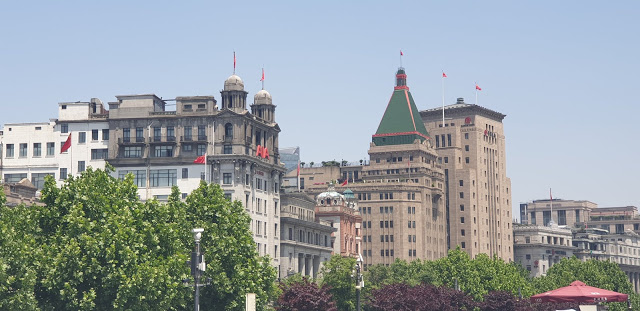
The architecture along the Bund or Waitan is a living museum of the colonial history of the 1800s. The area centers on a section of Zhongshan Road within the former Shanghai International Settlement.
The word bund means an embankment or an embanked quay. It was initially a British settlement; later the British and American settlements were combined in the International Settlement.
The Bund is a mile-long stretch of waterfront promenade along the Huangpu River. There are 52 buildings of various architectural styles, including Gothic, baroque, and neoclassical styles. The area is often referred to as “the museum of buildings”.
Building styles include Romanesque Revival, Gothic Revival, Renaissance Revival, Baroque Revival, Neo-Classical or Beaux-Arts, as well as a number in Art Deco style.
Having seen these buildings initially the night before, mostly lit up, our viewing this morning was from the land side, and particularly interesting in that the colonial architecture was really fascinating considering their location, but not surprising given Shanghai’s history. A lot of these buildings would be more at home in London, that out in the far east.
The Bund waterfront is about two kilometers long and impossible to cover in the time allowed for this part of the tour.
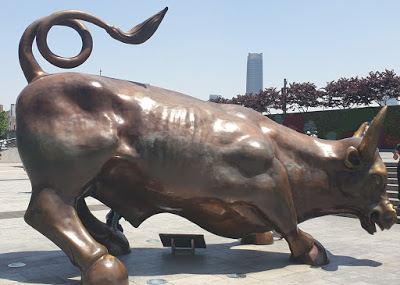
There was just enough time to get photos of the waterfront and the old buildings.
Some of these buildings had odd shapes, like one on the far right that looks like a bottle opener.
And, for some odd reason, a bull.
On the other side of the water, the sights that had been quite colorful the night before, were equally impressive though somewhat diminished by the haze.