As some may be aware, but many not, Chester, my faithful writing assistant, mice catcher, and general pain in the neck, passed away some years go.
Recently I was running a series based on his adventures, under the title of Past Conversations with my cat.
For those who have not had the chance to read about all of his exploits I will run the series again from Episode 1
These are the memories of our time together…
This is Chester. He’s not happy we’re cleaning the office.
I guess I’m not either.
But…
It’s school holidays and it’s natural that while parents are working grandparents take up the slack as childminders. The trick is keeping them amused, and away from computers or being planted in front of the TV.
Of course, knowing the level of fear the grandchildren can bring to the cat, he views their arrival with some apprehension, keeping his distance.
Based on previous experiences, he is assuming they will remain out of the office on the computer for one, and on the smartphone for the other, so he slinks down the passage and quickly runs into the office.
Is this going happen often, he asks.
They’re on holidays, it’s here or daycare, and I’d rather it be here.
Then they appear at the doorway. “OK. We’re here to clean the room. Where do we start?”
Chester’s cornered. He knows it. I know it, and worse still, they know it.
He disappears under the desk, safe for the moment, but it’s going to be a long morning.
I’m back home and this story has been sitting on the back burner for a few months, waiting for some more to be written.
The trouble is, there are also other stories to write, and I’m not very good at prioritizing.
But, here we are, a few minutes opened up and it didn’t take long to get back into the groove.
Chasing leads, maybe
—–
“You left a paper trail, a car registration form at the flat in Bromley.”
I saw him shake his head. “I thought I’d removed any evidence.”
“Good thing then, that I found it, and not Severin who was next through the door.”
He nodded towards Jennifer. “What’s she doing here, she was one of your surveillance team.”
“She came with me. The department threw her out, I found her and asked her if she wanted to find out what was going on. Apparently, she did. Everyone can put their guns down now. We are, believe it or not, all friends here.”
Jennifer put her gun back in a pocket I hadn’t seen before.
Adam lowered his, but it was still ready to shoot if either of us made the wrong move. The old woman’s aim hadn’t changed; she was still intent on shooting me if I moved.
“Mother, give it up.”
A few seconds later she lowered the weapon, but it was still ready. To fire if I moved.
“Can we sit,” I asked. Having a gun aimed at you tended to make you feel week in the knees. I was.
There were three chairs in front of the fireplace, this room also having a fire ready but not lit, and one chair by the writing-table. We sat in the three chairs, the old woman over by the table. She put the rifle down on the desktop, within easy reach.
“My first question,” I said, “has to be, how are you still alive?”
“You left when Severin’s crew arrived to clean up. He left at the same time. Luckily. Then two of Dobbin’s agents arrived and cleaned up the cleaners, as it were, and took me to a safe place where it was discovered my injuries were not fatal.”
“You were hit by a sniper, that’s hard to believe he, or she, aimed to miss.”
“They didn’t. I think I moved slightly because of you, so I have you to thank for my life. Something else to remember, Dobbin doesn’t know I’m here, and I think the only link was that registration certificate. No one actually knows me by Adam Quigley, except, of course, my mother.
“And the USB everyone is after?”
A few seconds of silence, then, “It’s missing.”
“Were you the only one who knew where it was?”
“No, but as far as I’m aware, that person is dead, killed by the explosion you witnessed. We were due to meet there, just before the explosion which is why I was heading there.”
“You walked past it, as I recall.”
“Standard procedure. I walk past, check to see if the contact is there, then come back a few minutes later. I was running late, just got past when it went up. We would have both been in there, and dead.”
“And the USB gone with it?”
“Yes. My friend had it with him at the time. I was going there to pick it up.”
“No copies?” It was too much to expect there would be, even if it was worth more than life itself.
“No. That sort of information needs to be in as few places as possible.”
“You knew what it was about?”
“Yes.”
“And…”
“It’s above all our pay grades. But something I can tell you; I know why your Severin and Maury wanted it back.”
“It was theirs?”
“Yes. They originally stole it. I stole it from them and trying to return it to whom it belonged.”
“Nobbin?”
“God, no. I’ve since discovered he’s as crooked as all the rest. But now that it’s gone, it doesn’t matter who the owner of the information is. Just staying one step ahead of the jackals, that’s the job in hand.”
The Writer’s Crossroads: When Is It Time to Hang Up the Quill?
Imagine for a moment. You’ve been writing for years, pouring your heart onto the page, publishing works on free sites, trying to garner a following. You’ve self-published your books on Amazon, seeing them as the culmination of countless hours, endless revisions, and boundless passion.
People read your stories. Most comments are of praise, echoing the beauty of your prose, the depth of your characters, the compelling nature of your plots. Reviews are overwhelmingly 4 and 5 stars, a testament to the quality you know you possess.
But sales? Only a few every week. A trickle, not the torrent you dreamed of, not the steady stream you need to even consider this a sustainable path.
And your query letters – letters you know are nothing short of brilliant, honed to perfection, showcasing your voice and vision – always come back with the same result: rejection. A polite “not for us,” or worse, silent dismissal.
It’s a scenario many writers know intimately, a soul-crushing paradox where internal validation clashes brutally with external reality. The question starts small, a whisper in the dark, then grows into a gnawing doubt: When is the time to hang up the quill?
The Pain of the Unseen Success
This isn’t about lacking talent. Your readers tell you otherwise. This isn’t about lack of effort. Years of dedication speak for themselves. This is about the heartbreaking disconnect between the quality of your work and its market reception. It’s about the emotional toll of constant rejection despite undeniable praise. It’s about feeling invisible in a crowded, noisy world.
Before You Hang It Up: Revisit Your “Why”
Before you even consider putting down your pen for good, ask yourself one crucial question: Why do you write?
Is it for the joy of creation? Does the act of building worlds, crafting characters, and weaving narratives bring you profound satisfaction, regardless of external validation?
Is it because you have stories that demand to be told? Do these ideas bubble up inside you, insistent, needing to be set free?
Is it for the connection with readers? Do those few 4 and 5-star reviews, those occasional heartfelt comments, fuel your spirit enough to keep going?
Is it for fame and fortune? Be honest. If it’s only for the big advance, the bestseller list, or the movie deal, then the current reality is indeed devastating.
The answer to this “why” is your compass.
When NOT to Hang Up the Quill
You might not be ready to quit if:
The creative spark still ignites you. If writing still feels like breathing, like an essential part of who you are, then the fire isn’t out.
Those few readers truly matter. If those handful of steady sales, those glowing reviews, remind you that your words do touch people, however few, don’t underestimate that impact.
You haven’t truly explored all avenues. Have you tried different genres? Different marketing strategies (even self-taught ones)? Different writing communities? Different approaches to querying (pitching a different book, refining your synopsis)?
You’re still learning and improving. Every rejection, every low sale, can be a data point. Are you actively seeking to understand why things aren’t working and adjusting your approach?
When It Might Be Time to Re-evaluate (Not Necessarily Quit)
There are legitimate reasons to reconsider your path, or at least, your approach:
When the joy is gone, replaced by resentment. If writing has become a bitter chore, a source of constant stress and negativity, it might be time to protect your mental well-being.
When your “why” has fundamentally shifted. If you started writing purely for the love of it, but now find yourself only chasing external metrics that aren’t materializing, and that chase is draining you, it’s time to check in.
When you’ve genuinely exhausted all strategic and emotional resources. If you’ve tried everything you can think of, sought professional advice, taken breaks, and still feel utterly depleted with no hope in sight, take a step back.
When the opportunity cost is too high. Is the time and energy you pour into writing preventing you from pursuing other passions, or even just living a balanced life?
Beyond Quitting: What Else Can You Do?
Hanging up the quill doesn’t have to be a surrender; it can be a pivot.
Take a Break, Not a Surrender: Step away for weeks or months. Let the creative well refill without pressure. Sometimes, absence makes the heart grow fonder, and new perspectives emerge.
Re-evaluate Your Strategy (Ruthlessly):
Marketing: Are you doing anything to market your self-published books effectively? This is often the biggest blind spot for writers. Learn about Amazon ads, social media, building an author platform.
Genre/Market: Is your brilliant work in a niche that’s too small? Or is it hard to categorize? Sometimes, a slight shift in genre or understanding market trends can make a huge difference.
Query Letters: Are they truly brilliant, or simply well-written? A brilliant query letter is strategic. It targets the right agent, highlights marketability, and hints at the “hook.” Consider professional query critiques.
Professional Feedback: Move beyond friends and family. Invest in a professional editor or sensitivity reader who can give you objective, market-aware advice on your manuscript’s strengths and weaknesses.
Redefine Success: Does success have to be a bestseller? Can it be the joy of finishing a manuscript? The connection with those few devoted readers? The personal growth you’ve experienced through the craft?
Write for Yourself (Again): If you’ve been constantly chasing trends or trying to impress agents, go back to writing the story only you can tell, purely for your own satisfaction. Publish it anonymously if you wish.
Explore Other Creative Outlets: Maybe your creative energy needs a different channel for a while – painting, music, coding, baking. It can refresh your writing perspective.
The Personal Journey
There’s no universal answer to “When is the time to hang up the quill?” It’s a deeply personal decision, one that only you can make. It’s not about being a “failure” if you choose to step back, nor is it about being “naive” if you choose to persist.
Listen to your writer’s heart. Does it still beat with the rhythm of stories untold? Does the mere thought of not writing feel like losing a part of yourself? If so, then perhaps it’s not time to hang up the quill. Perhaps, it’s simply time to sharpen it, to learn a new stroke, and to write a different kind of story – your own story of resilience, adaptation, and unwavering passion.
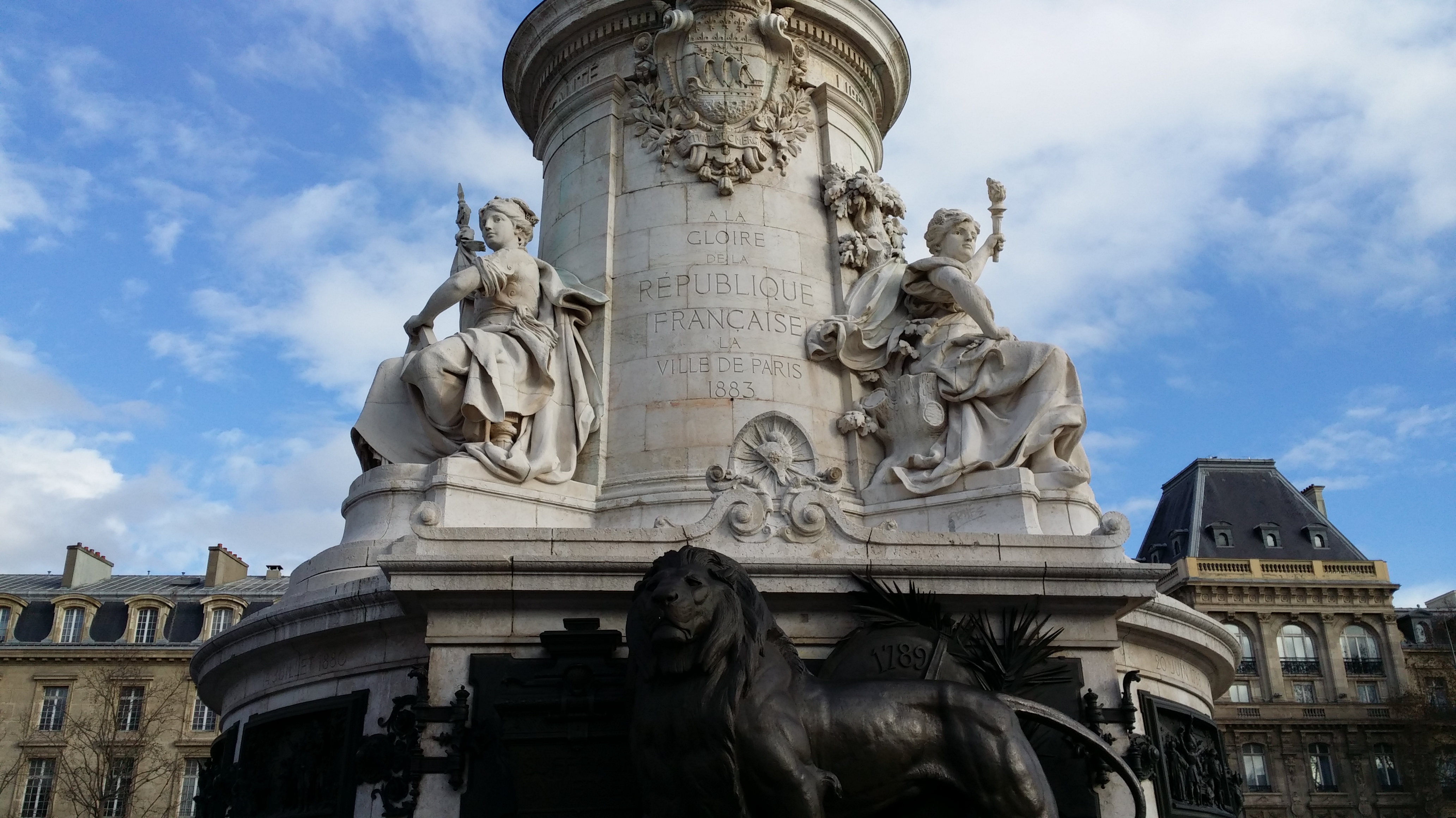
Whilst a rather important place for the French, for us visitors, it has a convenient hotel located just behind the square, and an underground, or Metro station, underneath.
Added to that was equally convenient cafes, one of which, The Cafe Republique, we had dinner every night. The service and food were excellent, and we had no problems with the language barriers.
At the top of the monument is a bronze statue of Marianne, said to be the personification of France.
Surrounding Marianne is three more statues, representing liberty, equality, and fraternity.
At the base is a lion guarding what is said to be a ballot box.
I first started writing by longhand, still do, in fact, then graduated to my mother’s portable, then moved upwards into the electric world having a pair of IBM electric typewriters I bought form one of the places I worked as second-hand cast-offs.
Until that is, I could no longer buy ribbons for my IBM Selectric, so it had to go the way of the dinosaurs.
IT was a good thing, then, that computers and word processing software started at about the same time.
So…
I didn’t get to sit down in front of the computer, well, to write that is. I thought I would go searching for some inspiration.
Bad idea.
It’s just that in that short distance, from, say, the couch where you were reading the latest blog posts in the WordPress reader, and the writers chair, your preparation for writing ends up getting confused at some of the pro-Trump and anti Trump bloggers, because it’s hard to find anything relevant to the man and his politics.
People seem to be radically for or radically opposed and there’s no middle ground. How does Government work in such a political climate?
But, there you are, my attention has been distracted and unless I’m about to indulge in political satire, I’m off track, with an out of balance mindset, and therefore unable to write.
Perhaps I should not read blog posts, but the newspapers.
Or not, because they all have an editorial policy that leans either and one way or another, which means their views are not necessarily unbiased.
I was a journalist once and hated the idea of having to toe the editorial line.
I’m coming around to thinking that it’s probably best left to the dark hours of the night when you would think all the distractions are behind you. After all, isn’t that what daytime is for?
With my attention elsewhere, I walked into a man who was hurrying in the opposite direction. He was a big man with a scar running down the left side of his face from eye socket to mouth, and who was also wearing a black shirt with a red tie.
That was all I remembered as my heart almost stopped.
He apologized as he stepped to one side, the same way I stepped, as I also muttered an apology.
I kept my eyes down. He was not the sort of man I wanted to recognize later in a lineup. I stepped to the other side and so did he. It was one of those situations. Finally getting out of sync, he kept going in his direction, and I towards the bus, which was now pulling away from the curb.
Getting my breath back, I just stood riveted to the spot watching it join the traffic. I looked back over my shoulder, but the man I’d run into had gone. I shrugged and looked at my watch. It would be a few minutes before the next bus arrived.
Wait, or walk? I could also go by subway, but it was a long walk to the station. What the hell, I needed the exercise.
At the first intersection, the ‘Walk’ sign had just flashed to ‘Don’t Walk’. I thought I’d save a few minutes by not waiting for the next green light. As I stepped onto the road, I heard the screeching of tires.
A yellow car stopped inches from me.
It was a high powered sports car, perhaps a Lamborghini. I knew what they looked like because Marcus Bartleby owned one, as did every other junior executive in the city with a rich father.
Everyone stopped to look at me, then the car. It was that sort of car. I could see the driver through the windscreen shaking his fist, and I could see he was yelling too, but I couldn’t hear him. I stepped back onto the sidewalk, and he drove on. The moment had passed and everyone went back to their business.
My heart rate hadn’t come down from the last encounter. Now it was approaching cardiac arrest, so I took a few minutes and several sets of lights to regain composure.
At the next intersection, I waited for the green light, and then a few seconds more, just to be sure. I was no longer in a hurry.
At the next, I heard what sounded like a gunshot. A few people looked around, worried expressions on their faces, but when it happened again, I saw it was an old car backfiring. I also saw another yellow car, much the same as the one before, stopped on the side of the road. I thought nothing of it, other than it was the second yellow car I’d seen.
At the next intersection, I realized I was subconsciously heading towards Harry’s new bar. It was somewhere on 6th Avenue, so I continued walking in what I thought was the right direction.
I don’t know why I looked behind me at the next intersection, but I did. There was another yellow car on the side of the road, not far from me. It, too, looked the same as the original Lamborghini, and I was starting to think it was not a coincidence.
Moments after crossing the road, I heard the roar of a sports car engine and saw the yellow car accelerate past me. As it passed by, I saw there were two people in it, and the blurry image of the passenger; a large man with a red tie.
Now my imagination was playing tricks.
It could not be the same man. He was going in a different direction.
In the few minutes I’d been standing on the pavement, it had started to snow; early for this time of year, and marking the start of what could be a long cold winter. I shuddered, and it was not necessarily because of the temperature.
I looked up and saw a neon light advertising a bar, coincidentally the one Harry had ‘found’ and, looking once in the direction of the departing yellow car, I decided to go in. I would have a few drinks and then leave by the back door if it had one.
We have been to Paris a number of times over the years.
The last time we visited Paris we brought the two eldest grandchildren. We took the Eurostar train from St Pancras station direct to Disneyland, then took the free bus from the station to the hotel. The train station was directly outside Disneyland.
We stayed at the Dream Castle Hotel, rather than Disneyland itself as it was a cheaper option and we had a family room that was quite large and breakfast was included every morning. Then it was a matter of getting the free bus to Disneyland.
We spent three days, time which seem to pass far too quickly, and we didn’t get to see everything. They did, however, find the time to buy two princess dresses, and then spent the rest of the time playing dress-ups whenever they could.
In Paris, we stayed at the Crown Plaza at Republique Square.
We took the children to the Eiffel Tower where the fries, and the carousel at the bottom of the tower, seemed to be more memorable than the tower itself. The day we visited, the third level was closed. The day was cold and windy so that probably accounted for the less than memorable visit. To give you some idea of conditions, it was the shortest queue to get in I’ve ever seen.
We traveled on the Metro where it was pointed out to me that the trains actually ran on rubber tires, something I had not noticed before. It was a first for both children to travel on a double-decker train.
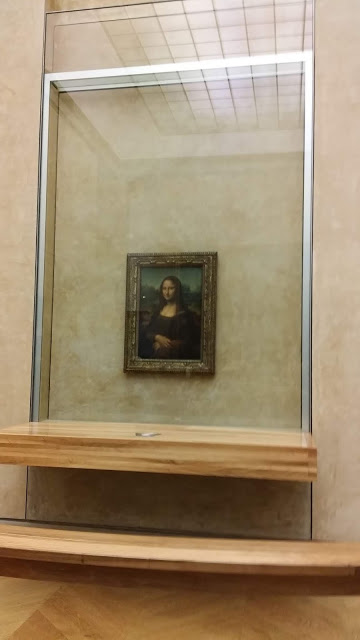
The same day, we went to the Louvre.
Here, it was cold, wet and windy while we waited, Once inside we took the girls to the Mona Lisa, and after a walk up and down a considerable numkber of stairs, one said, “and we walked all this way to see this small painting”.
It quickly became obvious their idea of paintings were the much larger ones hanging in other galleries.
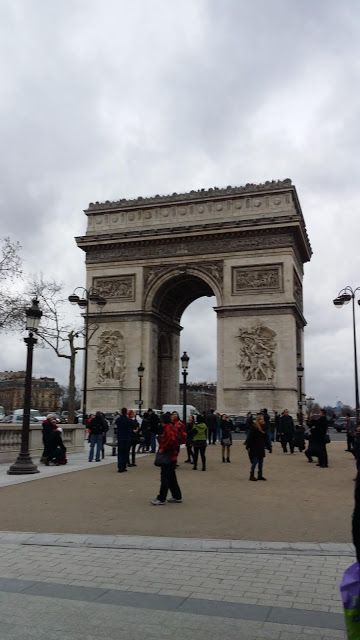
We also took them to the Arc de Triomphe.
We passed, and for some reason had to go into, the Disney shop, which I’m still wondering why after spending a small fortune at Disneyland itself.
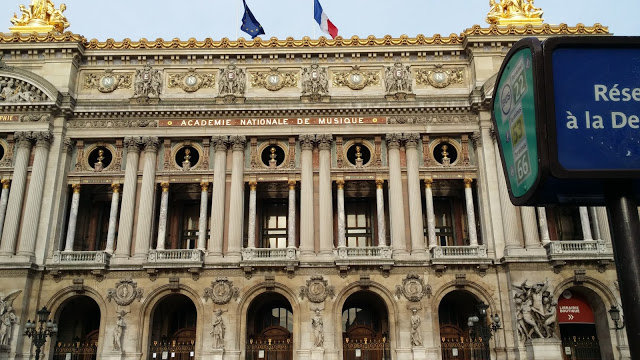
Next on the tour list was the Opera House.
where one of the children thought she saw the ghost and refused to travel in one of the elevators. At least it was quite amazing inside with the marble, staircases, and paintings on the roof.
Sadly, I don’t think they were all that interested in architecture, but at the Opera House, they did actually get to see some ballet stars from the Russian Bolshoi ballet company practicing. As we were leaving the next day we could not go and see a performance.
Last but not least was Notre Dame with its gargoyles and imp[osing architecture.
All in all, traveling with children and experiencing Paris through their eyes made it a more memorable experience.
The first we visited Paris was at the end of a whirlwind bus tour, seven countries in seven days or something like that. It was a relief to get to Paris and stay two nights if only to catch our breath.
I remember three events from that tour, the visit to the Eiffel Tower, the tour of the night lights, not that we were able to take much in from the inside of the bus, and the farewell dinner in one of the tour guides specially selected restaurants. The food and atmosphere were incredible. It was also notable for introducing us to a crepe restaurant in Montmartre, another of the tour guide’s favorite places.
On that trip to Paris, we also spent an afternoon exploring the Palace of Versailles.
The next time we visited Paris we flew in from London. OK, it was a short flight, but it took all day. From the hotel to the airport, the wait at the airport, departure, flying through time zones, arrival at Charles De Gaulle airport, now there’s an experience, and waiting for a transfer that never arrived, but that’s another story.
I can’t remember where we stayed the first time, it was somewhere out in the suburbs, but the second time we stayed at the Hilton near both the Eiffel Tower and the Australian Embassy, notable only because the concierge was dating an Australian girl working in the Embassy. That was our ticket for special treatment, which at times you need to get around in Paris.
It was the year before 2000 and the Eiffel Tower was covered in lights, and every hour or so it looked like a bubbling bottle of champagne. It was the first time we went to Level 3 of the Tower, and it was well worth it. The previous tour only included Level 2. This time we were acquainted with the fries available on the second level, and down below under the tower.
This time we acquainted ourselves with the Metro, the underground railway system, to navigate our way around to the various tourist spots, such as Notre Dame de Paris, The Louvre, Sacre-Coeur Basilica, and Les Invalides, and, of course, the trip to the crepe restaurant.
We also went to the Louvre for the express purpose of seeing the Mona Lisa, and I came away slightly disappointed. I had thought it to be a much larger painting. We then went to see the statue of Venus de Milo and spent some time trying to get a photo of it without stray visitors walking in front of us. Aside from that, we spent the rest of the day looking at the vast number of paintings, and Egyptian artifacts in the Museum.
We also visited the Opera House which was architecturally magnificent.
The third time we visited Paris we took our daughter, who was on her first international holiday. This time we stayed in a quaint Parisian hotel called Hotel Claude Bernard Saint Germain, (43 Rue Des Ecoles, Paris, 75005, France), recommended to us by a relation who’d stayed there the year before. It was small, and the elevator could only fit two people or one person and a suitcase. Our rooms were on the 4th floor, so climbing the stairs with luggage was out of the question.
It included breakfast and wifi, and it was quite reasonable for the four days we stayed there.
It was close to everything you could want, down the hill to the railway station, and a square where on some days there was a market, and for those days when we were hungry after a day’s exploring, a baguette shop where rolls and salad were very inexpensive and very delicious.
To our daughter we appeared to be experienced travelers, going on the Metro, visiting the Louvre, going, yes once again, to the crepe restaurant and the Basilica at Montmartre, Notre Dame, and this time by boat to the Eiffel Tower. We were going to do a boat rode on the Seine the last time but ran out of time.
We have some magnificent photos of the Tower from the boat.
Lunch on one of the days was at a restaurant not far from the Arc de Triomphe, where our daughter had a bucket of mussels. I was not as daring and had a hamburger and fries. Then we went to the center of the Arch and watched the traffic.
Our first time in Paris the bus driver got into the roundabout just to show us the dangers of driving in an unpredictable situation where drivers seem to take huge risks to get out at their exit. Needless to say, we survived that experience, though we did make a number of circuits.
50 photographs, 50 stories, of which there is one of the 50 below.
They all start with –
A picture paints … well, as many words as you like. For instance:
And the story:
It was once said that a desperate man has everything to lose.
The man I was chasing was desperate, but I, on the other hand, was more desperate to catch him.
He’d left a trail of dead people from one end of the island to the other.
The team had put in a lot of effort to locate him, and now his capture was imminent. We were following the car he was in, from a discrete distance, and, at the appropriate time, we would catch up, pull him over, and make the arrest.
There was nowhere for him to go.
The road led to a dead-end, and the only way off the mountain was back down the road were now on. Which was why I was somewhat surprised when we discovered where he was.
Where was he going?
“Damn,” I heard Alan mutter. He was driving, being careful not to get too close, but not far enough away to lose sight of him.
“What?”
“I think he’s made us.”
“How?”
“Dumb bad luck, I’m guessing. Or he expected we’d follow him up the mountain. He’s just sped up.”
“How far away?”
“A half-mile. We should see him higher up when we turn the next corner.”
It took an eternity to get there, and when we did, Alan was right, only he was further on than we thought.”
“Step on it. Let’s catch him up before he gets to the top.”
Easy to say, not so easy to do. The road was treacherous, and in places just gravel, and there were no guard rails to stop a three thousand footfall down the mountainside.
Good thing then I had the foresight to have three agents on the hill for just such a scenario.
Ten minutes later, we were in sight of the car, still moving quickly, but we were going slightly faster. We’d catch up just short of the summit car park.
Or so we thought.
Coming quickly around another corner we almost slammed into the car we’d been chasing.
“What the hell…” Aland muttered.
I was out of the car, and over to see if he was in it, but I knew that it was only a slender possibility. The car was empty, and no indication where he went.
Certainly not up the road. It was relatively straightforward for the next mile, at which we would have reached the summit. Up the mountainside from here, or down.
I looked up. Nothing.
Alan yelled out, “He’s not going down, not that I can see, but if he did, there’s hardly a foothold and that’s a long fall.”
Then where did he go?
Then a man looking very much like our quarry came out from behind a rock embedded just a short distance up the hill.
“Sorry,” he said quite calmly. “Had to go if you know what I mean.”
I’d lost him.
It was as simple as that.
I had been led a merry chase up the hill, and all the time he was getting away in a different direction.
I’d fallen for the oldest trick in the book, letting my desperation blind me to the disguise that anyone else would see through in an instant.
It was a lonely sight, looking down that road, knowing that I had to go all that way down again, only this time, without having to throw caution to the wind.
The Writer’s Crossroads: When Is It Time to Hang Up the Quill?
Imagine for a moment. You’ve been writing for years, pouring your heart onto the page, publishing works on free sites, trying to garner a following. You’ve self-published your books on Amazon, seeing them as the culmination of countless hours, endless revisions, and boundless passion.
People read your stories. Most comments are of praise, echoing the beauty of your prose, the depth of your characters, the compelling nature of your plots. Reviews are overwhelmingly 4 and 5 stars, a testament to the quality you know you possess.
But sales? Only a few every week. A trickle, not the torrent you dreamed of, not the steady stream you need to even consider this a sustainable path.
And your query letters – letters you know are nothing short of brilliant, honed to perfection, showcasing your voice and vision – always come back with the same result: rejection. A polite “not for us,” or worse, silent dismissal.
It’s a scenario many writers know intimately, a soul-crushing paradox where internal validation clashes brutally with external reality. The question starts small, a whisper in the dark, then grows into a gnawing doubt: When is the time to hang up the quill?
The Pain of the Unseen Success
This isn’t about lacking talent. Your readers tell you otherwise. This isn’t about lack of effort. Years of dedication speak for themselves. This is about the heartbreaking disconnect between the quality of your work and its market reception. It’s about the emotional toll of constant rejection despite undeniable praise. It’s about feeling invisible in a crowded, noisy world.
Before You Hang It Up: Revisit Your “Why”
Before you even consider putting down your pen for good, ask yourself one crucial question: Why do you write?
Is it for the joy of creation? Does the act of building worlds, crafting characters, and weaving narratives bring you profound satisfaction, regardless of external validation?
Is it because you have stories that demand to be told? Do these ideas bubble up inside you, insistent, needing to be set free?
Is it for the connection with readers? Do those few 4 and 5-star reviews, those occasional heartfelt comments, fuel your spirit enough to keep going?
Is it for fame and fortune? Be honest. If it’s only for the big advance, the bestseller list, or the movie deal, then the current reality is indeed devastating.
The answer to this “why” is your compass.
When NOT to Hang Up the Quill
You might not be ready to quit if:
The creative spark still ignites you. If writing still feels like breathing, like an essential part of who you are, then the fire isn’t out.
Those few readers truly matter. If those handful of steady sales, those glowing reviews, remind you that your words do touch people, however few, don’t underestimate that impact.
You haven’t truly explored all avenues. Have you tried different genres? Different marketing strategies (even self-taught ones)? Different writing communities? Different approaches to querying (pitching a different book, refining your synopsis)?
You’re still learning and improving. Every rejection, every low sale, can be a data point. Are you actively seeking to understand why things aren’t working and adjusting your approach?
When It Might Be Time to Re-evaluate (Not Necessarily Quit)
There are legitimate reasons to reconsider your path, or at least, your approach:
When the joy is gone, replaced by resentment. If writing has become a bitter chore, a source of constant stress and negativity, it might be time to protect your mental well-being.
When your “why” has fundamentally shifted. If you started writing purely for the love of it, but now find yourself only chasing external metrics that aren’t materializing, and that chase is draining you, it’s time to check in.
When you’ve genuinely exhausted all strategic and emotional resources. If you’ve tried everything you can think of, sought professional advice, taken breaks, and still feel utterly depleted with no hope in sight, take a step back.
When the opportunity cost is too high. Is the time and energy you pour into writing preventing you from pursuing other passions, or even just living a balanced life?
Beyond Quitting: What Else Can You Do?
Hanging up the quill doesn’t have to be a surrender; it can be a pivot.
Take a Break, Not a Surrender: Step away for weeks or months. Let the creative well refill without pressure. Sometimes, absence makes the heart grow fonder, and new perspectives emerge.
Re-evaluate Your Strategy (Ruthlessly):
Marketing: Are you doing anything to market your self-published books effectively? This is often the biggest blind spot for writers. Learn about Amazon ads, social media, building an author platform.
Genre/Market: Is your brilliant work in a niche that’s too small? Or is it hard to categorize? Sometimes, a slight shift in genre or understanding market trends can make a huge difference.
Query Letters: Are they truly brilliant, or simply well-written? A brilliant query letter is strategic. It targets the right agent, highlights marketability, and hints at the “hook.” Consider professional query critiques.
Professional Feedback: Move beyond friends and family. Invest in a professional editor or sensitivity reader who can give you objective, market-aware advice on your manuscript’s strengths and weaknesses.
Redefine Success: Does success have to be a bestseller? Can it be the joy of finishing a manuscript? The connection with those few devoted readers? The personal growth you’ve experienced through the craft?
Write for Yourself (Again): If you’ve been constantly chasing trends or trying to impress agents, go back to writing the story only you can tell, purely for your own satisfaction. Publish it anonymously if you wish.
Explore Other Creative Outlets: Maybe your creative energy needs a different channel for a while – painting, music, coding, baking. It can refresh your writing perspective.
The Personal Journey
There’s no universal answer to “When is the time to hang up the quill?” It’s a deeply personal decision, one that only you can make. It’s not about being a “failure” if you choose to step back, nor is it about being “naive” if you choose to persist.
Listen to your writer’s heart. Does it still beat with the rhythm of stories untold? Does the mere thought of not writing feel like losing a part of yourself? If so, then perhaps it’s not time to hang up the quill. Perhaps, it’s simply time to sharpen it, to learn a new stroke, and to write a different kind of story – your own story of resilience, adaptation, and unwavering passion.
Revenge is a dish best served cold – or preferably so when everything goes right
Of course, it rarely does, as Alistair, Zoe’s handler, discovers to his peril. Enter a wildcard, John, and whatever Alistair’s plan for dealing with Zoe was dies with him.
It leaves Zoe in completely unfamiliar territory.
…
John’s idyllic romance with a woman who is utterly out of his comfort zone is on borrowed time. She is still trying to reconcile her ambivalence, after being so indifferent for so long.
They agree to take a break, during which she disappears. John, thinking she has left without saying goodbye, refuses to accept the inevitable, calls on an old friend for help in finding her.
After the mayhem and being briefly reunited, she recognises an inevitable truth: there is a price to pay for taking out Alistair; she must leave and find them first, and he would be wise to keep a low profile.
But keeping a low profile just isn’t possible, and enlisting another friend, a private detective and his sister, a deft computer hacker, they track her to the border between Austria and Hungary.
What John doesn’t realise is that another enemy is tracking him to find her too. It could have been a grand tour of Europe. Instead, it becomes a race against time before enemies old and new converge for what will be an inevitable showdown.