One the first things you notice when driving around Beijing, other than the roads are congested with traffic, is the number of trees and flowers that have been planted, in the median strip as well as along the edges of the road.
What you also notice is the large number of multi-story apartment blocks, which are needed to house the millions of Beijing residents. What we have, so far, rarely seen, is single-story houses. These continuous areas of trees and rose bushes are, every now and then, broken up by very colorful garden beds:
Nearer to the square we are able to get up close to the flowers. These, we are told, are a variation on the rose, one that flowers for nine months of the year.
They come in a variety of colors.
And they are literally everywhere you go, on the side of the roadway, often blotting out the concrete jungle behind them.
I think that most authors are their own worst enemies!
Just when you think that the story is done, and you’re on the third re-read, just to make sure…
Damn!
I don’t like the way that chapter reads, and what’s worse, it’s about the tenth time I’ve looked at it.
It doesn’t matter the last three times you read it, it was just fine, or the editor has read it, and the chapter passed without any major comment.
I think the main problem I have is letting go. For some odd reason, certain parts of a story sometimes seem to me as though they are not complete, or may be missing a vital clue or connection for the story’s continuity.
That, of course, happens when you rewrite a section that is earlier in the story, and then have to make ongoing changes.
Yes, I hear the stern warnings that I should have made a comprehensive outline at the beginning, but the trouble is, I can change the ending as I’m writing it and then must go back and add the hooks earlier on. Not the best method, but isn’t that what an editor is for, to pick up the missed connections and out-of-the-blue events that happen for no reason?
I find that often after leaving a finished story for a month before the next reading, the whole picture must formulate itself in my head, so when I re-read, there was always a problem, one I didn’t want to think about until the re-read.
Even then, it might survive a second pass.
I know the scene is in trouble when I get to it, and alarm bells are going off. I find anything else to do but look at it.
So, here I am, making major changes.
But at least now I am satisfied with where it’s going.
Beijing Zoo Founded in 1906 during the late Qing dynasty, it is the oldest Zoo in China. It also has an aquarium and has 450 land-based species, some of which are rare and endemic to China like the Giant Panda, and 500 marine-based species. Other rare animals to be seen are the Red Panda, the Golden Snub-nosed Monkey, the South China Tiger, the White Lipped deer, the Chinese alligator, the Yak, and the Snow Leopard.
Most of the original animals were bought in 1908 from Germany by the viceroy of Liangjiang Duanfang. The Zoo first opened on June 16th, 1908. Currently, the Zoo grounds resemble classical Chinese gardens, and among the attractions are a number of Qing dynasty buildings to view, as well as an Elephant hall, a Lion and tiger hall, a Monkey hall, and a Panda hall. In all, there are 30 halls. The Zoo is located at 137 Xizhimen WaiDajie in Xicheng district, near the 2nd ring road.
We are primarily at the Zoo to see the Pandas, and there is a specific hall devoted to them, and by the way, it costs extra to see them. Everyone in our group is particularly interested in seeing them because it’s rare that any can be found anywhere else in the world. Perhaps if there had been more time, another hour, maybe, it might have made all the difference, but I think that extra time might have clashed with the pearl factory, and that, for obvious reasons, was deemed to be more important.
Our first stop is in the Panda hall.
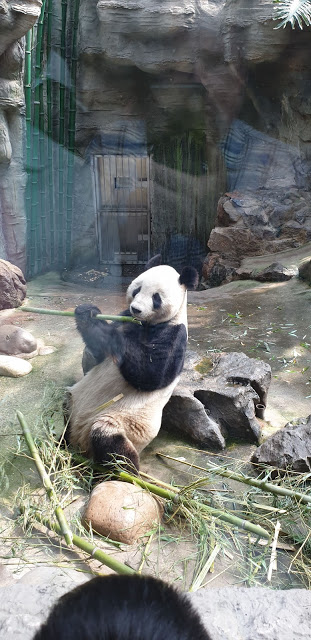
There are two pandas that we can see, one of whom is a little camera shy, and the other, above, who is demonstrating how pandas eat bamboo. They are behind a large glass wall, and you have to wait for the opportunity to get a good photo, and sometimes, only enough to include the top of the head of the person in front of you. Unfortunately, the Chinese visitors don’t understand the polite excuse me in English and can, at times, be rude enough to shove their way to the front.
What is also a problem is the uncooperativeness of the pandas to pose for photos. I guess there’s no surprise there, given the thousands of visitors every day with only one purpose in mind. We counted ourselves lucky to get the photos we did.
The hall itself is built onto the external enclosure, where there are several giant pandas, some of whom were on show, and were relatively lethargic, as though they had a big weekend, and we’re sleeping it off, like this panda below:
Then, remarkably, we came across one that decided to be a little more energetic and did a walk in front of hundreds of Chinese who had undoubtedly come to show their children the animals.
This Panda was also easier to photograph, whereas the other panda, one chewing on a morning feast of bamboo, saw a lot of pushing and shoving by the spectators to get the best spot to take his photograph. Having manners just doesn’t cut it here, so do what you have to get that photograph.
We also saw a couple of monkeys that were in the panda enclosure, but they were not much of a side benefit. They may have been there to use the Panda’s exercise equipment, though it was not quite like what we use. There was no time really to wander off to see much else, but apparently, there were also red pandas, and surprisingly, a category called Australian animals. But who goes to another country to view their own animals? The cutest animals were the stuffed pandas, and they were quite reasonably priced.
50 photographs, 50 stories, of which there is one of the 50 below.
They all start with –
A picture paints … well, as many words as you like. For instance:
And, the story:
Have you ever watched your hopes and dreams simply just fly away?
Everything I thought I wanted and needed had just left in an aeroplane, and although I said I was not going to, i came to the airport to see the plane leave. Not the person on it, that would have been far too difficult and emotional, but perhaps it was symbolic, the end of one life and the start of another.
But no matter what I thought or felt, we had both come to the right decision. She needed the opportunity to spread her wings. It was probably not the best idea for her to apply for the job without telling me, but I understood her reasons.
She was in a rut. Though her job was a very good one, it was not as demanding as she had expected, particularly after the last promotion, but with it came resentment from others on her level, that she, the youngest of the group would get the position.
It was something that had been weighing down of her for the last three months, and if noticed it, the late nights, the moodiness, sometimes a flash of temper. I knew she had one, no one could have such red hair and not, but she had always kept it in check.
And, then there was us, together, and after seven years, it felt like we were going nowhere. Perhaps that was down to my lack of ambition, and though she never said it, lack of sophistication. It hadn’t been an issue, well, not until her last promotion, and the fact she had to entertain more, and frankly I felt like an embarrassment to her.
So, there it was, three days ago, the beginning of the weekend, and we had planned to go away for a few days and take stock. We both acknowledged we needed to talk, but it never seemed the right time.
It was then she said she had quit her job and found a new one. Starting the following Monday.
Ok, that took me by surprise, not so much that it something I sort of guessed might happen, but that she would just blurt it out.
I think that right then, at that moment, I could feel her frustration with everything around her.
What surprised her was my reaction. None.
I simply asked where who, and when.
A world-class newspaper, in New York, and she had to be there in a week.
A week.
It was all the time I had left with her.
I remember I just shrugged and asked if the planned weekend away was off.
She stood on the other side of the kitchen counter, hands around a cup of coffee she had just poured, and that one thing I remembered was the lone tear that ran down her cheek.
Is that all you want to know?
I did, yes, but we had lost that intimacy we used to have when she would have told me what was happening, and we would have brainstormed solutions. I might be a cabinet maker but I still had a brain, was what I overheard her tell a friend once.
There’s not much to ask, I said. You’ve been desperately unhappy and haven’t been able to hide it all that well, you have been under a lot of pressure trying to deal with a group of troglodytes, and you’ve been leaning on Bentley’s shoulder instead of mine, and I get it, he’s got more experience in that place, and the politics that go with it, and is still an ally.
Her immediate superior and instrumental in her getting the position, but unlike some men in his position he had not taken advantage of a situation like some men would. And even if she had made a move, which I doubted, that was not the sort of woman she was, he would have politely declined.
One of the very few happily married men in that organisation, so I heard.
So, she said, you’re not just a pretty face.
Par for the course for a cabinet maker whose university degree is in psychology. It doesn’t take rocket science to see what was happening to you. I just didn’t think it was my place to jump in unless you asked me, and when you didn’t, well, that told me everything I needed to know.
Yes, our relationship had a use by date, and it was in the next few days.
I was thinking, she said, that you might come with me, you can make cabinets anywhere.
I could, but I think the real problem wasn’t just the job. It was everything around her and going with her, that would just be a constant reminder of what had been holding her back. I didn’t want that for her and said so.
Then the only question left was, what do we do now?
Go shopping for suitcases. Bags to pack, and places to go.
Getting on the roller coaster is easy. On the beginning, it’s a slow easy ride, followed by the slow climb to the top. It’s much like some relationships, they start out easy, they require a little work to get to the next level, follows by the adrenaline rush when it all comes together.
What most people forget is that what comes down must go back up, and life is pretty much a roller coaster with highs and lows.
Our roller coaster had just come or of the final turn and we were braking so that it stops at the station.
There was no question of going with her to New York. Yes, I promised I’d come over and visit her, but that was a promise with crossed fingers behind my back. After a few months in t the new job the last thing shed want was a reminder of what she left behind. New friends new life.
We packed her bags, three out everything she didn’t want, a free trips to the op shop with stiff she knew others would like to have, and basically, by the time she was ready to go, there was nothing left of her in the apartment, or anywhere.
Her friends would be seeing her off at the airport, and that’s when I told her I was not coming, that moment the taxi arrived to take her away forever. I remember standing there, watching the taxi go. It was going to be, and was, as hard as it was to watch the plane leave.
So, there I was, finally staring at the blank sky, around me a dozen other plane spotters, a rather motley crew of plane enthusiasts.
Already that morning there’s been 6 different types of plane depart, and I could hear another winding up its engines for take-off.
People coming, people going.
Maybe I would go to New York in a couple of months, not to see her, but just see what the attraction was. Or maybe I would drop in, just to see how she was.
As one of my friends told me when I gave him the news, the future is never written in stone, and it’s about time you broadened your horizons.
It may have been amusing back when I was a child, stepping through a broken mirror and imagining i had gone back in time, to an age when the house was a beautiful old mansion.
Once it was a landmark, a place with many rooms and a sprawling, manicured garden surrounding it, with a maze and a lake with fish.
Now it was a frightening outline against a dark, lightning-filled sky, surrounded by townsfolk who wanted the eyesore demolished.
The city authorities had issued a repair order on the house and gardens, and failure to comply would see it declared unfit for habitation and a demolition order.
The thing is, my grandmother, a very sprightly 90-year-old, was determined to fight them and everyone else, often brandishing her trusty old blunderbuss at anyone who dared to breach the front gates.
The mayor’s brother wanted the land so he could finish his condominium conversion and fulfil his promise to the other condo holders that the noise would be gone and a golf course and swimming pool, along with a clubhouse and cinema, would be built.
She was fighting a losing battle.
She didn’t have the money to do the repairs or to fight any more court battles.
My mother didn’t see the point. The developer had offered five million, enough to get a new house somewhere else. Gran wanted twenty million, what it was worth. The authorities were going to resume it for one million.
Such machinations were beyond my comprehension. I might be older now, but it was still a fairytale castle. Just the duel curved staircase from the foyer to the first floor was magic.
I had seen my sister descend that staircase in her prom dress like a princess, and could imagine all who came before her.
Standing in the middle of the ballroom, it was not hard to imagine the dances held there, the people doing a synchronised waltz as I had done once when learning it for my prom, the school orchestra playing, and all the boys and girls dancing.
And the parties it once hosted.
Now dusty, abandoned, silent except for the odd creaking of purported ghosts.
There were eighty rooms, sixty of them bedrooms, in two wings over three floors. Fifteen families were living in the house: my grandmother, each of her eight children, of which my mother was one, twenty-three grandchildren, and seven great-grandchildren.
None of the family left the city where they were born, lived, and most likely would die. None had ever seen the need to leave.
Until now.
I was sitting on the bottom step of the elegant but decrepit staircase, contemplating whether it would be safe to slide down the banister, when Aunt Ruby skipped down the stairs and plonked herself down next to me.
Aunt Ruby was always in Halloween costumes, or so I thought. She kept saying she was a Goth, but I had no idea what that meant.
She was also a computer hacker, and I knew what that was. Every day, we were waiting for the FBI or the CIA to turn up at the front door.
“Guess what?”
“The cops are coming to take you away?”
It was a running joke.
“No. Cracked it. We’re rich.”
Until the cops came and took her away.
“I’ll believe it when I see it.”
She handed me a piece of paper. It had the name of a bank that I had never heard of in the Cayman Islands, in the name of some corporation no one could pronounce.
The sum of money $22,176,328.76.
“You are this corporation?”
“After it slushes through forty-three shell companies that will keep whoever it is used for a year. It’s on its way to a Swiss numbered account, then Cloverville will be born.”
“Cloverville?”
“My money, my name.” She jumped up and ran off to tell Granny.
…
Of course, having the money and deciding what to do were two very different things. Everyone had a very different idea.
My parents wanted their room, already palatial, to be even more so. I wanted my room to be bigger with my own bathroom, now very tired of being last in line. Maybe if I got up earlier…
Everyone wanted a cafeteria and kitchen separate, modelled on the dining room at the Savoy, but my grandmother liked the current kitchen with a wooden stove that kept us all warm in winter and boiling in summer, and we were all together around a large table.
It also meant that we all wanted servants, but as Aunt Ruby said, people didn’t have servants these days, and we had to do our dirty work, like cooking and cleaning, and she would not be employing servants. Gran could remember the day when there were servants, and she said they had never been treated very well or taken for granted.
People were doing it now, so people could keep doing it after the renovations.
Everyone wanted their own TV, and of course, it was going to be like a motel. A TV in every bedroom. Maybe. Aunt Ruby said the children were not getting a TV; they would get an iPad, and that was it. Parents could go to the Cinema Room.
What Cinema Room?
The basement was being cleared out of 200 years of clutter, and it was going to be a cinema, holding about 100 or so people.
I was surprised Aunt Ruby didn’t want to take over the bedroom that my parents were in. That’s when I learned she was taking up residence in the north tower.
It could be said that of all the women one could meet, whether contrived or by sheer luck, what are the odds it would turn out to be the woman who was being paid a very large sum to kill you.
John Pennington is a man who may be lucky in business, but not so lucky in love. He has just broken up with Phillipa Sternhaven, the woman he thought was the one, but relatives and circumstances, and perhaps because she was a ‘princess’, may also have contributed to the end result.
So, what do you do when you are heartbroken?
That is a story that slowly unfolds, from the first meeting with his nemesis on Lake Geneva, all the way to a hotel room in Sorrento, where he learns the shattering truth.
What should have been solace after disappointment, turns out to be something else entirely, and from that point, everything goes to hell in a handbasket.
He suddenly realizes his so-called friend Sebastian has not exactly told him the truth about a small job he asked him to do, the woman he is falling in love with is not quite who she says she is, and he is caught in the middle of a war between two men who consider people becoming collateral damage as part of their business.
The story paints the characters cleverly displaying all their flaws and weaknesses. The locations add to the story at times taking me back down memory lane, especially to Venice where, in those back streets I confess it’s not all that hard to get lost.
All in all a thoroughly entertaining story with, for once, a satisfying end.
I hate it when other characters are drawn in, and without a proper introduction, the reader gets confused.
Well, let me tell you, the writer can get confused too.
The introduction of Jennifer cannot go without the introduction of Ellen Bill’s ex-wife, and we have talked a little about her background before.
She has a role, one that will have a major impact later on, but every now and then she is going to appear, adding to the backstory between her and Bill. There is no real animosity between them, their parting amicable because both knew it was time to end.
Bill’s problems were brought about his military service, and her father has a part to play in the story, though I’m not sure how to weave this in yet. But it’s not so much what Bill remembers of his service, but of what he has forgotten, or more to the point buried.
That will eventually rise to the surface.
However, at this time, it’s still at the part where the narrator has to introduce Jennifer.
There are three distinct stages to this relationship between the two most important characters, and as it happens it’s Ellen unknowingly that brings Bill and Jennifer together,
…
Then Ellen, my estranged, and sometimes difficult wife decided she wanted a divorce. I had no objection, and that was most likely the problem. Perhaps she had expected me to fight for her, but she had made it clear, many years before, that she was no longer interested in preserving the marriage and was only keeping it up until our two daughters were old enough to fend for themselves.
That time had come.
I found myself in a situation where I needed someone to talk to. I was not one of those people who made friends easily, nor did I spend much time seeking the company of other women. I had my work, and it had been enough.
But Ellen’s request for a divorce, for some reason, had shaken me, and the day I got the phone call, Jennifer has bustled into my office as she always did, dumping the pile of log file printouts on my desk, and instead of leaving, perhaps she had seen my look of dismay, or more to the point, utter shock, and stayed.
It caused a slight change in our relationship.
…
I’m still working on it, but there will be more.
Or perhaps fewer words, after all, it’s only meant to be a brief introduction.
See how simple things become complicated, very quickly.
It looked like a military camp, but the soldiers were not like my captor. They were as I had expected, of foreign origin. The woman driving the pickup was American, and also the last person I’d expect to see in what was quite obviously a military camp.
The pickup stopped with the brakes squealing outside a large wooden building covered in camouflage netting. The man sitting next to me got up, jumped off the end of the vehicle. The woman got out, they exchanged words in quiet voices I could not hear properly, then she walked away.
He walked down the side of the vehicle hitting the metal side quite hard. To wake me up, perhaps.
“Get down Mr. James. I’m not buying the jelly legs anymore.”
I shrugged. I hadn’t been pretending when they picked me up but maybe he knew my condition better than I did. I didn’t think it was worth annoying him.
I slid to the end of the well and dangled my legs over the side then slipped slowly till my feet touched the ground. Aches and pains in my ankles and knees, but they would hold me up.
Time to move on.
He stood beside me. “This way.”
As I surmised, we went into the wooden building, down a narrow passageway for a distance, and, judging by the gentle downward slope and the temperature drop, we were either going into a cave or underground.
A minute, two, then he stopped and opened a door. “Inside.”
I took a deep breath and stepped into the room, expecting to be either shot or worse.
But it was nothing like that. It was just an empty room with a camp stretcher.
The man put his head in the doorway. “Get some rest, Mr. James.”
The door swung shut and I heard the key turn in the lock. This was not a room that could readily be escaped from.
When Reality Bites: Navigating Overly Critical Beta Reviews
You pour your heart, soul, and countless hours into your manuscript. You polish it, you fret over it, you dream of the day it shines. Then, with a mixture of excitement and trepidation, you send it off to your beta readers, anticipating encouraging words, a few minor suggestions, and perhaps a high-five for a job well done.
Then the reviews come in. And they’re not what you expected.
Suddenly, those minor suggestions are major critiques. The encouraging words are overshadowed by lists of plot holes, character inconsistencies, and pacing issues. It’s a gut punch, isn’t it? That initial sting of disappointment, perhaps even defensiveness, confusion, and a creeping sense of “What just happened?”
If you’ve just received a batch of overly critical beta reviews that blindsided you, you are far from alone. This is a common and often painful rite of passage for creators of all kinds.
The Gut Punch: When Expectation Meets Harsh Reality
The most challenging part of these reviews isn’t just the criticism itself, but the massive chasm between what we hoped for and what we actually received. We expected validation, a pat on the back, and perhaps a few tweaks. What we got was a stark reminder that our vision, however clear to us, might not be translating as effectively as we thought.
This disconnect can be intensely disheartening. It makes you question your abilities, your story, and even your decision to share your work in the first place.
What to Do When the Feedback Feels Overwhelming
So, you’re reeling. What now? Here’s a practical, empathetic guide to help you move from disappointment to constructive action:
Step Away. Seriously. Your first reaction will likely be emotional. You might feel defensive, angry, or utterly defeated. This is not the headspace for objective analysis. Close the reviews. Go for a walk. Meditate. Vent to a trusted friend (not about the specifics of the reviews, but about how you feel). Give yourself at least 24-48 hours before you even think about looking at them again. Your emotional brain needs to cool down.
Shift Your Perspective: They’re Not Attacking YOU, They’re Helping Your WORK. This is perhaps the hardest mental shift. Beta readers are not paid critics; they’re volunteers who have invested their time to help you. Even if their feedback feels harsh or poorly worded, their intention (mostly) is to assist you in making your project better. They are your first line of defense against a wider, potentially harsher, public. They’re finding the flaws now, so you don’t have to later.
Read with an Editor’s Eye, Not an Author’s Heart. Once you’ve cooled down, go through the reviews again. This time, try to detach. Pretend you’re reading feedback for someone else’s work.
Look for Patterns: Where do multiple readers flag the same issue? These are your “golden nuggets” – the areas that definitively need attention. If three different people say the pacing drags in Chapter 5, that’s not subjective opinion; it’s a verifiable problem.
Distinguish Constructive vs. Unhelpful:
Constructive: “I got confused by Character X’s motivations here,” or “The tension dropped in the middle,” or “I didn’t understand the world-building rules.” These offer a problem you can solve.
Unhelpful: “I just didn’t like it,” or “This isn’t my kind of story,” or “You should change the ending entirely to what I would do.” These are often personal preferences or lack the specificity you need to act.
Prioritize: Make a list of the recurring, actionable issues.
Acknowledge the Gap, Then Bridge It. The unexpected nature of these reviews highlights the gap between your intent and the reader’s experience. This gap isn’t a failure; it’s an opportunity. It means you have clearer targets for revision.
Instead of thinking, “They didn’t get it,” ask, “How can I make it impossible to not get it?”
Instead of, “They’re wrong,” ask, “What in my work led them to this conclusion, and how can I guide them differently?”
Don’t Feel Obligated to Implement Everything. Your work is ultimately yours. You are the captain of your ship. Take the valuable feedback, discard the unhelpful, and politely consider (but don’t necessarily act on) the subjective preferences that don’t align with your core vision. If one reader hates your protagonist and everyone else loves them, that’s likely an outlier opinion.
Moving Forward with Resilience
Receiving critical beta reviews is tough. It can feel like a setback, a betrayal of your hopes. But it’s also an invaluable part of the creative process. It builds resilience, hones your critical eye, and ultimately makes your work stronger.
Remember, the goal of beta readers isn’t to tell you your work is perfect – it’s to help you make it perfect (or as close to it as possible). Embrace the sting, learn from the feedback, and let it fuel your next round of revisions. Your best work is often forged in the fires of honest critique.
Beijing Zoo Founded in 1906 during the late Qing dynasty, it is the oldest Zoo in China. It also has an aquarium and has 450 land-based species, some of which are rare and endemic to China like the Giant Panda, and 500 marine-based species. Other rare animals to be seen are the Red Panda, the Golden Snub-nosed Monkey, the South China Tiger, the White Lipped deer, the Chinese alligator, the Yak, and the Snow Leopard.
Most of the original animals were bought in 1908 from Germany by the viceroy of Liangjiang Duanfang. The Zoo first opened on June 16th, 1908. Currently, the Zoo grounds resemble classical Chinese gardens, and among the attractions are a number of Qing dynasty buildings to view, as well as an Elephant hall, a Lion and tiger hall, a Monkey hall, and a Panda hall. In all, there are 30 halls. The Zoo is located at 137 Xizhimen WaiDajie in Xicheng district, near the 2nd ring road.
We are primarily at the Zoo to see the Pandas, and there is a specific hall devoted to them, and by the way, it costs extra to see them. Everyone in our group is particularly interested in seeing them because it’s rare that any can be found anywhere else in the world. Perhaps if there had been more time, another hour, maybe, it might have made all the difference, but I think that extra time might have clashed with the pearl factory, and that, for obvious reasons, was deemed to be more important.
Our first stop is in the Panda hall.
There are two pandas that we can see, one of whom is a little camera shy, and the other, above, who is demonstrating how pandas eat bamboo. They are behind a large glass wall, and you have to wait for the opportunity to get a good photo, and sometimes, only enough to include the top of the head of the person in front of you. Unfortunately, the Chinese visitors don’t understand the polite excuse me in English and can, at times, be rude enough to shove their way to the front.
What is also a problem is the uncooperativeness of the pandas to pose for photos. I guess there’s no surprise there, given the thousands of visitors every day with only one purpose in mind. We counted ourselves lucky to get the photos we did.
The hall itself is built onto the external enclosure, where there are several giant pandas, some of whom were on show, and were relatively lethargic, as though they had a big weekend, and we’re sleeping it off, like this panda below:
Then, remarkably, we came across one that decided to be a little more energetic and did a walk in front of hundreds of Chinese who had undoubtedly come to show their children the animals.
This Panda was also easier to photograph, whereas the other panda, one chewing on a morning feast of bamboo, saw a lot of pushing and shoving by the spectators to get the best spot to take his photograph. Having manners just doesn’t cut it here, so do what you have to get that photograph.
We also saw a couple of monkeys that were in the panda enclosure, but they were not much of a side benefit. They may have been there to use the Panda’s exercise equipment, though it was not quite like what we use. There was no time really to wander off to see much else, but apparently, there were also red pandas, and surprisingly, a category called Australian animals. But who goes to another country to view their own animals? The cutest animals were the stuffed pandas, and they were quite reasonably priced.