“The Things We Do For Love”

Would you give up everything to be with the one you love?

Is love the metaphorical equivalent to ‘walking the plank’; a dive into uncharted waters?

For Henry, the only romance he was interested in was a life at sea, and when away from it, he strived to find sanctuary from his family and perhaps life itself.  It takes him to a small village by the sea, a place he never expected to find another just like him, Michelle, whom he soon discovers is as mysterious as she is beautiful.

Henry had long since given up the notion of finding romance, and Michelle couldn’t get involved for reasons she could never explain, but in the end, both acknowledge that something happened the moment they first met.  

Plans were made, plans were revised, and hopes were shattered.

A chance encounter causes Michelle’s past to catch up with her, and whatever hope she had of having a normal life with Henry, or anyone else, is gone.  To keep him alive she has to destroy her blossoming relationship, an act that breaks her heart and shatters his.

But can love conquer all?

It takes a few words of encouragement from an unlikely source to send Henry and his friend Radly on an odyssey into the darkest corners of the red-light district in a race against time to find and rescue the woman he finally realizes is the love of his life.

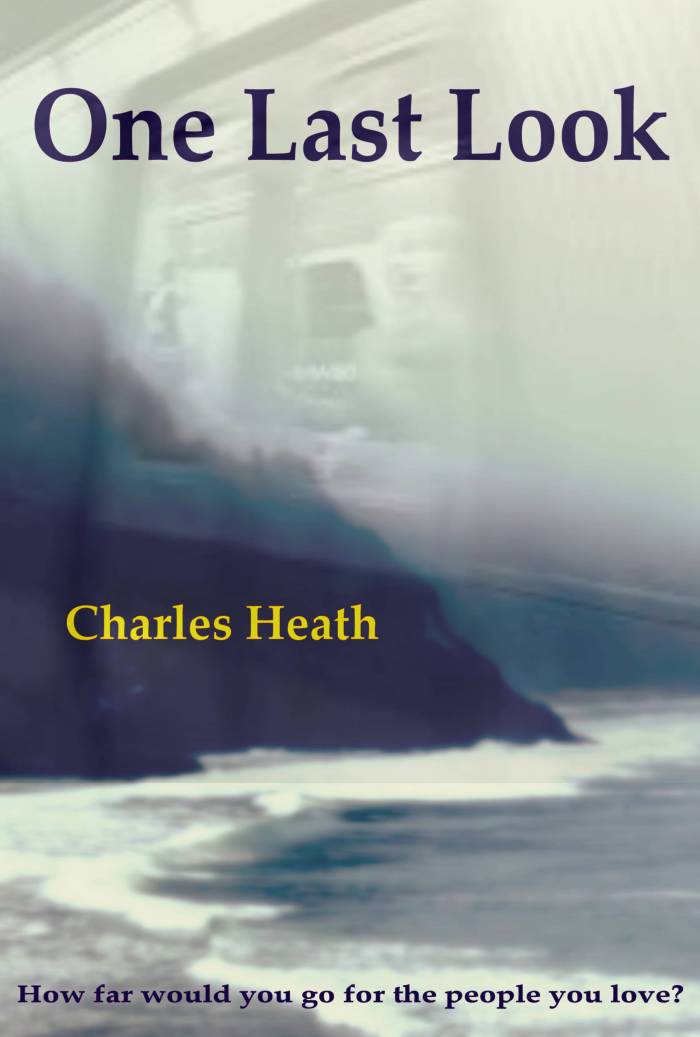
The cover, at the moment, looks like this:

lovecoverfinal1

Is love the metaphorical equivalent to ‘walking the plank’; a dive into uncharted waters?

For Henry, the only romance he was interested in was a life at sea, and when away from it, he strived to find sanctuary from his family and perhaps life itself.  It takes him to a small village by the sea, s place he never expected to find another just like him, Michelle, whom he soon discovers is as mysterious as she is beautiful.

Henry had long since given up the notion of finding romance, and Michelle couldn’t get involved for reasons she could never explain, but in the end, both acknowledge that something happened the moment they first met.  

Plans were made, plans were revised, and hopes were shattered.

A chance encounter causes Michelle’s past to catch up with her, and whatever hope she had of having a normal life with Henry, or anyone else, is gone.  To keep him alive she has to destroy her blossoming relationship, an act that breaks her heart and shatters his.

But can love conquer all?

It takes a few words of encouragement from an unlikely source to send Henry and his friend Radly on an odyssey into the darkest corners of the red-light district in a race against time to find and rescue the woman he finally realizes is the love of his life.

The cover, at the moment, looks like this:

lovecoverfinal1

Searching for locations: Flinders Street Station, Melbourne, Australia

This is the famous clock tower of the Flinders Street Station (the main train station for suburban trains) in Melbourne.

We were staying in a hotel (The Doubletree) directly opposite the station and our room overlooked the station and the clock tower.  I took photos of it during the day:

and this one, at night.  It came out better than I thought it would.

20160302_215639

“One Last Look”, nothing is what it seems

A single event can have enormous consequences.

A single event driven by fate, after Ben told his wife Charlotte he would be late home one night, he left early, and by chance discovers his wife having dinner in their favourite restaurant with another man.

A single event where it could be said Ben was in the wrong place at the wrong time.

Who was this man? Why was she having dinner with him?

A simple truth to explain the single event was all Ben required. Instead, Charlotte told him a lie.

A single event that forces Ben to question everything he thought he knew about his wife, and the people who are around her.

After a near-death experience and forced retirement into a world he is unfamiliar with, Ben finds himself once again drawn back into that life of lies, violence, and intrigue.

From London to a small village in Tuscany, little by little Ben discovers who the woman he married is, and the real reason why fate had brought them together.

It is available on Amazon here:  http://amzn.to/2CqUBcz

Writing a book in 365 days – 148

Day 148

Could any of the classics inspire you?

Given that they were written in a different time, with different people, and far different circumstances, the logical answer would be no.

But, the real question is, had the human condition changed any?

Could we believe that people are still the same people, the same feelings, the same hatreds, the same biases, there’s still poor and rich, and probably somewhere a comfortable middle class.

The rich people still rule the world.

Politicians are still the same greedy, insensitive, uncaring, self serving asses they always have been and always will. Who wants to be a politician? No man or woman in his or her right mind would want, no decent man or woman that is.


Men still covet their neighbour’s wife, or anyone else’s for that matter, we still get jealous, and a certain group still murder other people for sometimes the stupidest of reasons.

Whether it is 1720, 1830, or 1940, it doesn’t matter. We might have moved from horse and cart to automobiles, from stagecoaches to Concord SSTs, thatch cottages to mansions, tinkers to supermarkets, and a life span that used to be 40, to now somewhere in our 80s, but people, the actual human beings, have not changed.

Not one iota.

So, go and read a few of those classic novels, Charles Dickens, T.S. Eliot, George Eliot, Jane Austen, Leo Tolstoy, Laurence Sterne, just to name a few.

Check out what people were doing 200, 300 years ago, and if you read between the lines, you’re going to find they are no different to us. They just dress funny and talk funny, but then so do we, these days.

Scary, isn’t it?

An excerpt from “Mistaken Identity” – a work in progress

The odds of any one of us having a doppelganger are quite high. Whether or not you got to meet him or her, or be confronted by them was significantly lower. Except of course, unless you are a celebrity.

It was a phenomenon remarkable only for the fact, at times, certain high-profile people, notorious or not, had doubles if only to put off enemies or the general public. Sometimes we see people in the street, people who look like someone we knew, and made the mistake of approaching them like a long lost friend, only to discover an embarrassed individual desperately trying to get away for what they perceive is a stalker or worse.

And then sometimes it is a picture that looms up on a TV screen, an almost exact likeness of you. At first, you are fascinated, and then according to the circumstances, and narrative that is attached to that picture, either flattered or horrified.

For me one turned to the other when I saw an almost likeness of me flash up on the screen when I turned the TV on in my room. What looked to be my photo, with only minor differences, was in the corner of the screen, the newsreader speaking in rapid Italian, so fast I could only translate every second or third word.

But the one word I did recognize was murder. The photo of the man up on the screen was the subject of an extensive manhunt. The crime, the murder of a woman in the very same hotel I was staying, and it was being played out live several floors above me. The gist of the story, the woman had been seen with, and staying with the man who was my double, and, less than an hour ago, the body had been discovered by a chambermaid.

The killer, the announcer said, was believed to be still in the hotel because the woman had died shortly before she had been discovered.

I watched, at first fascinated at what I was seeing. I guess I should have been horrified, but at that moment it didn’t register that I might be mistaken for that man.

Not until another five minutes had passed, and I was watching the police in full riot gear, with a camera crew following behind, coming up a passage towards a room. Live action of the arrest of the suspected killer the breathless commentator said.

Then, suddenly, there was a pounding on the door. On the TV screen, plain to see, was the number of my room.
I looked through the peephole and saw an army of police officers. It didn’t take much to realize what had happened. The hotel staff identified me as the man in the photograph on the TV and called the police.

Horrified wasn’t what I was feeling right then.

It was fear.

My last memory was the door crashing open, the wood splintering, and men rushing into the room, screaming at me, waving guns, and when I put my hands up to defend myself, I heard a gunshot.

And in one very confused and probably near-death experience, I thought I saw my mother and thought what was she doing in Rome?

I was the archetypal nobody.

I lived in a small flat, I drove a nondescript car, had an average job in a low profile travel agency, was single, and currently not involved in a relationship, no children, and according to my workmates, no life.

They were wrong. I was one of those people who preferred their own company, I had a cat, and travelled whenever I could. And I did have a ‘thing’ for Rosalie, one of the reasons why I stayed at the travel agency. I didn’t expect anything to come of it, but one could always hope.

I was both pleased and excited to be going to the conference. It was my first, and the glimpse I had seen of it had whetted my appetite for more information about the nuances of my profession.

Some would say that a travel agent wasn’t much of a job, but to me, it was every bit as demanding as being an accountant or a lawyer. You were providing a customer with a service, and arguably more people needed a travel agent than a lawyer. At least that was what I told myself, as I watched more and more people start using the internet, and our relevance slowly dissipating.

This conference was about countering that trend.

The trip over had been uneventful. I was met at the airport and taken to the hotel where the conference was being held with a number of other delegates who had arrived on the same plane. I had mingled with a number of other delegates at the pre conference get together, including one whose name was Maryanne.

She was an unusual young woman, not the sort that I usually met, because she was the one who was usually surrounded by all the boys, the life of the party. In normal circumstances, I would not have introduced myself to her, but she had approached me. Why did I think that may have been significant? All of this ran through my mind, culminating in the last event on the highlight reel, the door bursting open, men rushing into my room, and then one of the policemen opened fire.

I replayed that last scene again, trying to see the face of my assailant, but it was just a sea of men in battle dress, bullet proof vests and helmets, accompanied by screaming and yelling, some of which I identified as “Get on the floor”.

Then came the shot.

Why ask me to get on the floor if all they were going to do was shoot me. I was putting my hands up at the time, in surrender, not reaching for a weapon.

Then I saw the face again, hovering in the background like a ghost. My mother. Only the hair was different, and her clothes, and then the image was going, perhaps a figment of my imagination brought on by pain killing drugs. I tried to imagine the scene again, but this time it played out, without the image of my mother.

I opened my eyes took stock of my surroundings. What I felt in that exact moment couldn’t be described. I should most likely be dead, the result of a gunshot wound. I guess I should be thankful the shooter hadn’t aimed at anything vital, but that was the only item on the plus side.

I was in a hospital room with a policeman by the door. He was reading a newspaper, and sitting uncomfortably on a small chair. He gave me a quick glance when he heard me move slightly, but didn’t acknowledge me with either a nod, or a greeting, just went back to the paper.

If I still had a police guard, then I was still considered a suspect. What was interesting was that I was not handcuffed to the bed. Perhaps that only happened in TV shows. Or maybe they knew I couldn’t run because my injuries were too serious. Or the guard would shoot me long before my feet hit the floor. I knew the police well enough now to know they would shoot first and ask questions later.

On the physical side, I had a large bandage over the top left corner of my chest, extending over my shoulder. A little poking and prodding determined the bullet had hit somewhere between the top of my rib cage and my shoulder. Nothing vital there, but my arm might be somewhat useless for a while, depending on what the bullet hit on the way in, or through.

It didn’t feel like there were any broken or damaged bones.

That was the good news.

On the other side of the ledger, my mental state, there was only one word that could describe it. Terrified. I was looking at a murder charge and jail time, a lot of it. Murder usually had a long time in jail attached to it.

Whatever had happened, I didn’t do it. I know I didn’t do it, but I had to try and explain this to people who had already made up their minds. I searched my mind for evidence. It was there, but in the confused state brought on by the medication, all I could think about was jail, and the sort of company I was going to have.

I think death would have been preferable.

Half an hour later, maybe longer, I was drifting in an out of consciousness, a nurse, or what I thought was a nurse, came into the room. The guard stood, checked her ID card, and then stood by the door.

She came over and stood beside the bed. “How are you?” she asked, first in Italian, and when I pretended I didn’t understand, she asked the same question in accented English.

“Alive, I guess,” I said. “No one has come and told what my condition is yet. You are my first visitor. Can you tell me?”

“Of course. You are very lucky to be alive. You will be fine and make a full recovery. The doctors here are excellent at their work.”

“What happens now?”

“I check you, and then you have a another visitor. He is from the British Embassy I think. But he will have to wait until I have finished my examination.”

I realized then she was a doctor, not a nurse.

My second visitor was a man, dressed in a suit the sort of which I associated with the British Civil Service.  He was not very old which told me he was probably a recent graduate on his first posting, the junior officer who drew the short straw.

The guard checked his ID but again did not leave the room, sitting back down and going back to his newspaper.

My visitor introduced himself as Alex Jordan from the British Embassy in Rome and that he had been asked by the Ambassador to sort out what he labelled a tricky mess.

For starters, it was good to see that someone cared about what happened to me.  But, equally, I knew the mantra, get into trouble overseas, and there is not much we can do to help you.  So, after that lengthy introduction, I had to wonder why he was here.

I said, “They think I am an international criminal by the name of Jacob Westerbury, whose picture looks just like me, and apparently for them it is an open and shut case.”  I could still hear the fragments of the yelling as the police burst through the door, at the same time telling me to get on the floor with my hands over my head.

“It’s not.  They know they’ve got the wrong man, which is why I’m here.  There is the issue of what had been described as excessive force, and the fact you were shot had made it an all-round embarrassment for them.”

“Then why are you here?  Shouldn’t they be here apologizing?”

“That is why you have another visitor.  I only took precedence because I insisted I speak with you first.  I have come, basically to ask you for a favour.  This situation has afforded us with an opportunity.  We would like you to sign the official document which basically indemnifies them against any legal proceedings.”

Curious.  What sort of opportunity was he talking about?  Was this a matter than could get difficult and I could be charged by the Italian Government, even if I wasn’t guilty, or was it one of those hush hush type deals, you do this for us, we’ll help you out with that.  “What sort of opportunity?”

“We want to get our hands on Jacob Westerbury as much as they do.  They’ve made a mistake, and we’d like to use that to get custody of him if or when he is arrested in this country.  I’m sure you would also like this man brought into custody as soon as possible so you will stop being confused with him.  I can only imagine what it was like to be arrested in the manner you were.  And I would not blame you if you wanted to get some compensation for what they’ve done.  But.  There are bigger issues in play here, and you would be doing this for your country.”

I wondered what would happen if I didn’t agree to his proposal.  I had to ask, “What if I don’t?”

His expression didn’t change.  “I’m sure you are a sensible man Mr Pargeter, who is more than willing to help his country whenever he can.  They have agreed to take care of all your hospital expenses, and refund the cost of the Conference, and travel.  I’m sure I could also get them to pay for a few days at Capri, or Sorrento if you like, before you go home.  What do you say?”

There was only one thing I could say.  Wasn’t it treason if you went against your country’s wishes?

“I’m not an unreasonable man, Alex.  Go do your deal, and I’ll sign the papers.”

“Good man.”

After Alex left, the doctor came back to announce the arrival of a woman, by the way she had announced herself, the publicity officer from the Italian police. When she came into the room, she was not dressed in a uniform.

The doctor left after giving a brief report to the civilian at the door. I understood the gist of it, “The patient has recovered excellently and the wounds are healing as expected. There is no cause for concern.”

That was a relief.

While the doctor was speaking to the civilian, I speculated on who she might be. She was young, not more than thirty, conservatively dressed so an official of some kind, but not necessarily with the police. Did they have prosecutors? I was unfamiliar with the Italian legal system.

She had long wavy black hair and the sort of sultry looks of an Italian movie star, and her presence made me more curious than fearful though I couldn’t say why.

The woman then spoke to the guard, and he reluctantly got up and left the room, closing the door behind him.
She checked the door, and then came back towards me, standing at the end of the bed. Now alone, she said, “A few questions before we begin.” Her English was only slightly accented. “Your name is Jack Pargeter?”

I nodded. “Yes.”

“You are in Rome to attend the Travel Agents Conference at the Hilton Hotel?”

“Yes.”

“You attended a preconference introduction on the evening of the 25th, after arriving from London at approximately 4:25 pm.”

“About that time, yes. I know it was about five when the bus came to collect me, and several others, to take us to the hotel.”

She smiled. It was then I noticed she was reading from a small notepad.

“It was ten past five to be precise. The driver had been held up in traffic. We have a number of witnesses who saw you on the plane, on the bus, at the hotel, and with the aid of closed circuit TV we have established you are not the criminal Jacob Westerbury.”

She put her note book back in her bag and then said, “My name is Vicenza Andretti and I am with the prosecutor’s office. I am here to formally apologize for the situation that can only be described as a case of mistaken identity. I assure you it is not the habit of our police officers to shoot people unless they have a very strong reason for doing so. I understand that in the confusion of the arrest one of our officers accidentally discharged his weapon. We are undergoing a very thorough investigation into the circumstances of this event.”

I was not sure why, but between the time I had spoken to the embassy official and now, something about letting them off so easily was bugging me. I could see why they had sent her. It would be difficult to be angry or annoyed with her.

But I was annoyed.

“Do you often send a whole squad of trigger happy riot police to arrest a single man?” It came out harsher than I intended.

“My men believed they were dealing with a dangerous criminal.”

“Do I look like a dangerous criminal?” And then I realized if it was mistaken identity, the answer would be yes.

She saw the look on my face, and said quietly, “I think you know the answer to that question, Mr. Pargeter.”

“Well, it was overkill.”

“As I said, we are very sorry for the circumstances you now find yourself in. You must understand that we honestly believed we were dealing with an armed and dangerous murderer, and we were acting within our mandate. My department will cover your medical expenses, and any other amounts for the inconvenience this has caused you. I believe you were attending a conference at your hotel. I am very sorry but given the medical circumstances you have, you will have to remain here for a few more days.”

“I guess, then, I should thank you for not killing me.”

Her expression told me that was not the best thing I could have said in the circumstances.

“I mean, I should thank you for the hospital and the care. But a question or two of my own. May I?”

She nodded.

“Did you catch this Jacob Westerbury character?”

“No. In the confusion created by your arrest he escaped. Once we realized we had made a mistake and reviewed the close circuit TV, we tracked him leaving by a rear exit.”

“Are you sure it was one of your men who shot me?”

I watched as her expression changed, to one of surprise.

“You don’t think it was one of my men?”

“Oddly enough no. But don’t ask me why.”

“It is very interesting that you should say that, because in our initial investigation, it appeared none of our officer’s weapons had been discharged. A forensic investigation into the bullet tells us it was one that is used in our weapons, but…”

I could see their dilemma.

“Have you any enemies that would want to shoot you Mr Pargeter?”

That was absurd because I had no enemies, at least none that I knew of, much less anyone who would want me dead.

“Not that I’m aware of.”

“Then it is strange, and will perhaps remain a mystery. I will let you know if anything more is revealed in our investigation.”

She took an envelope out of her briefcase and opened it, pulling out several sheets of paper.

I knew what it was. A verbal apology was one thing, but a signed waiver would cover them legally. They had sent a pretty girl to charm me. Perhaps using anyone else it would not have worked. There was potential for a huge litigation payout here, and someone more ruthless would jump at the chance of making a few million out of the Italian Government.

“We need a signature on this document,” she said.

“Absolving you of any wrong doing?”

“I have apologized. We will take whatever measures are required for your comfort after this event. We are accepting responsibility for our actions, and are being reasonable.”

They were. I took the pen from her and signed the documents.

“You couldn’t add dinner with you on that list of benefits?” No harm in asking.

“I am unfortunately unavailable.”

I smiled. “It wasn’t a request for a date, just dinner. You can tell me about Rome, as only a resident can. Please.”

She looked me up and down, searching for the ulterior motive. When she couldn’t find one, she said, “We shall see once the hospital discharges you in a few days.”

“Then I’ll pencil you in?”

She looked at me quizzically. “What is this pencil me in?”

“It’s an English colloquialism. It means maybe. As when you write something in pencil, it is easy to erase it.”

A momentary frown, then recognition and a smile. “I shall remember that. Thank-you for your time and co-operation Mr. Pargeter. Good morning.”

© Charles Heath 2015-2021

In a word: Order

I gave the order to my assistant to order the supplies we needed in order to maintain stock levels.

Oh, yes, the word order is one of my favourites, because it can confuse the hell out of many people in its simplicity and yet complexity.

I gave the order, it’s what happens in the armed forces, and a lot of other places, but mostly we would associate it with organisations that have hierarchical authority.

The military, for one, cut orders, the means of sending one of its minions to another place, or to do a specific job.

Order supplies, well, just about anyone can order something from somewhere, usually on the internet, and sometimes require or are given an order number so it can be tracked.

In order to maintain, in order to get what I want, in order to get elected, this is just another way of using the word, with the aim of achieving something, though I’m sure there’s probably a better way of expressing these sentiments.

Law and order, well, doesn’t everyone want this, and doesn’t it always turn up in an election campaign, and seems to be the first thing sacrificed after the election.  The thing is, no one can guarantee law and order.

There is the law and there is administering it.  There is no order that comes with it, we just hope that order is maintained, and deplore the situation when it isn’t.

Perhaps in order to maintain law and order, we might need more police.

Then, of course, there is alphabetical order, and numerical order, where things can be designated from A to Z, like this challenge, or from 1 to 10, or more.  We can sort words alphabetically, numbers numerically and data items by keys or an index.

This is naturally called a sort order.

Then there is my car, or bike, or washing machine, or mixmaster.  They are currently in good working order, though that might not last.

And lastly, in deference to all those out there who are thinking of becoming dictators, it’s always possible, one day, there will be a new world order.  They might actually be in their own particular order, whose intellect might be (?) of the highest order.

Surely that is one order too many.

My disdain for some reporters, and reporting these days

It is sometimes quite trashy and that’s saying something!

Having been a journalist in a previous lifetime, and one that always believed that the truth mattered, it didn’t take long to realize that journalists should never let the truth get in the way of a good story.

Newspapers, and all other forms of media, will only write what they believe will sell, or what they think the public wants to read. The truth, sadly, is not the first thing on the reader’s mind, only that someone is to blame for something they have no control over, and it doesn’t matter who.

And the more outlandish the situation, the more the public will buy into it.

This, I guess, is why we like reading about celebrities and royalty, not for the good they might do, but the fact they stumble and make mistakes, and that somehow makes us feel better about ourselves.

Similarly, if the media can beat up a subject, like the coronavirus, and make it worse than it is, then people will lap up the continuing saga, as it relates to them, and will take one of two stances, that they believe the horror of it, and do as they’re asked, or disbelieve it because nothing can be that bad, and ignore it and the consequences of disobedience. knowing the government will not press too hard against the non-compliers simply because of democracy issues it will stir up.

That is, then the media will get a hold of this angle and push it, and people will start to think disobedience is a good thing, not a bad one.

So, our problem of trying to get a fair and balanced look at what the coronavirus is all about is nigh on impossible. We are continuously bombarded with both right and wrong information, and the trouble is, both sides are very plausibly supported by facts.

And that’s the next problem we have in reporting. We can get facts to prove anything we want. It’s called the use and abuse of statistics and was an interesting part of the journalism degree I studied for. We were told all about statistics, good and bad, and using them to prove the veracity of our piece.

I remember writing a piece for the tutor extolling the virtues of a particular person who was probably the worst human since Vlad the Impaler, using only the facts that suited my narrative. I also remember the bollocking he gave me for doing so but had to acknowledge that sometimes that would happen.

The integrity of reporting only went as far as the editor, and if the editor hated something, you had to hate it too. This is infamously covered in various texts where newspaper publishers pick sides and can influence elections, and governments. It still happens.

So, the bottom line is, when I’m reading an article in the media, I always take it with a grain of salt, and do my own fact-checking, remembering, of course, not just to fact check to prove the bias one way of the other, but then get a sense of balance.

We have state elections coming up where I live, but it does not sink to the personal sniping level as it does in the US, we haven’t sunk that low yet, but we haven’t got past the sniping about all the wrongs and failed promises of the government of the day, or the endless tirade against the opposition and how bad a job they did when they were previously in government.

You can see, no one is talking about what they’re going to do for us, no one is telling us what their policies are. It’s simply schoolyard tit for tat garbage speak. What happened to the town hall meeting, a long and winding speech encompassing the policies, what the government plans to do for its people in the next three years, and then genuinely answering questions?

Perhaps we should ban campaigning, and just get each party to write a book about what they intend to do, and keep them away from the papers, the TV, and any other form of media, in other words, don’t let them speak!

And don’t get me started about the drivel they speak in the parliament. Five-year-olds could do a better job.

OK, rant over.

The cinema of my dreams – I always wanted to see the planets – Episode 40

Sorry, but it was the only option at the time

“What’s the situation with the other ship?”

Number one had come up to the bridge and was standing over the navigator, looking at the screen.

“Sir, might I remind you…”  Nancy began.

“We’ll discuss the ethics later, but right now we don’t have much of a choice.  I expect you to keep what just happened to yourself for the time being.  Am I understood?”

I wasn’t silencing her, it was a matter for reports and discussions in due course.

“Understood, sir.”

“Very good.  Just be ready to be in the boarding party when we catch up with them.”

Her expression told me that she was far from impressed with my decision, but, I wasn’t about to test our ship’s defenses against an unknown quantity.  That might come later, after a discussion with the military commander.

“Later, then.”  She gave me a last witheringly look, then left.

Number one turned.  “What happened over there?”

“Not for discussion right now.  The ship?”

“About fifteen minutes at maximum speed.   They seemed to have stopped.  No indication if they’re having problems.”

“Lay in a course and get us there, maximum speed.”

A moment later the navigator said, “Awaiting the order, air.”

“Go.”

A slight shift inside the ship as it gathered momentum, then the dampeners kicked in.

“Time to target 11 minutes, 35 seconds sir.” 

He didn’t add the “give or take” at the end signifying that it was a serious situation.

“Code Red, military commander to the bridge.”

The lights dimmed and a hush came over the bridge.

“Have we had time to analyze the data on the Russian ship or the alien vessel?”

“For the Russian ship, yes.  Schematics, vulnerabilities, propulsion.  A scaled version of ours, no doubt stolen by their spies, but without some of the modifications we think. It appears its maximum speed is about 60% of ours.”

“Then we can catch them if they try to escape?”

“If we need to, but I’m not sure why we’d want to?”

“There are reasons which at the moment you don’t need to worry about.  Just get us there, and be ready to go after them if they try to leave.”

“Sir.” 

He was also unhappy because our remit was not to be attacking our own ships, but there were always extenuating circumstances, circumstances that I needed to take up with the Admiral before I took any sort of action.

The military commander stepped on the bridge.  “You want to see me?”

“Come with me.  Number one, keep me posted on progress.”

I ushered the commander into my day room.

“I hear we’ve just made first contact.”

“You could say that.  They are following us, on our way to the Russian ship.  At the moment I don’t have the luxury of knowing whether or not the Russians committed atrocities, but the commander of the alien vessel says they did.  To prevent this ship from being destroyed I told him we would apprehend those involved and jointly sort out the mess. It was the best plan I could come up with in the time frame, and we don’t know much about the alien vessel.”

“A sticky situation then.”

“Not even the half of it General.  Our first encounter and already we’re behind the eight ball.  This is not exactly how I envisioned it, but our fellow humans have managed to let us down badly.  Now, you’ve got about 10 minutes to prepare for various outcomes, but that ship can’t be allowed to leave, and, if the alien vessel attacks us, you have to defend us.”

“Battles used to be so much easier, on the ground. Very well.  I’ll see you on the bridge.”

While I had a great deal of autonomy aboard the ship, because we were a long way from home and the sheer distance over which communications had to travel through subspace would make them difficult at best, I didn’t have high hopes of getting hold of the Admiral in the time I had available to me. Of course, the relay satellites we dropped along the way would help boost the signal, but when you’re hoping to rely on something in a crisis, it invariably will let you down.

The situation was one that fell within the guidelines where I needed to brief the Admiral of intended actions so at the very least if there were consequences, he would be in a position to comment, defend, or more likely apportion blame.

This would not be an issue if we were the only ship out on the edge of space, but we were not.

While talking to the General I had started the call but was not expecting to raise him. Given the parameters needed on a good day, and because this was urgent, I wasn’t expecting anything.

I was surprised when a blurry picture of his office appeared on my screen, before it crystallised into the Admiral sitting on the front of his desk. It was almost as if he had been expecting a call.  There would be a lag, but a lag I could live with.

“Captain, we calculated you must be getting close to Pluto’s orbit.  How are you?”

“Everything is fine, and you’re right, we are close to seeing what’s beyond our galaxy.  But, there’s a problem.  There’s another ship out here from earth, been over the border, one that’s neither alien or in our ship register.”

I waited.

“The infamous Russian or Chinese ship?”

“Yes.  But more significantly, we have made contact with an alien race, as have these other humans, and the experience has left the aliens with a severe mistrust of our intentions.  So much so, when we met, I was presented with an ultimatum.  Suffice to say, I’m left in a position where I have to oversee justice against some of that crew.  We don’t have time to discuss the details, it’s a situation where I’ll have to find a mutually beneficial resolution, or our exploration aspirations will be over before they start.”

It was a lot for him to digest.

“Is it likely to cause a problem with the other human ship?”

“The alien captain demanded we detain the guilty crew members, and have them face a judiciary.  I’ve negotiated a presence, but I’m not sure just what the limits of participation will be.”

“How long have you got?”

A look at the top of my screen told me we were on station with the other earth vessel, with the alien ship not far away.

“We’re there, now, so it’s minutes rather than hours.  For the moment it’s simply a heads up.  I’ll get back to you as soon as I can.  You might want to ask some hard questions as to who is out here, sir, because they’re not helping our cause.”

It was exactly the situation the Space Alliance had predicted would happen if we were to present a fractured front to whomever might be out there.  Armed with the knowledge I’d just passed on, the data file the scientific team had assembled, he would be able to ask the hard questions, and hopefully get answers

“It would seem not. But, just so you know, we have just had a conference with what appears to be the command center of the Russian vessel, which, I can now tell you, is a joint venture between the Russians and the Chinese. Further, they claim their ship is being unjustly harassed by the alien who, according to them, simply took exception to them for no apparent reason. Someone is not telling us the whole story.”

“What do you make of it?”

“Since they lied about building a ship, and then sending it out into space without telling us, and given the arrogance shown during the conference, I’d say, from the body language of the Chief of Operations, they have something to hide. You have the authority to take whatever action you deem necessary while walking that very thin line of diplomacy.

“We have a diplomat in the crew.”

“Of course.  Keep me informed of developments, and remember, you are representing the whole world.”

No pressure then.

© Charles Heath 2021-2022

Writing a book in 365 days – 147

Day 147

Writing Exercise

We sat across the table, with six feet of air between us, staring each other down, like the old days when we tried outstaring each other.

Usually I lose, but not today.

There was nothing at stake here but pride, and over the last thirty-two years, I had mine trodden on, beaten out of me, and have people proclaim in no uncertain terms it would be my downfall.

My downfall had been the cruelty dealt me by an unforgiving and monstrous father, and equally as monstrous sister, every bit her father.

The lawyer at the end of the table didn’t want to be there.

I didn’t want to be here; only someone had to stop the evil witch from destroying everything my mother had created for us, and the world around us.

“You’re pathetic.” It was the tenth time she’d said it.

“You are a monster.” It was the first time I used it, but it was water off a duck’s back.

She would claim she’d heard worse, and I would believe her. I was not the only one who thought she had gone down the wrong path.

“Jesus, Henry, is that the best you can do?”

“No. But you don’t bring out the big guns until you have to.”

“What’s that supposed to mean?”

“Just sign the papers and consign the building and contents to the historical society. It was mother’s wish and we will be adhering to it.”

I had a brief moment, back in her room, on her deathbed, holding my hand and telling me that the house should not under any circumstances go to anyone but the historical society. That had been in her will, but our father had contested it and won. Now, he was consigning it to a bunch of country club charlatans who wanted a hotel, spa, and golf course.

I’d worked out a deal with the historical society, and as beneficiaries, all we had to do was sign it over. Harriet wanted to sell it, take her half, and go on a first-class tour of the world, among other things.

“She was as pathetic as you are. She had no idea what the worth of the place was, and how it would help us.”

“It won’t help you. Whatever you get, you’ll have spent in a year. Do the right thing. It’ll be the only thing left of Mother to remember her.”

“She wasn’t a mother to me.”

“You weren’t a daughter to her.”

She stood up suddenly, and the chair fell backwards with a crash. “Then I’ll see you in court.”

“You go out that door, I will, but not in the way you would imagine.” I stood too. “Please. I dare you.”

A dare would do the job. It was time for the big guns.

She crossed to the door and had her hand on the handle. The lawyer was looking out the window. He knew what was coming and didn’t want to be a witness.

“What have you got up your sleeve?”

I looked up my sleeve. “An arm. Why do you ask?”

She came back and sat down. Then her manner completely changed. Yes, I’d seen that before. My father was very good at playing the game; he might not know what was going on, but in the end, he’d wheedle it out of you.

Harriet was no different. Except this time, I was immune. It was my mother’s affairs, and she was watching over me.

“What have you got up your sleeve, young Henry?” The same tone and manner as my father, in fact, it was like looking at and listening to him.

“Clue: 2022.”

“You were a bigger nincampoop then than you are now. So?”

Clue: Fry.”

“What? Fish and chips. Have you gone completely mad?”

“Clue: $20,000,000.”

A flicker. Fry was the accountant she employed to syphon twenty million dollars out of the business account, ostensibly to invest in the Fry and Walter Capital Investment Fund in 2022, as part of a tax dodge. Instead, it went into an offshore account in her name, while the paperwork covered the tracks. Then in 2024, we received advice that the Fry and Walter Capital Investment Fund had crashed, and the investors were left out of pocket. Convenient for her. Hardly a blip on the horizon for the business.

Except it looks like she’s spent it all, and is now back for more. Except, I had a visit the week before from some very nasty people telling me if I didn’t pay up her debts, to the tune of ten million and rising at the rate of one million a month, then someone was going to get hurt.

No smart ass reply. Yet.

“Last clue: Benny. I’m sure you are aware of who Benny is, grating voice, several prominent scars, no manners whatsoever.”

“When?” A whisper.

“Last week. Came to my house. Scared the living shit out of Willie. What happened to the twenty million you stole three years ago? No one can spend twenty million in two years.”

“I have a lifestyle and image to maintain.”

“Tell me how that can happen after Benny and his friend cut you up into twenty pieces and drop them into the sewer?”

“Is that what he threatened?”

“No, that’s what I told him I would do to you when I saw you next. What the hell do you think he was going to say?”

“Just sell the place, give me my share, and I’m in the wind. You won’t see me again.”

“No. You’ll sign the papers to hand this place over to the historical society, I will pay the debt, and you will surrender yourself to the police.”

“Hell will freeze over first. I got away with that free and clear. No one knows.”

“I do.”

“And I’ll make sure no one else does. I thought you might have done something like this. Rhonda told me you were acting strange and asking all these stupid questions. Well, I took out some insurance, just in case.”

I looked over at the lawyer. “You can leave now. You don’t want to be here until after we’ve sorted this out. By the side entrance.”

He didn’t need to be asked twice.

“Now,” I said, “You can try to do your worst.”

She picked up her cell phone and speed-dialled a number. Nothing happened.

“There’s no service in this room.”

She got up and went over to the door and opened it. A second later, she slammed it shut and turned around.

“What have you done?”

“I told Benny we were settling your debt today, one way or another. I had your boyfriend and his mates arrested, attempting to kidnap one of my children. That’s low even for you, Harriet. You’ve been under surveillance for the last three months, but not by me. You seem to have some terrible enemies on both sides of the law. By the way, Dad knew you took the money. He thought it showed initiative. So did I actually.”

“I’m happy to go to the police and tell them you were the one who did it. My name is not on any of the paperwork.”

“No. That was a deft touch. Fry took a little convincing before he told us what you did. Any more surprises up your sleeve, Harriet?”

Yes, one. A gun. In her handbag. A gun that she pointed at me.

“So,” she said, “This is how this is going to go. We are going to sign the resort deal, and I’m going to leave with it, and you’re not going to stop me.”

“And if I don’t?”

“I’ll do what I’ve always done, and sign for you. You have the easiest signature to forge, Henry.”

The last piece of the puzzle, and the confession I needed. “But if you can’t take it, then I know I can’t either.”

“What?”

“It’s what my mother told my father just before he killed her. I was there, by the way, by accident. I had no idea what she meant, but apparently he did. The thing is, I killed him, and he died before she did, outlasting him by a day and a half. And now you have to die.”

It was hardly a sound, just a plop that could not be heard outside the room. Behind me, the shadow materialised into a human shape. My mother. She had not been killed, just badly wounded. She was not going to suddenly reappear now Harriet was gone; that was never her plan. The monsters were dead, and she could retire to a shack in the Bahamas. The business was mine.

I went over to Harriet, now a crumpled heap on the floor. Dead. It was not my sister; she had been murdered and substituted three years ago. We knew it wasn’t her because my sister would not have stolen twenty million, but that aside, Harriet was her father’s daughter, but with a little more compassion.

A nod to Benson, my mother’s bodyguard, who was also hiding in the room, and he took Harriet away, leaving the room empty except for the papers on the desk. I signed the historical society document, first as Harriet and then as myself, and called the lawyer back in. He checked the signatures and then countersigned as a witness.

Then I went out and handed Benny a check for his debt, with the threat that if I saw him again, it would be the last time he saw me. Benson saw them out. Given all that had happened in the last three months, Mother and I needed a holiday.

In a little shack in the Bahamas.

©  Charles Heath  2025

Searching for locations: Flinders Street Station, Melbourne, Australia

This is the famous clock tower of the Flinders Street Station (the main train station for suburban trains) in Melbourne.

We were staying in a hotel (The Doubletree) directly opposite the station and our room overlooked the station and the clock tower.  I took photos of it during the day:

and this one, at night.  It came out better than I thought it would.

20160302_215639