The cinema of my dreams – Was it just another surveillance job – Episode 9

I’m back home and this story has been sitting on a back burner for a few months, waiting for some more to be written.

The trouble is, there are also other stories to write, and I’m not very good at prioritising.

But, here we are, a few minutes opened up and it didn’t take long to get back into the groove.

An interrogation and a revelation.

I think I just about reached that same conclusion just seconds before she uttered it.  But, I didn’t think this was the time to air my own thoughts on the matter.

The question I did ask was, “It appears our service has been compromised.”

She glanced at me almost condescendingly.  “It appears so.  Have you got your cell phone?”

I had it with me and gave it to her.  I had it ready because I knew they would ask for it.  It had a record of orders given, and phone conversations made, before, during, and after the operation.

For a review, or in this case, a search for the guilty.

I watched her put in the passcode, and go to the messages, and bring up the one sent to me, to attend the briefing.  It was all in order, no different to the previous five, with all the right designations and protocols.

“There was no reason to suspect it was anything but a real callout.”

Another glance at the screen, she put it on the desk next to the file.  “No, it looks real enough.”

Thought best kept to myself; how the hell did someone outside our organisation, know so well our inner workings?  I wanted to ask the question but refrained from doing so.

It also explained, now that I thought about it, the reason why the target had said he was one of us.  We had been hunting him so someone else, and enemy organisation perhaps, so they could kill him.  The question was, why?  Had he made a discovery, the evidence he was referring to that a certain Alfred Nobbin might have.

Perhaps a good idea, for the time being, to keep that snippet of information to myself.  After all, this new person in front of me could be one of Severin’s people.

Where I was sitting was not a familiar place to me, though I had been to the building before, which is why I knew where to go for this interview.  AS for the people, everyone I’d met so far, other than the other team members, bar one, I’d known from training.

So, now another expected question from me, or at least, if I was on the other side of the table, it’s one I’d expect to be asked.  “Just who was I working for, if it was not for us?”

Assuming she was one of us.

“That’s what we intend to find out.  Who was the target?”

I gave her the description we’d been given, and a copy of his photograph that had been circulated at the briefing.  I’d kept one of them, and luckily no one noticed it missing.  It was fortuitous that’s I’d copied the photo before I had to give it to her, which was right then.

There was not a flicker of recognition in her eyes.

“So, not one of us?” I asked.

For an interrogation, she wasn’t asking many relevant questions.

She looked up.  “Why would you say that, if your mission was to keep him under surveillance?”

“Which we now know was not sanctioned, so we have to assume that we had been persuaded to find and track one of our own agents.  You look as though you didn’t recognise him?”

“I don’t try to remember every agent we have in the field, here and overseas.  There a few too many for that.  But I’ve got a request out for his identity.  He didn’t say who he was?”

“No.”

“Anything at all that might be useful?”

“That he was one of us, who’d made a mistake, and feared we’d set the dogs on him.”

“Yes.  Someone definitely did that.”

© Charles Heath 2019

Writing a book in 365 days – 206

Day 206

Learn your craft before bending the rules

When we go to school, we learn to write.  It’s all part and parcel of learning the alphabet, then learning simple words to show how the letters of the alphabet are used, and then we learn to string those words together into sentences

Not in a jumble, but according to rules, requiring such things as a subject, nouns, verbs, adverbs, adjectives, predicates, until it all becomes so complicated that we all but give up.

Of course, in grade three, at eight or nine years old and with another two or so years to go, giving up is not an option.

I learned English, and my biggest enemy was the school books written by Rideout and McGregor, two authors whose ears must have burned until the day they died.

From elementary or primary school, we move to secondary or middle school, and there it is assumed we know everything going there is to know about writing good English.

Wrong.

Our essays come back drowned in red or green ink, scrawls almost illegible, but the teachers whose frustration levels are off the charts.

Judging by how most people speak these days, it’s probably a blessing we don’t write each other letters anymore.  And texts, the new communication method, I do not understand at all.

So, if we are hoping to become writers, then we need to have learned the Lagrange and all its nuances, even though those who read it might have trouble understanding.

Just be glad the editor at the publishers is old enough to have been around when schools were actually teaching good English.

I know my teachers tried and tried and had some measure of success.

But in this day and age, we have spell checkers, grammar checkers, and this thing called AI.  You would think that a robot would have the language down pat, but sadly, it’s only as good as the programmer who invented it.

But here’s the rub.  It’s all we’re going to have in the future because no one wants to learn; they just want what the phone and computer manufacturers offer because it’s easy, and they don’t have to think.

People are even writing books using AI.  Where does that leave us who are doing the hard graft?

But I digress, like I always do….

We can not get rid of teaching our language, and we must insist that checkers of any sort should be used with caution.

Otherwise, like many languages from the past, it will become extinct along with who we are and where we come from.

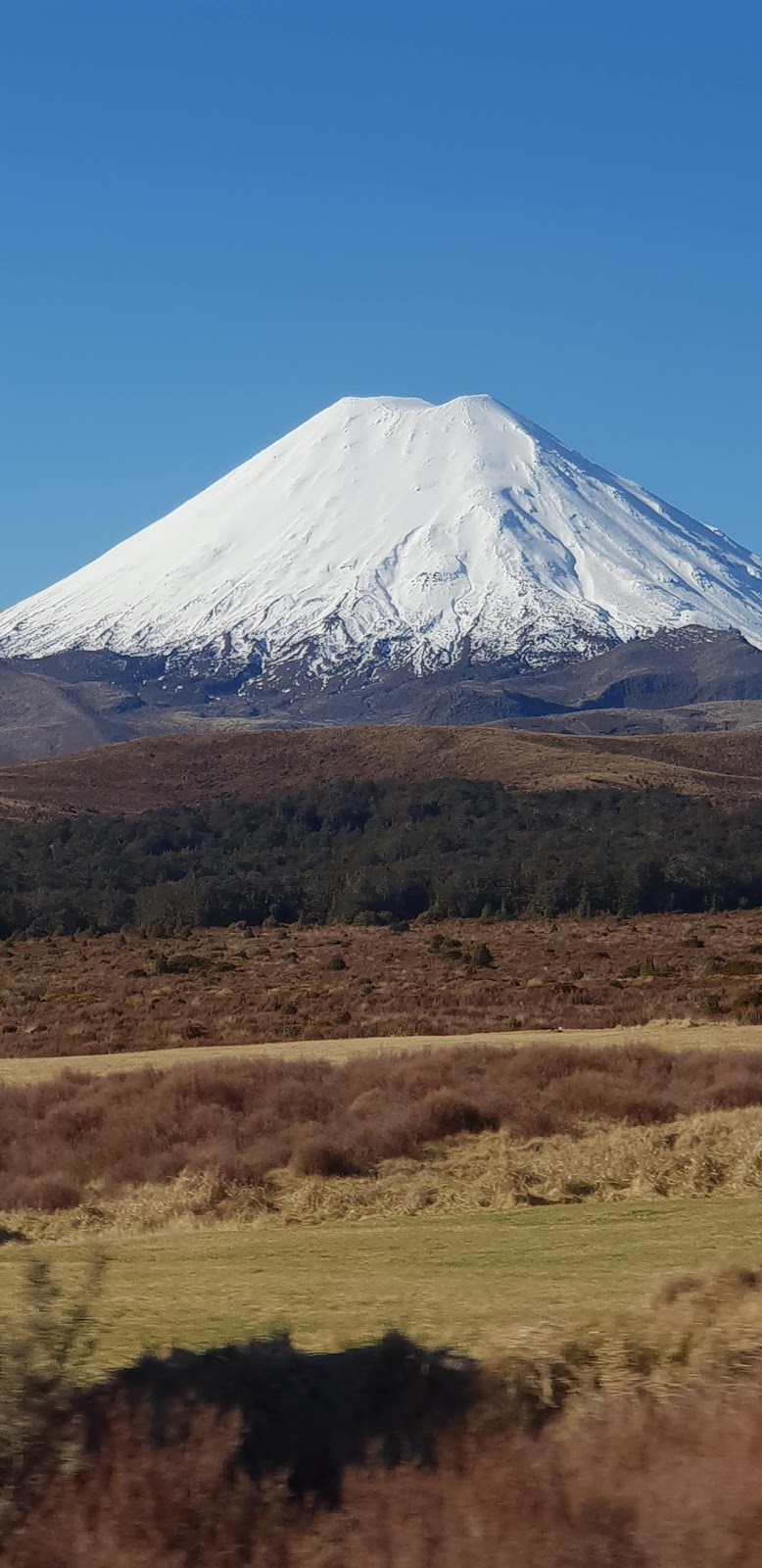
Searching for locations: Mount Ngauruhoe, New Zealand

Mount Ngauruhoe is apparently still an active volcano, has been for 2,500 years or so, and last erupted on 19th February 1975, and reportedly has erupted around 70 times since 1839.

The mountain is usually climbed from the western side, from the Mangatepopo track.

This photo was taken in summer from the Chateau Tongariro carpark.

In late autumn, on one of our many visits to the area, the mountain was covered with a light sprinkling of snow and ice.

On our most recent visit, this year, in winter, it was fully covered in snow.

It can be a breathtaking sight from the distance.

This is beginning to sound a lot like…

It’s odd how art sometimes imitates life, but it’s much, much worse when life imitates art.

I mean, in a sense, it’s good that life imitates Star Trek because we need lasers to ward off unfriendly aliens when they finally arrive, as well as having intergalactic warp-speed vessels.

But it’s very, very bad when a contagion pops up, and the scenario that follows is right out of the script for the movie Contagion.

Or Outbreak, not that any President would ever nuke a US City, which was the premise in that film.

Or follow along the lines of The Omega Man, where a virus turns everyone into a zombie-like creature, with the last surviving human finally running out of luck.

There’s been quite a few doomsday scenario films, the most interesting one involving walking plants (The Day of the Triffids) but scary as they might be, what’s happening now is equally scary.

And the thing is, with the benefit of hindsight, the COVID pandemic was predicted, so it seems sci-fi writers, and screenwriters knew long before us what was going to happen.

So, what’s the next thing sci-fi writers have in store for us?

Time travel?

It’s been getting a lot of reports, and photographs of people in the 1930s or 1940’s supposedly with mobile phones in their hands.

Were they just ‘visiting’ or were they there to change the course of history.  It doesn’t seem like there have been any changes so maybe it’s just about interpretation.

How about travelling through portals, one minute you’re in Sydney, and the next you’re in New York, on the other side of the planet.  That would be good, but then we’d be upsetting the plane manufacturers, so if there was such technology, wouldn’t they buy it and shelve it?

It’s what the oil people did every time someone invented a car engine that ran on water.

What else is there that people with vested interests have shelved – a cure for cancer maybe?

I guess that’s why we have science fiction, and how some authors’ ideas become reality.  I’m guessing somewhere in a laboratory there is a spaceship with a warp engine capable of travelling at the speed of light.

And there might be colonies of humans living on the moon, or on Mars – we just don’t know about it yet.

Or that aliens from other worlds live on earth, or that a select group of people on earth have met people from other planets, not necessarily in this solar system, because we know there are livable planets out there.

But the thing is if they told us the truth, would we believe it?

Another excerpt from ‘Betrayal’; a work in progress

My next destination in the quest was the hotel we believed Anne Merriweather had stayed at.

I was, in a sense, flying blind because we had no concrete evidence she had been there, and the message she had left behind didn’t quite name the hotel or where Vladimir was going to take her.

Mindful of the fact that someone might have been following me, I checked to see if the person I’d assumed had followed me to Elizabeth’s apartment was still in place, but I couldn’t see him. Next, I made a mental note of seven different candidates and committed them to memory.

Then I set off to the hotel, hailing a taxi. There was the possibility the cab driver was one of them, but perhaps I was slightly more paranoid than I should be. I’d been watching the queue, and there were two others before me.

The journey took about an hour, during which time I kept an eye out the back to see if anyone had been following us. If anyone was, I couldn’t see them.

I had the cab drop me off a block from the hotel and then spent the next hour doing a complete circuit of the block the hotel was on, checking the front and rear entrances, the cameras in place, and the siting of the driveway into the underground carpark. There was a camera over the entrance, and one we hadn’t checked for footage. I sent a text message to Fritz to look into it.

The hotel lobby was large and busy, which was exactly what you’d want if you wanted to come and go without standing out. It would be different later at night, but I could see her arriving about mid-afternoon, and anonymous among the type of clientele the hotel attracted.

I spent an hour sitting in various positions in the lobby simply observing. I had already ascertained where the elevator lobby for the rooms was, and the elevator down to the car park. Fortunately, it was not ‘guarded’ but there was a steady stream of concierge staff coming and going to the lower levels, and, just from time to time, guests.

Then, when there was a commotion at the front door, what seemed to be a collision of guests and free-wheeling bags, I saw one of the seven potential taggers sitting by the front door. Waiting for me to leave? Or were they wondering why I was spending so much time there?

Taking advantage of that confusion, I picked my moment to head for the elevators that went down to the car park, pressed the down button, and waited.

The was no car on the ground level, so I had to wait, watching, like several others, the guests untangling themselves at the entrance, and an eye on my potential surveillance, still absorbed in the confusion.

The doors to the left car opened, and a concierge stepped out, gave me a quick look, then headed back to his desk. I stepped into the car, pressed the first level down, the level I expected cars to arrive on, and waited what seemed like a long time for the doors to close.

As they did, I was expecting to see a hand poke through the gap, a latecomer. Nothing happened, and I put it down to a television moment.

There were three basement levels, and for a moment, I let my imagination run wild and considered the possibility that there were more levels. Of course, there was no indication on the control panel that there were any other floors, and I’d yet to see anything like it in reality.

With a shake of my head to return to reality, the car arrived, the doors opened, and I stepped out.

A car pulled up, and the driver stepped out, went around to the rear of his car, and pulled out a case. I half expected him to throw me the keys, but the instant glance he gave me told him was not the concierge, and instead brushed past me like I wasn’t there.

He bashed the up button several times impatiently and cursed when the doors didn’t open immediately. Not a happy man.

Another car drove past on its way down to a lower level.

I looked up and saw the CCTV camera, pointing towards the entrance, visible in the distance. A gate that lifted up was just about back in position and then made a clunk when it finally closed. The footage from the camera would not prove much, even if it had been working, because it didn’t cover the life lobby, only in the direction of the car entrance.

The doors to the other elevator car opened, and a man in a suit stepped out.

“Can I help you, sir? You seem lost.”

Security, or something else. “It seems that way. I went to the elevator lobby, got in, and it went down rather than up. I must have been in the wrong place.”

“Lost it is, then, sir.” I could hear the contempt for Americans in his tone. “If you will accompany me, please.”

He put out a hand ready to guide me back into the elevator. I was only too happy to oblige him. There had been a sign near the button panel that said the basement levels were only to be accessed by the guests.

Once inside, he turned a key and pressed the lobby button. The doors closed, and we went up. He stood, facing the door, not speaking. A few seconds later, he was ushering me out to the lobby.

“Now, sir, if you are a guest…”

“Actually, I’m looking for one. She called me and said she would be staying in this hotel and to come down and visit her. I was trying to get to the sixth floor.”

“Good. Let’s go over the the desk and see what we can do for you.”

I followed him over to the reception desk, where he signalled one of the clerks, a young woman who looked and acted very efficiently, and told her of my request, but then remained to oversee the proceeding.

“Name of guest, sir?”

“Merriweather, Anne. I’m her brother, Alexander.” I reached into my coat pocket and pulled out my passport to prove that I was who I said I was. She glanced cursorily at it.

She typed the name into the computer, and then we waited a few seconds while it considered what to output. Then, she said, “That lady is not in the hotel, sir.”

Time to put on my best-confused look. “But she said she would be staying here for the week. I made a special trip to come here to see her.”

Another puzzled look from the clerk, then, “When did she call you?”

An interesting question to ask, and it set off a warning bell in my head. I couldn’t say today, it would have to be the day she was supposedly taken.

“Last Saturday, about four in the afternoon.”

Another look at the screen, then, “It appears she checked out Sunday morning. I’m afraid you have made a trip in vain.”

Indeed, I had. “Was she staying with anyone?”

I just managed to see the warning pass from the suited man to the clerk. I thought he had shown an interest when I mentioned the name, and now I had confirmation. He knew something about her disappearance. The trouble was, he wasn’t going to volunteer any information because he was more than just hotel security.

“No.”

“Odd,” I muttered. “I thought she told me she was staying with a man named Vladimir something or other. I’m not too good at pronouncing those Russian names. Are you sure?”

She didn’t look back at the screen. “Yes.”

“OK, now one thing I do know about staying in hotels is that you are required to ask guests with foreign passports their next destination, just in case they need to be found. Did she say where she was going next?” It was a long shot, but I thought I’d ask.

“Moscow. As I understand it, she lives in Moscow. That was the only address she gave us.”

I smiled. “Thank you. I know where that is. I probably should have gone there first.”

She didn’t answer; she didn’t have to, her expression did that perfectly.

The suited man spoke again, looking at the clerk. “Thank you.” He swivelled back to me. “I’m sorry we can’t help you.”

“No. You have more than you can know.”

“What was your name again, sir, just in case you still cannot find her?”

“Alexander Merriweather. Her brother. And if she is still missing, I will be posting a very large reward. At the moment, you can best contact me via the American Embassy.”

Money is always a great motivator, and that thoughtful expression on his face suggested he gave a moment’s thought to it.

I left him with that offer and left. If anything, the people who were holding her would know she had a brother, that her brother was looking for her, and equally that brother had money.

© Charles Heath – 2018-2025

Searching for locations: Chateau Tongariro, New Zealand

This chateau was built in 1929 and was originally intended as a hostel for hikers.

It is now near the  Whakapapa skifield on the slopes of Mount Ruapehu and within  the boundary of the Tongariro National Park

chateautongoriro

We had afternoon tea in the lounge several times, and it is very pleasant in winter with the log fires burning.

togariro2

The interior is still as ornate as it had been in the 1930s.  The chairs are very comfortable, and the atmosphere pleasant.

Mount Ngauruhoe can be seen through the window of the lounge.  This was used a backdrop in the filming of Lord of the Rings.

mount-nz

But…

This place is the ideal setting for a murder, and I can see a story being written very much in the mold of Agatha Christie, with a couple of amateur sleuths who are staying there, trying to solve the crime.

Given the sort of shows being produced in New Zealand currently, for Acorn and other streaming services, this could be turned into a very pleasant two hour diversion with some very unique New Zealand, and foreign, characters.

Or just send the Brokenwood detective crew there!

“Sunday in New York”, a romantic adventure that’s not a walk in the park!

“Sunday in New York” is ultimately a story about trust, and what happens when a marriage is stretched to its limits.

When Harry Steele attends a lunch with his manager, Barclay, to discuss a promotion that any junior executive would accept in a heartbeat, it is the fact his wife, Alison, who previously professed her reservations about Barclay, also agreed to attend, that casts a small element of doubt in his mind.

From that moment, his life, in the company, in deciding what to do, his marriage, his very life, spirals out of control.

There is no one big factor that can prove Harry’s worst fears, that his marriage is over, just a number of small, interconnecting events, when piled on top of each other, points to a cataclysmic end to everything he had believed in.

Trust is lost firstly in his best friend and mentor, Andy, who only hints of impending disaster, Sasha, a woman whom he saved, and who appears to have motives of her own, and then in his wife, Alison, as he discovered piece by piece damning evidence she is about to leave him for another man.

Can we trust what we see with our eyes or trust what we hear?

Haven’t we all jumped to conclusions at least once in our lives?

Can Alison, a woman whose self-belief and confidence is about to be put to the ultimate test, find a way of proving their relationship is as strong as it has ever been?

As they say in the classics, read on!

Purchase:

http://tinyurl.com/Amazon-SundayInNewYork

Writing a book in 365 days – 206

Day 206

Learn your craft before bending the rules

When we go to school, we learn to write.  It’s all part and parcel of learning the alphabet, then learning simple words to show how the letters of the alphabet are used, and then we learn to string those words together into sentences

Not in a jumble, but according to rules, requiring such things as a subject, nouns, verbs, adverbs, adjectives, predicates, until it all becomes so complicated that we all but give up.

Of course, in grade three, at eight or nine years old and with another two or so years to go, giving up is not an option.

I learned English, and my biggest enemy was the school books written by Rideout and McGregor, two authors whose ears must have burned until the day they died.

From elementary or primary school, we move to secondary or middle school, and there it is assumed we know everything going there is to know about writing good English.

Wrong.

Our essays come back drowned in red or green ink, scrawls almost illegible, but the teachers whose frustration levels are off the charts.

Judging by how most people speak these days, it’s probably a blessing we don’t write each other letters anymore.  And texts, the new communication method, I do not understand at all.

So, if we are hoping to become writers, then we need to have learned the Lagrange and all its nuances, even though those who read it might have trouble understanding.

Just be glad the editor at the publishers is old enough to have been around when schools were actually teaching good English.

I know my teachers tried and tried and had some measure of success.

But in this day and age, we have spell checkers, grammar checkers, and this thing called AI.  You would think that a robot would have the language down pat, but sadly, it’s only as good as the programmer who invented it.

But here’s the rub.  It’s all we’re going to have in the future because no one wants to learn; they just want what the phone and computer manufacturers offer because it’s easy, and they don’t have to think.

People are even writing books using AI.  Where does that leave us who are doing the hard graft?

But I digress, like I always do….

We can not get rid of teaching our language, and we must insist that checkers of any sort should be used with caution.

Otherwise, like many languages from the past, it will become extinct along with who we are and where we come from.

“Echoes From The Past”, the past doesn’t necessarily stay there


What happens when your past finally catches up with you?

Christmas is just around the corner, a time to be with family. For Will Mason, an orphan since he was fourteen, it is a time for reflection on what his life could have been, and what it could be.

Until a chance encounter brings back to life the reasons for his twenty years of self-imposed exile from a life only normal people could have. From that moment Will’s life slowly starts to unravel and it’s obvious to him it’s time to move on.

This time, however, there is more at stake.

Will has broken his number one rule, don’t get involved.

With his nemesis, Eddie Jamieson, suddenly within reach, and a blossoming relationship with an office colleague, Maria, about to change everything, Will has to make a choice. Quietly leave, or finally, make a stand.

But as Will soon discovers, when other people are involved there is going to be terrible consequences no matter what choice he makes.

https://amzn.to/2CYKxu4

newechocover5rs

In a word: Light

Yes, I see the lighthouse, what’s it doing all the way out there?  The thing is, these places are sometimes so remote, I start thinking I should rent one for 6 months and then, without any distractions, I’ll get the blasted book finished.

Until there’s a shipwreck, of course!

Light is of course light, duh.  Turn on the switch and let there be light.

Hang on, didn’t someone else say that, millennia ago?  Someone famous?  It’s on the tip of my tongue.

No! It’s not cyanide…

So, whilst we need it to see everything, it has another meaning…

My, that’s a light load your carrying today, which means not very heavy.

Or, that’s a light-coloured jumper, which means pale.

Oh, and did you light the fire?

And, after you light the fire, do you light out to a safe haven in light traffic because really it was arson, and you got a light sentence the last time enabling you to do it again.

If you are trying to rob someone, then it was a kilo light.

And after a long hard struggle, did you light upon the correct answer?

This is not to be confused with another similar word, lite.

It seems this is only used for describing low-calorie drinks and food, such as lite beer, which seems to me to be a lazy way of not using light

Still, there’s not much other use of the word except as a suffix -lite, but then you’d have to mention -lyte as well.

The message here – just use the damn word light and be done with it.