Trying to pick up the pieces

I can see how it is that a writer’s life is one that, at times, has to be shut off from the outside world.

It’s a bit hard to keep a stream of thoughts going when in one ear is some banal detective show, and in the other, a conversation that you have to keep up with.  I know how hard it is because I’ve tried doing three things at once, and failed miserably in all three.

So, out I slink to the writing room and start by re-reading the previous chapters, to get back into the plot.  I should remember where I am, and get straight to it, but the devil is in the detail.

Going back, quite often I revise, and a plotline is tweaked, and a whole new window is opened.  God, I wish I didn’t do that!

Then I get to the blank page, ready to go, and…

The phone rings.

Damn.  Damn.  Damn.

Phone answered, back to the blank page, no, it’s gone, got yo go back, blast, another revision, and back to the blank page.

Half an hour shot to pieces.

The phone rings again.

Blast scam callers.  I nearly rip the cord out of the wall.

All through this the cat just watches, and, is that a knowing smile?

It can’t be, I’ve just learned that cats can’t smile, or make any sort of face.

I’m sure his thoughts are not a vague or scrambled, or wrestling with the ploys of several stories on the go, getting locations right, getting characters to think and do their thing with a fair degree of continuity.

The cat’s world is one of which chair to lie on, where is that elusive mouse be it real or otherwise, and is this fool going to feed me, and please, please, don’t let it be the lasagna.  I am not that cat!

Unlike other professions, it’s a steady, sometimes frustrating, slog where you can’t just walk away, have a great time, and come back and pick up where you left off.  Stories have to be written from beginning to end, not a bit here and a bit there.

It’s a bit like running a marathon.  You are in a zone, the first few miles are the hardest, the middle is just getting the rhythm and breathing under control, and then you hope you get to the end because it can seem that you’ve been going forever and the end is never in sight.

But, when you reach the end, oh, isn’t the feeling one of pure joy and relief.

Sorry, not there yet.

And no comment is required from the cat gallery, thankyou!


‘Sunday in New York’ – A beta reader’s view

I’m not a fan of romance novels but …

There was something about this one that resonated with me.

This is a novel about a world generally ruled by perception, and how people perceive what they see, what they are told, and what they want to believe.

I’ve been guilty of it myself as I’m sure we all have at one time or another.

For the main characters Harry and Alison there are other issues driving their relationship.

For Alison, it is a loss of self-worth through losing her job and from losing her mother and, in a sense, her sister.

For Harry, it is the fact he has a beautiful and desirable wife, and his belief she is the object of other men’s desires, and one in particular, his immediate superior.

Between observation, the less than honest motives of his friends, a lot of jumping to conclusions based on very little fact, and you have the basis of one very interesting story.

When it all comes to a head, Alison finds herself in a desperate situation, she realises only the truth will save their marriage.

But is it all the truth?

What would we do in similar circumstances?

Rarely does a book have me so enthralled that I could not put it down until I knew the result. They might be considered two people who should have known better, but as is often the case, they had to get past what they both thought was the truth.

And the moral of this story, if it could be said there is one, nothing is ever what it seems.

Available on Amazon here: amzn.to/2H7ALs8

Searching for Locations: Venice, Italy

Venice is definitely a city to explore.  It has an incredible number of canals and walkways, and each time we would start our exploration at St Marks square when it’s not underwater

Everyone I have spoken to about exploring Venice has told me how easy it is to get lost.  It has not happened to me, but with the infinite number of ways you can go, I guess it is possible.

We started our exploration of Venice in St Marks square, where, on one side there was the Museo di Palazzo Ducale and, next door, the Basilica di San Marco.  Early morning and/or at high tide, water can be seen bubbling up from under the square, partially flooding it.  I have seen this happen several times.  Each morning as we walked from the hotel (the time we stayed in the Savoia and Jolanda) we passed the Bridge of Sighs.

Around the other three sides of the square are archways and shops.  We have bought both confectionary and souvenirs from some of these stores, albeit relatively expensive.  Prices are cheaper in stores that are away from the square and we found some of these when we walked from St Marks square to the Railway station, through many walkways, and crossing many bridges, and passing through a number of small piazzas.

That day, after the trek, we caught the waterbus back to San Marco, and then went on the tour of the Museo di Palazzo Du which included the dungeons and the Bridge of Sighs from the inside.  It took a few hours, longer than I’d anticipated because there was so much to see.

The next day, we caught the waterbus from San Marco to the Ponte di Rialto bridge.  Just upstream from the wharf there was a very large passenger ship, and I noticed there were a number of passengers from the ship on the waterbus, one of whom spoke to us about visiting Venice.  I didn’t realize we looked like professional tourists who knew where we were going.

After a pleasant conversation, and taking in the views up and down the Grand Canal, we disembarked and headed for the bridge, looking at the shops, mostly selling upmarket and expensive gifts, and eventually crossing to the other side where there was a lot of small market type stalls selling souvenirs as well as clothes, and most importantly, it being a hot day, cold Limonata.  This was my first taste of Limonata and I was hooked.

Continuing on from there was a wide street at the end and a number of restaurants where we had lunch.  We had a map of Venice and I was going to plot a course back to the hotel, taking what would be a large circular route that would come out at the Accademia Bridge, and further on to the Terminal Fusina Venezia where there was another church to explore, the Santa Maria del Rosario.

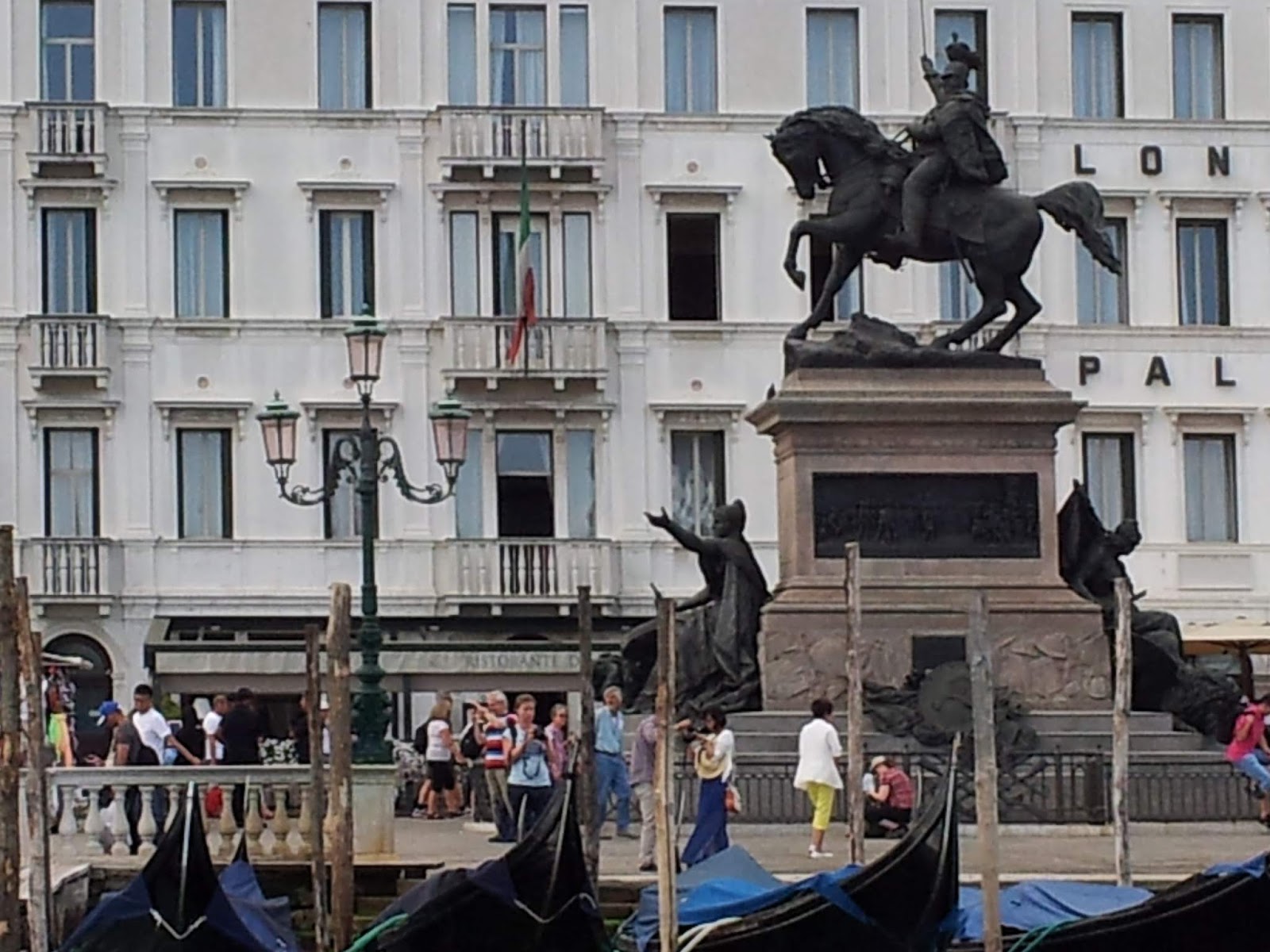
This is a photo of the Hilton Hotel from the other side of the canal.

It was useful knowledge for the second time we visited Venice because the waterbus from the Hilton hotel made its first stop, before San Marco, there.  We also discovered on that second visit a number of restaurants on the way from the terminal and church to the Accademia Bridge.

This is looking back towards San Marco from the Accademia Bridge:

And this, looking towards the docks:

Items to note:

Restaurants off the beaten track were much cheaper and the food a lot different to that in the middle of the tourist areas.

There are a lot of churches, big and small, tucked away in interesting spots where there are small piazza’s.  You can look in all of them, though some asked for a small fee.

Souvenirs, coffee, and confectionary are very expensive in St Marks square.

An excerpt from “Echoes from the Past”

Available on Amazon Kindle here:  https://amzn.to/2CYKxu4

With my attention elsewhere, I walked into a man who was hurrying in the opposite direction.  He was a big man with a scar running down the left side of his face from eye socket to mouth, and who was also wearing a black shirt with a red tie.

That was all I remembered as my heart almost stopped.

He apologized as he stepped to one side, the same way I stepped, as I also muttered an apology.

I kept my eyes down.  He was not the sort of man I wanted to recognize later in a lineup.  I stepped to the other side and so did he.  It was one of those situations.  Finally getting out of sync, he kept going in his direction, and I towards the bus, which was now pulling away from the curb.

Getting my breath back, I just stood riveted to the spot watching it join the traffic.  I looked back over my shoulder, but the man I’d run into had gone.  I shrugged and looked at my watch.  It would be a few minutes before the next bus arrived.

Wait, or walk?  I could also go by subway, but it was a long walk to the station.  What the hell, I needed the exercise.

At the first intersection, the ‘Walk’ sign had just flashed to ‘Don’t Walk’.  I thought I’d save a few minutes by not waiting for the next green light.  As I stepped onto the road, I heard the screeching of tires.

A yellow car stopped inches from me.

It was a high powered sports car, perhaps a Lamborghini.  I knew what they looked like because Marcus Bartleby owned one, as did every other junior executive in the city with a rich father.

Everyone stopped to look at me, then the car.  It was that sort of car.  I could see the driver through the windscreen shaking his fist, and I could see he was yelling too, but I couldn’t hear him.  I stepped back onto the sidewalk, and he drove on.  The moment had passed and everyone went back to their business.

My heart rate hadn’t come down from the last encounter.   Now it was approaching cardiac arrest, so I took a few minutes and several sets of lights to regain composure.

At the next intersection, I waited for the green light, and then a few seconds more, just to be sure.  I was no longer in a hurry.

At the next, I heard what sounded like a gunshot.  A few people looked around, worried expressions on their faces, but when it happened again, I saw it was an old car backfiring.  I also saw another yellow car, much the same as the one before, stopped on the side of the road.  I thought nothing of it, other than it was the second yellow car I’d seen.

At the next intersection, I realized I was subconsciously heading towards Harry’s new bar.   It was somewhere on 6th Avenue, so I continued walking in what I thought was the right direction.

I don’t know why I looked behind me at the next intersection, but I did.  There was another yellow car on the side of the road, not far from me.  It, too, looked the same as the original Lamborghini, and I was starting to think it was not a coincidence.

Moments after crossing the road, I heard the roar of a sports car engine and saw the yellow car accelerate past me.  As it passed by, I saw there were two people in it, and the blurry image of the passenger; a large man with a red tie.

Now my imagination was playing tricks.

It could not be the same man.  He was going in a different direction.

In the few minutes I’d been standing on the pavement, it had started to snow; early for this time of year, and marking the start of what could be a long cold winter.  I shuddered, and it was not necessarily because of the temperature.

I looked up and saw a neon light advertising a bar, coincidentally the one Harry had ‘found’ and, looking once in the direction of the departing yellow car, I decided to go in.  I would have a few drinks and then leave by the back door if it had one.

Just in case.

© Charles Heath 2015-2020

newechocover5rs

Writing a book in 365 days – 232

Day 232

Sometimes, the best books for writers bear little similarity to their medium

The Unconventional Muse: When Your Best Writing Lesson Comes From Anywhere But a ‘How-To’ Guide

We writers are always chasing that elusive spark, that deeper understanding of human nature and narrative that elevates our work from good to truly profound. We devour books on craft, attend workshops, and pore over articles dissecting plot points and character arcs. All valuable, of course.

But what if the most potent lessons for your writing don’t come from a book with “How To Write” in the title? What if your greatest storytelling mentor isn’t a famous novelist, but a philosopher, a historian, or even a scientist?

This isn’t just a quirky idea; it’s a fundamental truth for many successful writers. Sometimes, the best books for writers bear little similarity to their medium.

Why Look Beyond the Craft?

Writers are, at heart, observers and interpreters of the human condition. We craft worlds, yes, but those worlds gain their resonance from reflecting or distorting truths about our world. To truly understand the stories we tell, we need to understand the world itself – its history, its psychology, its moral dilemmas, its scientific wonders.

This is where seemingly unrelated disciplines become invaluable. They offer different lenses through which to view conflict, motivation, and the very fabric of reality.

The Playwright, the Philosopher, and the Clash of Two Rights

Let’s take a specific example that perfectly illustrates this premise: the playwright. Should a playwright read philosophy? An emphatic yes.

Consider the profound wisdom offered by thinkers like George Wilhelm Friedrich Hegel. His work, particularly his dialectical approach to history and conflict, provides an incredible framework for understanding the deepest dramatic tensions.

For Hegel, the true tragedy – and the most compelling drama – lies not in a clear-cut battle between good and evil, but in the irreconcilable clash of two rights.

Think about that for a moment. It’s not the simple Hollywood narrative where the hero is unequivocally good and the villain is purely evil. That kind of story, while sometimes entertaining, often lacks the true grit and complexity of human experience.

Instead, Hegel pointed to the underlying issues in Greek tragedy as a case in point. Take Sophocles’ Antigone. Here, the conflict isn’t between a righteous hero and an evil tyrant. It’s between Antigone’s undeniable moral right to bury her brother, honoring the divine laws and family duty, and Creon’s equally legitimate right to uphold the laws of the state, ensuring order and preventing further rebellion.

Both characters are, in their own frameworks, right. Both are acting out of deeply held convictions and duties. And it is precisely because both are “right” that their collision is so utterly devastating, leading to a profound, unavoidable tragedy. Neither can simply concede without betraying their core identity or belief system.

A Golden Key for Every Writer

This isn’t just an academic point for philosophers; it’s a golden key for anyone crafting a narrative, whether it’s a novel, a screenplay, a short story, or even a compelling blog post.

  • Complex Characters: When your antagonists aren’t just “bad” but are operating from their own deeply held, morally defensible (to them) positions, your characters instantly gain depth. Their motivations become understandable, even if you disagree with their actions.
  • Richer Conflict: The “two rights” dilemma elevates your plot beyond simplistic good vs. evil. It forces your characters, and your readers, to grapple with true moral ambiguity, making the stakes feel far higher and more authentic. Think of a nuanced political drama, a family saga fraught with misunderstanding, or even a personal internal struggle where the protagonist is torn between two equally valid, yet conflicting, desires.
  • Deeper Themes: This approach allows you to explore profound themes about ethics, justice, loyalty, and the inherent contradictions of human existence, without needing to preach. The conflict itself becomes the exploration.

When your characters operate from their own deeply held, morally defensible positions, the story becomes infinitely more resonant because it mirrors the complexities of real life.

Broaden Your Mind, Deepen Your Stories

So, what does this mean for your reading list?

Don’t limit yourself to books on plot structure or character arcs (though those are valuable!). Dive into history, neuroscience, poetry, economics, art criticism, and yes, philosophy. Seek out texts that grapple with ethics, existence, and the nature of reality. Read the great thinkers, not necessarily to agree with them, but to understand how they thought and what they wrestled with.

You’re not just reading to learn facts; you’re reading to broaden your understanding of the human experience itself. And that, my fellow writers, is the wellspring from which truly compelling stories flow. Expand your mind, expand your world, and watch your own narratives deepen and soar.

What unconventional books or fields of study have unexpectedly impacted your writing? Share your discoveries in the comments below!

Inspiration, maybe – Volume 1

50 photographs, 50 stories, of which there is one of the 50 below.

They all start with –

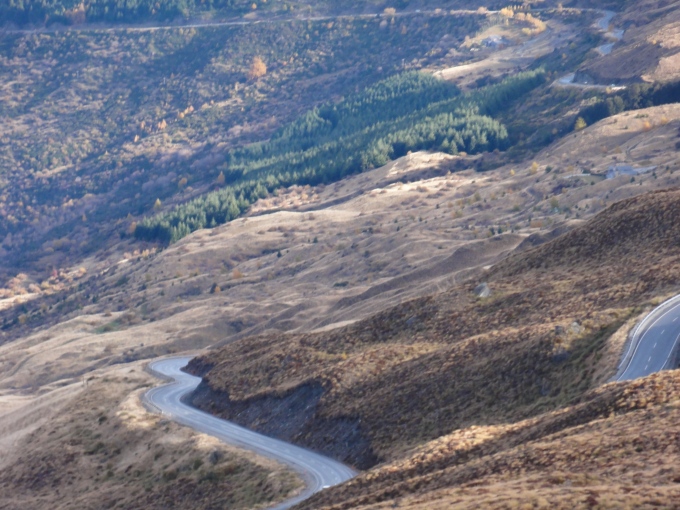
A picture paints … well, as many words as you like.  For instance:

lookingdownfromcoronetpeak

And the story:

It was once said that a desperate man has everything to lose.

The man I was chasing was desperate, but I, on the other hand, was more desperate to catch him.

He’d left a trail of dead people from one end of the island to the other.

The team had put in a lot of effort to locate him, and now his capture was imminent.  We were following the car he was in, from a discrete distance, and, at the appropriate time, we would catch up, pull him over, and make the arrest.

There was nowhere for him to go.

The road led to a dead-end, and the only way off the mountain was back down the road were now on.  Which was why I was somewhat surprised when we discovered where he was.

Where was he going?

“Damn,” I heard Alan mutter.  He was driving, being careful not to get too close, but not far enough away to lose sight of him.

“What?”

“I think he’s made us.”

“How?”

“Dumb bad luck, I’m guessing.  Or he expected we’d follow him up the mountain.  He’s just sped up.”

“How far away?”

“A half-mile.  We should see him higher up when we turn the next corner.”

It took an eternity to get there, and when we did, Alan was right, only he was further on than we thought.”

“Step on it.  Let’s catch him up before he gets to the top.”

Easy to say, not so easy to do.  The road was treacherous, and in places just gravel, and there were no guard rails to stop a three thousand footfall down the mountainside.

Good thing then I had the foresight to have three agents on the hill for just such a scenario.

Ten minutes later, we were in sight of the car, still moving quickly, but we were going slightly faster.  We’d catch up just short of the summit car park.

Or so we thought.

Coming quickly around another corner we almost slammed into the car we’d been chasing.

“What the hell…” Aland muttered.

I was out of the car, and over to see if he was in it, but I knew that it was only a slender possibility.  The car was empty, and no indication where he went.

Certainly not up the road.  It was relatively straightforward for the next mile, at which we would have reached the summit.  Up the mountainside from here, or down.

I looked up.  Nothing.

Alan yelled out, “He’s not going down, not that I can see, but if he did, there’s hardly a foothold and that’s a long fall.”

Then where did he go?

Then a man looking very much like our quarry came out from behind a rock embedded just a short distance up the hill.

“Sorry,” he said quite calmly.  “Had to go if you know what I mean.”

I’d lost him.

It was as simple as that.

I had been led a merry chase up the hill, and all the time he was getting away in a different direction.

I’d fallen for the oldest trick in the book, letting my desperation blind me to the disguise that anyone else would see through in an instant.

It was a lonely sight, looking down that road, knowing that I had to go all that way down again, only this time, without having to throw caution to the wind.

“Maybe next time,” Alan said.

“We’ll get him.  It’s just a matter of time.”

© Charles Heath 2019-2021

Find this and other stories in “Inspiration, maybe”  available soon.

InspirationMaybe1v1

In a word: Flower

It’s what we expect to see when we walk past the front of some houses but instead sometimes see lawn, rocks, or a disaster.

They are what makes the difference between a delightful street and an ugly one, and by that I mean flowers.

By definition though, it means the state or period in which the plant’s flowers have developed and opened/

Just beware the man who turns up with a bunch of flowers that look vaguely familiar to those that grow in your neighbour’s gardens.

They are also in abundance in horticultural gardens, and in florist shops.

My favourites are roses.

And just a word of warning, look out for triffids.  If you read John Wyndham’s science fiction you’ll know what I mean.

Another meaning for the word is to reach the optimum stage of development, though the word bloom could also be used to describe the same thing.

There is another similar-sounding word, flour, but this is the stuff used to make bread, scones, and puddings.

By definition, it is the result of grinding wheat or other grains to a powder.

If something is said to be floury, then it means it is bland.

First Dig Two Graves

A sequel to “The Devil You Don’t”

Revenge is a dish best served cold – or preferably so when everything goes right

Of course, it rarely does, as Alistair, Zoe’s handler, discovers to his peril. Enter a wildcard, John, and whatever Alistair’s plan for dealing with Zoe was dies with him.

It leaves Zoe in completely unfamiliar territory.

John’s idyllic romance with a woman who is utterly out of his comfort zone is on borrowed time. She is still trying to reconcile her ambivalence, after being so indifferent for so long.

They agree to take a break, during which she disappears. John, thinking she has left without saying goodbye, refuses to accept the inevitable, calls on an old friend for help in finding her.

After the mayhem and being briefly reunited, she recognises an inevitable truth: there is a price to pay for taking out Alistair; she must leave and find them first, and he would be wise to keep a low profile.

But keeping a low profile just isn’t possible, and enlisting another friend, a private detective and his sister, a deft computer hacker, they track her to the border between Austria and Hungary.

What John doesn’t realise is that another enemy is tracking him to find her too. It could have been a grand tour of Europe. Instead, it becomes a race against time before enemies old and new converge for what will be an inevitable showdown.

“Possibilities” – a short story


How many choices could one person have?

Usually, from a very early age, you have some idea of what you intend to do with your life.

Those early choices of fireman, policeman, doctor, fighter pilot, slowly disappear from the list as the education requirements become clearer, and their degree of impossibility.

Then you have to factor in academic achievement or failure, hone situation, what blows life has dealt you, and your financial ability to fund any it all of your hopes and dreams, especially for that all-important university education, and even then, it has to be the right one.

Then there are the family aspirations where parents really want you to follow in their footsteps, as a doctor or a lawyer or in the military.

And if you get past all that, and everything has fallen into place, and you’re ready to head out on that highway of life, you should be fully imbibed with the knowledge and the drive to make everything happen.

Now I was lying in a hospital bed staring at the ceiling wondering at what point it all went wrong.

Right on the starting line where everything I had worked for was about to come to fruition, it had all come to an abrupt halt.

My memory got as far as driving home from a work party where we had been celebrating the company’s most recent success, and my progression to the next level of management, when a car failed to stop at a stop sign and T-boned me.

The car was a write-off. I was still not sure what happened to me, but I had heard someone say, in that murky twilight of pain medication, that if I was a horse, they would have to shoot me. It was the only thing I remembered between the car hitting mine and waking up in the hospital bed.

But that was not all the story, and I had plenty of time to mull over everything that had happened in that last week. There was a certain symmetry to it all, as if one event led to the next, and then the next, and it was the last straw, on the last day, that broke the proverbial camel’s back.

And here’s the thing.

I would not have been in that accident had I not taken the car. I wasn’t going to, I had intended to take the train to a friend’s place and stay there for a few days, what the boss had told me would be a well-earned rest.

Even then, I might have not taken the car, except for a cryptic text message I received from my sister, about needing to be ‘rescued’ from a bad date.

Nothing unusual for her, she was currently on a dating site binge, and after half a dozen bad experiences, I thought she had given up.

That was the thought that ran through my head as I watched her curled up in the chair next to the bed, half asleep.

Her first words, on arrival, and when she was allowed to see me, was to apologize, believing it had been her fault. She knew I hated driving in the city, so coming to get her, as I always did, had been preying on her mind, and I could see the tangible effects of it in the worried expression, and unkempt manner which was so totally unlike her.

“It was simply an accident, and could have happened to anyone,” I told her.

“You were going to Jeremy’s, I should have sorted my own problem out for once. It’s not as if I couldn’t just call up an Uber, and now look what’s happened. I’m so sorry.”

She wouldn’t accept that it was not her fault, nor would she leave until she knew I would be OK. I didn’t understand what she meant by that because, in the three discussions I had with the head doctor, I was going to make a full recovery.

He had used the word lucky more than once, and seemingly the sequence of events, and other factors like the car safety features, the angle the car had struck, and where, the fact the other driver had to dodge a pedestrian, all of it played a part.

Had they not, quite simply I would be dead.

My sister and her dating were only one aspect of how my life was being driven.

Another memory returned, from that week, that of another text message, from a girl I used to know back at university.

Erica.

She was what some might have called a free soul. She didn’t conform to what I would have called normal. Her clothes sense was somewhat odd, she always looked as though her hair needed combing, and she never had any money.

And, for a while, she lived with me, in a small, cramped room ideal for single University students on a budget, but not for two. Yet, for some strange reason, she never seemed to get in the way or mind the closeness of our existence.

In that short period, she became my first real love, but she had said that while we were together, it was fine, but she was not seeking anything permanent. Nor, she said, did she believe in monogamy. Until she left, studies completed, I wanted to believe she would stay, but a last lingering kiss goodbye and she was gone.

Now, the message said, she wondered if I was still free, and like to meet. Of course, ten years of water had passed under that bridge, so I was not sure where it would go. I hadn’t replied, and the message was still sitting on my phone.

That invitation, however, had been on my mind moments before the crash, and I had to wonder, thinking of her, contributed to it.

Then, on top of all that, there were my parents. Married for 40 years, and the epitome of the perfect marriage.

Or so I thought.

That morning, before I went to work, I had called in to see them after my mother had called the day before saying she wanted to talk to me about something.

Before I knocked on the door, I could hear yelling, and it seemed the perfect marriage had hit a rocky stretch.

Or simply that my father had chosen to have an affair and had been caught out by the simplest of means, my mother answered his phone when he was out of the room thinking it was important work matters, only to discover it was his ‘floozie’.

No guessing then why my mother had called me. After hearing all I wanted to, and not wanting to face an angry couple I just headed on to work.

My mother had yet to come to the hospital to see me. My father had been, but he made no mention of her, or anything else, except to tell me if there was anything I wanted, all I had to do was ask. Then he left and didn’t come back.

Then, last but not least, were the rumours.

The owner of the company I worked for was getting older and didn’t have an heir. One thing or another had managed to foil his succession plans, and in the end, he did not have a son or a daughter to pass the reins to.

With the latest success, the company was about to have a bigger profile which meant more work and plans to open branches in other cities. It was too much for one man, now in his 70s, and looking to wind down.

A rumour had started about a week before the accident that he was looking to sell, and there were at least half a dozen suitors. There was supposed to be an announcement, but it hadn’t happened while I was at work, but considering how long I’d been in hospital, and the two weeks in an induced coma, anything could have happened.

Louisa stretched and changed positions.

“You look better,” she said.

“Relative to what, or when?”

“Half an hour ago.”

I shook my head. Sometimes Louisa was prone to saying the oddest stuff. “What’s the deal between our parents. Dad was here for all of five minutes. Where’s our mother?”

“She left.”

OK. Blunt, but plausible. “Why?”

“Dad was being an ass.”

“Does she know I was in an accident?”

“I told her.”

“So, you’re seeing her?”

“She calls. I don’t know where she is. I think she might have gone to stay with one of our aunts.”

I sighed. Louise had an awfully bad memory, and I was sure one day she was going to forget who I was.

There were four sisters, our mother the youngest. She had a love-hate relationship with the middle two, so the best bet would be the eldest sister, Jane. Jane was also the crankiest because she hated children, never got married, and was set in her ways.

Then, there was something else lurking in the back of my mind. Another item I’d overheard when I suspect I was not meant to be listening.

I might not have a job to go back to if the company had been sold, I might not have a home to go back to if my parents had split up, and I might not be able to do anything for a long, long time. Recovery might be complete, but it wasn’t going to happen overnight.

I had a sister who blamed herself for my accident, and an old girlfriend who wanted to see me, though I suspect not like this, broken and useless. What else could there be?

Oh, yes. Another snipped from the shouting match behind the door. And an explanation of why my father had all but abandoned me. My mother had also had an affair, and his son, well he was not his son.

No surprise then I had a father who didn’t want to know me.

What else could go wrong?

There was movement outside the room, and raised voices, one of which was saying that whoever was out there couldn’t go into the room. It didn’t have any effect as seconds later, a man and a police officer came in. The officer stood by the door.

Louisa looked surprised but didn’t move.

The man, obviously a detective, came over. “Your name Oliver Watkins?”

It was, and hopefully still is. “Yes.”

“I need you to answer some questions.”

“About the accident?”

He looked puzzled for a moment, then realized what I was referring to. “No. Not the accident. About the embezzlement of 50 million dollars from the company you work for. It seems you didn’t cover your tracks very well.” He turned around to look at Louisa, “You need to leave now, miss.”

“I’ll stay.”

He nodded to the officer, “You leave now, or he will remove you.”

She looked at me, with a different expression, “You didn’t tell me you were a crook, Olly.”

“Because I’m not.”

The officer escorted her from the room and shut the door.

The detective sat in the recently vacated chair. “Now, Mr Watkins. It seems there is such a thing as karma.”

© Charles Heath 2021

Memories of the conversations with my cat – 68

As some may be aware, but many not, Chester, my faithful writing assistant, mice catcher, and general pain in the neck, passed away some years ago.

Recently I was running a series based on his adventures, under the title of Past Conversations with my cat.

For those who have not had the chance to read about all of his exploits I will run the series again from Episode 1

These are the memories of our time together…

20160902_093736

This is Chester.  We’re both a little tired this morning.

I spent a little too much time on the next few chapters of my NaNoWriMo project and lost track of time.  It was going so well, I thought it best not to interrupt the flow of words.

But…

This morning, after getting to bed about 2:30 am, I found it hard to get out of bed.

Fortunately, as usual, I had the cat alarm clock wake me out of deep sleep to be informed that it was breakfast.

I looked at the clock and saw it was 6:30 am.

I mean to say, Chester was with me at 2:30 when I was writing, and he didn’t tell me that it was time to go to bed, much earlier than I did.

I think he enjoys torturing me like this.

So…

I get up, get him breakfast, some smelly fish food that even he turns his nose up at, and go out to the writing room with the intention of getting on with the story.

Next thing I know, there’s a gentle tapping on my forehead,

I wake up and it’s Chester.

What? I ask.  You can’t possibly want more food.

No.  I thought you were dead.

That’s amusing, he sees me asleep in bed and doesn’t think I’m dead.

How could you think that?

There are only two reasons why people become inanimate in their chair, they have suffered a heart attack or stroke, or they’re dead.

What about simply falling asleep because they’re too tired, and their faithful assistant didn’t tell them to go to bed earlier?

Look, let’s not make a beak deal out of this.  I was concerned.  Perhaps I won’t be next time.  A final glare and he jumps down off the keyboard, which left a page of endless d’s on the page I had been working on.

Perhaps he’s getting old and forgetful, or, suddenly he realises I mean more to him than just giving him food and cleaning the litter.  No, stop deluding yourself.  You’re his friend, he’s not your friend.

Oh, well, for a moment there…