Writing a book in 365 days – 237

Day 237

Working on what pays, not necessarily what you would like to be working on

The Writer’s Dilemma: Why the Money-Paying Tale Often Takes Center Stage (and What It Means for Your Craft)

Every writer knows this internal monologue. It’s late, the house is quiet, and the cursor blinks expectantly. Before you, on one screen, is the outline for that sprawling, genre-bending novel that called you to writing in the first place – your magnum opus, your heart project. On another tab, emails from a client remind you of the looming deadline for that article on “The Top 10 Uses for Biodegradable Sponges” or that ghostwritten piece on “Modern Pet Grooming Techniques.”

And if you’re like many authors, the biodegradable sponges often win.

It’s a source of quiet guilt for some, a pragmatic acceptance for others, but the question remains: Why is it often postulated that it’s better to work on the money-paying tales, rather than the serious writing that sparked your passion, or that beloved pet project? Let’s peel back the layers of this very real writer’s dilemma.

1. The Unsexy Truth: Bills Don’t Pay Themselves

This is, overwhelmingly, the primary driver. Writing, for most, isn’t a guaranteed goldmine, especially when you’re starting out or delving into niche literary fiction. While the dream is to live off your art, the reality is that rent, groceries, internet bills, and – let’s be honest – that ever-growing coffee habit, require immediate, tangible income.

Money-paying tales – be it freelance articles, copywriting gigs, ghostwriting assignments, or even genre fiction with a reliable market – offer a more predictable cash flow. They keep the lights on, the laptop charged, and food on the table. Without this foundational stability, the mental and emotional space required for deeply serious, often financially unrewarding, creative work becomes almost impossible to cultivate.

2. Sharpening the Axe: Professionalism and Practice

Think of money-paying projects not as a distraction, but as a different kind of training. Even if the subject matter isn’t your passion, these gigs offer invaluable professional development:

  • Meeting Deadlines: A crucial skill for any published author, even in the literary world.
  • Adhering to Briefs/Guidelines: Learning to work within constraints hones your precision and adaptability.
  • Understanding Your Audience: Every paying gig requires you to write for a specific reader, which is a transferable skill for any type of writing.
  • Honing Craft: Whether it’s crafting compelling sentences, structuring arguments, or developing clear prose, every word you write is practice. Even “mundane” writing can teach you about flow, conciseness, and impact.
  • Building a Reputation: Delivering quality work consistently, even on commercial projects, establishes you as a reliable and professional writer. This professional goodwill can open doors later.

Sometimes, the very act of writing anything takes the pressure off. Your “serious” work can feel monumental, intimidating. A paying gig, while perhaps less creatively fulfilling, can be a welcome change of pace, a chance to simply put words on a page without the intense emotional investment.

3. Building the Foundation (and the Platform)

For many, the “money tales” are a strategic investment in their larger writing career.

  • Financial Runway: Earning money now means you might save up enough to take dedicated time off later to really immerse yourself in your passion project without immediate financial pressure.
  • Publishing Credits: Even if it’s not the type of writing you ultimately want to be famous for, any published work builds a portfolio. It shows you’re a working writer, capable of producing content.
  • Networking: Commercial projects often connect you with editors, publishers, and other industry professionals. These connections can be invaluable when you eventually pitch your more serious work.
  • Market Intelligence: Working on commercially viable projects gives you a direct line to understanding what sells, what the market demands, and how publishing houses operate. This insight, while not dictating your art, can be useful for strategizing the release of your passion project.

4. The Creative Tug-of-War: Balancing Act, Not Betrayal

It’s natural to feel a pang of guilt or a sense of creative betrayal when you prioritize a paying gig over your deep-seated artistic ambitions. However, many authors view this not as an either/or, but as a strategic balancing act.

  • Allocate Time: Dedicate specific hours or days to your passion project, even if it’s just 30 minutes a day. Consistency is key.
  • Refuel Your Muse: Sometimes, the “light” work of a commercial gig can be less creatively draining than wrestling with your masterpiece, leaving you with more energy for your passion project when you do turn to it.
  • Remember Your “Why”: Keep a tangible reminder of your larger goal – a sticky note, a vision board, a printed outline. This helps combat the feeling of drift.

In essence, for many, working on money-paying tales isn’t a surrender of artistic integrity, but a practical, often necessary, step on the path to sustaining a writing life. It’s about building a solid foundation, sharpening the tools of the trade, and sometimes, simply ensuring you have the time and resources to eventually tell the stories that truly matter most to your heart.

It’s a marathon, not a sprint, and sometimes the best way to keep running is to earn a little cash along the way.


What’s your take on this writer’s dilemma? How do you balance the demands of paying work with your passion projects? Share your strategies and insights in the comments below!


Skeletons in the closet, and doppelgangers

A story called “Mistaken Identity”

How many of us have skeletons in the closet that we know nothing about? The skeletons we know about generally stay there, but those we do not, well, they have a habit of coming out of left field when we least expect it.

In this case, when you see your photo on a TV screen with the accompanying text that says you are wanted by every law enforcement agency in Europe, you’re in a state of shock, only to be compounded by those same police, armed and menacing, kicking the door down.

I’d been thinking about this premise for a while after I discovered my mother had a boyfriend before she married my father, a boyfriend who was, by all accounts, the man who was the love of her life.

Then, in terms of coming up with an idea for a story, what if she had a child by him that we didn’t know about, which might mean I had a half brother or sister I knew nothing about. It’s not an uncommon occurrence from what I’ve been researching.

There are many ways of putting a spin on this story.

Then, in the back of my mind, I remembered a story an acquaintance at work was once telling us over morning tea, that a friend of a friend had a mother who had a twin sister and that each of the sisters had a son by the same father, without each knowing of the father’s actions, both growing up without the other having any knowledge of their half brother, only to meet by accident on the other side of the world.

It was an encounter that in the scheme of things might never have happened, and each would have remained oblivious of the other.

For one sister, the relationship was over before she discovered she was pregnant, and therefore had not told the man he was a father. It was no surprise the relationship foundered when she discovered he was also having a relationship with her sister, a discovery that caused her to cut all ties with both of them and never speak to either from that day.

It’s a story with more twists and turns than a country lane!

And a great idea for a story.

That story is called ‘Mistaken Identity’.

In a word: Yellow

It was an easy choice from the start, yellow is a colour, in any number of shades from very pale to very dark.

We have yellow egg yolks, yet another y word, and depending on whether the eggs are farmed in cages or free range can dictate the shade of yellow.  Free-range gives the brightest yellow, by the way.

We have yellow cabs, but oddly enough these cabs are orange, not yellow as in this country, though the same may not be the case overseas, particularly in New York.  Good thing they are bright yellow so you can see them coming if you are crossing the road, perhaps illegally.

We have yellow bananas and lemons, probably the most common answers when asked, what is yellow?  That, and perhaps the yellow rose of Texas.

Then there is a more sinister meaning of the word, and it is associated with cowardice, and cowards are said to have a yellow streak down their backs.

If you have yellow fever then you are in a whole world of pain.

You can sometimes have what appears to be yellow skin, a sign of jaundice.

There is a yellow sea, and then there are the yellow pages, sometimes a substitute name for a telephone directory of businesses.

And lastly, an expression that comes out of the past, and not used so much these days, but people from Asia were thought to have yellow skin.

“How could that possibly happen…” – A short story

I had hoped by the time I was promoted to assistant manager it might mean something other than long hours and an increase in pay.

It didn’t.

But unlike others who had taken the job, and eventually become jaded and left, I stayed. Something I realized that others seemed to either ignore or just didn’t understand, this was a company that rewarded loyalty.

It was why there were quite a few who had served 30 years or more. They might not reach the top job, but they are certainly well looked after.

I had a long way to go, having been there only 8 years, and according to some, on a fast track. I was not sure how I would describe this so-called ‘fast track’ other than being in the right place at the right time and making a judicial selection.

When it was my turn to be promoted, I had a choice of a plum department, or one most of my contemporaries had passed over. At the time, the words of my previous manager sprang to mind, that being a manager for the most sought-after department or the least sought-after, came with exactly the same privileges.

And, he was right. I took the least sought-after, much to their disdain and disapproval. One year on, that disapproval had turned almost to envy; that was when the Assistant Managers were granted a new privilege, tea, and lunch in the executive dining room.

“So, what’s it like?” John asked when our group met on a Friday night, this was the first after the privilege was granted.

He had been one of the three, including me, who had the opportunity to take the role. Both he and Alistair had both declined, prepared to wait for a more prestigious department. It hadn’t happened to them yet.

“The same as the staff dining room, only smaller. Except, I guess, the waitstaff and butler. They come and serve you when you have to go to them in the staff room. They’re the same staff, by the way, except for the butler.”

I could see the awe, or was it envy, in their eyes. “but it’s not that great. The Assistant Managers all sit at one end of the table, and we’re not part of the main group, so no sharing of information I’m afraid. And the meals are the same, just served on fancier crockery.”

“Then nothing to write home about?” Will was one of those who they also thought to be on a ‘fast track’. I was still trying to see how my ‘fast track’ was actually that fast.

“Put it this way, the extra pay doesn’t offset the long hours because you get overtime, I don’t, so on a good week, you’d all be earning more than me. Without responsibility, if anything goes wrong. I think that’s why Assistant Managers were created, to take the blame when anything goes wrong.”

That had been the hardest pill to swallow. Until I got the role, I hadn’t realized what it really involved. Nor had the others, and it was not something we could whinge about. My first-day introductory speech from Tomkins, my Manager, was all about taking responsibility, and how I was there to make his life easier. It was a speech he made a few times because he’d been Manager for the last 16 years, much the same as the others, and promotion if ever, would come when they died.

And Manager’s rarely died, because of their Assistant Managers.

“How old is Tomkins now?” Bert, a relative newcomer to our group, asked. He was still in the ‘in awe’ phase.

“About the same as Father Time,” I said. “But the reality is, no one knows, except perhaps for the personnel manager.” O looked over at Wally, the Personnel Department’s Assistant Manager. “Any chance of you telling us?”

“No. You know I can’t.”

“But you know?” I asked.

“Of course, but you know the rules. That’s confidential information. Not like what you are the custodian of, information everyone needs.”

Which, of course, was true. Communication and Secretarial Services had no secrets, except for twice a year when the company Bord of Directors met, and we were responsible for all the documents used at their meetings. Then, and only then, was I privy to all the secrets, including promotions. And be asked ‘What’s happening?’.

“Just be content to know that he’s as old as the hills, as most of them. It seems to me that one of the pre-requisites for managership is that you have been employed here for 30 years.”

Not all, though, I’d noticed, but there wasn’t one under the age of fifty.

And so it would go, the Friday night lament, those ‘in’ the executive, and those who were not quite there yet.
It seemed prophetic, in a sense, that we had been talking about Mangers and their ages. By a quirk of fate, some weeks before, that I learned of Tomkins’s currents state of health via a call on his office phone. At the time he was out, where, he had not told me, but by his the I believed it was something serious, so serious he didn’t want me, or anyone else, to know about it.

That phone call was from his wife, Eleanor, whom I’d met on a number of occasions when she came to take him home from work. I liked her, and couldn’t help but notice she was his exact opposite, Tomkins, silent and at times morose, and Eleanor, the life of the party. I could imagine her being a handful in her younger days, and it was a stark reminder of that old saying ‘opposites attract’.

She was concerned and asked me if he had returned from the specialist. I simply said he had but was elsewhere, and promised to get him to call her when he returned. Then I made a quick call around to see where he was and found that he was in Personnel. I left an innocuous message on his desk, and then let my imagination run wild.

At least for a day or so, the time it took for me to realize that it was probably nothing, the lethargy he’d been showing, gone.

I’d put it out of my mind until my cell phone rang, and it was from the Personnel Manager. On a Sunday, no less. In the few seconds before I answered it, I’d made the assumption that Tomkins’s secretive visits to the specialist meant he needed time off for a routine operation.

Greetings over, O’Reilly, the Personnel Manager, cut straight to the chase, “For your personal information, and not to be repeated, Tomkins will be out of action for about two months, and as that is longer than the standard period, you will become Acting Manager. We’ll talk more about this Tuesday morning.” Monday was a holiday.

All Assistant Managers knew the rules. Any absence of a manager for longer than a month, promotion to Acting Manager. Anything less, you sat in the office, but no change in title. There was one more rule, that in the event of the death of a manager, the assistant manager was immediately promoted to Manager. This had only happened once before. 70 years ago. If a manager retired, then the position of Manager was thrown open to anyone in the organization.

It was an intriguing moment in time.

Tuesday came, and as usual, I went into the office, with only one thought in mind, let the staff in the department know what was happening, of course, the moment I was given the approval to do so by Personnel.

Not a minute after I sat down, the phone rang. I picked it up, gave my name and greeting. It was met with a rather excitable voice of the Assistant Manager, Personnel, “I just got word from on high, you’ve been promoted to manager. How could that possibly happen…”

Then a moment later, as realization set in, “Unless…”

—-

© Charles Heath 2020-2021

Memories of the conversations with my cat – 73

As some may be aware, but many not, Chester, my faithful writing assistant, mice catcher, and general pain in the neck, passed away some years ago.

Recently I was running a series based on his adventures, under the title of Past Conversations with my cat.

For those who have not had the chance to read about all of his exploits I will run the series again from Episode 1

These are the memories of our time together…

This is Chester. He has suddenly become delusional.

I’m not sure if a cat can become so, but since I gave him a role in one of my stories, he’s started acting weirdly.

I’m sure if he could wear sunglasses indoors he would. As it is, it’s head in the air, looking straight ahead, ignoring everything and everyone around him.

I think about opening the concertina doors that lead into the dining room just to see if he crashes into them.

He thinks, no doubt, that I think he’s just sniffing the air to see if there are any mice to be caught, but I’m on to him.

As he strolls past I say, “Perhaps I might turn that role into a walk on.”

He stops in mid step, and turns his head.

“You can’t. I’ve read the latest chapter. I’m integral to the plot.”

I smile. “You do realise often the best roles end up on the cutting room floor, or in this case, perhaps I’ll start editing early. There’s such a thing as the delete key.”

Smug, or is that haughty, look gone.

“Just go back to being your usual self,” I say, “and I’ll reconsider your role.”

“Does that mean no fresh fish for lunch today?”

“Don’t push your luck.”

I’m sure cats can’t shrug, but he gives it his best shot, and continues on his way minus the attitude.

For now. Who knows what tomorrow will bring

The cinema of my dreams – Was it just another surveillance job – Episode 39

I’m back home and this story has been sitting on a back burner for a few months, waiting for some more to be written.

The trouble is, there are also other stories to write, and I’m not very good at prioritizing.

But, here we are, a few minutes opened up and it didn’t take long to get back into the groove.

Chasing leads, maybe

Sometimes the best-laid plans worked out, but today it was as if the Gods were trying to ruin my day.  Earlier days this week had been getting darkish between three and four, but today it was a little later.

It meant we had to spend a little more quality time together before we embarked on some breaking and entering.

Of course, it might have helped if I’d told her what I was intending to do before I brought her along for the ride, but it was exactly for that reason I did because if she didn’t like the idea, there would be little option to change he mind.

But the initial displeasure was expected.

“Breaking and entering is not exactly how I envisioned my first few days on the job market.”

“You learned all of the requisite skills in training.  I know, I was your partner in crime more than once.”

And that was a question I had once told myself I’d ask her if I ever ran into her again outside of work.

Which I did now.  “Why was that?”

At a guess, it had to be because I knew what I was doing whereas the other men were more like blunt instruments.  They’d taught us the finesse in breaking into a wide variety of entrances, but they seemed to like and use bashing the door in.

“I knew I had a better chance of success if I stuck with you.”

“What about Yolanda?”

She was another woman I had put into the same category as Jennifer, she was possessed of a calm demeanor in a crisis, and actually took the time to lean the subtitles of her tradecraft.  I had been disappointed when she didn’t make the final cut, though I suspect there was more to her ‘failing’ than met the eye.

And, I never got to find out the real reason.

I had liked her and had thought the feelings were mutual, but after she left, I’d not heard from her again.  I guess I could have tried to reach out, and might still do if this ever came to an end where I didn’t finish up dead.

“She was never going to stick the distance.  I got the impression she wasn’t happy about one of the others making life uncomfortable for her.”

“Student or instructor?”

Interesting she should say that because I had thought there was something going on between her and Maury, and when I asked her she didn’t deign to answer.

“Both.  She considered it was best just to leave.”

Which apparently, she did.

But, back to our current problem.  “All I need you to do is have my back.  I’ll go in, see if he is there, or anyone else, and if the coast is clear, we’ll search the place and leave.  No need to be there one second longer than we have to be.”

But I will; be disappointed if the USB is not there.

“That means we have about an hour to kill,” she said.

Which is why I decided to stop off at a traditional English pub and have an early dinner of bangers and mash.  I was not sure why it just appealed to me.  I’d feel so much better breaking in with a full stomach.

And a mobile phone with the sound turned off.

© Charles Heath 2020

Writing a book in 365 days – 235/236

Day 235 and Day 236

Imagine a story about an affair that disrupts the life of a married couple.

I put the phone down and leaned back in the chair.

It was not what I expected, and then it was.  I just didn’t think I’d get to hear about it.

And it was nothing I did that precipitated the call.  That came from someone else, a person I was not pleased with.  Saying they would do something after I said I didn’t care showed poor judgment.

I could understand why they did, and in other circumstances, I would probably not feel as bad, but their actions had forced my hand.

“Sir?”

James, the butler who had served my father, then me, the very soul of discretion, looked over from the sideboard.

The question, in not so many words, was whether I wanted a drink, not whether I needed one.  The truth was, I needed one.

A nod in his direction, he put ice in a crystal glass and poured a small quantity of Scotch into it.  He placed it on a tray and brought it over.

“Thank you, James.  That will be all.”

“Yes, sir.  Good night, sir.”

Silence reigned after the door closed for a few minutes before my cell phone, sitting on the armrest of the chair, buzzed.

I looked at the screen.  “Cecily.”

My sister was calling.  Why?  Our business was concluded the week before, and she had promised not to call me unless it was absolutely necessary.  She wanted to run the company her way, and I was happy for her to do so.

I shrugged and answered it.

“Yes, Cecily?”

“I just had a strange call from Jack Burroughs.”

Jack Burroughs was the Chief Financial Officer.  He moved in strange, or what I called strange, circles.  He was also just a little strange himself, but work-related, he was a genius.

“He is strange, Cecily.”

“He told me he saw Margaret in a …” and then didn’t, or couldn’t bring herself to use the words.

I didn’t think she knew that Burroughs was gay simply because he didn’t identify as one. 

“He saw her at Moreno’s.”  Moreno’s was an obscure bar that celebrities sometimes went to so they would not make the media headlines. When I didn’t answer immediately, she took a deep breath, then said, “You know?”

“I got a call from someone else.”

“What is she doing there?”

“What do you think she is doing there?”

Silence as she grappled with the ramifications.

“So, you knew that she was…?”

“I suspected.  She told me before we married that she had been in a relationship with a girl, and it wasn’t who she thought she was.  Seems it’s not the case, and they’re back together.”

“What are you going to do?”

“It’s done.  I’m no longer part of the company or anything.  There’s the prenuptial you insisted on, so no one is walking away from this with anything.  It hasn’t been much of a relationship for nearly six months now, so I’m going to break the news that there’s no more money and we’re moving to the log cabin, courtesy of your generosity.”

“Oh.  Make me the bad guy.”

“You’ll make such a good one.  Don’t worry yourself.  I’m disappointed, but it’s not unexpected.  And I’ll get over it.  I am going to the log cabin, by the way, in the next few days.”

“OK.  Call me if you need anything.”

She took it better than I thought she would.

I waited.

I thought about watching a movie or reading a book, but in the end, I decided to do some reading of a different sort.  I had been sent a prospectus and background paper on a new concept car, one that wasn’t going to destroy the world.

By the time I got through to the end, three hundred pages of technical details that I would have to pass to the research department, I heard the front door open and close.

Frances had returned.

I looked at the clock, and it was 3:13 in the morning.

I heard her take that first step up the staircase to the room, then stopped.  Perhaps she had seen the light under the door in the sitting room.

A moment later, she appeared in the doorway.  She still had that ability to make my heart miss a beat every time I saw her.

I wondered then I’d she ever really loved me.

“You’re up late.”

“Reading, lost track of time.”

“Oh.”  She came in and sat opposite me, slightly askew on the chair.  She never really sat properly in the chair or any chair.

“Did you have a good night?”

She had said she was going out with some of her old friends from school days, and technically, she was not lying.

“I did.”  She gave me a curious look.  “Eloise was there.”

Eloise was the previous girlfriend.  I had our legal department check up on her, and she was one of those people whose private life was private.  She wasn’t married, had male friends, but was financially independent.

I never understood why she had picked Margaret as her lover, but I  freely admit I didn’t know much about love.

“You did say they were your old friends.  Was she happy to see you?”

Again, another curious look, though this time, is more wary.

She sighed.  “How long have you known?” 

“Long enough.  And before you say anything, I’m not surprised.  I haven’t really been there for you of late.  I’m sorry.”

“Who told you?”

“Would you believe me?”

“Eloise.”

“She said you were unhappy when you ran into each other.  It just grew from there.  She said she had never stopped loving you.  I can see why.”

“She asked me to come back.”

“And?”

“I am married to you.  You are my husband, and people have expectations.  You might have expectations.”

I shrugged.  “Maybe once upon a time, but now?  I’m no longer working for the company or any part of it.  Everything I had, the company owned.  If you so desire, you can leave without regret.  There’s nothing more for you to do.”

“You’ll still be that many about town.”

“No.  You’ll find that once people discover you have nothing, no job, no wealth, no status, they simply stop calling and stop inviting.  Cecily had offered me the use of a log cabin my father used to go to when he needed a few days away.  Montana or Wyoming or some such place.”

“Are you alright?  I mean, the company and everything.  It’s your life.”

“Not any more.  It’s Cecily’s now.  Everything.”

“When?”

“About two months ago.  When I realised that whatever we had was over.  Like I said, I don’t blame you.  I did to you what my father did to my mother.  Things are a little different in my case.  You found someone else to fill that void.  My mother simply killed herself.”

It had been preventable, and I had blamed my father for it.  It culminated in the argument that killed him.  Yelling at me, he had a heart attack and dropped dead in front of me.  I hadn’t recovered from that, but bounced into this relationship, then married, and some could say it was doomed from the start.

“I’m sorry.  Why didn’t you tell me?”

“I don’t know.  I was trying to get past it, but instead of sharing, I just threw myself into the job.  There was no need to burden yourself with my problems.”

She shook her head.  “That was silly.  I made the commitment and would have helped in any way I could.  It might have brought us closer together.”

“Or pushed you away.  You can not change who you are, Frances.  It will always be there, and if you have to fight it, it will eventually be a fight you will lose.  I don’t want that for you.”

“But what about you?”

“I’m fine. I’ll get to read the classic, sit by a light fire, catch and eat food that is fresh, not supermarket fresh.  The fresh mountain air, well, that might kill me or cure me.”

She sat, the conversation seemingly over, adjusting her dress and then readjusting it as if something was not quite right.  I knew she preferred tank tops, short skirts, and jeans to the expensive clothes she believed she had to wear.

“I can stay, if you like.  Go up to the cabin, wherever it is.  Are there bears and snakes?”

“Probably.  You don’t have to, but you can’t stay here.  You can take what’s yours, though, but it will have to be before the end of the week.”

She gave me a steely look.  “Then it’s over, we’re over?”

“Yes.  You should have told me, Frances.  I deserved at least that much.”

“I know.  I’m sorry.”

There was another knock on the door.  For the hour of the morning, it was quite busy.

James came out to open it, then ushered the visitor in.  Eloise.

I saw Frances glance at her and mouth the words, “Why are you here?”

“I’ve come to take Frances home.”  She said it in a tone that suggested she wouldn’t take no for an answer.

I looked at her.  “I have no objection if that’s what you think.  Frances has always been free to decide what she wants to do.  I only asked if she was intending to get into trouble, that she be discreet.”

“It has always been so

“Until you went to Moreno’s, which was a calculated move on your part.  Whatever your reasons, it was wasted effort.  I have nothing, I own nothing, nor does Frances.”

“It was not about the money,” Frances said, looking at Eloise, and her expression was priceless.  “Was it?”

Eloise looked at me.  “You’re in the top one hundred richest men in the country.  You can’t tell me that just disappeared overnight.”

“No, you’re right, it didn’t.  That happened last week when I signed the final documents to give it all to my sister Cecily.  I had reached the end of my association, and the company rules state that I could only be in charge for five years, at the end of which I have to walk away.  I didn’t have to forgo my personal wealth during the process, but having it all wasn’t the same as having everything.  Frances, according to her agreement, will be equally as penniless the moment she walks out of this apartment.  She now owns as much as I do.  Nothing. I truly hope you were not asking her to come back because she was about to become a billionaire.”

Judging by the expression on Eloise’s face, I think that was exactly what she believed.

Eloise swivelled on Frances.  “Is this true?”

“Why does it matter?”

“You are entitled to half of everything he had, prenuptial or not.  Even your lawyers would…”

And there she stopped, perhaps realising what she had said and done, because Frances was greatly surprised, and her expression, to me, didn’t augur well for their relationship lasting.

Her tone was soft, and there was a slight tremor in her voice. Perhaps now the full realisation of Eloise’s intent was clear,  “Even if I didn’t divorce him, there was never any money.  There never was because I never needed it.  I had nice things, but they were never mine, and I have no claim on them, nor would I want to.  I told you a while back that I’ve had enough of the high life.  Now I think I would prefer to embrace the country air in Wyoming.”

Perhaps Eloise, too, was beginning to see what the reality of the situation was.  I got the impression Frances had tried to tell her, and she wouldn’t listen. 

“I thought…” Eloise began.

“She was about to become mega-rich?” I finished the sentence for her.  “No.”

I could see the expression on Frances’ face change from surprise, to shock, to something bordering on anger, if not rage.  And come to the same conclusion about the same time I did. 

“You didn’t just run into me, did you?”  Frances said, so quietly I almost missed it.

“You’re a silly girl who will never have anything.  Not unless you stand up for yourself.  I’ll show myself out.”

We both watched her leave.

©  Charles Heath 2025

Searching for locations: Innsbruck, Austria

On this occasion, we drove from Florence to Innsbruck, a journey of about 500 kilometers and via the E45, a trip that would take us about five and a half hours.

We drove conservatively, stopped once for lunch and took about seven hours, arriving in Innsbruck late in the afternoon

The main reason for this stay was to go to Swarovski in Wattens for the second time, to see if anything had changed, and to buy some pieces.  We were still members of the club, and looking forward to a visit to the exclusive lounge and some Austrian champagne.

Sadly, there were no new surprises waiting, and we came away a little disappointed.

We were staying at the Innsbruck Hilton, where we stayed the last time, and it only a short walk to the old town.

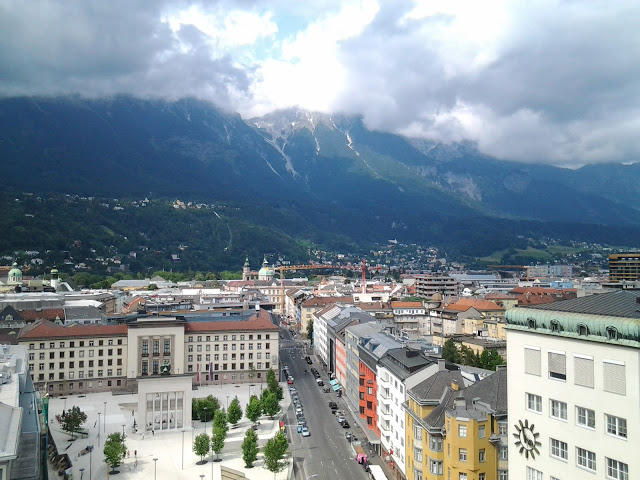
From the highest level of the hotel, it is possible to get a look at the mountains that surround the city.  This view is in the direction we had driven earlier, from Florence.

The change in the weather was noticeable the moment we entered the mountain ranges.

This view looks towards the old town and overlooks a public square.

This view shows some signs of the cold, but in summer, I doubted we were going to see any snow.

We have been here in winter, and it is quite cold, and there is a lot of snow.  The ski resorts are not very far away, and the airport is on the way to Salzburg.

There is a host of restaurants in the old town, and we tried a few during our stay.  The food, beer, and service were excellent.

On a previous visit, we did get Swiss Army Knives, literally, from a small store called Victorinox.

And, yes, we did see the golden roof.

My grandchildren are now working in their first job

It’s hard to believe that both the 20-year-old and the 17-year-old have joined the workforce and started on their path of working for the next 50 to 60 years. The 14-year-old is about to start in the next few weeks. How quickly they grow up.

They seem quite amused at the thought, and not without reason, and are not really considering the idea. Not yet, anyway.

The novelty is still quite new, and it has a sense of excitement, but this will no doubt wear off in the coming months. After all, as new workers, they only have to do between 3 and 5-hour shifts.

I guess the fact they decided to work at such a young age reminded me of my experience, way back when I was the same age.

Unlike them, who will be afforded to opportunity to remain in school to the end, Year 12, and possibly the chance to go to University, in my case we did not have the money to continue education beyond Year 10, and there was no question of ever going to University. Only the rich could afford that, and we were anything but rich.

Instead, I guess hating school helped facilitate my departure, and the notion that I would have to pay my own way forced me into working.

Of course, it helped to live in a small country town, and my father had a job that brought him in contact with everyone who was anyone and thus got offers to work in whatever profession I chose.

I ended up in the Post Office, what I considered the easiest of jobs, originally employed as a telegram delivery boy, and mail collector from the post boxes scatted about the town. As you can imagine, there were not many telegrams to deliver, so other duties included sorting mail, and then mail delivery. Yes, I became a postman!

Then, after a few months, I became the night switchboard operator, and with a host of other operators, had some of the most interesting and varied conversations imaginable.

It was a bit of a wrench when we finally moved from the country town back to the city.

When we did, my father bought a small business, and for a year or so, I became a shop assistant.

That lasted for a year or two until I was 17. Realising that a lack of education was going to make it difficult to ever get a good-paying job, I took the opportunity to go back to night school while I had the chance, and it necessitated finding another job to help pay for it.

That was packing books for a wholesale bookseller, part of a small team hidden away in the basement of a very old building. It might not be the best-paying job or the best working conditions, but I suspect it was the universe telling me something.

That job, and being surrounded by books started me off on a journey of reading and eventually writing.

“The Devil You Don’t”, she was the girl you would not take home to your mother!

Now only $0.99 at https://amzn.to/2Xyh1ow

John Pennington’s life is in the doldrums. Looking for new opportunities, and prevaricating about getting married, the only joy on the horizon was an upcoming visit to his grandmother in Sorrento, Italy.

Suddenly he is left at the check-in counter with a message on his phone telling him the marriage is off, and the relationship is over.

If only he hadn’t promised a friend he would do a favour for him in Rome.

At the first stop, Geneva, he has a chance encounter with Zoe, an intriguing woman who captures his imagination from the moment she boards the Savoire, and his life ventures into uncharted territory in more ways than one.

That ‘favour’ for his friend suddenly becomes a life-changing event, and when Zoe, the woman who he knows is too good to be true, reappears, danger and death follow.

Shot at, lied to, seduced, and drawn into a world where nothing is what it seems, John is dragged into an adrenaline-charged undertaking, where he may have been wiser to stay with the ‘devil you know’ rather than opt for the ‘devil you don’t’.

newdevilcvr6