Inspiration comes from the most unlikely sources

And this was one of those times.

Before the COVID-19 pandemic, a time that is rapidly disappearing in our collective memories, we came down from Brisbane to Melbourne for a wedding, perhaps the last for this family for quite some time, this being my wife’s brother’s last daughter to tie the knot, so to speak.

And like someone said, as with births, weddings and funerals, it turned into a family reunion on my wife’s side of the family.

But there were extra benefits…

We got to meet the extended family of the groom.

And, we got an insight into their friends, the thirty-something, footloose and fancy-free acquaintances that had been off and on a part of the bride and groom’s life for about 15 or so years, and most of who had been to London, for various stints, and who are now scattered across Australia, and other international destinations.

I have to say that these people were quite interesting.

As an older person, I didn’t have much in common, so I followed one of my father’s old adages, if you’ve got nothing to say, shut up and listen.

And as a writer, I did something else, observe.

It was an eye-opening experience if nothing else, and a rather interesting look into what it might be like as an unmarried reasonably well-off thirty-something. For starters, you didn’t have to worry about the price of drinks, or how much you drank. You can just up and go anywhere in the world at the drop of a hat. For a few minutes there I was starting to feel envious.

It was sometimes overindulgence, but I noticed it was never to the point of becoming what some refer to as legless. Noisy perhaps, crude at times, yes, but in reminiscing, it was a curious phenomenon that they had all “hooked up” at some time or other.

Aside from learning what appeared to be a new “language”, there was also a running theme that at one time or another nearly all of them had lived with the groom in London for a period.

It got me thinking.

It would make a good story.

It was just trying to find a context, other than a wedding, that would bring them together, one where a series of vignettes that involved each of them, in turn, could bring the story of that person to life.

In this case, but not so much the reminiscing, it was the wedding.

What if it was an untimely funeral?

Trying to find joy in the midst of a very sad occasion.

I’m sure this has been done to death many times, but after hearing a lot of happy memories, it seems to me that in this case, it could be uplifting.

Yes, the ideas need a little work, but it’s firmly there in my mind.

Perhaps when I get back home, I might just start writing.

Writing about writing a book – Day 34

So it seems that Aitchison, the latest addition to the story, has reservations about what’s is or isn’t going on.  Aitchison is in charge of the security, not only the computer systems, but for everyone, and, of course, the first person the police would go and see.

It’s also time to bring in the CEO, a rather elusive character, but one who will have a great deal to do with our main character for a lot of different reasons.  But, for now, all the reader needs to know is that he exists,  and is very elusive for one particular reason.

Halligan is just another incidental character, significant only because he is also dead, and where there are multiple deaths, there had to be a conspiracy.  Aitchison, of course, is not what he seems, not that we know that yet, but for now, is a man with a problem.

…

I looked Aitchison directly in the eye, so he would not think I was lying. “Since the last debacle, I rarely see Halligan, and, when I do, I can assure you the last thing he wants to do is ask for favors. My last visit was to set up a laptop on his desk, not connected to the network. Does the CEO know anything about this?”

The CEO was almost the equivalent of the invisible man. No one could remember seeing him in the office, or when he visited the last time and was rumored to be at his Nevada ranch most of the time where he had an office. I remember setting up video conferencing for him a year or so ago, but I don’t think it had even been used.
But Aitchison was one of a few who had met him personally.

“I put a call in. He’s at a retreat with the American management team, going through some team-building exercises. I’m waiting for his call, but I think I can safely say he will deny everything, and plead innocence.”

“Has the staff members been questioned?”

“Yes. No one had anything constructive to add. But one other interesting bit of information that did come out of that briefing with the Chief Inspector was that Halligan also attempted to log onto this other network. That’s why I asked you about Halligan.”

Something was not right. Halligan was dumb when it came to computers, and only wanted a computer, not connected to the network. Of course, he needed a networked desktop for email, and sourcing documents, and perhaps the peek at a porn site through the internet, but that was the extent of his involvement. His knowledge of networking was solely based on the background papers I wrote for him when he needed information for meetings and conferences. He even had trouble logging into the network at times, because he kept forgetting his password.

I kept that to myself. Aitchison was probably not interested in anything that would refute his belief of what the situation entailed. He was partially wrong, but that was driven by fear.

“What had Halligan have to say about all of this?”

It was an innocent question, but it drew the sharpest reaction and given a sudden ashen look on his face, the catalyst of his fear. The mere mention of questioning Halligan had caused him to turn white.

“He’s dead too, and conveniently cannot answer any questions. The doctor said it was a heart attack.”

“Dead? Where, when?”

“Early this morning, at home. Apparently, his wife is away, overseas visiting relatives, and neither we nor the police have been able to contact her. I only found out when I tried to call him this morning after the news about Richardson broke, and the police answered the phone.”

He poured a splash of whiskey into the glass and drank it down. If it was to settle his nerves it wasn’t working.

“And you don’t think it was a heart attack?”

“Too convenient, far too convenient, especially so soon after the Richardson thing, and in the light of this other network logon episode. The very two people who allegedly knew about this network both dying of innocent causes? Something is going on here, and we have to get to the bottom of it, before the police, Interpol or any forensic experts, if that’s what they are.”

He poured himself another liberal drink from the bottle and offered me one. I declined. Too early, and my nerves were not yet getting the better of me.

A shiver ran down my spine. I was beginning to buy into his paranoia. It was beginning to look like anyone associated with this secret network found themselves on some sort of hit list. No wonder Aitchison was jumpy. He’d obviously come to the same conclusion I did. He’d been making inquiries, and it might be enough to have his name added to the list.

Telling me about it might just be enough to add my name to that same list. I looked at the whiskey bottle and the glass. It might be time for a nerve-steadying drink.

Aitchison was still talking, and I just caught what he was saying, “… it’s your network. People will be asking questions.”

If he was trying to scare me, it was working.

He continued, “The police were rather sceptical when I said we didn’t know the network was in place. I’m to be interviewed next. You shouldn’t be far behind. Forewarned is forearmed.”

He turned to look out at the city. The view was magnificent, despite the wintry weather.
After a minute, he said, “At least there is one irrefutable fact. Richardson was in the wrong place at the wrong time. It’s the only explanation. I don’t believe he was trying to log into anything, but he was the victim of a random key combination or a glitch in the power supply to the system. You’ve seen it happen yourself when the power goes down momentarily and just enough time elapses to trick the computer into thinking it has to log in again. There was a brief power outage last night, during the storm. It might be worth investigating that event, and the effect on our systems.”

That was not a bad assessment, and one I hadn’t thought of.

“Then, there is something else, the Chief Inspector mentioned in passing, and that was one of the employees claims his building pass card had been stolen. Again, convenient, but the police are questioning him, but according to building security, that pass was used last night.”

“The person who killed Richardson?”

“If you put two and two together and get four. The police aren’t saying much, but that’s the inference I’d draw?”

“And the person with the missing card?”

“A janitor, or maintenance worker, not one of our people. He probably has a police record as long as his arm. You should go. And just a thought. If it was a desktop system connected to the in-house network, then one of our servers had to be used as a gateway. Tell me you installed those special log files when I asked you to last week?”

I had been in two minds about implementing that particular request because in part it when against the privacy regulations we had to adhere to.  After reading the relevant legislation and taking to a consulting security company who had advised we were well within our rights to do so, in the end, I did. And it had given several positive results immediately after its implementation, proving beneficial in tracking down people using the network incorrectly. I’m glad he remembered it. In the panic, it slipped my mind.
“Of course! How do you think I tracked down the troublemaker in Distribution?”

“Good. Start the investigation as soon as you bet back to the floor, but be careful to make sure no one knows about it, or what you are doing. People connected with this seem to be suffering from terminal health problems.”

I stood. I was not sure if I felt suitably inspired.

“I’ll let you know what I find.”

…

© Charles Heath 2015-2023

All the days seem the same

I feel like I’m on the outside looking in at this poor fellow struggling to work out what needs to be done, and in the end, getting nothing done.

Writing had suddenly become all that more difficult to do, not because I can’t, there’s an endless supply of ideas running around in my head, it’s just wanting to sit down and do it.

What are my expectations? 

I had set a list of projects I wanted to work on, more episodes for the three continuing stories, and a start to the next episodic story, ‘motive, means, and opportunity’, though for this story I have brought together all the writing I’ve been doing in past few months.

Then there is the completion of ‘the things we do for love’ which at long last now has a completed second draft with a lot of updates and changes to properly reflect the situation of the characters.  I have also got ‘strangers we’ve become’ to a point where it can finally get editorial sign-off. Publishing is not far away after that.

It would be easy to blame COVID 19 for the delays or the lack of commitment to the task, but that’s not the problem.  I’ve been home and had the time, but there have been a number of distractions, and ideas for new stories always seem to divert my attention from what I should be doing.

It’s not writer’s block.  It’s not laziness.  It seems that I just don’t have the time to work on them, and that might be because my subconscious is telling me there are problems with the narrative, and I’m just not ready to address them.

What has got my attention then?

I’m not sure how or why, but something triggered the idea of passing through a portal into another time, in the past.  I think I might have been looking for photographs to write another photo/story, and I came across a covered bridge, and which led to looking for photographs of ghost towns.  What topped it off, there was an old western in black and white, High Noon, which provoked a whole lot of memories of many westerns I’d seen in the past.

What other reason do you need to write your own story?

Then, when visiting my grandchildren, we just happened to do some stargazing, using Google Sky Map, picking out the planets.  Somehow I managed to take a photo, and looking at it, took me back to the days of Star Trek, and the many series, which sort of gave me an idea for another story, which has been running off and on over the last few months.

Equally, I’m always on the lookout for photo opportunities that I can use to write short stories, and these continue apace, the latest, number 150.  These are being formed into anthologies, stories 1 to 50, and stories 51 to 100.  The first has been assembled into book form and is awaiting the editor’s first reading and report.  I’m still working on the second.

And, now there is the next, stories 101 to 150.

Perhaps some of the time has been spent keeping up with Twitter, where over the last six months, and more recently, sales of my books on Amazon have been increasing.  Not to best-seller numbers, but people are reading my stories, and the reviews have been very good.

It has, of course, pushed me to work harder on marketing and that has consumed some of my time, which unfortunately takes me away from writing.  It sometimes feels like a self-defeating exercise, but it is the same for all of us.

Oh, and something else that cropped up this month, my brother has been digging into our family history, and around the middle of the month, he found some interesting revelations about some family members, including a pseudo-Luddite that ended up in Tasmania of all places, and then later on, when chasing down the places that we, as a family, lived, and this brought out some very interesting information about our father.

I’m discovering for what I’d always assumed was an ordinary man, he had done a lot of very interesting things in his life, and not only that, I’ve been fictionalizing the story.  I have potted pieces written over various stages, and, one day, it might come together as a sort of biography.  It is astonishing just how much you don’t know about your family, until much later on, at least for some of us.  Our relatives have always been a mystery to me, and it’s fascinating as each one is brought to life with a new detail here and there.

Looking back on what I’ve just written, perhaps the passing of time had been more productive than I first thought.  It just seems like nothing major has happened.

“Jump Now” – A short story

It was 2 am, the ideal time to assemble a team that would be clandestinely boarding a vessel.

Dark and moonless, it was fortuitous rather than planned, and, dressed in black from head to toe, it was hard to see the others in the inky darkness.  At least something was on our side.

Up until this point, we’d had nothing but bad luck, though I was more of the opinion we had a traitor in our midst because some of the events could not have any other explanation.

It had caused me to be far more selective in who I gave details of the mission to.

Each of the four team members had arrived and let themselves into the shed.  It was not far from the ocean, and a small pier where there was a landing craft waiting.  From there, it would be a half-hour trip out to the ship in question, where, if we got close enough, we would either have to go over the side and swim, or pull alongside, but either way we’d have to go up a rope.

A lot depended on the crew member we had recruited getting a rope overboard, and given the luck we had so far, if there was a flaw in the plan, that was it.

Aside from the four people sitting in front of me, there were only three others privy to what was about to happen.  Now, with recent events, it was hard to imagine that one of them could betray us. That’s why I hadn’t completely told them what they were about to do, just that they needed to be prepared to get wet.

“I’m sure, now we’re here, you can tell us what’s going on.”  Robert was the most trusted of my team and my best friend.

“And why all the hush-hush,”  Linda added.  She had been amused at the secrecy and my explanation.

I was never very good at spinning a story.  She knew that but had not questioned why.

“It’s been touch and go for the last week.  It’s why we’ve all been on standby, with this last-minute call out.  We’ve been waiting for a particular ship to leave port, and now it has.  So, without further ado, let’s get to it.  A boat ride, just enough time to gather the courage to the sticking point, and then with any luck we won’t have to go into the water and swim, but a short shimmy up a rope.  I hope you’ve all been working out.”

The boat ride was in silence.  I’d worked with this group before and they were not big on talking.  Aside from the fact that noise traveled over water, and since we had a specially silenced motor on the boat, there was not going to be any unnecessary conversation.

We could see the ship once we reached the headland, and aside from it’s running lights, there were lights where I presumed the bridge was, and several in the crew quarters.  Closer again, I got the impression it was not moving, or if it was, it was very slow.  It was hard to tell in the darkness.  That same darkness aided our approach.

When we were within several hundred yards I could see that the ship was not moving, and, in fact, had the anchor out.

That was not expected.  Were they waiting for us?  Had they discovered the cream member who was working with us?  We’d know soon enough if there was no rope in the designated point, not far forward of the stern, a spot where we could maneuver the boat under the hull curvature.

The driver piloted the boat slowly to the designated point and the rope was there.  He would stay with the boat and wait.  The four of us would go up and collect what we came for.

I watched the three go up the rope before me, waiting for the last to stop at the top and then go over the side onto the deck.  It took nearly a minute before I got the signal it was clear to follow.

It had been too easy.

I went up the rope slowly, slower than the others, something else other than the object of the exercise on my mind.  Not three days before I had a conversation with my boss, telling him that I’d been doing the job too long and that it was time to retire.  Approaching forty wasn’t exactly retirement age, but in this job, lasting that long was almost a miracle.  The places I’d been, the sights I’d seen, and the people I’d met.  And how many lives I’d used up.

It was a dangerous thing, thinking about anything other than the job when you’re on the job.

I reached the top and pulled myself over the railing and onto the deck.  A little off balance it took a moment to stand.  By then it was too late.

Two of the three other members of the team were sitting by the superstructure, heads on their heads, two members of the crew were watching them, guns at the ready, and Linda had one pointing at me.

“I can’t imagine how MacIntyre thought he was going to convince Petra to defect.  Or how this charade of a rescue attempt was ever going to work.”

I put my hands up.  Not entirely unexpected.  “It was not the mission objective.”

“What…”

I was surprised that she had made her move so early.  If it was my operation, I would wait until we were well into the superstructure, heading to the cabin where Petra would be waiting, and then make the move.

Three seconds, three shots, two guards taken out, and Linda incapacitated.  She would not be moving or fighting back any time soon.  The Petra came out of the shadows, and I collected Linda’s gun and stood near her, just in case Petra missed the target.

Petra cut the two other’s bindings, and said, “get to the side and jump now.”

Linda looked up at me.  “What now?”

I shrugged.  “Time for us to leave.”  I gave Petra a nod, and she went over to the side, took one look back at Linda, shook her head, then jumped.

“You’re just going to leave me here?”

“If it were up to me, I’d shoot you, but MacIntire is getting a little soft in his old age.  But yes, I’m leaving you here.  Now, I really must go.”

I took a last look at Linda, who realized that if she moved it would only worsen her injury, and jumped, not exactly my preferred way of leaving the ship.

The boat came up alongside me and two hands dragged me on board, at the same time we could hear the sound of the anchor chain being pulled up, and the propellers creating a wash as the ship started moving.

Job done, and not one that pleased me.  “Let’s go home,” I told the driver, “it’s past my bedtime.”

—-

© Charles Heath 2020-2021

Searching for locations: An old country homestead, Canungra, Australia

Or to be more precise, the homestead at what is now O’Reilly’s vineyard, where there is a pleasant lawn out back running down to the river for picnics, an alpaca farm next door, and the homestead plays host to functions and wine tastings

My interest was that we had assumed there was a restaurant, and we were going to have lunch. There might be one, but not the day we visited, it was just cafe food or a picnic available.

I was more interested in the old homestead because it was a fine example of the homesteads built in the ‘outback’.

…

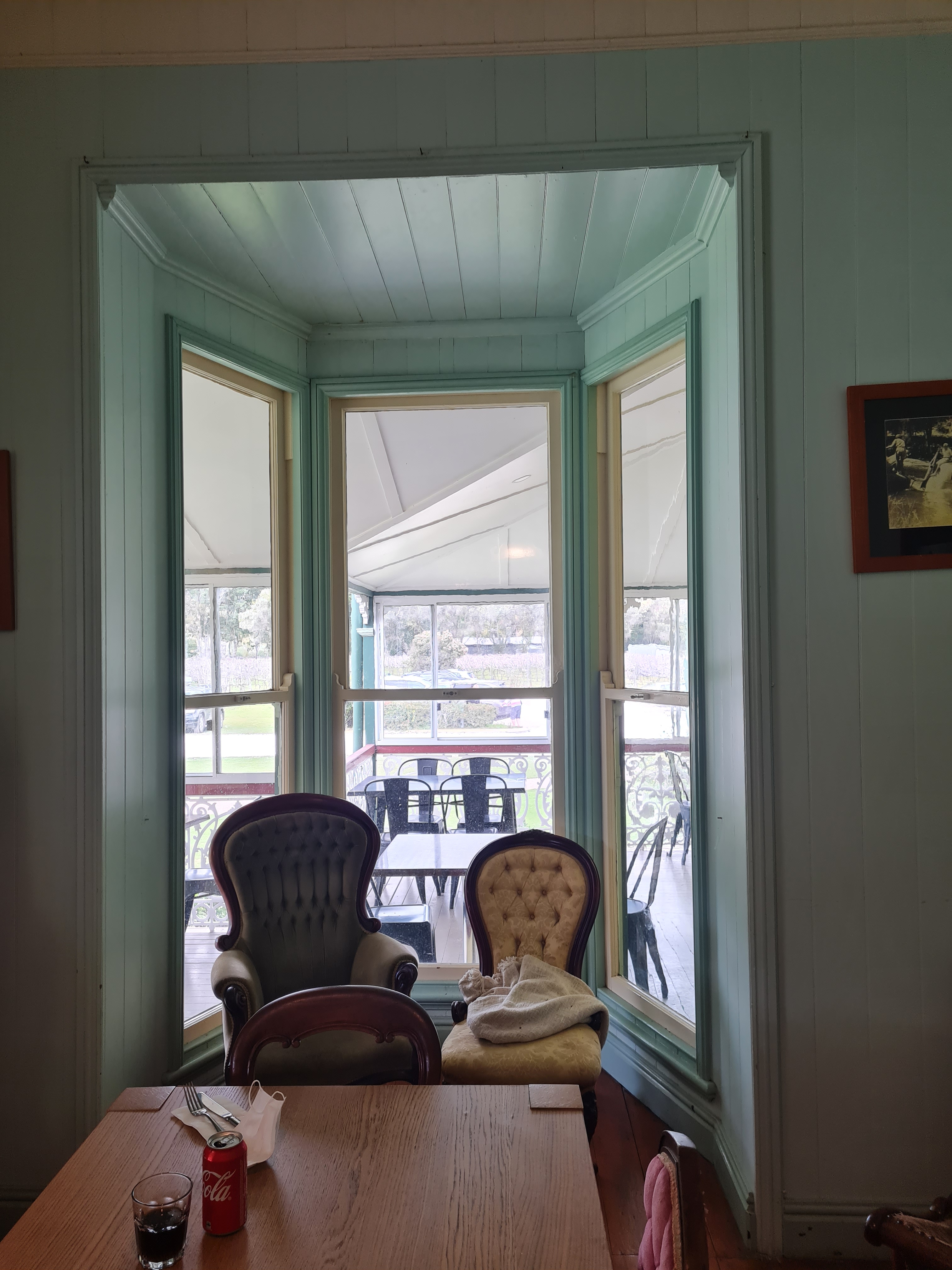
Today we are having lunch in the Platypus room, in the O’Reilly’s vineyard farmhouse, which, if you close your eyes and let your imagination run free, could see it as the master bedroom of a homestead.

Certainly, the building is old, made completely of timber, inside and out, with the traditional high ceilings to keep the heat at bay.

At one end, a large bay window, which would be ideal to sit and view the outside, past the sweeping verandah.  There is a small lawn and a rotunda, but beyond that what might have been extended gardens, is the vineyard.

The homestead is in an ideal position midway between the main road and the river, has the traditional surrounding verandah, and shows signs of being extended on almost all sides.

On the other side of the wide corridor that leads you to the bar, and, coincidentally, down the centre of the house, is a smaller bedroom, also used as a dining room, and ubiquitously named the library.

It may be small but it does have a fireplace, which the assumed master bedroom does not, but now I’m thinking that room might have been the morning room.

Behind the room, we’re in is another bedroom, or perhaps this might be the master because it does have a fireplace and is quite large.  And a name, the Ambassador room.  Now it serves as the pickup place for picnic baskets.

There is another room on the opposite side of the corridor called the Drawing Room but is not open to the public.  But, going into the room with the fireplace adjacent to it, you can sell the aroma of pizzas, so it’s probably an extension of the kitchen, and, walking around the outside that side of the house proves it to be the case.

After all, they do catering for weddings and need a very large food preparation area which I discovered runs down the whole of that side of the house.

At the end of the corridor I’d the bar and spare space, and running off that and behind that is where there is a large dining area, perhaps prior to COVID, the restaurant.

It’s not hard to imagine that area as a very large entertaining area, either for very large dinner parties, or dancing.

As for the food, it’s either a picnic basket or pizzas.  We chose the latter, not realising the bases were not homemade, but bought in.  

The toppings however were both plentiful and tasty.  It could have been hotter, because it was a cold day, and it was cold in the room.

As for something to do other than taste the wine, and buy a few bottles, you can get up close to the vines, which, at this time of the year gave been pruned back and look quite dead, look at or walk an alpaca, even feed it, or all of them, or go down to the river and see if you can spot a Platypus.

Perhaps next time we’ll have a picnic down by the river.

“Trouble in Store” – Short stories my way: Still working on the start

I have reworked the first part of the story with a few new elements about the characters and changed a few of the details of how the characters finish up in the shop before the policewoman makes her entrance.

This is part of the new first section that involves Jack:

Jack was staring down the barrel of a gun.

He had gone down to the corner shop to get a pack of cigarettes.

He had to hustle because he knew the shopkeeper, Alphonse, liked to close at 11:00 pm sharp.  His momentum propelled him through the door, causing the customer warning bell to ring loudly as the door bashed into it, and before the sound had died away, he knew he was in trouble.

It took a second, perhaps three, to sum up the situation. 

A young girl, about 16 or 17, scared, looking sideways at a man on the ground, then Alphonse, and then Jack.  He recognized the gun, a Luger, German, relic of WW2, perhaps her father’s souvenir, or more likely a stolen weapon, now pointing at him then Alphonse, then back to him.

Jack took another second or two to consider if he could disarm her.  No, the distance was too great.  He put his hands out where she could see them.  No sudden movements, try to remain calm, his heart rate up to the point of cardiac arrest.  No point making a bad situation worse.

Pointing with the gun, she said, “Move closer to the counter where I can see you better.”

Everything but her hand steady as a rock.  Only telltale sign of stress, the bead of perspiration on her brow.  It was 40 degrees Fahrenheit in the shop.

Jack shivered and then did as he was told. 

A few seconds more for him to decide she was in an unpredictable category.

“What’s wrong with your friend?”  Jack tried the friendly approach after he’d taken the three steps sideways necessary to reach the counter.

The shopkeeper, Alphonse, who, Jack noted seemed to have aged another ten years in the last few months, spoke instead; “I suspect he’s an addict, looking for a score.  At the end of his tether, my guess, and her to get some money.”

A simple hold up that had gone wrong.  Wrong time, wrong place, in more ways than one Jack thought, now realizing he had walked into a very dangerous situation.  She didn’t look like a user.  The boy on the ground, he did, and he looked like he was going through the beginnings of withdrawal.

Oddly, though, Jack had noticed a look pass between the shopkeeper and the girl.

 “All you had to go was give us the money, and we wouldn’t be here, now.”  She was glaring back at Alphonse.  “You can still make this right.”

A flicker of memory jumped out of the depths on Jack’s mind, something discussed at the dinner table with their neighbors, something about the shop as a pick-up point for drugs.

The boy on the floor, he was not here for the money.

Jack thought he’d try another approach.  “Look, I don’t want trouble, and you don’t want trouble.  I’ll go, forget this ever happened.  You might want to do the same.”

The girl looked like she was thinking.  The gun, though, still moved between him and the shopkeeper.

Another assessment of the girl; this was not her real home.  She was from a better class of people, a different part of town.  Caught up in a downward spiral because of her friend on the floor.

Caught in a situation she was not equipped to deal with.

That didn’t bode well for his, or anyone else in that shop right then, health.

© Charles Heath 2016-2020

“The Things We Do For Love” – Coming soon

Is love the metaphorical equivalent to ‘walking the plank’; a dive into uncharted waters?

For Henry the only romance he was interested in was a life at sea, and when away from it, he strived to find sanctuary from his family and perhaps life itself.  It takes him to a small village by the sea, a place he never expected to find another just like him, Michelle, whom he soon discovers is as mysterious as she is beautiful.

Henry had long since given up the notion of finding romance, and Michelle couldn’t get involved for reasons she could never explain, but in the end both acknowledge that something happened the moment they first met.  

Plans were made, plans were revised, and hopes were shattered.

A chance encounter causes Michelle’s past to catch up with her, and whatever hope she had of having a normal life with Henry, or anyone else, is gone.  To keep him alive she has to destroy her blossoming relationship, an act that breaks her heart and shatters his.

But can love conquer all?

It takes a few words of encouragement from an unlikely source to send Henry and his friend Radly on an odyssey into the darkest corners of the red-light district in a race against time to find and rescue the woman he finally realizes is the love of his life.

The cover, at the moment, looks like this:

lovecoverfinal1

The cinema of my dreams – I always wanted to go on a treasure hunt – Episode 17

Here’s the thing…

Every time I close my eyes, I see something different.

I’d like to think the cinema of my dreams is playing a double feature but it’s a bit like a comedy cartoon night on Fox.

But these dreams are nothing to laugh about.

Once again there’s a new instalment of an old feature, and we’re back on the treasure hunt.


I could hardly say no, but it was not going to be a place either of us would want to be if he came back, and especially if he had company.

But, Boggs didn’t seem to care, and strolled up to the dock, and then walked down to the boat.  IT wasn’t gated like some of the others were, but they had very expensive yachts that no doubt belongs to the local millionaires, people like the Benderby’s and their country club friends.

I remember my father talking about them once, and he had little respect for any of them.,  They, he said, had no time or money to worry about the welfare of their employees, but never lacked for anything themselves.

Looking at those yachts now, I could believe him.

I couldn’t say the same for Rico’s boat.  It was old, made of wood, and looked like boats I’d seen in old movies.  It was about 40 or 50 foot long, with a tall mast and a sail tied up ready to unfurl when out to see.

It had a large diesel engine, and it was this Rico used to get out of the bay until he was past the sandbank at the entrance.

On the transom, it had the words ‘Freedom Runner’ starting to peel and fade, and you could just make out the old name of the boat, ‘Elsie’, perhaps the wife or lover of the previous owner.  That must have been a long time ago, because I’d known Rico as long as I’d known Boggs, and that was nearly 18 years.

I had to ask, “You think Rico is running a collection service?”

“Someone is, according to the police chief.”

“How do you know that?  I thought the police were our sworn enemy.”

Considering the trouble we’d got into over the years, and the number of times the police chief had locked us up in the cells as punishment, we just spent our days avoiding him..  Perhaps the punishment had worked.

“He was around out place the other night.”

I wasn’t aware that Boggs was up to anything that would interest the law, but, then, he never told me everything he did.

“Why?”

“Come to see my mother.”

“What’s she been doing?”

“Nothing.  He was asking her out on a date.  Probably trying to cosy up to her so he can snoop on what Rico’s doing.  There’s no other reason why he would be interested in her.”

Actually, he was wrong.  Boggs mother was, for her age, quite attractive, or so my mother said.  She said a few other uncomplimentary things about her, but I was not going to repeat them to Boggs.

Nor did I agree with my mother’s assessment.  At times I saw more of Boggs mother than my own.

“Or maybe not.  But if she was to go out with him, that would make Rico think twice about doing anything, including giving you a hard time, or trying to steal the map.”

“You don’t know Rico.  He is just plain stupid.”

“He hasn’t been caught.”

“Yet.”

Then Boggs decided to walk over to the side of the boat and step onto the deck.

”What are you doing?” I hissed.

People on the other boats tied up to the pier were looking or pretending not to look, but I had no doubt they would report our actions to Rico

“Going on board.  I don’t think Rico would mind.”

It was said with a fair degree of bravado, but the halting tone told me otherwise.

“Are you coming?”

Damn him.  It was not as if he was going me a choice.

I shrugged.  God help us if Rico came back.


© Charles Heath 2019

An excerpt from “If Only” – a work in progress

Investigation of crimes doesn’t always go according to plan, nor does the perpetrator get either found or punished.

That was particularly true in my case.  The murderer was incredibly careful in not leaving any evidence behind, to the extent that the police could not rule out whether it was a male or a female.

At one stage the police thought I had murdered my own wife though how I could be on a train at the time of the murder was beyond me.  I had witnesses and a cast-iron alibi.

The officer in charge was Detective First Grade Gabrielle Walters.  She came to me on the day after the murder seeking answers to the usual questions like, when was the last time you saw your wife, did you argue, the neighbors reckon there were heated discussions the day before.

Routine was the word she used.

Her fellow detective was a surly piece of work whose intention was to get answers or, more likely, a confession by any or all means possible.  I could sense the raging violence within him.  Fortunately, common sense prevailed.

Over the course of the next few weeks, once I’d been cleared of committing the crime, Gabrielle made a point of keeping me informed of the progress.

After three months the updates were more sporadic, and when, for lack of progress, it became a cold case, communication ceased.

But it was not the last I saw of Gabrielle.

The shock of finding Vanessa was more devastating than the fact she was now gone, and those images lived on in the same nightmare that came to visit me every night when I closed my eyes.

For months I was barely functioning, to the extent I had all but lost my job, and quite a few friends, particularly those who were more attached to Vanessa rather than me.

They didn’t understand how it could affect me so much, and since it had not happened to them, my tart replies of ‘you wouldn’t understand’ were met with equally short retorts.  Some questioned my sanity, even, for a time, so did I.

No one, it seemed, could understand what it was like, no one except Gabrielle.

She was by her own admission, damaged goods, having been the victim of a similar incident, a boyfriend who turned out to be an awfully bad boy.  Her story varied only in she had been made to witness his execution.  Her nightmare, in reliving that moment in time, was how she was still alive and, to this day, had no idea why she’d been spared.

It was a story she told me one night, some months after the investigation had been scaled down.  I was still looking for the bottom of a bottle and an emotional mess.  Perhaps it struck a resonance with her; she’d been there and managed to come out the other side.

What happened become our secret, a once-only night together that meant a great deal to me, and by mutual agreement, it was not spoken of again.  It was as if she knew exactly what was required to set me on the path to recovery.

And it had.

Since then, we saw each about once a month in a cafe.   I had been surprised to hear from her again shortly after that eventful night when she called to set it up, ostensibly for her to provide me with any updates on the case, but perhaps we had, after that unspoken night, formed a closer bond than either of us wanted to admit.

We generally talked for hours over wine, then dinner and coffee.  It took a while for me to realize that all she had was her work, personal relationships were nigh on impossible in a job that left little or no spare time for anything else.

She’d always said that if I had any questions or problems about the case, or if there was anything that might come to me that might be relevant, even after all this time, all I had to do was call her.

I wondered if this text message was in that category.  I was certain it would interest the police and I had no doubt they could trace the message’s origin, but there was that tiny degree of doubt, about whether or not I could trust her to tell me what the message meant.

I reached for the phone then put it back down again.  I’d think about it and decide tomorrow.

© Charles Heath 2018-2020

The cinema of my dreams – Was it just another surveillance job – Episode 20

I’m back home and this story has been sitting on a back burner for a few months, waiting for some more to be written.

The trouble is, there are also other stories to write, and I’m not very good at prioritising.

But, here we are, a few minutes opened up and it didn’t take long to get back into the groove.

A chessboard of players

I sighed.  Someone else who wasn’t who they seemed to be.

At a guess, it was a gun in my back.  We were far enough away from anyone else for them to recognise what was happening.

“No need for whatever weapon you have in my back.  I’m neither armed nor dangerous.”

“Why are you following me?”

Should I tell her the truth or tell her a lie.  The latter would be the most expedient, but I needed to talk to her, so I went with the former.

“You know O’Connell.”

“Were you the one who attacked me?”

“I told you I meant you no harm.  What happened to you wasn’t my fault.”

Whatever was in my back was no longer there, so I turned around to face her.  She had changed her look since O’Connell’s flat, not only the change in hair colour and length but also the makeup, making it difficult for anyone to recognise her from a distance.  I’d been lucky.

“What do you want with him?”

“More than likely the same as you.  He made the mistake of thinking you were interested in him, but I suspect your assignment was to get close, and the flat next door was as close as you could get.”

“What are you babbling about?  We were friends.”

“How often did he stay in that flat?  Everything in it still has the price tag on it.”

“You’re loopy.  I’m going now, and I suggest you don’t follow me again.”

“I know where you live remember.  All I want is some answers.”

“There are no answers.  He was a friend, that’s it.  I’m going now.”  She turned and started to walk away.

“If I know who you are, the chances are the others do too.”

She stopped.  Interesting response.  In her shoes, my first reaction, if I was an innocent person, would be to call for a policeman to have me taken away for assaulting her.

She turned and took two steps back towards me.  “What are you talking about now?”

“O’Connell’s flat was like Marks and Spenser this morning.  I came and found another woman claiming to live next door, named Josephine, unconscious on the floor, and I didn’t do it by the way.  She works for a man named Nobbin, McConnell’s direct superior, and whom I think, indirectly I do too, and I suspect she was neutralised by another man named Severin.

“Whatever O’Connell was up to, there are a lot of people who want a missing USB with what I suspect is very interesting, and probably damaging information.  You wouldn’t have it, by the way?”

“Who are you?”

“That’s what I’m not sure about.  Like I said, I think I work for the same man whom O’Connell worked for, but before that, I worked with the people who had him killed for whatever was on the USB.”  It sounded far more horrible out loud than it had a few seconds earlier in my head.  God only knew what she was thinking about it.  “Who do you work for, because a woman who can do the transformation you just did is either a call girl or an agent?”  Another thought just occurred to me, a reason perhaps why she had changed her appearance so radically.  “Your flat was searched too, wasn’t it?”

No need to answer yes or no.  The look on her face was enough.

We ordered coffee and sat down.  She was still very wary of me, but since I seemed to know, or presumed to know, what had happened, she was going to ask me some questions I wasn’t going to be able to answer.

And not because the answers were in the top-secret category, it was simply because I didn’t know.

“So,” I asked, “who do you work for?”

“You don’t need to know.”

“But you were either keeping O’Connell close company by insinuating yourself into his life, or you were maintaining some sort of surveillance.”

She was plating it close, and with a poker face.  She was better at it than I was.

“Where is he, by the way?”

“Dead.”

“Dead?”  

No mistaking that look of fear the flickered on her face, then disappear again into rocky granite.

“Dead.  Seems he came across some information, and it caused his death.  I was there shortly before he died, shot by a sniper, I think, and there was nothing I could do about it.  Any idea what that information was?”

“I still don’t know what you’re talking about, but either way, if I did or I didn’t the answer would be the same, no.  He told me he was a reporter, working on a really big story, and that he would have to go away for a few days.  I knew that was his cover story.”

“Were you after that same information?”

“Probably, maybe, I don’t know.  Our information was mostly conjecture, a profile built up by our research department, based on his travels, and sightings at a location we know is running a network of agents.  The conclusion was that it was not one of ours, so I was assigned to find out exactly who they were.”

“O’Connell would not have told you.”

“Given the circumstances I find myself in, I’m beginning to think that.  If you worked with him, then he was on the same side as you, so are you good or bad?”

That was a rather interesting question to be asking me at this late stage, and especially after she had told me basically what I needed to know, bar who she worked for, but that, I was beginning to think, was MI6.

“A rather silly question to ask, don’t you think?  It stands to reason that if I was bad, then I would not have left you alive in O’Connell’s flat.”

“Not unless you wanted something from me and set this up as a trap.”

So that was the reason why she kept checking everyone she could see upstairs and monitoring the stairs to see who arrived and left.  We were in the right spot to keep tabs on everyone.  And I knew her gun wasn’t very far from her hand.

“Obviously you don’t have it, so my work is done here.  I suggest you don’t go back to that flat.”  I stood.  “Your location and probably who you are is compromised.  And two men and their attack dogs will be looking for you.  Good luck with that.”

“Aren’t you one of those two men attack dog, by your own admission?”

“I’m new and not cynical enough to shoot people out of hand.  You’re probably lucky in that regard.  And if someone like me can find you, then think what a seasoned professional would be able to do.  Have a nice life, what you have left of it.”

© Charles Heath 2019