Writing a book in 365 days – 260

Day 260

Turning your real-life experiences into a story, and then with a great deal of luck, into a legendary film.

From Your Life to the Legendary Silver Screen: The Audacious Quest for Cinematic Immortality

We’ve all seen them – those incredible films that resonate deep within our souls, stories so potent and true, you just know they must have sprung from the messy, magnificent wellspring of real life. Think “Schindler’s List,” “127 Hours,” “The Pursuit of Happyness,” “Erin Brockovich.” These aren’t just great movies; they’re cultural touchstones, etched into our collective consciousness.

And who hasn’t, at some point, looked at a pivotal moment in their own life – a harrowing challenge, an unlikely triumph, a profound transformation – and thought, “Now that would make an amazing movie.”

The leap from your personal experience to a legendary film is, let’s be honest, vast. It’s akin to catching lightning in a bottle, then harnessing its power to illuminate the world. It requires a potent blend of authenticity, craft, perseverance, and indeed, a great deal of luck. But understanding the steps, the possible path, can turn a fleeting thought into a focused ambition.

Here’s how one might embark on this audacious, often miraculous, journey:


Step 1: Harvesting Your Truth – The Origin Story

Before you even think about a script, you must dive deep into your own experience. This isn’t just recounting events; it’s excavating the emotional core.

  • Identify the Core Conflict & Transformation: What was the central struggle? Who were you before, and who did you become after? Legendary stories thrive on profound change.
  • Pinpoint the Universal: While your experience is unique, what universal themes does it touch upon? Love, loss, injustice, courage, resilience, redemption? These are the hooks that connect your singular story to a global audience.
  • Embrace Authenticity, Not Just Facts: Don’t be afraid to explore the messy, uncomfortable, or unsung aspects. Truth, in its rawest form, is compelling.
  • The “Why Now?”: Why is this story important right now? What message does it carry for contemporary society?

This isn’t just memory; it’s meaningful introspection.


Step 2: Crafting the Narrative – From Raw Emotion to Gripping Story

Your life isn’t a film script; it’s a sprawling, unedited saga. The next crucial step is to shape that reality into a compelling narrative arc.

  • Outline the Narrative Beats: Think like a storyteller. What’s the inciting incident? The rising action? The climax? The falling action? The resolution? Even if it didn’t happen perfectly in real life, you need to find this structure.
  • Identify Your Protagonist (You, or an Alter-Ego): What are their desires, flaws, strengths? How do they drive the story forward?
  • Build Your Supporting Cast: Who are the key players in your life’s drama? What roles do they play in your journey?
  • Write It Down (Seriously, Write It): Start as a memoir, a detailed story, or even a treatment. Get the essence of the story, its characters, and its emotional journey down on paper in prose form. This is your foundation.

This is where “storytelling” begins its magic, often requiring you to condense, combine, or even slightly fictionalize elements to serve the larger truth.


Step 3: Translating to the Screen – The Art of the Screenplay

This is where the specialized craft truly begins. A screenplay is a blueprint, a visual language.

  • Learn Screenwriting Fundamentals: Read screenplays of films you admire. Understand structure (three-act, sequences), formatting, dialogue, and “show, don’t tell.”
  • Visualize Everything: How does your story look on screen? What are the key images, sounds, and moments that convey emotion without dialogue?
  • Find Your Voice: Even with technical rules, your unique perspective should shine through.
  • Consider Collaboration: Unless you are an experienced screenwriter, you might need to find a professional screenwriter who can adapt your story into a compelling script. This often means selling them the rights to your life story, or collaborating closely. Be prepared for changes – the film version won’t be a literal transcription of your life.

This stage transforms your story from a personal account into a potential cinematic experience.


Step 4: The Industry Gauntlet – Pitching, Persistence, and People

Even a brilliant script needs to find its way into the right hands. This is where the “luck” factor amplifies, but you can certainly increase your odds.

  • Seek Feedback & Refine: Share your script with trusted readers, writers’ groups, or professional consultants. Be open to critique and revise, revise, revise.
  • Build Your Network: Attend film festivals, writing conferences, and industry events. Connect with other emerging writers, producers, and directors.
  • Enter Contests & Fellowships: Prestigious screenwriting competitions (like The Nicholl Fellowships, Austin Film Festival) can open doors and get your script noticed by agents and producers.
  • Find Representation: A literary agent or manager can be crucial for getting your script read by studios and production companies. This often requires a strong script and some initial buzz.
  • The Pitch: Be ready to articulate your story’s essence, its universal appeal, and its marketability in a concise, compelling way.

This phase is a marathon of networking, rejection, and the occasional glimmer of hope.


Step 5: The Alchemy of Production – From Script to Silver Screen

If your script catches fire, it enters the labyrinthine world of development and production.

  • Optioning & Development Deals: A production company or studio might “option” your script, buying the exclusive right to develop it for a period. This is where the project gets a producer, perhaps a director attached, and financing is sought.
  • Creative Evolution (and Compromise): Be prepared for your story to be shaped by many hands – directors, actors, studio executives. Your initial vision might evolve significantly. This is a collaborative art form.
  • Casting the Dream: The right cast can elevate a good story to greatness, bringing characters to life in unexpected ways.
  • Filming & Post-Production: The arduous process of shooting, editing, scoring, and visual effects comes next.

This is where your story truly transforms, gaining flesh, blood, and a voice beyond your own.


Step 6: The Spark of Legend – Beyond Your Control

Achieving “legendary” status is the ultimate, and most unpredictable, outcome.

  • Critical Acclaim & Audience Resonance: A film needs to connect deeply with both critics and audiences, earning rave reviews and robust box office (though not always).
  • Cultural Impact: Does the film spark conversations? Does it influence other art? Does it stand the test of time, becoming a reference point for future generations?
  • The Right Moment: Sometimes, a story simply arrives at the perfect cultural moment, addressing unspoken needs or reflecting pressing issues. This is pure serendipity.
  • Awards & Recognition: While not the sole arbiter of “legendary,” major awards (Oscars, Golden Globes) certainly amplify a film’s reach and cemented its place in history.

This is the realm of magic, where your personal truth, skillfully told, transcends entertainment and becomes a lasting cultural artifact.


The path from your unique life experience to a legendary film is steep, winding, and littered with “almosts.” Many incredible stories remain untold, or stop short of the silver screen. But the very act of distilling your truth, crafting it into a compelling narrative, and daring to share it with the world is a profound journey in itself.

So, listen to the whisper of your own story. What profound truth is waiting to be unearthed? What cinematic masterpiece might be hiding within the chapters of your life? The first step, always, is simply to begin.

“What Sets Us Apart”, a mystery with a twist

David is a man troubled by a past he is trying to forget.

Susan is rebelling against a life of privilege and an exasperated mother who holds a secret that will determine her daughter’s destiny.

They are two people brought together by chance. Or was it?

When Susan discovers her mother’s secret, she goes in search of the truth that has been hidden from her since the day she was born.

When David realizes her absence is more than the usual cooling off after another heated argument, he finds himself being slowly drawn back into his former world of deceit and lies.

Then, back with his former employers, David quickly discovers nothing is what it seems as he embarks on a dangerous mission to find Susan before he loses her forever.

Find the kindle version on Amazon here:  http://amzn.to/2Eryfth

whatsetscover

In a word: Order

I gave the order to my assistant to order the supplies we needed in order to maintain stock levels.

Oh, yes, the word order is one of my favourites, because it can confuse the hell out of many people in its simplicity and yet complexity.

I gave the order, it’s what happens in the armed forces, and a lot of other places, but mostly we would associate it with organisations that have hierarchical authority.

The military, for one, cut orders, the means of sending one of its minions to another place, or to do a specific job.

Order supplies, well, just about anyone can order something from somewhere, usually on the internet, and sometimes require or are given an order number so it can be tracked.

In order to maintain, in order to get what I want, in order to get elected, this is just another way of using the word, with the aim of achieving something, though I’m sure there’s probably a better way of expressing these sentiments.

Law and order, well, doesn’t everyone want this, and doesn’t it always turn up in an election campaign, and seems to be the first thing sacrificed after the election.  The thing is, no one can guarantee law and order.

There is the law and there is administering it.  There is no order that comes with it, we just hope that order is maintained, and deplore the situation when it isn’t.

Perhaps in order to maintain law and order, we might need more police.

Then, of course, there is alphabetical order, and numerical order, where things can be designated from A to Z, like this challenge, or from 1 to 10, or more.  We can sort words alphabetically, numbers numerically and data items by keys or an index.

This is naturally called a sort order.

Then there is my car, or bike, or washing machine, or mixmaster.  They are currently in good working order, though that might not last.

And lastly, in deference to all those out there who are thinking of becoming dictators, it’s always possible, one day, there will be a new world order.  They might actually be in their own particular order, whose intellect might be (?) of the highest order.

Surely that is one order too many.

The story behind the story: A Case of Working With the Jones Brothers

To write a private detective serial has always been one of the items at the top of my to-do list, though trying to write novels and a serial, as well as a blog, and maintain a social media presence, well, you get the idea.

But I made it happen, from a bunch of episodes I wrote a long, long time ago, used these to start it, and then continue on, then as now, never having much of an idea where it was going to end up, or how long it would take to tell the story.

That, I think is the joy of ad hoc writing, even you, as the author, have as much idea of where it’s going as the reader does.

It’s basically been in the mill since 1990, and although I finished it last year, it looks like the beginning to end will have taken exactly 30 years.  Had you asked me 30 years ago if I’d ever get it finished, the answer would be maybe?

My private detective, Harry Walthenson

I’d like to say he’s from that great literary mold of Sam Spade, or Mickey Spillane, or Phillip Marlow, but he’s not.

But, I’ve watched Humphrey Bogart play Sam Spade with much interest, and modelled Harry and his office on it.  Similarly, I’ve watched Robert Micham play Phillip Marlow with great panache, if not detachment, and added a bit of him to the mix.

Other characters come into play, and all of them, no matter what period they’re from, always seem larger than life.  I’m not above stealing a little of Mary Astor, Peter Lorre or Sidney Greenstreet, to breathe life into beguiling women and dangerous men alike.

Then there’s the title, like

The Case of the Unintentional Mummy – this has so many meanings in so many contexts, though I imagine that back in Hollywood in the ’30s and ’40s, this would be excellent fodder for Abbott and Costello

The Case of the Three-Legged Dog – Yes, I suspect there may be a few real-life dogs with three legs, but this plot would involve something more sinister.  And if made out of plaster, yes, they’re always something else inside.

But for mine, to begin with, it was “The Case of the …”, because I had no idea what the case was going to be about, well, I did, but not specifically.

Then I liked the idea of calling it “The Case of the Brother’s Revenge” because I began to have a notion there was a brother no one knew about, but that’s stuff for other stories, not mine, so then went the way of the others.

Now it’s called ‘A Case of Working With the Jones Brothers’, finished the first three drafts, and at the editor for the last.

I have high hopes of publishing it in early 2021.  It even has a cover.

PIWalthJones1

“Trouble in Store” – Short stories my way: Still working on the start

I have reworked the first part of the story with a few new elements about the characters and changed a few of the details of how the characters finish up in the shop before the policewoman makes her entrance.

This is part of the new first section that involves Jack:

Jack was staring down the barrel of a gun.

He had gone down to the corner shop to get a pack of cigarettes.

He had to hustle because he knew the shopkeeper, Alphonse, liked to close at 11:00 pm sharp.  His momentum propelled him through the door, causing the customer warning bell to ring loudly as the door bashed into it, and before the sound had died away, he knew he was in trouble.

It took a second, perhaps three, to sum up the situation. 

A young girl, about 16 or 17, scared, looking sideways at a man on the ground, then Alphonse, and then Jack.  He recognized the gun, a Luger, German, relic of WW2, perhaps her father’s souvenir, or more likely a stolen weapon, now pointing at him then Alphonse, then back to him.

Jack took another second or two to consider if he could disarm her.  No, the distance was too great.  He put his hands out where she could see them.  No sudden movements, try to remain calm, his heart rate up to the point of cardiac arrest.  No point making a bad situation worse.

Pointing with the gun, she said, “Move closer to the counter where I can see you better.”

Everything but her hand steady as a rock.  Only telltale sign of stress, the bead of perspiration on her brow.  It was 40 degrees Fahrenheit in the shop.

Jack shivered and then did as he was told. 

A few seconds more for him to decide she was in an unpredictable category.

“What’s wrong with your friend?”  Jack tried the friendly approach after he’d taken the three steps sideways necessary to reach the counter.

The shopkeeper, Alphonse, who, Jack noted seemed to have aged another ten years in the last few months, spoke instead; “I suspect he’s an addict, looking for a score.  At the end of his tether, my guess, and her to get some money.”

A simple hold up that had gone wrong.  Wrong time, wrong place, in more ways than one Jack thought, now realizing he had walked into a very dangerous situation.  She didn’t look like a user.  The boy on the ground, he did, and he looked like he was going through the beginnings of withdrawal.

Oddly, though, Jack had noticed a look pass between the shopkeeper and the girl.

 “All you had to go was give us the money, and we wouldn’t be here, now.”  She was glaring back at Alphonse.  “You can still make this right.”

A flicker of memory jumped out of the depths on Jack’s mind, something discussed at the dinner table with their neighbors, something about the shop as a pick-up point for drugs.

The boy on the floor, he was not here for the money.

Jack thought he’d try another approach.  “Look, I don’t want trouble, and you don’t want trouble.  I’ll go, forget this ever happened.  You might want to do the same.”

The girl looked like she was thinking.  The gun, though, still moved between him and the shopkeeper.

Another assessment of the girl; this was not her real home.  She was from a better class of people, a different part of town.  Caught up in a downward spiral because of her friend on the floor.

Caught in a situation she was not equipped to deal with.

That didn’t bode well for his, or anyone else in that shop right then, health.

© Charles Heath 2016-2020

Memories of the conversations with my cat – 96

As some may be aware, but many are not, Chester, my faithful writing assistant, mice catcher, and general pain in the neck, passed away some years ago.

Recently, I was running a series based on his adventures, under the title of Past Conversations with my cat.

For those who have not had the chance to read about all of his exploits, I will run the series again from Episode 1

These are the memories of our time together…

20160902_093753

This is Chester

Once again, it’s Sunday night, and he’s looking for a philosophical discussion.   COVID 19 is off the topic list.

He’s suitably disappointed that the Trump Show is over, as far as we are aware, though he’s not surprised.

But he is worried that two cats have tested positive.

I try to tell him that it is in New York, about 18,000 miles away, where there are over 200,000 cases. We have just over 1,000 and they are all isolated so we cannot be harmed.

I guess it’s hard to convince a cat when his mind is made up.

We’ve also taken the grandchildren off the list of topics too,

They arrive a few hours ago, and studiously ignored him when they arrived. I tried to point out that he was in hiding when they arrived, but again, the stubbornness of opinion is amazing, or normal.

I should be used to this sort of contrariness.

So, what is on the discussion list?

Outlander, Season 5 Episode 10. Well, I say, we haven’t seen it yet, so don’t tell me what the plots is.

He looks at me as if I’m mad. I only get to see it when you do, he says. How should I know what the plot is?  In fact, what is the plot?

Time travel, I say.

Pity we can’t do some of that, he says.

Why I asked, and really, I should know better.

Because I could go back to the day you came to the pet shop and hide. I have given you 18 years to improve, and you’re still the same as you were then.

Discussion over.

Not his favorite food for dinner tonight.

The cinema of my dreams – Was it just another surveillance job – Episode 62

This story is now on the list to be finished so over the new few weeks, expect a new episode every few days.

The reason why new episodes have been sporadic, there are also other stories to write, and I’m not very good at prioritizing.

But, here we are, a few minutes opened up and it didn’t take long to get back into the groove.

Things are about to get complicated…


I was straight back to the scenario where O’Connell was expendable after performing his role, and that Anna was cleaning up before leaving, or she had already gone.

O’Connell had no doubt told her about the Peasdale address, and the fact he’d told me, and she might have assumed that there would be a window of opportunity to get some belongings at her flat.

Would she be there?

I switched off the light, backtracked to the door, and then went back outside into the passage.  Jennifer appeared beside me.

“O’Connell’s in there, dead.  Shot in the head.”

“Your friend?”

I’m not sure how she came up with the designation, ‘Your Friend’, but after the shortened version of my time with Josephine, and the fact we had a hotel room together, could have inspired such a thought.

I went to her flat and listened at the door.

Nothing.  There was no light showing under the door, so this could be a fruitless exercise.  The same operation as before, Jennifer waited outside, and I would go in.  It didn’t take as long to pick her lock.  Practise.

I opened the door, the gun in hand, and went slowly into the room.

There was a glow from what might be a night light coming from the end of the passage where the bedroom was.

She was in, or she forgot to turn off the light.

It was also not so dark in this flat, with several pilot lights casting red, blue or green hues over the furniture and floor.  It took a few seconds for my eyes to adjust.

“Drop the gun, Sam.”

Josephine, now just discernible across the room, a gun of her own aimed at me.

I shot her.  Without hesitation.

She was taken utterly by surprise, dropping her own weapon and spinning sideways into the arm of the chair, lost balance and crashed down to the floor.

Jennifer was in the door and had it closed behind her, and switched on the light.  We were both blinded for a second, enough time for Josephine to reach for her weapon which hadn’t fallen very far from her and for Jennifer to shoot her gun hand.

I remembered in that instant, that Jennifer scored the highest in gun training.  She would be ‘deadly’ Maury had said.

“OK, enough, what the hell was that for?” Jo said, stretching out on the floor and holding the hand that Jennifer shot.

“You played me, Anna.”

“Operation necessity.  I had to know what you were up to.  O’Connell said you were going to be a problem.”

“Did you kill him?”

“Me?  No.  He was dead when I got here.  We were here just to get our away bags.  How did you guess?”

“Lucky.  I was going to the other flat, but I figured it was too new for O’Connell to probably tell you.  He may have been planning to double-cross you too.  It seems the way of things in this op.  Where are the USBs?”

“What makes you think I have them?”

“The fact you just said them, when all we knew for sure was there was only one. I assume you have one each for safety’s sake, and coming back here, one or other of you was going to pull a double cross.”

“Until someone else got another idea.  Right now, you have a window of opportunity, Sam.  A big payday, for the two of you.”

“Tempting, but no.  I’m not in this for the money.”

“Then you’re a fool.  No one does anything except line their own pockets.  If you give the USBs to your chief, what do you think they’re going to do?  O’Connell got five million, the person who gave him the money will get ten at the very least.  They’re not interested in saving the world, Sam.”

She was probably right.

I looked at Jennifer.  “Are you in this for the money, Jennifer?”

“I just want my old life back.”

“Then keep an eye on the door, we’ll be having visitors very soon.  Anyone who comes through it using a key, disarm them.  Don’t hesitate.”

Back to Anna.  “Where are they?  Bear in mind I have no qualms about shooting you until you do tell me, so make it easy on yourself, because the next thing I shoot at is your knees.”

A moment’s thought, and a shot into the wall that just missed her head, decided the matter.

“In the backpack pocket.”

She nodded her head in the direction of the backpack sitting on the kitchen bench.

I went over and in the third pocket I opened there were two USBs in a plastic bag.

“What are you going to do with them?”

“Destroy them.  The world doesn’t need any more pandemics any time soon.”  I went over to the microwave oven and put them in and set it running.

“You’re only delaying the inevitable.”

“We’ve got company,” Jennifer said.

“You know what to do.”

© Charles Heath 2020-2023

Writing a book in 365 days – 259

Day 259

Writing Exercise

That was it, she realised, the dress was torn and there was nothing to be done.

It made no sense to her why Brenda Cartwright and her group of mean girls would want to wreck any chance of her appearing at the Prom because she had no date, and she wasn’t going to stay long. The dress, well, she had found it at a shop where there were a few old dresses, and she had used her dressmaking skills to improve it.

It hardly competed with Brenda or any of them. They had rich parents.

It was a slow walk from the front door to the bus stop outside the school. She had arrived late anyway and was the last to arrive. Oddly, Brenda had been waiting for her.

Again, why?

About ten minutes passed, while she debated with herself whether she would call her brother or her father. Her mother didn’t drive at night. Perhaps best if she didn’t. Her brother would go in and probably get arrested for assaulting Brenda. Her father would also make a ‘scene’ and be told to leave. No point in either of them coming.

Then a stretch limousine pulled up at the bus stop. The driver got out and opened the passenger’s door. She hadn’t seen the cart before, and she was intrigued.

“Milly? What aren’t you inside with the others?”

“Jason. The Mayor’s son. I used to attend the school but left mid-year to attend another one. Or perhaps it was because he was accused of beating up Roger Richardson, the school bully. And best friends with Brenda.

“Had a run-in with Brenda.” She showed him the rip in the dress and that it was irreparable.

“She hasn’t changed then?” He sat down beside her.

She ignored that and asked, “Why are you here. You left.”

“I did. But someone sent me a message to say it would be to my advantage if I turned up. How could I turn down such an offer? Perhaps it was you?”

“Me? No. Don’t care much. Last year and all, college awaits.”

“Still want to go?”

She looked him up and down. “In this?” The dress was ruined.

“I think we can do something about that. There’s a box in the car. You can change into it; no one will see you, and Jenkins will stay outside and ensure your privacy. I’ll wait here.”

“No tricks?”

“Definitely.”

It was a difficult choice. She didn’t really trust anyone, but it seemed too good to be true. Just a quick look then. How could he possibly know what side she was, anyway?

“Alright. No peeking.”

“You have my word.”

She gave Jenkins a long, hard stare, then peered through the windows but couldn’t see in. She shrugged and got in the back. She shut the door and looked over the other side at the box.

A dress box with red ribbon.

She took off the lid, and there was the most exquisite white dress she had ever seen. A very expensive dress.

Then, with a sigh and a shrug, she changed into it. If they were peeking, they would only see her in her underwear. which was rather old-fashioned.

10 minutes after getting in, she got out, stood and smoothed out the invisible wrinkles, and found that it fitted perfectly.

“How did you know my size?”

“Your fairy Godmother told me.”

“How long have you had it? You could not have got something like this in the last hour or so, so what is this all about?”

“It was simply an idea I had a while back. I was going to ask you to the prom, but I didn’t get around to it, and then my father dragged me out of school. I was always coming back, and was on my way to see you at home, but again it was too late. I saw what Brenda did, and then just waited, trying to work up the courage.”

“All you had to do was ask. No one did.”

“If only I had the courage.”

“Well, now you have to ask me.”

He took a deep breath and then said, “Millicent Thayer, would you go to the prom with me?”

She smiled. “Of course I would. if only to see Brenda’s face. She’s going to have a pink fit.”

It might be more than that. I had told her the last time I’d seen her that if I ever returned, her family and she, particularly, were going to be in a great deal of trouble. It had taken an army of private investigators, but I’d finally got proof she was responsible for what happened to my sister, and the reason why we left.

Two state police cars went past, on their way to the school.

That was my cue.

“Then let’s see what a pink fit looks like.”

©  Charles Heath  2025


Searching for locations: Central Park, New York. USA

It’s a place to go and spot the movie stars, or perhaps their dogs.

It’s a place to go for long walks on idyllic spring or autumn days

It’s a place to go to look at a zoo, though I didn’t realize there was one until I made a wrong turn.

It’s a place to go for a horse and carriage ride, although it does not last that long

It’s a place to go to look at statues, fountains, architecture, and in winter, an ice skating rink

I’m sure there’s a whole lot more there that I don’t know about.

I have to say I’ve only visited in winter, and the first time there was snow, the second, none.

Both times it was cold, but this didn’t seem to deter people.

But…

We decided to go visit another part of the park, this time walking to West 67th Street before crossing Central Park West and into the park where Sheep Meadow is.

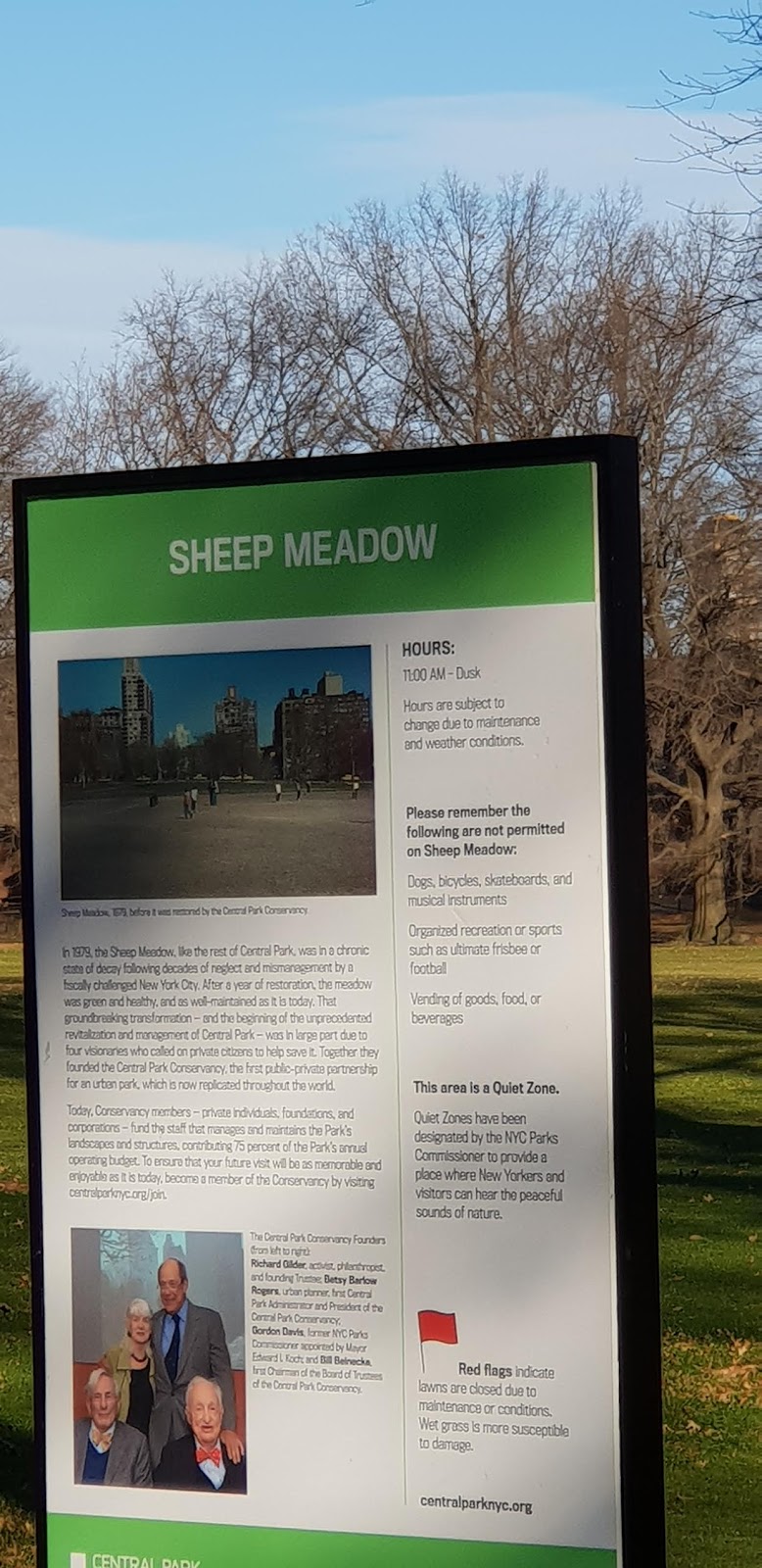
Once upon a time sheep did graze on the meadow, but these days it is designated a quiet area inspiring calm and refreshing thoughts, except for a period in the 1960s where there was more than one counter-culture protest, or love in, going on.

And, there’s the sign to say it was Sheep Meadow,

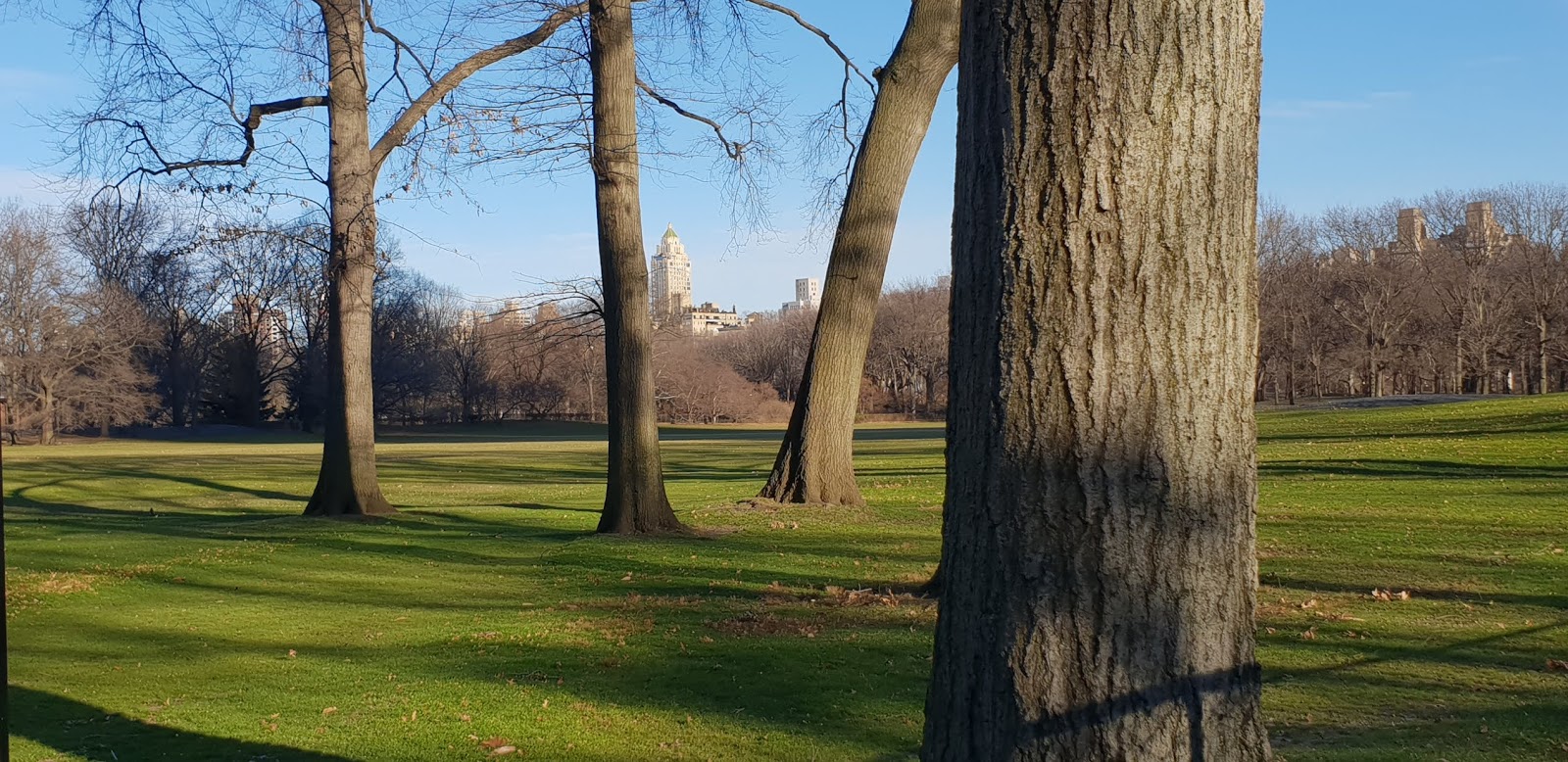
and that’s the meadow behind the sign,

Well, I don’t see any sheep, but of course, that’s not why the meadow is named or should there be any sheep on it.  That greenery that can be seen, restoring for the spring, was a very expensive addition to the park.

As a matter of fact, there is nothing was on it, because signs were up to say the meadow was closed for the winter, a new and interesting variation on the ‘Don’t Walk On The Grass’ signs.

I’m sure I could climb the fence, or, maybe not.  I’m a bit old to be climbing fences.

So, unable to walk on the grass, we tossed an imaginary coin, should we go towards West 110th Street, or back to West 59th Street.

West 59th Street won.

and, just in case we had any strange ideas about walking on the grass, the fence was there to deter us.  Perhaps if we had more determination…

One positive aspect of the park is that you could never get lost, and the tall buildings surrounding the park are nearly always visible through the trees, more so in winter because there is no foliage, maybe less so later in the year.

There is also a lot of very large rocky type hills, or outcrops where people seem to stand on, king of the mountain style, or sit to have a picnic lunch, quickly before it freezes.

Yes, it is cold outside and seems more so in the park.

I wondered briefly if it ever got foggy, then this place would be very spooky, particularly after the sun goes down.

What I learned about writing – Where do the ideas come from?

The Elusive Spark: Where Do Your Creative Ideas Really Come From?

Ever stared at a blank page, a blinking cursor, or a sketching pad, feeling the immense pressure to “be creative”? We’re often told creativity is a skill, something to be honed, but what about the moment the idea actually strikes? How does that elusive spark ignite?

It’s a question as old as creation itself, and the truth is, there’s no single answer. The source of our most brilliant ideas is often as unique and varied as the ideas themselves.

Is it an internal wellspring, finally overflowing?

Perhaps you’re someone who carries ideas around like precious cargo in your head – fragments of dialogue, vivid images, a compelling plot twist – for weeks, months, even years. The “how” of creativity, for you, might simply be finding that neutral, quiet space to finally unleash them. Whether it’s the crisp pages of a notebook, the welcoming glow of a laptop screen, or the ubiquitous notes app on your smartphone, the act of simply getting it out is the critical first step. It’s less about conjuring and more about excavating.

Or is it a serendipitous whisper from the world?

Then there’s the magic of external stimulation. Picture this: you’re by the window, the comforting warmth of a coffee cup in your hands, a perhaps-too-indulgent slice of cake nearby. Your gaze wanders, catches on something – a passing stranger, the way the light hits a distant building, a conversation snippet drifting from the street below. And suddenly, a switch flips. The words begin to form, the scene unfolds, a character takes shape. It’s not forced; it’s discovered. These are the moments when the world itself becomes your muse, offering up gifts you didn’t even know you were looking for.

Could connection be the ignition?

Sometimes, the spark comes not from within, or from the observant quiet, but from interaction. Think of those conversations with a muse, a trusted partner, a spouse, a friend – or even a fleeting encounter with a stranger. You’re bouncing ideas, exploring possibilities, or perhaps even getting “the wrong ideas” that, ironically, lead straight to the right ones (especially if you’re writing a particular kind of story!). Human connection, the clash and blend of different perspectives, can be an incredibly potent catalyst for creativity, unlocking narratives you might never have considered alone.

Facing the Inner Critic: Why Bother?

But let’s be honest, creativity isn’t always a gentle breeze of inspiration. There are days when the well feels dry, when the voices of doubt are louder than any muse. In those moments, I sometimes find myself metaphorically moving seats, sitting opposite “the writer’s chair.” I imagine myself as an outsider, someone dragged in off the street, looking critically at this person trying to create. What would I ask?

No doubt, that imaginary person would be cynical. “Why bother?” they’d ask. “There are a million others out there trying to do the exact same thing.”

And that, my friends, is the easiest question to answer.

Every story is different. Every piece of art, every innovative solution, every poem is unique. Why? Because you are unique. Every creator brings a different point of view, a different set of life experiences, a different personality, a different circle of friends. This list could go on forever, forming an intricate tapestry of individuality that no one else possesses.

The Ultimate Proof: Your Uniqueness is Your Superpower

Here’s the test to prove this point, simple yet profound: Outline a basic story concept, give that exact same outline to ten different writers, and you will get ten distinctly different stories. Each will bear the unmistakable fingerprints of its creator – their voice, their fears, their hopes, their humour, their unique way of seeing the world.

So, how do you become creative? It’s not about finding a magic formula or waiting for a lightning bolt (though those moments are wonderful). It’s about:

  • Honouring your internal world: Giving your brewing ideas the space and time to emerge.
  • Engaging with your external world: Staying open, observant, and curious.
  • Connecting with others: Allowing conversations and different viewpoints to spark new thoughts.
  • And most importantly, trusting yourself: Believing that your unique perspective, your individual tapestry of experiences, is precisely what makes your creativity valuable and irreplaceable.

Don’t strive to be a creative. Strive to be your creative. Because the most brilliant spark you possess is the one that’s uniquely, unmistakably, YOU.