“The Document” – a thirty-day revision – Day 1

This book has been written for some time and the manuscript was sitting in a box with half a dozen others gathering dust and not quite as complete, so this month it is going to get the makeover, a first draft for the editor.

And so it begins…

…

I thought I had this under control.

After all, for the first time, I had a title, a plan, and a synopsis, and was ready to go. I’ve never tried to write a novel this way before.

Of course, it was originally a NANOWRIMO project, and to write 50,000 words in a month you need a plan. Ad-hoc writing just doesn’t get it done.

Even though for the previous two years, it has.

So, I start writing.

Then, damn it, I get another idea, and off I go on that tangent.

The plan’s now looking like it needs an update.

Didn’t plan for that, did I?

Oh, well, day 1 down, 29 more to go, perhaps tomorrow will be better.

An excerpt from “If Only” – a work in progress

Investigation of crimes doesn’t always go according to plan, nor does the perpetrator get either found or punished.

That was particularly true in my case.  The murderer was incredibly careful in not leaving any evidence behind, to the extent that the police could not rule out whether it was a male or a female.

At one stage the police thought I had murdered my own wife though how I could be on a train at the time of the murder was beyond me.  I had witnesses and a cast-iron alibi.

The officer in charge was Detective First Grade Gabrielle Walters.  She came to me on the day after the murder seeking answers to the usual questions like, when was the last time you saw your wife, did you argue, the neighbors reckon there were heated discussions the day before.

Routine was the word she used.

Her fellow detective was a surly piece of work whose intention was to get answers or, more likely, a confession by any or all means possible.  I could sense the raging violence within him.  Fortunately, common sense prevailed.

Over the course of the next few weeks, once I’d been cleared of committing the crime, Gabrielle made a point of keeping me informed of the progress.

After three months the updates were more sporadic, and when, for lack of progress, it became a cold case, communication ceased.

But it was not the last I saw of Gabrielle.

The shock of finding Vanessa was more devastating than the fact she was now gone, and those images lived on in the same nightmare that came to visit me every night when I closed my eyes.

For months I was barely functioning, to the extent I had all but lost my job, and quite a few friends, particularly those who were more attached to Vanessa rather than me.

They didn’t understand how it could affect me so much, and since it had not happened to them, my tart replies of ‘you wouldn’t understand’ were met with equally short retorts.  Some questioned my sanity, even, for a time, so did I.

No one, it seemed, could understand what it was like, no one except Gabrielle.

She was by her own admission, damaged goods, having been the victim of a similar incident, a boyfriend who turned out to be an awfully bad boy.  Her story varied only in she had been made to witness his execution.  Her nightmare, in reliving that moment in time, was how she was still alive and, to this day, had no idea why she’d been spared.

It was a story she told me one night, some months after the investigation had been scaled down.  I was still looking for the bottom of a bottle and an emotional mess.  Perhaps it struck a resonance with her; she’d been there and managed to come out the other side.

What happened become our secret, a once-only night together that meant a great deal to me, and by mutual agreement, it was not spoken of again.  It was as if she knew exactly what was required to set me on the path to recovery.

And it had.

Since then, we saw each about once a month in a cafe.   I had been surprised to hear from her again shortly after that eventful night when she called to set it up, ostensibly for her to provide me with any updates on the case, but perhaps we had, after that unspoken night, formed a closer bond than either of us wanted to admit.

We generally talked for hours over wine, then dinner and coffee.  It took a while for me to realize that all she had was her work, personal relationships were nigh on impossible in a job that left little or no spare time for anything else.

She’d always said that if I had any questions or problems about the case, or if there was anything that might come to me that might be relevant, even after all this time, all I had to do was call her.

I wondered if this text message was in that category.  I was certain it would interest the police and I had no doubt they could trace the message’s origin, but there was that tiny degree of doubt, about whether or not I could trust her to tell me what the message meant.

I reached for the phone then put it back down again.  I’d think about it and decide tomorrow.

© Charles Heath 2018-2020

In a word: Cell

For those who break the law, they will be very familiar with the meaning of the word cell.  It’s a room a jail, not very big, with an uncomfortable bed, and no sharp edges.

And I’m sure the prisoners are not supplied with knives so they can dig through the mortar and remove bricks on their way to the great escape.  That, I’m sure only happens at the movies.

A cell can also be a building block in the creation of humans, animals, fish, and plants.  No doubt there are a million other things that require cells.

Perhaps the most interesting aspect of this cellular activity is whether or not there is life, and therefore cells, on Mars.  I’m guessing we’ll have to wait a little longer to find out.

We can have a cell phone, which in some parts of the world is also the name of a mobile phone.

Don’t get me started on what I think of cell phones, or how intrusive they are on our everyday lives, the number of people who seem to be continually glued to the screen, or how many near misses there are in the street and crossing the road.

On the other hand cell phones in the hands of a writer are very useful because when we get flashes of story or plotlines in one of those once awkward moments, we can now jot it down on a cell phone scribbling pad.

A cell can also be used to describe a smaller unit within a larger organisation, or, if you are a thriller writer who dabbles in espionage, you will be very familiar with the concept of a sleeper cell.

Who knows, in reality, there might be some living next door to us and we would never know.  Oops, been watching too much television again.

Digging deeper into the more obscure definitions of the word cell, we come up with a single transparent sheet that has a single drawing on it, one of many that make up an animated film, or film.  If a film runs at 32 frames per second, that means there are 32 cells.

There are fuel cells

There are dry cell batteries

And as a general warning, don’t go too near cell towers or you will be a victim of radiation that might be extremely harmful to your health.

“What Sets Us Apart”, a mystery with a twist

David is a man troubled by a past he is trying to forget.

Susan is rebelling against a life of privilege and an exasperated mother who holds a secret that will determine her daughter’s destiny.

They are two people brought together by chance. Or was it?

When Susan discovers her mother’s secret, she goes in search of the truth that has been hidden from her since the day she was born.

When David realizes her absence is more than the usual cooling off after another heated argument, he finds himself being slowly drawn back into his former world of deceit and lies.

Then, back with his former employers, David quickly discovers nothing is what it seems as he embarks on a dangerous mission to find Susan before he loses her forever.

Find the kindle version on Amazon here:  http://amzn.to/2Eryfth

whatsetscover

Writing about writing a book – Day 7 continues

Will it ever end?

I’m late.

I’m not usually late.  One thing I always pride myself on is being on time.  If other people have the courtesy to turn up on time, I should too.  It’s one of those old-fashioned traits that was hammered into me when I was young.

I apologize.

It is the first time I have seen Marilyn for over a year, though we have exchanged a few phone calls.  It was much easier to talk to her from a distance, and over something as impersonal as a telephone.

Sitting opposite her was an entirely different proposition.

Like a giddy schoolboy on a first date, I was nervous.  It took me back about 40 years when I did go out with her, but it wasn’t a date.  She wanted to ask me about Hal, the man she eventually married, and the man who was once my best friend.

I was nervous then, but for different reasons, and then I was disappointed.  I guess I had a lot to learn then about life, and women.  I’m not so sure with the passing of time I had learned much at all.

I look at her now, forty years on, and I still see the same woman in front of me that was sitting practically in the same place.  It was the same café, she had selected the venue.  I thought it had burned down long ago and been replaced by a residential tower.

That was next door.

There was something to be said for nostalgia.  I think the furnishings and the building itself was the same as it was back then.

“I’ve been meaning to tell you, Hal and I got a divorce.  It seems your initial assessment of his character all those years ago was correct.”

It had been a passing comment.   He told me monogamy was for idiots, and there was a world of women out there just waiting for the right man.  Him apparently.  All I had said to her was that I didn’t think he was ready to settle down.

“I’m sorry to hear that.  I hope it wasn’t too painful.”

I had nothing to start with so my divorce was painless.  She took everything, not that it amounted to very much.

“The lawyers won, I guess they always win.”

Someone had an eloquent saying about lawyers, but I couldn’t remember who.  I’d have to remember not to quote literature to Marilyn.  She was not a ‘book’ person.

“How come you didn’t tell me?  I’m very good at holding hands.”

She smiles, perhaps remembering the one time we went for a stroll through a park near the university, a day she had come to tell me her problems with Hal.  I was a sympathetic listener, but I longed for more, for what I couldn’t have.

I could still feel the tugs at my heartstrings.

“You had your own problems to deal with.  Besides, I finally had to stand up for myself, after living in the shadows for so long.  You know how it is.”

Yes, I did.  Sacrifice, and not necessarily by the right partner in a marriage.  My ex-wife had told me enough times until I finally agreed with her.

“So now you’re free.”

“As a bird, as they say.  You hungry?” she asks.

“Not really.”

“Neither am I.”


© Charles Heath 2016-2019

When you’re tired, anything can happen!

It’s late at night and there are twenty other story ideas that are currently running around in my head, instead of the story I should be working on.

These ideas are impinging on the current story, and somehow are finding their way onto the page.

Writing, cursing, deleting, re-writing, deleting, cursing.

I’m working on the latest book and it is not going well.  I don’t have writer’s block, I think it is more a case of self-doubt.  It’s why I can’t concentrate.

It’s why I’m thinking about the next story and not staying on track.

This leads me to be over critical of what I have written and much pressing of the delete key.  Only to realize that an action taken in haste can be regrettable, and makes me feel even more depressed when I realize the deletions are irrecoverable.

Damn.

I think I’d be happier in a garret somewhere channeling van Gogh’s rage.

Lesson learned – don’t delete, save it to a text file so it can be retrieved when sanity returns.

I was not happy with the previous start.  Funny about that, because until a few weeks ago I thought the start was perfect.

It seems it’s been like that for a few weeks now, not being able to stick to the job in hand, doing anything but what I’m supposed to be doing.  I recognize the restlessness, I’m not happy with the story as it is, so rather than getting on with it, I find myself writing words just for the sake of writing words.

Any words are better than none, right?

So I rewrote the start, added about a hundred pages and now I have to do a mass of rewriting of what was basically the whole book.

But here’s the thing.

This morning I woke up and looked at the new start, and it has inspired me.

Perhaps all I needed was several weeks of teeth gnashing, and self-doubt to get myself back on track.


The cinema of my dreams – I always wanted to write a war story – Episode 40

For a story that was conceived during those long boring hours flying in a steel cocoon, striving to keep away the thoughts that the plane and everyone in it could just simply disappear as planes have in the past, it has come a long way.

Whilst I have always had a fascination with what happened during the second world war, not the battles or fighting, but in the more obscure events that took place, I decided to pen my own little sidebar to what was a long and bitter war.

And, so, it continues…

—

I had to almost restrain Carlo from going up to the castle and singlehandedly kill everyone in it.  I didn’t doubt he could do it, for a short time at least, until they realized what was going on.  There were too many of them to take on alone.

It would need a careful plan, and knowledge of the layout of the castle, and the likely spots where the soldiers were located.  It was a plan that had been slowly formulating in the back of my mind, especially after Carlo’s help with an internal map of the castle, some parts of which I hadn’t got to see in my brief stay.

I forgot that being built back in the middle ages, and the history of cities fighting against each other, there were ways in, out, and around, both inside and in the walls, so that soldiers could travel from one part of the castle to another without being seen, and not having to go inside the castle itself.

There were, also, tunnels, one of which I had inadvertently found, but there were more, and it seems only Carlo knew of those.  Some were useful, others would lead to an early confrontation, and give early notice of our intentions.  Those we would avoid, or use to escape.

We had set up a command center at the church ruins, having found several rooms off the cellar that had two exits.  I didn’t like the idea of being trapped, nor waiting in a location that Fernando was familiar with and was likely to return to.

Which, in a sense, I was hoping he would because we had set a trap and he and his men would be caught in the crossfire.  He was not going to get a chance to explain, nor would I ask any questions, or show him any mercy.

Especially when I found out what he had done to Martina.  If it was as bad as Chiara, he would be repaid in kind, if the opportunity arose.  I tentatively agreed to give Carlo five minutes in the room alone with him, but he knew that expediency might not give him that luxury.  Blinky was not happy about it, but he hadn’t been here long enough to know what the man or his people were like.

We’d also worked out the surveillance system so that we would know when anyone turned up in the village, particularly our prized defector Meyer, and whether anyone left the castle to come down to the village because it was possible there would be more defectors passing through, and they needed to be warned.

What was particularly useful was finding the radio that Martina had been using.  It was in the church grounds, which was not entirely unexpected, but one of Blink’s men had stumbled over it when looking to set up a latrine.

Blinky had brought a radioman, but his radio had been damaged in the parachute landing.  Now he had a new toy to tinker with, and got a connection back to Thompson, after some initial difficulty in translation.  That I could help him with, my Italian was marginally better than a schoolboy.

Thompson was relieved to hear from me, as I was to talk to him.

“It’s been difficult to get a clear picture with Martina, but I got the impression you had to be precise with your questions.”

“A case of getting lost in translation, perhaps.”  I had not had similar problems, but Thompson was from the aristocracy, and his version of English was sometimes quaint.

“The situation is bad, I understand.”

“It is.  The castle is over-run with British-German double agents.  The three you sent out, and reinforcements that followed.  I get the impression we have about 20 odd dead soldiers languishing in shallow graves somewhere on the Italian countryside.”

It hadn’t been hard to realize that while the officers were known British officers, the soldiers were substituted Germans whose English language and mannerisms were impeccable.  I had no doubt once they’d reeled in Meyer, they would move on, integrating into invasion forces and creating havoc from within, unless of course, we stopped them.

A sigh at the other end, perhaps a lamentation of such needless loss of life.  This war was getting tiresome for both of us.

“How close is Meyer?  We last heard he was in Gaole, waiting for a courier to take him to the village.  His arrival is anticipated to be any time from tomorrow onwards.”

“We’ve got men out keeping tabs on everyone.”

“Blinky arrive with his team?”

“All bar the radio, but as you can hear, we have access to one do it will not be a problem.  I think we might finish this and talk again tomorrow.  Don’t want the Germans tracking the radio waves.”

“Good.  Tomorrow, and hour before today.”

I’d almost forgotten that the Germans were good at tracking radio signals, especially when they thought the enemy was using them, as those at the castle would.  That radio unit could also be used to trace other radio signals, and no doubt they had picked up the signal.  Hopefully, we had not been on long enough for them to run the trace.

That was not going to be a problem.  One of Blinky’s soldiers on village reconnaissance was waiting for us as we approached the church ruins.”

“What is it, man?”

“There are four people at the village, looking for someone or something.”

“More defectors,” I said.  “We’d better get to them before Leonardo and his men get to them first.”

—

© Charles Heath 2020-2021

“The Document” – a thirty-day revision – Day 3

This book has been written for some time and the manuscript was sitting in a box with half a dozen others gathering dust and not quite as complete, so this month it is going to get the makeover, a first draft for the editor.

And so it begins…

…

So, finally, the plan is working

…

The story is progressing and I can see, for the moment, that the story is heading in the right direction.

Of course, in saying that, it might just jinx the project.

There was a small moment of hesitation though, one of those, perhaps this might be a ‘better way moment’ that caused a brief stoppage while I considered the consequences. Then of course I make that fatal change that will have consequences later on.

Then I just added another sticky note to the four hundred others lining the monitor and nearby shelves and went back to work.

Who needs a good memory when you’ve got a hundred pads of stick notes just waiting to be used.

Got to get those 1,667 words revised.

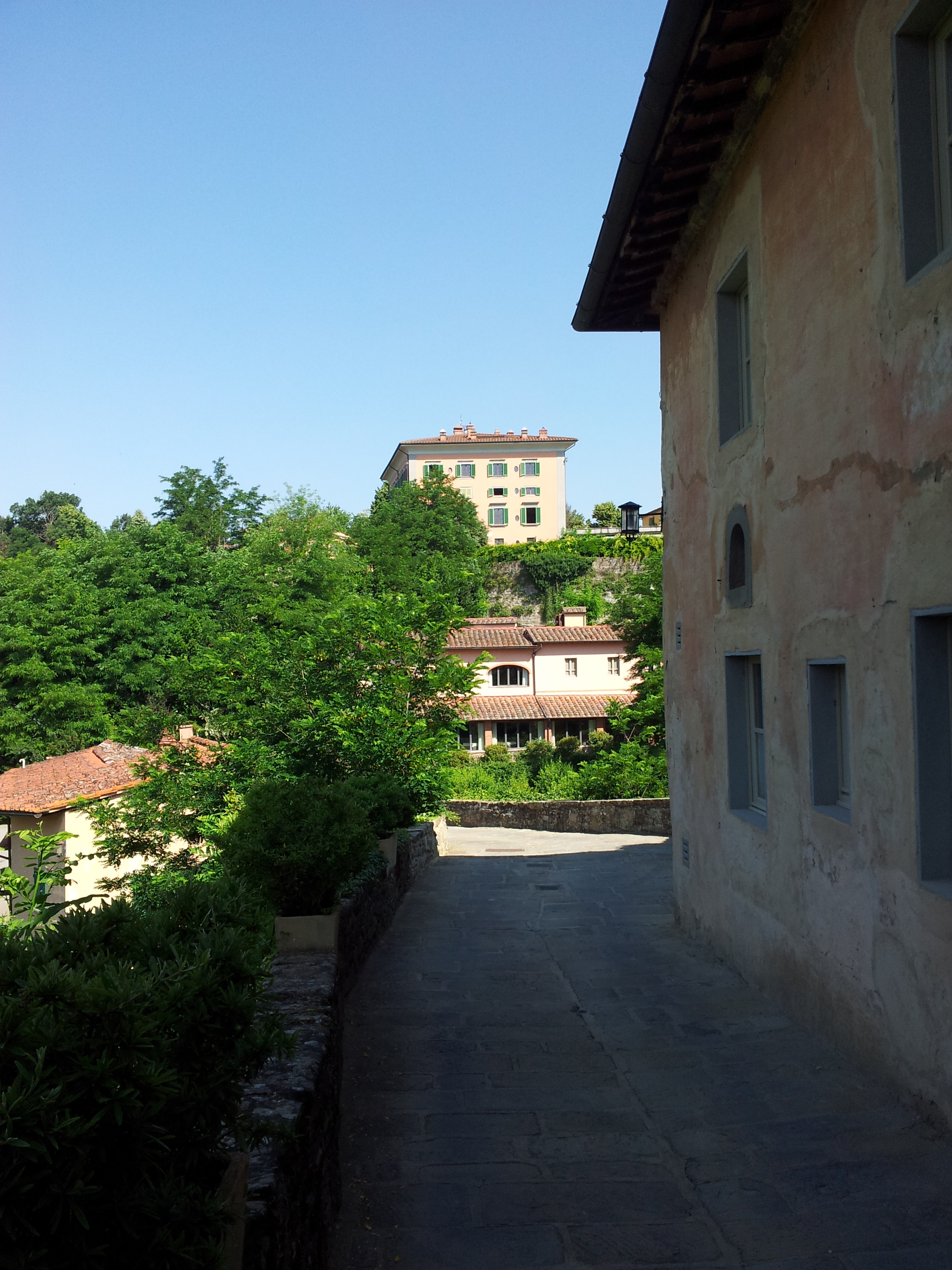
Searching for locations: Somewhere in Tuscany, Italy, a hilltop town

It’s a town we visited in Italy when on a private tour.  Of course, I wrote it down on a notepad app on my phone at the time, and, yes, not long after that, an accidental reset lost all the data.

Now, I have no idea with the name of the town is, just that it was a picturesque stopover in the middle of a delightful private tour of Tuscany.

2013-06-20 10.12.54

There are narrow laneways that I suspect no one 300 hundred years ago planned for cars

2013-06-20 10.17.36

Narrower walkways that lead to very dark places


Walkways on the side of the hills that look down on the picturesque valleys

2013-06-20 10.15.27

And rather interesting hillsides, some of which provided inspiration for Leonardo da Vinci

2013-06-20 10.15.48

Or maybe it was this landscape, though it is difficult to see what could be found as inspiration in such a bland hillside

2013-06-20 10.15.55

A lot of houses, some of them quite large, nestled in amongst the trees

2013-06-20 10.17.41 (2)

Gardens, of sorts, balcony’s, not so big, and hidden doorways

2013-06-20 10.17.53 (2)

Even not so secret passageways between houses.

All in all, it was an interesting visit, and it made me wonder what it would be like to live here, all crowded together, rather than living on our relatively isolated quarter-acre blocks.

How would we survive without what we now take for granted?

There is a saying ‘you don’t know what you’ve got till it’s gone’.

For a long time, in days before the current technological age, I didn’t really understand what that meant.

Until now.

How many times, in the last few days have I heard the question, “Where’s my mobile phone?”.

It seems we can lose almost anything else but, without the phone, we are completely lost.

The same now applies to all of our household appliances.

Then, the other day I heard, “We aren’t able to do very much because the microwave oven is broken.”

How did we manage in the days before we had such devices?  I know my grandmother used to have a wood stove and cooked everything, bread, meat, fish, vegetables, cakes, puddings, even made a cup of tea with that stove.

I don’t think I ever had a cup of coffee at her house, but I have a lot of memories of some amazing food.  No such thing as electric kitchen appliances, or a microwave oven, not in that house.

We had the same experience ourselves when one of the fridge/freezer units broke down, and severely restricted what we could cook and store, especially the freezer.

And perhaps that’s the problem.  We take so many things for granted and live a life that is centered around convenience.

What would happen if those conveniences were taken away?

Certainly, for me, I know, what it’s like to lose the use of a kitchen appliance and having to improvise, but I’m not sure how we would react if we had a real catastrophe, like having no electricity.

We try not to think about what it would be like, just a short blackout is enough to frighten us.

But, I haven’t lost my phone yet.

Let’s hope it never happens.