“Sunday in New York” is ultimately a story about trust, and what happens when a marriage is stretched to its limits.
When Harry Steele attends a lunch with his manager, Barclay, to discuss a promotion that any junior executive would accept in a heartbeat, it is the fact his wife, Alison, who previously professed her reservations about Barclay, also agreed to attend, that casts a small element of doubt in his mind.
From that moment, his life, in the company, in deciding what to do, his marriage, his very life, spirals out of control.
There is no one big factor that can prove Harry’s worst fears, that his marriage is over, just a number of small, interconnecting events, when piled on top of each other, points to a cataclysmic end to everything he had believed in.
Trust is lost firstly in his best friend and mentor, Andy, who only hints of impending disaster, Sasha, a woman whom he saved, and who appears to have motives of her own, and then in his wife, Alison, as he discovered piece by piece damning evidence she is about to leave him for another man.
Can we trust what we see with our eyes or trust what we hear?
Haven’t we all jumped to conclusions at least once in our lives?
Can Alison, a woman whose self-belief and confidence is about to be put to the ultimate test, find a way of proving their relationship is as strong as it has ever been?
I’m sure I’ve been down this road more than once, and with the same novel, but whereas the last edit, which was probably the second or third, finished up in the pile, then forgotten.
I’m doing an active update to all my works in progress, and sending them to the editor, after going through the manuscript once again, with a view to publishing. Hopefully, before the year is out.
…
The problems of the day before are gone, and I get back to the plan.
Today I have concentrated on the side excursion I’d come up with the other day and thought it could wait, but I’m at a point, further on, where I need to have this written in order to feed into the main story.
I’m in two minds about how this should be written because I had two sketched out two possible outcomes, and one leads to quite a different ending.
The plan, son, the plan!
I edit it as it should be, and the other outcome gets crossed out, and the outline is sent to the ‘to be written sometime in the future’ pile. It’s a strong enough ending to power its own story.
I might even become a sequel.
Hang on, don’t get carried away. Get this one finished first.
What happens when your past finally catches up with you?
…
Christmas is just around the corner, a time to be with family. For Will Mason, an orphan since he was fourteen, it is a time for reflection on what his life could have been, and what it could be.
Until a chance encounter brings back to life the reasons for his twenty years of self-imposed exile from a life only normal people could have. From that moment Will’s life slowly starts to unravel and it’s obvious to him it’s time to move on.
This time, however, there is more at stake.
Will has broken his number one rule, don’t get involved.
With his nemesis, Eddie Jamieson, suddenly within reach, and a blossoming relationship with an office colleague, Maria, about to change everything, Will has to make a choice. Quietly leave, or finally, make a stand.
But as Will soon discovers, when other people are involved there is going to be terrible consequences no matter what choice he makes.
Simply because I want you to wait here while I go down the shops.
How long will that be?
I don’t know. A while. Anything from half an hour to a lifetime.
Then there’s another way of using the word: While I do this can you do that.
This is more definite but still ambiguous. How long will that be?
As long as it takes. Anything from half an hour to a lifetime.
it is by definition, a period of time.
Then it gets more ambiguous, in that the arrangements say in place while he is alive.
Being a murder mystery writer and reader, it becomes a sufficient reason to kill a wealthy relative to get their inheritance. But, if murder is not in mind, then it can be anything from a half-hour to a lifetime!
Less of an enigma is this use of the word: I’m going the while away the time playing computer games.
At least you know how long that’s going to be, i.e. till you get bored.
This is not to be confused with the word wile, which means to use a cunning or devious means to get someone to do your bidding.
We’ve all heard of feminine wiles. Granddaughters are experts in using them, I can personally attest to that.
There are other meanings but these are no longer used in modern English.
There’s something to be said for a story that starts like a James Bond movie, throwing you straight in the deep end, a perfect way of getting to know the main character, David, or is that Alistair?
A retired spy, well not so much a spy as a retired errand boy, David’s rather wry description of his talents, and a woman that most men would give their left arm for, not exactly the ideal couple, but there is a spark in a meeting that may or may not have been a setup.
But as the story progressed, the question I kept asking myself was why he’d bother.
And, page after unrelenting page, you find out.
Susan is exactly the sort of woman to pique his interest. Then, inexplicably, she disappears. That might have been the end to it, but Prendergast, that shadowy enigma, David’s ex-boss who loves playing games with real people, gives him an ultimatum, find her or come back to work.
Nothing like an offer that’s a double-edged sword!
A dragon for a mother, a sister he didn’t know about, Susan’s BFF who is not what she seems or a friend indeed, and Susan’s father who, up till David meets her, couldn’t be less interested, his nemesis proves to be the impossible dream, and he’s always just that one step behind.
When the rollercoaster finally came to a halt, and I could start breathing again, it was an ending that was completely unexpected.
It was a relic from the past, put back together by a dedicated group of volunteers who had not wanted the last vestiges of the past to disappear.
Train enthusiasts, the called themselves.
They’d put together a steam locomotive, five carriages, a restaurant car, and the conductor’s car. The original train might have been twice to three times as long, but these days, the tourist market rarely filled the train.
I was one of a group who made it their mission to visit and rate every vintage train, not only in this country, but all over the world. It was a sad state of affairs when I first began, with locomotives and carriages dropping out of the system due to lack of funds, but more disheartening, the lack of government assistance in keeping it’s heritage alive.
It seemed money was short, and there were better things to spend it on, like two brand new 737-800 jets just to ferry the prime minister and government officials around. Just think of what that quarter of a billion dollars could have bought in heritage.
But it is what it is.
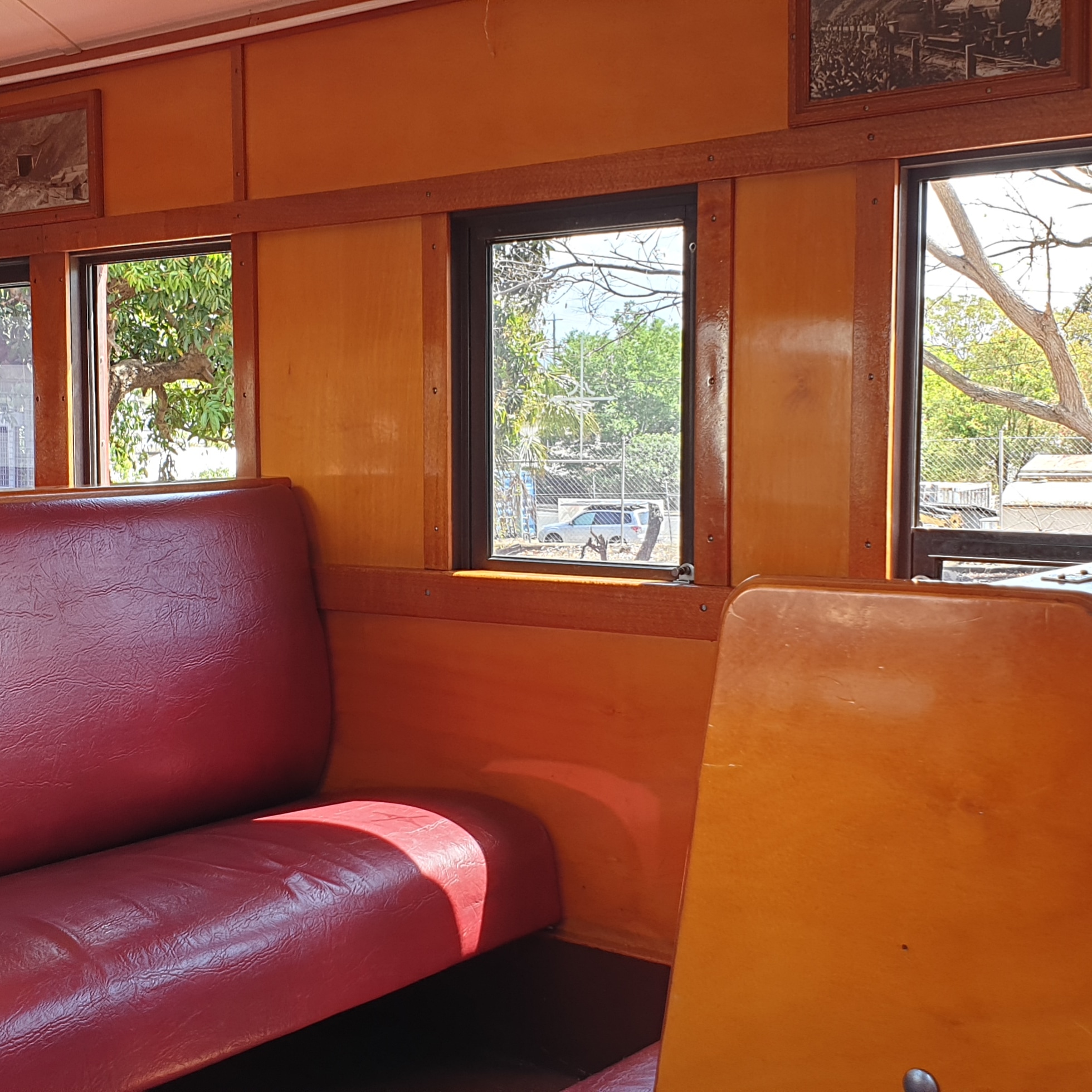
What I had before me was one of the most recent restorations to check out, and on first glance, it was remarkable just how lifelike and true to age it was.
Of course, I was of an age that could remember the old railway carriages, what were called red rattlers because of the ill fitting windows that went up and down, allow fresh air, or in days gone by, smoke from the locomotive hauling the train. I had not travelled during the last glorious years of steam, but the carriages had lived on briefly before the advent of the sterile aluminum tin cans with uncomfortably hard seats.
These carriages were built for comfort, and my first experience had been a five hour trip from Melbourne to Wangaratta, in Victoria, on my way to Mt Buffalo Chalet, a guesthouse owned by the Railways.
That too had been a remarkable old chalet style guest house with a room and all the dining included. I always left after the week having put on weight. Breakfast, morning tea, lunch, afternoon tea, and dinner, every day, and high tea on Sunday.
But this carriage, the polished wood that had shellac rather than varnish, highlighting the timber’s grain, the leather seats with generous padding, the curved ceilings with hanging lights, windows the could be opened and closed, allowing fresh air to circulate.
There was also a carriage with the passageway, and five or six separate compartments, each sitting six passengers. I remembered these well, having quite often ridden in one to work for some years when the country trains still ran.
It was always remarkable how a sight or a scent could trigger such memories.
For this carriage on this train, it used to ply the Gympie to Brooloo branch line from about 1915 onwards.
That was the history. It only went as far as Amamoor these days, it was still long enough to capture the sensation of riding the rails back in what is always referred to as the good old days, even if they were not.
There is a saying ‘you don’t know what you’ve got till it’s gone’.
For a long time, in days before the current technological age, I didn’t really understand what that meant.
Until now.
How many times, in the last few days have I heard the question, “Where’s my mobile phone?”.
It seems we can lose almost anything else but, without the phone, we are completely lost.
The same now applies to all of our household appliances.
Then, the other day I heard, “We aren’t able to do very much because the microwave oven is broken.”
How did we manage in the days before we had such devices? I know my grandmother used to have a wood stove and cooked everything, bread, meat, fish, vegetables, cakes, puddings, even made a cup of tea with that stove.
I don’t think I ever had a cup of coffee at her house, but I have a lot of memories of some amazing food. No such thing as electric kitchen appliances, or a microwave oven, not in that house.
We had the same experience ourselves when one of the fridge/freezer units broke down, and severely restricted what we could cook and store, especially the freezer.
And perhaps that’s the problem. We take so many things for granted and live a life that is centered around convenience.
What would happen if those conveniences were taken away?
Certainly, for me, I know, what it’s like to lose the use of a kitchen appliance and having to improvise, but I’m not sure how we would react if we had a real catastrophe, like having no electricity.
We try not to think about what it would be like, just a short blackout is enough to frighten us.
Every time I close my eyes, I see something different.
I’d like to think the cinema of my dreams is playing a double feature but it’s a bit like a comedy cartoon night on Fox.
But these dreams are nothing to laugh about.
Once again there’s a new installment of an old feature, and back on the treasure hunt.
…
“Who the hell is that horrible man?” I asked, still staring after the car, long after it had gone.
I knew trouble when I saw it, and that man was serious trouble.
And the fact he believed there was a treasure map…
“My uncle Rico, he was the one my mother always credited leading my father astray. Whatever they had been doing back then, it was never anything legal.”
So, he knows about the treasure map?”
“He knows nothing. He thinks he knows something, he thinks I know something, but he’s not going to get it out of me.”
“What if he comes after me next?”
It was a daunting prospect, and just looking at Rico was enough to scare me. If he had a machete to back up his insistence I tell the truth? I shuddered.
“You tell him the truth. We have a map, we bought it at the bar like everyone else.”
He was right.
“Boggs?”
His aunt yelled out his name in a manner that meant he was in trouble.
He motioned to keep quiet and follow him.
He took one step before she added, “You take one more step away from this house, and you’ll have more than Rico to worry about.”
A shrug, a wan smile, and then he turned back. “Nothing more today. See you at the Bar tomorrow, and we’ll start the search.
“Surely you don’t think that map is real?”
“Real enough, with missing pieces, we have to track down. Tomorrow.”He turned and went back into the house, the wooden screen door slamming shut behind him.
Followed by the raised voice of an angry Aunt. “What is all this malarkey about a treasure map, and what the hell were you doing in a bar? I bet it was that Johnson kid leading you astray again.”
Never, according to her, Boggs’ fault, and always mine.
I’m sure I’ve been down this road more than once, and with the same novel, but whereas the last edit, which was probably the second or third, finished up in the pile, then forgotten.
I’m doing an active update to all my works in progress, and sending them to the editor, after going through the manuscript once again, with a view to publishing. Hopefully, before the year is out.
…
One of the hazards of writing can be being continually critical of your own work. I’m guilty as charged.
But in writing to a plan and in only 30 days having to edit 50,000 words there is no time to be critical.
Except…
So far down the track, I should be writing, not being critical.
But the thing is, I’m finding that I have to go back three chapters and read them through to pick up the thread. It’s not because it’s changed in any way from the plan, it’s just that I’m finding it hard to edit to a plan when usually I fly by the seat of my pants.
The trouble with doing that, it gives rise to considering changes, and right now there’s no time for change.