Inspiration, maybe – Volume 1

50 photographs, 50 stories, of which there is one of the 50 below.

They all start with –

A picture paints … well, as many words as you like.  For instance:

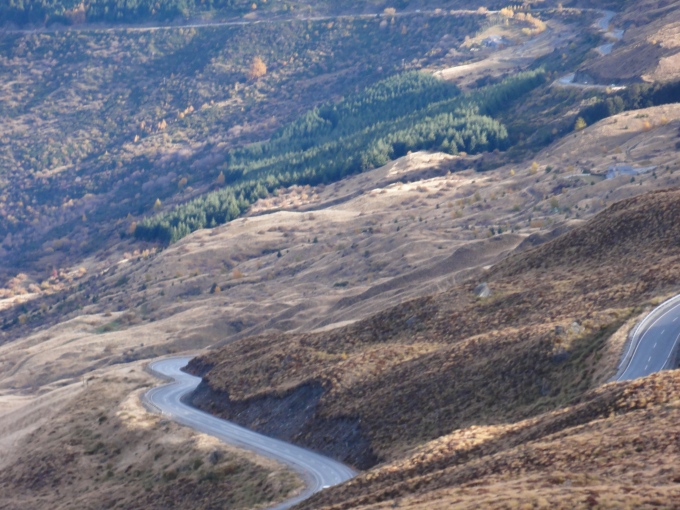
lookingdownfromcoronetpeak

And the story:

It was once said that a desperate man has everything to lose.

The man I was chasing was desperate, but I, on the other hand, was more desperate to catch him.

He’d left a trail of dead people from one end of the island to the other.

The team had put in a lot of effort to locate him, and now his capture was imminent.  We were following the car he was in, from a discrete distance, and, at the appropriate time, we would catch up, pull him over, and make the arrest.

There was nowhere for him to go.

The road led to a dead-end, and the only way off the mountain was back down the road were now on.  Which was why I was somewhat surprised when we discovered where he was.

Where was he going?

“Damn,” I heard Alan mutter.  He was driving, being careful not to get too close, but not far enough away to lose sight of him.

“What?”

“I think he’s made us.”

“How?”

“Dumb bad luck, I’m guessing.  Or he expected we’d follow him up the mountain.  He’s just sped up.”

“How far away?”

“A half-mile.  We should see him higher up when we turn the next corner.”

It took an eternity to get there, and when we did, Alan was right, only he was further on than we thought.”

“Step on it.  Let’s catch him up before he gets to the top.”

Easy to say, not so easy to do.  The road was treacherous, and in places just gravel, and there were no guard rails to stop a three thousand footfall down the mountainside.

Good thing then I had the foresight to have three agents on the hill for just such a scenario.

Ten minutes later, we were in sight of the car, still moving quickly, but we were going slightly faster.  We’d catch up just short of the summit car park.

Or so we thought.

Coming quickly around another corner we almost slammed into the car we’d been chasing.

“What the hell…” Aland muttered.

I was out of the car, and over to see if he was in it, but I knew that it was only a slender possibility.  The car was empty, and no indication where he went.

Certainly not up the road.  It was relatively straightforward for the next mile, at which we would have reached the summit.  Up the mountainside from here, or down.

I looked up.  Nothing.

Alan yelled out, “He’s not going down, not that I can see, but if he did, there’s hardly a foothold and that’s a long fall.”

Then where did he go?

Then a man looking very much like our quarry came out from behind a rock embedded just a short distance up the hill.

“Sorry,” he said quite calmly.  “Had to go if you know what I mean.”

I’d lost him.

It was as simple as that.

I had been led a merry chase up the hill, and all the time he was getting away in a different direction.

I’d fallen for the oldest trick in the book, letting my desperation blind me to the disguise that anyone else would see through in an instant.

It was a lonely sight, looking down that road, knowing that I had to go all that way down again, only this time, without having to throw caution to the wind.

“Maybe next time,” Alan said.

“We’ll get him.  It’s just a matter of time.”

© Charles Heath 2019-2021

Find this and other stories in “Inspiration, maybe”  available soon.

InspirationMaybe1v1

Searching for locations: Terracotta Warriors and Horses Museum, X’ian, China

Terracotta Warriors and Horses Museum

A little history, and anecdotal advice first:

In 1974 a 26-year-old farmer, Yang Jide, was drilling a well and found fragments of the terracotta soldiers and bronze weapons.

What was discovered later was one of the biggest attended burial pits of China’s first feudal Emperor, Qin Shi Huang.  In the following years remains had been found in 3 pits, yielding at least 8,000 soldiers and horses, and over 100 chariots.  The soldiers were infantry, cavalry, and others.

Emperor Qin was born in 259 BC and died in 210 BC.  He began building a mausoleum for himself at the foot of Mount Li when he was 13.  Construction took 38 years, from 247 BC to 208 BC.  It was divided into 3 stages and involved 720,000 conscripts.

The pits of pottery figures are 1.5 km east of Emperor Qin’s mausoleum.  Pit 1 has about 6,000 terracotta armored warriors and horses and 40 wooden chariots.  Pit 2 is estimated to have over 900 terracotta warriors and 350 terracotta horses with about 90 wooden chariots.  Pit 3 had so far yielded only 66 pottery figures and one chariot drawn by four horses.

Official records say it was discovered later that it was likely Xiang Yu, a rebel, intentionally damaged the Mausoleum and the soldiers in the pits, by setting fire to the wooden roof rafters, and these fell on and broke the warriors into pieces.

However, we were told that after the terracotta warriors were completed, the Emperor ordered the builders to be killed so that they would not tell anyone about the warriors, and then of those that remained alive deliberately smashed all of the artifacts.

The thing is, all of the terracotta figures that have been found are in pieces, and they need computers to piece them back together again.

The visit:
The first impression is the size of the car park and the number of buses parked in the lot, and a hell of a lot more outside up the road an off on side streets.  Obviously, it costs money to park in the parking lot.

The other first impressions; the numbers waiting to get in were not as many as yesterday outside the forbidden city, in fact, a lot less.

Be warned there’s a long walk from the entrance gate where your bags are scanned and a body scan as well, before admittance.  This walk is through a landscaped area which it is expect might sometime in the future reveal more soldiers, or other artifacts.

At the end of the walk that takes about ten minutes, you can get a one-way ride to the second checkpoint, but we opted not to as no one else in our group did.

That walk is the warm-up exercise to an organized viewing of the exhibits after going through a second ticket checkpoint.  On the other side, we had to hand our tickets back to the tour guide which was disappointing not to end up with a memento of actually having been there.

So, on the other side in the courtyard, the guide told us the most important parts of the exhibition, that we should spend most of the time looking at pit 1, and then spent a little time in 2 which is only there in the first stages of excavation.  Then move onto the museum if only to see the replica chariots.

We do.

The chariots were small but interesting

The horses were better and intricately detailed

These are soldiers, perhaps complete examples of those types found in the end pit.

This is one of the archers.  You can tell by the way he wears his hair.

Pit 2

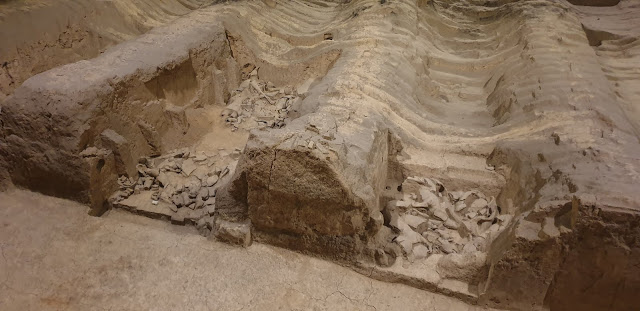
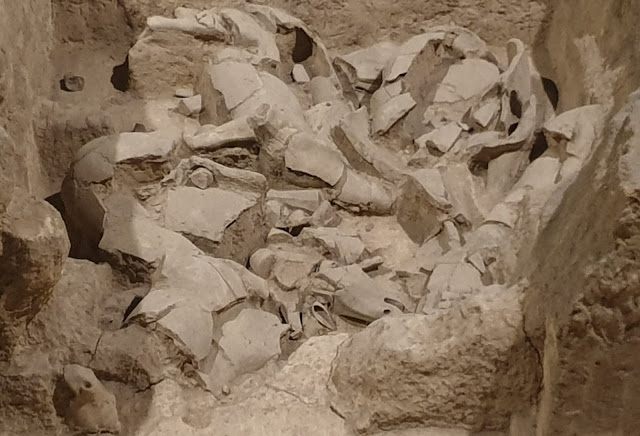
The excavation of this pit has only just begun, so it is possible to see where they have carefully removed the top cover, and you can see the broken parts of the warriors lying in a heap.

Some parts of the warriors are more discernible closer up

These parts are carefully extracted and taken to the ‘hospital’ where they are digitised and the computer will match each part with the warrior it belongs to.

Pit 1

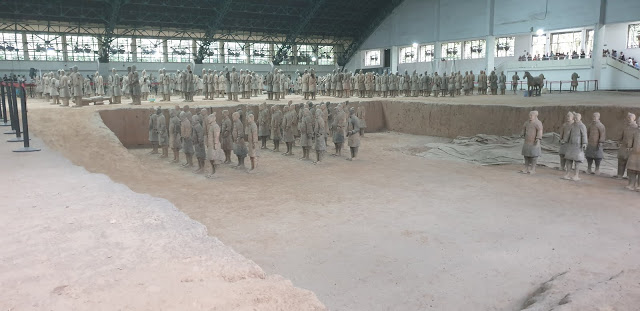
This has quite a number of standing soldiers that have been glued back together, but not necessarily complete and I notice a number if the statues were incomplete. And if they cannot find the missing pieces, then they are not added to or filled in.

The scale of the pit is enormous, and they have hardly scratched the surface in the restoration process.

What is there is a number of horses as well.

That’s at the front of the pit, a long line of statues, and what is clear is the location of the well where the first fragments were found by a farmer.

There are about eight lines of soldiers, and some lining the sides.

Midway down there is a large area currently under excavation

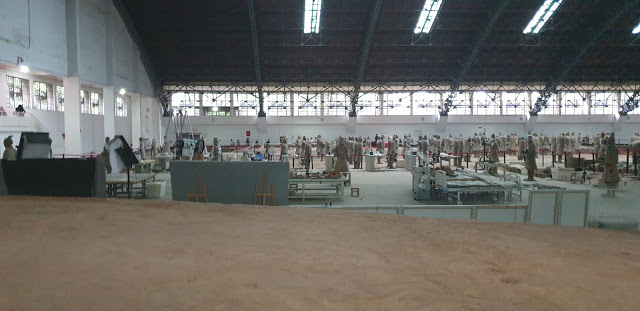
At the back is the hospital where the soldiers are reassembled.  There’s nearly a hundred in the various stages of rebuilding.  These days the soldiers are rebuilt using computer imaging.

The hospital area is where they are put back together

And these are some of the statues in various stages of reconstruction

Another two views of the size and scale of the reconstruction project

The coffee shop is also a sales centre, but there are too many people waiting for coffee and too few places to sit down.

An excerpt from “Strangers We’ve Become” – Coming Soon

I wandered back to my villa.

It was in darkness.  I was sure I had left several lights on, especially over the door so I could see to unlock it.

I looked up and saw the globe was broken.

Instant alert.

I went to the first hiding spot for the gun, and it wasn’t there.  I went to the backup and it wasn’t there either.  Someone had found my carefully hidden stash of weapons and removed them.

Who?

There were four hiding spots and all were empty.  Someone had removed the weapons.  That could only mean one possibility.

I had a visitor, not necessarily here for a social call.

But, of course, being the well-trained agent I’d once been and not one to be caught unawares, I crossed over to my neighbor and relieved him of a weapon that, if found, would require a lot of explaining.

Suitably armed, it was time to return the surprise.

There were three entrances to the villa, the front door, the back door, and a rather strange escape hatch.  One of the more interesting attractions of the villa I’d rented was its heritage.  It was built in the late 1700s, by a man who was, by all accounts, a thief.  It had a hidden underground room which had been in the past a vault but was now a wine cellar, and it had an escape hatch by which the man could come and go undetected, particularly if there was a mob outside the door baying for his blood.

It now gave me the means to enter the villa without my visitors being alerted, unless, of course, they were near the vicinity of the doorway inside the villa, but that possibility was unlikely.  It was not where anyone could anticipate or expect a doorway to be.

The secret entrance was at the rear of the villa behind a large copse, two camouflaged wooden doors built into the ground.  I move aside some of the branches that covered them and lifted one side.  After I’d discovered the doors and rusty hinges, I’d oiled and cleaned them, and cleared the passageway of cobwebs and fallen rocks.  It had a mildew smell, but nothing would get rid of that.  I’d left torches at either end so I could see.

I closed the door after me, and went quietly down the steps, enveloped in darkness till I switched on the torch.  I traversed the short passage which turned ninety degrees about halfway to the door at the other end.  I carried the key to this door on the keyring, found it and opened the door.  It too had been oiled and swung open soundlessly.

I stepped in the darkness and closed the door.

I was on the lower level under the kitchen, now the wine cellar, the ‘door’ doubling as a set of shelves which had very little on them, less to fall and alert anyone in the villa.

Silence, an eerie silence.

I took the steps up to the kitchen, stopping when my head was level with the floor, checking to see if anyone was waiting.  There wasn’t.  It seemed to me to be an unlikely spot for an ambush.

I’d already considered the possibility of someone coming after me, especially because it had been Bespalov I’d killed, and I was sure he had friends, all equally as mad as he was.  Equally, I’d also considered it nigh on impossible for anyone to find out it was me who killed him because the only people who knew that were Prendergast, Alisha, a few others in the Department, and Susan.

That raised the question of who told them where I was.

If I was the man I used to be, my first suspect would be Susan.  The departure this morning, and now this was too coincidental.  But I was not that man.

Or was I?

I reached the start of the passageway that led from the kitchen to the front door and peered into the semi-darkness.  My eyes had got used to the dark, and it was no longer an inky void.  Fragments of light leaked in around the door from outside and through the edge of the window curtains where they didn’t fit properly.  A bone of contention upstairs in the morning, when first light shone and invariably woke me up hours before I wanted to.

Still nothing.

I took a moment to consider how I would approach the visitor’s job.  I would get a plan of the villa in my head, all entrances, where a target could be led to or attacked where there would be no escape.

Coming in the front door.  If I was not expecting anything, I’d just open the door and walk-in.  One shot would be all that was required.

Contract complete.

I sidled quietly up the passage staying close to the wall, edging closer to the front door.  There was an alcove where the shooter could be waiting.  It was an ideal spot to wait.

Crunch.

I stepped on some nutshells.

Not my nutshells.

I felt it before I heard it.  The bullet with my name on it.

And how the shooter missed, from point-blank range, and hit me in the arm, I had no idea.  I fired off two shots before a second shot from the shooter went wide and hit the door with a loud thwack.

I saw a red dot wavering as it honed in on me and I fell to the floor, stretching out, looking up where the origin of the light was coming and pulled the trigger three times, evenly spaced, and a second later I heard the sound of a body falling down the stairs and stopping at the bottom, not very far from me.

Two assassins.

I’d not expected that.

The assassin by the door was dead, a lucky shot on my part.  The second was still breathing.

I checked the body for any weapons and found a second gun and two knives.  Armed to the teeth!

I pulled off the balaclava; a man, early thirties, definitely Italian.  I was expecting a Russian.

I slapped his face, waking him up.  Blood was leaking from several slashes on his face when his head had hit the stairs on the way down.  The awkward angle of his arms and legs told me there were broken bones, probably a lot worse internally.  He was not long for this earth.

“Who employed you?”

He looked at me with dead eyes, a pursed mouth, perhaps a smile.  “Not today my friend.  You have made a very bad enemy.”  He coughed and blood poured out of his mouth.  “There will be more …”

Friends of Bespalov, no doubt.

I would have to leave.  Two unexplainable bodies, I’d have a hard time explaining my way out of this mess.  I dragged the two bodies into the lounge, clearing the passageway just in case someone had heard anything.

Just in case anyone was outside at the time, I sat in the dark, at the foot of the stairs, and tried to breathe normally.  I was trying not to connect dots that led back to Susan, but the coincidence was worrying me.

A half-hour passed and I hadn’t moved.  Deep in thought, I’d forgotten about being shot, unaware that blood was running down my arm and dripping onto the floor.

Until I heard a knock on my front door.

Two thoughts, it was either the police, alerted by the neighbors, or it was the second wave, though why would they be knocking on the door?

I stood, and immediately felt a stabbing pain in my arm.  I took out a handkerchief and turned it into a makeshift tourniquet, then wrapped a kitchen towel around the wound.

If it was the police, this was going to be a difficult situation.  Holding the gun behind my back, I opened the door a fraction and looked out.

No police, just Maria.  I hoped she was not part of the next ‘wave’.

“You left your phone behind on the table.  I thought you might be looking for it.”  She held it out in front of her.

When I didn’t open the door any further, she looked at me quizzically, and then asked, “Is anything wrong?”

I was going to thank her for returning the phone, but I heard her breathe in sharply, and add, breathlessly, “You’re bleeding.”

I looked at my arm and realized it was visible through the door, and not only that, the towel was soaked in blood.

“You need to go away now.”

Should I tell her the truth?  It was probably too late, and if she was any sort of law-abiding citizen she would go straight to the police.

She showed no signs of leaving, just an unnerving curiosity.  “What happened?”

I ran through several explanations, but none seemed plausible.  I went with the truth.  “My past caught up with me.”

“You need someone to fix that before you pass out from blood loss.  It doesn’t look good.”

“I can fix it.  You need to leave.  It is not safe to be here with me.”

The pain in my arm was not getting any better, and the blood was starting to run down my arm again as the tourniquet loosened.  She was right, I needed it fixed sooner rather than later.

I opened the door and let her in.  It was a mistake, a huge mistake, and I would have to deal with the consequences.  Once inside, she turned on the light and saw the pool of blood just inside the door and the trail leading to the lounge.  She followed the trail and turned into the lounge, turned on the light, and no doubt saw the two dead men.

I expected her to scream.  She didn’t.

She gave me a good hard look, perhaps trying to see if I was dangerous.  Killing people wasn’t something you looked the other way about.  She would have to go to the police.

“What happened here?”

“I came home from the cafe and two men were waiting for me.  I used to work for the Government, but no longer.  I suspect these men were here to repay a debt.  I was lucky.”

“Not so much, looking at your arm.”

She came closer and inspected it.

“Sit down.”

She found another towel and wrapped it around the wound, retightening the tourniquet to stem the bleeding.

“Do you have medical supplies?”

I nodded.  “Upstairs.”  I had a medical kit, and on the road, I usually made my own running repairs.  Another old habit I hadn’t quite shaken off yet.

She went upstairs, rummaged, and then came back.  I wondered briefly what she would think of the unmade bed though I was not sure why it might interest her.

She helped me remove my shirt, and then cleaned the wound.  Fortunately, she didn’t have to remove a bullet.  It was a clean wound but it would require stitches.

When she’d finished she said, “Your friend said one day this might happen.”

No prizes for guessing who that friend was, and it didn’t please me that she had involved Maria.

“Alisha?”

“She didn’t tell me her name, but I think she cares a lot about you.  She said trouble has a way of finding you, gave me a phone and said to call her if something like this happened.”

“That was wrong of her to do that.”

“Perhaps, perhaps not.  Will you call her?”

“Yes.  I can’t stay here now.  You should go now.  Hopefully, by the time I leave in the morning, no one will ever know what happened here, especially you.”

She smiled.  “As you say, I was never here.”

…

© Charles Heath 2018-2022

strangerscover9

“Strangers We’ve Become” – The final countdown to publishing in 15 Days

A new edition of the Spanish inquisition

…

At what point do you stop ignoring the signs and start considering the possibility that:

  1.  Susan is no longer the woman he married, or
  2.  Susan has undergone such a transformation after the traumatising time her father put her through that she has completely changed, or
  3. The demands of running the Featherington commercial empire are such that there is no time left for David and Susan to spend time together in a meaningful way, or
  4. Susan is not his Susan, but another of the clones.

David certainly doesn’t want to believe the last option was the case.  There is enough from their current interactions to convince him that his Susan is in there somewhere, but those photographs he received in Moscow before the assassination attempt convinced him that it was possible the damage done by her father had changed her.

He never expected she would have an affair.

The thing is, did he know here all that well given the little time they had spent together?

Still reeling from the assassination attempt in Yaroslavl, and the fact it nearly cost Alisha her life, David decides it’s time to do a little investigating into the woman that is his wife.

For now.

And being on the inside, that surveillance job was going to be easy.

Except…

He just has to get past the new security detail Susan has hired.

…

“Sunday in New York”, a romantic adventure that’s not a walk in the park!

“Sunday in New York” is ultimately a story about trust, and what happens when a marriage is stretched to its limits.

When Harry Steele attends a lunch with his manager, Barclay, to discuss a promotion that any junior executive would accept in a heartbeat, it is the fact his wife, Alison, who previously professed her reservations about Barclay, also agreed to attend, that casts a small element of doubt in his mind.

From that moment, his life, in the company, in deciding what to do, his marriage, his very life, spirals out of control.

There is no one big factor that can prove Harry’s worst fears, that his marriage is over, just a number of small, interconnecting events, when piled on top of each other, points to a cataclysmic end to everything he had believed in.

Trust is lost firstly in his best friend and mentor, Andy, who only hints of impending disaster, Sasha, a woman whom he saved, and who appears to have motives of her own, and then in his wife, Alison, as he discovered piece by piece damning evidence she is about to leave him for another man.

Can we trust what we see with our eyes or trust what we hear?

Haven’t we all jumped to conclusions at least once in our lives?

Can Alison, a woman whose self-belief and confidence is about to be put to the ultimate test, find a way of proving their relationship is as strong as it has ever been?

As they say in the classics, read on!

Purchase:

http://tinyurl.com/Amazon-SundayInNewYork

In a word: Land


And, yes, the simple description for this word is that area of the earth that isn’t covered by water.

It could also describe that little patch that my house is built on, and is generally covered by the expression, house and land as a package.

After all, a piece of land is not much used to you unless there’s a dwelling on it, or, on rare occasions, under it.  Does that mean then that land in this instance only as what you can see?

OK, now it’s getting confusing.

What if I wanted to live off the land.  A small patch will not do, in this case, is need a large area, perhaps thousands if hectares.

It is said that the Australian aborigines have lived off the land for thousands of years, with a nomadic lifestyle.

No small patch of land for them.

Now, what if I come down out of the sky. Oddly enough this means I have to land, even if I come back to earth over later.  It’s still a landing.

Now it’s getting interesting.

So what if you wanted to refer to where you live?  That would be your homeland or motherland, and it describes a country.

So it’s my patch, my country, any area where there isn’t water.  What about describing a country, say the land of the long white cloud, or the land of the rising sun?

And just to add to the confusion

I can land a fish

Make land, after being all at sea, and,

Best of all, land that much desired job.

Wow.

I’m beginning to think it’s another one of those ‘four-letter words’

“Echoes From The Past”, the past doesn’t necessarily stay there


What happens when your past finally catches up with you?

…

Christmas is just around the corner, a time to be with family. For Will Mason, an orphan since he was fourteen, it is a time for reflection on what his life could have been, and what it could be.

Until a chance encounter brings back to life the reasons for his twenty years of self-imposed exile from a life only normal people could have. From that moment Will’s life slowly starts to unravel and it’s obvious to him it’s time to move on.

This time, however, there is more at stake.

Will has broken his number one rule, don’t get involved.

With his nemesis, Eddie Jamieson, suddenly within reach, and a blossoming relationship with an office colleague, Maria, about to change everything, Will has to make a choice. Quietly leave, or finally, make a stand.

But as Will soon discovers, when other people are involved there is going to be terrible consequences no matter what choice he makes.

https://amzn.to/2CYKxu4

newechocover5rs

“Second Thoughts”, a short story

Get me to the church on time.

It was a tune out of My Fair Lady, and it was in my head the moment I woke up that morning.  And this day was, to quote some immortal’s line, was supposed to be the happiest day of my life.

But, somehow, it didn’t feel like that and lying under the warm covers of my bed, perhaps for the last time at my parent’s home, the last place I thought I’d find myself, I began to consider how it was I had ended up in this situation.

It was not a question of who the bride was, we had been friends from an early age and used to joke about getting married, but at the age of six or seven, that was a concept rather than something we might act on in the future.

Except that was how it panned out, and, not for the reasons one might think would lead to such an eventuality.

Yes, we were close friends till the early teens, then my family went in one direction, New York, and her family went in another, San Francisco, and in each place both families built successful businesses.

Josephine, the intended bride, and I met off and on over the next fifteen years, some of that mutually when we were at university together, and, I might add, living together.  Even then, there had been no suggestion of permanency because we each had to go home to eventually work in the family business.

In those few years, it had been easy because there had been no expectations by either of us.  We simply came together, stayed together, and parted at the end both happy to have enjoyed the experience.

Then, several events changed the course of our lives.

My father died unexpectedly at a crucial point in the company’s expansion, and without his direction, it began to flounder.  Then, Josephine arrived in New York to open a branch of her family’s business, and just happened to arrive on the day of my father’s funeral.

I thought it a coincidence and was grateful for her support at a time when I needed it.

A month after that, one of the lead investors in the new expansion plan pulled out, as was his right because the loan had been contingent on my father overseeing the project.  It was the end of a very bad week, and instead of being the last to leave the office, I left early, called up an old friend, Rollo, who had followed us to New York, and we went to his favourite bar.

He suggested a night on the town was called for and I agreed with him.  I think by that time I’d had enough of the problems for a few days.  But with Rollo, I learned no invitation was without its twists and turns, so when he said his sister was bringing a friend, I had to act happy even if I didn’t feel like it.  Her friends could be a little strange.

Another coincidence, the friend was Josephine.  Hearing from her once maybe, but twice in the same week, I didn’t think so, so I let it pass.  Yet despite my reservations, in the end, I had to admit I was glad to see her because the last thing I wanted to do was entertain a quirky woman I didn’t know.

Long story short, Josephine’s family business came aboard as the replacement investor, but not without some rather stringent requirements, and though no one on either side would admit it, it was suggested that perhaps Josephine and I would make an excellent match.  After all, we were childhood friends, had lived together without the problems that sometimes came with it, and we would be working very closely together.

I proposed, she accepted, and everyone was happy.

Well, not everyone.

I was down in the dining room getting breakfast, before the wedding, when Rollo arrived.  It went without saying Rollo was going to be the best man.

Curiously, he was neither surprised nor shocked to learn of my proposal, but it was a surprise to learn, in a roundabout way, he wasn’t exactly happy for me.  It was not anything I could put my finger on, but more of a feeling I had.  And, to be honest, before I had proposed to her, I was sure that Rollo had feelings for her, and at times I thought how much more sense it would make if they were together.

I’d even asked him once or twice if he liked her, and he just said they were friends.

The other side of that equation was his sister, Adrienne, who was, I thought, charming, funny, and sometimes a little offbeat, which is why I was drawn to her.  Over time, I think I may have developed feelings for her, but by the time those feelings were rising to the surface, I was advised that a woman of Josephine’s standing was more my type.

My mother could be very annoying at times, and whilst she might be looking after her son’s best interests, she was also looking after the company’s interests as best she could.  I suspect Josephine’s parents were the same, hoping their daughter would marry advantageously.

Rollo, being on the outside, had summed it up perfectly, ‘if this had been the eighteenth century there’s no doubt you two would be the perfect match’.

“You look as happy as I feel,” I said when I saw him.

“It’s going to be a big day, church wedding, in Latin of all languages, then the society event of the year.  What’s not to be happy about?”

Put like that, I shrugged.  “A registry office, burger and chips at the local diner, then a few days in the Catskills would have sufficed.”

“And on what planet do you think you are right now?”

I didn’t answer.  I simply poured another cup of black coffee and sat down.  It was a large room, with seats for a dozen, and I was the only one up.  I had expected a room full of family members, of which at least twenty were upstairs right now recovering from last night’s festivities.

Rollo poured some tea into a cup and sat opposite.  “OK.  What’s wrong?  Wedding day jitters?”

Could he read my mind?

“It just doesn’t seem right.  I mean, it seems we have been on this track forever, but you know, there’s something missing.”

“Love?”

Exactly.  It was another of those thoughts I had just before I got out of bed.  I liked her, maybe I loved her once, when I didn’t really know what love was, but now?  I don’t know what it was I felt about her.  I had been expecting those mythical thunderbolts to strike, but as the days, weeks, and months wore on, it just didn’t happen.

It was almost if we were going through the motions.

“It feels like it’s going to be a marriage of convenience.”  There, I said it.

And I expected Rollo to start having a fit.  Instead, he concentrated on putting three spoonful’s of sugar into his tea and stirring.  And stirring.  And stirring.

“Say something,” I said.  “Anything.  Tell me I’m being stupid, tell me to get out of my funk and screw my courage to the sticking place, or whatever it is you say in times like this.”

“It’s not like you to drop a bomb like this at a time like this…”

I felt he had more to say, the good part where he’d call me an ass, and then tell me to get my shit together.  It wouldn’t be the first time.

“But…”

“But I rather get the impression this wedding might not be going ahead.”

“It has to.  God knows how many people have put themselves out to be here.  It was, my mother said, a logistical nightmare.”

“It wouldn’t be the first time this has happened.”

“You’re supposed to be arguing for the wedding, not against it.”

“I would if I knew your heart was in it.  But it isn’t, is it?  I think you’ve spent so much time trying to please everyone else, that you have forgotten about yourself.  I know you’re not happy.  I also happen to know that Jo isn’t either.”

“You’ve spoken to her?”

“Just before I got here.  Call her.  You two need to talk.  In the meantime, you’re going to have to repay a huge debt after I somehow manage to sort this mess out.  My car’s outside.  Leave now, and I’ll let you know when it’s safe to return.”

“Where will I go?”

He smiled.  “I’m sure you’ll know by the time you get in the car.”

It was reckless and would cause a lot of pain and anguish for my mother, but I considered how much more pain it would cause to Josephine if I didn’t call it off.

I made the call on the way upstairs to finish dressing.

“I’m assuming you’ve spoken to Rollo?”  She didn’t wait for me to speak.

“You feel the same way?”

“It started out with the best of intentions, but I can’t help thinking if we were right for each other we would have married after university.  We are best friends, Alan, and I don’t think it’s ever going to progress from there.  I know you feel that too, it’s just the pressure from our families has managed to mask our true feelings.”

“Do you have any idea what sort of storm is about to erupt?”

“Everyone will get over it.  There’s too much at stake on both sides for there to be any real or lasting consequences.  I guess Rollo is going to have his work cut out for him.  I’ll see you one the other side.”

She didn’t say what other side, but I suspect it meant when the dust had settled.

I literally ran downstairs, mainly because I heard movement and didn’t want to run into anyone, and out the door towards Rollo’s car.

Once again I had to admire the fact he had exquisite taste in cars, and the one he’d brought was no exception, a Lamborghini, yellow, fast, and he knew I wanted to drive it.

What I didn’t expect. His sister, Phoebe, sitting in the passenger seat.

© Charles Heath 2019

The cinema of my dreams – I always wanted to go on a treasure hunt – Episode 38

Here’s the thing…

Every time I close my eyes, I see something different.

I’d like to think the cinema of my dreams is playing a double feature but it’s a bit like a comedy cartoon night on Fox.

But these dreams are nothing to laugh about.

Once again there’s a new installment of an old feature, and we’re back on the treasure hunt.

Before we embarked on the great driving expedition, for which I was beginning to think might be harder than it seemed to Boggs’ one-track mind, we decided to go and check out the mall, and if, indeed, there was an underground river, or, at the very least, if his flooding theory was correct. 

We were going to need very old clothes, and when I left the next morning, my mother noticed it.

“I’m going to do some gardening with Boggs.  He came up with this notion we could help out tat the old folk’s home.”

“That’s a nice thought.”

And it was a lie I knew would eventually come back to bite me.  My mother hadn’t exactly told me to stop seeing Boggs, because she was beginning to think his mental capacity had been diminished after the beating.

It was a logical and perfectly acceptable reason for his odd behavior.

I went directly to Boggs’ house, and he was waiting for me.  From there it was about twenty minutes, to a spot where he knew the surrounding fence had a hole big enough for us to crawl through.

It was odd seeing the place again, sitting out a few miles from the town, looking forlorn.  At the front entrance, off the road specially built between it and the town, there were miles of cyclone fencing, with signs alternately telling people to keep out on threat of prosecution for trespass, and more recently, hazard signs proclaiming the whole area was unsafe.

From where we’d stopped, we could see the carpark, enough for hundreds of cars, a bus terminus, a taxi rank, and the front façade of the shopping center, mostly looking like the front of a castle, with towers and ramparts.

There had been auxiliary plans for a medieval theme park at one stage, that would have blended in with the mall buildings, but that had to be abandoned, even though the land allocated to it was stable.  Or so a surveyor said.

We continued on until we reached the side leading to the marina.  From this vantage point looking one way, there was the ocean, and the other, the damage to the side of the mall buildings, the cracks, and, in places, where the roof had collapsed.

This would be the first time I’d set foot in the place since it had been a mall.

It had been popular, and there was always plenty of people shopping, eating and drinking, going to the cinemas, or just having a day out.  There had also been a museum dedicated to the naval days.

Now there was nothing.

It was ironic that as many of the castles in the British Isles that had been reduced to rubble, that was exactly what was going to happen here if someone didn’t take a bulldozer to the lot and level it out.

And that might happen sooner rather than later.  This was reputed to be the site of many a disappearance of a local person.  Three girls, two men, and a boy were supposedly hidden somewhere inside the mall, but the bodies had never been found.

I was thinking of those missing people when I said, with a degree of trepidation, “Do you really want to do this?  I mean, if you’re sure there’s an underground waterway here, I’ll happily take your word for it.”

Boggs just shook his head.  “You’re the last person I’d expect to chicken out.”

“It not that.”

“Isn’t it?  I can go by myself if you’re worried about getting hurt.”

“No.  You and me together.  I have to learn to fight those fears.”

Another look, then, “OK.  “Just a little further.”

Another minute or so, we reached a large rusting cylinder which had an almost illegible sign on it say the tank held inflammable liquid.  I tapped on the metal and it sounded empty.  I guess as part of the shut down they would have had to drain the tank.  I followed the tangle of pipes that ran slightly downhill for about 20 yards and then saw the opening in the fence Boggs had referred to.

We left our bikes behind the tank, among some bushes.

We then walked down to the fence line where the pipes passed through, and Boggs pulled back the chain wire.  A closer look showed it had been cut halfway up, making it easy to slip by, easier if there were two people along for the visit.

“Did you cut the fence,” I asked him.

He didn’t answer.  I guess he wanted me to think he had.

“Have you been here before?”

“Through here, yes.  A few times.”  He held the wire away and I climbed through.  I did the same for him on the other side, and he joined me.  The two halves melded back together so from a distance no one could tell the fence had been tampered with.

From the fence, we had to cross the access road to the marina, and across a carpark, now overgrown with weeds, and bushes, with the odd tree springing up through the cracks in the concrete.

The wall, when we reached it, was where several large cracks joined, and part of the wall had fallen away leaving a hole large enough to crawl through.  I put my head through the crack and could barely see anything.  There was light coming from the seaward side, but on the other, it was inky darkness.

There was also a very disturbing aroma, like freshly laid concrete crossed with the smell of a garage repair shop.  Years of spilled oil and grease.

“Is it safe?”  I asked.

Boggs shrugged.  “It could all fall down at any moment.  You read the signs on the fence.  Basically, this is, on one hand, cheating death.  On the other, we could be on the verge of an interesting discovery.”  Then, without another word, he went through the gap and inside. 

A few seconds later, I could see the light from his cell phone.

I shrugged.  If anything happened, like the building falling on me, I probably wouldn’t feel it.  And he was right, we could be on the verge of an interesting discovery.

I followed him inside and slid down the broken concrete and bricks to a dirty but solid-feeling floor, where Boggs was waiting, the light from his phone pointed in the direction of a storefront.

And looking at a dummy still dressed in clothes left behind.

I couldn’t help but think I’d seen that style of clothes somewhere before.

© Charles Heath 2020

“Strangers We’ve Become” – The final countdown to publishing in 16 Days

Third time’s the charm

…

There are three things going on here, well, that’s going on in Yaroslavl.

The first is that David’s old handler is losing it over the fact he had upped and gone to Moscow, Russia.  Old handlers always suspect their charges that go to Russia are looking to defect.  That isn’t David’s intention, but he knows Prendergast is never going to see reason.

The fact he sent one of his minders along, presumably to drag him back home is reason to suspect a major breakout of paranoia.

The second was a visit to the palace ruins, but it was going to take someone with more imagination than he had to see what the attraction is.  Whatever had been there, in that peaceful, tranquil spot must have had an air of magnificence about it.

Of course, Susan turns up, and they have words, and things might have gone smoother if it had not been for Prendergast’s minder.

Enough said, for the moment.

Back at the hotel, having missed the flight back with Susan, David gets to relive some of those lingering thoughts of Alisha, though he doesn’t act on them.

The third event, it was nearly a case of third-time lucky as the assassination attempt was almost successful.

Sadly, Alicia is nearly killed, and they need Boris to rescue them.

Two spies, a major injury and a dead body in a hotel room spell trouble in any country, but more so in Russia.

Could things get any more complicated?

…