“Trouble in Store” – Short stories my way: Adding a catalyst

Just when there’s enough complication in the story, we could leave it there with the current three protagonists and see what happens.

But I like mayhem.

So rather than another customer, it’s time to add a complication; an off-duty policeman, or more to the point, policewoman.  A beat cop, if they still exist.

Her back story in a sentence or so:

…

It had been another long day at the office for Officer Margaret O’Donnell, or, out in the streets, coping with people who either didn’t know or didn’t care about the law.

People who couldn’t cross the road where there were crossings and lights to protect them, silly girls shoplifting on a dare, and boys who thought they were men and could walk on water.

The one they scraped off the road would never get to grow up, and his mother, well, she was not doing another call on a family to give them the bad news.

That was her day.  So far.

…

What is she doing near the shop?  She lives around the corner.  Perhaps she knows the reputation of the shopkeeper or perhaps not.  It’s not relevant, then, as it is a place she avoids.

Now, she may not have the option.  She sees the shop is still open, past the usual closing time.

Let’s continue:

…

She came around the corner into the street where she lived and saw the lights were on in the corner store.

She looked at her watch and saw it was ten minutes to midnight.  Long past closing time.  She looked through the window but from the other side of the road and could only see three heads and little else.

Damn, she thought, I’m going to have to check it out.  There were rumours, and she hoped they were not true.

…

Meanwhile, back in the shop how are the others faring?

The shopkeeper is in an invidious position, he can’t supply the kids with the drugs and get them out, not in front of the customer.

The fact the girl has a gun makes the situation almost impossible.  What would happen if he suggests the customer leave?  Without him, the situation would be simpler.

Alphonse had only a few moments to sum up the situation, and the sum of those deliberations was the remove the only problem, the customer.

He could still salvage this:

…

The shopkeeper changed his expression to one more placatory, and said quietly to the girl, ‘Look, this is not this chap’s problem.’  He nodded in the direction of the customer.  ‘I’m sure he’d rather not be here, and you would be glad of one less distraction.’

He could see she was wavering, she was not holding the gun so steadily, and the longer this dragged on, the more nervous and unpredictable she would become.

And in the longer game, the customer would sing his praises no matter what happened after he left.

The girl looked at Jack.  The shopkeeper was right.  If he wasn’t here this could be over.  But there was another problem.  It didn’t look like Simmo was in any shape to get away.  In fact, this was looking more like a suicide mission.

She waved the gun in his direction.  ‘Get out now, before I change my mind.’

As the gun turned to the shopkeeper, Jack wasn’t going to wait to be asked twice and started sidling towards the door.

…

What happens next?

And the story for this section, with a few minor changes:

It had been another long day at the office for Officer Margaret O’Donnell, or, out in the streets, coping with people who either didn’t know or didn’t care about the law.

People who couldn’t cross the road where there were crossings and lights to protect them, silly girls shoplifting on a dare, and boys who thought they were men and could walk on water.

The one they scraped of the road would never get to grow up, and his mother, well, she was not doing another call on a family to give them the bad news.

That was her day.  So far.  For now, she was glad to be getting home, putting her feet up, and forgetting about everything until the next morning when it would start all over again.

Coming around that last corner, the home stretch she called it, she was directly opposite the corner shop, usually closed at this hour of the night.  It was not.  The lights were still on.

She looked at her watch and saw it was ten minutes to midnight, and long past closing time.  She looked through the window but from the other side of the road and could only see three heads and little else.

Damn, she thought, I’m going to have to check it out.  There were rumours, and she hoped they were not true.

The shopkeeper changed his expression to one more placatory, and said quietly to the girl, ‘Look, this is not this chap’s problem.’  He nodded in the direction of the customer.  ‘I’m sure he’d rather not be here, and you would be glad of one less distraction.’

He could see she was wavering, she was not holding the gun so steadily, and the longer this dragged on, the more nervous and unpredictable she would become.

And in the longer game, the customer would sing his praises no matter what happened after he left.

The girl looked at Jack.  The shopkeeper was right.  If he wasn’t here this could be over.  But there was another problem.  It didn’t look like Simmo was in any shape to get away.  In fact, this was looking more like a suicide mission.

She waved the gun in his direction.  ‘Get out now, before I change my mind.’

As the gun turned to the shopkeeper, Jack wasn’t going to wait to be asked twice and started sidling towards the door.

Next:  Actions have consequences

© Charles Heath 2016-2023

Figures of speech

I found this explanation on the internet: ‘a word or phrase used in a non-literal sense for rhetorical or vivid effect.’

We as writers should not use these in our writing because most people might not understand their use.  I think it sometimes adds a degree of whimsy to the story.

I remember some years ago when I working with a Russian chap who’d not been in the country very long, and though he had a reasonable use of English, was not quite up with our figures of speech.

And made me realize when he kept asking me what they meant, just how many I used in everyday use.

Most of these figures of speech use descriptions that do not necessarily match the word being described, such as ‘I dance like I have two left feet’.

And that pretty much sums up how good I can dance.  But …

‘Like a bat out of hell’, not sure how this got into the vernacular

‘Like a bull in a China shop’, describes a toddler let loose

‘More front than Myers’, as my mother used to say, but in context, Myers is the Australian version of the English Selfridges or Harrods or Paris Galleries Lafayette.  It refers to the width of the street frontage of the stores

‘As mad as a hatter’, though not necessarily of the millinery kind, but, well, you can guess

‘As nutty as a fruitcake’, provided your fruitcake has nuts in it

You can see, if you get the references, they are somewhat apt, and, yes, they sometimes creep into my stories.

The cinema of my dreams – I always wanted to go on a treasure hunt – Episode 46

Here’s the thing…

Every time I close my eyes, I see something different.

I’d like to think the cinema of my dreams is playing a double feature but it’s a bit like a comedy cartoon night on Fox.

But these dreams are nothing to laugh about.

Once again there’s a new installment of an old feature, and we’re back on the treasure hunt.

…

Aside from working on what I was going to tell my mother, and Boggs for that matter, where I’d been all night, the last thing I could say was that I spent the night with Nadia.

It had a curious ring to it when I said to myself, I slept with Nadia.  Most people would take it the wrong way, but, by a quirk of fate, it was true.  I guess that little gem of truth would have to stay locked away in my head.

One the other hand, if I told my mother I was out doing reconnaissance work for Boggs, she would get very angry, messing around in Boggs’ fantasies.  She had no time for people who didn’t want to get a job, and work hard for a living.

At least I’d gone up in her estimation when I started working for the Benderby’s.

But the reconnaissance line would work with Boggs, and all I had to do was come up with a plausible set of circumstances he would believe.  At the moment, all I had was Alex going to the mall, and that I waited to see when he came out.  The question I would pose, what was he doing in there for four or five hours.

All I had to do was hope Alex had been out of town and Boggs hadn’t seen him.  Always a chance of coming unstuck.  Perhaps I should just not volunteer anything.

As for my mother, I couldn’t say I was working overtime for Benderby.  She was likely to call him and tell him off for making me work so hard. 

I was still no further advanced on that point when I got to the library. 

It was a familiar place for me, and I had spent a lot of my time there escaping the real world, and of course, being able to keep away from Alex and Vince.

The librarian, Gwen, had been there for a hundred years or more, or so they said, and she should have retired about 20 years ago.

Pity the poor mayor who got the job of telling her to leave.  Three had tried, and three had failed.  The current incumbent was smarter than that.  He just hired an assistant and told her that she had no problems handing over the reins when she was ready.

That woman, Winifred Pankhurst, no relation to the suffragette, was quiet, polite but firm in doing her duties and dealing with the public.  She and I had butted heads a few times, especially when Gwen wasn’t in, but today was not going to be one of those days.

I could see Gwen in her office, and headed straight there, under Winnie’s watchful eye.  And no, I didn’t dare call her Winnie.  Her name, she said, was Miss Pankhurst thank you very much.

Gwen looked up as I knocked on the door, and she smiled.

“Long time no see.”

It had been several weeks.  The job and everything else had made it less of a priority to get there,

“New job, crazy hours.  Never thought I’d become a working stiff.”

“About time.  All that talent being wasted.”

I came in and sat down opposite her.

“How are you?”

“Getting old.”

For her to admit that was a worry.  She was, last time I checked, somewhere between 93 and 95.  She never quite told anyone her actual date of birth, not even the Mayor’s office who employed her.  And she didn’t look a day over 80.  Good, clean living she said.

“Isn’t that inevitable?”

“For some of us.  Now, enough of being maudlin, what can I do for you?”

“What makes you think I want something?”

“That expression.  A cat’s curiosity.”

She could still see through me.  The only other people who could was my English teacher in the final year at school and my mother.

“What do you know about the Ormiston’s.”

A change in expression on her face told me it was not a surprise I was asking.  Alex’s thug had been here earlier, had someone else?

“They’re popular this week.  Young Elmer was in here a few days ago asking the same question.  I suspect he was working for Alex Benderby.”

The way she said his name, it was with the usual venom used for him.  She had a run in with Benderby a long time ago, and she’d never forgotten.  Or ever will.  That’s why Alex would never get anything from her about anything.

“He was.”

“Is this in relation to the treasure you and that lad Boggs are searching for?”

Of course, she’d know who and what was going on in this town.  No one could keep a secret from her.  Or her extensive network of old ladies in the knitting club.

“Boggs seems to think he had some idea of where it might be, though I’m not so sure.  I just go along for the ride, it balances out the depressive life we have to live living here.”

“Oh, come now.  It’s not all that bad.”

“Perhaps not, now that I have a job.  What can you tell me, if there’s anything to tell?”

“Ormiston was as bad if not worse than the Boggs, father and son alike.  He had the treasure bug too.  Obsessed.  In the end drove away his wife and family, eventually ran out of money after mounting six different search operations, and then, when that happened, sold the land to the Navy.  Quite an extensive area, about 100 square miles or so, from the coast back to the fault line.  Used to be a lake, once, now it’s just a dustbowl.”

A fault line?  This was something Boggs didn’t know about, and it could be significant.  But just how significant?

…

© Charles Heath 2020

“Strangers We’ve Become” – The final countdown to publishing in 8 Days

So what’s been happening?

…

Surveillance is in full swing, both at home and at the external office.

David discovers that Susan has a stepbrother, firstly by overhearing a conversation at the external office where works as the architect of the Russian palace rebuild, a man he has seen before.

He has a rather interesting name, was born in East Berlin to the same father, and different mothers, and has to go on a field trip.

David can see an opportunity to talk to him and follows him to France.

But, someone else is there which takes him very much by surprise and injects a sinister undertone to the visit.  Not everything is as it seems.

It’s also a chance to interrogate one of the new security team, accompanying him on his field trip, one that yields some very interesting information about the leader of the security team, and not-so-good news for the bodyguard.

When David returns, Alisha is discharged from the hospital and insists on helping David with the surveillance of the external office.

They are ensconced in a hotel room opposite the office, and her closeness brings problems for David of a different sort.

More is learned about why the new security team recommended by Prendergast is at Susan’s, and what might need to be done to help get rid of them, sooner rather than later; something that involves an estranged wife and missing daughter.

But just how are all of these titbits of information and characters connected, in what David no doubt believes is another of Prendergast’s elaborate schemes.

…

Searching for locations: The Silk Factory, Suzhou, China

China is renowned for its exquisite silk, so naturally, a visit to the Silk Spinning Factory is part of today’s tour.

After that, we will be heading downtown to an unspecified location where we’re getting a boat ride, walk through a typical Chinese shopping experience, and coffee at a coffee shop that is doubling as the meeting place, after we soak up the local atmosphere.

The problem with that is that if the entire collective trip a deal tourists take this route then the savvy shopkeepers will jack up their prices tenfold because we’re tourists with money.  It’ll be interesting to see how expensive everything is.

So…

Before we reach the silk factory, we are told that Suzhou is the main silk area of China, and we will be visiting a nearly 100 years old, Suzhou No 1 Silk Mill, established in 1926.  Suzhou has a 4,700-year history of making silk products.  It is located at No. 94, Nanmen Road, Suzhou, Jiangsu, China.

Then we arrive at the Silk Factory, another government-owned establishment with a castiron guarantee of quality and satisfaction.

The look and feel of the doona cover certainly backs up that claim

And the colors and variety is amazing (as is the cost of those exquisite sets)

We get to see the silk cocoon stretched beyond imagination, and see how the silk thread is extracted, then off to the showroom for the sales pitch.

It isn’t a hard sell, and the sheets, doonas, pillows, and pillowcases, are reasonably priced, and come with their own suitcase (for free) so you can take them with you, or free shipping, by slow boat, if you prefer not to take the goods with you.

We opt for the second choice, as there’s no room left in our baggage after packing the Chinese Medicine.

NANOWRIMO November 2023 – Day 28

“Opposites Attract”

…

All’s well…

…

Maybe.

Shotguns are in abundance, Tim has one, and it’s a standoff until he sees Annie.

I guess when I was writing this it was a little moving, and not for the first time when writing something that is emotionally difficult, a tear or two happens.

It’s the same when I watch really emotional movies, though I never used to be like that.

To be honest, I don’t know what it would be like to be confronted with a very ill loved one.  I think there would be stunned silence, then the start of the realisation of what it means, followed by all sorts of thoughts.

Not what it would be like if there was nothing I could do.

It has happened to a lot of people around me.  My sister-in-law lost a daughter, taken by cancer.  They had been hoping she had beaten it, but it came back.

My wife’s best friend’s daughter has finally discovered why she was having stomach pains, yes, cancer again, stage 3 and there is hope.

But the emotional roller coaster is not one any of us want to get on.

At least in this story, I can give hope.

…

Today’s words:  1.787, for a total of 50,507

OMG, it’s Friday again

Someone, many years ago, told me that once you turned 65 the weeks just flew, you know, like when a day was a long time, days will seem like hours, weeks like days, and years, well, it’s like watching the time clock on a time machine.

That last week went really fast, and now suddenly I’m 70.  What happened to the last five years!

But…

I finally knuckled down and got some work done on the multitude of writing projects I’ve got going on.

I’ve recently been working on a story I’ve been calling ‘The helicopter story that’s been keeping me awake’, that got to the fifteenth episode, the end of what I now call part one, and as of the sixteenth episode is now under the ubiquitous title of ‘What happens after an action-packed start’.

Now written through to episode thirty, it starts on the third part and the climax of the story, and I may call it ‘What happens when you’re sent on a fool’s errand’.

The story will have three parts and will become a novella.  The title, “Under the Cover of Darkness”, and Part 1 is called “Crash Landing”.  More news on the other parts soon.

It has also become part of my “Cinema of my dreams” series, under the subtitle of ‘I never wanted to go to Africa.”

Another that I have been calling ‘I Always Wanted to go on a Treasure Hunt” was a whimsical idea that cropped up because I was stuck on an aeroplane, where the initial idea was formed, then home where it was a hot afternoon, and it reminded me of a desert island, just where you’d expect to find treasure.

Of course, the treasure isn’t on an island, it’s somewhere on the Florida coast, and there’s an intrepid adventurer who had the ‘real’ map, sought after by a variety of bad people.

It’s now rounded out into ninety-one episodes, and nothing like what I originally envisaged.

It too is one of the ‘Cinema of my dreams’ series, subtitled, naturally, ‘I always wanted to go on a treasure hunt’.

Last week I even began drawing up the treasure map, after all, you can’t have a treasure hunt without a map, can you?

Then there’s my war story, without a title.  That might not happen until it is finished.  It has forty-seven episodes so far, but we’re heading towards the end quite quickly.

It’s in WW2, and the Germans are about to discover all is not going their way.

Another of the ‘Cinema of my dreams’ series, it is subtitled ‘I always wanted to write a war story’.

There is a fourth story, under the title “Was it just another surveillance job’ that has surprisingly found a new life, and I’m having fun trying to work out the lies from the truth, except in the spy business, no one ever really knows which is which, do they?

It has just ended with 67 episodes and is finally at a conclusion.

There’s a fifth, a story that started out being fuelled by screenshots of planets in Skymap, that blossomed into my take on space travel and meeting alien races out on the edge of the galaxy.  Fifty-one episodes on, it’s a miracle they haven’t been blasted out of the sky.

Stay tuned for another progress report.

An excerpt from “What Sets Us Apart”, a mystery with a twist

See the excerpt from the story below, just a taste of what’s in store…

http://amzn.to/2Eryfth

whatsetscover

McCallister was old school, a man who would most likely fit in perfectly campaigning on the battlefields of Europe during the Second World War. He’d been like a fish out of water in the army, post-Falklands, and while he retired a hero, he still felt he’d more to give.

He’d applied and was accepted as head of a SWAT team, and, watching him now as he and his men disembarked from the truck in almost military precision, a look passed between Annette, the police liaison officer, and I that said she’d seen it all before. I know I had.

There was a one in four chance his team would be selected for this operation, and she had been hoping it would be one of the other three. While waiting for them to arrive she filled me in on the various teams. His was the least co-operative, and the more likely to make ad-hoc decisions rather than adhere to the plan, or any orders that may come from the officer in charge.

This, she said quite bluntly, was going to end badly.

I still had no idea why Prendergast instructed me to attend the scene of what looked to be a normal domestic operation, but as the nominated expert in the field in these types of situations, it was fairly clear he wasn’t taking any chances. It was always a matter of opinion between us, and generally I lost.

In this case, it was an anonymous report identifying what the authorities believed were explosives in one of the dockside sheds where explosives were not supposed to be.

The only reason why the report was given any credence was the man, while not identifying himself by name, said he’d been an explosive expert once and recognized the boxes. That could mean anything, but the Chief Constable was a cautious man.

With his men settled and preparing their weapons, McCallister came over to the command post, not much more than the SUV my liaison and I arrived in, with weapons, bulletproof vests, and rolls of tape to cordon off the area afterward. We both had coffee, steaming in the cold early morning air. Dawn was slowly approaching and although rain had been forecast it had yet to arrive.

A man by the name of Benson was in charge. He too had groaned when he saw McCallister.

“A fine morning for it.” McCallister was the only enthusiastic one here.

He didn’t say what ‘it’ was, but I thought it might eventually be mayhem.

“Let’s hope the rain stays away. It’s going to be difficult enough without it,” Benson said, rubbing his hands together. We had been waiting for the SWAT team to arrive, and another team to take up their position under the wharf, and who was in the final stages of securing their position.

While we were waiting we drew up the plan. I’d go in first to check on what we were dealing with, and what type of explosives. The SWAT team, in the meantime, were to ensure all the exits to the shed were covered. When I gave the signal, they were to enter and secure the building. We were not expecting anyone inside or out, and no movement had been detected in the last hour since our arrival and deployment.

“What’s the current situation?”

“I’ve got eyes on the building, and a team coming in from the waterside, underneath. Its slow progress, but they’re nearly there. Once they’re in place, we’re sending McKenzie in.”

He looked in my direction.

“With due respect sir, shouldn’t it be one of us?” McCallister glared at me with the contempt that only a decorated military officer could.

“No. I have orders from above, much higher than I care to argue with, so, McCallister, no gung-ho heroics for the moment. Just be ready to move on my command, and make sure you have three teams at the exit points, ready to secure the building.”

McCallister opened his mouth, no doubt to question those orders, but instead closed it again. “Yes sir,” he muttered and turned away heading back to his men.

“You’re not going to have much time before he storms the battlements,” Benson quietly said to me, a hint of exasperation in his tone. “I’m dreading the paperwork.”

It was exactly what my liaison officer said when she saw McCallister arriving.

The water team sent their ‘in position’ signal, and we were ready to go.

In the hour or so we’d been on site nothing had stirred, no arrivals, no departures, and no sign anyone was inside, but that didn’t mean we were alone. Nor did it mean I was going to walk in and see immediately what was going on. If it was a cache of explosives then it was possible the building was booby-trapped in any number of ways, there could be sentries or guards, and they had eyes on us, or it might be a false alarm.

I was hoping for the latter.

I put on the bulletproof vest, thinking it was a poor substitute for full battle armor against an exploding bomb, but we were still treating this as a ‘suspected’ case. I noticed my liaison officer was pulling on her bulletproof vest too.

“You don’t have to go. This is my party, not yours,” I said.

“The Chief Constable told me to stick to you like glue, sir.”

I looked at Benson. “Talk some sense into her please, this is not a kindergarten outing.”

He shrugged. Seeing McCallister had taken all the fight out of him. “Orders are orders. If that’s what the Chief Constable requested …”

Madness. I glared at her, and she gave me a wan smile. “Stay behind me then, and don’t do anything stupid.”

“Believe me, I won’t be.” She pulled out and checked her weapon, chambering the first round. It made a reassuring sound.

Suited up, weapons readied, a last sip of the coffee in a stomach that was already churning from nerves and tension, I looked at the target, one hundred yards distant and thought it was going to be the longest hundred yards I’d ever traversed. At least for this week.

A swirling mist rolled in and caused a slight change in plans.

Because the front of the buildings was constantly illuminated by large overhead arc lamps, my intention had been to approach the building from the rear where there was less light and more cover. Despite the lack of movement, if there were explosives in that building, there’d be ‘enemy’ surveillance somewhere, and, after making that assumption, I believed it was going to be easier and less noticeable to use the darkness as a cover.

It was a result of the consultation, and studying the plans of the warehouse, plans that showed three entrances, the main front hangar type doors, a side entrance for truck entry and exit and a small door in the rear, at the end of an internal passage leading to several offices. I also assumed it was the exit used when smokers needed a break. Our entry would be by the rear door or failing that, the side entrance where a door was built into the larger sliding doors. In both cases, the locks would not present a problem.

The change in the weather made the approach shorter, and given the density of the mist now turning into a fog, we were able to approach by the front, hugging the walls, and moving quickly while there was cover. I could feel the dampness of the mist and shivered more than once.

It was nerves more than the cold.

I could also feel rather than see the presence of Annette behind me, and once felt her breath on my neck when we stopped for a quick reconnaissance.

It was the same for McCallister’s men. I could feel them following us, quickly and quietly, and expected, if I turned around, to see him breathing down my neck too.

It added to the tension.

My plan was still to enter by the back door.

We slipped up the alley between the two sheds to the rear corner and stopped. I heard a noise coming from the rear of the building, and the light tap on the shoulder told me Annette had heard it too. I put my hand up to signal her to wait, and as a swirl of mist rolled in, I slipped around the corner heading towards where I’d last seen the glow of a cigarette.

The mist cleared, and we saw each other at the same time. He was a bearded man in battle fatigues, not the average dockside security guard.

He was quick, but my slight element of surprise was his undoing, and he was down and unconscious in less than a few seconds with barely a sound beyond the body hitting the ground. Zip ties secured his hands and legs, and tape his mouth. Annette joined me a minute after securing him.

A glance at the body then me, “I can see why they, whoever they are, sent you.”

She’d asked who I worked for, and I didn’t answer. It was best she didn’t know.

“Stay behind me,” I said, more urgency in my tone. If there was one, there’d be another.

Luck was with us so far. A man outside smoking meant no booby traps on the back door, and quite possibly there’d be none inside. But it indicated there were more men inside, and if so, it appeared they were very well trained. If that were the case, they would be formidable opponents.

The fear factor increased exponentially.

I slowly opened the door and looked in. A pale light shone from within the warehouse itself, one that was not bright enough to be detected from outside. None of the offices had lights on, so it was possible they were vacant. I realized then they had blacked out the windows. Why hadn’t someone checked this?

Once inside, the door closed behind us, progress was slow and careful. She remained directly behind me, gun ready to shoot anything that moved. I had a momentary thought for McCallister and his men, securing the perimeter.

At the end of the corridor, the extent of the warehouse stretched before us. The pale lighting made it seem like a vast empty cavern, except for a long trestle table along one side, and, behind it, stacks of wooden crates, some opened. It looked like a production line.

To get to the table from where we were was a ten-yard walk in the open. There was no cover. If we stuck to the walls, there was equally no cover and a longer walk.

We needed a distraction.

As if on cue, the two main entrances disintegrated into flying shrapnel accompanied by a deafening explosion that momentarily disoriented both Annette and I. Through the smoke and dust kicked up I saw three men appear from behind the wooden crates, each with what looked like machine guns, spraying bullets in the direction of the incoming SWAT members.

They never had a chance, cut down before they made ten steps into the building.

By the time I’d recovered, my head heavy, eyes watering and ears still ringing, I took several steps towards them, managing to take down two of the gunmen but not the third.

I heard a voice, Annette’s I think, yell out, “Oh, God, he’s got a trigger,” just before another explosion, though all I remember in that split second was a bright flash, the intense heat, something very heavy smashing into my chest knocking the wind out of me, and then the sensation of flying, just before I hit the wall.

I spent four weeks in an induced coma, three months being stitched back together and another six learning to do all those basic actions everyone took for granted. It was twelve months almost to the day when I was released from the hospital, physically, except for a few alterations required after being hit by shrapnel, looking the same as I always had.

But mentally? The document I’d signed on release said it all, ‘not fit for active duty; discharged’.

It was in the name of David Cheney. For all intents and purposes, Alistair McKenzie was killed in that warehouse, and for the first time ever, an agent left the Department, the first to retire alive.

I was not sure I liked the idea of making history.

© Charles Heath 2016-2020

Searching for locations: The Erqi Memorial Tower, Zhengzhou, China

A convoluted explanation on the reasons for this memorial came down to it being about the deaths of those involved in the 1923 Erqi strike, though we’re not really sure what the strike was about.

So, after a little research, this is what I found:

The current Erqi Tower was built in 1971 and was, historically, the tallest building in the city. It is a memorial to the Erqi strike and in memory of Lin Xiangqian and other railway workers who went on strike for their rights, which happened on February 7, 1923.

It has 14 floors and is 63 meters high. One of the features of this building is the view from the top, accessed by a spiral staircase, or an elevator, when it’s working (it was not at the time of our visit).

There seems to be an affinity with the number 27 with this building, in that

  • It’s the 27th memorial to be built
  • to commemorate the 27th workers’ strike
  • located in the 27th plaza of Zhengzhou City.

We drive to the middle of the city where we once again find traveling in kamikaze traffic more entertaining than the tourist points

When we get to the drop-off spot, it’s a 10-minute walk to the center square where the tower is located on one side. Getting there we had to pass a choke point of blaring music and people hawking goods, each echoing off the opposite wall to the point where it was deafening. Too much of it would be torture.

But, back to the tower…

It has 14 levels, but no one seemed interested in climbing the 14 or 16 levels to get to the top. The elevator was broken, and after the great wall episode, most of us are heartily sick of stairs.

The center square was quite large but paved in places with white tiles that oddly reflected the heat rather than absorb it. In the sun it was very warm.

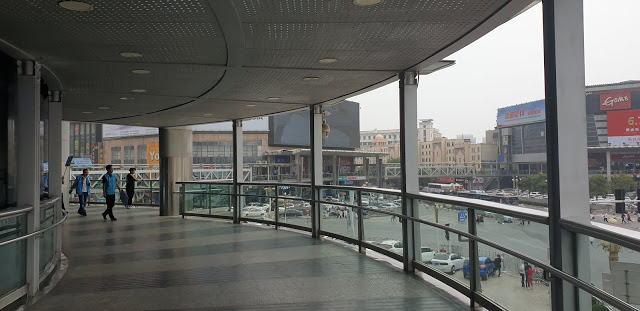
Around the outside of two-thirds of the square, and crossing the roads, was an elevated walkway, which if you go from the first shops and around to the other end, you finish up, on the ground level, at Starbucks.

This is the Chinese version and once you get past the language barrier, the mixology range of cold fruity drinks are to die for, especially after all that walking. Mine was a predominantly peach flavor, with some jelly and apricot at the bottom. I was expecting sliced peaches but I prefer and liked the apricot half.

A drink and fruit together was a surprise.

Then it was the walk back to the meeting point and then into the hotel to use the happy house before rejoining the kamikaze traffic.

We are taken then to the train station for the 2:29 to our next destination, Suzhou, the Venice of the East.

An excerpt from “What Sets Us Apart”, a mystery with a twist

See the excerpt from the story below, just a taste of what’s in store…

http://amzn.to/2Eryfth

whatsetscover

McCallister was old school, a man who would most likely fit in perfectly campaigning on the battlefields of Europe during the Second World War. He’d been like a fish out of water in the army, post-Falklands, and while he retired a hero, he still felt he’d more to give.

He’d applied and was accepted as head of a SWAT team, and, watching him now as he and his men disembarked from the truck in almost military precision, a look passed between Annette, the police liaison officer, and I that said she’d seen it all before. I know I had.

There was a one in four chance his team would be selected for this operation, and she had been hoping it would be one of the other three. While waiting for them to arrive she filled me in on the various teams. His was the least co-operative, and the more likely to make ad-hoc decisions rather than adhere to the plan, or any orders that may come from the officer in charge.

This, she said quite bluntly, was going to end badly.

I still had no idea why Prendergast instructed me to attend the scene of what looked to be a normal domestic operation, but as the nominated expert in the field in these types of situations, it was fairly clear he wasn’t taking any chances. It was always a matter of opinion between us, and generally I lost.

In this case, it was an anonymous report identifying what the authorities believed were explosives in one of the dockside sheds where explosives were not supposed to be.

The only reason why the report was given any credence was the man, while not identifying himself by name, said he’d been an explosive expert once and recognized the boxes. That could mean anything, but the Chief Constable was a cautious man.

With his men settled and preparing their weapons, McCallister came over to the command post, not much more than the SUV my liaison and I arrived in, with weapons, bulletproof vests, and rolls of tape to cordon off the area afterward. We both had coffee, steaming in the cold early morning air. Dawn was slowly approaching and although rain had been forecast it had yet to arrive.

A man by the name of Benson was in charge. He too had groaned when he saw McCallister.

“A fine morning for it.” McCallister was the only enthusiastic one here.

He didn’t say what ‘it’ was, but I thought it might eventually be mayhem.

“Let’s hope the rain stays away. It’s going to be difficult enough without it,” Benson said, rubbing his hands together. We had been waiting for the SWAT team to arrive, and another team to take up their position under the wharf, and who was in the final stages of securing their position.

While we were waiting we drew up the plan. I’d go in first to check on what we were dealing with, and what type of explosives. The SWAT team, in the meantime, were to ensure all the exits to the shed were covered. When I gave the signal, they were to enter and secure the building. We were not expecting anyone inside or out, and no movement had been detected in the last hour since our arrival and deployment.

“What’s the current situation?”

“I’ve got eyes on the building, and a team coming in from the waterside, underneath. Its slow progress, but they’re nearly there. Once they’re in place, we’re sending McKenzie in.”

He looked in my direction.

“With due respect sir, shouldn’t it be one of us?” McCallister glared at me with the contempt that only a decorated military officer could.

“No. I have orders from above, much higher than I care to argue with, so, McCallister, no gung-ho heroics for the moment. Just be ready to move on my command, and make sure you have three teams at the exit points, ready to secure the building.”

McCallister opened his mouth, no doubt to question those orders, but instead closed it again. “Yes sir,” he muttered and turned away heading back to his men.

“You’re not going to have much time before he storms the battlements,” Benson quietly said to me, a hint of exasperation in his tone. “I’m dreading the paperwork.”

It was exactly what my liaison officer said when she saw McCallister arriving.

The water team sent their ‘in position’ signal, and we were ready to go.

In the hour or so we’d been on site nothing had stirred, no arrivals, no departures, and no sign anyone was inside, but that didn’t mean we were alone. Nor did it mean I was going to walk in and see immediately what was going on. If it was a cache of explosives then it was possible the building was booby-trapped in any number of ways, there could be sentries or guards, and they had eyes on us, or it might be a false alarm.

I was hoping for the latter.

I put on the bulletproof vest, thinking it was a poor substitute for full battle armor against an exploding bomb, but we were still treating this as a ‘suspected’ case. I noticed my liaison officer was pulling on her bulletproof vest too.

“You don’t have to go. This is my party, not yours,” I said.

“The Chief Constable told me to stick to you like glue, sir.”

I looked at Benson. “Talk some sense into her please, this is not a kindergarten outing.”

He shrugged. Seeing McCallister had taken all the fight out of him. “Orders are orders. If that’s what the Chief Constable requested …”

Madness. I glared at her, and she gave me a wan smile. “Stay behind me then, and don’t do anything stupid.”

“Believe me, I won’t be.” She pulled out and checked her weapon, chambering the first round. It made a reassuring sound.

Suited up, weapons readied, a last sip of the coffee in a stomach that was already churning from nerves and tension, I looked at the target, one hundred yards distant and thought it was going to be the longest hundred yards I’d ever traversed. At least for this week.

A swirling mist rolled in and caused a slight change in plans.

Because the front of the buildings was constantly illuminated by large overhead arc lamps, my intention had been to approach the building from the rear where there was less light and more cover. Despite the lack of movement, if there were explosives in that building, there’d be ‘enemy’ surveillance somewhere, and, after making that assumption, I believed it was going to be easier and less noticeable to use the darkness as a cover.

It was a result of the consultation, and studying the plans of the warehouse, plans that showed three entrances, the main front hangar type doors, a side entrance for truck entry and exit and a small door in the rear, at the end of an internal passage leading to several offices. I also assumed it was the exit used when smokers needed a break. Our entry would be by the rear door or failing that, the side entrance where a door was built into the larger sliding doors. In both cases, the locks would not present a problem.

The change in the weather made the approach shorter, and given the density of the mist now turning into a fog, we were able to approach by the front, hugging the walls, and moving quickly while there was cover. I could feel the dampness of the mist and shivered more than once.

It was nerves more than the cold.

I could also feel rather than see the presence of Annette behind me, and once felt her breath on my neck when we stopped for a quick reconnaissance.

It was the same for McCallister’s men. I could feel them following us, quickly and quietly, and expected, if I turned around, to see him breathing down my neck too.

It added to the tension.

My plan was still to enter by the back door.

We slipped up the alley between the two sheds to the rear corner and stopped. I heard a noise coming from the rear of the building, and the light tap on the shoulder told me Annette had heard it too. I put my hand up to signal her to wait, and as a swirl of mist rolled in, I slipped around the corner heading towards where I’d last seen the glow of a cigarette.

The mist cleared, and we saw each other at the same time. He was a bearded man in battle fatigues, not the average dockside security guard.

He was quick, but my slight element of surprise was his undoing, and he was down and unconscious in less than a few seconds with barely a sound beyond the body hitting the ground. Zip ties secured his hands and legs, and tape his mouth. Annette joined me a minute after securing him.

A glance at the body then me, “I can see why they, whoever they are, sent you.”

She’d asked who I worked for, and I didn’t answer. It was best she didn’t know.

“Stay behind me,” I said, more urgency in my tone. If there was one, there’d be another.

Luck was with us so far. A man outside smoking meant no booby traps on the back door, and quite possibly there’d be none inside. But it indicated there were more men inside, and if so, it appeared they were very well trained. If that were the case, they would be formidable opponents.

The fear factor increased exponentially.

I slowly opened the door and looked in. A pale light shone from within the warehouse itself, one that was not bright enough to be detected from outside. None of the offices had lights on, so it was possible they were vacant. I realized then they had blacked out the windows. Why hadn’t someone checked this?

Once inside, the door closed behind us, progress was slow and careful. She remained directly behind me, gun ready to shoot anything that moved. I had a momentary thought for McCallister and his men, securing the perimeter.

At the end of the corridor, the extent of the warehouse stretched before us. The pale lighting made it seem like a vast empty cavern, except for a long trestle table along one side, and, behind it, stacks of wooden crates, some opened. It looked like a production line.

To get to the table from where we were was a ten-yard walk in the open. There was no cover. If we stuck to the walls, there was equally no cover and a longer walk.

We needed a distraction.

As if on cue, the two main entrances disintegrated into flying shrapnel accompanied by a deafening explosion that momentarily disoriented both Annette and I. Through the smoke and dust kicked up I saw three men appear from behind the wooden crates, each with what looked like machine guns, spraying bullets in the direction of the incoming SWAT members.

They never had a chance, cut down before they made ten steps into the building.

By the time I’d recovered, my head heavy, eyes watering and ears still ringing, I took several steps towards them, managing to take down two of the gunmen but not the third.

I heard a voice, Annette’s I think, yell out, “Oh, God, he’s got a trigger,” just before another explosion, though all I remember in that split second was a bright flash, the intense heat, something very heavy smashing into my chest knocking the wind out of me, and then the sensation of flying, just before I hit the wall.

I spent four weeks in an induced coma, three months being stitched back together and another six learning to do all those basic actions everyone took for granted. It was twelve months almost to the day when I was released from the hospital, physically, except for a few alterations required after being hit by shrapnel, looking the same as I always had.

But mentally? The document I’d signed on release said it all, ‘not fit for active duty; discharged’.

It was in the name of David Cheney. For all intents and purposes, Alistair McKenzie was killed in that warehouse, and for the first time ever, an agent left the Department, the first to retire alive.

I was not sure I liked the idea of making history.

© Charles Heath 2016-2020