“The Things We Do For Love”

Would you give up everything to be with the one you love?

Is love the metaphorical equivalent to ‘walking the plank’; a dive into uncharted waters?

For Henry, the only romance he was interested in was a life at sea, and when away from it, he strived to find sanctuary from his family and perhaps life itself.  It takes him to a small village by the sea, a place he never expected to find another just like him, Michelle, whom he soon discovers is as mysterious as she is beautiful.

Henry had long since given up the notion of finding romance, and Michelle couldn’t get involved for reasons she could never explain, but in the end, both acknowledge that something happened the moment they first met.  

Plans were made, plans were revised, and hopes were shattered.

A chance encounter causes Michelle’s past to catch up with her, and whatever hope she had of having a normal life with Henry, or anyone else, is gone.  To keep him alive she has to destroy her blossoming relationship, an act that breaks her heart and shatters his.

But can love conquer all?

It takes a few words of encouragement from an unlikely source to send Henry and his friend Radly on an odyssey into the darkest corners of the red-light district in a race against time to find and rescue the woman he finally realizes is the love of his life.

The cover, at the moment, looks like this:

lovecoverfinal1

Is love the metaphorical equivalent to ‘walking the plank’; a dive into uncharted waters?

For Henry, the only romance he was interested in was a life at sea, and when away from it, he strived to find sanctuary from his family and perhaps life itself.  It takes him to a small village by the sea, s place he never expected to find another just like him, Michelle, whom he soon discovers is as mysterious as she is beautiful.

Henry had long since given up the notion of finding romance, and Michelle couldn’t get involved for reasons she could never explain, but in the end, both acknowledge that something happened the moment they first met.  

Plans were made, plans were revised, and hopes were shattered.

A chance encounter causes Michelle’s past to catch up with her, and whatever hope she had of having a normal life with Henry, or anyone else, is gone.  To keep him alive she has to destroy her blossoming relationship, an act that breaks her heart and shatters his.

But can love conquer all?

It takes a few words of encouragement from an unlikely source to send Henry and his friend Radly on an odyssey into the darkest corners of the red-light district in a race against time to find and rescue the woman he finally realizes is the love of his life.

The cover, at the moment, looks like this:

lovecoverfinal1

NANOWRIMO – November 2025 – Day 6

The Third Son of a Duke

It was the golden age of travel, where the opulence of the Titanic filtered down into the ships that went in the opposite direction.

It was also the golden age for migration from England to Australia, with ships leaving from a number of ports, a wave that had started in the mid-1800s.

I discovered which ship my grandmother took from Tilbury to Melbourne, the RMS “Orama”, over 10,000 tons and the latest iteration in the design that saw four of five similar ships before it, run by the Orient Shipping Line, and these ships departed every 14 days.

First class, second class, and third class, which sounds so much better than steerage.  The second-class ticket cost 40 pounds, which could be regarded as a small fortune back then, when wages were about 80 pounds a year.

My grandmother had a little inheritance money, and having cousins living in Australia, I am sure her intention was to simply visit them for a while and then go back home.

Of course, there was just one problem.

World War One was brewing in Europe. 

Perhaps if she thought it might all blow up, she could have stayed at home. But I think there was another reason why she was making such a journey.

1610 words, for a total of 9620 words.

The story behind the story: A Case of Working With the Jones Brothers

To write a private detective serial has always been one of the items at the top of my to-do list, though trying to write novels and a serial, as well as a blog, and maintain a social media presence, well, you get the idea.

But I made it happen, from a bunch of episodes I wrote a long, long time ago, used these to start it, and then continue on, then as now, never having much of an idea where it was going to end up, or how long it would take to tell the story.

That, I think is the joy of ad hoc writing, even you, as the author, have as much idea of where it’s going as the reader does.

It’s basically been in the mill since 1990, and although I finished it last year, it looks like the beginning to end will have taken exactly 30 years.  Had you asked me 30 years ago if I’d ever get it finished, the answer would be maybe?

My private detective, Harry Walthenson

I’d like to say he’s from that great literary mold of Sam Spade, or Mickey Spillane, or Phillip Marlow, but he’s not.

But, I’ve watched Humphrey Bogart play Sam Spade with much interest, and modelled Harry and his office on it.  Similarly, I’ve watched Robert Micham play Phillip Marlow with great panache, if not detachment, and added a bit of him to the mix.

Other characters come into play, and all of them, no matter what period they’re from, always seem larger than life.  I’m not above stealing a little of Mary Astor, Peter Lorre or Sidney Greenstreet, to breathe life into beguiling women and dangerous men alike.

Then there’s the title, like

The Case of the Unintentional Mummy – this has so many meanings in so many contexts, though I imagine that back in Hollywood in the ’30s and ’40s, this would be excellent fodder for Abbott and Costello

The Case of the Three-Legged Dog – Yes, I suspect there may be a few real-life dogs with three legs, but this plot would involve something more sinister.  And if made out of plaster, yes, they’re always something else inside.

But for mine, to begin with, it was “The Case of the …”, because I had no idea what the case was going to be about, well, I did, but not specifically.

Then I liked the idea of calling it “The Case of the Brother’s Revenge” because I began to have a notion there was a brother no one knew about, but that’s stuff for other stories, not mine, so then went the way of the others.

Now it’s called ‘A Case of Working With the Jones Brothers’, finished the first three drafts, and at the editor for the last.

I have high hopes of publishing it in early 2021.  It even has a cover.

PIWalthJones1

Writing about writing a book – Day 20

It is a day of rest although writers are ready and able to work on any given day at any hour of the day or night when an idea or thought comes to them.

I’m trying not to think, but that’s not working.

I’ve been going over the reasons for writing the first draft of the book 30 odd years ago and it had something to do with the fact I was working with personal computers and local area networking when both were in their infancy, and I wanted to blend this knowledge into a story.

Of course, I’d always wanted to write thrillers, and this presented the opportunity to use computers as a basis for a worldwide conspiracy.  How easy it is these days to do just that, but back in those days, it was a lot of hard work.

I remember sitting in a meeting when the company I was working for at the time had just implemented a network and personal computer to replace the mainframe and dumb terminals, also looking to leverage the new technologies of spreadsheets and word-processing, effectively making accounts staff more productive, and removing typists and moving into the world of centralized word processing.  It was not a new idea with Wangwriter, but using PC’s was.

One of the departmental managers got up to give his take on the new technology, this about six months after implementation, and after a lot of teething troubles caused mainly by people who were vehemently resisting change, and his message was, it should not be called ‘networking’, but ‘not working’, in reference to the number of times the network went down.

But this is a digression.  Computers are only a part of the story.

The story also goes back to a time when there was a clear demarcation between the management levels.  Management offices were oasis’s whereas the staff worked in a stark desert-like environment.  When one came to work for such an organization, it was with the belief that you start at the bottom, and over time, you work your way up the ladder.  There was, very definitely, class distinction, and the various management levels never mixed, at work or socially, except within their own level.

There were Managers, Assistant Managers, and Manager’s Assistants, a typing pool, a secretary, that young, or old, lady who did so many jobs for their boss, that these days it would be considered demeaning.  They were dedicated to their jobs and irreplaceable.  There was no such person as a Personal Assistant.

Nor was such a thing as sexual harassment.  One company I worked in where one of the Assistant Managers was sexually abusing an office girl, her complaints didn’t get a prosecution as it would now, it just had him transferred to another branch.  Reprehensible, yes, and thankfully no longer a problem, except of course, in Fifty Shades of Grey which apparently condones such behavior.

There were department heads, General Managers, and Board Members.  The upper management level and participants were in a world of their own, one few could ever aspire to.  This is the world in which Transworld, my fictitious (but based on a very real) company lives.

I have to work on my company structure to make sure it is right.

Now I have two charts.  A timeline, for both Bill, and the story, and a hierarchy for the office management and staff.

This is beginning to be more complicated than I thought.


© Charles Heath 2016-2020

The cinema of my dreams – I never wanted to go to Africa – Episode 29

Our hero knows he’s in serious trouble.

The problem is, there are familiar faces and a question of who is a friend and who is foe made all the more difficult because of the enemy, if it was the enemy, simply because it didn’t look or sound or act like the enemy.

Now, it appears, his problems stem from another operation he participated in.


I had to wonder if Lallo had already called the number on the phone he had handed Jacobi, and then considered, if that was the case, there would be no need for Jacobi to call anyone.  Or Lallo had got an answer, just not the answer he was expecting.

Jacobi looked at the phone, and I got the impression he was weighing his options.  The first was how long Lallo would hold him in custody.  That I think we could both assumed to be forever if necessary.  There was, no doubt, a cell at a black site with his name on it already.  The second, if he did call his contact, would that contact co-operate, though it was hard what it was Lallo was expecting Jacobi’s co-operation for.

But there was no doubt Lallo had a plan.

Jacobi took a moment to consider any further options I hadn’t thought of, and then made the call.  We were only going to get one side of the call.

A raised eyebrow indicated Jacobi had an answer on the other end.

“It’s me.”

Why did everyone say it’s me when asked to identify themselves, or as in the case announce themselves?

“No.  An unfortunate set of circumstances, and a gross breach of our agreement.  I am supposed to have autonomy of operations at home.  These bumbling idiots may have blown my cover.”

Somehow, the fact he was sitting in a small room told me his cover was more than likely a myth.  If this was our supposed point man in the failed operation I’d been on, then I could see why it cost a lot of good men their lives.

He had been playing both sides of the fence and sold us out.

“You would have to ask them.”

A moment later he handed the phone to Lallo.  “Prepare to die,” was all Jacobi said.

It didn’t move Lallo in the slightest,

He took the phone and asked, “Whom am I speaking to?”

The expression change told me that it was most likely none of his business.

“This man is responsible for the deaths of a good many men.”  A minute’s silence, then, “I doubt that would be the case considering the number of phones and their credentials.  He had been playing you, and perhaps many others.”

The silence was a lot longer, but the expressions changing by the minute told me that Lallo was not going to get what he wanted.

“No, that is not going to happen, not in the circumstances you describe.  I will be sending him back, yes, but for another mission.  I think it’s time you realized he’s been feeding you false intel for some time.”  Silence again, then, “By the time you do, he will no longer be here, there.  I’m sorry.”

He disconnected the call and put the phone back in the plastic evidence bag.

Then he sat, and gave Jacobi a long, hard stare.

No effect.

“What is happening,” Jacobi finally asked.

“You’re going home.”

“Good.  I expect once I get back there you will leave me alone.”

“On the contrary, Mr Jacobi, you will not be going back alone.  In fact, I’m sending you back with my team, and we are going to extract the same people you were supposed to help us extract the last time.”

“I had nothing to do with that.  It was simply your incompetence.”

“Be that as it may, you will do as I ask.”

“You are a fool.  Why would I do anything for you, and especially since they are both probably dead now, or, if not, past the point of saving.”

“You will then want to hope that isn’t the case, simply because if they are, then three members of your family will be executed.  You can say goodbye to them before you leave, or tell them you will see them again, it’s your choice.”

Lallo, it seems, was no fool, and had ensured he had the necessary leverage.  There was no mistaking the shock on Jacobi’s face.

“You lie.”

Lallo got up from his seat and knocked on the door.  It opened and two men brought in a large screen connected to a computer on a trolley.  They moved it to the vacant wall and left.  Lallo pressed several keys and a picture came up on the screen.  A woman and two small children, and judging from the expression on Jacobi’s face, exactly who he was hoping he would not see.

There were two hooded soldiers either side with guns loosely pointing in their direction.

“One word from me, and they will be shot.  Considering the treachery you have perpetrated, it’s taking a great deal of restraint for me not to give the order to kill them.”

He took a few seconds to regain his composure.  “This serves no purpose,” Jacobi said in a rising pitch, “your people are most likely dead.  It has been a long time.”

“I don’t think so.  We have word from a different source, a more reliable source, that they are still alive.  Barely, but alive, serving a life sentence for treason.  And helping the General with information.  All you need to do is get a small team of mine in and assist them to effect an escape.  They come home alive and, well, your family lives.  They don’t come back alive, well, I don’t think that’s an option, is it?”

Jacobi was in an invidious position of being damned if he did help us, or damned if he didn’t.  Either way, it didn’t guarantee his co-operation or assistance.  Painted into a corner, sometimes people like Jacobi chose the easy road, sacrificing everything to stay alive.  No doubt, until this predicament, he was well in favour with Bahti, and from what I’d heard, Bahti was not a man to cross.  There was a graveyard in the prison that was full of the remains of his enemies.  And people who were once his friends.

I knew firsthand what it was like to be between the proverbial rock and a hard place, and unfortunately, there was no upside.  No doubt the team leader of this new folly would have orders to shoot Jacobi once his work was done.  Lallo would not be able to leave a man in his position alive because of what he knew.

And from my perspective, I felt sorry for the team Lallo had selected to go on what could quite possibly be another suicide mission.


© Charles Heath 2019

Writing a book in 365 days – 293

Day 293

Show, Don’t Tell: Painting Pictures with Your Words

We’ve all heard the writing advice: “Don’t use adjectives to describe.” It sounds like a recipe for bland, uninspired prose. “I feel terrible,” or “It was a delightful surprise” – these phrases are so common, they barely register. The instruction isn’t to eliminate description, but to evolve it. The real challenge, and immense reward, lies in crafting your words so that your reader experiences the feeling you want to convey, arriving at their own perfect description.

Think of yourself as a painter, not a labeler. A painter doesn’t just write “sad” over a canvas. They blend blues and grays, create drooping lines, and shade in hollows under the eyes. They evoke sadness through imagery, through the subtle manipulation of color and form. Your words are your brushstrokes.

So, how do you achieve this evocative power? It’s about engaging your reader’s senses and emotions, and letting them do the heavy lifting. Here’s how to move beyond tired adjectives and paint vivid pictures that resonate:

1. Embrace Sensory Details: The Five Pillars of Experience

Adjectives often serve as a shortcut to describe a sensory input. Instead of saying something was “loud,” show the impact of that loudness.

  • Instead of: The music was loud.
  • Try: The bass vibrated through the floorboards, rattling the glassware on the counter. My ears rang long after the final chord.

This immediately tells the reader about the volume and its physical, visceral effect.

  • Instead of: The food was delicious.
  • Try: The aroma of roasting garlic and rosemary filled the air, mingling with the sweet scent of caramelized onions. The first bite melted on my tongue, a perfect balance of savory and tangy.

Here, the reader can almost taste and smell the food, leading them to their own conclusion of deliciousness.

2. Focus on Actions and Reactions: What Do They Do?

How does your character, or the subject of your description, behave when experiencing a certain emotion or state? Their actions are far more telling than a simple adjective.

  • Instead of: She was angry.
  • Try: Her jaw clenched, and a muscle pulsed in her cheek. She slammed the cupboard door shut, the sound echoing through the silent kitchen. Her gaze, sharp and unwavering, bore into him.

These actions paint a picture of contained fury, a volcano ready to erupt.

  • Instead of: It was a surprising victory.
  • Try: The scoreboard blinked, then blinked again, showing the impossible score. A collective gasp swept through the stadium, followed by a roar that shook the foundations. Players stumbled over each other, faces a mixture of disbelief and elation.

The crowd’s reaction, the players’ astonishment – these are powerful indicators of surprise.

3. Use Vivid Verbs and Specific Nouns: The Building Blocks of Power

Often, a strong verb or a precise noun can carry the weight of an adjective.

  • Instead of: He was a timid person.
  • Try: He shuffled his feet, his eyes darting to the floor whenever someone spoke to him. His voice was a low murmur, barely audible above the din.

The verbs “shuffled” and “darting” create an image of hesitation and nervousness.

  • Instead of: The city was beautiful at night.
  • Try: The cityscape shimmered, a galaxy of twinkling lights against the velvet darkness. Neon signs bled vibrant colors onto the rain-slicked streets, painting fleeting masterpieces.

“Shimmered,” “twinkling,” and “bled” are much more evocative than “beautiful.”

4. Show Internal States Through Physical Manifestations: The Body Knows

Emotions often manifest physically. By describing these physical cues, you allow the reader to infer the internal state.

  • Instead of: He was nervous.
  • Try: His palms were slick with sweat, and he kept running his tongue over his dry lips. A tremor ran through his leg as he tried to stand still.

This shows the physical symptoms of nervousness.

  • Instead of: She was happy.
  • Try: A wide smile stretched across her face, crinkling the corners of her eyes. She bounced on the balls of her feet, humming a tuneless melody.

The physical expression of joy is undeniable.

5. Employ Figurative Language: Similes and Metaphors

Similes and metaphors are your secret weapons for painting abstract concepts in concrete terms.

  • Instead of: The idea was terrible.
  • Try: The idea landed with the sickening thud of a lead weight in the pit of her stomach.

The metaphor clearly conveys the negative impact of the idea.

  • Instead of: The conversation was enjoyable.
  • Try: The conversation flowed like a gentle stream, each remark a smooth stone polished by friendly tides.

This simile creates a sense of ease and pleasure.

The Power of the Reader’s Interpretation

When you “show” instead of “tell,” you invite your reader into an active role. You’re not dictating their feelings; you’re providing the raw material for them to discover those feelings. This is where the magic happens. Your reader, drawing on their own experiences and emotions, will fill in the blanks with the perfect adjective, the precise nuance, the exact word that resonates most deeply with them.

So, the next time you find yourself reaching for a familiar adjective, pause. Ask yourself: What does this feel like? What does it look like? What does it sound like? What does it do? By painting with your words, you’ll create a richer, more immersive, and ultimately more unforgettable experience for your readers. Let them come to their own delightful surprise, and you’ll know you’ve truly succeeded.

Searching for locations: The Maglev (Magnetic Levitation) Train, Shanghai, China

So, the first treat for the day is the high-speed magnetic train, something we only learned about after arriving in China and was not on any of the pre-tour documentation.

The train line connects Shanghai Pudong International Airport and Longyang Road Station (in the outskirts of central Pudong).  It is the oldest commercial maglev still in operation, and the first commercial high-speed maglev with cruising speed of 431 km/h (268 mph).  At full speed, the journey takes 7 minutes and 20 seconds to complete the distance of about 30 km.

Construction of the line began on March 1, 2001 and public services commenced on 1 January 2004.  It was built by a joint venture of Siemens and ThyssenKrupp from Kassel, Germany.

But, like visiting anything from a hotel, first we have to drive to the station and because we are leaving at 8, its peak hour traffic, and it takes 1 hour 10 minutes to get there.

The train also has a practical use and that is to take passengers from Shanghai to Pudong international airport as well as for those train enthusiasts, which is what we are.

On the train, it has the same sleek look as the bullet trains, but it is completely different, and you are able to see from the front of the train to the back.

Reputed to travel at 431 kph we take a seat and it is not long before the doors shut, and a loud humming noise is soon replaced by what sounds like an engine, then we start moving.  It sounds just like a normal train, and is a lot noisier than a normal bullet train.

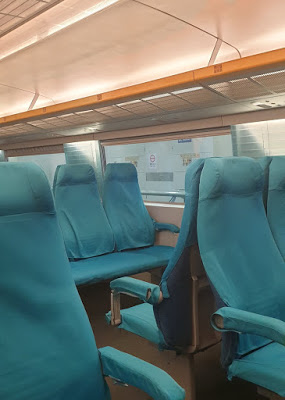
Seating on the train was nothing special, as one might expect

It didn’t take long before it hits the advertised speed of 431 kph.  This is not sustained for very long, because the distance is on 40 odd kilometers, and the whole trip takes about 7 minutes.

We go to the airport, and then we come back.  Is it worth the price, yes.  If you are a train enthusiast.

What I learned about writing – A writer isn’t just a writer

Is he, or she?

No, we have any number of other functions, so the notion that we can sit down all day, every day and just write is a misnomer.

I know for a fact I can’t.

I have jobs to do around the house, and therein lies the problem.

I sit down, once the jobs for that part of the day are done, and fire up the computer, or sometimes sharpen the pencils.

Then, free to write, it’s like starting the lawnmower, wait till it settles into a steady rhythm, and then, as you begin to mow the lawn, it runs out of petrol.

Yes, that’s happened to me a few times and only goes to highlight the other problems.

When you have to do something else, your mind is happily working on the book, story, article, piece, or whatever, and then, when you sit down, your mind is on the next lot of chores.

Only the most disciplined mind can separate the two so that each allotted time is allotted to the task.

Me, I suck at that.

Like now.  I want to get on with one of my longer stories, and my mind is telling me I have to write a blog post.

So, I’m writing the blog post.

I know that tomorrow I’m not going to get much writing time because the grandchildren are over for a mini stay, and we’re going to see Doolittle.

But can I get it done now?

No.  In the background, the Australia vs India one-day cricket match is murmuring, and we’re not doing so good.  It’s a necessary distraction, but I still haven’t learned to multitask.

Perhaps it’s too late for that.

Anyway, I have to go.  We just got a wicket, and the tide is turning.

I hope!

An excerpt from “If Only” – a work in progress

Investigation of crimes doesn’t always go according to plan, nor does the perpetrator get either found or punished.

That was particularly true in my case.  The murderer was incredibly careful in not leaving any evidence behind, to the extent that the police could not rule out whether it was a male or a female.

At one stage the police thought I had murdered my own wife though how I could be on a train at the time of the murder was beyond me.  I had witnesses and a cast-iron alibi.

The officer in charge was Detective First Grade Gabrielle Walters.  She came to me on the day after the murder seeking answers to the usual questions like, when was the last time you saw your wife, did you argue, the neighbors reckon there were heated discussions the day before.

Routine was the word she used.

Her fellow detective was a surly piece of work whose intention was to get answers or, more likely, a confession by any or all means possible.  I could sense the raging violence within him.  Fortunately, common sense prevailed.

Over the course of the next few weeks, once I’d been cleared of committing the crime, Gabrielle made a point of keeping me informed of the progress.

After three months the updates were more sporadic, and when, for lack of progress, it became a cold case, communication ceased.

But it was not the last I saw of Gabrielle.

The shock of finding Vanessa was more devastating than the fact she was now gone, and those images lived on in the same nightmare that came to visit me every night when I closed my eyes.

For months I was barely functioning, to the extent I had all but lost my job, and quite a few friends, particularly those who were more attached to Vanessa rather than me.

They didn’t understand how it could affect me so much, and since it had not happened to them, my tart replies of ‘you wouldn’t understand’ were met with equally short retorts.  Some questioned my sanity, even, for a time, so did I.

No one, it seemed, could understand what it was like, no one except Gabrielle.

She was by her own admission, damaged goods, having been the victim of a similar incident, a boyfriend who turned out to be an awfully bad boy.  Her story varied only in she had been made to witness his execution.  Her nightmare, in reliving that moment in time, was how she was still alive and, to this day, had no idea why she’d been spared.

It was a story she told me one night, some months after the investigation had been scaled down.  I was still looking for the bottom of a bottle and an emotional mess.  Perhaps it struck a resonance with her; she’d been there and managed to come out the other side.

What happened become our secret, a once-only night together that meant a great deal to me, and by mutual agreement, it was not spoken of again.  It was as if she knew exactly what was required to set me on the path to recovery.

And it had.

Since then, we saw each about once a month in a cafe.   I had been surprised to hear from her again shortly after that eventful night when she called to set it up, ostensibly for her to provide me with any updates on the case, but perhaps we had, after that unspoken night, formed a closer bond than either of us wanted to admit.

We generally talked for hours over wine, then dinner and coffee.  It took a while for me to realize that all she had was her work, personal relationships were nigh on impossible in a job that left little or no spare time for anything else.

She’d always said that if I had any questions or problems about the case, or if there was anything that might come to me that might be relevant, even after all this time, all I had to do was call her.

I wondered if this text message was in that category.  I was certain it would interest the police and I had no doubt they could trace the message’s origin, but there was that tiny degree of doubt, about whether or not I could trust her to tell me what the message meant.

I reached for the phone then put it back down again.  I’d think about it and decide tomorrow.

© Charles Heath 2018-2020

Searching for locations: Old Shanghai, China

The old Shanghai refers to a small area of Shanghai that used to be walled in and remained that way until about 1912 when all but a small section of the wall was demolished.  With the advent of the concessions, Old Shanghai became the administrative center until later when it became a shopping complex.

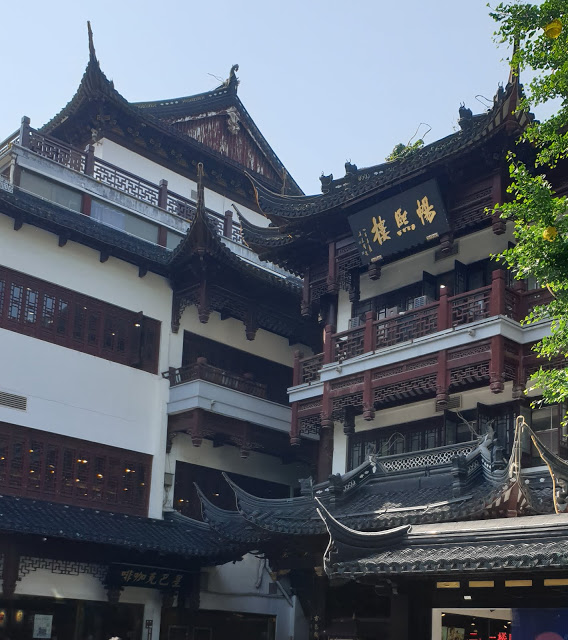
Now it has many restored historical buildings as well as new buildings in a somewhat traditional style that has become one of Shanghai’s main tourist attractions, housing many shops and restaurants.

The “Old Town” is not exclusively old, as you still have a chance to take in the atmosphere if you wander into the quaint side streets.

But, on first viewing walking down the street towards the complex, I’m not sure I’d go as far as to say this is in reality old Shanghai, except for what appears to be a true representation of it architecturally. 

The buildings, which are shops and restaurants, are set out symmetrically, with streets, alleyways, and squares which may prove that it was specially built for the tourists, and no mechanized traffic.

Anyway…

The buildings are magnificent, and a photographer’s delight, and you’d finish up having hundreds of photos by the time you leave.  All the buildings are exquisite representations of traditional Chinese architecture. 

As for buying stuff, remember if you’re not Chinese you have the sucker tourist stamp on your forehead, so be prepared to walk away if the vendors will not bargain.  

Nothing here is worth the price tag and in our group discounts like from 130 RMB to 50 RMB and from 1 for 1,200 to 2 for 950 RMB are common.

Here common t-shirts that we can get for 3 dollars back home start at 150 RMB which is roughly 35 dollars.  It’s that kind of market.

We end up is a tea room, on the third floor of the meeting point below, and discover all the tour guides sitting around a table counting money, and I have to say it’s the most $50 notes I’ve ever seen in one place.  
It is, we were told, where they discussed ‘strategy’.