In a word: Can

Yes, another three letter word with a multitude of meanings, like

I can do this, it’s what we tell ourselves when faced with an impossible mission

You might want to carry a can, perhaps of drink, once made out of steel but now from aluminium.  It can also hold food, like baked beans

You might have a jerry can, which holds petrol, mighty handy if you are driving and run out.  It’s happened to me once

There’s the can-can, but that’s a dance

Can you do this, can I have a drink, you can park over there, it seems we can seek or be given permission

It is an informal name for either prison or a toilet, though it depends on where you are

And in the United States, a ‘tin can’ can also be used to describe a navy vessel

If you get canned from your job, it really means you got fired

In the can means the film has been completed

Of course, there is always a trash can which makes both a mess and a loud noise when they tip over, particularly at night

And, which also make a good set of wickets, painted on, when playing backyard cricket with your friends


“What Sets Us Apart”, a mystery with a twist

David is a man troubled by a past he is trying to forget.

Susan is rebelling against a life of privilege and an exasperated mother who holds a secret that will determine her daughter’s destiny.

They are two people brought together by chance. Or was it?

When Susan discovers her mother’s secret, she goes in search of the truth that has been hidden from her since the day she was born.

When David realizes her absence is more than the usual cooling off after another heated argument, he finds himself being slowly drawn back into his former world of deceit and lies.

Then, back with his former employers, David quickly discovers nothing is what it seems as he embarks on a dangerous mission to find Susan before he loses her forever.

Find the kindle version on Amazon here:  http://amzn.to/2Eryfth

whatsetscover

Writing about writing a book – Day 23

I’ve been thinking a lot about Bill’s service, and the characters he meets along the way, some of whom shape the man he became, others he remained friends with after he was discharged, and those that were killed.

Several have a direct bearing in the main story, for instance, Brainless, a rather ubiquitous nickname, given to him because of his actions, that is to say, he acts without thinking, sometimes when in great peril, a man who never quite recovered, but is, for all intents and purposes Bill’s friend and someone he feels responsible to look after, perhaps because of how many times he saved Bill from death, or worse.

There is also Manilow, but we’ll save him for later.

So, this is where ‘Brainless’ get’s his introduction:

It was the first time I’d been hit by a bullet, and it hurt.  It was a steep learning curve, realizing you have been hit, and then the brain going into overdrive to tell you first it going to hurt like hell, and then begin to assess the damage, running every scenario from ‘it’s a flesh wound’ to ‘Oh God, I’m going to die’.

At least, that was what had happened to me for my first time.

Seconds, or minutes, or hours later, a man who doubled as a Medic came scrabbling over to me and looked at the wound.  A silly thought, how did he know I’d been shot?  Had I screamed?  He made a quick assessment, told me I’d live, and dressed it as good and as quickly as he could.

There were other casualties.

I lasted until I was brought into a clearing some miles further on, after the enemy had been killed, or had retreated, and loaded onto a helicopter.  There I was told everything would be OK and then the lights went out.

My first visit to a mobile army hospital, after being hit, was a novelty.  It was nothing like a real hospital.  Nor was the staff.  It took a different sort of medical personnel to man a front-line hospital where you were just as likely to become a casualty yourself.

The doctor was quite jovial about the whole matter saying I would be back out again in no time, not exactly a prospect I was looking forward to.  It was almost a mend job without anesthetic and the memory of it remained with me for some time.  Facilities were not primitive, but they just appeared that way.

I was one of the less needy casualties that day.  After being stitched up, a nurse took me to a bed in a ward with a mixture of serious and not so seriously wounded.

The nurse, whose name was Wendy, had the same sense of humor I had.  She insisted we be on first name terms from the start.  How she kept her humor was a mystery, for most noticeable was her tired look as if she had been doing the same thing for too long.

The bed was comfortable, the temperature bearable, and the food edible.  Being, and remaining, injured had its good points.

I slept well the first night.  I presumed the injection she’d given me was to ensure I had a restful sleep.  It was long overdue and much needed.

The next morning the numbers had thinned.  Two men had died, several others returned to duty.  To my left was a sad and distant private, who, from time to time, would start moaning.  He’d been in the middle of a mortar attack and was both deaf and had serious psychological problems.

To my right, there was a large man who barely fit in the bed.  He was a perpetually unhappy person, with only minor injuries, a bullet wound to his upper leg.  Nothing serious, he said, and just wanted to leave as soon as possible.  Brainless, the nurse called him.  Always wanted to get back to the war and kill some more of the enemy.  An obsession, she said.

He was staring morosely at the ceiling when I woke.  It took a few minutes to regain full consciousness, a sign I’d been in a drugged sleep.

“What are you in for?” he asked.

“Leg wound.  Nothing serious.”  You?”

“Leg.  Bastards snuck up on me.  And the useless rearguard didn’t do his job properly.”

“Landmine?”

“Sniper.”

I’d seen both.  Tread in the wrong place, and you didn’t do it again.  Sniper’s fire came from almost anywhere, taking out soldiers and civilians indiscriminately.  You could never hear the bullet, just feel it.

“Mongrel,” I said with feeling.

“Yours?”

“Probably the same.  I didn’t see it coming.  I hate it when you can’t see the bastards.  There ought to be some law they send you a message first.  Give you a chance….”

“Chap other side killed himself.  Had enough.  It was written all over his face.  What kind of sooks are we bringing over here?”

“National service,” I said quietly.

“You?” he asked.

I could feel his contempt for ‘Nashos’ and to be glad I was not one.  “I believe I volunteered.”

He didn’t ask what I meant, and even if he had, I probably would have made up a lie.  I hardly thought if I said my father in law hated me that much he would send me here, would make any sense, particularly to this man beside me.

He snorted.  “More the fool you, then.”

We were both released on the same day.  His unit had suffered major casualties, and the story he gave me in the hospital was not quite true.  He’d gone down trying to save what men he could in an ambush.  Heroics came to mind, but his selfless actions were much more than that.  Without a unit, he joined ours.

Wendy remained in my mind for some time after that visit.  When I returned the next time, my injuries being more serious, I enquired as to her whereabouts, only to discover she was dead too, a victim of her own hand, simply because she could not cope with the death, mutilation, and waste.

There was no doubt it affected all of us in different ways.  Some didn’t like the idea of going back out into the jungle and found their own peace.  Others, like Wendy, needed something more, but all too often, no-one recognized what the solution was until it was too late.

Now that I have paved the way, I must get back to the main story and write the part where Brainless enters the picture.

© Charles Heath 2016-2020

Memories of the conversations with my cat – 9

As some may be aware, but many not, Chester, my faithful writing assistant, mice catcher, and general pain in the neck, passed away some months ago.

Recently I was running a series based on his adventures, under the title of Past Conversations with my cat.

For those who have not had the chance to read about all of his exploits I will run the series again from Episode 1

These are the memories of our time together…

20160921_071506

This is Chester.   He’s undercover.

I’ve asked him to investigate the mouse problem, and this is how he responds.

Hiding in the ‘grass’.

Waiting, watching, ever wary.

Those mice will not see him coming.

I try to tell him that hiding on the chair, whilst the mice are on the floor doesn’t make much sense.

We’ll just have to wait and see.

The cinema of my dreams – I never wanted to go to Africa – Episode 5

It a ‘Houston, we have a problem’ moment

Our hero has survived the crash, now he’s stuck in enemy territory.

…

This was supposed to be a milk run.  There had been no reported activity in our zone and the pilot had decided to go up just the log some more air time.

He was hoping after reaching a 1,000 hours so he might be able to move to fixed wing aircraft and then move on to becoming an airline pilot.  Unfortunately, he was not going become anything now.

That didn’t explain why we encountered a convoy out in the desert, especially one with a rocket launcher and English speaking soldier types.

Did we stumble across another outfit running a secret operation and mistook us for the enemy?  It didn’t seem the case, our helicopter was distinctively marked just so we wouldn’t be mistaken, and then there was the fact the man knew my name.

How could that happen?  It would need someone back at the base to tell someone of the fact the helicopter was going up and who was in it, and there weren’t too many people who knew that information.

And only one who knew exactly when and where we would be.  Unless, of course, the pilot had strayed into a no-fly zone.  There was only one that I knew of and it was nowhere near our flight path.  Of course, it wouldn’t take much to bamboozle me in the air because I had no sense of direction.

Unless the pilot had another agenda.  I could hardly tell where we were because desert all looked the same to me, and navigation wasn’t my strongest point.

After the first few miles of very bumpy road, I managed to get into a sitting position and look in the direction we were heading.

More desert.

Ten minutes later I could see an encampment in the distance, literally an oasis in the middle of nowhere.  A secret base camp or something else?

As we got closer I could see it was mostly covered by camouflage so it couldn’t be seen from above. Clever.  Chances were we had no idea this place was in the desert.

Who or what is waiting for him?

…

© Charles Heath 2019-2021

“The Document” – editor’s second draft – Day 13

This book has finally come back from the Editor, so this month it is going to get a second revision, a second draft for the editor, and beta readers.

And so it begins…

…

It’s that unlucky number

…
Hopefully, it won’t hex my writing.

It’s day 13 and I’m over halfway in that devil on the shoulder word count, 27, 275 words to be exact.

That is if Microsoft Word is not playing ‘Friday the Thirteenth’ tricks on me. Good thing it’s not Friday.

Part 2 is proceeding as expected with no surprises, and the characters are behaving themselves, well, in the writing sense.

I’ve found that I now need to write another chapter, before the end of the first part, to help explain, later on, some of the plot nuances. This sort of issue often arises for me when getting to a particular point in a later section, I realize the reader needs a pointer or a nuance earlier on so that the revelation makes sense, not come out of left field.

Sorry, I have to get back to work, I don’t know where the time goes.

Searching for locations: – Lake Louise, Canada, ice, snow, and cold

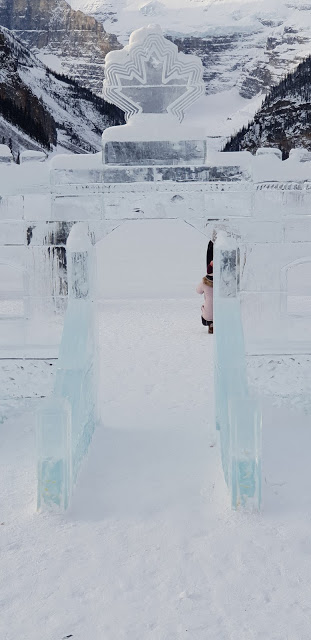
The Fairmont at Lake Louise, in Canada, is noted for its ice castle in winter.  This has been created by the ice sculptor, Lee Ross since 2007, using about 150 blocks of ice, each weighing roughly 300 pounds.

When I first saw it, from a distance, looked like it was made out of plastic  It’s not.  Venturing out into the very, very cold, a close inspection showed it was made of ice.


And, it’s not likely to melt in a hurry given the temperature when I went down to look at it was hovering around minus 10 degrees Fahrenheit.


And that was the warmest part of the day.

Sometimes it’s better to say that an expressed opinion is your own

It’s always a good thing to get that across especially if you work for an organization that could misinterpret what that opinion is, or generally have an opposing opinion.  Of course, by saying your opinions are your own, you’re covering yourself from becoming unemployed, but is this a futile act?

Perhaps its better to not say anything because everything you say and do eventually find its way to those you want most not to hear about it, perhaps one of the big negatives of the internet and social media.

And…

It seems odd to me that you can’t have an opinion of your own, even if it is contrary to that of the organization you work for, and especially if their opinion has changed over time.  An opposing opinion, not delivered in a derogatory manner, would have the expectation of sparking healthy debate, but it doesn’t always end up like that.

I’m sure there are others out there that will disagree, and use the overused word, loyalty’.   Perhaps their mantra will be ‘keep your opinions to yourself’.

This, too, often crops up in personal relationships, and adds weight to the statement, ‘you can pick your friends but not your relatives’.

I’m told I have an opinion on everything, a statement delivered in a manner that suggests sarcasm.  Whether it’s true or not, isn’t the essence of free speech, working within the parameters of not inciting hate, bigotry, racism, or sexism, a fundamental right of anyone in a democracy?

Seems not.

There’s always someone out there, higher up the food chain, with an opinion of their own, obviously the right one, and who will not hesitate to silence yours.  But, isn’t it strange that in order to silence you, they have to use leverage, like your job, to get theirs across.

Well, my opinions are in my writing, and whether or not you agree with them or not, I’m sure you will let me know.  In a robust but respectful manner.

Unlike some, my door is always open.

“The Devil You Don’t”, she was the girl you would not take home to your mother!

Now only $0.99 at https://amzn.to/2Xyh1ow

…

John Pennington’s life is in the doldrums. Looking for new opportunities, and prevaricating about getting married, the only joy on the horizon was an upcoming visit to his grandmother in Sorrento, Italy.

Suddenly he is left at the check-in counter with a message on his phone telling him the marriage is off, and the relationship is over.

If only he hadn’t promised a friend he would do a favour for him in Rome.

At the first stop, Geneva, he has a chance encounter with Zoe, an intriguing woman who captures his imagination from the moment she boards the Savoire, and his life ventures into uncharted territory in more ways than one.

That ‘favour’ for his friend suddenly becomes a life-changing event, and when Zoe, the woman who he knows is too good to be true, reappears, danger and death follow.

Shot at, lied to, seduced, and drawn into a world where nothing is what it seems, John is dragged into an adrenaline-charged undertaking, where he may have been wiser to stay with the ‘devil you know’ rather than opt for the ‘devil you don’t’.

newdevilcvr6

Searching for locations: Driving in ice and snow, Canada

This morning started with a visit to the car rental place in Vancouver.  It reinforced the notion that you can be given the address and still not find the place.  It happened in Washington where it was hiding in the back of the main railway station, and it happened again in Vancouver when it was hidden inside a hotel.

We simply walked straight past it.  Pity there wasn’t a sign to let people know.

However…

We went in expecting a Grand Jeep Cherokee and walked out with a Ford Flex, suitable for three people and four large suitcases.  It actually seats 7, but forget the baggage, you’d be lucky to get two large suitcases in that configuration.

It is more than adequate for our requirements.

Things to note, it was delivered with just over a quarter of a tank of gas, and it had only done about 11,000 km, so it’s relatively new.  It’s reasonably spacious, and when the extra seats are folded down, there is plenty of baggage space.

So far, so good.

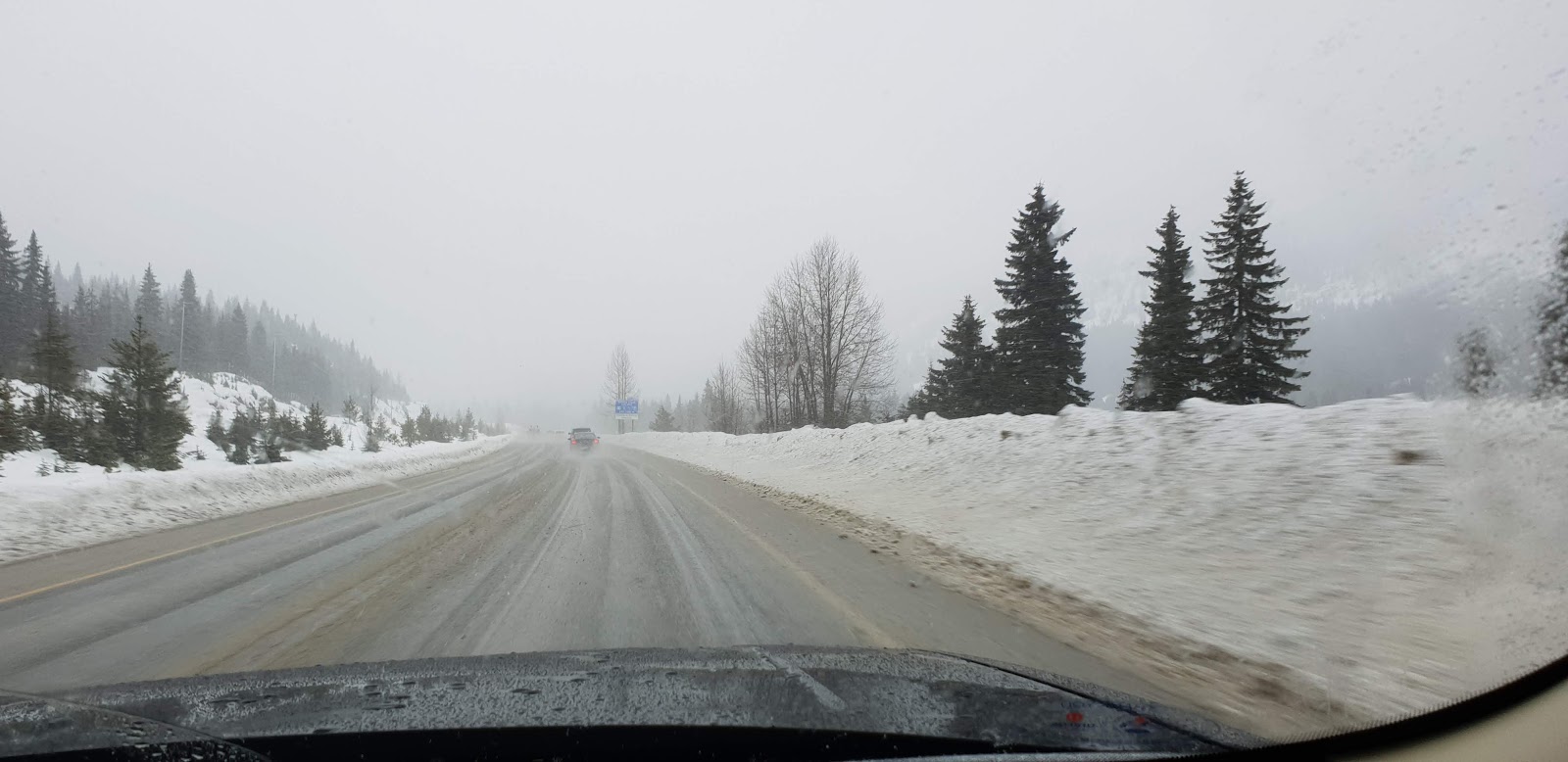
We finally leave the hotel at about half-past ten, and it is raining.  It is a simple task to get on Highway 1, the TransCanada Highway, initially, and then onto Highway 5, the Coquihalla Highway for the trip to Kamloops.

It rains all the way to the top of the mountain, progress hampered from time to time by water sprays from both vehicles and trucks.  The rain is relentless.  At the top of the mountain, the rain turns into snow and the road surface to slush.  It’s 0 degrees, but being the afternoon, I was not expecting it to turn to ice very quickly.

On the other side of the mountain, closer to Kamloops, there was sleet, then rain, then nothing, the last 100kms or so, in reasonably dry conditions.

Outside Kamloops, and in the town itself, there was evidence of snow recently cleared, and slushy roads.  Cars in various places were covered in snow, indicating the most recent falls had been the night before.

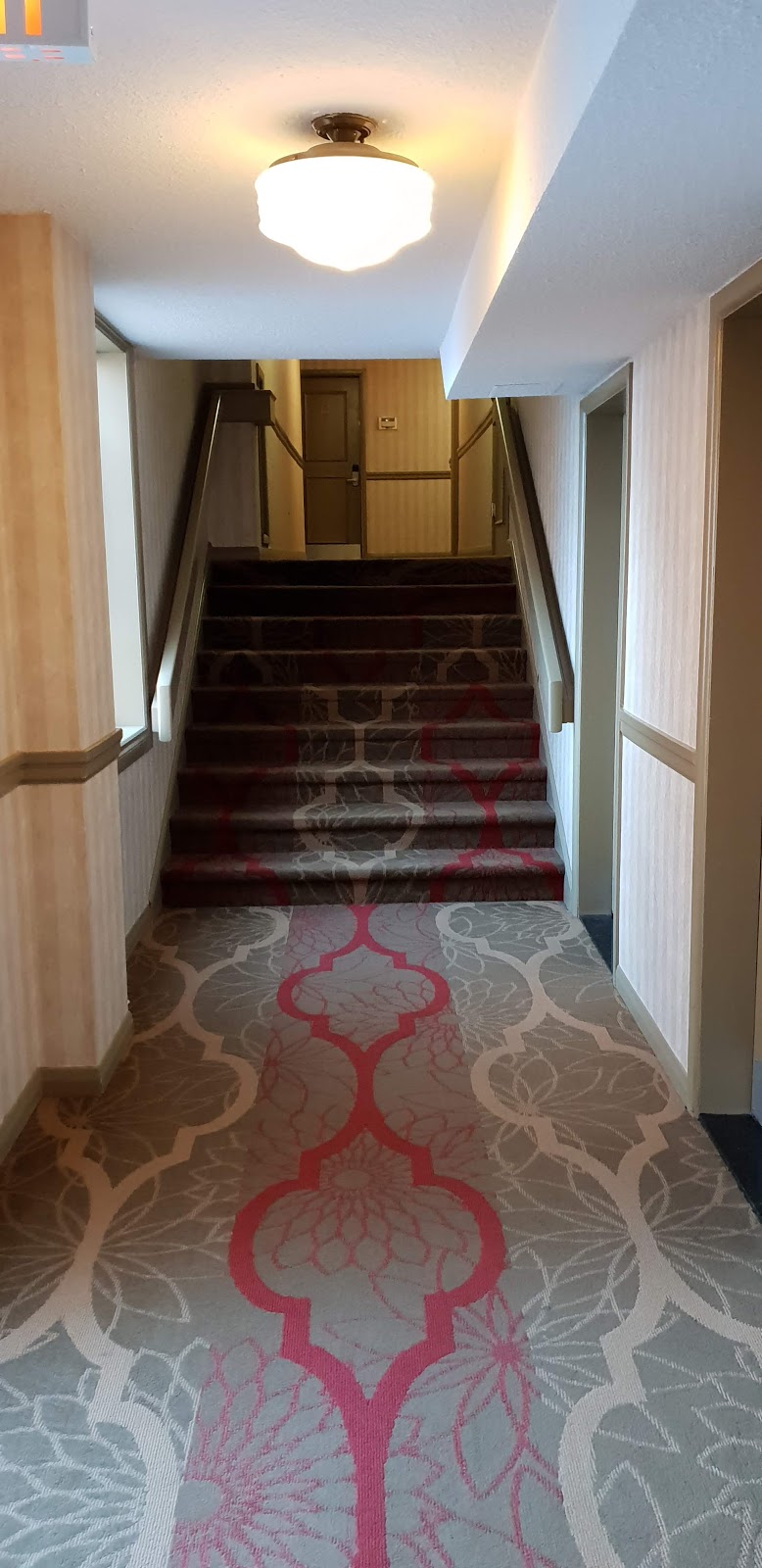
We’re staying at the Park Hotel, a heritage building, apparently built in the later 1920s.  In the style of the time, it is a little like a rabbit warren with passages turning off in a number of directions, and showing it is spread across a number of different buildings.

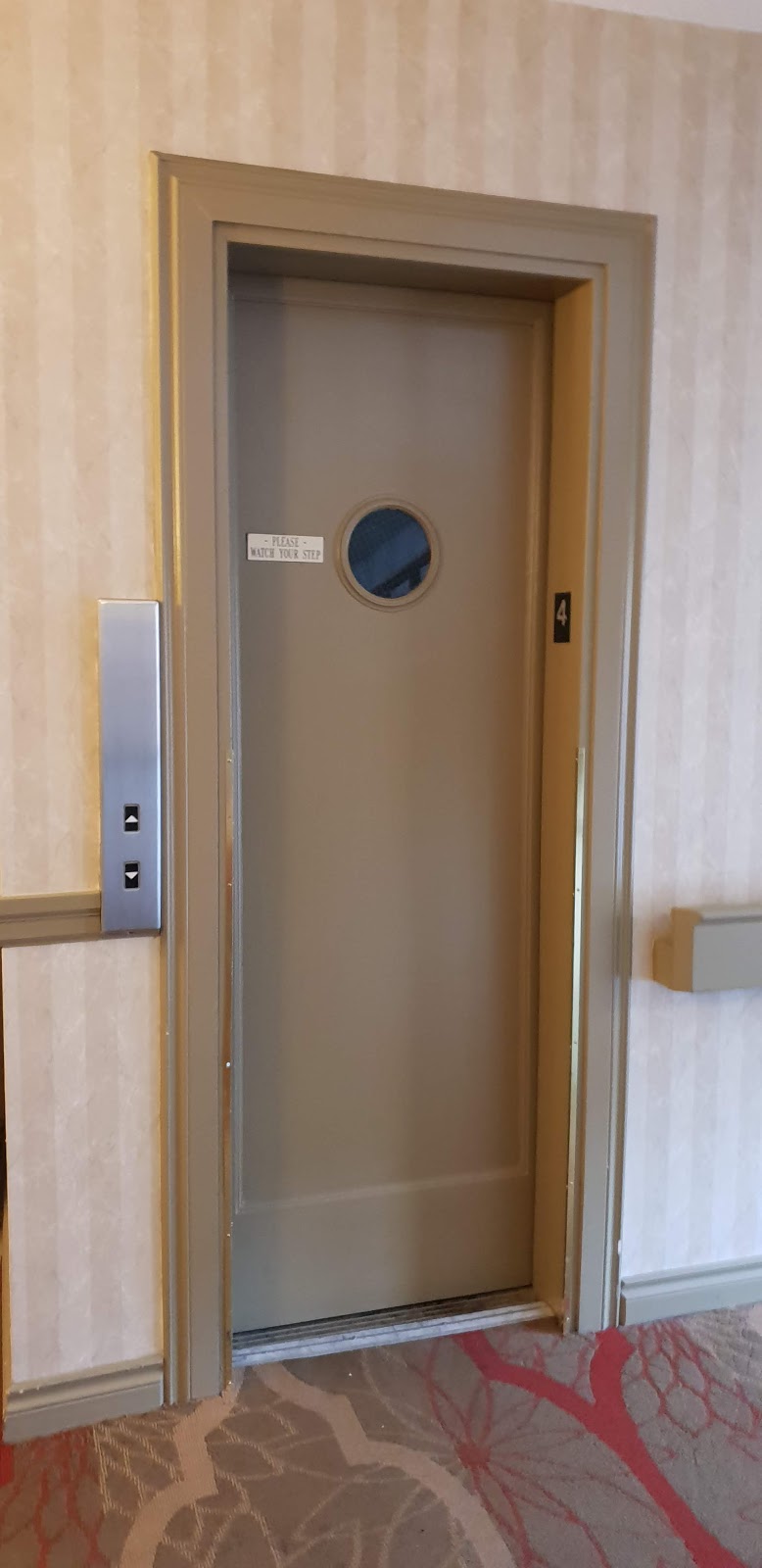
It has the original Otis elevator that can take a maximum of four passengers, and a sign on the wall that says “no horseplay inside the elevator” which is a rather interesting expression that only someone of my vintage would understand.  And, for those without a sense of humor, you definitely couldn’t fit a horse in it to play with.

The thing is, how do you find a balance between keeping the old world charm with modern-day expectations.  You can’t.  Some hotels try valiantly to get that balance.  Here, it is simply old world charm, which I guess we should be grateful for because sooner rather than later it’s going to disappear forever.

In my writer’s mind, given the importance of the railways, this was probably a thriving place for travelers, and once upon a time, there were a lot more hotels like this one.