In a word: Incline

When you first think of this word, it is with a slippery slope in mind.

I’ve been on a few of those in my time.

And while we’re on the subject, those inclines measured in degrees are very important if you want a train to get up and down the side of a mountain.

For the train, that’s an incline plane, the point where traction alone won’t get the iron horse up the hill.

Did I say ‘Iron Horse’?  Sorry, regressed there, back to the mid-1800s in the American West for a moment.

It’s not that important when it comes to trucks and cars, and less so if you like four-wheel driving; getting up near-vertical mountainsides often present a welcome challenge to the true enthusiast

But for the rest of us, not so much if you find yourself sliding in reverse uncontrollably into the bay.  I’m sure it’s happened more than once.

Then…

Are you inclined to go?

A very different sort of incline, ie to be disposed towards an attitude or desire.

An inclination, maybe, not to go four-wheel driving?

There is another, probably more obscure use of the word incline, and that relates to an elevated geological formation.  Not the sort of reference that crops up in everyday conversation at the coffee shop.

But, you never know.  Try it next time you have coffee and see what happens.

Writing about writing a book – Day 31

I’ve been toiling away in the attic putting the pieces together, and continuing to get the story written.

This means I’ve almost got Chapter 2 somewhere near the first draft, or maybe second. I didn’t expect it would take this long, but most authors, I suppose, take a year, or more, to write a book.

It’s been hot in the attic and making it hard to think let alone write, but it is a good background for the steamy jungles of Southeast Asia, and it has given me a few more ideas for the background sequences.

I’ll share one or two of those next.

In the meantime, so far so good.

The following is the first musings of what Chapter 2 might read like:

…

The first sign of anything amiss was the three police cars outside the building, parked awkwardly on the plaza in front of the building. Their lights were still flashing, and several policemen were standing near them, talking.

As I went through the front revolving door I could see several uniformed and plainclothes police in the lobby. Two were by the door, perhaps to prevent someone from leaving, one on the desk with two of the building security guards, and another near the elevator lobby.

Temporary barriers had been erected, funnelling everyone through a narrow gap, where building security was checking ID cards and building passes, both of which I handed to one of the guards. These men were new, I hadn’t seen them before, and, when I took a closer look, saw they were from a different security company.

I guess with the shooting of Richardson, our management had decided the existing building security was not good enough. These new men looked a lot tougher if the number of visible tattoos on each was anything to go by, the sort of men I’d call mercenaries or ex-soldiers.

One of them gave me a good look, at my face to see if it was the same as that looking back at him on the ID card. It was not a good photo of me, and it was no surprise he was having difficulty. I’d cut my hair, I was wearing glasses, and I have the makings of a three-day beard.

I had not intended to shave while I was on holiday, and, given the urgent nature of the recall, had no time to do so before coming into the office. Benton could have warned me of the new security arrangements, but it did not surprise me he didn’t.

He called over a friend, not by turning and motioning to him, but by talking into his collar communication device. It was rather pointless, the man he spoke to was no more than 20 feet away. He checked me versus the ID photo and let me pass. Perhaps his eyesight was better.

In the elevator heading up to my floor, 18, I had a few moments to consider the implications. New security meant trouble. It had happened once before, and it caused all manner of trouble for me and my staff. We had been locked out of the server room then.

The elevator jerked to a stop, and the doors opened. Everything looked quiet. I could not see any police or security personnel. But waiting for me in the lobby was Benton’s personal assistant, waiting to tell me that Benton had been dragged off to an emergency meeting, one, she said, that involved share prices or stock exchange announcements. I could not make sense of what she was saying, because his hysteria had become hers. The events of the morning so far had traumatized both of them.

I smiled, trying to be my usual charming self, and then wrote a message on a scrap of paper, and gave it to her to give to him when he returned from wherever he had gone. I was quite sure it was not a meeting. She reminded me Aitchison was still waiting to see me, and then walked off.

I turned and pressed the ‘up’ button, and the doors to the elevator car I’d stepped out of opened.  I stepped in, pressed the button for 59, and the doors closed.  Once again I was alone with my thoughts in an elevator.  I had just enough time to realize that the investigation into Richardson must be more serious than I first thought if the police were still here in numbers.

I thought I might visit the 17th floor after seeing Aitchison, and see what was happening. A decision was still pending when the doors opened, and I stepped out into ‘Fantasyland’.

It was the unofficial nickname we mortals from the lower floors called the Executive levels. They were the top three in the 60-story building. The mortals lived on levels 17 through 22.

This level housed all the Assistant General Managers. We had six. Aitchison was the AGM – Security. Goldstein, who was waiting in the lobby for an elevator, was the AGM – Administration. He was a surly chap near the age of retirement and spent more time on holiday than in the office. Preparing for retirement some said. Others were less charitable.

He nodded in my direction as we passed, I came out of the elevator car, and he went in. The doors closed behind me and I let the silence envelop me.

…

© Charles Heath 2016-2021

Skeletons in the closet, and doppelgangers

A story called “Mistaken Identity”

…

How many of us have skeletons in the closet that we know nothing about? The skeletons we know about generally stay there, but those we do not, well, they have a habit of coming out of left field when we least expect it.

In this case, when you see your photo on a TV screen with the accompanying text that says you are wanted by every law enforcement agency in Europe, you’re in a state of shock, only to be compounded by those same police, armed and menacing, kicking the door down.

I’d been thinking about this premise for a while after I discovered my mother had a boyfriend before she married my father, a boyfriend who was, by all accounts, the man who was the love of her life.

Then, in terms of coming up with an idea for a story, what if she had a child by him that we didn’t know about, which might mean I had a half brother or sister I knew nothing about. It’s not an uncommon occurrence from what I’ve been researching.

There are many ways of putting a spin on this story.

Then, in the back of my mind, I remembered a story an acquaintance at work was once telling us over morning tea, that a friend of a friend had a mother who had a twin sister and that each of the sisters had a son by the same father, without each knowing of the father’s actions, both growing up without the other having any knowledge of their half brother, only to meet by accident on the other side of the world.

It was an encounter that in the scheme of things might never have happened, and each would have remained oblivious of the other.

For one sister, the relationship was over before she discovered she was pregnant, and therefore had not told the man he was a father. It was no surprise the relationship foundered when she discovered he was also having a relationship with her sister, a discovery that caused her to cut all ties with both of them and never speak to either from that day.

It’s a story with more twists and turns than a country lane!

And a great idea for a story.

That story is called ‘Mistaken Identity’.

Memories of the conversations with my cat – 16

As some may be aware, but many not, Chester, my faithful writing assistant, mice catcher, and general pain in the neck, passed away about 2 years ago, and I still miss him.

This is my way of remembering him.

For those who have not had the chance to read about all of his exploits, I will run the series again from Episode 1

…

Character development

20161008_135142

This is Chester, he thinks he is an expert on people

He has meandered in checking out what I’m doing, or maybe he’s here because the room is cooler.

He gives me the ‘What are you doing’ look.

It doesn’t matter how many times I’m a writer, it’s like talking to a brick wall.

I say I’m working on developing a new character.

Name?

I’m thinking of John.

A shake of the head and the eyes roll.  Can you be a little more inventive, like, well, Chester?

Predictable.  How about Xavier?

Would you call your kid Xavier?  He’s going to have a very rough time of it at school.  Unless this character has a tortured soul.

Good point.  How about William?

Bill, that’s what you get in the mail.  Another shake of the head.  You’re not very good at this, are you?

Apparently not.  Haven’t you got some mice to catch?

He yawns, then curls up on the seat.  Wake me when you’ve got some better ideas.

Maybe not.  I’ve come up with a name, Daniel, and I don’t care what he thinks.

For now.

The cinema of my dreams – I never wanted to go to Africa – Episode 12

It’s still a battle of wits, but our hero knows he’s in serious trouble.

The problem is, there are familiar faces and a question of who is a friend and who is foe made all the more difficult because the enemy if it is the enemy, doesn’t look or sound or act like the enemy.

If at first, you don’t succeed, try a few threats, or leverage


He took a deep breath, gave me a look a parent would give a miscreant child, and started again.

“What’s the deal with you and Commander Breeman?”

Yes, he does know about her proclivities, but he was hardly in a position to condemn her.  He, too, had a ‘thing’ for the female trainees under his command, and one in particular.

“She has to eat, I have to eat, in the same mess as it happens.”

He gave me another of his penetrating glares.

“Nothing else?”

“That would be against regulations, as I think you are fully aware.”  I returned his glare but with more intensity.

“What did you discuss over the dinner table?”

Odd question.  Not operational matters, if that was what he wanted to hear.  But what we spoke about had little relevance to work.

“Cars.”

It was true.  She liked restoring old cars from the mid-war period, some of which had been used as props in period movies.  I had an old Cadillac, the sort that would fail any fuel economy test.

I could see it was not the answer he was looking for.  He would have to ask a specific question in order to get a specific answer one way or the other.

“Did she mention the no-fly zone?”

I thought about it for a moment, and then said, “No, there are no cars out there to speak of.”

“Flippancy doesn’t become you, Alan.”

Perhaps not, but it was all he was going to get.

And for added emphasis, I said, “Like I said to your predecessor, I don’t know how or why you would have to ask the pilot.”

He stood abruptly, nearly knocking the chair over.  Angry.

“You know something, Alan, otherwise you would not have been on that helo.  She threw you under the bus, and the quicker you realize that the better.”

Then he walked out, slamming the door behind him.


© Charles Heath 2019

“The Document” – the editor’s second draft – Day 20

This book has finally come back from the Editor, so this month it is going to get a second revision, a second draft for the editor, and beta readers.

And so it begins…

…

Reworking the synopsis

…

Yes, it’s that time, nearly three weeks in, and writing a story sequentially from start to finish has some perils involved with it.

Like the plotting, and like any good actor given a bit part in a movie, the objective is to make it their own.

I think it’s called, grabbing hold of your fifteen minutes of fame and using it.

Characters do this us, they force themselves out of their restrictive cacoon.  One of mine has taken her bit part and is now the frontrunner for the villain.

How do you make such personable people drip with evil?

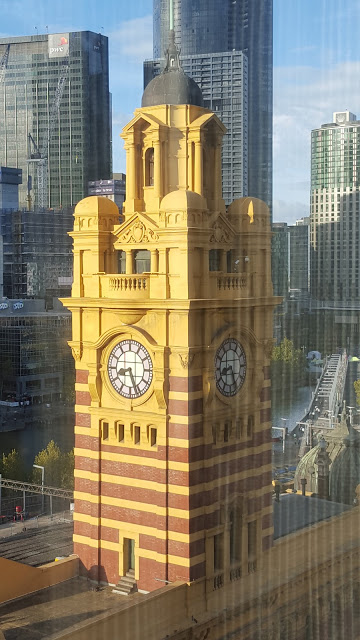
Searching for locations: Flinders Street Station, Melbourne, Australia

This is the famous clock tower of the Flinders Street Station (the main train station for suburban trains) in Melbourne.

We were staying in a hotel (The Doubletree) directly opposite to the station and our room overlooked the station and the clock tower.  I took photos of it during the day:

and this one, at night.  It came out better than I thought it would.

20160302_215639

I’m trying to write a period piece

Televison is a great recorder of the past, and most channels, and especially cable tv have great libraries of films that go back more than a hundred years.

And, whilst it’s possible that modern day films and television series can try to recapture the past, the English as an exception being very good at it, often it is impossible to capture it correctly.

But, if you have a film shot in the moment, then you have a visual record of what life, and what was once part of our world before you in all it’s dated glory. The pity of it is that, then, we never appreciated it.

After all, in those particular times, who had the time to figuratively stop and smell the roses. Back then as life was going on, we were all tied up with just trying to get through each day.

Years later, often on reflection, we try to remember the old days, and, maybe, remember some of what it was like, but the chances are that change came far too rapidly, and often too radical, that it erases what we thought we knew existed before.

My grandmothers house is a case in point. In it’s place is a multi lane super highway, and there’s nothing left to remind us, or anyone of it, just some old sepia photographs.

I was reminded of how volatile history really is when watching an old documentary, in black and white, and how the city I grew up in used to look.

Then, even though it seemed large to me then, it was a smaller city, with suburbs that stretched about ten or so miles in every direction, and the outer suburbs were where people moved to get a larger block, and countrified atmosphere.

Now, those outer suburbs are no longer spacious properties, the acreage subdivided and the old owners now much richer for a decision made with profit not being the motivator, and the current suburban sprawl is now out to forty or fifty miles.

The reason for the distance is no longer the thought of open spaces and cleaner air, the reason for moving now is that land further out is cheaper, and can make buying that first house more affordable.

This is where I tip my hat to the writers of historical fiction. I myself am writing a story based in the 1970s, and its difficult to find what is and isn’t time specific.

If only I had a dollar for every time I went to write the character pulling out his or her mobile phone.

What I’ve found is the necessity to research, and this has amounted to finding old films, documentaries of the day, and a more fascinating source of information, the newspapers of the day.

The latter especially has provoked a lot of memories and a lot of stuff I thought I’d forgotten, some of it by choice, but others that were poignant.

Yes, and don’t get me started on the distractions.

If only I’d started this project earlier…

An excerpt from “If Only” – a work in progress

Investigation of crimes doesn’t always go according to plan, nor does the perpetrator get either found or punished.

That was particularly true in my case.  The murderer was incredibly careful in not leaving any evidence behind, to the extent that the police could not rule out whether it was a male or a female.

At one stage the police thought I had murdered my own wife though how I could be on a train at the time of the murder was beyond me.  I had witnesses and a cast-iron alibi.

The officer in charge was Detective First Grade Gabrielle Walters.  She came to me on the day after the murder seeking answers to the usual questions like, when was the last time you saw your wife, did you argue, the neighbors reckon there were heated discussions the day before.

Routine was the word she used.

Her fellow detective was a surly piece of work whose intention was to get answers or, more likely, a confession by any or all means possible.  I could sense the raging violence within him.  Fortunately, common sense prevailed.

Over the course of the next few weeks, once I’d been cleared of committing the crime, Gabrielle made a point of keeping me informed of the progress.

After three months the updates were more sporadic, and when, for lack of progress, it became a cold case, communication ceased.

But it was not the last I saw of Gabrielle.

The shock of finding Vanessa was more devastating than the fact she was now gone, and those images lived on in the same nightmare that came to visit me every night when I closed my eyes.

For months I was barely functioning, to the extent I had all but lost my job, and quite a few friends, particularly those who were more attached to Vanessa rather than me.

They didn’t understand how it could affect me so much, and since it had not happened to them, my tart replies of ‘you wouldn’t understand’ were met with equally short retorts.  Some questioned my sanity, even, for a time, so did I.

No one, it seemed, could understand what it was like, no one except Gabrielle.

She was by her own admission, damaged goods, having been the victim of a similar incident, a boyfriend who turned out to be an awfully bad boy.  Her story varied only in she had been made to witness his execution.  Her nightmare, in reliving that moment in time, was how she was still alive and, to this day, had no idea why she’d been spared.

It was a story she told me one night, some months after the investigation had been scaled down.  I was still looking for the bottom of a bottle and an emotional mess.  Perhaps it struck a resonance with her; she’d been there and managed to come out the other side.

What happened become our secret, a once-only night together that meant a great deal to me, and by mutual agreement, it was not spoken of again.  It was as if she knew exactly what was required to set me on the path to recovery.

And it had.

Since then, we saw each about once a month in a cafe.   I had been surprised to hear from her again shortly after that eventful night when she called to set it up, ostensibly for her to provide me with any updates on the case, but perhaps we had, after that unspoken night, formed a closer bond than either of us wanted to admit.

We generally talked for hours over wine, then dinner and coffee.  It took a while for me to realize that all she had was her work, personal relationships were nigh on impossible in a job that left little or no spare time for anything else.

She’d always said that if I had any questions or problems about the case, or if there was anything that might come to me that might be relevant, even after all this time, all I had to do was call her.

I wondered if this text message was in that category.  I was certain it would interest the police and I had no doubt they could trace the message’s origin, but there was that tiny degree of doubt, about whether or not I could trust her to tell me what the message meant.

I reached for the phone then put it back down again.  I’d think about it and decide tomorrow.

© Charles Heath 2018-2020

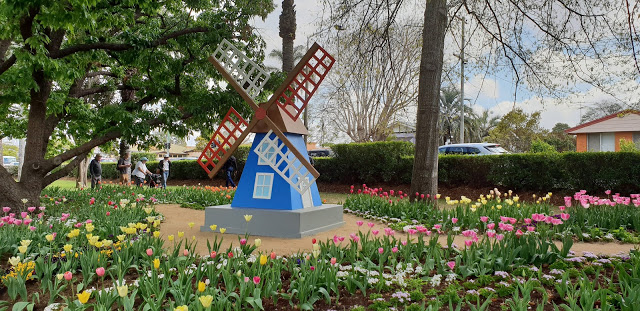
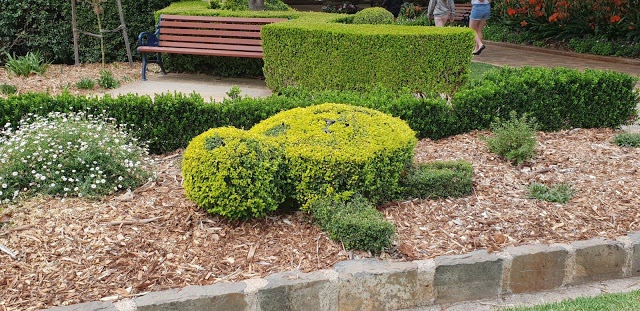
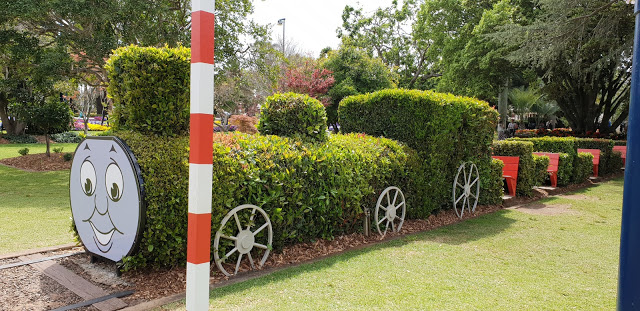
Searching for locations: Toowoomba Flower Festival, Toowoomba, Queensland, Australia

The Toowoomba Carnival of Flowers is held in September, and generally runs for ten days at the end of the month.

We visited the Laurel Bank Park, where there are beds of many colorful flowers,

open spaces,

statues,

an area set aside for not only tulips but a model windmill

and quite a number of hedge sculptures

There was also the opportunity to go on a morning or afternoon garden tour which visited a number of private gardens of residences in Toowoomba.