Inspiration, maybe – Volume 1

50 photographs, 50 stories, of which there is one of the 50 below.

They all start with –

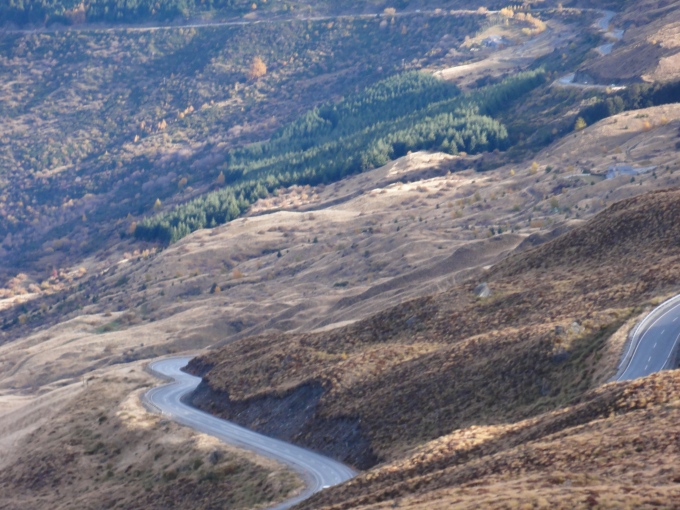
A picture paints … well, as many words as you like.  For instance:

lookingdownfromcoronetpeak

And the story:

It was once said that a desperate man has everything to lose.

The man I was chasing was desperate, but I, on the other hand, was more desperate to catch him.

He’d left a trail of dead people from one end of the island to the other.

The team had put in a lot of effort to locate him, and now his capture was imminent.  We were following the car he was in, from a discrete distance, and, at the appropriate time, we would catch up, pull him over, and make the arrest.

There was nowhere for him to go.

The road led to a dead-end, and the only way off the mountain was back down the road were now on.  Which was why I was somewhat surprised when we discovered where he was.

Where was he going?

“Damn,” I heard Alan mutter.  He was driving, being careful not to get too close, but not far enough away to lose sight of him.

“What?”

“I think he’s made us.”

“How?”

“Dumb bad luck, I’m guessing.  Or he expected we’d follow him up the mountain.  He’s just sped up.”

“How far away?”

“A half-mile.  We should see him higher up when we turn the next corner.”

It took an eternity to get there, and when we did, Alan was right, only he was further on than we thought.”

“Step on it.  Let’s catch him up before he gets to the top.”

Easy to say, not so easy to do.  The road was treacherous, and in places just gravel, and there were no guard rails to stop a three thousand footfall down the mountainside.

Good thing then I had the foresight to have three agents on the hill for just such a scenario.

Ten minutes later, we were in sight of the car, still moving quickly, but we were going slightly faster.  We’d catch up just short of the summit car park.

Or so we thought.

Coming quickly around another corner we almost slammed into the car we’d been chasing.

“What the hell…” Aland muttered.

I was out of the car, and over to see if he was in it, but I knew that it was only a slender possibility.  The car was empty, and no indication where he went.

Certainly not up the road.  It was relatively straightforward for the next mile, at which we would have reached the summit.  Up the mountainside from here, or down.

I looked up.  Nothing.

Alan yelled out, “He’s not going down, not that I can see, but if he did, there’s hardly a foothold and that’s a long fall.”

Then where did he go?

Then a man looking very much like our quarry came out from behind a rock embedded just a short distance up the hill.

“Sorry,” he said quite calmly.  “Had to go if you know what I mean.”

I’d lost him.

It was as simple as that.

I had been led a merry chase up the hill, and all the time he was getting away in a different direction.

I’d fallen for the oldest trick in the book, letting my desperation blind me to the disguise that anyone else would see through in an instant.

It was a lonely sight, looking down that road, knowing that I had to go all that way down again, only this time, without having to throw caution to the wind.

“Maybe next time,” Alan said.

“We’ll get him.  It’s just a matter of time.”

© Charles Heath 2019-2021

Find this and other stories in “Inspiration, maybe”  available soon.

InspirationMaybe1v1

A score to settle – The Second Editor’s draft – Day 31

The time has come to work on the second draft for the editor, taking into account all of the suggested changes, and there are quite a few. So much for thinking I could put in an almost flawless manuscript.

…

Now the pressure to write each day is over, I can take my time over the last chapters of the story.

I took the day off yesterday and spent a little time staring at the ceiling. Well, that’s my euphemism for mentally going over the story so far in my head.

I know I’m guilty of writing chapters instead of pages, and pages instead of paragraphs, so already I can see some parts of the story could do with a bit of editing, but that’s not my focus yet.

For the last few days I’ve had big band music running around in my head, and it came to me that the ball preceding the conference should have a big band playing all of those songs from the 1940s, and, in particular, Sing, Sing, Sing by Benny Goodman, In the Mood by Glenn Miller, and a few others.

Listening to it has been inspirational.

The ending has changed, and now it focuses on the two main characters. I’ve given up the notion of exacting revenge, and gone for a more happier ending if that is possible after a rebel revolt. We’ll all have to wait and see if it succeeds, who comes out on top, and whether there are any casualties.

Certainly, there will be one person who will reappear like a messiah, a man thought to be dead at the hands of the military. More than one person has said they should have killed him rather than keep him prisoner, and a few more glad that they didn’t kill him.

And like all good authors, I’m trying to write an ending that leads into a sequel, though how I can top a revolution might be just a little difficult.

And although the word count is low for two days of work, a lot of other work has gone into changing the plan, and the ending, as well as a host of notes for changes in the middle, to accommodate the ending. I might just get around to writing a white paper on ‘how to capture airports and media stations for the purpose of taking over a country’ by the end of this project.

An excerpt from “Strangers We’ve Become” – Coming Soon

I wandered back to my villa.

It was in darkness.  I was sure I had left several lights on, especially over the door so I could see to unlock it.

I looked up and saw the globe was broken.

Instant alert.

I went to the first hiding spot for the gun, and it wasn’t there.  I went to the backup and it wasn’t there either.  Someone had found my carefully hidden stash of weapons and removed them.

Who?

There were four hiding spots and all were empty.  Someone had removed the weapons.  That could only mean one possibility.

I had a visitor, not necessarily here for a social call.

But, of course, being the well-trained agent I’d once been and not one to be caught unawares, I crossed over to my neighbor and relieved him of a weapon that, if found, would require a lot of explaining.

Suitably armed, it was time to return the surprise.

There were three entrances to the villa, the front door, the back door, and a rather strange escape hatch.  One of the more interesting attractions of the villa I’d rented was its heritage.  It was built in the late 1700s, by a man who was, by all accounts, a thief.  It had a hidden underground room which had been in the past a vault but was now a wine cellar, and it had an escape hatch by which the man could come and go undetected, particularly if there was a mob outside the door baying for his blood.

It now gave me the means to enter the villa without my visitors being alerted, unless, of course, they were near the vicinity of the doorway inside the villa, but that possibility was unlikely.  It was not where anyone could anticipate or expect a doorway to be.

The secret entrance was at the rear of the villa behind a large copse, two camouflaged wooden doors built into the ground.  I move aside some of the branches that covered them and lifted one side.  After I’d discovered the doors and rusty hinges, I’d oiled and cleaned them, and cleared the passageway of cobwebs and fallen rocks.  It had a mildew smell, but nothing would get rid of that.  I’d left torches at either end so I could see.

I closed the door after me, and went quietly down the steps, enveloped in darkness till I switched on the torch.  I traversed the short passage which turned ninety degrees about halfway to the door at the other end.  I carried the key to this door on the keyring, found it and opened the door.  It too had been oiled and swung open soundlessly.

I stepped in the darkness and closed the door.

I was on the lower level under the kitchen, now the wine cellar, the ‘door’ doubling as a set of shelves which had very little on them, less to fall and alert anyone in the villa.

Silence, an eerie silence.

I took the steps up to the kitchen, stopping when my head was level with the floor, checking to see if anyone was waiting.  There wasn’t.  It seemed to me to be an unlikely spot for an ambush.

I’d already considered the possibility of someone coming after me, especially because it had been Bespalov I’d killed, and I was sure he had friends, all equally as mad as he was.  Equally, I’d also considered it nigh on impossible for anyone to find out it was me who killed him because the only people who knew that were Prendergast, Alisha, a few others in the Department, and Susan.

That raised the question of who told them where I was.

If I was the man I used to be, my first suspect would be Susan.  The departure this morning, and now this was too coincidental.  But I was not that man.

Or was I?

I reached the start of the passageway that led from the kitchen to the front door and peered into the semi-darkness.  My eyes had got used to the dark, and it was no longer an inky void.  Fragments of light leaked in around the door from outside and through the edge of the window curtains where they didn’t fit properly.  A bone of contention upstairs in the morning, when first light shone and invariably woke me up hours before I wanted to.

Still nothing.

I took a moment to consider how I would approach the visitor’s job.  I would get a plan of the villa in my head, all entrances, where a target could be led to or attacked where there would be no escape.

Coming in the front door.  If I was not expecting anything, I’d just open the door and walk-in.  One shot would be all that was required.

Contract complete.

I sidled quietly up the passage staying close to the wall, edging closer to the front door.  There was an alcove where the shooter could be waiting.  It was an ideal spot to wait.

Crunch.

I stepped on some nutshells.

Not my nutshells.

I felt it before I heard it.  The bullet with my name on it.

And how the shooter missed, from point-blank range, and hit me in the arm, I had no idea.  I fired off two shots before a second shot from the shooter went wide and hit the door with a loud thwack.

I saw a red dot wavering as it honed in on me and I fell to the floor, stretching out, looking up where the origin of the light was coming and pulled the trigger three times, evenly spaced, and a second later I heard the sound of a body falling down the stairs and stopping at the bottom, not very far from me.

Two assassins.

I’d not expected that.

The assassin by the door was dead, a lucky shot on my part.  The second was still breathing.

I checked the body for any weapons and found a second gun and two knives.  Armed to the teeth!

I pulled off the balaclava; a man, early thirties, definitely Italian.  I was expecting a Russian.

I slapped his face, waking him up.  Blood was leaking from several slashes on his face when his head had hit the stairs on the way down.  The awkward angle of his arms and legs told me there were broken bones, probably a lot worse internally.  He was not long for this earth.

“Who employed you?”

He looked at me with dead eyes, a pursed mouth, perhaps a smile.  “Not today my friend.  You have made a very bad enemy.”  He coughed and blood poured out of his mouth.  “There will be more …”

Friends of Bespalov, no doubt.

I would have to leave.  Two unexplainable bodies, I’d have a hard time explaining my way out of this mess.  I dragged the two bodies into the lounge, clearing the passageway just in case someone had heard anything.

Just in case anyone was outside at the time, I sat in the dark, at the foot of the stairs, and tried to breathe normally.  I was trying not to connect dots that led back to Susan, but the coincidence was worrying me.

A half-hour passed and I hadn’t moved.  Deep in thought, I’d forgotten about being shot, unaware that blood was running down my arm and dripping onto the floor.

Until I heard a knock on my front door.

Two thoughts, it was either the police, alerted by the neighbors, or it was the second wave, though why would they be knocking on the door?

I stood, and immediately felt a stabbing pain in my arm.  I took out a handkerchief and turned it into a makeshift tourniquet, then wrapped a kitchen towel around the wound.

If it was the police, this was going to be a difficult situation.  Holding the gun behind my back, I opened the door a fraction and looked out.

No police, just Maria.  I hoped she was not part of the next ‘wave’.

“You left your phone behind on the table.  I thought you might be looking for it.”  She held it out in front of her.

When I didn’t open the door any further, she looked at me quizzically, and then asked, “Is anything wrong?”

I was going to thank her for returning the phone, but I heard her breathe in sharply, and add, breathlessly, “You’re bleeding.”

I looked at my arm and realized it was visible through the door, and not only that, the towel was soaked in blood.

“You need to go away now.”

Should I tell her the truth?  It was probably too late, and if she was any sort of law-abiding citizen she would go straight to the police.

She showed no signs of leaving, just an unnerving curiosity.  “What happened?”

I ran through several explanations, but none seemed plausible.  I went with the truth.  “My past caught up with me.”

“You need someone to fix that before you pass out from blood loss.  It doesn’t look good.”

“I can fix it.  You need to leave.  It is not safe to be here with me.”

The pain in my arm was not getting any better, and the blood was starting to run down my arm again as the tourniquet loosened.  She was right, I needed it fixed sooner rather than later.

I opened the door and let her in.  It was a mistake, a huge mistake, and I would have to deal with the consequences.  Once inside, she turned on the light and saw the pool of blood just inside the door and the trail leading to the lounge.  She followed the trail and turned into the lounge, turned on the light, and no doubt saw the two dead men.

I expected her to scream.  She didn’t.

She gave me a good hard look, perhaps trying to see if I was dangerous.  Killing people wasn’t something you looked the other way about.  She would have to go to the police.

“What happened here?”

“I came home from the cafe and two men were waiting for me.  I used to work for the Government, but no longer.  I suspect these men were here to repay a debt.  I was lucky.”

“Not so much, looking at your arm.”

She came closer and inspected it.

“Sit down.”

She found another towel and wrapped it around the wound, retightening the tourniquet to stem the bleeding.

“Do you have medical supplies?”

I nodded.  “Upstairs.”  I had a medical kit, and on the road, I usually made my own running repairs.  Another old habit I hadn’t quite shaken off yet.

She went upstairs, rummaged, and then came back.  I wondered briefly what she would think of the unmade bed though I was not sure why it might interest her.

She helped me remove my shirt, and then cleaned the wound.  Fortunately, she didn’t have to remove a bullet.  It was a clean wound but it would require stitches.

When she’d finished she said, “Your friend said one day this might happen.”

No prizes for guessing who that friend was, and it didn’t please me that she had involved Maria.

“Alisha?”

“She didn’t tell me her name, but I think she cares a lot about you.  She said trouble has a way of finding you, gave me a phone and said to call her if something like this happened.”

“That was wrong of her to do that.”

“Perhaps, perhaps not.  Will you call her?”

“Yes.  I can’t stay here now.  You should go now.  Hopefully, by the time I leave in the morning, no one will ever know what happened here, especially you.”

She smiled.  “As you say, I was never here.”

…

© Charles Heath 2018-2022

strangerscover9

In a word: Scene

This is an easy one.

It’s a part of a book or film which covers a single event, and predominantly with a set group of characters.

It could also mean it might relate to a particular genre that you like, as in,

I’m part of the jazz scene or the symphonic scene, though I think it had a more sinister context back in the late 60s early 70s.

A scene could also be a landscape (especially in art)

Then, of course, the last thing you want is a child to make a scene in front of others, in a display of temper, or bad manners

This is not to be confused with seen, as in, you should be seen and not heard, an oft used expression by a parent.

You could be seen, especially in places where you were not meant to be, or, conversely, make sure you are seen by the ‘right’ people in the ‘right’ places

Have you seen my dictionary, it’s quite large and heavy

I have seen his bad qualities

I have seen better days, though at the moment I can’t remember when

I have seen them all, sometimes seemingly impossible, but it is generated by exasperation, and generally more like I’ve seen everything now!


“Sunday in New York”, a romantic adventure that’s not a walk in the park!

“Sunday in New York” is ultimately a story about trust, and what happens when a marriage is stretched to its limits.

When Harry Steele attends a lunch with his manager, Barclay, to discuss a promotion that any junior executive would accept in a heartbeat, it is the fact his wife, Alison, who previously professed her reservations about Barclay, also agreed to attend, that casts a small element of doubt in his mind.

From that moment, his life, in the company, in deciding what to do, his marriage, his very life, spirals out of control.

There is no one big factor that can prove Harry’s worst fears, that his marriage is over, just a number of small, interconnecting events, when piled on top of each other, points to a cataclysmic end to everything he had believed in.

Trust is lost firstly in his best friend and mentor, Andy, who only hints of impending disaster, Sasha, a woman whom he saved, and who appears to have motives of her own, and then in his wife, Alison, as he discovered piece by piece damning evidence she is about to leave him for another man.

Can we trust what we see with our eyes or trust what we hear?

Haven’t we all jumped to conclusions at least once in our lives?

Can Alison, a woman whose self-belief and confidence is about to be put to the ultimate test, find a way of proving their relationship is as strong as it has ever been?

As they say in the classics, read on!

Purchase:

http://tinyurl.com/Amazon-SundayInNewYork

Motive, means, and opportunity – Some background

I’m working on a novella which may boringly be called “Motive, Means and Opportunity” where I will present a chunk of information from which you if you want to, can become the armchair detective.

This might give some clues to the players, and the events.

…

So, the question is, how did I find myself in such a situation.

It came down to choices, as it always does.

And, from the very moment I met Wendy Mauson, I knew life with her, if it came to pass, would be interesting.

She was a popular girl; one of the cheer squad that made their presence felt at most sports.  Her usual boyfriend was Garry Frobish, star quarterback and mainstay of the football team.  I played basketball, after a fashion, because I had not had the necessary growth spurt in those vital teen years, I found myself relegated to guard, of which there were many.

How did we meet?  By accident.  Garry, Wendy, and I were all at the same party, Garry made a mistake, they had a huge fight, and I was there.  It was not one of those right time right-place events, she just picked me as the most level-headed of those on offer that night.  But, I had no illusions, and whilst it was on again and off again over the next year, her real interest, and love of her life was Garry.

So, how did I finish up with Wendy?  Wendy and Garry came together as a couple at the prom, and it looked like it was a perfect match.  Until he got her pregnant, she wouldn’t get rid of the baby and he dumped her.  Who was next, me.  Did I know she was pregnant?  No.  That I discovered much later, at a hospital in tragic circumstances.

But, blissfully ignorant, and universally loved by her family, we were married.  And not long after a son, Dale, was born.

I should have recognised the signs in the few months after the birth, where she was rather self-absorbed for a time.  Had I investigated it, I would have discovered that she had been seeing Garry again, but that, too, wasn’t discovered until much later too.

But despite the ups and downs, we managed to get along as a family once she settled into the idea of being a mother until Dale was old enough to go to school.  Then she went back to work, in the office of the company that was owned by Garry’s parents.

I thought it a coincidence, but, like I said, she managed to keep it all under a shroud of secrecy for many years.

Until the unlikely happened, as it always does.  Secrets are not secrets if more than one person knows about it, and if there are more, well, it doesn’t take long for it to become common knowledge.

One of Dale’s friends told him, under the category of ‘can you keep a secret’, that my wife and Garry were ‘old’ friends, and that it had been going on for years.  How this ‘friend’ knew about it was never explained, but it turned out to be true.

I spoke to her about it, and she assured me that, yes, they did meet, but it was not like ‘that’.  I gave her the benefit of the doubt but followed her a few times observing them together, and it seemed to be as she said.

Then Dale was killed.  It was a senseless accident that in any other situation would have seen him walk away with just a few scratches.   He was rushed to the hospital and since he was a rare blood type, they tested me, and his mother.  Neither of us was a match, which seemed odd.  But even when they found a donor, in actual fact Garry, though I didn’t know it at the time, it was too late.  In fact, when I identified the body, there was not a mark on him.  He had sustained a slight bump to the head which activated an aneurysm.

A week after, when we had the funeral, and everyone came, commiserated, and left, the doctor remained.  An old basketball friend, he gave me a piece of paper and told me to read it later.  I did.  DNA proved that Dale was Garry and Wendy’s son, not mine.

Even then, I was willing to let it go.  Wendy had taken Dale’s death hard and decided the only way she could recover was to go away for a while.  And not with me.  Not a surprise, because we had been arguing a lot, over money, and the way she spent it like it was water, and I thought she had found someone else, and that was who she was going away with.

But, taking her sister was supposed to throw me off the scent.

I guess if you were going to try and continue hiding a secret relationship, you would take steps to prevent the other from finding out.  Perhaps her grief had got in the way and clouded her thinking, or she was just in a hurry to leave.

Three weeks later, a phone bill arrived at home, for a phone I certainly didn’t have, so it had to be hers.  On it were calls and texts to two numbers, one was Garry’s, the other to a man who was simply a code name.  Whilst she had left me numbers of the places she was staying, and with instructions only to call if someone was dying, I did try once, and a man answered.

I put two and two together.

And kept it to myself.  Along with all of the evidence, which consisted of a number of accounts, one from a hotel, several from car rental companies and a rental agreement for a flat, one that cost a considerable amount each month, and, when I checked through the finances, which I left her in charge of, I discovered large discrepancies in what she said we had, and what was there.

And, with all the accounts from her recovery ‘holiday’ put on the ‘no limit’ credit card which had to be paid, it took what was left.  I was left with the choice of going bankrupt or selling assets.  I did the latter, first the condominium in Bermuda, and then the lakeside holiday shack by the lake up country.  We rarely used either, so I took the gamble she wouldn’t find out.

Then she came back, I handed the accounts back to her and said nothing.  As far as she was aware, the main accounts had sufficient funds to pay the bills, and any money I’d earned in her absence had been squirrelled away.

Perhaps, by that time, I could see the end was nigh.

As it was when Garry was found murdered and set off the chain of events that saw me being implicated in his murder, by Wendy, but for reasons she thought I didn’t know about.

That was about to change when I was summoned to a meeting at her lawyer’s office.  I didn’t know she personally had one.  Then, there was a lot about Wendy I knew nothing about.

…

© Charles Heath 2019-2023

Sayings: Flogging a dead horse

This wouldn’t be so apt if it didn’t bring back a raft of bad memories, those days I used to go to the races, and back all of the wrong horses.

I had a knack, you see, of picking horses that fell over, or came dead last.

Perhaps that’s another of those sayings, dead last, with a very obvious meaning.  Dead!  Last!

But…

In the modern vernacular, flogging a dead horse is like spending further time on something in which the outcome is already classed as a complete waste of time.

However…

Back in the old days, the dead horse referred to the first month’s wages when working aboard a ship, usually paid for before you stepped on board the ship.  At the end of the first month, the theoretical dead horse was tossed overboard symbolically, and thereafter you were paid.

It still didn’t make sense to me that someone would tell me I was flogging a dead horse, until I realized, one day, the lesson to be learned was never to get paid in advance.

The cinema of my dreams – I always wanted to see the planets – Episode 28

Space is not the high seas, is it?

…

I’m guessing no one ever wanted to think about criminals in space.

With the Chief Engineer working on the status and availability of our propulsion unit, and the status of the ship’s systems after the jump to a speed that was probably never considered at design time. All the heads of departments had reported back little or no damage other than crew blackouts. And, a systematic check of all crew by the medical staff showed no one had suffered any side effects. Well, none that were showing in the last hour or so.

That gave me some time to consider just how it might be possible for pirates to exist.

The cost was astronomical, to the point where many governments had pooled their resources to get where we were now, scraping at the edges of our so-called known galaxy. There were just too many zeros at the end of the numbers that simply represented the investment in the ship I was on.

But the thought of criminal activity, that wasn’t on the radar, well, not mine anyway.

As we progressed with new ships replacing the old, it was not hard to assume that someone with a lot of money and will could get their hands on an old ship or two, and find people who were willing to commit crimes, particularly if they were already at a penal colony under limited supervision.

Perhaps they had hoped to stay off the radar, but unfortunately ran into us, a ship that could move as fast as they could, and chase them down. Of course, that led to another thought, right at that moment, one that told me that it was not in their best interests to have us reporting their existence.

if what I thought to be true, was, then it would simply be a matter of destroying their ships and sending them back to Mars, but they still had a bargaining chip, our nuclear scientist. We had to rescue her first.

And I thought meeting aliens was going to be difficult.

…

It was time to have a chat with Lt Colonel Baxter about this ship’s capabilities, defense-wise, and rather than summon him to the bridge, I thought a low-key approach might be better.

He was expecting me.

“You’ve spoken to O’Mara?” O’Mara was the scanning specialist.

“I assume the previous captain had been briefed on the possibility we might run into pirates?”

It felt weird calling them pirates because most of history portrayed them as being on the high seas.

“It was mentioned in passing. We were never expected to run into any, but aside from that, there’s very little intelligence on them. We’re only just hearing about the breakout at the Mars mining outpost.”

“Sounds like bad luck. Of all the places in space we can go, we had to end up in the same sector. Have you spoken to your superiors back home?”

From what I had read on the trip to join ship, the military were on board for defense purposes, if we needed to be defended, otherwise our own security people would take care of any problems we encountered. We were not on a mission to seek out trouble, but explore, particularly galaxies beyond our own.

Our mission was not to get involved problems like pirates, labour disputes, or matters that were the providence of the so-called space police. The need for such an authority had only just been recognised, and being new, were still in the throes of getting ships and personnel, and a workable frame of reference.

“I have. Their preference is for us to stay on mission, and not engage, unless of course, we’re attacked.”

“At which point we can retaliate.”

“With full force and effect, yes, but only as a last resort. I recognize the need to rescue our crew member, but if it means compromise, perhaps it’s best not to engage. That being said, I believe O’Mara has a plan to rescue her without causing any problems.”

He could have mentioned that, but I suspect he didn’t want to come to me with something that might not work.

“Just the same, I would like you on the bridge while we’re within hailing distance of what O’Mara informs me, are pirate ships.”

“As you wish, sir.”

…

© Charles Heath 2021

A score to settle – The Second Editor’s draft – Day 30

The time has come to work on the second draft for the editor, taking into account all of the suggested changes, and there are quite a few. So much for thinking I could put in an almost flawless manuscript.

…

Tis the last day, but not the last day, if that makes sense.

I did not get the story done in the 30 days, but I did knock a big hole in it. All 85,177 words of it.

I did not anticipate the story would go that long, or consider that it might even be longer, say, around 100,000 words.

But, this is what happens when the story tells itself, going down narrow alleys and ending up in dark corners you never anticipated at the start.

That and the fact the characters evolve, and some even begin to start stealing the show and have to be reined in.

It’s been an enjoyable journey though, and fun to write, but after I’ve got the first draft done, there is going to be a 6-month hiatus because so many other projects got put on hold so I could get this done.

Fortunately, at this time, we have the perfect weather for writing, continuous rain, so it makes it easy not to regret not going out.

There will be further updates until the book is done.

But, for now, it is done!

Searching for locations: On the road to Tiananmen Square, Beijing, China

One the first things you notice when driving around Beijing, other than the roads are congested with traffic, is the number of trees and flowers that have been planted, in the median strip as well as along the edges of the road.

What you also notice is the large number of multi-story apartment blocks, which are needed to house the millions of Beijing residents.  What we have, so far, rarely seen, is single-story houses.
These continuous areas of trees and rose bushes are, every now and then, broken up by very colorful garden beds:

Nearer to the square we are able to get up close to the flowers.  These, we are told, are a variation on the rose, one that flowers for nine months of the year.

They come in a variety of colors.

And they are literally everywhere you go, on the side of the roadway, often blotting out the concrete jungle behind them.