Writing a book in 365 days – 361/362

Days 361 and 362 – Writing exercise

A member of a group in a remote location during a team bonding camp goes missing

My job was not an easy one.  Working in HR for a family-run business, a particularly successful one, brought with it specific challenges.

Over the years, working for the grandfather, then the father and his brother, had its moments, but they were all successful and influential.  They earned respect and rewarded loyalty.

But, moving into a different world, a vastly different economic climate and commercial challenges brought on more aggressive competition, as well as a new generation, it wasn’t quite the same as it had been in the past.

I was an anachronism from a different generation.  My contemporaries had moved on, and between the Managing Director and me, we were the last two to hand over the reins to a younger generation.

The boss to his son, Chester Wordsworth Moseby III, and me the the Assistant HR Manager, Walter James, who was not my son.

I just had to survive until the end of the annual team bonding exercise, which was designed to strengthen the working relationships of the top management group, and had been for the last ten years.

It was staged on an Island paradise, a place that could also be hell on earth depending on the package purchased, and ours was for various teams to be dropped in different parts of the island, and the ‘teams’ work together to get back to base.

A simple exercise for each team if they work together.  Three days maximum.  And in the ten previous events, not a single problem, though it did identify those who were not necessarily ‘team players’.

That, I suspected, was not going to be the case this year, a fear I kept to myself because the one reservation I had and communicated to the boss had been heard and dismissed.

It made me wonder, briefly, if I was being overly cautious, and I decided that it soon wouldn’t be my problem.

Even so, I was one of those people who worried about consequences, and one who knew that little things mattered.

Little things, such as reports that didn’t find their way to my desk, little things that subordinates filed away, doing what they were told rather than what was expected of them.

And finding out about some of them quite by accident, a week before the event.  Disquieting, but pointing to a planned action by a certain individual which, if allowed to continue, would have consequences for the company.

I had done my duty of care, and it was noted, if ignored.  I pondered the situation for three days before I decided to take action.

It would be my last act for the company.

It led to two actions.

The first was a phone call.  I was sitting in the park opposite the company headquarters building, where I had been every day for nearly the last 45 years, and where I first met the woman I eventually married.

A surly voice on the other end answered.

“David.  What are you doing for the next two weeks?”

“Dad?  Why?”

“I have a little job for you and three of those interesting friends of yours.”

“What have you done?”

“Nothing.  Well, perhaps something, but I think you’ll like it.”

He sighed.  He had told me that all he wanted to do was relax.  This was almost as good.

“OK, what kind of mess have you made now?”

The second was an invitation to a picnic lunch.

I had been watching a young woman, Millie, climb slowly through the ranks, battling a corporate mentality that favoured men over women, and it had been getting better until the father announced his retirement, and the son assumed some of the responsibility.

Unlike his father, he was no judge of character and certainly didn’t promote on merit.

But that wasn’t the only problem with the new wave of management.  The son was in trouble, and had been for a long time, and being the only son, he had traded on indulgent parents.

He had a bad history with women, outside of the company, with his relationships, each foundering, I suspect, when the women in question discovered his character, or lack of it, and then dealings within the company.

That disdain had landed on Millie, the latest in a line of women he had tried to date and failed.  She had, like others before her, complained, but those complaints never reached me, and the one I’d found was by accident.

And then it didn’t take long to find the test, the pattern, and the enablers.  Like I said, it was going to be my final act.

The girl who had first arrived seven years ago was shy, but intelligent, unworldly, yet had a manner about her whose qualifications were impeccable and a work ethic the father looked for in his employees.

The father also thought her the ideal wife for his errant son.  That, I’d told him, would never happen.  The son tried and failed led and then did something stupid.

It’s how he got on my radar.

She sat at the other end of the bench and looked far from the young woman she had become.

“I got your letter of resignation,” I said.  “I can’t say I’m surprised.  Now that I know the truth.  I’m just a little disappointed you didn’t trust me.”

I could understand.  She didn’t know what my situation was, or where my loyalty lay.

“I’m sorry, but I didn’t know who I could trust.”

“Trust has to be earned.  And to do that, I have a job for you.  It might go pear-shaped because we’re dealing with an unstable entity.”

“Chester?”

“At least we agree on that, then.”

“If you knew…”

“Suspected, because I didn’t have the previous complaints.  You’re not the only one who now has trust issues.  I’m sorry you had to endure what happened, but it isn’t going to stop unless we do something about it.”

“How?  The entitled son of a bitch had been allowed to get away with it for too long.  His friends are everywhere.”

I looked around.  “They’re not here, now.  And where he’s going, not so many.  Top management, only this year, people of my choosing.  A place where he cannot leave until I say he can.  A place where anything can happen, and probably will.”

“Give me a gun.”

“You kill him, you will have to go to jail.  Sorry.  I can’t condone murder.  But a lesson, a very tough lesson, might work.  The thing is, I need your help, but if you prefer not to, that’s fine.  I’ll make sure you get a glowing reference and suitable compensation.  But if you stay, and help me…”

“There isn’t really any upside…”

“Just think about it.  Please.”

It was stifling on the island, particularly out on the field.  There was shelter, if you knew where to look, and food.

There was a day of basic training, which, if you were smart, you listened and learned, just in case you got disoriented, lost, or injured.

Those who didn’t get what they deserved.  Humiliation when they had to be rescued.  People thought that because it was an island, it would be easy to get back to the main camp.

It was not.  The island was bigger than it looked, especially when arriving in the corporate jet.  From 20,000 feet, it looked small.

When the teams were delivered to their drop-off point, the helicopters stayed at tree height, and moving so fast was disorienting, so players did not get a sense of direction or any landmarks to find their way back.

They didn’t get one compass and a heading.  They got food for three days, rations and water each.

Four teams of six, each with a chain of command that was supposed to work together.

The other team, well, it went exactly as I expected.

Chester’s team was different.  Chester, his cousin, a yes man, the CFO, who hated him, the Administration manager, who was indecisive, Millie, who finally agreed to go, and Eileen, a senior PA, an outdoors adventuress.

On paper, it was the strongest team.

Three days later, the other three teams were home and luxuriating in the spa before attending a banquet.

Chester and his cousin, Walter, were in two separate cages, the sort American soldiers captured in Vietnam by the Viet Cong were held, the CFO and Administration manager were being escorted to another camp where they would be ‘interrogated’, and Millie and the adventuress were exploring the island with a guide.

The adventure of a lifetime package.  It went for a week.  Long enough to terrorise Chester over crimes he did not commit, but didn’t know that.  They were getting the prisoner-of-war package.

So was I, for all intents and purposes.

Chester thought for all of ten seconds that I had come to save him.

“Richards, thank God.  Pay them whatever it takes and let’s get out of this shithole.”

I thought the theatrics were brilliant.  My clothes were torn, blood stains on my shirt and a headband that belied a whack from the butt of a rifle.  Certainly, my handling in front of him was rough.

“What did you do to piss these people off?”  I growled, the manner of a man not happy about his situation.

The man behind my shilling me in the back with his rifle barrel, just hard enough to hurt, said, with anger and feeling, “You’re wasting your time with this piece of shit.  Chucked two women in the river.  Drowned them.”

My cage was next to his.  I was shoved in the door closed.

“You killed them?  Why?”

“What do you mean, I killed them.  They fell in the river, and I tried to save them.”

I’d reviewed the video footage.  There had been an argument at the drop-off zone, which was near the River.  The Adventuress had suggested they follow the river, Chester said they were dumb bitches who knew nothing, Millie said they were supposed to be a team, and then Chester shoved both women into the river, telling them they could follow the river … from within it.

Unexpected, but every eventuality had been covered.  David and his team rescued them from the river.  A day later, they picked up the others, split then, and brought Chester and Wally to the cages, then contacted me.

“We’ve got video.  They fished two bodies out of the river a day later, and they’re in the process of calling the authorities.  You’re going to be charged with murder.  If we get off this island.”

“Murder?  That’s ridiculous.”

“That as may be, but I got the call, brought a million bucks ransom, and here I am.  They took the money and now want five million.  This isn’t going to end well.”

“Not if you pay them.”

“You don’t get it.  We pay, the person paying becomes a prisoner, and they demand more.  There is one other small problem: we don’t pay, they started executing prisoners.”

He snorted.  “World’s dumbest kidnappers.  You kill the hostages, how do you get paid?”

Not as dumb as he looks, then.

It took 10 days to break him.

When he was brought back to the main camp, a shadow of his former self, his father was there to meet him.

He had been reviewing the interrogation tapes, where bragging had been replaced by bluff, blustery and then the truth.

It wasn’t pretty, and his father couldn’t believe that his son could be that reprehensible.  Until he realised the truth.

Needless to say, I didn’t get the reception I expected, but I guess it was, in the end, for the greater good.

He was astonished to find that Millie was still alive, not only alive but so much better for her experience.  She was still close to leaving because she believed a leopard would never change its spots.

In the back of my mind, she was probably right.

As for the rest, only Wally left.  The experience had destroyed him.  And I doubt he and Chester would ever speak again.

Chester’s enablers at the company were fired, and Chester did not move into the top job, not for five years.  Nobody ever found out what happened on the island, where he had been held or by whom.  Only Millie and I knew that, and she never told anyone.

It wasn’t a surprise that some years later, she married David, and I got to see her and my grandchildren every year on the island until I was too old to travel.

Chester eventually died in a car accident, rather conveniently making an investigation into commercial malfeasance on his part go away, but sadly wrapping up the company’s 145-year history.

It was always going to happen; they could not weather the foreign import storm, and hadn’t diversified fast enough to keep the company afloat.

As for that fateful team-building event, what happened died with me, the report Chester’s father had asked me to write never saw the light of day, and now, well, it was just folklore, a day that was commemorated as the day Chester grew up.

©  Charles Heath  2025

Top 5 sights on the road less travelled – La Paz

Discovering La Paz: Five Hidden Gems Off the Beaten Path

Introduction
Nestled amidst the towering peaks of the Andes, La Paz is a city of vibrant cultures and breathtaking landscapes. While many travellers flock to its iconic Witches Market and the Death Road, the Bolivian capital holds countless secrets for the curious. For those seeking an authentic, less-travelled journey, here are five extraordinary experiences that redefine what La Paz has to offer.


1. Cholitas Licking: A Celebration of Andean Identity
Step into the striking world of the cholitas, traditional Aymara women, and immerse yourself in their fearless blend of style, resilience, and heritage. This unique cultural encounter, often described as “Cholitas Licking,” features fashion shows, workshops, and artisan markets where cholitas showcase their vibrant polleras (dresses) and colonial-era masks. More than a spectacle, this experience challenges stereotypes and honours indigenous identity. Visit their community centres in El Alto for a deeper understanding of their role as cultural ambassadors.

Tip: Respect cultural significance—ask for permission before photographing participants.


2. Kallawaya School of Traditional Healing: Ancient Wisdom in Modern Medicine
Journey to the outskirts of La Paz to explore the Kallawaya School of Traditional Healing, a living archive of pre-Columbian medicinal knowledge. The Kallawaya people, renowned for their healing practices, offer workshops on herbal remedies, music therapy, and shamanic rituals. Wander their medicinal garden, where over 200 plant species are catalogued, and learn how to craft teas or tinctures for common ailments. This is a rare chance to connect with Bolivia’s spiritual and ecological heritage.

Tip: Book workshops in advance—offerings (regalos) to the mountain (apacheta) are customary.


3. Wuli Qhapaq Cable Car to Chimehua: Sky-High Serenity
Traverse the urban sprawl of La Paz aboard the Wuli Qhapaq (Red) cable car network. While most travellers stick to the main routes, venture to the Chimehua line, a golden cable car that extends into the Illimani Valley. This lesser-known route offers panoramic views of the Illimani volcano and descends into the lush, remote countryside. Alight at a local farm for a chicha (corn beer) tasting or a guided hike through cloud forests teeming with orchids.

Tip: Bring a reusable bottle for coca tea from the local market—perfect for altitude adjustment.


4. Sopocachi Caves: Earth’s Hidden Art Gallery
Just 20 minutes from downtown La Paz, the Sopocachi Cave System reveals a subterranean wonderland of stalactites, stalagmites, and ancient rock art. These caves, once inhabited by pre-Columbian communities, are adorned with mysterious symbols and animal carvings. The self-guided tour is affordable (£16-£20) and led by local guides who share tales of the caves’ role in ancestral rituals.

Tip: Visit early in the day to avoid crowds and bring a headlamp for optimal visibility.


5. Trek to the Valley of the Moon: A Martian Landscape
While Salar de Uyuni is Bolivia’s most famous attraction, venture toward the Valley of the Moon (Valle de la Luna) for a quieter, equally dramatic experience. Located near Salar de Cotapata, this surreal red and orange badlands, sculpted by wind and erosion, feels like another planet. Guided day tours from La Paz (lasting 8-10 hours) include a detour to this hidden gem, where photography and hiking are unspoiled by crowds.

Tip: Visit during dry seasons (April–September) for the best colour contrasts without mud.


Conclusion: La Paz, Redefined
La Paz is more than its skyline—it’s a gateway to the extraordinary. By stepping beyond the cobbled streets of the city, travellers can uncover traditions, landscapes, and communities that epitomise Bolivia’s soul. Whether you’re sipping chicha at a cloud forest farm or tracing your fingers along ancient rock art, these hidden adventures promise memories that linger long after your boots return to solid ground. So, pack your sense of curiosity and let La Paz surprise you.

Final Tip: Learn a few Aymara phrases—Suma qhapaq kama (Beautiful is the life well lived) is a poetic way to end your journey. 🌄

What I learned about writing – A masterclass in playwriting

Why The Doll’s House by Henrik Ibsen is a Masterclass in Playwriting—and the Magic of Stage Directions

Henrik Ibsen’s The Doll’s House (1879) is more than a revolutionary feminist text; it’s a blueprint for how to craft a play that transcends time. Often hailed as the “Father of Modern Drama,” Ibsen’s work is a masterclass in storytelling, character development, and structural innovation. But one of the most underrated tools Ibsen wields? Stage directions. In this blog, we’ll explore why the play is a gold standard in playwriting and delve into how stage directions bring its world—and themes—to life.


A Masterclass in Playwriting: What Makes The Doll’s House Revolutionary?

  1. Complex Characterisation That Challenges Expectations
    At its heart, The Doll’s House revolves around Nora Helmer, a woman trapped in a gilded cage of societal expectations. Ibsen crafts her not as a static figure but as a deeply human, evolving character. Her journey from a “dutiful daughter,” wife, and mother to a self-aware individual demanding autonomy is nuanced and gripping. Even secondary characters like the pragmatic Mrs. Linde and the morally ambiguous Krogstad are layered with motivations that defy stereotypes. Ibsen’s ability to blend vulnerability, wit, and defiance in his characters makes them timeless—and a master’s lesson in creating relatable, multidimensional figures.
  2. Themes That Speakeasy to the Soul of Society
    The play’s themes—conformity vs. individuality, the gendered roles of marriage, and the illusion of happiness—resonate as boldly today as they did in the 19th century. Ibsen doesn’t lecture; instead, he embeds his critique within the lived experiences of his characters. For instance, Nora’s secret loan to save Torvald’s life, hidden for years, exposes the fragility of their “perfect” marriage. This thematic depth invites audiences to reflect on their own world, proving how a play can be both a mirror and a hammer for change.
  3. Structure That Builds to a Defiant Climax
    The play’s three-act structure is a masterstroke. Act I introduces the seemingly idyllic Helmer household, with its Christmas cheer and playful dynamic between Nora and Torvald. But Ibsen subtly plants seeds of tension—Nora’s nervous energy, Krogstad’s looming threat. Act II escalates the stakes as secrets unravel, and Act III delivers the gut-punch climax: Nora’s door-slamming exit. The pacing is deliberate, with each act tightening the narrative like a coiled spring, teaching playwrights the power of gradual, inevitable build-ups.

The Alchemy of Stage Directions: How They Bring the Story to Life

While the dialogue in The Doll’s House crackles with subtext, it’s the stage directions that truly immerse the audience in the play’s world. Here’s how they work their magic:

  1. Setting as Symbolism
    Ibsen’s opening stage direction—“The interior must look lived in”—is a commandment for realism. The Helmer home, described as “exquisite but somewhat childish or girl-like,” mirrors Nora’s role as both a “doll” and a child to her husband. Every detail, from the silk drapes to the Christmas tree, becomes a symbol of her entrapment in a gilded cage. The decaying tree, later neglected in Act III, parallels the family’s unravelling harmony.
  2. Psychology Through Action
    Stage directions reveal characters’ inner lives without needing words. Nora’s nervous habit of fidgeting with her necklace or macaroons betrays her anxiety. Torvald’s rigid posture and patronising gestures underscore his condescension. These physical cues—rooted in Ibsen’s commitment to realism—show rather than tell, a technique every playwright should emulate.
  3. The Final Scene: A Symphony of Symbolism
    The play’s most iconic stage direction is the slamming of the door at the end. This single, visceral action—Nora’s defiant exit—sums up her rejection of societal roles. Without it, the play’s power would diminish; it’s the auditory and visual punctuation that makes her liberation irreversible. Ibsen uses the stage direction not to describe an action, but to perform it, etching Nora’s transformation into the audience’s memory.

Why Stage Directions Matter—and Why You Should Care

In many plays, stage directions are merely instructions. But in The Doll’s House, they are storytellers in their own right. They create atmosphere, foreshadow events, and amplify emotional beats. Consider how the Christmas tree’s gradual decay or the stark lighting in Act III heightens tension. Ibsen’s directions are not just decorative; they are the scaffolding upon which the narrative and themes rest.

For modern playwrights, The Doll’s House is a reminder that stage directions can be as creative as dialogue. They’re a tool to sculpt mood, reveal character, and guide the audience’s gaze—sometimes, even to let silence and space speak louder than words.


Conclusion: A Legacy in Three Acts

The Doll’s House remains a masterclass because it marries bold ideas with meticulous craftsmanship. Ibsen’s character development, structural precision, and thematic daring are matched only by his innovative use of stage directions, which transform a written text into a visceral, living experience. For anyone studying or writing plays, the lesson is clear: a great story isn’t just told—it’s performed, from the first word to the final slam of a door.

So the next time you sit in a theatre, remember: behind every powerful moment is a playwright who knew exactly how to use the stage to make the invisible visible. And no one did that better than Henrik Ibsen.

‘What Sets Us Apart’ – A beta readers view

There’s something to be said for a story that starts like a James Bond movie, throwing you straight in the deep end, a perfect way of getting to know the main character, David, or is that Alistair?

A retired spy, well not so much a spy as a retired errand boy, David’s rather wry description of his talents, and a woman that most men would give their left arm for, not exactly the ideal couple, but there is a spark in a meeting that may or may not have been a setup.

But as the story progressed, the question I kept asking myself was why he’d bother.

And, page after unrelenting page, you find out.

Susan is exactly the sort of woman to pique his interest.  Then, inexplicably, she disappears.  That might have been the end to it, but Prendergast, that shadowy enigma, David’s ex-boss who loves playing games with real people, gives him an ultimatum, find her or come back to work.

Nothing like an offer that’s a double-edged sword!

A dragon for a mother, a sister he didn’t know about, Susan’s BFF who is not what she seems or a friend indeed, and Susan’s father who, up till David meets her, couldn’t be less interested, his nemesis proves to be the impossible dream, and he’s always just that one step behind.

When the rollercoaster finally came to a halt, and I could start breathing again, it was an ending that was completely unexpected.

I’ve been told there’s a sequel in the works.

Bring it on!

The book can be purchased here:  http://amzn.to/2Eryfth

Top 5 sights on the road less travelled – Santiago

Discover Santiago’s Hidden Treasures: 5 Off-the-Beaten-Path Adventures

Santiago, Chile’s vibrant capital, is often associated with its iconic landmarks like Cerro San Cristóbal and the Central Cathedral. But for travellers eager to uncover the city’s soul, there’s a world of hidden gems waiting to be explored. Let’s venture beyond the guidebooks and dive into Santiago’s lesser-known treasures that promise unforgettable experiences. Grab your sense of curiosity and join us on this journey!


1. Barrio Lastarria: A Cultural Escape

Tucked just north of downtown, Barrio Lastarria is a bohemian enclave where cobblestone streets, ivy-clad buildings, and creative energy reign. This neighbourhood is a haven for artists, intellectuals, and foodies. Stroll through its tree-lined avenues to discover cozy cafés, indie bookstores, and art galleries like Galería Gabriela Mistral. Don’t miss the Cine Lastarria, a beloved 19th-century cinema that hosts independent films and cultural events. For lunch, try El Rincón de Mafalda, a charming parrilla where locals gather for juicy empanadas and artisanal wines. Weekends are best spent exploring its bustling outdoor markets and hidden patios that buzz with live music.


Visit the heart of Santiago, see the Metropolitan Cathedral, the Presidential Palace (La Moneda), and soak in the atmosphere with street performers at the main square, Plaza de Armas. Historic Downtown Santiago, centred around the lively Plaza de Armas, is Chile’s historical heart, featuring iconic buildings like the Metropolitan Cathedral, Central Post Office, and National History Museum, all surrounding the leafy square with its monuments, street performers, and vibrant local atmosphere, offering a perfect starting point for exploring the city’s rich heritage and culture. Visitors can enjoy free entry to the square and surrounding museums, observe local life, and easily access it via the Metro.


3. Mapocho Valley: A Modern Cultural Oasis

Once an industrial hub, the Mapocho Valley has been transformed into Santiago’s hippest cultural destination. Home to the Gabriela Mistral Park, this riverside haven offers jogging trails, art installations, and the striking Biomuseo, a modern art space with rotating exhibitions. Nearby, the Pabellón 5 hosts innovative food and craft fairs, while the Museo del Banco Central showcases Chilean art and history. Arrive in the evening to witness the glow of the Mapocho Wharf, a perfect spot to sip a chicha morada (purple corn drink) and watch the city skyline shimmer.


4. Mercado de las Pulgas: Time-Travel at the Flea Market

Every Saturday and Sunday, the Mercado de las Pulgas (Flea Market) resurrects Santiago’s colonial past in the Mansión Villarrica. Spread over 30 blocks, this open-air bazaar is a treasure hunt for antiques, handicrafts, and vintage clothing. Haggling is part of the fun—pick up a handwoven poncho or a pre-Columbian artifact at stalls owned by passionate vendors. The surrounding Parque Forestal is perfect for a post-shopping stroll, where street performers and food trucks add to the lively atmosphere.


5. Fundo Balmaceda: A Botanical Sanctuary

Tucked away in the leafy suburb of Ñuñoa, Fundo Balmaceda is a hidden garden paradise. This historic estate features lush botanical gardens, tranquil ponds, and a small museum of pre-Columbian art. It’s a peaceful retreat from the city’s hustle, where you can picnic, bird-watch, or simply lose yourself in the beauty of over 1,500 species of plants. The best part? Admission is free, and the site’s blend of nature and history makes it a local favourite. Tip: Visit during the day (it’s closed at night) and bring a camera for those Insta-worthy moments.


Local Tips for the Best Experience

  • Getting Around: Use Santiago’s efficient metro system or bike-share program (Bicentenario) to reach these spots.
  • Timing: Plan your visits around local events—check out the Santiago a Mil theatre festival or Ciclo del Terror horror film season for added flair.
  • Safety: Stay in well-populated areas, especially in neighbourhoods like Barrio Lastarria and La Vega Central.

Conclusion: Santiago Beyond the Surface
Santiago’s magic isn’t just in its skyline or its museums—it’s in the whispered stories of its hidden corners. From the depths of the catacombs to the blooms of Fundo Balmaceda, these experiences offer a deeper connection to Chile’s heritage and creativity. So, step off the main road; the most rewarding adventures lie where few tourists tread. ¡Buen viaje!


Final Note: Ready to explore? Share your favourite hidden spots in Santiago in the comments—let’s keep the road less travelled ever-evolving! 🌿

Writing a book in 365 days – 361/362

Days 361 and 362 – Writing exercise

A member of a group in a remote location during a team bonding camp goes missing

My job was not an easy one.  Working in HR for a family-run business, a particularly successful one, brought with it specific challenges.

Over the years, working for the grandfather, then the father and his brother, had its moments, but they were all successful and influential.  They earned respect and rewarded loyalty.

But, moving into a different world, a vastly different economic climate and commercial challenges brought on more aggressive competition, as well as a new generation, it wasn’t quite the same as it had been in the past.

I was an anachronism from a different generation.  My contemporaries had moved on, and between the Managing Director and me, we were the last two to hand over the reins to a younger generation.

The boss to his son, Chester Wordsworth Moseby III, and me the the Assistant HR Manager, Walter James, who was not my son.

I just had to survive until the end of the annual team bonding exercise, which was designed to strengthen the working relationships of the top management group, and had been for the last ten years.

It was staged on an Island paradise, a place that could also be hell on earth depending on the package purchased, and ours was for various teams to be dropped in different parts of the island, and the ‘teams’ work together to get back to base.

A simple exercise for each team if they work together.  Three days maximum.  And in the ten previous events, not a single problem, though it did identify those who were not necessarily ‘team players’.

That, I suspected, was not going to be the case this year, a fear I kept to myself because the one reservation I had and communicated to the boss had been heard and dismissed.

It made me wonder, briefly, if I was being overly cautious, and I decided that it soon wouldn’t be my problem.

Even so, I was one of those people who worried about consequences, and one who knew that little things mattered.

Little things, such as reports that didn’t find their way to my desk, little things that subordinates filed away, doing what they were told rather than what was expected of them.

And finding out about some of them quite by accident, a week before the event.  Disquieting, but pointing to a planned action by a certain individual which, if allowed to continue, would have consequences for the company.

I had done my duty of care, and it was noted, if ignored.  I pondered the situation for three days before I decided to take action.

It would be my last act for the company.

It led to two actions.

The first was a phone call.  I was sitting in the park opposite the company headquarters building, where I had been every day for nearly the last 45 years, and where I first met the woman I eventually married.

A surly voice on the other end answered.

“David.  What are you doing for the next two weeks?”

“Dad?  Why?”

“I have a little job for you and three of those interesting friends of yours.”

“What have you done?”

“Nothing.  Well, perhaps something, but I think you’ll like it.”

He sighed.  He had told me that all he wanted to do was relax.  This was almost as good.

“OK, what kind of mess have you made now?”

The second was an invitation to a picnic lunch.

I had been watching a young woman, Millie, climb slowly through the ranks, battling a corporate mentality that favoured men over women, and it had been getting better until the father announced his retirement, and the son assumed some of the responsibility.

Unlike his father, he was no judge of character and certainly didn’t promote on merit.

But that wasn’t the only problem with the new wave of management.  The son was in trouble, and had been for a long time, and being the only son, he had traded on indulgent parents.

He had a bad history with women, outside of the company, with his relationships, each foundering, I suspect, when the women in question discovered his character, or lack of it, and then dealings within the company.

That disdain had landed on Millie, the latest in a line of women he had tried to date and failed.  She had, like others before her, complained, but those complaints never reached me, and the one I’d found was by accident.

And then it didn’t take long to find the test, the pattern, and the enablers.  Like I said, it was going to be my final act.

The girl who had first arrived seven years ago was shy, but intelligent, unworldly, yet had a manner about her whose qualifications were impeccable and a work ethic the father looked for in his employees.

The father also thought her the ideal wife for his errant son.  That, I’d told him, would never happen.  The son tried and failed led and then did something stupid.

It’s how he got on my radar.

She sat at the other end of the bench and looked far from the young woman she had become.

“I got your letter of resignation,” I said.  “I can’t say I’m surprised.  Now that I know the truth.  I’m just a little disappointed you didn’t trust me.”

I could understand.  She didn’t know what my situation was, or where my loyalty lay.

“I’m sorry, but I didn’t know who I could trust.”

“Trust has to be earned.  And to do that, I have a job for you.  It might go pear-shaped because we’re dealing with an unstable entity.”

“Chester?”

“At least we agree on that, then.”

“If you knew…”

“Suspected, because I didn’t have the previous complaints.  You’re not the only one who now has trust issues.  I’m sorry you had to endure what happened, but it isn’t going to stop unless we do something about it.”

“How?  The entitled son of a bitch had been allowed to get away with it for too long.  His friends are everywhere.”

I looked around.  “They’re not here, now.  And where he’s going, not so many.  Top management, only this year, people of my choosing.  A place where he cannot leave until I say he can.  A place where anything can happen, and probably will.”

“Give me a gun.”

“You kill him, you will have to go to jail.  Sorry.  I can’t condone murder.  But a lesson, a very tough lesson, might work.  The thing is, I need your help, but if you prefer not to, that’s fine.  I’ll make sure you get a glowing reference and suitable compensation.  But if you stay, and help me…”

“There isn’t really any upside…”

“Just think about it.  Please.”

It was stifling on the island, particularly out on the field.  There was shelter, if you knew where to look, and food.

There was a day of basic training, which, if you were smart, you listened and learned, just in case you got disoriented, lost, or injured.

Those who didn’t get what they deserved.  Humiliation when they had to be rescued.  People thought that because it was an island, it would be easy to get back to the main camp.

It was not.  The island was bigger than it looked, especially when arriving in the corporate jet.  From 20,000 feet, it looked small.

When the teams were delivered to their drop-off point, the helicopters stayed at tree height, and moving so fast was disorienting, so players did not get a sense of direction or any landmarks to find their way back.

They didn’t get one compass and a heading.  They got food for three days, rations and water each.

Four teams of six, each with a chain of command that was supposed to work together.

The other team, well, it went exactly as I expected.

Chester’s team was different.  Chester, his cousin, a yes man, the CFO, who hated him, the Administration manager, who was indecisive, Millie, who finally agreed to go, and Eileen, a senior PA, an outdoors adventuress.

On paper, it was the strongest team.

Three days later, the other three teams were home and luxuriating in the spa before attending a banquet.

Chester and his cousin, Walter, were in two separate cages, the sort American soldiers captured in Vietnam by the Viet Cong were held, the CFO and Administration manager were being escorted to another camp where they would be ‘interrogated’, and Millie and the adventuress were exploring the island with a guide.

The adventure of a lifetime package.  It went for a week.  Long enough to terrorise Chester over crimes he did not commit, but didn’t know that.  They were getting the prisoner-of-war package.

So was I, for all intents and purposes.

Chester thought for all of ten seconds that I had come to save him.

“Richards, thank God.  Pay them whatever it takes and let’s get out of this shithole.”

I thought the theatrics were brilliant.  My clothes were torn, blood stains on my shirt and a headband that belied a whack from the butt of a rifle.  Certainly, my handling in front of him was rough.

“What did you do to piss these people off?”  I growled, the manner of a man not happy about his situation.

The man behind my shilling me in the back with his rifle barrel, just hard enough to hurt, said, with anger and feeling, “You’re wasting your time with this piece of shit.  Chucked two women in the river.  Drowned them.”

My cage was next to his.  I was shoved in the door closed.

“You killed them?  Why?”

“What do you mean, I killed them.  They fell in the river, and I tried to save them.”

I’d reviewed the video footage.  There had been an argument at the drop-off zone, which was near the River.  The Adventuress had suggested they follow the river, Chester said they were dumb bitches who knew nothing, Millie said they were supposed to be a team, and then Chester shoved both women into the river, telling them they could follow the river … from within it.

Unexpected, but every eventuality had been covered.  David and his team rescued them from the river.  A day later, they picked up the others, split then, and brought Chester and Wally to the cages, then contacted me.

“We’ve got video.  They fished two bodies out of the river a day later, and they’re in the process of calling the authorities.  You’re going to be charged with murder.  If we get off this island.”

“Murder?  That’s ridiculous.”

“That as may be, but I got the call, brought a million bucks ransom, and here I am.  They took the money and now want five million.  This isn’t going to end well.”

“Not if you pay them.”

“You don’t get it.  We pay, the person paying becomes a prisoner, and they demand more.  There is one other small problem: we don’t pay, they started executing prisoners.”

He snorted.  “World’s dumbest kidnappers.  You kill the hostages, how do you get paid?”

Not as dumb as he looks, then.

It took 10 days to break him.

When he was brought back to the main camp, a shadow of his former self, his father was there to meet him.

He had been reviewing the interrogation tapes, where bragging had been replaced by bluff, blustery and then the truth.

It wasn’t pretty, and his father couldn’t believe that his son could be that reprehensible.  Until he realised the truth.

Needless to say, I didn’t get the reception I expected, but I guess it was, in the end, for the greater good.

He was astonished to find that Millie was still alive, not only alive but so much better for her experience.  She was still close to leaving because she believed a leopard would never change its spots.

In the back of my mind, she was probably right.

As for the rest, only Wally left.  The experience had destroyed him.  And I doubt he and Chester would ever speak again.

Chester’s enablers at the company were fired, and Chester did not move into the top job, not for five years.  Nobody ever found out what happened on the island, where he had been held or by whom.  Only Millie and I knew that, and she never told anyone.

It wasn’t a surprise that some years later, she married David, and I got to see her and my grandchildren every year on the island until I was too old to travel.

Chester eventually died in a car accident, rather conveniently making an investigation into commercial malfeasance on his part go away, but sadly wrapping up the company’s 145-year history.

It was always going to happen; they could not weather the foreign import storm, and hadn’t diversified fast enough to keep the company afloat.

As for that fateful team-building event, what happened died with me, the report Chester’s father had asked me to write never saw the light of day, and now, well, it was just folklore, a day that was commemorated as the day Chester grew up.

©  Charles Heath  2025

Inspiration, Maybe – Volume 2

50 photographs, 50 stories, of which there is one of the 50 below.

They all start with –

A picture paints … well, as many words as you like.  For instance:

And, the story:

Have you ever watched your hopes and dreams simply just fly away?

Everything I thought I wanted and needed had just left in an aeroplane, and although I said I was not going to, i came to the airport to see the plane leave.  Not the person on it, that would have been far too difficult and emotional, but perhaps it was symbolic, the end of one life and the start of another.

But no matter what I thought or felt, we had both come to the right decision.  She needed the opportunity to spread her wings.  It was probably not the best idea for her to apply for the job without telling me, but I understood her reasons.

She was in a rut.  Though her job was a very good one, it was not as demanding as she had expected, particularly after the last promotion, but with it came resentment from others on her level, that she, the youngest of the group would get the position.

It was something that had been weighing down of her for the last three months, and if noticed it, the late nights, the moodiness, sometimes a flash of temper.  I knew she had one, no one could have such red hair and not, but she had always kept it in check.

And, then there was us, together, and after seven years, it felt like we were going nowhere.  Perhaps that was down to my lack of ambition, and though she never said it, lack of sophistication.  It hadn’t been an issue, well, not until her last promotion, and the fact she had to entertain more, and frankly I felt like an embarrassment to her.

So, there it was, three days ago, the beginning of the weekend, and we had planned to go away for a few days and take stock.  We both acknowledged we needed to talk, but it never seemed the right time.

It was then she said she had quit her job and found a new one.  Starting the following Monday.

Ok, that took me by surprise, not so much that it something I sort of guessed might happen, but that she would just blurt it out.

I think that right then, at that moment, I could feel her frustration with everything around her.

What surprised her was my reaction.  None.

I simply asked where who, and when.

A world-class newspaper, in New York, and she had to be there in a week.

A week.

It was all the time I had left with her.

I remember I just shrugged and asked if the planned weekend away was off.

She stood on the other side of the kitchen counter, hands around a cup of coffee she had just poured, and that one thing I remembered was the lone tear that ran down her cheek.

Is that all you want to know?

I did, yes, but we had lost that intimacy we used to have when she would have told me what was happening, and we would have brainstormed solutions. I might be a cabinet maker but I still had a brain, was what I overheard her tell a friend once.

There’s not much to ask, I said.  You’ve been desperately unhappy and haven’t been able to hide it all that well, you have been under a lot of pressure trying to deal with a group of troglodytes, and you’ve been leaning on Bentley’s shoulder instead of mine, and I get it, he’s got more experience in that place,  and the politics that go with it, and is still an ally.

Her immediate superior and instrumental in her getting the position, but unlike some men in his position he had not taken advantage of a situation like some men would.  And even if she had made a move, which I doubted, that was not the sort of woman she was, he would have politely declined.

One of the very few happily married men in that organisation, so I heard.

So, she said, you’re not just a pretty face.

Par for the course for a cabinet maker whose university degree is in psychology.  It doesn’t take rocket science to see what was happening to you.  I just didn’t think it was my place to jump in unless you asked me, and when you didn’t, well, that told me everything I needed to know.

Yes, our relationship had a use by date, and it was in the next few days.

I was thinking, she said, that you might come with me,  you can make cabinets anywhere.

I could, but I think the real problem wasn’t just the job.  It was everything around her and going with her, that would just be a constant reminder of what had been holding her back. I didn’t want that for her and said so.

Then the only question left was, what do we do now?

Go shopping for suitcases.  Bags to pack, and places to go.

Getting on the roller coaster is easy.  On the beginning, it’s a slow easy ride, followed by the slow climb to the top.  It’s much like some relationships, they start out easy, they require a little work to get to the next level, follows by the adrenaline rush when it all comes together.

What most people forget is that what comes down must go back up, and life is pretty much a roller coaster with highs and lows.

Our roller coaster had just come or of the final turn and we were braking so that it stops at the station.

There was no question of going with her to New York.  Yes, I promised I’d come over and visit her, but that was a promise with crossed fingers behind my back.  After a few months in t the new job the last thing shed want was a reminder of what she left behind.  New friends new life.

We packed her bags, three out everything she didn’t want, a free trips to the op shop with stiff she knew others would like to have, and basically, by the time she was ready to go, there was nothing left of her in the apartment, or anywhere.

Her friends would be seeing her off at the airport, and that’s when I told her I was not coming, that moment the taxi arrived to take her away forever.  I remember standing there, watching the taxi go.  It was going to be, and was, as hard as it was to watch the plane leave.

So, there I was, finally staring at the blank sky, around me a dozen other plane spotters, a rather motley crew of plane enthusiasts.

Already that morning there’s been 6 different types of plane depart, and I could hear another winding up its engines for take-off.

People coming, people going.

Maybe I would go to New York in a couple of months, not to see her, but just see what the attraction was.  Or maybe I would drop in, just to see how she was.

As one of my friends told me when I gave him the news, the future is never written in stone, and it’s about time you broadened your horizons.

Perhaps it was.


© Charles Heath 2020-2021

Coming soon.  Find the above story and 49 others like it in:

In a word: Drink

Everyone loves a drink, and that interesting expression, ‘what’s your poison’ often resonates at a bar when among friends.

The thing is, we are supposed to know what our friends drink, me, for instance, I like beer, preferably in a bottle and not local mass-produced brew if I can avoid it.

But, some like white wine, no preference to type, some like cocktails like a Manhattan, or a Long Island Iced Tea, very dangerous if made correctly which quite often it isn’t, or champagne, the real thing not just leftover wine carbonated and given a name like ‘sparkling …’ something.

Every now and then we need to have more than one drink, and that desire is fuelled by our emotions.  A celebration, it’s two or three, just enough to allow the euphoria to seep in.  A tragedy of any sort means more than a few, usually prefixed with a statement like, ‘I need to get hammered’, but not literally.

Perhaps that’s why it’s called drowning our sorrows.

Of course, there are other meanings for the word ‘drink’ and often poets, and romance novelists will refer to a phrase such as ‘drink in…’ where it may refer to a loving gaze or a look of adulation.  You could also, at a stretch, drink in the sight of a magnificent landscape.

Then, at the end of that drinking session, good or bad, where you may have had the opportunity to drink in looks or locations, you might, if you didn’t play your cards right, get thrown in the drink.

Not in the glass, that’s a bit small, but it means a much larger body of water such as a pool, a lake, or the ocean.

And lastly, but probably not the only context for the word ‘drink’, it could be said you were ‘driven to drink’, and I don’t mean by another drinker to the hotel, bar, restaurant or party.

Driven to drink means you blame someone else for your recently acquired desire to drink as much as you can so that it blots out something or someone.

I’m officially blaming my dog for my drinking problem.  He drove me to drink.

And that’s all I have to say about it.

Pour me another drink, will you?

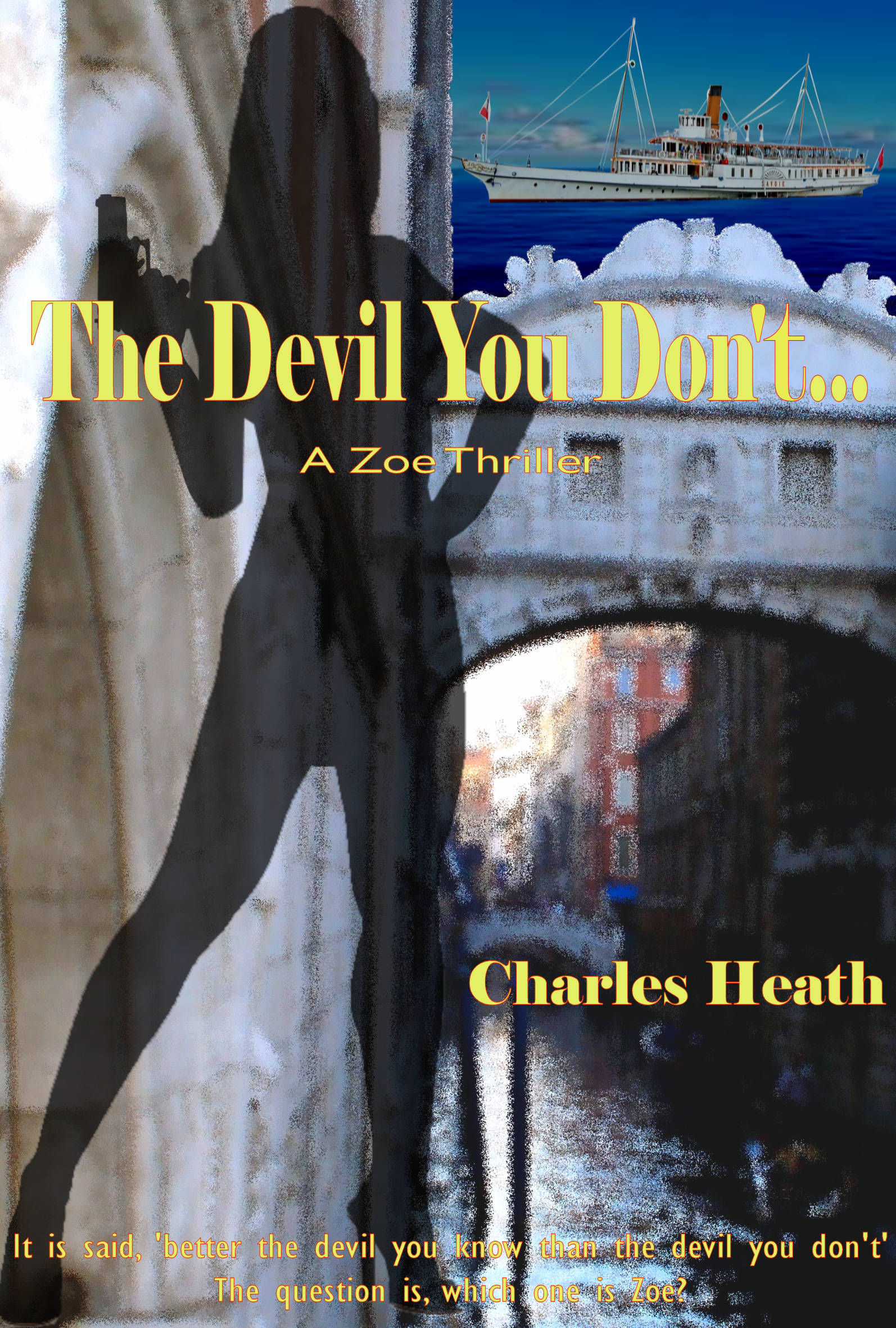
‘The Devil You Don’t’ – A beta reader’s view

It could be said that of all the women one could meet, whether contrived or by sheer luck, what are the odds it would turn out to be the woman who was being paid a very large sum to kill you.

John Pennington is a man who may be lucky in business, but not so lucky in love. He has just broken up with Phillipa Sternhaven, the woman he thought was the one, but relatives and circumstances, and perhaps because she was a ‘princess’, may also have contributed to the end result.

So, what do you do when you are heartbroken?

That is a story that slowly unfolds, from the first meeting with his nemesis on Lake Geneva, all the way to a hotel room in Sorrento, where he learns the shattering truth.

What should have been solace after disappointment, turns out to be something else entirely, and from that point, everything goes to hell in a handbasket.

He suddenly realizes his so-called friend Sebastian has not exactly told him the truth about a small job he asked him to do, the woman he is falling in love with is not quite who she says she is, and he is caught in the middle of a war between two men who consider people becoming collateral damage as part of their business.

The story paints the characters cleverly displaying all their flaws and weaknesses. The locations add to the story at times taking me back down memory lane, especially to Venice where, in those back streets I confess it’s not all that hard to get lost.

All in all a thoroughly entertaining story with, for once, a satisfying end.

Available on Amazon here: https://amzn.to/2Xyh1ow

The cinema of my dreams – I always wanted to write a war story – Episode 18

For a story that was conceived during those long boring hours flying in a steel cocoon, striving to keep away the thoughts that the plane and everyone in it could just simply disappear as planes have in the past, it has come a long way.

Whilst I have always had a fascination in what happened during the second world war, not the battles or fighting, but in the more obscure events that took place, I decided to pen my own little sidebar to what was a long and bitter war.

And, so, it continues…


It was clear, however, that Marina was familiar with the man and very annoyed with the woman.

When I took a longer look at the man, I realised he was not a man at all, but a boy in his teens, blessed by the fact he looked older than he was.  My guess, about 16.  I was surprised he had not been conscripted into the war, there seemed very few young men in the area.

Marina went straight over to him and snatched the elderly rifle he was holding away from him, the glared at Chiara

“Are you stark staring mad.  Enrico is not supposed to be out in the open, hell, it’s been a battle to keep him hidden away.  What will his parents think when they discover he’s here?”

“Pleased,” Enrico said.  “My father said it’s about time I did something to rid of the Germans, of the English too for that matter.  None of you has any right to be here.”

Fervently spoken, and to the wrong person, it would earn him a bullet to the back of the head.  But I agreed with him.

“All well and good,” Marina said to him, “but now there’s no easy way of doing that.  We must be careful, and you must stay put with your parents.  What we’re doing isn’t a game, you are neither trained or equipped to take anyone on, except perhaps rabbits.”

Back at Chiara.  “Take him home, and never bring him back here.  You don’t want to be the one who has to tell his mother if he gets killed.  Now, both of you go now, before I shoot both of you myself.”

“This is not the end of the matter,” Enrico said.

“And when you’ve taken him back, come back here.  We need to talk.”

Chiara said nothing, just nodded sullenly.  I think she believed the less said the better and did as she was asked, nodding her head in his direction, and adding a few choice phrases in Italian to him that I couldn’t understand.  It also just occurred to me that she had not asked Chiara the questions about the two men from the castle.  I guess that would have to wait until the safety of Enrico was settled, and she returned.

“Make sure they’re safe,” she said to Carlo, and he disappeared, leaving us alone.

“I thought all of the young men had been taken away by the Italian Army.”

“Not all.  We managed to hide a few away, but as you can see, despite our best efforts, they don’t seem to appreciate the trouble they could get into.  We used to have about a hundred young men from 14 through to 20 at the start of the war.  Two have found their way back, casualties of war, the rest, we may never see them again.  Enrico just doesn’t see the trouble he could get into.”

“It’s called youthful enthusiasm.  In the first world war, joining up, or going to war, was a lark.  It was a little less so this time because most of the parents knew from firsthand experience what it was like and tried to shield them.  And if you didn’t join up, questions were asked, and quite often jail, except for some who landed cushy jobs away from the fighting.”

“You were not so lucky?”

“No, I was one of those mad buggers who thought joining up to fight would be an adventure.  That quickly faded when the enemy started shooting at me.”

“And now you’re here, and a spy to boot.  That’s what they’ll hang on you if you get caught.”

“Then I shall try very hard not to get caught.  Again.”


Chiara came back about an hour later.  It seemed to me it was a lot safer to move around at night with the blackout, and I doubted Thompson would spare any men from the castle to check up on the local farmers.

And while I was at the castle, I didn’t hear anything raised about the local resistance, which I thought odd at the time, but now I knew why.  Most of them had joined him.  Better that than be hunted down and killed.

Chiara still looked sullen.  A closer look showed she was not very old herself, barely out of her twenties, and surprising that the Italian army, or Thomson for that matter, had not rounded her up for ‘duties’ at the castle.

There were a number of the local women working up at the castle, but they were mostly staff, or more likely forced labour, though I had thought we, when I believed it to be a British outpost, would be fairer to the locals than either the Germans or their own Italian military.  It’s odd how you tend to look at certain situations because of who you are, and the fact you would not do similar things at home.  The Germans, however, we would always treat differently, because they were the enemy, and because we expected the worst from them.  At that moment, though, wouldn’t the Germans think the same of us if the positions were reversed?

Best not to think about that.  My view of the war and the people in it was clouded enough.

Chiara, however, clearly thought the worst of me, and of those in the castle, and certainly didn’t think I was as neutral as I appeared.  A gun always in hand, I was sure she would shoot me again with the least provocation.

We sat, both Chiara and Marina with their weapons on the table in front of them.  I wasn’t trusted enough to be given a weapon.

Marina’s first question was directed at Chiara, “I’m told there were two men from the castle following Sam, and that he told you about them.”

“He did.  We did not see them.  We didn’t take the path, because, as you know, it’s not safe.”

It was a reasonable answer.  If the men at the castle were unfamiliar with the area, as I’m sure they would be, because they hadn’t been there for very long, and I doubt Thompson would want to advertise the nationality of those at the castle unless he had to, they would stick to the clearly-marked roads and paths.

I had on my way to the castle, from a different direction.  It didn’t explain why I had not been met by the leader of the resistance as arranged, but that was now explained, both by the former leader trying to kill me in a roadside explosion, and then what I learned at the castle in the last few days.

“Even so, there’s not that much distance between the two, and it is possible to shadow them.”

“I keep well away from them.  Perhaps Leonardo saw them.  He doesn’t have to worry about what they might do because they use him to supply food.  Maybe he knows more.”

“Perhaps I shall ask him next time I see him.  We need to know who from the castle is about and when so that we don’t get caught.”

“I’ll remember next time.  Is that all?”

“Yes.”

Chiara picked up her gun, gave me an extra-long sullen stare.  “I don’t trust this one, Marina.  You 

need to be careful.”

“I will.”

We waited a few minutes until after she had departed, and then Marina said, “We should be going too.  This place is a little eerie at night.  There are far too many ghosts for my liking.”

I shuddered, then followed her out.


© Charles Heath 2019