I have seen this television program once or twice, where a television personality digs into their past and sometimes they discover they had famous, or sometimes infamous, relatives.
I don’t think I would be so lucky, or unlucky as the case may be.
But, to be honest I haven’t really been interested in digging into the past.
On the other hand, my older brother has a keen interest in genealogy in general, borne from a desire to find out more about our family tree.
And he has gone back to the 1600s, for the relatives who came out from England, and no, they have no transported convicts, or at least he’s not saying.
Genealogy is a rather fascinating subject, and, I’ve discovered, is taught in university as a degree. My brother has one now.
What I didn’t realize is that I’ve been playing with it for years because in writing what might be called sagas you need to create your own set of mythical families, and then trace to forebears back in time.
I have one novel I’m writing that has required a family tree, and recently another for a story that required starting with a character who participated in the Eureka Stockade. We had to create parents, a migration from England to Australia, and then construct a family tree through to today so we could write a story from the perspective of a fourth-generation girl at school doing a school project.
If that sounds complicated, believe me, it is. But from my granddaughter who came up with the idea, she is very excited about it.
Much better than sitting in front of a computer playing games or a tv watching cartoons.
But once again I digress…
I have found a lot of genealogy stuff that my mother had been working on, and I’m taking it to my brother, and at the same time, l will get the latest installment on our family.
So far I’ve learned that I come from a combination of British relatives on both my mother and father’s side, the most recent my father’s mother who was born in England, and German from my mother’s side, her surname being Auhl.
No doubt, and with a great deal of irony, my relatives probably fought against each other in two world wars.
I’m sure more will be revealed on Wednesday.
But, the more I learn the more I feel inclined to create a fictionalized history with my family members as characters in the story. At the moment a biographical account of the family would be reasonably boring since as yet no one notorious had been discovered.
Category: Autobiography
What do we know about life?
Our view of life, love, relationships, and marriage come from our own experiences. This is basically the same for all of us for everything that happens to us through life, as young children, at school, at work, at leisure, and, as we grow as a person.
Our ideas about life will come from the experiences of having our children, watching over our children as they grow up, from our relatives, both our own and those acquired by marriage or relationships, and from our friends.
No two life experiences will be exactly the same. There will be similarities but differences which may or may not give us a different perspective, whether that might be for the better or for the worse. Not everything that will happen to us will be good, or bad, but just an experience that we will remember or forget, take notice of or ignore, helps us grow, or cause us pain.
There will be the experiences we have when interaction with others that are outside our family sphere but haling an influence on us directly or indirectly, like politicians, doctors, government officials, and police. There will also be experiences involving those at work that we interact with in a professional manner, and others, who have influence in ways that sometimes can be unimaginable.
These interactions will influence our feelings, thoughts, and how we react and behave, the highs and lows of having children and grandchildren, interactions with aunts, uncles, our parents. Equally there will be moments of despair, of losing a job or missing out on a promotion, of dealing with people in the workplace that make life difficult, dealing with relatives who are not very nice, in short all of those interactions with all these people around you, and more.
Yes, your life is steered by all of these influences, and your views are often coloured by any or all of these people. They make up the sum of who you are, who you will be, and what you want to be. Those dreams will seem, sometimes, within your grasp, but quite often they will seem as far from your grasp as touching the moon.
But all of this, while it makes up who you are, will also make up who your characters are in a story.
They will be people you know, people you’ve met, people you’ve interacted with, people you’ve seen.
Over a series of posts I’ll try to describe some of my influences, and then refine them into the characters and locations of my stories.
What do we know about life?
Our view of life, love, relationships, and marriage come from our own experiences. This is basically the same for all of us for everything that happens to us through life, as young children, at school, at work, at leisure, and, as we grow as a person.
Our ideas about life will come from the experiences of having our children, watching over our children as they grow up, from our relatives, both our own and those acquired by marriage or relationships, and from our friends.
No two life experiences will be exactly the same. There will be similarities but differences which may or may not give us a different perspective, whether that might be for the better or for the worse. Not everything that will happen to us will be good, or bad, but just an experience that we will remember or forget, take notice of or ignore, helps us grow, or cause us pain.
There will be the experiences we have when interaction with others that are outside our family sphere but haling an influence on us directly or indirectly, like politicians, doctors, government officials, and police. There will also be experiences involving those at work that we interact with in a professional manner, and others, who have influence in ways that sometimes can be unimaginable.
These interactions will influence our feelings, thoughts, and how we react and behave, the highs and lows of having children and grandchildren, interactions with aunts, uncles, our parents. Equally there will be moments of despair, of losing a job or missing out on a promotion, of dealing with people in the workplace that make life difficult, dealing with relatives who are not very nice, in short all of those interactions with all these people around you, and more.
Yes, your life is steered by all of these influences, and your views are often coloured by any or all of these people. They make up the sum of who you are, who you will be, and what you want to be. Those dreams will seem, sometimes, within your grasp, but quite often they will seem as far from your grasp as touching the moon.
But all of this, while it makes up who you are, will also make up who your characters are in a story.
They will be people you know, people you’ve met, people you’ve interacted with, people you’ve seen.
Over a series of posts I’ll try to describe some of my influences, and then refine them into the characters and locations of my stories.
A book review, “Life at the end of the Rainbow” by Jenny Andrews
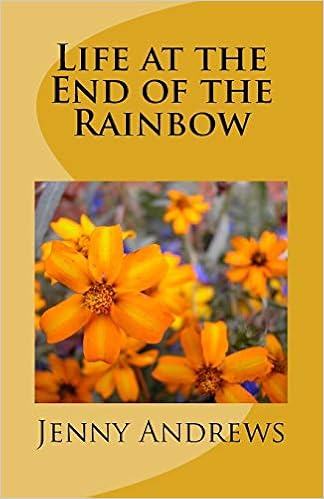
Life at the end of the Rainbow, by Jenny Andrews
Poetry is like art, its beauty is in the eye of the beholder.
But, while art can be very subjective, poetry often has a special meaning, to both the writer and then the reader. In turn, for each of us readers, a poem will have a different meaning, some will see what it represents, and others may not.
And, whilst I have not read a lot of poetry over the years, that changed recently when I subscribed to several blogs and discovered this whole new class of literature.
This view was strengthened when I came across a volume of poems by Jenny Andrews, titled Life at the End of the Rainbow.
For me, each poem is an insight into an extraordinary life, where the author sometimes lays bare those raw emotions, which, at times, we will find ourselves drawing parallels.
In a sense, I think we have all been to this mythical place called, The End of the Rainbow, and sometimes need a gentle reminder that it took a lot of ups and downs to get there.
This is, to my mind, a remarkable piece of work.
I, for one, can’t wait to see what the next stage of the journey will be.
A book review, “Life at the end of the Rainbow” by Jenny Andrews
Life at the end of the Rainbow, by Jenny Andrews
Poetry is like art, its beauty is in the eye of the beholder.
But, while art can be very subjective, poetry often has a special meaning, to both the writer and then the reader. In turn, for each of us readers, a poem will have a different meaning, some will see what it represents, and others may not.
And, whilst I have not read a lot of poetry over the years, that changed recently when I subscribed to several blogs and discovered this whole new class of literature.
This view was strengthened when I came across a volume of poems by Jenny Andrews, titled Life at the End of the Rainbow.
For me, each poem is an insight into an extraordinary life, where the author sometimes lays bare those raw emotions, which, at times, we will find ourselves drawing parallels.
In a sense, I think we have all been to this mythical place called, The End of the Rainbow, and sometimes need a gentle reminder that it took a lot of ups and downs to get there.
This is, to my mind, a remarkable piece of work.
I, for one, can’t wait to see what the next stage of the journey will be.
My grandchildren have just started working
It’s hard to believe that both the 17 year old and the 14 year old have just both got jobs and started on their path of working for the next 50 to 60 years.
They seem quite amused at the thought, and not without reason, and are not really considering the idea. Not yet, anyway.
The novelty is still quite new, and it has a sense of excitement, but this will no doubt wear off in the coming months. After all, as new workers, they only have to do between 3 and 5 hour shifts.
I guess the fact they have decided to work at such a young age reminded me of my experience, way back when I was 15.
Unhlike them, who will be afforded to opportunity to remain in school to the end, Year 12, and possibly the chance to go to University, in my case we did not have the money to continue education beyond Year 10, and there was no question of ever going to University. Only the rich could afford that, and we were anything but rich.
Instead, I guess hating school helped facilitate my departure, and the notion that I would have to pay my own way, forced me into working.
Of course, it helped living in a small country town, and my father having a job that brought him in contact with everyone who was an anyone, and thus got offers to work in whatever profession I chose.
I ended up in the Post Office, what I considered as the easiest of jobs, originally employed as a telegram delivery boy, and mail collector from the post boxes scatted about the town. As you can imagine, there were not many telegrams to deliver, so other duties included sorting mail, and then mail delivery. Yes I because a postman!
Then, after a few months, I became the night switchboard operator, and with a host of other operators, had some of the most interesting and varied conversations imaginable.
It was a bit of a wrench when we finally moved from the country town back to the city.
When we did, my father bought a small business, and for a year of so, I became a shop assistant.
That lasted for a year or two, until I was 17. Realising that a lack of education was going to make it difficult to ever get a good paying job, I took the opportunity to go back to night school while I had the chance, and it necessitated finding another job to help pay for it.
That was packing books for a wholesale bookseller, part of a small team hidden away in the basement of a very old building. It might not be the best paying job, or the best working conditions, but I suspect it was the universe telling me something.
That job, and being surrounded by books started me off on a journey of reading, and eventually writing.
What makes a character – 1 – The beginnings of a writer
My characters are many, a diverse group of people that are based on people I know, people I’ve known, people I’ve met, or seen, or interacted with. Some of them make up a single character with several traits.
Some are like me, but most are people I would have like to have been rather than the dull as ditchwater person I am. No-one wants to read about dull people, they want someone larger than life, someone who can do the impossible, or at the very least, the improbably.
I’ve always wanted to be someone else. For a long time I never liked who I was, and, to a certain extent, I still don’t. That was a result of the early stages of my life, those years the form who we are going to be.
And, had you asked me 50 years ago whether I would be the person I am now, I’d probably laugh and say it would be impossible. Yet here I am, and it’s nothing like what I thought I would be.
But, for now, lets look at the traits that live in some of my characterisations.
For instance, to understand the influences people have on us, I use my father, a man always voted for a particular political party, and that alone was an influence on who I would vote for when I got old enough, after listening for years his reasons for hating the opposition. For years he aired his grievances, which, at the time, he believed were real and caused by that opposition party.
Politics can be very polarising. There’s also a saying, throw enough mud, some of it sticks. That, of course applied to a great many things. Another was only the rich could afford a University education, and for years I believed that. It was, he said, how the rich kept their influence over, and suppress the poor.
It was a similar case with religion, another polarising topic, and my family were Protestants and therefore didn’t like other religions such as Catholics. It didn’t strike me till much later in life why this was so. But as a child we were sent to Sunday school and, irregularly, to church services of the Presbyterian faith.
Then there were our relatives, none of whom we ever really met. I knew we had relatives, my fathers parents because for a while we used to visit them every month or so where my father would cut their lawn, and my mother had a mother, he father had died not long after I’d been born.
My father had a lot of brothers and a sister. My mother had a brother and a sister. She also had an aunt that I’m sure I met several times before she died. But these are fleeting memories. We saw my father’s brothers and sister rarely, so rarely now I don’t remember them. The same applied to my mother’s sister, of whom I got the impression she was immensely jealous of.
I never understood why. Not then, any way.
But as for my mother’s mother, our grandmother, she was a likable soul who lived in the country, and she never came to see us, we went to see her, but those visits were long after we stopped seeing my father’s parents.
At the time we were young, she lived in the country, and we had to drive there which took time we didn’t seem to have.
Later in my pre teens my brother and I used to stay at her house for a week or two during the school holidays. It was a very large house on a large block, very old with high ceilings and large rooms, and we always had lots to eat, and delicious food at that, and we couldn’t understand why we didn’t have the same with our parents.
Of course there was a reason for that too, but this only became clear a few years ago when my brother started collecting information for a family history. My brother hunted down all of the relatives that were still alive and began to learn why we never saw them. It was not because of them, but because of my parents.
One stark revelation was that nearly all of them were better off than we were.
So here was my early childhood in equally stark reality.
It would be easy to blame parents for everything, but that’s the easy way out, and probably what every child who felt they were deprived of a proper life would do. More than likely, for years, that’s exactly how I felt, and, equally, the reason why I withdrew into a whole different world, or worlds, of my own.
I might not have put words on paper, but in my mind stories were beginning and evolving, stories that I told others to hide what I really was, and what I felt.
What makes a location – 1 – The places around me
Having just described some of the early life, and the abject misery of being in a house with people who didn’t seem to care about anyone or anything, it flowed down into us.
But, here’s the thing.
When you are so young, you don’t know much about the world, and the people in it. This is learned from your parents, those first people in your life and who teach you the fundamentals, according to their beliefs.
It is the reason why a lot of children who when they eventually begin interacting with others have some horrendous traits, difficulty with language, or the use of swear words, and the treatment of others. If you’re a boy and your father drinks, smokes, swears incessantly, and beats his wife and children, then that’s what the child will do.
Similarly if you are just there, and no one treats you with the care that a child needs, then they become introverted and quiet. You listen and don’t speak, you observe, and wonder what else there is than this life that you have.
When you leave the house, and begin to interact with others, that sheltered life, and lack of interaction with relatives and others leaves you alone and miserable in a world you know little about and are totally unprepared for.
It’s where you start making a different world, one you can cope with, one that you are more than just nothing in. There is television, but it’s not something you can see all the time, and viewing was limited to what parents watch. There’s radio, but it’s from a world outside your own. There are other people you meet, but they might as well come from another planet so different they are from you.
But there are moments when things are different.
Like going to stay at my grandmothers place in the country.
It became a castle. A house with many rooms. A house that was old, made of bricks, had high ceilings, worn carpets, and holes in the floor. A small kitchen with a wood stove. A separate room to eat in, where the food served was completely different to what we had at home.
A large house on a large block of land, next to a church.
A place where there was a garage, rusting hulks of old cars, a large workshop that had all manner of tools and wood lying around, dusty and cobwebbed from years of no use. A whole day could be spent there just finding new and old things, each of which had a story of their own.
A block that had a huge garden, and overgrown fernery, and a huge overgrown water fountain, with paths going off in all directions. And a front garden that would rival the best of any rose garden.
In short, it was a place a child with an active imagination, could turn into anything.
I stayed there with my brother. I doubt he had the awe and wonder that I had, but he too was an explorer and between us we hacked away at the overgrowth, looking for and restoring parts of the rose garden and the fountain.
I remember it well. We never came in the front door. No one did because the path to the front verandah was blocked by overgrowth. But from inside, the entrance hall was huge with ornate wooden panelling.
One one side was my grandmothers bedroom, on the other, the lounge room, with a worn carpet square that covered nearly the whole wooden floor, and huge lounge chairs with wide arms, on castors.
Further across was a huge dining table, and an access through to the kitchen. We never used the dining table because it was covered in crockery, stuff my grandmother won when she went to lawn bowls.
Through an archway to the rest of the house, a huge hallway, where down one side were the bedrooms, four of them, and a bathroom at the end on the other side, and a door that led to the back porch.
THe first room was a storeroom filled with old stuff.
The second room was where we stayed.
The third was empty, and the fourth bedroom was when my mother’s brother, our uncle lived.
In this hall was a piano. It was a hall large enough to hold a dance in, only that would be difficult given that parts of the floor had rotted, and there was no sneaking about because the floorboards creaked.
It was, to me, a house with loads of character.
It was fitting then that it became the inspiration for a castle, and a life that was so very different to mine.
What do we know about life?
Our view of life, love, relationships, and marriage come from our own experiences. This is basically the same for all of us for everything that happens to us through life, as young children, at school, at work, at leisure, and, as we grow as a person.
Our ideas about life will come from the experiences of having our children, watching over our children as they grow up, from our relatives, both our own and those acquired by marriage or relationships, and from our friends.
No two life experiences will be exactly the same. There will be similarities but differences which may or may not give us a different perspective, whether that might be for the better or for the worse. Not everything that will happen to us will be good, or bad, but just an experience that we will remember or forget, take notice of or ignore, helps us grow, or cause us pain.
There will be the experiences we have when interaction with others that are outside our family sphere but haling an influence on us directly or indirectly, like politicians, doctors, government officials, and police. There will also be experiences involving those at work that we interact with in a professional manner, and others, who have influence in ways that sometimes can be unimaginable.
These interactions will influence our feelings, thoughts, and how we react and behave, the highs and lows of having children and grandchildren, interactions with aunts, uncles, our parents. Equally there will be moments of despair, of losing a job or missing out on a promotion, of dealing with people in the workplace that make life difficult, dealing with relatives who are not very nice, in short all of those interactions with all these people around you, and more.
Yes, your life is steered by all of these influences, and your views are often coloured by any or all of these people. They make up the sum of who you are, who you will be, and what you want to be. Those dreams will seem, sometimes, within your grasp, but quite often they will seem as far from your grasp as touching the moon.
But all of this, while it makes up who you are, will also make up who your characters are in a story.
They will be people you know, people you’ve met, people you’ve interacted with, people you’ve seen.
Over a series of posts I’ll try to describe some of my influences, and then refine them into the characters and locations of my stories.
Leaving a legacy…
I’ve been reading a few blog posts off and on today, and one that caught my eye was about leaving a legacy.
This I presumed to be ‘something to be remembered by’.
I have always suspected that when I pass on, the memory will not linger very long, except when someone, in the years ahead, pulls out a an old photo, and says, “Who’s this old man?”
I’m sure the answer would hover somewhere between “You don’t really want to know,” to “He’s the eccentric side of the family.”
The thing is, I’ve discovered that children in this family seem to have an insatiable appetite for discovering information about their forebears. It also seems to be that the school they go to makes a big deal about the children learning genealogy, and get an assignment either in year 5 or year 6 where they have to trace their forebears back as far as they can.
I have to say I’ve always been curious, but never really did anything about it, except go back a few generations, i.e. those people we could remember, and, yes, we had eccentric aunts and uncles, grandmothers, and grandfathers.
But my older brother, he got the bug, and went into genealogy in a big way, got himself a university degree, and then takes a trip or two overseas every year delving into the murky past of the Heaths and the Auhls.
The Heaths apparently came from Dorset in England, and the Auhls, somewhere in Germany. He told me, but I’ve forgotten, but I do have a file somewhere that tells me.
And being in Australia, it’s like gold if you have a forebear who was a convict, but unfortunately we didn’t, though I recently learned one of our forebears who came out to Tasmania, was a pseudo Luddite (he was arraigned as guilty by association, but he was no Luddite) in the 1860’s.
But finding a legacy somewhere amongst all those relatives is no mean feat, because it seems none of us were famous, and I haven’t broken the mold, or at least not yet. I might still get to be a (famous?) writer or blogger.
So I am sitting here wondering what the real definition of legacy is, if it can’t apply to wealth or fame. Could it be the next generation of Heaths, the grandchildren? Could one call them a legacy? We will no doubt eventually leave them behind to continue, and maybe one of them will be famous.
The youngest has a desire to be an artist, and she is quite good at drawing, The middle granddaughter wants to be a scientist, and is doing well at school. Of course, there are the middle years, where boys are not yet a distraction, so who knows what the future will bring. As for the eldest, being 16 going on 17 is just too hard.
How could you possibly know at 16 or 17 what it is you want to be? When I was that age I had a choice of being academic, ie maths and science, or hand’s on, a carpenter, sheet metal worker or mechanic.
I did work as a builder for a while, but moved to night switchboard operator/postman, shipping clerk, services manager, and then computer programmer, which none of my learning while at school had any bearing on, except perhaps for maths.
So I’m guessing my legacy was my children, and their legacy is their children, and so on.
As for fame, I don’t think it’s all it’s cracked up to be.

