I have seen this television program once or twice, where a television personality digs into their past and sometimes they discover they had famous, or sometimes infamous, relatives.
I don’t think I would be so lucky, or unlucky as the case may be.
But, to be honest I haven’t really been interested in digging into the past.
On the other hand, my older brother has a keen interest in genealogy in general, borne from a desire to find out more about our family tree.
And he has gone back to the 1600s, for the relatives who came out from England, and no, they have no transported convicts, or at least he’s not saying.
Genealogy is a rather fascinating subject, and, I’ve discovered, is taught in university as a degree. My brother has one now.
What I didn’t realize is that I’ve been playing with it for years because in writing what might be called sagas you need to create your own set of mythical families, and then trace to forebears back in time.
I have one novel I’m writing that has required a family tree, and recently another for a story that required starting with a character who participated in the Eureka Stockade. We had to create parents, a migration from England to Australia, and then construct a family tree through to today so we could write a story from the perspective of a fourth-generation girl at school doing a school project.
If that sounds complicated, believe me, it is. But from my granddaughter who came up with the idea, she is very excited about it.
Much better than sitting in front of a computer playing games or a tv watching cartoons.
But once again I digress…
I have found a lot of genealogy stuff that my mother had been working on, and I’m taking it to my brother, and at the same time, l will get the latest installment on our family.
So far I’ve learned that I come from a combination of British relatives on both my mother and father’s side, the most recent my father’s mother who was born in England, and German from my mother’s side, her surname being Auhl.
No doubt, and with a great deal of irony, my relatives probably fought against each other in two world wars.
I’m sure more will be revealed on Wednesday.
But, the more I learn the more I feel inclined to create a fictionalized history with my family members as characters in the story. At the moment a biographical account of the family would be reasonably boring since as yet no one notorious had been discovered.
Category: Autobiography
Who do you think you are?
I have seen this television program once or twice, where a television personality digs into their past and sometimes they discover they had famous, or sometimes infamous, relatives.
I don’t think I would be so lucky, or unlucky as the case may be.
But, to be honest I haven’t really been interested in digging into the past.
On the other hand, my older brother has a keen interest in genealogy in general, borne from a desire to find out more about our family tree.
And he has gone back to the 1600s, for the relatives who came out from England, and no, they have no transported convicts, or at least he’s not saying.
Genealogy is a rather fascinating subject, and, I’ve discovered, is taught in university as a degree. My brother has one now.
What I didn’t realize is that I’ve been playing with it for years because in writing what might be called sagas you need to create your own set of mythical families, and then trace to forebears back in time.
I have one novel I’m writing that has required a family tree, and recently another for a story that required starting with a character who participated in the Eureka Stockade. We had to create parents, a migration from England to Australia, and then construct a family tree through to today so we could write a story from the perspective of a fourth-generation girl at school doing a school project.
If that sounds complicated, believe me, it is. But from my granddaughter who came up with the idea, she is very excited about it.
Much better than sitting in front of a computer playing games or a tv watching cartoons.
But once again I digress…
I have found a lot of genealogy stuff that my mother had been working on, and I’m taking it to my brother, and at the same time, l will get the latest installment on our family.
So far I’ve learned that I come from a combination of British relatives on both my mother and father’s side, the most recent my father’s mother who was born in England, and German from my mother’s side, her surname being Auhl.
No doubt, and with a great deal of irony, my relatives probably fought against each other in two world wars.
I’m sure more will be revealed on Wednesday.
But, the more I learn the more I feel inclined to create a fictionalized history with my family members as characters in the story. At the moment a biographical account of the family would be reasonably boring since as yet no one notorious had been discovered.
A book review, “Life at the end of the Rainbow” by Jenny Andrews
Life at the end of the Rainbow, by Jenny Andrews
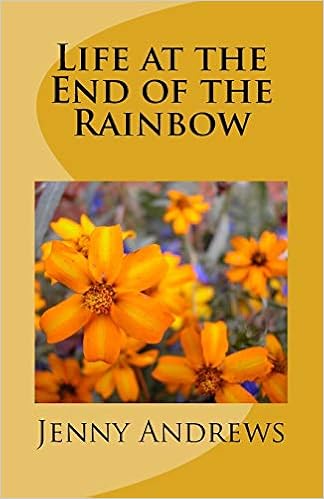
Poetry is like art, its beauty is in the eye of the beholder.
But, while art can be very subjective, poetry often has a special meaning, to both the writer and then the reader. In turn, for each of us readers, a poem will have a different meaning, some will see what it represents, and others may not.
And, whilst I have not read a lot of poetry over the years, that changed recently when I subscribed to several blogs and discovered this whole new class of literature.
This view was strengthened when I came across a volume of poems by Jenny Andrews, titled Life at the End of the Rainbow.
For me, each poem is an insight into an extraordinary life, where the author sometimes lays bare those raw emotions, which, at times, we will find ourselves drawing parallels.
In a sense, I think we have all been to this mythical place called, The End of the Rainbow, and sometimes need a gentle reminder that it took a lot of ups and downs to get there.
This is, to my mind, a remarkable piece of work.
I, for one, can’t wait to see what the next stage of the journey will be.
A book review, “Life at the end of the Rainbow” by Jenny Andrews
Life at the end of the Rainbow, by Jenny Andrews
Poetry is like art, its beauty is in the eye of the beholder.
But, while art can be very subjective, poetry often has a special meaning, to both the writer and then the reader. In turn, for each of us readers, a poem will have a different meaning, some will see what it represents, and others may not.
And, whilst I have not read a lot of poetry over the years, that changed recently when I subscribed to several blogs and discovered this whole new class of literature.
This view was strengthened when I came across a volume of poems by Jenny Andrews, titled Life at the End of the Rainbow.
For me, each poem is an insight into an extraordinary life, where the author sometimes lays bare those raw emotions, which, at times, we will find ourselves drawing parallels.
In a sense, I think we have all been to this mythical place called, The End of the Rainbow, and sometimes need a gentle reminder that it took a lot of ups and downs to get there.
This is, to my mind, a remarkable piece of work.
I, for one, can’t wait to see what the next stage of the journey will be.
A photograph from the Inspirational bin – 33
This is countryside somewhere inside the Lamington National Park in Queensland. It was one of those days where the rain come and went…

We were spending a week there, in the middle of nowhere on a working macadamia farm in a cottage, one of four, recuperating from a long exhausting lockdown.
It was not cold, and we were able to sit out of the verandah for most of the day, watching the rain come and pass over on its way up the valley, listing to the gentle pitter-patter of the rain on the roof and nearby leaves.
But as for inspiration:
This would be the ideal setting for a story about life, failed romance, or a couple looking to find what it was they lost.
It could be a story about recovering from a breakdown, or a tragic loss, to be anywhere else but in the middle of dealing with the constant reminders of what they had.
It could be a safe house, and as we all know, safe houses in stories are rarely safe houses, where it is given away by someone inside the program, or the person who it’s assigned to give it away because they can’t do as they’re supposed to; lay low.
Then there’s camping, the great outdoors, for someone who absolutely hates being outdoors, or those who go hunting, and sometimes become the hunted.
Oh, and watch out for the bears!
A photograph from the Inspirational bin – 33
This is countryside somewhere inside the Lamington National Park in Queensland. It was one of those days where the rain come and went…
We were spending a week there, in the middle of nowhere on a working macadamia farm in a cottage, one of four, recuperating from a long exhausting lockdown.
It was not cold, and we were able to sit out of the verandah for most of the day, watching the rain come and pass over on its way up the valley, listing to the gentle pitter-patter of the rain on the roof and nearby leaves.
But as for inspiration:
This would be the ideal setting for a story about life, failed romance, or a couple looking to find what it was they lost.
It could be a story about recovering from a breakdown, or a tragic loss, to be anywhere else but in the middle of dealing with the constant reminders of what they had.
It could be a safe house, and as we all know, safe houses in stories are rarely safe houses, where it is given away by someone inside the program, or the person who it’s assigned to give it away because they can’t do as they’re supposed to; lay low.
Then there’s camping, the great outdoors, for someone who absolutely hates being outdoors, or those who go hunting, and sometimes become the hunted.
Oh, and watch out for the bears!
My grandchildren have just started working
It’s hard to believe that both the 17 year old and the 14 year old have just both got jobs and started on their path of working for the next 50 to 60 years.
They seem quite amused at the thought, and not without reason, and are not really considering the idea. Not yet, anyway.
The novelty is still quite new, and it has a sense of excitement, but this will no doubt wear off in the coming months. After all, as new workers, they only have to do between 3 and 5 hour shifts.
I guess the fact they have decided to work at such a young age reminded me of my experience, way back when I was 15.
Unhlike them, who will be afforded to opportunity to remain in school to the end, Year 12, and possibly the chance to go to University, in my case we did not have the money to continue education beyond Year 10, and there was no question of ever going to University. Only the rich could afford that, and we were anything but rich.
Instead, I guess hating school helped facilitate my departure, and the notion that I would have to pay my own way, forced me into working.
Of course, it helped living in a small country town, and my father having a job that brought him in contact with everyone who was an anyone, and thus got offers to work in whatever profession I chose.
I ended up in the Post Office, what I considered as the easiest of jobs, originally employed as a telegram delivery boy, and mail collector from the post boxes scatted about the town. As you can imagine, there were not many telegrams to deliver, so other duties included sorting mail, and then mail delivery. Yes I because a postman!
Then, after a few months, I became the night switchboard operator, and with a host of other operators, had some of the most interesting and varied conversations imaginable.
It was a bit of a wrench when we finally moved from the country town back to the city.
When we did, my father bought a small business, and for a year of so, I became a shop assistant.
That lasted for a year or two, until I was 17. Realising that a lack of education was going to make it difficult to ever get a good paying job, I took the opportunity to go back to night school while I had the chance, and it necessitated finding another job to help pay for it.
That was packing books for a wholesale bookseller, part of a small team hidden away in the basement of a very old building. It might not be the best paying job, or the best working conditions, but I suspect it was the universe telling me something.
That job, and being surrounded by books started me off on a journey of reading, and eventually writing.
You learn something new every day (2)
I got a call this morning from my brother who has been delving into the places we have lived over the years, including those before we were born.
My recollection, hazy at best, is that my father’s parents lived in Camberwell, a suburb of Melbourne, and the boys, those that survived the war, lived there too. He had three brothers, I think, and a sister. From what I’ve read, his older brother was a sensible chap and the peacemaker between him and his parents.
Later one of his brothers went to Sydney, his sister lived among orchards our Ringwood way, and another, much later, moved to Queensland. We very rarely, if ever, saw them, and the last time I did with most in one place, was after my Grandmother died. I do remember Dora, the site, visiting us once, and being young at the time, she seemed a very forbidding woman.
But, this is about where they lived.
My father, presumably before and immediately after the war, at home, and my mother at her home in Pakenham. There her father ran a service station and motor mechanic shop and was well known. Their house, at the time, was built over the road, just a short walk from home to work. The place, the first time I saw it, was a mechanics dream, with old cars and car parts outside and inside garages, and a woodworking shop with every tool imaginable.
Once the place had very elegant gardens, but by the time I got to stay there, in the 1960s, it was all overgrown, and the house was in disrepair. My mother’s brother lived there with my grandmother, and he was a fearsome, huge man who said little. All I knew about him was that, a) he was the one who found his father after he had killed himself, b) he liked fishing and went to a place called Corinella, and c) he was a mechanic like his father.
So, at some point in 1948, my father must have up and left, perhaps after an argument with his parents, and moved to Keiwa House, Bogong, where the Snowy River Hydro-Electric Scheme was being built, as a projectionist, bringing films to the workers in Town Halls.
As I’ve said, my mother stayed in a boarding house for ladies during the week and went home on weekends. I have the first letter that my father wrote to her and references the fact he went calling on her, and she was not there. We’ll never know what she thought, but there’s a second letter, after she wrote back, so a friendship was struck. He told her, almost in minute detail, what he was doing, and presumably, she told him about hers.
A year later, they married.
Now it gets interesting. We both thought that their first house, after getting married was in Carrum. It wasn’t. In the pile of letters were references to the family staying in a rented flat in Camberwell.
Sometime after that, there is a contract for a war service loan in relation to a property in Carrum, which turns out to be the first house they lived in, and where my brother, born in 1950) lived, and where I lived after I was born in 1953. I have interesting if vague memories of this house, and of the people who lived behind us because we could climb through the fence into their property. We knew them during, and after living in Carrum.
Now, today, some interesting new facts came to light about the Carrum house. We always assumed we owned it, but it seems that we didn’t. A copy of the title for that property never had the name Heath on it, so did we rent it? More information is required, and we need to dig deeper. Let’s hope there are no skeletons there.
And something else came out of a discussion with the daughter of my mothers sister, that it was believed my mother’s parents bought them a house in Chelsea, but my father, apparently, refused to live in it and sold it.
OK, I never claimed that my father was the sort that might have accepted charity, so perhaps in a moment of madness, he lost the plot. The question is, what happened to the money?
Recycle bin(0)Empty

