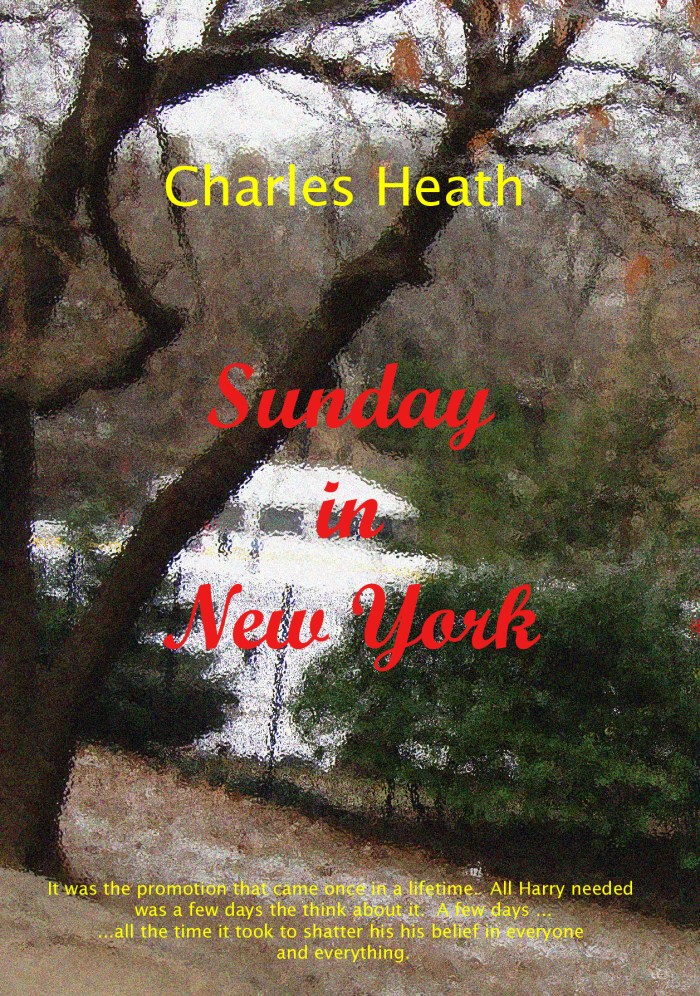
“Sunday in New York”, a romantic adventure that’s not a walk in the park!

“Sunday in New York” is ultimately a story about trust, and what happens when a marriage is stretched to its limits.

When Harry Steele attends a lunch with his manager, Barclay, to discuss a promotion that any junior executive would accept in a heartbeat, it is the fact his wife, Alison, who previously professed her reservations about Barclay, also agreed to attend, that casts a small element of doubt in his mind.

From that moment, his life, in the company, in deciding what to do, his marriage, his very life, spirals out of control.

There is no one big factor that can prove Harry’s worst fears, that his marriage is over, just a number of small, interconnecting events, when piled on top of each other, points to a cataclysmic end to everything he had believed in.

Trust is lost firstly in his best friend and mentor, Andy, who only hints of impending disaster, Sasha, a woman whom he saved, and who appears to have motives of her own, and then in his wife, Alison, as he discovered piece by piece damning evidence she is about to leave him for another man.

Can we trust what we see with our eyes or trust what we hear?

Haven’t we all jumped to conclusions at least once in our lives?

Can Alison, a woman whose self-belief and confidence is about to be put to the ultimate test, find a way of proving their relationship is as strong as it has ever been?

As they say in the classics, read on!

Purchase:

http://tinyurl.com/Amazon-SundayInNewYork

In a word: Scene

This is an easy one.

It’s a part of a book or film which covers a single event, and predominantly with a set group of characters.

It could also mean it might relate to a particular genre that you like, as in,

I’m part of the jazz scene or the symphonic scene, though I think it had a more sinister context back in the late 60s early 70s.

A scene could also be a landscape (especially in art)

Then, of course, the last thing you want is a child to make a scene in front of others, in a display of temper, or bad manners

This is not to be confused with seen, as in, you should be seen and not heard, an oft used expression by a parent.

You could be seen, especially in places where you were not meant to be, or, conversely, make sure you are seen by the ‘right’ people in the ‘right’ places

Have you seen my dictionary, it’s quite large and heavy

I have seen his bad qualities

I have seen better days, though at the moment I can’t remember when

I have seen them all, sometimes seemingly impossible, but it is generated by exasperation, and generally more like I’ve seen everything now!


“Echoes From The Past”, the past doesn’t necessarily stay there


What happens when your past finally catches up with you?

Christmas is just around the corner, a time to be with family. For Will Mason, an orphan since he was fourteen, it is a time for reflection on what his life could have been, and what it could be.

Until a chance encounter brings back to life the reasons for his twenty years of self-imposed exile from a life only normal people could have. From that moment Will’s life slowly starts to unravel and it’s obvious to him it’s time to move on.

This time, however, there is more at stake.

Will has broken his number one rule, don’t get involved.

With his nemesis, Eddie Jamieson, suddenly within reach, and a blossoming relationship with an office colleague, Maria, about to change everything, Will has to make a choice. Quietly leave, or finally, make a stand.

But as Will soon discovers, when other people are involved there is going to be terrible consequences no matter what choice he makes.

https://amzn.to/2CYKxu4

newechocover5rs

“Bloody hell…” – a short story

The cell phone’s insistent and shrill ring dragged my mind away from the crossword, and after a fairly mild curse, I picked it up.

Sidney, my brother.  Odd he was calling me at this hour of the night.

“What,” I barked into the microphone.

“That’s no way to speak to your baby brother.”  His smooth tones rarely reached a screaming point, which was often the reason why mine did.

And who calls the younger brother ‘baby’ brother these days?

“What do you want?”

A hesitation.  He was in trouble again; I could feel it.

“Can you come down to the bar?  I seem to have left my wallet at home.”  Sheepish, and just enough to stop me from yelling at him.  It was not the first time, nor would it be the last.

“I told you the last time was the last time.”

“Just this once, please?”

I shook my head.  That was probably my biggest fault, giving in to him.  After our mother had died, and our father had to work, it was left to me to bring him up.  He was going to be the death of me yet.  “Where?”

“The usual place.”

I was surprised because the last I’d heard they’d banned him from going in there.  It was only a twenty-minute walk from my apartment, but, late at night, and in winter, there was snow in the air.  And the odd snowflake falling, a prelude to much worse.

About a hundred yards from the bar I had a shiver go down my spine.  I’d not had that for a long time, not since school, and the trouble with Wiley, the school bully.  Wiley had graduated to the local thug, done a few stints in jail, and last I heard he had been sent down for a few years for an assault.

I stopped and took a moment.  Perhaps karma was trying to tell me something.

I shrugged.  Just in my imagination.  I reached the door, took a moment then went in.  He was standing by the bat looking a little apprehensive.  He was in more trouble than just not paying his bar bill.

Close up I could see the fear in his expression.  “Bloody hell, Sid, what have you done now?”

“A problem that he insists his older brother would be happy to pay for.”

I knew that voice and felt instant dread.

Wiley.

In the flesh, and not looking very happy at all.

© Charles Heath 2020-2021

The 2am Rant: It’s still raining

It suits my mood and is bound to affect my writing.

There are days when you write like you feel.

Wet and miserable.

But as a major contradiction, I actually like the rain. The pattering of raindrops on the roof and on the leaves of the foliage outside the window, the droplets running down the glass of the windows.

It has a calming effect

Then there is the wind.

It can have the un-nerving effect, sort of like the wailing of a banshee.

Or a sort of humming sound as it blows through the electricity lines.

Or has the effect, of a cold day, of cutting through your clothes and chilling you to the bone, more so if you are soaking wet.

Or when the wind blows the rain sideways, and you can feel it on your skin like a shower of frozen icicles.

It’s the sort of weather for staying inside, rugged up by the fire with a large cup or mug of hot tea and cookies, reflecting on when the good weather will return.

It reminds me of a set of allegories I read about a long time ago,

Winter – sad

Spring – hope

Summer – happy

Autumn – reflective

Perhaps it is a little early for me to be reflective, because where I live, Autumn is just around the corner.

Oh well, it’s time to get back to work!

Writing a book in 365 days – 329

Day 329

Tell a Dream, Lose a Reader – Why Your Aspirational Stories May Be Turning Audiences Away (And How to Fix It)

“If you can’t explain it simply, you haven’t understood it well enough.” – Albert Einstein

In the world of blogging, the line between “inspiring” and “incomprehensible” is razor‑thin. You’ve probably heard the old adage: “Tell a dream, lose a reader.” It’s a warning, not a destiny. In this post we’ll unpack why lofty, abstract storytelling can actually drive readers away, and we’ll give you a concrete roadmap to keep those dreams alive and keep your audience glued to the page.


1. The Allure of the “Dream” Narrative

Every great brand, influencer, or thought‑leader has a vision—a big picture that fuels their work. Think of Elon Musk’s Mars colony, Simon Sinek’s “Start With Why,” or a startup’s promise to “revolutionize the way people travel.”

These dreams:

  • Create emotional resonance – they tap into hopes, fears, and aspirations.
  • Differentiate the voice – a compelling vision makes you stand out in a sea of generic how‑tos.
  • Provide long‑term direction – they guide content strategy, product roadmaps, and community building.

So why would sharing a dream ever backfire?


2. When Dreams Become “Dream‑Noise”

Dream‑Heavy SymptomWhy It Turns Readers Off
Vague, lofty language (e.g., “We aim to reshape humanity”)Readers can’t picture the concrete outcome.
All‑talk, no‑action (no steps, no proof)The audience feels you’re all hype, no substance.
Ignoring the audience’s needs (talking about your mission without linking to their problems)Readers wonder, “What’s in it for me?”
Over‑long, meandering storiesAttention spans are limited; the main point gets lost.
Lack of relatable examplesPeople connect with stories they can see themselves in.

These pitfalls cause a cognitive overload: the brain wants a clear mental model, not a cloud of abstract promises. When that model is missing, the reader disengages—often before the first paragraph ends.


3. The Science Behind the Drop‑Off

  • Attention Span: Studies show the average online reader spends only 8‑10 seconds scanning a piece before deciding to stay or leave.
  • Cognitive Fluency: The brain prefers information that’s easy to process. When you bombard readers with nebulous concepts, they experience mental friction and instinctively retreat.
  • Emotional Alignment: Readers stay when they feel the story resonates with their own goals. A dream that feels distant creates an emotional gap—and gaps drive exits.

4. Turning Dream‑Talk Into Reader‑Retention Gold

Below is a step‑by‑step framework that lets you share your grand vision without losing traction.

Step 1: Anchor the Dream in a Tangible Problem

Instead of: “We’ll change the way the world thinks about sustainability.”
Try: “Every year, 1.2 billion tons of plastic end up in oceans. Our platform gives brands a zero‑waste packaging solution that cuts that number by 30 % within two years.”

Why it works: Readers instantly see the stakes and how your dream addresses a real pain point.

Step 2: Break the Vision into Three Concrete Milestones

MilestoneTimeframeReader Benefit
Prototype LaunchQ2 2025Early adopters get 20 % discount & co‑design input
Beta ScalingQ4 2025Access to analytics dashboards to track waste reduction
Full Roll‑outQ2 2026Certification as a “Zero‑Waste Partner” for marketing

Why it works: Short, numbered milestones make the journey digestible and create mini‑wins that keep readers invested.

Step 3: Weave a Relatable Human Story

  • Introduce a protagonist (real or fictional) who embodies the reader.
  • Show their struggle with the problem.
  • Demonstrate how the solution (your dream) changes their life in measurable terms.

Example: “When Maya, a boutique owner in Austin, switched to our biodegradable sleeves, she cut packaging costs by $3,200 in six months and saw a 12 % lift in repeat customers.”

Step 4: Use Concrete Data & Social Proof

  • Include stats, testimonials, or case studies that prove the dream is already moving.
  • Visuals (infographics, before/after photos) reduce abstraction and boost credibility.

Step 5: End With a Clear Call‑to‑Action (CTA) Aligned to the Dream

  • “Join our pilot program and be among the first to showcase a waste‑free storefront.”
  • “Download the free roadmap that walks you through the first step of going plastic‑free.”

Why it works: The CTA transforms inspiration into a next step—the bridge from dream to action.


5. Real‑World Examples: Dream‑Talk Done Right

BrandDream StatementHow They Ground ItResult
Patagonia“We’re in business to save our home planet.”Constantly shares specific initiatives (e.g., 1% for the Planet, repair kits, supply‑chain transparency).Loyal community of 4M+ activists; consistent sales growth.
Airbnb“Belong anywhere.”Provides concrete stories of hosts and guests, clear guidelines for community standards, and data on economic impact.150 M+ users, $5B+ annual revenue.
Tesla“Accelerate the world’s transition to sustainable energy.”Regularly releases measurable milestones (Model 3 production numbers, Supercharger network expansion).Valuation > $1 trillion, massive media buzz.

Notice how each brand starts with a bold dream, but immediately anchors it in specific, relatable, and data‑driven details. The dream becomes a promise you can see, feel, and act upon.


6. Quick Checklist: Is Your Dream Story Reader‑Friendly?

  •  Problem‑First – Do you start with the reader’s pain point?
  •  Three‑Step Roadmap – Is the vision broken into digestible milestones?
  •  Human Hook – Is there a relatable protagonist?
  •  Concrete Evidence – Do you back up claims with data or testimonials?
  •  Clear CTA – Does the post end with a next step tied to the dream?

If you tick four or more boxes, you’re on the right track. If not, it’s time to rewrite.


7. Takeaway: Dream Boldly, Write Clearly

Your audience craves big ideas—but only when those ideas are presented in a way that feels real, relevant, and actionable. The mantra becomes:

“Tell a dream, keep the reader.”

By anchoring ambition in concrete problems, breaking it into bite‑size milestones, and wrapping it in human stories, you turn a lofty vision into a magnetic narrative that inspires and converts.


Ready to Test This On Your Next Post?

  1. Draft your dream statement.
  2. Apply the five‑step framework above.
  3. Run a quick A/B test: original vs. revised version.
  4. Measure dwell time, scroll depth, and CTA clicks.

Share your results in the comments—let’s learn from each other’s journeys toward dreaming and delivering.

Happy writing, and may your dreams never lose a reader again!

Top 5 sights on the road less travelled – Crete

Crete is a large island with many stunning locations that are far from the main tourist crowds. To help you on your road less travelled, here are five “next best” places and activities offering unique and authentic Cretan experiences.


1. Loutro: The Car-Free Seaside Village

Loutro is one of Crete’s most idyllic hidden gems, tucked away on the southwest coast. It is famously accessible only by boat or on foot, ensuring its protected, tranquil, and car-free atmosphere.

  • What makes it “Road Less Travelled”: The inability to drive directly to the village makes it a natural barrier to mass tourism. It feels like a remote, car-free island escape.
  • Activity: Relax on the small pebble beach, swim in the turquoise waters of the Libyan Sea, or use it as a base to hike to nearby coastal attractions.

2. Sarakina Gorge: The Hidden Canyon

While Samaria Gorge is famous and crowded, the Sarakina Gorge (sometimes called Sarantapichos Gorge) offers a shorter, equally stunning, and much less-trafficked hiking adventure in southeastern Crete, near the village of Mithi.

  • What makes it “Road Less Travelled”: It’s often overlooked by tourists heading to the larger, better-known gorges, offering a raw, untouched hiking experience.
  • Activity: Hike through the narrow canyon. Be prepared for a challenging trek that involves crossing the riverbed and may require wading through water in some sections, depending on the season.

3. Xerokampos: The Unspoilt Beaches of the East

Located on the far eastern coast of Crete, Xerokampos is a small, quiet settlement known for its collection of unspoilt, undeveloped beaches. The drive there is winding and remote, contributing to its solitude.

  • What makes it “Road Less Travelled”: Its remote location requires a dedicated drive on mountain roads, meaning few constructions and a distinct lack of crowds, even during high season.
  • Activity: Enjoy pristine sand and crystal-clear waters on a truly secluded beach day. The landscape is unique, with mountains dropping down to the sea.

4. The Abandoned Village of Aradaina: An Atmospheric Ghost Town

Near the Sfakia region in western Crete, the village of Aradaina was deserted in 1948 following a tragic family vendetta. Today, it stands as an atmospheric ghost town overlooking the dramatic Aradena Gorge.

  • What makes it “Road Less Travelled”: It is a haunting historical site, not a resort or commercial centre, offering a quiet, slightly eerie, and historically rich stop.
  • Activity: Stroll through the narrow paths and empty stone houses to experience the region’s complex history. You can access it via a long metal bridge that spans the canyon.

5. Agrotouristic Village of Vamos: Authentic Cultural Immersion

The traditional village of Vamos, 25km southeast of Chania, is a pioneer in eco-tourism. A collective of locals has committed to preserving its authentic character and offering traditional experiences.

  • What makes it “Road Less Travelled”: This is a chance to move beyond sightseeing and participate in the local, daily life of the island.
  • Activity: Stay in a preserved old mansion, take part in local activities like making bread in a wood-fired oven, picking olives, or learning to prepare raki, the local pomace brandy.

What I learned about writing – It often feels like you are on a merry-go-round

Self-published authors are fully aware that perhaps the easiest part of the writing journey is the actual writing.  Well, compared to the marketing aspect I believe it is.

I have read a lot of articles, suggestions and tips and tricks to market the book to the reading public.  It is, to say the least, a lot harder to market eBooks than perhaps their hard or paper-covered relatives.

This is despite the millions of eReaders out there.

Then there is that other fickle part of the publishing cycle, the need for reviews.

Proper reviews of course.

As we are learning, reviews can be bought, and in more ways than one.  What happened to finding writers of the same genre and offering to buy one copy and write a review in return for a buy one copy and write a review.

I’ve noticed that all the current best selling novelists do the same for their fellow novelists though I guess when you get to be a best-seller, you might not have to buy a copy, so I can only dream of attaining such lofty heights in the publishing world.

But until I reach such rarefied air, I guess I have to figure out how to appeal to my fellow writers, and, of course, hope that my work is good enough.

It might be a start in getting through that difficult cycle, more reviews means more sales, etc.  And getting those first sales and reviews  …

Therein lies the conundrum.  It is a question of paying for advertising or working it out for ourselves.  I guess if I were to get more sales, I could afford the advertising … yes, back on the merry-go-round!

And yet, the harder the road, the more I enjoy what I do.  It is exhilarating while writing, it is a joy to finish the first draft, it is an accomplishment when it is published, but when you sell that first book, well, there is no other feeling like it.

I am inspired.

Now as for that advertisement and where to post it…

An excerpt from “What Sets Us Apart”, a mystery with a twist

See the excerpt from the story below, just a taste of what’s in store…

http://amzn.to/2Eryfth

whatsetscover

McCallister was old school, a man who would most likely fit in perfectly campaigning on the battlefields of Europe during the Second World War. He’d been like a fish out of water in the army, post-Falklands, and while he retired a hero, he still felt he’d more to give.

He’d applied and was accepted as head of a SWAT team, and, watching him now as he and his men disembarked from the truck in almost military precision, a look passed between Annette, the police liaison officer, and I that said she’d seen it all before. I know I had.

There was a one in four chance his team would be selected for this operation, and she had been hoping it would be one of the other three. While waiting for them to arrive she filled me in on the various teams. His was the least co-operative, and the more likely to make ad-hoc decisions rather than adhere to the plan, or any orders that may come from the officer in charge.

This, she said quite bluntly, was going to end badly.

I still had no idea why Prendergast instructed me to attend the scene of what looked to be a normal domestic operation, but as the nominated expert in the field in these types of situations, it was fairly clear he wasn’t taking any chances. It was always a matter of opinion between us, and generally I lost.

In this case, it was an anonymous report identifying what the authorities believed were explosives in one of the dockside sheds where explosives were not supposed to be.

The only reason why the report was given any credence was the man, while not identifying himself by name, said he’d been an explosive expert once and recognized the boxes. That could mean anything, but the Chief Constable was a cautious man.

With his men settled and preparing their weapons, McCallister came over to the command post, not much more than the SUV my liaison and I arrived in, with weapons, bulletproof vests, and rolls of tape to cordon off the area afterward. We both had coffee, steaming in the cold early morning air. Dawn was slowly approaching and although rain had been forecast it had yet to arrive.

A man by the name of Benson was in charge. He too had groaned when he saw McCallister.

“A fine morning for it.” McCallister was the only enthusiastic one here.

He didn’t say what ‘it’ was, but I thought it might eventually be mayhem.

“Let’s hope the rain stays away. It’s going to be difficult enough without it,” Benson said, rubbing his hands together. We had been waiting for the SWAT team to arrive, and another team to take up their position under the wharf, and who was in the final stages of securing their position.

While we were waiting we drew up the plan. I’d go in first to check on what we were dealing with, and what type of explosives. The SWAT team, in the meantime, were to ensure all the exits to the shed were covered. When I gave the signal, they were to enter and secure the building. We were not expecting anyone inside or out, and no movement had been detected in the last hour since our arrival and deployment.

“What’s the current situation?”

“I’ve got eyes on the building, and a team coming in from the waterside, underneath. Its slow progress, but they’re nearly there. Once they’re in place, we’re sending McKenzie in.”

He looked in my direction.

“With due respect sir, shouldn’t it be one of us?” McCallister glared at me with the contempt that only a decorated military officer could.

“No. I have orders from above, much higher than I care to argue with, so, McCallister, no gung-ho heroics for the moment. Just be ready to move on my command, and make sure you have three teams at the exit points, ready to secure the building.”

McCallister opened his mouth, no doubt to question those orders, but instead closed it again. “Yes sir,” he muttered and turned away heading back to his men.

“You’re not going to have much time before he storms the battlements,” Benson quietly said to me, a hint of exasperation in his tone. “I’m dreading the paperwork.”

It was exactly what my liaison officer said when she saw McCallister arriving.

The water team sent their ‘in position’ signal, and we were ready to go.

In the hour or so we’d been on site nothing had stirred, no arrivals, no departures, and no sign anyone was inside, but that didn’t mean we were alone. Nor did it mean I was going to walk in and see immediately what was going on. If it was a cache of explosives then it was possible the building was booby-trapped in any number of ways, there could be sentries or guards, and they had eyes on us, or it might be a false alarm.

I was hoping for the latter.

I put on the bulletproof vest, thinking it was a poor substitute for full battle armor against an exploding bomb, but we were still treating this as a ‘suspected’ case. I noticed my liaison officer was pulling on her bulletproof vest too.

“You don’t have to go. This is my party, not yours,” I said.

“The Chief Constable told me to stick to you like glue, sir.”

I looked at Benson. “Talk some sense into her please, this is not a kindergarten outing.”

He shrugged. Seeing McCallister had taken all the fight out of him. “Orders are orders. If that’s what the Chief Constable requested …”

Madness. I glared at her, and she gave me a wan smile. “Stay behind me then, and don’t do anything stupid.”

“Believe me, I won’t be.” She pulled out and checked her weapon, chambering the first round. It made a reassuring sound.

Suited up, weapons readied, a last sip of the coffee in a stomach that was already churning from nerves and tension, I looked at the target, one hundred yards distant and thought it was going to be the longest hundred yards I’d ever traversed. At least for this week.

A swirling mist rolled in and caused a slight change in plans.

Because the front of the buildings was constantly illuminated by large overhead arc lamps, my intention had been to approach the building from the rear where there was less light and more cover. Despite the lack of movement, if there were explosives in that building, there’d be ‘enemy’ surveillance somewhere, and, after making that assumption, I believed it was going to be easier and less noticeable to use the darkness as a cover.

It was a result of the consultation, and studying the plans of the warehouse, plans that showed three entrances, the main front hangar type doors, a side entrance for truck entry and exit and a small door in the rear, at the end of an internal passage leading to several offices. I also assumed it was the exit used when smokers needed a break. Our entry would be by the rear door or failing that, the side entrance where a door was built into the larger sliding doors. In both cases, the locks would not present a problem.

The change in the weather made the approach shorter, and given the density of the mist now turning into a fog, we were able to approach by the front, hugging the walls, and moving quickly while there was cover. I could feel the dampness of the mist and shivered more than once.

It was nerves more than the cold.

I could also feel rather than see the presence of Annette behind me, and once felt her breath on my neck when we stopped for a quick reconnaissance.

It was the same for McCallister’s men. I could feel them following us, quickly and quietly, and expected, if I turned around, to see him breathing down my neck too.

It added to the tension.

My plan was still to enter by the back door.

We slipped up the alley between the two sheds to the rear corner and stopped. I heard a noise coming from the rear of the building, and the light tap on the shoulder told me Annette had heard it too. I put my hand up to signal her to wait, and as a swirl of mist rolled in, I slipped around the corner heading towards where I’d last seen the glow of a cigarette.

The mist cleared, and we saw each other at the same time. He was a bearded man in battle fatigues, not the average dockside security guard.

He was quick, but my slight element of surprise was his undoing, and he was down and unconscious in less than a few seconds with barely a sound beyond the body hitting the ground. Zip ties secured his hands and legs, and tape his mouth. Annette joined me a minute after securing him.

A glance at the body then me, “I can see why they, whoever they are, sent you.”

She’d asked who I worked for, and I didn’t answer. It was best she didn’t know.

“Stay behind me,” I said, more urgency in my tone. If there was one, there’d be another.

Luck was with us so far. A man outside smoking meant no booby traps on the back door, and quite possibly there’d be none inside. But it indicated there were more men inside, and if so, it appeared they were very well trained. If that were the case, they would be formidable opponents.

The fear factor increased exponentially.

I slowly opened the door and looked in. A pale light shone from within the warehouse itself, one that was not bright enough to be detected from outside. None of the offices had lights on, so it was possible they were vacant. I realized then they had blacked out the windows. Why hadn’t someone checked this?

Once inside, the door closed behind us, progress was slow and careful. She remained directly behind me, gun ready to shoot anything that moved. I had a momentary thought for McCallister and his men, securing the perimeter.

At the end of the corridor, the extent of the warehouse stretched before us. The pale lighting made it seem like a vast empty cavern, except for a long trestle table along one side, and, behind it, stacks of wooden crates, some opened. It looked like a production line.

To get to the table from where we were was a ten-yard walk in the open. There was no cover. If we stuck to the walls, there was equally no cover and a longer walk.

We needed a distraction.

As if on cue, the two main entrances disintegrated into flying shrapnel accompanied by a deafening explosion that momentarily disoriented both Annette and I. Through the smoke and dust kicked up I saw three men appear from behind the wooden crates, each with what looked like machine guns, spraying bullets in the direction of the incoming SWAT members.

They never had a chance, cut down before they made ten steps into the building.

By the time I’d recovered, my head heavy, eyes watering and ears still ringing, I took several steps towards them, managing to take down two of the gunmen but not the third.

I heard a voice, Annette’s I think, yell out, “Oh, God, he’s got a trigger,” just before another explosion, though all I remember in that split second was a bright flash, the intense heat, something very heavy smashing into my chest knocking the wind out of me, and then the sensation of flying, just before I hit the wall.

I spent four weeks in an induced coma, three months being stitched back together and another six learning to do all those basic actions everyone took for granted. It was twelve months almost to the day when I was released from the hospital, physically, except for a few alterations required after being hit by shrapnel, looking the same as I always had.

But mentally? The document I’d signed on release said it all, ‘not fit for active duty; discharged’.

It was in the name of David Cheney. For all intents and purposes, Alistair McKenzie was killed in that warehouse, and for the first time ever, an agent left the Department, the first to retire alive.

I was not sure I liked the idea of making history.

© Charles Heath 2016-2020
Top 5 sights on the road less travelled – Malta

That’s a fantastic way to explore Malta! While the island nation is small, it hides numerous incredible spots away from the main tourist crowds.

Here are five places and activities off the well-trodden path in Malta and Gozo:

1. The Three Cities (Vittoriosa, Senglea, and Cospicua)

While not exactly “unknown,” the Three Cities are often overshadowed by Valletta and Mdina, making them a more authentic and less crowded alternative.

  • Vittoriosa (Birgu): As the oldest of the three, it was the first home of the Knights of St. John in Malta. Wander its narrow, ancient streets, and visit Fort St. Angelo for stunning views across the Grand Harbour back to Valletta.
  • Senglea (L-Isla): Walk through the charming backstreets and find your way to the Gardjola Gardens for one of the most iconic views of Valletta. The watchtower here has an eye and ear carved into its stone, symbolising vigilance.

2. Wied il-Għasri (Gozo)

For a secluded and unique swimming spot, head to the island of Gozo to find this hidden gem.

  • The Place: Wied il-Għasri is a spectacular sea gorge, or “fjord,” with crystal-clear turquoise waters. It cuts inland between dramatic cliffs, ending in a tiny pebbly beach.
  • The Activity: It’s perfect for a quiet swim, snorkelling, or simply enjoying the serenity away from the more crowded beaches. For the adventurous, you can rent a kayak to paddle through the gorge and out into the open sea.

3. Coral Lagoon (Malta)

The Coral Lagoon, also known as the Bilblija Cave, is a stunning natural sea cave located in the north of the main island, near Armier.

  • The Place: It’s an open-air cave with a large hole in the roof, allowing light to pour into the azure water below. The opening to the sea is small, making the lagoon feel like a massive, natural swimming pool.
  • The Activity: You can carefully climb down into the water for a unique swim. Many locals also use the surrounding cliff face as a jumping-off point. It requires a short hike to reach and is best visited on a calm day.

4. Il-Majjistral Nature and History Park (Malta)

If you’re looking for a dedicated nature escape, this park on the northwestern coast offers beautiful hiking trails, historical sites, and untouched coastlines.

  • The Place: The park stretches along the coast from Golden Bay up to Popeye Village. It’s Malta’s only natural park, protecting the area’s geology, archaeology, and ecology.
  • The Activity: Go for a walk or hike to explore the rural landscape, see the clay cliffs, and discover abandoned military and historical structures. It offers views that are completely different from the fortified cities and coastal resorts.

5. Ta’ Ċenċ Cliffs (Gozo)

While the Dingli Cliffs on the main island of Malta are famous for sunsets, the Ta’ Ċenċ Cliffs on Gozo offer a similar dramatic clifftop experience with far fewer people.

  • The Place: Located on the southern coast of Gozo, these cliffs are less accessible by major roads, ensuring a peaceful experience. The area is also a designated bird sanctuary.
  • The Activity: Take a sunset stroll along the top of the cliffs. The vast, uninterrupted views of the Mediterranean Sea are breathtaking, and it’s a perfect spot for nature photography or a picnic. You can also hike along the coastal path toward Xlendi or Mgarr Ix-Xini.