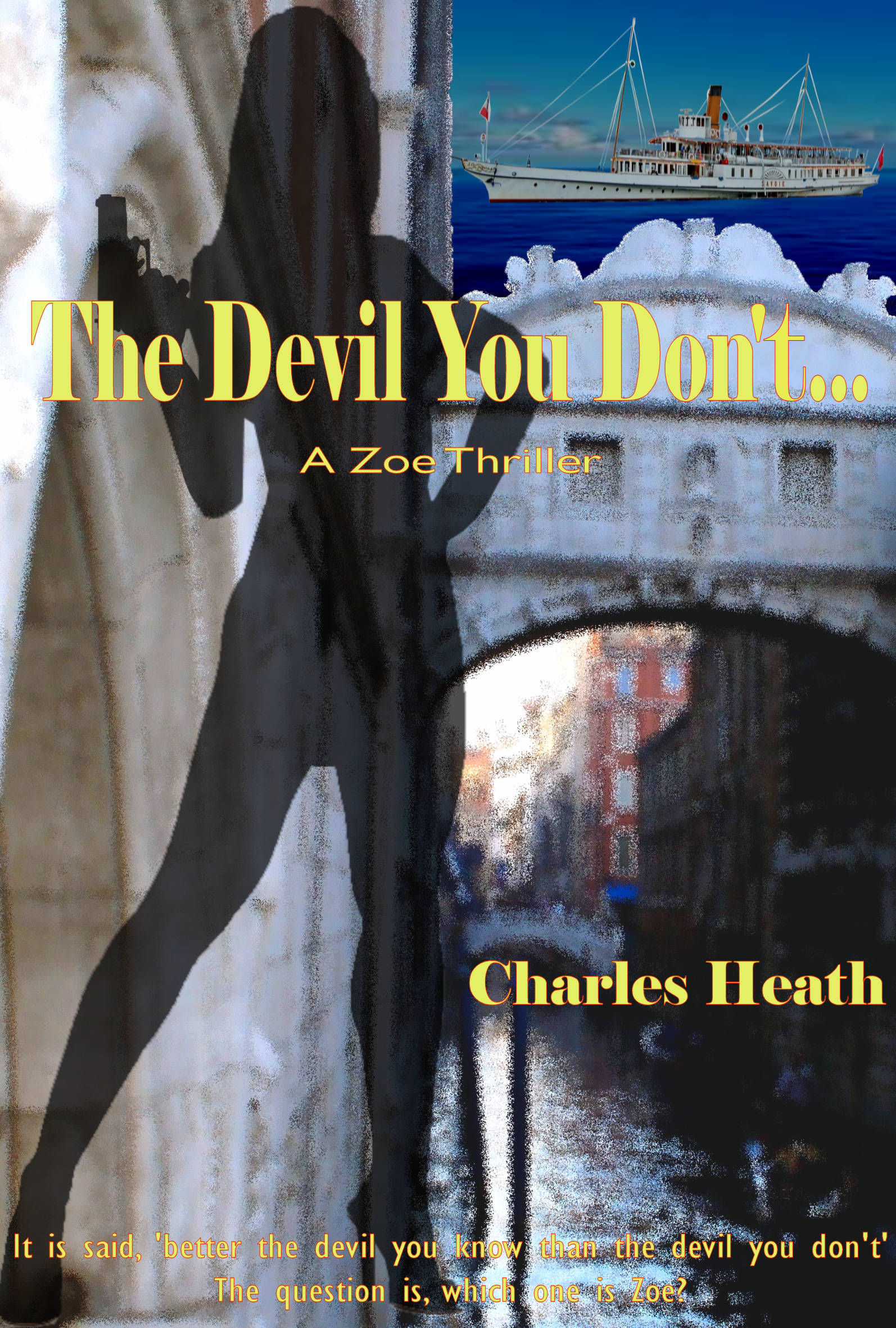
It could be said that of all the women one could meet, whether contrived or by sheer luck, what are the odds it would turn out to be the woman who was being paid a very large sum to kill you?
John Pennington is a man who may be lucky in business, but not so lucky in love. He has just broken up with Phillipa Sternhaven, the woman he thought was the one, but relatives and circumstances, and perhaps because she was a ‘princess’, may also have contributed to the end result.
So, what do you do when you are heartbroken?
That is a story that slowly unfolds, from the first meeting with his nemesis on Lake Geneva, all the way to a hotel room in Sorrento, where he learns the shattering truth.
What should have been solace after disappointment turns out to be something else entirely, and from that point, everything goes to hell in a handbasket.
He suddenly realises his so-called friend Sebastian has not exactly told him the truth about a small job he asked him to do, the woman he is falling in love with is not quite who she says she is, and he is caught in the middle of a war between two men who consider people becoming collateral damage as part of their business.
The story paints the characters, cleverly displaying all their flaws and weaknesses. The locations add to the story at times, taking me back down memory lane, especially to Venice, where, in those back streets, I confess it’s not all that hard to get lost.
All in all, a thoroughly entertaining story with, for once, a satisfying end.
Discovering La Paz: Five Hidden Gems Off the Beaten Path
Introduction Nestled amidst the towering peaks of the Andes, La Paz is a city of vibrant cultures and breathtaking landscapes. While many travellers flock to its iconic Witches Market and the Death Road, the Bolivian capital holds countless secrets for the curious. For those seeking an authentic, less-travelled journey, here are five extraordinary experiences that redefine what La Paz has to offer.
1. Cholitas Licking: A Celebration of Andean Identity Step into the striking world of the cholitas, traditional Aymara women, and immerse yourself in their fearless blend of style, resilience, and heritage. This unique cultural encounter, often described as “Cholitas Licking,” features fashion shows, workshops, and artisan markets where cholitas showcase their vibrant polleras (dresses) and colonial-era masks. More than a spectacle, this experience challenges stereotypes and honours indigenous identity. Visit their community centres in El Alto for a deeper understanding of their role as cultural ambassadors.
Tip: Respect cultural significance—ask for permission before photographing participants.
2. Kallawaya School of Traditional Healing: Ancient Wisdom in Modern Medicine Journey to the outskirts of La Paz to explore the Kallawaya School of Traditional Healing, a living archive of pre-Columbian medicinal knowledge. The Kallawaya people, renowned for their healing practices, offer workshops on herbal remedies, music therapy, and shamanic rituals. Wander their medicinal garden, where over 200 plant species are catalogued, and learn how to craft teas or tinctures for common ailments. This is a rare chance to connect with Bolivia’s spiritual and ecological heritage.
Tip: Book workshops in advance—offerings (regalos) to the mountain (apacheta) are customary.
3. Wuli Qhapaq Cable Car to Chimehua: Sky-High Serenity Traverse the urban sprawl of La Paz aboard the Wuli Qhapaq (Red) cable car network. While most travellers stick to the main routes, venture to the Chimehua line, a golden cable car that extends into the Illimani Valley. This lesser-known route offers panoramic views of the Illimani volcano and descends into the lush, remote countryside. Alight at a local farm for a chicha (corn beer) tasting or a guided hike through cloud forests teeming with orchids.
Tip: Bring a reusable bottle for coca tea from the local market—perfect for altitude adjustment.
4. Sopocachi Caves: Earth’s Hidden Art Gallery Just 20 minutes from downtown La Paz, the Sopocachi Cave System reveals a subterranean wonderland of stalactites, stalagmites, and ancient rock art. These caves, once inhabited by pre-Columbian communities, are adorned with mysterious symbols and animal carvings. The self-guided tour is affordable (£16-£20) and led by local guides who share tales of the caves’ role in ancestral rituals.
Tip: Visit early in the day to avoid crowds and bring a headlamp for optimal visibility.
5. Trek to the Valley of the Moon: A Martian Landscape While Salar de Uyuni is Bolivia’s most famous attraction, venture toward the Valley of the Moon (Valle de la Luna) for a quieter, equally dramatic experience. Located near Salar de Cotapata, this surreal red and orange badlands, sculpted by wind and erosion, feels like another planet. Guided day tours from La Paz (lasting 8-10 hours) include a detour to this hidden gem, where photography and hiking are unspoiled by crowds.
Tip: Visit during dry seasons (April–September) for the best colour contrasts without mud.
Conclusion: La Paz, Redefined La Paz is more than its skyline—it’s a gateway to the extraordinary. By stepping beyond the cobbled streets of the city, travellers can uncover traditions, landscapes, and communities that epitomise Bolivia’s soul. Whether you’re sipping chicha at a cloud forest farm or tracing your fingers along ancient rock art, these hidden adventures promise memories that linger long after your boots return to solid ground. So, pack your sense of curiosity and let La Paz surprise you.
Final Tip: Learn a few Aymara phrases—Suma qhapaq kama (Beautiful is the life well lived) is a poetic way to end your journey.
It could have been anywhere in the world, she thought, but it wasn’t. It was in a city where if anything were to go wrong…
She sighed, came away from the window and looked around the room. It was quite large and expensively furnished. It was one of several she had been visiting in the last three months.
Quite elegant too, as the hotel had its origins dating back to before the revolution in 1917. At least, currently, there would not be a team of KGB agents somewhere in the basement monitoring everything that happened in the room.
There was no such thing as the KGB anymore, though there was an FSB, but such organisations were of no interest to her.
She was here to meet with Vladimir.
She smiled to herself when she thought of him, such an interesting man whose command of English was as good as her command of Russian, though she had not told him of that ability.
All he knew of her was that she was American, worked in the Embassy as a clerk, nothing important, whose life both at work and at home was boring. Not that she had blurted that out the first time they met, or even the second.
That first time, at a function in the Embassy, was a chance meeting, a catching of his eye as he looked around the room, looking, as he had told her later, for someone who might not be as boring as the function itself.
It was a celebration honouring one of the Embassy officials’ service in Moscow, soon to be returning home after 10 years. She had been there one and still hadn’t met all the staff.
They had talked; Vladimir knew a great deal about England, having been stationed there for a year or two, and had politely asked questions about where she lived, her family, and, of course, what her role was, all questions she fended off with an air of disinterested interest.
It fascinated him, as she knew it would, a sort of mental sparring as one would do with swords if this were a fencing match.
They had said they might or might not meet again when the party was over, but she suspected there would be another opportunity. She knew the signs of a man interested in her, and Vladimir was.
The second time came in the form of an invitation to an art gallery and a viewing of the works of a prominent Russian artist, an invitation she politely declined. After all, invitations issued to Embassy staff held all sorts of connotations, or so she was told by the Security officer when she told him.
Then, it went quiet for a month. There was a party at the American embassy, and along with several other staff members, she was invited. She had not expected to meet Vladimir, but it was a pleasant surprise when she saw him, on the other side of the room, talking to several military men.
A pleasant afternoon ensued.
And it was no surprise that they kept running into each other at the various events on the diplomatic schedule.
By the fifth meeting, they were like old friends. She had broached the subject of being involved in a platonic relationship with him with the head of security at the embassy. Normally, for a member of her rank, it would not be allowed, but in this instance, it was.
She did not work in any sensitive areas, and, as the security officer had said, she might just happen upon something useful. In that regard, she was to keep her eyes and ears open and file a report each time she met him.
After that discussion, she got the impression her superiors considered Vladimir more than just a casual visitor on the diplomatic circuit. She also formed the impression that he might consider her an ‘asset’, a word that had been used at the meeting with security and the ambassador.
It was where the word ‘spy’ popped into her head and sent a tingle down her spine. She was not a spy, but the thought of it, well, it would be fascinating to see what happened.
A Russian friend. That’s what she would call him.
And over time, that relationship blossomed, until, after a visit to the ballet, late and snowing, he invited her to his apartment not far from the ballet venue. It was like treading on thin ice, but after champagne and an introduction to caviar, she felt like a giddy schoolgirl.
Even so, she had made him promise that he would remain on his best behaviour. It could have been very easy to fall under the spell of a perfect evening, but he promised, showed her to a separate bedroom, and after a brief kiss, their first, she did not see him until the next morning.
So, it began.
It was an interesting report she filed after that encounter, one she had expected to be reprimanded.
She wasn’t.
It wasn’t until six weeks had passed that he asked her if she would like to take a trip to the country. It would involve staying in a hotel, as always, in separate rooms. When she reported the invitation, no objection was raised, only a caution: keep her wits about her.
Perhaps, she had thought, they were looking forward to a more extensive report. After all, her reports on the places, the people, and the conversations she overheard were no doubt entertaining reading for some.
But on this visit, the nature of the relationship changed, and it was one that she did not immediately report. She had realised at some point before the weekend away that she had feelings for him, and it was not that he was pushing her in that direction or manipulating her in any way.
It was just one of those moments where, after a grand dinner, a lot of champagne, and delightful company, things happen. Standing at the door to her room, a lingering kiss, not intentional on her part, just happened.
And for not one moment did she believe she had been compromised, but for some reason she had not reported that subtle change in the relationship to the powers that be, and so far, no one had any inkling.
She took off her coat and placed it carefully on the back of one of the ornate chairs in the room. She stopped for a moment to look at a framed photograph on the wall, one representing Red Square.
Then, after a minute or two, she went to the minibar and took out the bottle of champagne left there for them, a treat Vladimir arranged for each encounter.
There were two champagne flutes set aside on the bar, next to a bowl of fruit. She picked up the apple and thought about how Eve must have felt in the Garden of Eden, and the temptation.
Later perhaps, after…
She smiled at the thought and put the apple back.
A glance at her watch told her it was time for his arrival. It was, if anything, the one trait she didn’t like, and that was his punctuality. A glance at the clock on the room wall was a minute slow.
The doorbell rang, right on the appointed time.
She put the bottle down and walked over to the door.
Building the Invisible Architecture: Why Every Novelist Must First Create a World They Believe In
“Every novelist must begin by creating himself a world, great or little, in which he can honestly believe.” — Joseph Conrad
When we open a novel, we aren’t just looking for a sequence of events. We are looking for a portal. We want to step out of the mundane architecture of our daily lives and inhabit somewhere else—whether that somewhere else is the misty decks of a 19th-century trading ship, the neon-lit alleys of a cyberpunk dystopia, or the quiet, devastating emotional landscape of a suburban kitchen.
But before a reader can ever step foot into that fictional realm, the author must build it, brick by invisible brick. And as Joseph Conrad famously noted, that process begins with belief.
If the writer doesn’t buy the reality of the world they are constructing, why should the reader?
Let’s explore what Conrad’s timeless wisdom means for modern novelists, world-building, and the psychological heavy lifting required to write fiction that resonates.
The Anatomy of Belief: What Does It Mean to “Believe” in Your World?
Belief in writing is not about magic systems, historical accuracy, or encyclopedic lore (though those things can help). It is about internal coherence and emotional truth.
When Conrad spoke of creating a world “great or little,” he wasn’t just talking about epic fantasy maps. A “little” world might be a single boarding house in Dublin, a courtroom during a three-day trial, or the strained silence across a breakfast table.
To believe in your world, you must know its gravity. You must understand:
The sensory reality: What does it smell like after a heavy rain? What is the quality of the light at 4:00 PM?
The unspoken rules: What do the inhabitants take for granted? What are the cultural taboos, economic pressures, and quiet griefs that shape their daily choices?
The moral pulse: Even if the author is entirely objective, the world must operate on a set of internal cause-and-effect dynamics where actions have real, believable consequences.
If you are writing a scene and you feel a twinge of artificiality—a sense that you are moving characters around like chess pieces just to get to the next plot point—you have stopped believing in your world. And the moment the author stops believing, the reader’s suspension of disbelief shatters like cheap glass.
World-Building is Self-Discovery
Notice the phrasing in Conrad’s quote: “creating himself a world.”
Before a novelist creates a world for the reader, they must create it for themselves. Writing a novel is an act of self-interrogation. The world you build often becomes a mirror for your own obsessions, fears, questions, and philosophies.
Tolkien didn’t just invent Middle-earth for the sake of an adventure; he built it out of a profound love for lost mythologies and philology, creating languages that necessitated a world to speak them.
Austen mapped the rigid, polite, and deeply economic marriage market of 19th-century England because she was keenly interested in the intersection of female autonomy, social survival, and genuine affection.
When you sit down to write, your fictional world is your testing ground. It is the ecosystem where you explore what you actually believe about human nature, power, love, and betrayal. If your heart isn’t invested in the truths of that ecosystem, your prose will lack the pulse of life.
The Danger of the “Cardboard Set”
We have all read books that feel like movie sets made of painted cardboard. The dialogue is snappy, the plot moves fast, but the moment a character leans against a wall, you feel like the whole thing might tip over.
This happens when a writer focuses entirely on mechanics rather than immersion. They outline the plot beats, design the twists, but fail to inhabit the space.
To avoid the cardboard set trap, adopt Conrad’s mindset:
Dig deeper than the surface details. Don’t just invent a futuristic city; figure out where the garbage goes, who cleans the streets, and what people sing when they’re drunk.
Let the world talk back. A believable world has momentum. When your characters make a choice, the world should react in ways that aren’t always convenient for your outline.
Write for the senses, not just the intellect. Bring your scenes to life through texture, temperature, and tone.
How to Cultivate Radical Belief in Your Writing
If you are struggling to connect with your story-world, how do you bridge the gap? How do you reach that state of honest belief?
Write toward the unknown: Don’t plan every single square inch before you start. Leave room for discovery. Sometimes, believing in your world means exploring it alongside your characters, letting it surprise you.
Anchor the fantastical in the visceral: If you are writing high fantasy or hard sci-fi, ground the extraordinary in ordinary human experiences. A dragon rider still gets a sore back; a starship captain still worries about aging or estranged children.
Interrogate your own cynicism: If you find yourself rolling your eyes at your own plot developments, stop. Figure out why. Fix the underlying logic until you can nod to yourself and say, Yes, that is how this world works.
Final Thoughts: The Invitation to the Reader
Writing a novel is an act of supreme audacity. You are essentially asking a complete stranger to sit in a quiet room, look at a series of black symbols on a white page, and hallucinate an entire reality for several hours.
The only way that magic trick works is if your own conviction is absolute.
When you create a world—whether it spans galaxies or exists entirely within the confines of a single room—you must believe in it first. Pour your curiosity, your empathy, and your attention into its soil. Because when you honestly believe in the world you’ve made, the reader won’t just visit it—they will live in it.
Are you currently building a fictional world? What is the hardest part of making it feel real to you—the physical details, the emotional stakes, or the internal logic? Let us know in the comments below!
This story has been ongoing since I was seventeen, and just to let you know, I’m 72 this year.
Yes, it’s taken a long time to get it done.
Why, you might ask.
Well, I never gave it much interest because I started writing it after a small incident when I was 17, and working as a book packer for a book distributor in Melbourne
At the end of my first year, at Christmas, the employer had a Christmas party, and that year, it was at a venue in St Kilda.
I wasn’t going to go because at that age, I was an ordinary boy who was very introverted and basically scared of his own shadow and terrified by girls.
Back then, I would cross the street to avoid them
Also, other members of the staff in the shipping department were rough and ready types who were not backwards in telling me what happened, and being naive, perhaps they knew I’d be either shocked or intrigued.
I was both adamant I wasn’t coming and then got roped in on a dare.
Damn!
So, back then, in the early 70s, people looked the other way when it came to drinking, and of course, Dutch courage always takes away the concerns, especially when normally you wouldn’t do half the stuff you wouldn’t in a million years
I made it to the end, not as drunk and stupid as I thought I might be, and St Kilda being a salacious place if you knew where to look, my new friends decided to give me a surprise.
It didn’t take long to realise these men were ‘men about town’ as they kept saying, and we went on an odyssey. Yes, those backstreet brothels where one could, I was told, have anything they could imagine.
Let me tell you, large quantities of alcohol and imagination were a very bad mix.
So, the odyssey in ‘The things we do’ was based on that, and then the encounter with Diana. Well, let’s just say I learned a great deal about girls that night.
Firstly, not all girls are nasty and spiteful, which seemed to be the case whenever I met one. There was a way to approach, greet, talk to, and behave.
It was also true that I could have had anything I wanted, but I decided what was in my imagination could stay there. She was amused that all I wanted was to talk, but it was my money, and I could spend it how I liked.
And like any 17-year-old naive fool, I fell in love with her and had all these foolish notions. Months later, I went back, but she had moved on, to where no one was saying or knew.
Needless to say, I was heartbroken and had to get over that first loss, which, like any 17-year-old, was like the end of the world.
But it was the best hour I’d ever spent in my life and would remain so until I met the woman I have been married to for the last 48 years.
As Henry, he was in part based on a rebel, the son of rich parents who despised them and their wealth, and he used to regale anyone who would listen about how they had messed up his life
If only I’d come from such a background!
And yes, I was only a run away from climbing up the stairs to get on board a ship, acting as a purser.
I worked for a shipping company and they gave their junior staff members an opportunity to spend a year at sea working as a purser on a cargo ship that sailed between Melbourne, Sydney and Hobart in Australia.
One of the other junior staff members’ turn came, and I would visit him on board when he would tell me stories about life on board, the officers, the crew, and other events. These stories, which sounded incredible to someone so impressionable, were a delight to hear.
Alas, by that time, I had tired of office work and moved on to be a tradesman at the place where my father worked.
It proved to be the right move, as that is where I met my wife. Diana had been right; love would find me when I least expected it.
I’m back home and this story has been sitting on a back burner for a few months, waiting for some more to be written.
The trouble is, there are also other stories to write, and I’m not very good at prioritising.
But, here we are, a few minutes opened up and it didn’t take long to get back into the groove.
A body and a whole bunch of questions.
A full minute passed, with only one car passing, the rest of the time there was a strange sort of silence.
The man on the ground didn’t move. Whoever shot him had shot to kill. I took the few steps to stand beside him and could see the hole and the bloodstain of the wound. Shot in the heart, instant death.
Usually, if it was a sniper, it was a head shot. Less chance of missing a vital organ and leaving the target alive.
Odd too that it was just before he told me where some ‘evidence’ was located. And who the hell was this Alfred Nobbin?
I heard a car turn into the alley and come towards me. Halfway, it stopped, the engine switched off, and the doors opened.
Two men. Maury, my handler, and Severin, the instructor. Neither was carrying a gun, so neither had shot him. That meant someone else was still in play.
I said, “I had him, but someone shot him.”
Stating the obvious, Maury’s expression told me.
“You’re not dead.”
“Perhaps I wasn’t a target.”
“Today. Did he say who he was?”
“No.”
No hesitation or they’ll think I’m lying, which I am. I was not sure why, but was it because I detected a note of sincerity in the target’s tone?
“Checked for identification yet?”
“Just about to.” I knelt down and went through his pockets. Nothing. I told Maury that.
“Pity.” He hadn’t moved from where he stopped. Severin had been looking back up the alley, no doubt looking for where the bullet came from.
Had he reached the same conclusion I had, a balcony on the third floor of the left-hand building? The shooter would be long gone by now.
A white van pulled into the lane and pulled up behind Maury’s car. The cleaners.
It raided questions. How did Maury know we’d be here, and that the target would be shot dead? Or had he assumed I’d all but kill him in revenge for what had happened to the others.
What had happened to the others?
“The rest of the team,” I asked.
“Two dead, one critical. One safe. Let’s go. We need to have a debriefing.”
I took a last look at the body, the joined Maury and Severin in the car. I had questions of my own.
“A bad day’s work,” Severin muttered, as he drove off.
“But conclusive proof we have a traitor, the last thing we need right now.”
I was surprised they were discussing high-level matters that I considered above my pay grade. And, I had to say, it worried me.
Williams’ Restaurant, East 65th Street, New York, Saturday, 8:00 p.m.
We met the Blaines at Williams’, a rather upmarket restaurant that the Blaines frequently visited and had recommended.
Of course, during the taxi ride there, Alison reminded me that with my new job, we would be able to go to many more places like Williams’. It was, at worst, more emotional blackmail, because as far as Alison was concerned, we were well on our way to posh restaurants, the Trump Tower Apartments, and the trappings of the ‘executive set’.
It would be a miracle if I didn’t strangle Elaine before the night was over. It was she who had filled Alison’s head with all this stuff and nonsense.
Aside from the half-frown, half-smile, Alison was looking stunning. It had been months since she had last dressed up, and she was especially wearing the dress I’d bought her for our 5th anniversary that cost a month’s salary. On her, it was worth it, and I would have paid more if I had to. She had adored it and me, for a week or so after.
For tonight, I think I was close to getting back on that pedestal.
She had the looks and figure to draw attention, the sort movie stars get on the red carpet, and when we walked into the restaurant, I swear there were at least five seconds of silence, and many more gasps.
I even had a sudden loss of breath earlier in the evening when she came out of the dressing room. Once more, I was reminded of how lucky I was that she had agreed to marry me. Amid all those self-doubts, I couldn’t believe she had loved me when there were so many others out there who were more appealing.
Elaine was out of her seat and came over just as the Head Waiter hovered into sight. She personally escorted Alison to the table, allowing me to follow like the Queen’s consort, while she and Alison basked in the admiring glances of the other patrons.
More than once, I heard the muted question, “Who is she?”
Jimmy stood, we shook hands, and then we sat together. It was not the usual boy, girl, boy, girl seating arrangement. Jimmy and I on one side and Elaine and Alison on the other.
The battle lines were drawn.
Jimmy was looking fashionable, with a permanent blade one beard, unkempt hair, and a designer dinner suit that looked like he’d slept in it. Alison insisted I wear a tuxedo, and I looked like the proverbial penguin or just a thinner version of Alfred Hitchcock.
The bow tie had been slightly crooked, but just before we stepped out, she had straightened it. And took the moment to look deeply into my soul. It was one of those moments when words were not necessary.
Then it was gone.
I relived it briefly as I sat and she looked at me. A penetrating look that told me to ‘behave’.
When we were settled, Elaine said, in that breathless, enthusiastic manner of hers when she was excited, “So, Harry, you are finally moving up.” It was not a question, but a statement.
I was not sure what she meant by ‘finally’, but I accepted it with good grace. Sometimes, Elaine was prone to using figures of speech I didn’t understand. I guessed she was talking about the new job. “It was supposed to be a secret.”
She smiled widely. “There are no secrets between Al and me, are there, Al?”
I looked at ‘Al’ and saw a brief look of consternation.
I was not sure Alison liked the idea of being called Al. I tried it once and was admonished. But it was interesting that her ‘best friend forever’ was allowed that distinction when I was not. It was, perhaps, another indicator of how far I’d slipped in her estimation.
Perhaps, I thought, it was a necessary evil. As I understood it, the Blaines were our mentors at the Trump Tower, because they didn’t just let ‘anyone’ in. I didn’t ask if the Blaines thought we were just ‘anyone’ before I got the job offer.
And then there was that look between Alison and Elaine, quickly stolen before Alison realised I was looking at both of them. I was out of my depth, in a place I didn’t belong, with people I didn’t understand. And yet, apparently, Alison did. I must have missed the memo.
“No,” Alison said softly, stealing a glance in my direction, “No secrets between friends.”
No secrets. Her look conveyed something else entirely.
The waiter brought champagne, Krug, and poured glasses for each of us. It was not the cheap stuff, and I was glad I brought a couple of thousand dollars with me. We were going to need it.
Then, a toast.
To a new job and a new life.
“When did you decide?” Elaine was effusive at the best of times, but with the champagne, it was worse.
Alison had a strange expression on her face. It was obvious she had told Elaine it was a done deal, even before I’d made up my mind. Perhaps she’d assumed I might be ‘refreshingly honest’ in front of Elaine, but it could also mean she didn’t really care what I might say or do.
Instead of consternation, she looked happy, and I realised it would be churlish, even silly, if I made a scene. I knew what I wanted to say. I also knew that it would serve little purpose provoking Elaine or upsetting Alison. This was not the time or the place. Alison had been looking forward to coming here, and I was not going to spoil it.
Instead, I said, smiling, “When I woke up this morning and found Alison missing. If she had been there, I would not have noticed the water stain on the roof above our bed, and decided there and then how much I hated the place.” I used my reassuring smile, the one I used with the customers when all hell was breaking loose, and the forest fire was out of control. “It’s the little things. They all add up until one day …” I shrugged. “I guess that one day was today.”
I saw an incredulous look pass between Elaine and Alison, a non-verbal question; perhaps, is he for real? Or, I told you he’d come around.
I had no idea the two were so close.
“How quaint,” Elaine said, which just about summed up her feelings towards me. I think, at that moment, I lost some brownie points. It was all I could come up with at short notice.
“Yes,” I added, with a little more emphasis than I wanted. “Alison was off to get some studying in with one of her friends.”
“Weren’t the two of you off to the Hamptons, a weekend with some friends?” Jimmy piped up and immediately got the ‘shut up, you fool’ look that cut that line of conversation dead. Someone forgot to feed Jimmy his lines.
It was followed by the condescending smile from Elaine, and “I need to powder my nose. Care to join me, Al?”
A frown, then a forced smile for her new best friend. “Yes.”
I watched them leave the table and head in the direction of the restroom, looking like they were in earnest conversation. I thought ‘Al’ looked annoyed, but I could be wrong.
I had to say Jimmy looked more surprised than I did.
There was that odd moment of silence between us, Jimmy still smarting from his death stare, and for me, the Alison and Elaine show. I was quite literally gob-smacked.
I drained my champagne glass, gathering some courage and turned to him. “By the way, we were going to have a weekend away, but this legal tutorial thing came up. You know Alison is doing her law degree.”
He looked startled when he realised I had spoken. He was looking intently at a woman several tables over from us, one who’d obviously forgotten some basic garments when getting dressed. Or perhaps it was deliberate. She’d definitely had some enhancements done.
He dragged his eyes back to me. “Yes. Elaine said something or other about it. But I thought she said the tutor was out of town and it had been postponed until next week. Perhaps I got it wrong. I usually do.”
“Perhaps I’ve got it wrong.” I shrugged as the dark thoughts started swirling in my head again. “This week or next, what does it matter?”
Of course, it mattered to me, and I digested what he said with a sinking heart. It showed there was another problem between Alison and me; she might have been telling me lies. If what he said was true and I had no reason to doubt him, where was she going tomorrow morning, and had she really been with a friend studying today?
We poured some more champagne, had a drink, then he asked, “This promotion thing, what’s it worth?”
“Trouble, I suspect. Definitely more money, but less time at home.”
“Oh,” raised eyebrows. Obviously, the women had not talked about the job in front of him, or, at least, not all the details. “You sure you want to do that?”
At last, the voice of reason. “Me? No.”
“Yet you accepted the job.”
I sucked in a breath or two while I considered whether I could trust him. Even if I couldn’t, I could see my ship was sinking, so it wouldn’t matter what I told him, or what Elaine might find out from him. “Jimmy, between you and me, I haven’t as yet decided one way or another. To be honest, I won’t know until I go up to Barclay’s office and he asks me the question.”
“Barclay?”
“My boss.”
“Elaine’s doing a job for a Barclay who recently moved into the tower a block down from us. I thought I recognised the name.”
“How did Elaine get the job?”
“Oh, Alison put him onto her.”
“When?”
“A couple of months ago. Why?”
I shrugged and tried to keep a straight face, while my insides were churning up like the wake of a supertanker. I felt sick, faint, and wanted to die all at the same moment. “Perhaps she said something about it, but it didn’t connect at the time. Too busy with work, I expect. I think I seriously need to get away for a while.”
I could hardly breathe, my throat was constricted, and I knew I had to keep it together. I could see Elaine and Alison coming back, so I had to calm down. I sucked in some deep breaths and put my ‘manage a complete and utter disaster’ look on my face.
And I had to change the subject, quickly, so I said, “Jimmy, Elaine told Alison, who told me, you were something of a guru of the cause and effects of the global economic meltdown. Now, I have a couple of friends who have been expounding this theory …”
Like flicking a switch, I launched into the well-worn practice of ‘running a distraction’, like at work when we needed to keep the customer from discovering the truth. It was one of the things I was good at, taking over a conversation and pushing it in a different direction. It was salvaging a good result from an utter disaster, and if ever there was a time that it was required, it was right here, right now.
When Alison sat down and looked at me, she knew something had happened between Jimmy and me. I might have looked pale or red-faced, or angry or disappointed, but it didn’t matter. If that didn’t seal the deal for her, the fact that I took over the dining engagement did. She knew well enough that the only time I did that was when everything was about to go to hell in a handbasket. She’d seen me in action before and had been suitably astonished.
But I got into gear, kept the champagne flowing and steered the conversation, as much as one could from a seasoned professional like Elaine, and, I think, in Jimmy’s eyes, he saw the battle lines and knew who took the crown on points. Neither Elaine nor Jimmy suspected anything, and if the truth be told, I had improved my stocks with Elaine. She was at times both surprised and interested, even willing to take a back seat.
Alison, on the other hand, tried poking around the edges, and, once when Elaine and Jimmy had got up to have a cigarette outside, questioned me directly. I chose to ignore her and pretend nothing had happened, rather than tell her how much I was enjoying the evening.
She had her ‘secrets’. I had mine.
At the end of the evening, when I got up to go to the bathroom, I was physically sick from the pent-up tension and the implications of what Jimmy had told me. It took a while for me to pull myself together; so long, in fact, that Jimmy came looking for me. I told him I’d drunk too much champagne, and he seemed satisfied with that excuse. When I returned, both Alison and Elaine noticed how pale I was, but neither made any comment.
It was a sad way to end what was supposed to be a delightful evening, which, to a large degree, it was for the other three. But I had achieved what I set out to do: to play them at their own game, watching the deception once I knew there was one, as warily as a cat watches its prey.
I had also discovered Jimmy’s real calling; a professor of economics at the same University Alison was doing her law degree. It was no surprise in the end, on a night where surprises abounded, that the world could really be that small.
We parted in the early hours of the morning, a taxi whisking us back to the Lower East Side, another taking the Blaines back to the Upper West Side. But, in our case, as Alison reminded me, it would not be for much longer. She showed concern for my health and asked me what was wrong. It took all the courage I could muster to tell her it was most likely something I ate and the champagne, and that I would be fine in the morning.
She could see quite plainly it was anything other than what I told her, but she didn’t pursue it. Perhaps she just didn’t care what I was playing at.
And yet, after everything that had happened, once inside our ‘palace’, the events of the evening were discarded, like her clothing, and she again reminded me of what we had together in the early years before the problems had set in.
It left me confused and lost.
I couldn’t sleep because my mind had now gone down that irreversible path that told me I was losing her, that she had found someone else, and that our marriage was in its last death throes.
And now I knew it had something to do with Barclay.
Every time I close my eyes, I see something different.
I’d like to think the cinema of my dreams is playing a double feature but it’s a bit like a comedy cartoon night on Fox.
But these dreams are nothing to laugh about.
Once again there’s a new installment of an old feature, and we’re back on the treasure hunt.
…
Back to the newspaper office
…
I went around to Boggs’s house on the chance that he might have come home, just as his mother was heading off to her night job. I raised the possibility that something might have happened to him but she didn’t agree, nor did she look all that concerned.
The fact he had experience in cave exploration and used to camping out with his father and later uncle Rico and had told he might not be back for a few days was not cause for concern, and we left it at that, telling her I would drop in again soon.
She didn’t seem to think that he might get into trouble considering the instability of some of the caves, nor the fact they have warning signs and or been boarded up to stop explorers concern her.
The possibility it could happen and had happened to others, bothered me, as was the fact he was starting to emulate his father with this obsession. If the story in the paper was anything to go by, at worst he could finish up just like his father, buried under a pile of rubble.
Did I believe that was where his father was?
I didn’t know what to think, because the waters were so muddied by people who were driven by self-interest.
There was so much more to this story, mostly driven by self-interest, revenge perhaps, and, worse, greed. It was perhaps a symptom of everything that had gone wrong in not only this town but what was happening on a much larger scale to the whole country. But, that was someone else’s problem. My concern was here, now, and saving Biggs from following the same destructive path his father had
And, to do that, I needed to know more. That meant, first thing the next morning, a trip to the newspaper office.
When I returned to the newspaper office Lenny was in his usual seat with a paper in hand, reading. Keeping up with the competition, he said, though the difference in circulation was counted in millions.
There was a woman behind the other desk.
“Staff journalist,” he said when he saw me looking at her. “And family. My wife, Jennifer.”
I’d not seen her before, and she didn’t come from here, or I would have recognized her.
She smiled, and there was something in that expression that struck me as familiar.
“Are you related to the Ormistons?”
It was a vague resemblance, after seeing so many pictures of the Ormistons, that everyone looked like them.
“It’s a name I don’t use anymore,” she said, “for obvious reasons. My grandfather stirred a lot of resentment.”
“And,” Lenny added, “it’s between us and these four walls, Sam.”
I nodded. I could understand the sentiment. And it explained Lenny’s depth of knowledge.
“Just to be clear, your grandfather didn’t find the treasure?”
She sighed.
Lenny said, sharply, “Sam!”
I shrugged. “Sorry. I had to ask.”
“No, he did not, and believe me, that’s a sore point with everyone whose lives he destroyed.”
“I can imagine. Does anyone know what happened to him, the real story?”
“There is no real story Sam. I tried to discover the truth and failed. For Jennifer’s peace of mind. We may never know what happened to him.”
“But surely you don’t believe he died in a cave somewhere?”
“It’s the most plausible.”
“And what about Boggs’s father?”
“He was a fool,” Jennifer said. “From what I remember of him, he was always insistent that the treasure was in a cavern up in the hills, accessible only by an underground river that flowed down to the sea. He originally thought it was the one the mall was built over, except every cave had a dead end.”
“Before or after the mall was built?”
“My father explored the cave system, with my grandfather, extensively, before the mall was built. There was no underground river.”
“How did the mall get destroyed in a flood then?”
“That was the Benderby’s cost-cutting the foundations. The flooding was man-made, not an act of nature like they said it was. That was just so they could claim the insurance. No one could really tell the difference, and the specialist the got to sign off on it lied. The same guy that turned up dead on Rico’s boat, by the way.”
“The Benderby’s cleaning up another mess, but their way.” Jennifer sounded, and probably had every right to be, resentful.
“Then there still could be an underground river somewhere along the coast?”
“If there is, I haven’t found it, and neither has Alex and that fancy boat of his. It’s another dead end, and like as not, another nail in the coffin of what was a fairy tale, to begin with. There was no treasure, just a fable invented by the Cossatinos.”
“Even so, it’s part of the folklore of this county and will have a place in the history I’m writing. I noticed over the years the treasure had a prominent place in the paper.”
“My father, and his before him thought it would be good for the town. You know, bring in tourists. It was my father’s idea to print treasure maps, and then the Cossatino’s embellished it but producing what they called ‘the real map’ each a slight variation on the other, commanding a special fee, and swearing the purchases to a promise of silence, and adding to the authenticity, demanding a 19 percent share of whatever they found. People lapped it up and my father said they’d made a fortune out of it. Boggs’s father hand-made the copies, and used that money to fund his own explorations. Everyone made money out of it, one way or another except Ormiston.”
A bitter irony if there was ever one. There was more money in the illusion of treasure than the actual treasure itself.
“And the so-called real map that Boggs reputedly found in the pirate’s hideaway?”
“No one ever saw it, except that one time it was authenticated age-wise, so no one ever got to see it. Boggs made sure of that, and never let it out of his sight. Now we’ll never know. I’m sure Boggs junior doesn’t have it, but with him, he’s as daft as his father was.”
“He had a lot of his father’s stuff he found in a box in the attic recently. I’ve seen some of it, but not an authentic map, so maybe your right.”
“Of course I am. When you have an idea of what this history of yours is going to look like, let me know. And I’ll publish it in parts if you want, maybe pass it on to the dailies. It might be worth something.”
“Thanks. I will. But more study first, you have the history of the place in that back room, maybe you should write something yourself. Being the journalist.”
“Too busy with births deaths and marriages, Sam, and the antics of the Benderby’s and Cossatino’s. You know that Benderby is demolishing the mall and putting a marina in its place? Talk of building a hotel, boosting tourism. Talking of running for mayor, you know, the first stop on the way to the presidency?”
“A crook for a mayor?”
“Wouldn’t be the first, won’t be the last. But one thing is for sure, that kind of news sells papers.”
It did, but I had a feeling the Benderby’s were all about creating a distraction, and something else was going on at that mall site.
Leave, Vacation, or Holiday – don’t you deserve a break?
Some people we know have come up for a holiday in what could be described as a very touristy location.
But is it for a ‘holiday’?
They have come from one state and are staying in what could be called an apartment, not a hotel. They are here for a week.
So, they have a kitchen of sorts and can cook their own meals, unlike staying in a hotel room and having to eat out or in the hotel restaurant, and the apartment has a mini laundry.
How much different is this to being at home?
Perhaps we need to have a definition of the word ‘holiday’ and its variations. A lot of people’s use the term ‘vacation’. Others use the term ‘leave’. Leave’s a difficult term because it can cover a number of types such as annual, sick, and maternity.
But whatever we want to call it, is it when you’re taking some time away from work.
Is it when you go ‘away’, that is to say anywhere but home?
You say, ‘I’m going on vacation.”
We say, “Oh, where are you going?”
Some say camping. Is that any different than staying in an apartment, or even a holiday house? Still all the same chores, cooking, cleaning, washing.
Is this why so many people are now going on cruises and hotels are so full these days.
There will always those who will go camping and stay is self-serve places like apartments, but for me, a holiday is staying in a five-star hotel where the only worry is where the nearest dry cleaner is.
Writing isn’t just about putting words on a page; it’s a craft that demands focus, organisation, and the right set of tools to bring ideas to life. The software you choose can:
Boost productivity – by cutting down on manual formatting and navigation.
Protect your creative flow – by offering distraction‑free modes and version control.
Scale with your project – from a single‑page article to a 500‑page novel or a multi‑chapter research thesis.
With a flood of options on the market, two camps dominate the conversation:
Run‑of‑the‑mill word processors (Microsoft Word, Google Docs, Apple Pages).
Let’s dive deep into the strengths, weaknesses, and ideal use‑cases for each, so you can make an informed decision that aligns with your workflow.
1. Dedicated Writing Software – The Specialist’s Toolkit
1.1 What Makes a “Dedicated” App Different?
Dedicated writing apps are built from the ground up for long‑form, project‑based writing. They go beyond the classic “type‑and‑print” paradigm and provide:
4. Practical Tips to Get the Most Out of Your Chosen Software
Start with a Template – Most dedicated apps ship with ready‑made templates that handle margins, headers, and chapter styles. Save time by customising once and reusing.
Leverage Cloud Sync – Even if you love Scrivener, store your project folder in Dropbox or OneDrive to protect against hardware loss.
Combine Tools – Write first drafts in a distraction‑free environment (Scrivener, Ulysses, or even a plain‑text editor), then import into Word for final formatting and submission.
Use Keyboard Shortcuts – Learn the top 10 shortcuts for your platform; they shave seconds off every page.
Backup Regularly – Set up an automatic backup schedule (e.g., weekly zip of your project folder) regardless of cloud storage.
5. Bottom Line: There Is No One‑Size‑Fits‑All Answer
If your writing is project‑heavy, non‑linear, and you need robust organisation, dedicated software like Scrivener (or its Mac‑centric cousins) is the clear winner.
If you work primarily in teams, need instant collaboration, or are delivering polished documents to publishers or academia, Microsoft Word or Google Docs will serve you better.
My personal recommendation? Use a hybrid workflow: draft and outline in Scrivener for its unrivalled project management, then export your manuscript to Word for final polishing, formatting, and sharing. For collaborative pieces, switch to Google Docs during the editing phase, then bring the clean version back into Word.
Bonus: Quick Comparison Chart
Feature
Scrivener
Ulysses
Microsoft Word
Google Docs
Project Binder
Distraction‑Free Mode
Real‑Time Collaboration
(online)
Advanced Export (ePub, Kindle)
(needs add‑on)
Citation Management
Limited
Limited
(via add‑ins)
(via add‑ons)
Price (as of 2026)
$49 (one‑time)
$49.99/yr
$149.99 (Microsoft 365)
Free (Google Workspace)
Learning Curve
Moderate
Low
Low
Low
Take Action Today
Identify your primary writing goal (novel, article, thesis, team report).
Match the goal to the software using the matrix above.
Download a free trial (Scrivener offers a 30‑day trial; Word has a 60‑day Microsoft 365 trial).
Test a small project—write a single chapter or a 1,000‑word article. Observe how the tool fits your workflow.
Commit to the software that feels like an extension of your creative mind, not a barrier.


 (online)


 (needs add‑on)
 (via add‑ins)
 (via add‑ons)

