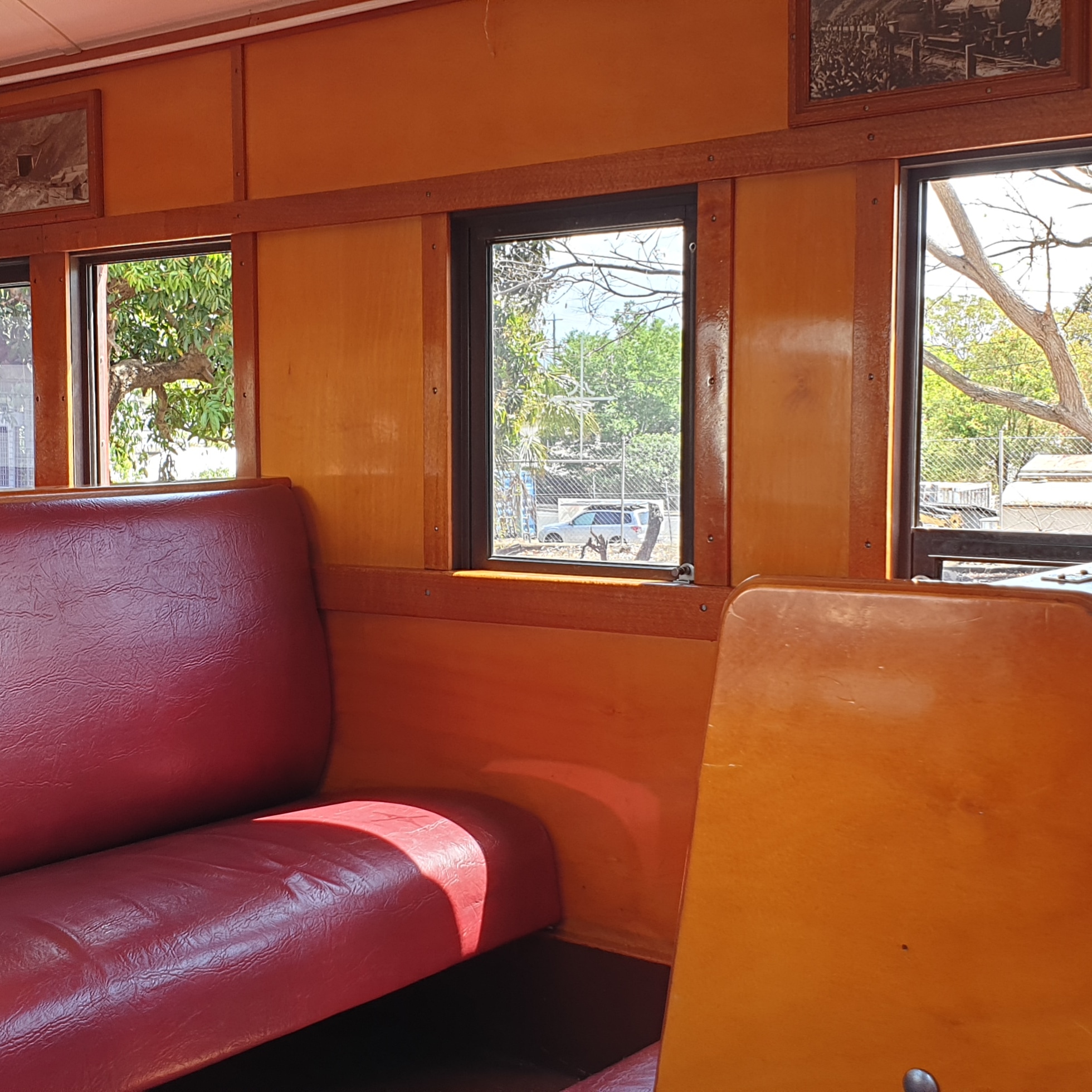
A photograph from the inspirational bin – 10

It was a relic from the past, put back together by a dedicated group of volunteers who had not wanted the last vestiges of the past to disappear.

Train enthusiasts, the called themselves.

They’d put together a steam locomotive, five carriages, a restaurant car, and the conductor’s car. The original train might have been twice to three times as long, but these days, the tourist market rarely filled the train.

I was one of a group who made it their mission to visit and rate every vintage train, not only in this country, but all over the world. It was a sad state of affairs when I first began, with locomotives and carriages dropping out of the system due to lack of funds, but more disheartening, the lack of government assistance in keeping it’s heritage alive.

It seemed money was short, and there were better things to spend it on, like two brand new 737-800 jets just to ferry the prime minister and government officials around. Just think of what that quarter of a billion dollars could have bought in heritage.

But it is what it is.

What I had before me was one of the most recent restorations to check out, and on first glance, it was remarkable just how lifelike and true to age it was.

Of course, I was of an age that could remember the old railway carriages, what were called red rattlers because of the ill fitting windows that went up and down, allow fresh air, or in days gone by, smoke from the locomotive hauling the train. I had not travelled during the last glorious years of steam, but the carriages had lived on briefly before the advent of the sterile aluminum tin cans with uncomfortably hard seats.

These carriages were built for comfort, and my first experience had been a five hour trip from Melbourne to Wangaratta, in Victoria, on my way to Mt Buffalo Chalet, a guesthouse owned by the Railways.

That too had been a remarkable old chalet style guest house with a room and all the dining included. I always left after the week having put on weight. Breakfast, morning tea, lunch, afternoon tea, and dinner, every day, and high tea on Sunday.

But this carriage, the polished wood that had shellac rather than varnish, highlighting the timber’s grain, the leather seats with generous padding, the curved ceilings with hanging lights, windows the could be opened and closed, allowing fresh air to circulate.

There was also a carriage with the passageway, and five or six separate compartments, each sitting six passengers. I remembered these well, having quite often ridden in one to work for some years when the country trains still ran.

It was always remarkable how a sight or a scent could trigger such memories.

For this carriage on this train, it used to ply the Gympie to Brooloo branch line from about 1915 onwards.

That was the history. It only went as far as Amamoor these days, it was still long enough to capture the sensation of riding the rails back in what is always referred to as the good old days, even if they were not.

Now for the ride….

© Charles Heath 2021

The cinema of my dreams – Was it just another surveillance job – Episode 29

I’m back home and this story has been sitting on a back burner for a few months, waiting for some more to be written.

The trouble is, there are also other stories to write, and I’m not very good at prioritizing.

But, here we are, a few minutes opened up and it didn’t take long to get back into the groove.

Chasing leads, maybe

Alone in the room, Herman returned.  I hadn’t seen him leave, but he was a cat, and cats were adept at slinking around, quietly stalking their quarry.  On the edge of that threshold between passage and living room, he was sitting, watching me.

“So, Herman.  The stories you could tell, eh?”

It elicited a meow and a deadpan expression.  No point in trying to read his mind, I’d probably finish up with a headache.

“Don’t suppose you could tell me where O’Connell’s secret hideout is?”

Another meow.

If he could talk no doubt he was saying that he wouldn’t tell me even if I tried to bribe him.  I thought about it, but instead went over to the door and opened it about six inches.

“You can go now.  It’s not safe, for man, woman or cat.”

Nothing this time.

“You’d better go before I change my mind.”

We were having a staring match.

Was that a nod?  He stood and started walking towards the door.  Perhaps he sensed I might close it just before he made it there.  Then, in a flash, he was gone.

I shrugged, and followed him out, closing the door behind me.

He was fast.  He was nowhere in sight.  Places to go no doubt.

Like me.

Only I wasn’t quite sure where it was.  I pulled out the piece of paper that was for a flat for sale, with several part words on it, ‘oak’ and underneath it, ‘Brom’.

It had to be part of the street name and a suburb.  The ‘Brom was obviously Bromley, the other a part of the street address.

I needed to find an internet café and do some research.  I also needed a new cell phone, but that could wait.  The main problem was finding an internet café, once just about on every corner, but now, with everyone owning a smartphone, there were very few to be found.

It took an hour before I found one in a back street in an area where there were several low-cost hotels, the sort that backpackers stayed in.

Armed with coffee and a sandwich, I began the search, starting with the realtor, and found the listing was no longer available, that is, not on their internet site.  It told me that the flat was taken up, possibly by O’Connell.

Next, I brought up a map application and put in the address, for information on both pieces of paper and ended up with Oakwood Avenue of Bromley Road, nearer to Beckenham than Bromley.

I had the flat number, now all I had to do was check it out.

Another search on the computer gave me the relative times, and a map to follow, by bus, train, and car.  I would have to get my car, which would take about half an hour, then drive out to the address which would take a further half-hour.

The flat was on the ground floor, and the realtor’s brochure had the layout of the block, and where the flat was located.  That it was on the ground floor and on a corner would make it easier to gain access without causing any trouble.

I would time my arrival for after dark so that I would go relatively unnoticed.  

© Charles Heath 2020

365 Days of writing, 2026 – 23

Day 23 – The subtle art of getting a message across

The Subtle Art of Getting a Message Across

(And Why You Should Stop Preaching to the Converted)

If you’ve ever read a post, an op‑ed, or a social‑media thread that felt more like a sermon than a conversation, you know the feeling: the message lands in a vacuum, heard only by those who already agree, while everyone else scrolls past, rolls their eyes, or—worst of all—writes back with a snarky “thanks, Captain Obvious.”

It’s a common trap for writers, marketers, and anyone trying to influence opinions: preaching to the converted. You assume your audience already shares your worldview, and you end up sounding like a church bulletin rather than a compelling storyteller. The result? Your ideas get stuck in an echo chamber, your reach stalls, and the people who could benefit most from your insight remain untouched.

In this post, we’ll explore:

  1. Why preaching to the converted is a dead‑end.
  2. How to spot the symptoms in your own writing.
  3. Practical techniques for widening your net without diluting your voice.
  4. A quick checklist to keep you honest.

Let’s turn that echo chamber into a lively town square.


1. The Hidden Cost of Talking to the Choir

What It Looks LikeWhy It Fails
“All true leaders know X, Y, and Z. If you’re still doing A, you’re obviously clueless.”Assumes agreement – readers who don’t already see themselves as “leaders” feel dismissed.
“As we all know, climate change is real, and we must act now.”No invitation – skeptics are met with a wall of affirmation, not a door to dialogue.
“If you love productivity hacks, you’ll love this new framework.”Self‑selection bias – you’re preaching to an audience that already bought into the premise.

The core problem is audience mismatch. When you talk only to those who already nod along, you:

  • Limit impact – only a fraction of the potential readers engage.
  • Reinforce tribalism – echo chambers tighten, making it harder to bridge divides.
  • Waste energy – perfecting a sermon for a crowd that’s already convinced feels like polishing a trophy you’ll never win.

The antidote? Write as if you’re inviting a stranger into a conversation, not delivering a lecture to a congregation.


2. Diagnose Your Own Writing: Are You Preaching?

a. The “We All Know” Test

If you can replace “we all know” with “some people think,” you’ve probably slipped into preaching.

Original: “We all know that the best way to boost ROI is by cutting costs.”
Revised: “Many marketers believe that cutting costs can boost ROI, but there are other angles worth exploring.”

b. The “Assumed Identity” Check

Ask yourself: Does my reader already identify as X? If the answer is “no,” you need to re‑frame.

Original: “If you’re a seasoned entrepreneur, you already understand the power of pivoting.”
Revised: “Even if you’re just starting out, the concept of pivoting can be a game‑changer.”

c. The “Zero‑Tolerant” Scale

Do you use absolutes like “always,” “never,” “must,” or “should” without qualification? Absolutes tend to alienate.

Original: “You must stop using email for lead generation.”
Revised: “Consider whether email is the best tool for your current lead‑generation goals.”

If any of these red flags light up, you’re on the preaching‑to‑the‑converted track.


3. How to Speak to the Unconverted (Without Selling Out)

1. Start With Curiosity, Not Conviction

Instead of stating the conclusion first, pose a question that acknowledges the reader’s perspective.

Preachy: “The truth is, remote work kills collaboration.”
Curious: “What impact does remote work have on collaboration, and how can teams preserve synergy?”

2. Use Stories as Bridges

Stories are the universal language. Show, don’t tell. A personal anecdote or a case study with relatable characters invites empathy, even from sceptics.

Example: “When I first tried the Pomodoro technique, I was skeptical. After three weeks, I realized it helped me finish my thesis without the usual midnight panic. Here’s how you can adapt it for any project.”

3. Offer Evidence, Not Edicts

Give data, cite sources, and explain the reasoning behind your claim. Let the reader see the logic rather than being handed a verdict.

Instead of: “SEO is dead.”
Try: “Recent studies from Moz and Ahrefs show a 30% decline in organic traffic for sites that ignore user intent. Here’s what that means for your SEO strategy.”

4. Invite the Reader to Test the Idea

A call to experiment rather than a command lowers defensiveness.

“Try swapping your usual morning coffee for a 10‑minute walk. Track your focus for a week and see if you notice any difference.”

5. Acknowledge Counterarguments

Show that you understand the other side. A brief, respectful nod to opposing views builds credibility.

“Some argue that rapid iteration leads to sloppy products. While that’s a valid concern, incorporating a lightweight QA step can keep quality high without sacrificing speed.”

6. Use Inclusive Language

Words like “we,” “us,” and “together” can be powerful—but only when they truly include the reader. Pair them with clarifying qualifiers.

“We—whether you’re a freelancer or part of a large corporation—face the same challenge of balancing creativity with deadlines.”


4. The One‑Minute Checklist Before Publishing

✅ CheckWhat to Look For
Audience GapHave I assumed the reader already agrees?
Open‑Ended IntroDoes the opening pose a question or scenario?
Story > StatementIs there at least one anecdote or case study?
EvidenceDo I cite data, sources, or personal experiments?
InvitationHave I encouraged the reader to try something?
CounterpointHave I respectfully acknowledged an opposing view?
Inclusive LanguageDoes “we” really include them, not just me?

If you can answer “yes” to every line, you’ve likely avoided preaching to the choir.


5. A Mini‑Exercise: Rewrite a Preachy Paragraph

Original (Preachy):

“If you’re serious about personal finance, you must start budgeting today. Anyone who doesn’t track every dollar is basically throwing money away.”

Revised (Conversational):

“Wondering how to get a better handle on your money? Many people find that tracking their spending—whether through a simple spreadsheet or an app—offers surprising insights. Give it a try for a week and see where your dollars actually go; you might be surprised by the small changes that add up.”

Notice the shift from imperative to suggestion, the inclusion of a low‑bar entry point, and the invitation to experiment.


6. Closing Thought: Influence Is a Conversation, Not a Sermon

The most persuasive writing feels less like a lecture hall and more like a coffee‑shop chat where both parties leave a little wiser. By recognising the echo chamber, checking our assumptions, and crafting content that invites curiosity, we can reach new audiences without compromising our core message.

Next time you sit down to write, ask yourself: Am I preaching, or am I inviting? The answer will determine whether your words echo in a closed room or ripple across a broader community.

Happy writing—and may your messages travel farther than the choir they were meant for.


Preaching to the converted limits reach and reinforces echo chambers.

  • Spot the habit with “we all know,” assumed identities, and absolutes.
  • Replace them with curiosity, stories, evidence, experiments, and respectful counterpoints.
  • Use the one‑minute checklist before you hit “publish.”

Your audience is waiting—just open the door.

If I only had one day to stop over in – Budapest – what would I do?

One Day in Budapest: The One Place You Must Visit to Make It Unforgettable

Budapest, the radiant capital of Hungary, straddles the mighty Danube River with regal grace. If you’re passing through with just a 24-hour stopover, time is precious—and every minute counts. You could scramble to tick off museums, thermal baths, and ruin bars, but to make your brief encounter with this city truly memorable, there’s one place that captures the soul, history, and breathtaking beauty of Budapest in a single panoramic view:

The Fisherman’s Bastion (Halászbástya).

Perched atop Castle Hill in the historic Buda district, the Fisherman’s Bastion isn’t just a viewpoint—it’s a fairytale come to life. Built between 1895 and 1902 in a neo-Gothic and neo-Romanesque style, this ornate terrace was originally constructed as part of Budapest’s millennium celebrations. Legend says it was named after the medieval guild of fishermen who once defended this stretch of the city walls.

But why prioritise this over Budapest’s many other wonders?

1. The View That Defines Budapest

From the seven turrets and arcaded terraces of Fisherman’s Bastion, you get the postcard panorama of the city. To the east, across the shimmering Danube, lies the grand Hungarian Parliament Building—its domed silhouette glowing in the morning light or illuminated like a crown at night. The Chain Bridge stretches beneath, connecting Buda and Pest in elegant symmetry. At sunrise or sunset, the city feels like a living painting.

This view alone makes the climb worth it. It’s not just scenery—it’s a moment of awe that crystallises your entire Budapest experience.

2. A Fairytale Atmosphere

With its whitewashed stone turrets, intricate balconies, and stairways that seem lifted from a storybook, the Bastion feels like something out of a dream. It’s especially enchanting in the early morning, when the crowds are thinner, and the golden light spills over the rooftops of the old town.

Don’t miss the underground section—originally a fish market—now housing exhibitions and offering unique angles of the Danube and Parliament.

3. Next-Door to the Magic

The Fisherman’s Bastion sits right beside Matthias Church, a stunning 13th-century Gothic church with a kaleidoscopic tiled roof and an interior glittering with gold and stained glass. Spend 15 quiet minutes inside, and you’ll feel like you’ve stepped back centuries.

Together, these two landmarks form the heart of Budapest’s medieval heritage—compact, walkable, and utterly Instagram-worthy.

4. The Perfect Starting (or Ending) Point

Whether you begin your day here at sunrise or end it with the city lights flickering to life, Fisherman’s Bastion sets the tone. After soaking in the view, you can easily descend into the charming Vörösmarty Square, explore Váci Street for coffee and souvenirs, or hop on a Danube cruise to see the city from the water—all within your tight schedule.

Pro Tips for Your One-Day Stopover:

  • Arrive early. Beat the tour groups by getting there right at opening time (typically 9:00 AM).
  • Visit at dusk. The city lights reflect off the river, and Parliament glows in golden illumination—a sight you’ll remember forever.
  • Combine it with Castle Hill. Take 30 minutes to wander the cobbled streets of the Buda Castle district—quaint cafés, artisan shops, and hidden courtyards await.
  • Use public transport. Take Tram 19 or 47 to Széll Kálmán tér, then the funicular up to the Castle—fast, scenic, and efficient.

Final Thoughts

In just one day, you can’t see everything Budapest offers—but you can feel its spirit. And at Fisherman’s Bastion, with the wind in your hair and the Danube gleaming below, you’ll feel it deeply. It’s more than a sightseeing stop; it’s the soul of the city in a single, breathtaking moment.

So when your plane touches down for that brief layover, let Fisherman’s Bastion be your destination. Because sometimes, one perfect place is all it takes to fall in love with an entire city.

One day. One view. A lifetime of memories.

What I learned about writing – Reference books

Today, we’re tackling the subject of reference books for writers, the sort that teach us the rudiments of grammar, style, how-to, and how not to write.

Short of getting a complete idiot’s guide, which may or may not help, the sort of books that tell you how to write a novel in a week, month, or year may be equally amusing. It may have worked for the author, but when it comes to another individual, I’m not so sure it helps.

For me, I collected a wide range of how-to and references to aid in writing and read a great many articles in magazines, all of which helped in small ways. I kept my own references, and out of those notes are bits and pieces I add to my blog for people to read or ignore as they wish.

No one ever likes the idea of being told what to do, except when it comes to a publisher’s editor, because in the end, we all want our book published and to hold that final product in our hands and say, I did that.

As a magazine, I find Writer’s Digest is quite good if it is still published. I used to get it, but the subscription lapsed a few years back. Others are Poets and Writers, and The Paris Review.

Books that I found useful: A Style Manual, Self-Editing for Fiction Writers, A Compendium of Good Writing, the Oxford Essential Guide to Writing, and quite a collection of dictionaries and thesauruses, the best of which is the Oxford Shorter Dictionary, though how the word shot got in the title is beyond me.

And then there are the obligatory books on writing by famous authors such as Stephen King and Patricia Highsmith, just to name two.

The first case of PI Walthenson – “A Case of Working With the Jones Brothers”

This case has everything, red herrings, jealous brothers, femme fatales, and at the heart of it all, greed.

See below for an excerpt from the book…

Coming soon!

PIWalthJones1

An excerpt from the book:

When Harry took the time to consider his position, a rather uncomfortable position at that, he concluded that he was somehow involved in another case that meant very little to him.

Not that it wasn’t important in some way he was yet to determine, it was just that his curiosity had got the better of him, and it had led to this: sitting in a chair, securely bound, waiting for someone one of his captors had called Doug.

It was not the name that worried him so much, it was the evil laugh that had come after the name was spoken.

Doug what? Doug the ‘destroyer’, Doug the ‘dangerous’, Doug the ‘deadly’; there was any number of sinister connotations, and perhaps that was the point of the laugh, to make it more frightening than it was.

But there was no doubt about one thing in his mind right then: he’d made a mistake. A very big. and costly, mistake. Just how big the cost, no doubt he would soon find out.

His mother, and his grandmother, the wisest person he had ever known, had once told him never to eavesdrop.

At the time he couldn’t help himself and instead of minding his own business, listening to a one-sided conversation which ended with a time and a place. The very nature of the person receiving the call was, at the very least, sinister, and, because of the cryptic conversation, there appeared to be, or at least to Harry, criminal activity involved.

For several days he had wrestled with the thought of whether he should go. Stay on the fringe, keep out of sight, observe and report to the police if it was a crime. Instead, he had willingly gone down the rabbit hole.

Now, sitting in an uncomfortable chair, several heat lamps hanging over his head, he was perspiring, and if perspiration could be used as a measure of fear, then Harry’s fear was at the highest level.

Another runnel of sweat rolled into his left eye, and, having his hands tied, literally, it made it impossible to clear it. The burning sensation momentarily took his mind off his predicament. He cursed and then shook his head trying to prevent a re-occurrence. It was to no avail.

Let the stinging sensation be a reminder of what was right and what was wrong.

It was obvious that it was the right place and the right time, but in considering his current perilous situation, it definitely was the wrong place to be, at the worst possible time.

It was meant to be his escape, an escape from the generations of lawyers, what were to Harry, dry, dusty men who had been in business since George Washington said to the first Walthenson to step foot on American soil, ‘Why don’t you become a lawyer?” when asked what he could do for the great man.

Or so it was handed down as lore, though Harry didn’t think Washington meant it literally, the Walthenson’s, then as now, were not shy of taking advice.

Except, of course, when it came to Harry.

He was, Harry’s father was prone to saying, the exception to every rule. Harry guessed his father was referring to the fact his son wanted to be a Private Detective rather than a dry, dusty lawyer. Just the clothes were enough to turn Harry off the profession.

So, with a little of the money Harry inherited from one of his aunts, he leased an office in Gramercy Park and had it renovated to look like the Sam Spade detective agency, you know the one, Spade and Archer, and The Maltese Falcon.

There’s a movie and a book by Dashiell Hammett if you’re interested.

So, there it was, painted on the opaque glass inset of the front door, ‘Harold Walthenson, Private Detective’.

There was enough money to hire an assistant, and it took a week before the right person came along, or, more to the point, didn’t just see his business plan as something sinister. Ellen, a tall cool woman in a long black dress, or so the words of a song in his head told him, fitted in perfectly.

She’d seen the movie, but she said with a grin, Harry was no Humphrey Bogart.

Of course not, he said, he didn’t smoke.

Three months on the job, and it had been a few calls, no ‘real’ cases, nothing but missing animals, and other miscellaneous items. What he really wanted was a missing person. Or perhaps a beguiling, sophisticated woman who was as deadly as she was charming, looking for an errant husband, perhaps one that she had already ‘dispatched’.

Or for a tall, dark and handsome foreigner who spoke in riddles and in heavily accented English, a spy, or perhaps an assassin, in town to take out the mayor. The man was such an imbecile Harry had considered doing it himself.

Now, in a back room of a disused warehouse, that wishful thinking might be just about to come to a very abrupt end, with none of the romanticized trappings of the business befalling him. No beguiling women, no sinister criminals, no stupid policemen.

Just a nasty little man whose only concern was how quickly or how slowly Harry’s end was going to be.

© Charles Heath 2019-2024

If I only had one day to stop over in – Vienna – what would I do?

One Day in Vienna: A Symphony of Splendour at Schönbrunn Palace

Vienna is a city of emperors, composers, and unparalleled grandeur—a place where history, art, and music intertwine. But if you’re stuck with a one-day stopover, how do you choose just one place to visit? Amid the city’s iconic attractions, Schönbrunn Palace rises as the perfect answer. This UNESCO World Heritage Site is more than a palace; it’s a portal to the opulence of the Habsburg Empire and a living testament to Vienna’s legacy. Here’s how to make the most of your day in this majestic setting.


Why Schönbrunn? A Journey Through Time and Taste

Nestled in the heart of Vienna’s 11th district, Schönbrunn Palace served as the summer residence of the Habsburg dynasty for centuries. Its name, which means Beautiful Spring, nods to the natural spring discovered by a shepherd in the 11th century. By the 17th century, it had transformed into a Baroque masterpiece under the direction of Emperor Leopold I. The palace’s grandeur is matched only by its history: it witnessed imperial triumphs, the horrors of WWI, and the resilience of Austrian culture.

Walking through its gates, you’re instantly transported into a world of gilded halls, stately gardens, and stories whispered in marble corridors. Whether you’re a history buff, an art lover, or a seeker of beauty, Schönbrunn offers layers of experience that resonate with every visitor.


The Highlights: A Gilded Itinerary

1. The Grand Tour of the Palace
Start with the Imperial Apartments, where the Habsburgs lived and ruled. The opulent rooms—like the Mirrors Hall and the Kleiner Prunksaal—showcase the dynasty’s wealth and taste. Don’t miss the intricate frescoes, Venetian chandeliers, and the Schönbrunn Silver Museum, home to over 6000 pieces of exquisite tableware.

2. The Gloriette: A Garden’s Jewel
No visit is complete without ascending to the Gloriette, the garden’s crowning glory. This neoclassical pavilion, framed by 500 sculpted cypress trees, offers panoramic views of the city. The surrounding Parc de la Thomayer is a tranquil spot to take a break, its geometric pathways and fountains a nod to Versailles.

3. The Baroque Gardens
Spanning 180,000 square meters, the gardens are a masterclass in design. Walk through the Esterházy Gate into “Maria Therese’s Garden,” where flowerbeds bloom in vibrant symmetry. Stop by the Orangery, once vital for protecting tropical plants in winter, or the Children’s Zoo, where a mirror maze adds whimsy to the imperial ambience.


Practical Tips for a Perfect Day

  • Skip the Line: Book tickets in advance to avoid long waits, especially on weekends.
  • Timing is Everything: Arrive early to maximise your time. A full visit to the palace and gardens can take 3–4 hours; allow extra if you stroll the gardens thoroughly.
  • Guided Tours or Self-Guided? Opt for a guided Palatine Tour (45 minutes) for context, then explore on your own.
  • Grab a Coffee Break: The Palace Café serves classic Austrian pastries and coffee. For a more hidden gem, stop by Café Gloriette in the gardens for light bites with a view.

Why Schönbrunn Makes the Day Memorable

Schönbrunn is the essence of Vienna in one location. It’s where history breathes in frescoed walls and where nature dances in meticulously designed gardens. As the sun sets, casting golden light on the palace’s façade, you’ll understand why this place remains the heartbeat of Austria’s imperial past.

In just a day, Schönbrunn offers a narrative of power, artistry, and human ambition. It’s a place where even fleeting moments feel eternal, and where you’ll leave with not just photos, but a sense of wonder. For a one-day stopover, there’s no better choice to make Vienna unforgettable.


Schönbrunn Palace is open daily from 9:00 AM to 6:30 PM (season-dependent). For more details, visit www.schoenbrunn.at.

What would you do with a day in Vienna? Let us know in the comments!


📸 Pro Tip: Bring a camera—every corner of Schönbrunn is a postcard waiting to be snapped.

‘Sunday in New York’ – A beta reader’s view

I’m not a fan of romance novels but …

There was something about this one that resonated with me.

This is a novel about a world generally ruled by perception, and how people perceive what they see, what they are told, and what they want to believe.

I’ve been guilty of it myself, as I’m sure we all have at one time or another.

For the main characters, Harry and Alison, other issues are driving their relationship.

For Alison, it is a loss of self-worth through losing her job and from losing her mother and, in a sense, her sister.

For Harry, it is the fact that he has a beautiful and desirable wife, his belief that she is the object of other men’s desires, and, in particular, his immediate superior’s.

Between observation, the less-than-honest motives of his friends, a lot of jumping to conclusions based on very little fact, and you have the basis of one very interesting story.

When it all comes to a head, Alison finds herself in a desperate situation, and she realises only the truth will save their marriage.

But is it all the truth?

What would we do in similar circumstances?

Rarely does a book have me so enthralled that I could not put it down until I knew the result. They might be considered two people who should have known better, but as is often the case, they had to get past what they both thought was the truth.

And the moral of this story, if it could be said there is one, is that nothing is ever what it seems.

Available on Amazon here: amzn.to/2H7ALs8

365 Days of writing, 2026 – 23

Day 23 – The subtle art of getting a message across

The Subtle Art of Getting a Message Across

(And Why You Should Stop Preaching to the Converted)

If you’ve ever read a post, an op‑ed, or a social‑media thread that felt more like a sermon than a conversation, you know the feeling: the message lands in a vacuum, heard only by those who already agree, while everyone else scrolls past, rolls their eyes, or—worst of all—writes back with a snarky “thanks, Captain Obvious.”

It’s a common trap for writers, marketers, and anyone trying to influence opinions: preaching to the converted. You assume your audience already shares your worldview, and you end up sounding like a church bulletin rather than a compelling storyteller. The result? Your ideas get stuck in an echo chamber, your reach stalls, and the people who could benefit most from your insight remain untouched.

In this post, we’ll explore:

  1. Why preaching to the converted is a dead‑end.
  2. How to spot the symptoms in your own writing.
  3. Practical techniques for widening your net without diluting your voice.
  4. A quick checklist to keep you honest.

Let’s turn that echo chamber into a lively town square.


1. The Hidden Cost of Talking to the Choir

What It Looks LikeWhy It Fails
“All true leaders know X, Y, and Z. If you’re still doing A, you’re obviously clueless.”Assumes agreement – readers who don’t already see themselves as “leaders” feel dismissed.
“As we all know, climate change is real, and we must act now.”No invitation – skeptics are met with a wall of affirmation, not a door to dialogue.
“If you love productivity hacks, you’ll love this new framework.”Self‑selection bias – you’re preaching to an audience that already bought into the premise.

The core problem is audience mismatch. When you talk only to those who already nod along, you:

  • Limit impact – only a fraction of the potential readers engage.
  • Reinforce tribalism – echo chambers tighten, making it harder to bridge divides.
  • Waste energy – perfecting a sermon for a crowd that’s already convinced feels like polishing a trophy you’ll never win.

The antidote? Write as if you’re inviting a stranger into a conversation, not delivering a lecture to a congregation.


2. Diagnose Your Own Writing: Are You Preaching?

a. The “We All Know” Test

If you can replace “we all know” with “some people think,” you’ve probably slipped into preaching.

Original: “We all know that the best way to boost ROI is by cutting costs.”
Revised: “Many marketers believe that cutting costs can boost ROI, but there are other angles worth exploring.”

b. The “Assumed Identity” Check

Ask yourself: Does my reader already identify as X? If the answer is “no,” you need to re‑frame.

Original: “If you’re a seasoned entrepreneur, you already understand the power of pivoting.”
Revised: “Even if you’re just starting out, the concept of pivoting can be a game‑changer.”

c. The “Zero‑Tolerant” Scale

Do you use absolutes like “always,” “never,” “must,” or “should” without qualification? Absolutes tend to alienate.

Original: “You must stop using email for lead generation.”
Revised: “Consider whether email is the best tool for your current lead‑generation goals.”

If any of these red flags light up, you’re on the preaching‑to‑the‑converted track.


3. How to Speak to the Unconverted (Without Selling Out)

1. Start With Curiosity, Not Conviction

Instead of stating the conclusion first, pose a question that acknowledges the reader’s perspective.

Preachy: “The truth is, remote work kills collaboration.”
Curious: “What impact does remote work have on collaboration, and how can teams preserve synergy?”

2. Use Stories as Bridges

Stories are the universal language. Show, don’t tell. A personal anecdote or a case study with relatable characters invites empathy, even from sceptics.

Example: “When I first tried the Pomodoro technique, I was skeptical. After three weeks, I realized it helped me finish my thesis without the usual midnight panic. Here’s how you can adapt it for any project.”

3. Offer Evidence, Not Edicts

Give data, cite sources, and explain the reasoning behind your claim. Let the reader see the logic rather than being handed a verdict.

Instead of: “SEO is dead.”
Try: “Recent studies from Moz and Ahrefs show a 30% decline in organic traffic for sites that ignore user intent. Here’s what that means for your SEO strategy.”

4. Invite the Reader to Test the Idea

A call to experiment rather than a command lowers defensiveness.

“Try swapping your usual morning coffee for a 10‑minute walk. Track your focus for a week and see if you notice any difference.”

5. Acknowledge Counterarguments

Show that you understand the other side. A brief, respectful nod to opposing views builds credibility.

“Some argue that rapid iteration leads to sloppy products. While that’s a valid concern, incorporating a lightweight QA step can keep quality high without sacrificing speed.”

6. Use Inclusive Language

Words like “we,” “us,” and “together” can be powerful—but only when they truly include the reader. Pair them with clarifying qualifiers.

“We—whether you’re a freelancer or part of a large corporation—face the same challenge of balancing creativity with deadlines.”


4. The One‑Minute Checklist Before Publishing

✅ CheckWhat to Look For
Audience GapHave I assumed the reader already agrees?
Open‑Ended IntroDoes the opening pose a question or scenario?
Story > StatementIs there at least one anecdote or case study?
EvidenceDo I cite data, sources, or personal experiments?
InvitationHave I encouraged the reader to try something?
CounterpointHave I respectfully acknowledged an opposing view?
Inclusive LanguageDoes “we” really include them, not just me?

If you can answer “yes” to every line, you’ve likely avoided preaching to the choir.


5. A Mini‑Exercise: Rewrite a Preachy Paragraph

Original (Preachy):

“If you’re serious about personal finance, you must start budgeting today. Anyone who doesn’t track every dollar is basically throwing money away.”

Revised (Conversational):

“Wondering how to get a better handle on your money? Many people find that tracking their spending—whether through a simple spreadsheet or an app—offers surprising insights. Give it a try for a week and see where your dollars actually go; you might be surprised by the small changes that add up.”

Notice the shift from imperative to suggestion, the inclusion of a low‑bar entry point, and the invitation to experiment.


6. Closing Thought: Influence Is a Conversation, Not a Sermon

The most persuasive writing feels less like a lecture hall and more like a coffee‑shop chat where both parties leave a little wiser. By recognising the echo chamber, checking our assumptions, and crafting content that invites curiosity, we can reach new audiences without compromising our core message.

Next time you sit down to write, ask yourself: Am I preaching, or am I inviting? The answer will determine whether your words echo in a closed room or ripple across a broader community.

Happy writing—and may your messages travel farther than the choir they were meant for.


Preaching to the converted limits reach and reinforces echo chambers.

  • Spot the habit with “we all know,” assumed identities, and absolutes.
  • Replace them with curiosity, stories, evidence, experiments, and respectful counterpoints.
  • Use the one‑minute checklist before you hit “publish.”

Your audience is waiting—just open the door.

An excerpt from “Echoes from the Past”

Available on Amazon Kindle here:  https://amzn.to/2CYKxu4

With my attention elsewhere, I walked into a man who was hurrying in the opposite direction.  He was a big man with a scar running down the left side of his face from eye socket to mouth, and who was also wearing a black shirt with a red tie.

That was all I remembered as my heart almost stopped.

He apologized as he stepped to one side, the same way I stepped, as I also muttered an apology.

I kept my eyes down.  He was not the sort of man I wanted to recognize later in a lineup.  I stepped to the other side and so did he.  It was one of those situations.  Finally getting out of sync, he kept going in his direction, and I towards the bus, which was now pulling away from the curb.

Getting my breath back, I just stood riveted to the spot watching it join the traffic.  I looked back over my shoulder, but the man I’d run into had gone.  I shrugged and looked at my watch.  It would be a few minutes before the next bus arrived.

Wait, or walk?  I could also go by subway, but it was a long walk to the station.  What the hell, I needed the exercise.

At the first intersection, the ‘Walk’ sign had just flashed to ‘Don’t Walk’.  I thought I’d save a few minutes by not waiting for the next green light.  As I stepped onto the road, I heard the screeching of tires.

A yellow car stopped inches from me.

It was a high powered sports car, perhaps a Lamborghini.  I knew what they looked like because Marcus Bartleby owned one, as did every other junior executive in the city with a rich father.

Everyone stopped to look at me, then the car.  It was that sort of car.  I could see the driver through the windscreen shaking his fist, and I could see he was yelling too, but I couldn’t hear him.  I stepped back onto the sidewalk, and he drove on.  The moment had passed and everyone went back to their business.

My heart rate hadn’t come down from the last encounter.   Now it was approaching cardiac arrest, so I took a few minutes and several sets of lights to regain composure.

At the next intersection, I waited for the green light, and then a few seconds more, just to be sure.  I was no longer in a hurry.

At the next, I heard what sounded like a gunshot.  A few people looked around, worried expressions on their faces, but when it happened again, I saw it was an old car backfiring.  I also saw another yellow car, much the same as the one before, stopped on the side of the road.  I thought nothing of it, other than it was the second yellow car I’d seen.

At the next intersection, I realized I was subconsciously heading towards Harry’s new bar.   It was somewhere on 6th Avenue, so I continued walking in what I thought was the right direction.

I don’t know why I looked behind me at the next intersection, but I did.  There was another yellow car on the side of the road, not far from me.  It, too, looked the same as the original Lamborghini, and I was starting to think it was not a coincidence.

Moments after crossing the road, I heard the roar of a sports car engine and saw the yellow car accelerate past me.  As it passed by, I saw there were two people in it, and the blurry image of the passenger; a large man with a red tie.

Now my imagination was playing tricks.

It could not be the same man.  He was going in a different direction.

In the few minutes I’d been standing on the pavement, it had started to snow; early for this time of year, and marking the start of what could be a long cold winter.  I shuddered, and it was not necessarily because of the temperature.

I looked up and saw a neon light advertising a bar, coincidentally the one Harry had ‘found’ and, looking once in the direction of the departing yellow car, I decided to go in.  I would have a few drinks and then leave by the back door if it had one.

Just in case.

© Charles Heath 2015-2020

newechocover5rs