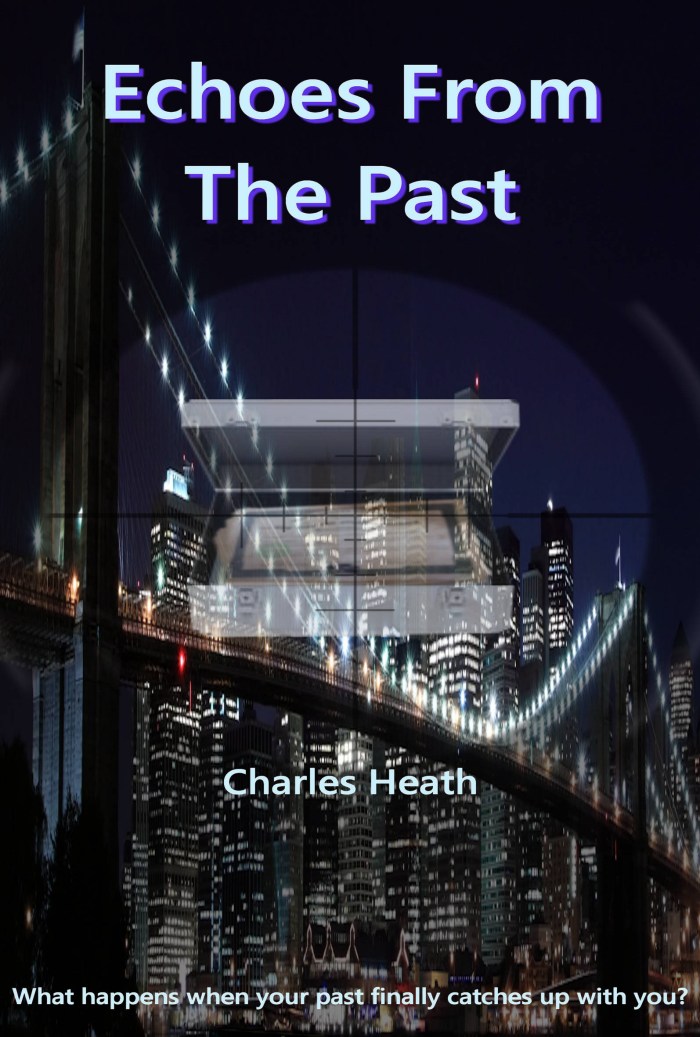
An excerpt from “Echoes from the Past”

Available on Amazon Kindle here:  https://amzn.to/2CYKxu4

…

With my attention elsewhere, I walked into a man who was hurrying in the opposite direction.  He was a big man with a scar running down the left side of his face from eye socket to mouth, and who was also wearing a black shirt with a red tie.

That was all I remembered as my heart almost stopped.

He apologized as he stepped to one side, the same way I stepped, as I also muttered an apology.

I kept my eyes down.  He was not the sort of man I wanted to recognize later in a lineup.  I stepped to the other side and so did he.  It was one of those situations.  Finally getting out of sync, he kept going in his direction, and I towards the bus, which was now pulling away from the curb.

Getting my breath back, I just stood riveted to the spot watching it join the traffic.  I looked back over my shoulder, but the man I’d run into had gone.  I shrugged and looked at my watch.  It would be a few minutes before the next bus arrived.

Wait, or walk?  I could also go by subway, but it was a long walk to the station.  What the hell, I needed the exercise.

At the first intersection, the ‘Walk’ sign had just flashed to ‘Don’t Walk’.  I thought I’d save a few minutes by not waiting for the next green light.  As I stepped onto the road, I heard the screeching of tires.

A yellow car stopped inches from me.

It was a high powered sports car, perhaps a Lamborghini.  I knew what they looked like because Marcus Bartleby owned one, as did every other junior executive in the city with a rich father.

Everyone stopped to look at me, then the car.  It was that sort of car.  I could see the driver through the windscreen shaking his fist, and I could see he was yelling too, but I couldn’t hear him.  I stepped back onto the sidewalk, and he drove on.  The moment had passed and everyone went back to their business.

My heart rate hadn’t come down from the last encounter.   Now it was approaching cardiac arrest, so I took a few minutes and several sets of lights to regain composure.

At the next intersection, I waited for the green light, and then a few seconds more, just to be sure.  I was no longer in a hurry.

At the next, I heard what sounded like a gunshot.  A few people looked around, worried expressions on their faces, but when it happened again, I saw it was an old car backfiring.  I also saw another yellow car, much the same as the one before, stopped on the side of the road.  I thought nothing of it, other than it was the second yellow car I’d seen.

At the next intersection, I realized I was subconsciously heading towards Harry’s new bar.   It was somewhere on 6th Avenue, so I continued walking in what I thought was the right direction.

I don’t know why I looked behind me at the next intersection, but I did.  There was another yellow car on the side of the road, not far from me.  It, too, looked the same as the original Lamborghini, and I was starting to think it was not a coincidence.

Moments after crossing the road, I heard the roar of a sports car engine and saw the yellow car accelerate past me.  As it passed by, I saw there were two people in it, and the blurry image of the passenger; a large man with a red tie.

Now my imagination was playing tricks.

It could not be the same man.  He was going in a different direction.

In the few minutes I’d been standing on the pavement, it had started to snow; early for this time of year, and marking the start of what could be a long cold winter.  I shuddered, and it was not necessarily because of the temperature.

I looked up and saw a neon light advertising a bar, coincidentally the one Harry had ‘found’ and, looking once in the direction of the departing yellow car, I decided to go in.  I would have a few drinks and then leave by the back door if it had one.

Just in case.

© Charles Heath 2015-2020

newechocover5rs

In a word: Wall

There’s nothing like ‘hitting the wall’.  It’s a rather quaint expression used when you have used up all your energy and there’s nothing left.  A lot of sportspeople are very familiar with this expression.

But it doesn’t have anything to do with hitting a real wall, you know the sort, made out of plaster, or bricks, or timber.  Some people hit the wall in this case too, and soon find out what it’s like to have a broken hand.

There’s wall street, you know the one, it has a bull in it, and it’s in New York, down that end of the city where the Twin Towers used to be.  It’s rumoured lots of ‘jiggery-pokery’ goes on there.

Try stonewalling, you know, give answers to questions that don’t answer the questions, or find something else to do and put off being questioned.  I’m not sure, however, that’s how Stonewall Jackson got his name.

We can climb the walls, metaphorically speaking, but it is something we don’t actually do when we’re bored.

And, I’m sure everyone has heard of the Great Wall of China.  Even those who travel in space have seen it, from a long, long way away.  I’ve tried walking along it, and up it, yes, parts of it go up the sides of mountains, and it’s challenging.  Maybe you should try it sometime.

Perhaps a few others, just to finish with, like

I got hit by a wall of water – yep, watch out for them tidal waves

There’s a wall between us, nope, not gonna talk to you

His stomach wall is failing, which means he’s in very bad shape, and

He couldn’t get through the wall of players, oh, well, maybe we’ll win the FA cup final next year!

Inspiration, maybe – Volume 1

50 photographs, 50 stories, of which there is one of the 50 below.

They all start with –

A picture paints … well, as many words as you like.  For instance:

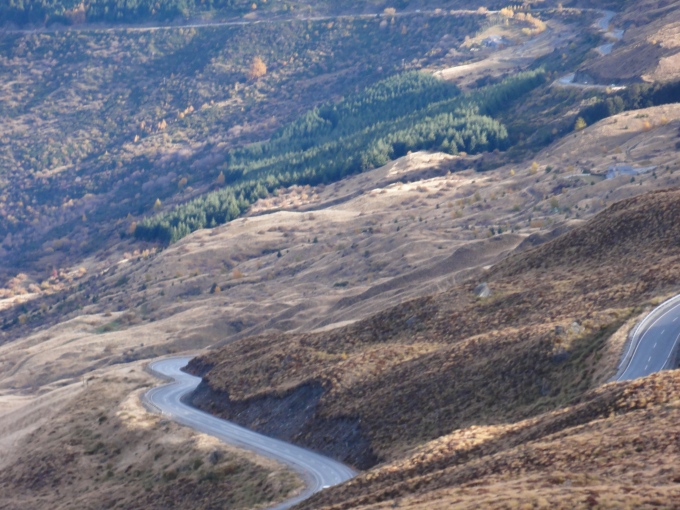
lookingdownfromcoronetpeak

And the story:

It was once said that a desperate man has everything to lose.

The man I was chasing was desperate, but I, on the other hand, was more desperate to catch him.

He’d left a trail of dead people from one end of the island to the other.

The team had put in a lot of effort to locate him, and now his capture was imminent.  We were following the car he was in, from a discrete distance, and, at the appropriate time, we would catch up, pull him over, and make the arrest.

There was nowhere for him to go.

The road led to a dead-end, and the only way off the mountain was back down the road were now on.  Which was why I was somewhat surprised when we discovered where he was.

Where was he going?

“Damn,” I heard Alan mutter.  He was driving, being careful not to get too close, but not far enough away to lose sight of him.

“What?”

“I think he’s made us.”

“How?”

“Dumb bad luck, I’m guessing.  Or he expected we’d follow him up the mountain.  He’s just sped up.”

“How far away?”

“A half-mile.  We should see him higher up when we turn the next corner.”

It took an eternity to get there, and when we did, Alan was right, only he was further on than we thought.”

“Step on it.  Let’s catch him up before he gets to the top.”

Easy to say, not so easy to do.  The road was treacherous, and in places just gravel, and there were no guard rails to stop a three thousand footfall down the mountainside.

Good thing then I had the foresight to have three agents on the hill for just such a scenario.

Ten minutes later, we were in sight of the car, still moving quickly, but we were going slightly faster.  We’d catch up just short of the summit car park.

Or so we thought.

Coming quickly around another corner we almost slammed into the car we’d been chasing.

“What the hell…” Aland muttered.

I was out of the car, and over to see if he was in it, but I knew that it was only a slender possibility.  The car was empty, and no indication where he went.

Certainly not up the road.  It was relatively straightforward for the next mile, at which we would have reached the summit.  Up the mountainside from here, or down.

I looked up.  Nothing.

Alan yelled out, “He’s not going down, not that I can see, but if he did, there’s hardly a foothold and that’s a long fall.”

Then where did he go?

Then a man looking very much like our quarry came out from behind a rock embedded just a short distance up the hill.

“Sorry,” he said quite calmly.  “Had to go if you know what I mean.”

I’d lost him.

It was as simple as that.

I had been led a merry chase up the hill, and all the time he was getting away in a different direction.

I’d fallen for the oldest trick in the book, letting my desperation blind me to the disguise that anyone else would see through in an instant.

It was a lonely sight, looking down that road, knowing that I had to go all that way down again, only this time, without having to throw caution to the wind.

“Maybe next time,” Alan said.

“We’ll get him.  It’s just a matter of time.”

© Charles Heath 2019-2021

Find this and other stories in “Inspiration, maybe”  available soon.

InspirationMaybe1v1

Writing about writing a book – Research – 12

Background material used in researching the Vietnam war and various other aspects of that period

…

Who were the North Vietnamese, really?

…

More Than Just Tunnels: Deconstructing North Vietnam’s Winning Strategy

The Vietnam War remains one of the most studied and strategically complex conflicts of the 20th century. Facing the overwhelming technological and logistical might of the United States and its allies, the armed forces of North Vietnam—primarily the People’s Army of Vietnam (PAVN), often referred to as the NVA, supported by the southern irregular forces known as the Viet Cong (VC)—employed a doctrine that defied conventional military wisdom.

Their strategy was not about winning battles in the traditional sense; it was about protracted war and the exhaustion of the enemy’s political will.

Here is a deep dive into how the North deployed its troops and the sophisticated methodology they utilized to take the fight to the Allied soldiers.


1. The Deployment Structure: Two Armies, One Goal

The North’s deployment strategy was inherently flexible, relying on a tiered military structure designed to adapt to any environment, from dense jungle to urban centers.

A. The Viet Cong (VC): The Irregular Force

The Viet Cong served as the political and military instrument in the South. They were not a conventional army but an insurgency operating within South Vietnam’s villages and hamlets.

Deployment Methodology:

  • Decentralization: VC units were deployed locally, focused on small-scale harassment, ambushes, and targeted assassinations of ARVN (South Vietnamese Army) officials.
  • Infiltration by Footprint: VC units were often indistinguishable from the local populace, deploying fighters who worked the rice paddies by day and fought by night.
  • Infrastructure Destruction: Their primary military deployment targets were the infrastructure supporting the US/ARVN presence: supply lines, airbases, and communication centers.

B. The PAVN (NVA): The Main Force

The PAVN was the formal, organized army of North Vietnam. These were well-trained, disciplined, and heavily armed conventional units, often deployed in regimental and divisional strength.

Deployment Methodology:

  • Strategic Infiltration: PAVN forces were primarily deployed via the Ho Chi Minh Trail (see below). They avoided direct, large-scale contact with US forces until the conditions were optimal (e.g., during the Tet Offensive or the 1972 Easter Offensive).
  • The Element of Surprise: When PAVN units were deployed in pitched battles, they focused on achieving total surprise and concentrating overwhelming, temporary firepower before rapidly melting back into the jungle or border sanctuaries.

2. The Logistics Highway: The Ho Chi Minh Trail

The single greatest factor in troop deployment was the elaborate logistical network known as the Ho Chi Minh Trail. This was not a single road but a constantly shifting, 16,000-kilometer web of trails, paths, rivers, and depots running through neutral Laos and Cambodia.

Strategic Impact on Deployment:

  • Bypassing Defenses: The Trail allowed hundreds of thousands of troops and vast amounts of material to bypass the heavily fortified Demilitarized Zone (DMZ) and move deep into the South, often positioning them directly behind US defenses.
  • Sustained Pressure: By keeping the logistics flowing despite intense American air interdiction (Operation Rolling Thunder and others), the North could continually refresh its forces, deploying new units to replace losses and ensuring the insurgency never withered away.
  • Mobility as Fortress: Because the Trail routes changed daily and were covered by dense jungle canopy, the US bombing campaigns often failed to halt troop movement, making mobility itself a form of defense.

3. Methodology in Combat: Neutralizing US Advantages

The North Vietnamese knew they could not win a conventional war against American firepower. Their methodology was designed purely to negate the US technological superiority.

A. The Strategy of “Clinging to the Belt”

This was one of the most effective tactical moves deployed by the PAVN. When engaging American ground forces, NVA units were instructed to deploy forces and fight at extremely close quarters, often termed “grabbing the enemy’s belt.”

Rationale:

  • By fighting nose-to-nose, the Americans could not safely call in their most powerful assets—tactical aircraft, napalm, or heavy artillery—without risking friendly fire casualties.
  • This effectively reduced the battle back to infantry vs. infantry, minimizing the US advantage in technology and maximizing the North’s advantage in tenacity and knowledge of the terrain.

B. Ambushes and Rapid Dispersal

VC and PAVN units specialized in the planned ambush. This was a deployment methodology based on hit-and-run tactics:

  1. Selection of Terrain: Choosing areas where US mobility was constrained (jungles, rice paddies, or remote valleys).
  2. Overwhelming Fire: Deploying all available troops and weapons to achieve a massive initial burst of fire, inflicting maximum casualties in the first minutes.
  3. Rapid Retreat: Before the American command could organize a counter-attack or coordinate air support, the NVA/VC forces would melt away, using prepared escape routes, tunnels, or border sanctuaries (known as Base Areas).

C. The Use of Tunnels and Base Areas

Deployment wasn’t just about moving across the surface; it was under it. The famous Cu Chi Tunnels near Saigon and similar networks served multiple strategic purposes:

  • Sanctuaries: Allowing troops to deploy and stage operations deep inside areas the US considered secured.
  • Hidden Bases: Providing underground logistics hubs, hospitals, and command centers.
  • Evasion: Allowing forces to disappear immediately after an engagement, frustrating US “search and destroy” missions.

4. The Political Dimension: The Protracted War

The PAVN/VC deployment was always dictated by political goals. General Vo Nguyen Giap, the architect of the North Vietnamese struggle, emphasized that the true battlefield was the American political landscape.

The Methodology of Exhaustion:

  • Avoid Annihilation: Troops were deployed carefully to avoid any battle that could lead to a decisive defeat. Their goal was survival, not conquest until the final stages of the war.
  • Inflict Casualties: Every single US casualty inflicted by a sustained troop deployment amplified anti-war sentiment back home. The deployment strategy was therefore calibrated to maximize enemy losses while minimizing the risk to the overall force structure.
  • The Final Phase: Only late in the war, when the US had significantly withdrawn and the ARVN was left struggling, did PAVN change its deployment methodology to focus on large-scale, conventional maneuvers (like the deployment of tank columns and heavy artillery) necessary to secure the final victory in 1975.

The North Vietnamese methodology for deploying troops was a brilliant exercise in adaptability. They transformed their logistical weaknesses into defensive strengths, used geography to neutralize superior air power, and ensured that every soldier deployed served the overarching political mission: convincing the American public that victory was impossible. Their success remains a testament to the strategic power of insurgency and asymmetric warfare.

The 2am Rant: I think the asylum is beckoning

I’m sitting at my desk surrounded by any number of scraps of paper with more storylines, written excepts, parts of stories, and a number of chapters of a work in progress.

Does this happen to anyone else?

The business of writing requires a talent to keep focused on the one project, and silence all the other screaming voices in your head, pouring out their side of the story.

But it’s not working.

I try to be determined in my efforts to edit my current completed novel, after letting it ‘rest’ in my head for a few months.

I planned to have so time off, but all of those prisoners in my head started clamoring for my attention.  A story I started some time ago needs revising, another story I wrote last year of NANOWRIMO has come back to haunt me, and characters, well, they’re out in the waiting room, pacing up and down, ready to tell me their life stories.

Is the temporary cure coffee or wine?

Now I think I really do need a holiday

Or a trip to the asylum.  Thank God this is not the early 20th century, or I might never return.  And if it’s named Bellview, it would be just another story to be written.

The Author that went Bonkers!

Does it ever end?

Writing a book in 365 days – 322

Day 322

Writing exercise – The tea cart was at least five minutes late; something had to be done.

…

I worked in an office full of self-absorbed people, who cared only about themselves and what the company could do for them.

It was always about the bonus, about the amenities, about anything they can get for nothing.

So, don’t get me started on the morning tea.

And afternoon tea.

Because of the nature of the work, it wasn’t a good idea to leave the desk, except at lunch when they had to have a break, and when they went home, which sometimes some forgot to.

Or so they said.

I wasn’t that dedicated, so perhaps that was the only reason why I wasn’t rocketing up the promotions ladder.  The higher you went, the more the company owned you.

I looked around.  Five-thousand-dollar suits, car keys for Maseratis and Ferraris proudly on display.  An ancient Ford wasn’t a status symbol, but then I was never about status, just about getting the job done.

Walters, the current ‘ace employee of the month’, was sitting back in his chair and looking at his watch, a Rolex, of course, then the office clock, which was never on time.

“Where’s the tea lady?”

There were two options: going up to the breakout area on the floor below the executive suite or having it at the desk.

Several elderly ladies ran the trolley, a nice, easy job for an hour or so in the morning and the afternoon.  The three that serviced our floor were Doris, my favourite, Matilda, who always had a dour demeanour, and Lizzie, younger, once a showgirl, or so she said.

I was never quite sure what ‘showgirl’ meant.

Today, it should have been Lizzie.

“Still boiling the water.”  Frazer, equally boorish as Walters, was known for smart ass remarks.

“It’s not as if you haven’t been late when you have to be somewhere.”

Like any appointment with his supervisor.

“Be a good chap, Roly, and find out where it is.”

I glared at him.  My name was Rollins, but he called me Rolly.  He had a name for everyone he considered beneath him in status.

His other name, Roly Poly, he said when he was with the others at the Friday night drinks at a nearby bar.  I went once, heard his slanging off the lesser employees and the others laughing, and decided it was not my thing.

I was going to tell him off, but it would simply go through one ear and out the other.

The breakout area had an annexe where the tea ladies prepared before coming down to their designated food by the freight elevator.

I’d been in it once, and it was lucky to be working.  The day I was in it, it stopped twice without reason and missed the floor by a foot which would make it impossible to unload a negotiating.

I went up via the main elevator lobby.  Mt first thought was that the freight elevator was stuck, and she was in it

I crossed the breakout area, very spacious and airy, walls without windows lined with vending machines, free tea, coffee and cold water all day.

Today, there were cookies, which sometimes found their way onto the tea cart.

I knocked on the door to the tea lady’s room, and there was no answer.  I opened the door and stepped in.  It was a restricted area, but there was no key card entry required.

The room was a mess.  It looked to me as though someone had a tantrum and started throwing stuff.  Until I looked closely and realised someone had been searching through everything in a methodical manner.

There was another door on the other side of the room.  I picked my way carefully through the mess; security was going to have to find out what happened here.

Again, I knocked, but there was no answer.

I opened the door

The three ladies were bound and gagged, sitting on the floor.  It was then that I realised the tea carts were missing.

I called security.  “You have a situation.   The tea ladies are bound and gagged, and their trolleys are missing.”

No questions or instructions, a few seconds later, the fire evacuation siren was blaring, a voice over, “This is not a drill.  I repeat, this is not a drill.  Please evacuate the building in a calm and orderly manner as directed.  Floor wardens are to immediately supervise and evaluate floors as directed.”

While that announcement was being made, I untied and removed Lizzie’s gag, then she helped one and I the other.

When they were free, I asked, “What happened?”

Two men and a woman came in and started asking questions.  We thought they were health inspectors until they started tossing stuff everywhere, looking for a pass.”

“A pass?”

“Floor access key.  Or maybe a master key.  Then, because Lizzie went for the phone we finished up where you found us.”

“Did they say anything else?”

“Only they were going to kill some bloke because he didn’t do his job properly.”

“Someone who works here?”

“That would be my guess,” Lizzie said. “Anything important happening?”

Important in this place.  Nothing that was ever exciting enough to incite what just happened.”

“Did they find the pass?”

“Yes.  It had a man’s face on it, but it was too far away to recognise it.”

I called security again.

“You’re looking for two men, a woman, three tea carts, and they have a pass key that someone else left for them to collect.  Do you have CCTV up here?”

He didn’t answer, just hung up.  I took that as a no.

When I turned around to tell the ladies we had to evacuate the building, Lizzie was by the door holding a gun.

A gun.  Where did she get it? Why did she have it?

“Join the other two and go back into the room.” She motioned with the gun for emphasis.  “Now.”

She looked at her watch.

Time was a factor.  

“Why are you doing this?  Are you in league with those criminals?”

“They’re not criminals.  You lot are the criminals.  Get in the room, I won’t ask again.”

You can’t argue with a gun.  “Let’s go, do as she asks.  Not worth the trouble refusing.”

They looked to me like they were going to say something, then thought twice about it and went into the room.  I followed, and before she shut the door, I said, “Whatever you’re doing, I hope it’s worth it.”

“It will be.”

The door closed, and I heard the turn of the key in the lock.  It was a flimsy door, but this wasn’t the time to kick it in.  I waited by the door, and a minute or so later, I heard the outer room door close and I assumed she had locked that too.

“If I hadn’t come, she would have got away with it,” I said.

“She didn’t look like she was working with them.  Just goes to show, you think you know someone.”

“And there’s someone else out there working with them.”

“To do what?”

Good question.  I was wondering that myself.  Lizzie had called the company criminals.  All we did was invest money, make the clients richer.  Admittedly, it had become that much harder to pick the market given the volatility, which, some argued, was deliberately being manipulated.

One negative word from a government official could send a stock higher or plummet in value, leaving investors with huge losses.

Walters had been flying high on a lot of good tips, but the last stock that went up, he should have sold, instead, waited just a little too long.  Perhaps he’d crossed his tipster.  That would mean he was effectively insider trading.

Interesting how something comes together with the right catalyst. 

The thing is, investors knew who their trader was, so if anyone was upset, they could complain or demand an explanation.  The supervisor was tough but fair. You cause a mess, you clean it up.

I doubted Lizzie was one of those high roller investors, but in such a job, a few bucks to supply a pass key was nothing to her.  Unless it turned into a murder.  Brandishing guns in a highly volatile situation was a recipe for disaster.

“It might have something to do with bad investments.”

And something else just dredged up from the back of my mind.  A sighting about a month back of one of the directors of the company having lunch at a fancy restaurant I had wanted to go to, passed most days on the way home from work.

It was not because he was dining there; it was the woman he was with.  I thought he might be having an affair, but several days after that, her face popped up on TV, and she was being linked to a government project that was worth billions of dollars.

And the report was about the next big thing in the construction industry

Interesting.

“Not a good look for an investment company to have bad investments.”

“It’s a volatile market, and a lot of investment houses have problems.  But you’re right, not a good look, and very problematic if the investors start getting itchy feet.”

“And that happened here?”

“Everyone praises you when you back the right horse, but like a horse race, you never really know which horse is going to win.  Sometimes, even dead certs lose.  It happens everywhere.”

I don’t think I sold the ‘we are the best of the best’ to her.  At that moment, the fire alarm stopped, and the silence was blessed.  She just shrugged and produced a set of keys.

“You have the keys to the door?”

“Of course.  Senior tea lady.  It just wasn’t safe to go out there, until now.”

I stepped back, and she unlocked the door. 

“You open it.  Lizzie must still be out there.”

I debated whether I should tell her I heard Lizzie leave, but decided not to.  I opened the door a crack and peered out.

Nothing.

I pushed the door open and came out into the room.

Silence, which was strange in itself.  There was always noise.

She gave me the keys to open the outset door and check.  Once again, only opening it slightly, I glanced down both sides of the corridor.  If Lizzie had any sense, she would have left quickly

“Stay here and lock the door.  I’ll go and see what’s happening.”

I took the closest staircase to go down.  In a fire alarm, all the doors on each floor were unlocked.  It was eerily quiet on the stairwell as I slowly went down to my floor.  I told myself that it could not have been about Walters and the others.

At the level, I slowly opened the door.  Silence.  If anyone was there, there would be noise, at the very least, Walters babbling on about the intrusion.

I waited a minute.  Two.  Nothing.

Then, slowly walking up the corridor to the pit, the workspaces of the half dozen of us in the group, and in the office overlooking the outside, the supervisor.

I stopped at the door and nearly vomited.  They were all dead, shot multiple times, with blood and bodies everywhere.  My five colleagues and the supervisor.  Dead.

Walters had done me a favour by sending me off to find the tea lady.  Otherwise, I’d be with them, just another dead body.

That’s when the police arrived, about a dozen of them screaming for me to get on the floor, hands behind my head.

…

©  Charles Heath 2025
Top 5 sights on the road less travelled – Beijing

The Beijing Beyond the Wall: 5 Unforgettable Adventures on the Road Less Travelled

Beijing is a city of superlatives. Its imperial history shouts from the rooftops of the Forbidden City, and its sheer physical scale is awe-inspiring as you gaze upon the Great Wall. But what happens when you step off the imperial highway?

The true heart of Beijing—dynamic, quirky, and deeply authentic—often hides beneath the surface, skipped over by tour buses and rushed itineraries.

If you’re ready to trade the packed crowds for local flavour and spectacular solitude, lace up your comfortable shoes. Here are the top five unforgettable experiences for the seasoned traveller seeking the authentic, road-less-travelled side of China’s grand capital.


1. Conquer the Dragon: Hiking the Wild Great Wall at Jiankou

Forget the perfectly manicured, accessible sections like Badaling or Mutianyu. For a truly visceral, historical experience, head northeast to the Jiankou (Arrow Nock) section of the Great Wall.

Jiankou is the definition of “unrestored.” It clings precariously to steep mountain ridges, with crumbling parapets, overgrown foliage, and towers that look ready to tumble. This is the Wall as it stood centuries ago, demanding respect and fitness.

The hike is challenging—it involves scrambling up steep rock faces (like the infamous ‘Heavenly Ladder’) and navigating slippery slopes—but the reward is solitude and arguably the most dramatic photographic views of the entire structure. Standing here, with views stretching uninterrupted into the misty mountains, you truly feel the weight of history in your palms.

Why it’s on the list: You won’t encounter souvenir vendors or large crowds. It’s an intimate, strenuous dialogue with one of the greatest manmade structures on Earth.

Pro Tip: This is not a sanctioned tourist site. Go with an experienced local guide, wear appropriate hiking boots (not sneakers), and plan for a full day. Begin your trek early to avoid the mid-day heat and finish before sunset.


2. Unearth Treasures at Panjiayuan Antique Market (The Sunday Sunrise Hunt)

If you want a genuine glimpse into the organised chaos and bartering culture of Beijing, bypass the shiny malls and head to the Panjiayuan Antique Market (潘家园).

While the market is open throughout the week, the real magic happens on Sunday mornings, starting just before dawn. This is when dealers from across China descend upon the sprawling grounds, laying out everything from delicate porcelain and jade jewellery to Cultural Revolution memorabilia, old propaganda posters, and surprisingly beautiful second-hand furniture.

The energy is infectious. Vendors hawk their wares, locals sip hot soy milk, and the air crackles with negotiation. Whether you’re searching for a genuine Ming Dynasty relic (unlikely, but fun to look!) or just a quirky, affordable souvenir with a story, Panjiayuan offers a fascinating glimpse into China’s material history.

Why it’s on the list: It’s a sensory immersion. It’s loud, crowded, dusty, and absolutely bursting with character. It’s where Beijing locals shop for history, not just tourists.

Pro Tip: Arrive by 6:30 AM on Sunday. The best items are snapped up quickly by serious collectors. Don’t be afraid to barter fiercely; it’s expected (start at 30-40% of the asking price).


3. The Tranquil Chaos: Exploring the Wudaoying Hutong District

Everyone knows Nanluoguxiang, but for the traveller seeking the intersection of traditional Beijing charm and contemporary cool, Wudaoying Hutong (五道营胡同) is the hidden gem.

Located just north of the Yonghegong Lama Temple, Wudaoying retains the narrow alleyways and courtyard houses (siheyuan) of old Beijing, but its atmosphere is worlds apart. Instead of mass-market merchandise, you’ll find independent coffee roasters, minimalist clothing boutiques, vegan cafés, and stylish bars carved out of traditional architecture.

Spend an afternoon wandering the adjacent quiet backstreets, observing elderly residents playing chess or hanging laundry, then duck into a courtyard café for a specialised tea ceremony. This area perfectly encapsulates modern Beijing life, respecting its ancient roots.

Why it’s on the list: It offers a peaceful, aesthetically pleasing alternative to the hyper-touristy hutongs, allowing you to sample contemporary Chinese lifestyle without losing touch with history.

Pro Tip: Pair your visit with an hour at the adjacent Lama Temple (Yonghegong). This adds a powerful historical and spiritual contrast to the area’s trendy vibe.


4. The Poignant Ruins of Yuanmingyuan (The Old Summer Palace)

While the Summer Palace (Yiheyuan) is rightly famous for its picturesque gardens and restored temples, we recommend visiting its scarred, more historically resonant counterpart: Yuanmingyuan (圆明园), the Old Summer Palace.

Once hailed as the “Garden of Gardens,” Yuanmingyuan was an unparalleled imperial complex renowned for its vast gardens and magnificent collection of European-style palaces and fountains. It was tragically destroyed by British and French troops in 1860 during the Second Opium War.

Today, the sprawling grounds are a poignant national memorial. The ruins of the European palaces stand as dramatically skeletal remains—marble arches and broken fountain heads swallowed by lush foliage. It’s a powerful, melancholy place that speaks volumes about China’s century of humiliation and resilience.

Why it’s on the list: It’s a cultural necessity. It offers deep context to modern Chinese history and provides vast, beautiful parkland often bypassed by international tourists.

Pro Tip: Focus your exploration on the western-most section (the European-style ruins) for the most dramatic photographs and historical reflection.


5. Get Lost (Intentionally) in the 798 Art District

The 798 Art District (Dashanzi) is well-known, but the “road less travelled” experience here is achieved through timing and focus.

During the mid-day rush, 798 can feel commercial. To truly appreciate its industrial-chic aesthetic—old Bauhaus-style factories transformed into sprawling galleries and studios—you need to visit at the margins of the day.

Arrive just as the galleries open (10:00 AM) or linger into the late afternoon (4:00 PM onward). Skip the large, famous galleries and dive into the smaller, independent warehouses. Look for emerging Chinese artists pushing boundaries in installation art, experimental photography, and sculpture. Getting intentionally lost in the alleys and stumbling upon an avant-garde exhibition is the goal.

Why it’s on the list: It shows the incredible creative dynamism of contemporary China, offering a sharp, modern contrast to the imperial history found elsewhere.

Pro Tip: Look beyond the main streets. Many smaller, edgier studios are housed in the back alleys and second-floor mezzanines hidden behind large gallery facades. If you see a rickety staircase, climb it.


Beijing is a city that rewards the curious and the bold. By stepping away from the standard itinerary, you don’t just see China—you engage with its history, its culture, and its vibrant, unpredictable present. Happy travels on the road less travelled!

What I learned about writing – Monday is just another day of the week

I don’t like Mondays – a song lingering on the periphery of my memory, and I’m not sure who sung it.

But it’s official, I don’t like Mondays.

I’ve been procrastinating since last Thursday, telling myself I have to get the next part of one of my stories written, but I keep putting it off.  I’m not sure why but it always seems like this, and I have to force myself to sit in front of the computer screen, and come up with the goods.

I didn’t do anything on Sunday, and, as a writer, I guess that’s not very good.  I’m supposed to be writing a page, or a hundred or thousand words a day, just to keep the juices flowing.

I’m not in the mood.  I sit and stare at the computer screen, and nothing is coming.  Is this the first sign of writer’s block?

I dig out several articles on how to overcome it and start putting their suggestions into action.  No.  No.  Maybe.  No.  I don’t think it’s writer’s block.

Perhaps I need some inspiration so I go to my tablet playlist, spend 10 minutes trying to find the headphones that were carelessly discarded on a seat that had a lot of other stuff on it, by one of my grandchildren the last time they were here.

And, yes, the tablet was left in the middle of playing a Minecraft video which has drained the battery.  Now I can’t find the charger!

Back at the computer, holding a dead tablet, and a pair of headphones, inspiration is as far away as the mythical light at the end of the tunnel.  Today perhaps it will be an oncoming express train.

Perhaps a pen and paper will work.

An idea pops into my head…

…

Is it possible the passing of a weekend could change the course of your life?

 An interesting question, one to ponder as I sat on the floor of a concrete cell, with only the sound of my breathing, and the incessant screams coming from a room at the end of the corridor.

It was my turn next.  That was what the grinning ape of a guard said in broken English.  He looked like a man who relished his job.

What goes through your mind at a time like this, waiting, waiting for the inevitable?  Will I survive, what will they do to me, will it hurt?

The screaming stops abruptly, and a terrible silence falls over the facility.

Then, looking in the direction of where the screams had come from, I hear the clunk of the door latch being opened, and then the slow nerve-tingling screech of rusty metal as the door opens slowly.

Oh God, Oh God, Oh God, no.

….

No writer’s block.  But I have to stop watching late-night television.

First Dig Two Graves

A sequel to “The Devil You Don’t”

…

Revenge is a dish best served cold – or preferably so when everything goes right

Of course, it rarely does, as Alistair, Zoe’s handler, discovers to his peril. Enter a wildcard, John, and whatever Alistair’s plan for dealing with Zoe was dies with him.

It leaves Zoe in completely unfamiliar territory.

…

John’s idyllic romance with a woman who is utterly out of his comfort zone is on borrowed time. She is still trying to reconcile her ambivalence, after being so indifferent for so long.

They agree to take a break, during which she disappears. John, thinking she has left without saying goodbye, refuses to accept the inevitable, calls on an old friend for help in finding her.

After the mayhem and being briefly reunited, she recognises an inevitable truth: there is a price to pay for taking out Alistair; she must leave and find them first, and he would be wise to keep a low profile.

But keeping a low profile just isn’t possible, and enlisting another friend, a private detective and his sister, a deft computer hacker, they track her to the border between Austria and Hungary.

What John doesn’t realise is that another enemy is tracking him to find her too. It could have been a grand tour of Europe. Instead, it becomes a race against time before enemies old and new converge for what will be an inevitable showdown.

Top 5 sights on the road less travelled – Bonn

Beyond Beethoven: Five Unique Experiences on Bonn’s Road Less Travelled

Bonn! The city of Beethoven’s birth, vibrant cherry blossoms, and a rich political past. Most visitors flock to the Beethoven-Haus, stroll along the Rhine, or admire the Münster. And rightly so – these are truly wonderful experiences!

But what if you’ve already “done” the main sights, or simply yearn for a deeper, more authentic connection with a place? What if you’re the kind of traveller who thrives on uncovering hidden gems, exploring local life, and stepping slightly off the well-trodden path?

If that sounds like you, then welcome to Bonn’s road less travelled! Here are five unique things to do that will give you a fresh perspective on this charming Rhineland city.


1. Scale the Petersberg & Soak in Panoramic History

While most tourists head for the Drachenfels for that iconic Siebengebirge view, the Petersberg offers an equally stunning, often quieter, and historically significant alternative. Perched majestically above the Rhine, this mountain is home to the Steigenberger Grandhotel & Spa Petersberg, a legendary venue that served as Germany’s state guesthouse for decades.

Why it’s unique: Imagine dining where world leaders once negotiated treaties, or simply enjoying a coffee with a view that inspired generations. You can hike up through lush forests (multiple trails offer varying difficulties), or take a scenic drive. The views over the Rhine valley, the city of Königswinter, and across to the Drachenfels are simply breathtaking, especially at sunset. It’s less about a specific attraction and more about the serene atmosphere and the weight of history in the air.

Do this: Choose a clear afternoon, pack some snacks, and hike up one of the quieter trails. Reward yourself with a drink on the hotel terrace, soaking in the panoramic vista. Explore the small chapel and reflect on the significant meetings that took place here.


2. Dive into Art & Herstory at the Frauenmuseum Bonn

Move beyond the grand national museums and discover a truly groundbreaking institution: the Frauenmuseum Bonn. Established in 1981, it was the world’s first museum dedicated to female artists and their cultural-historical contributions.

Why it’s unique: This isn’t just another art gallery. The Frauenmuseum is a vibrant, feminist space that constantly challenges perspectives through its diverse and thought-provoking exhibitions. It showcases contemporary art by women, presents historical themes from a female viewpoint, and fosters dialogue about gender roles and societal change. It’s a dynamic place that feels deeply relevant and often sparks lively discussion.

Do this: Check their current exhibition schedule before you go, as they change frequently. Allow yourself to be challenged, inspired, and educated. Don’t forget to browse their small but interesting gift shop for unique souvenirs.


3. Wander Through the Bonn University Botanical Gardens (Poppelsdorfer Gärten)

While the Poppelsdorf Palace is a known landmark, many visitors simply admire its facade without fully exploring its magnificent Botanical Gardens. These aren’t just any gardens; they are among the oldest and most species-rich botanical gardens in Germany, managed by the University of Bonn.

Why it’s unique: Tucked behind the ornate palace, these gardens are a tranquil oasis packed with scientific wonder. From ancient redwoods to tropical greenhouses brimming with exotic plants, you can travel the world’s flora in an afternoon. It’s a place of quiet contemplation, learning, and incredible beauty, often frequented more by students and local residents than tourists.

Do this: Dedicate a good hour or two. Explore the different sections, marvel at the giant water lilies in summer, and step into the warm, humid greenhouses to discover rare orchids and carnivorous plants. It’s especially beautiful in spring and early summer.


4. Get Lost in the Architectural Charm of the Südstadt

Forget the central hubbub for a moment and take a leisurely stroll through Bonn’s Südstadt (South Town). This district is one of Germany’s largest and best-preserved Gründerzeit (late 19th-century) residential areas, boasting stunning historical architecture around every corner.

Why it’s unique: It’s a living, breathing neighbourhood, not a museum district. The Südstadt’s streets are lined with beautifully ornate Wilhelminian-era buildings, each with unique facades, intricate balconies, and charming details. There are no major “attractions” here, just pure aesthetic pleasure and a glimpse into Bonn’s elegant past and present-day local life. You’ll find quiet cafes, small boutiques, and a sense of calm distinct from the city centre.

Do this: Start near Poppelsdorfer Allee and simply wander the side streets like Argelanderstraße, Kaiserstraße, and Bonner Talweg. Look up and admire the architectural details. Stop at a local cafe for Kaffee und Kuchen (coffee and cake) and soak in the atmosphere.


5. Savor Authentic “Bönnsch” at a Traditional Brauhaus

While Bonn isn’t as famous for beer as Cologne, it has its own unique brew and a strong pub culture. Seek out a traditional Bönnsch Brauhaus for an authentic taste of local life and regional cuisine.

Why it’s unique: “Bönnsch” is a specific top-fermented beer brewed only in Bonn, similar to Cologne’s Kölsch but with its own distinct character. These Brauhäuser are more than just pubs; they’re social hubs where locals gather. You’ll find a lively, unpretentious atmosphere, hearty German dishes, and endlessly refilled small glasses (Stangen) of the refreshing local brew. It’s an immersive cultural experience that connects you directly with Bonn’s everyday rhythm.

Do this: Head to a well-regarded local brewery-pub. Order a “Bönnsch” (or just wait for the Köbes/waiter to bring one) and a traditional dish like “Sauerbraten Rheinische Art” (Rhenish pot roast) or “Himmel un Ääd” (Heaven and Earth – blood sausage with mashed potatoes and apple sauce). Don’t be shy; strike up a conversation with a local if the opportunity arises!


Bonn is a city that rewards those willing to peel back its layers. So, next time you’re in this beautiful city, dare to wander a little further, look a little closer, and discover the unique spirit that truly makes Bonn special. Happy travels on the road less travelled!

Have you discovered any other hidden gems in Bonn? Share your finds in the comments below!