An excerpt from “Sunday in New York”

Now available on Amazon at:  https://amzn.to/2H7ALs8

Williams’ Restaurant, East 65th Street, New York, Saturday, 8:00 p.m.

We met the Blaine’s at Williams’, a rather upmarket restaurant that the Blaine’s frequently visited, and had recommended.

Of course, during the taxi ride there, Alison reminded me that with my new job, we would be able to go to many more places like Williams’.  It was, at worst, more emotional blackmail, because as far as Alison was concerned, we were well on our way to posh restaurants, the Trump Tower Apartments, and the trappings of the ‘executive set’.

It would be a miracle if I didn’t strangle Elaine before the night was over.  It was she who had filled Alison’s head with all this stuff and nonsense.

Aside from the half frown half-smile, Alison was looking stunning.  It was months since she had last dressed up, and she was especially wearing the dress I’d bought her for our 5th anniversary that cost a month’s salary.  On her, it was worth it, and I would have paid more if I had to.  She had adored it, and me, for a week or so after.

For tonight, I think I was close to getting back on that pedestal.

She had the looks and figure to draw attention, the sort movie stars got on the red carpet, and when we walked into the restaurant, I swear there were at least five seconds silence, and many more gasps.

Even I had a sudden loss of breath earlier in the evening when she came out of the dressing room.  Once more I was reminded of how lucky I was that she had agreed to marry me.  Amid all those self-doubts, I couldn’t believe she had loved me when there were so many others ‘out there’ who were more appealing.

Elaine was out of her seat and came over just as the Head Waiter hovered into sight.  She personally escorted Alison to the table, allowing me to follow like the Queen’s consort, while she and Alison basked in the admiring glances of the other patrons.

More than once I heard the muted question, “Who is she?”

Jimmy stood, we shook hands, and then we sat together.  It was not the usual boy, girl, boy, girl seating arrangement.  Jimmy and I on one side and Elaine and Alison on the other.

The battle lines were drawn.

Jimmy was looking fashionable, with the permanent blade one beard, unkempt hair, and designer dinner suit that looked like he’d slept in it.  Alison insisted I wear a tuxedo, and I looked like the proverbial penguin or just a thinner version of Alfred Hitchcock.

The bow tie had been slightly crooked, but just before we stepped out she had straightened it.  And took the moment to look deeply into my soul.  It was one of those moments when words were not necessary.

Then it was gone.

I relived it briefly as I sat and she looked at me.  A penetrating look that told me to ‘behave’.

When we were settled, Elaine said, in that breathless, enthusiastic manner of hers when she was excited, “So, Harry, you are finally moving up.”  It was not a question, but a statement.

I was not sure what she meant by ‘finally’ but I accepted it with good grace.  Sometimes Elaine was prone to using figures of speech I didn’t understand.  I guessed she was talking about the new job.  “It was supposed to be a secret.”

She smiled widely.  “There are no secrets between Al and I, are there Al?”

I looked at ‘Al’ and saw a brief look of consternation.

I was not sure Alison liked the idea of being called Al.  I tried it once and was admonished.  But it was interesting her ‘best friend forever’ was allowed that distinction when I was not.  It was, perhaps, another indicator of how far I’d slipped in her estimation.

Perhaps, I thought, it was a necessary evil.  As I understood it, the Blaine’s were our mentors at the Trump Tower, because they didn’t just let ‘anyone’ in.  I didn’t ask if the Blaine’s thought we were just ‘anyone’ before I got the job offer.

And then there was that look between Alison and Elaine, quickly stolen before Alison realized I was looking at both of them.  I was out of my depth, in a place I didn’t belong, with people I didn’t understand.  And yet, apparently, Alison did.  I must have missed the memo.

“No,” Alison said softly, stealing a glance in my direction, “No secrets between friends.”

No secrets.  Her look conveyed something else entirely.

The waiter brought champagne, Krug, and poured glasses for each of us.  It was not the cheap stuff, and I was glad I brought a couple of thousand dollars with me.  We were going to need it.

Then, a toast.

To a new job and a new life.

“When did you decide?”  Elaine was effusive at the best of times, but with the champagne, it was worse.

Alison had a strange expression on her face.  It was obvious she had told Elaine it was a done deal, even before I’d made up my mind.  Perhaps she’d assumed I might be ‘refreshingly honest’ in front of Elaine, but it could also mean she didn’t really care what I might say or do.

Instead of consternation, she looked happy, and I realized it would be churlish, even silly if I made a scene.  I knew what I wanted to say.  I also knew that it would serve little purpose provoking Elaine, or upsetting Alison.  This was not the time or the place.  Alison had been looking forward to coming here, and I was not going to spoil it.

Instead, I said, smiling, “When I woke up this morning and found Alison missing.  If she had been there, I would not have noticed the water stain on the roof above our bed, and decide there and then how much I hated the place.” I used my reassuring smile, the one I used with the customers when all hell was breaking loose, and the forest fire was out of control.  “It’s the little things.  They all add up until one day …”  I shrugged.  “I guess that one day was today.”

I saw an incredulous look pass between Elaine and Alison, a non-verbal question; perhaps, is he for real?  Or; I told you he’d come around.

I had no idea the two were so close.

“How quaint,” Elaine said, which just about summed up her feelings towards me.  I think, at that moment, I lost some brownie points.  It was all I could come up with at short notice.

“Yes,” I added, with a little more emphasis than I wanted.  “Alison was off to get some study in with one of her friends.”

“Weren’t the two of you off to the Hamptons, a weekend with some friends?” Jimmy piped up, and immediately got the ‘shut up you fool’ look, that cut that line of conversation dead.  Someone forgot to feed Jimmy his lines.

It was followed by the condescending smile from Elaine, and “I need to powder my nose.  Care to join me, Al?”

A frown, then a forced smile for her new best friend.  “Yes.”

I watched them leave the table and head in the direction of the restroom, looking like they were in earnest conversation.  I thought ‘Al’ looked annoyed, but I could be wrong.

I had to say Jimmy looked more surprised than I did.

There was that odd moment of silence between us, Jimmy still smarting from his death stare, and for me, the Alison and Elaine show.  I was quite literally gob-smacked.

I drained my champagne glass gathering some courage and turned to him.  “By the way, we were going to have a weekend away, but this legal tutorial thing came up.  You know Alison is doing her law degree.”

He looked startled when he realized I had spoken.  He was looking intently at a woman several tables over from us, one who’d obviously forgotten some basic garments when getting dressed.  Or perhaps it was deliberate.  She’d definitely had some enhancements done.

He dragged his eyes back to me.  “Yes.  Elaine said something or other about it.  But I thought she said the tutor was out of town and it had been postponed until next week.  Perhaps I got it wrong.  I usually do.”

“Perhaps I’ve got it wrong.”  I shrugged, as the dark thoughts started swirling in my head again.  “This week or next, what does it matter?”

Of course, it mattered to me, and I digested what he said with a sinking heart.  It showed there was another problem between Alison and me; it was possible she was now telling me lies.  If what he said was true and I had no reason to doubt him, where was she going tomorrow morning, and had she really been with a friend studying today?

We poured some more champagne, had a drink, then he asked, “This promotion thing, what’s it worth?”

“Trouble, I suspect.  Definitely more money, but less time at home.”

“Oh,” raised eyebrows.  Obviously, the women had not talked about the job in front of him, or, at least, not all the details.  “You sure you want to do that?”

At last the voice of reason.  “Me?  No.”

“Yet you accepted the job.”

I sucked in a breath or two while I considered whether I could trust him.  Even if I couldn’t, I could see my ship was sinking, so it wouldn’t matter what I told him, or what Elaine might find out from him.  “Jimmy, between you and me I haven’t as yet decided one way or another.  To be honest, I won’t know until I go up to Barclay’s office and he asks me the question.”

“Barclay?”

“My boss.”

“Elaine’s doing a job for a Barclay that recently moved in the tower a block down from us.  I thought I recognized the name.”

“How did Elaine get the job?”

“Oh, Alison put him onto her.”

“When?”

“A couple of months ago.  Why?”

I shrugged and tried to keep a straight face, while my insides were churning up like the wake of a supertanker.  I felt sick, faint, and wanting to die all at the same moment.  “Perhaps she said something about it, but it didn’t connect at the time.  Too busy with work I expect.  I think I seriously need to get away for a while.”

I could hardly breathe, my throat was constricted and I knew I had to keep it together.  I could see Elaine and Alison coming back, so I had to calm down.  I sucked in some deep breaths, and put my ‘manage a complete and utter disaster’ look on my face.

And I had to change the subject, quickly, so I said, “Jimmy, Elaine told Alison, who told me, you were something of a guru of the cause and effects of the global economic meltdown.  Now, I have a couple of friends who have been expounding this theory …”

Like flicking a switch, I launched into the well-worn practice of ‘running a distraction’, like at work when we needed to keep the customer from discovering the truth.  It was one of the things I was good at, taking over a conversation and pushing it in a different direction.  It was salvaging a good result from an utter disaster, and if ever there was a time that it was required, it was right here, right now.

When Alison sat down and looked at me, she knew something had happened between Jimmy and I.  I might have looked pale or red-faced, or angry or disappointed, it didn’t matter.  If that didn’t seal the deal for her, the fact I took over the dining engagement did.  She knew well enough the only time I did that was when everything was about to go to hell in a handbasket.  She’d seen me in action before and had been suitably astonished.

But I got into gear, kept the champagne flowing and steered the conversation, as much as one could from a seasoned professional like Elaine, and, I think, in Jimmy’s eyes, he saw the battle lines and knew who took the crown on points.  Neither Elaine nor Jimmy suspected anything, and if the truth be told, I had improved my stocks with Elaine.  She was at times both surprised and interested, even willing to take a back seat.

Alison, on the other hand, tried poking around the edges, and, once when Elaine and Jimmy had got up to have a cigarette outside, questioned me directly.  I chose to ignore her, and pretend nothing had happened, instead of telling her how much I was enjoying the evening.

She had her ‘secrets’.  I had mine.

At the end of the evening, when I got up to go to the bathroom, I was physically sick from the pent up tension and the implications of what Jimmy had told me.  It took a while for me to pull myself together; so long, in fact, Jimmy came looking for me.  I told him I’d drunk too much champagne, and he seemed satisfied with that excuse.  When I returned, both Alison and Elaine noticed how pale I was but neither made any comment.

It was a sad way to end what was supposed to be a delightful evening, which to a large degree it was for the other three.  But I had achieved what I set out to do, and that was to play them at their own game, watching the deception, once I knew there was a deception, as warily as a cat watches its prey.

I had also discovered Jimmy’s real calling; a professor of economics at the same University Alison was doing her law degree.  It was no surprise in the end, on a night where surprises abounded, that the world could really be that small.

We parted in the early hours of the morning, a taxi whisking us back to the Lower East Side, another taking the Blaine’s back to the Upper West Side.  But, in our case, as Alison reminded me, it would not be for much longer.  She showed concern for my health, asked me what was wrong.  It took all the courage I could muster to tell her it was most likely something I ate and the champagne, and that I would be fine in the morning.

She could see quite plainly it was anything other than what I told her, but she didn’t pursue it.  Perhaps she just didn’t care what I was playing at.

And yet, after everything that had happened, once inside our ‘palace’, the events of the evening were discarded, like her clothing, and she again reminded me of what we had together in the early years before the problems had set in.

It left me confused and lost.

I couldn’t sleep because my mind had now gone down that irreversible path that told me I was losing her, that she had found someone else, and that our marriage was in its last death throes.

And now I knew it had something to do with Barclay.

© Charles Heath 2015-2020
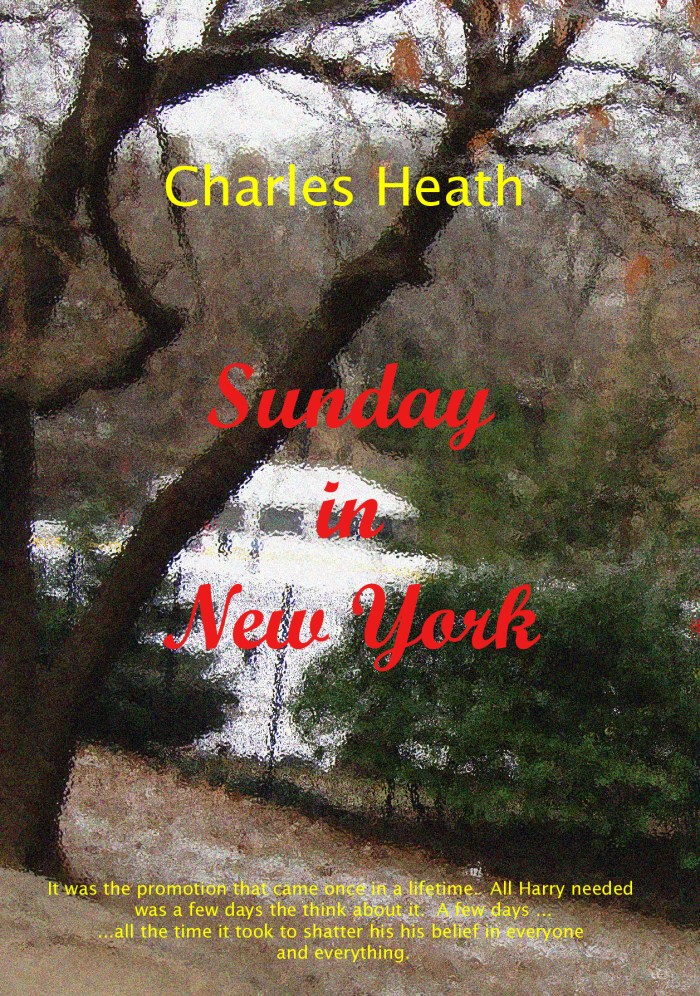
Sunday In New York

365 Days of writing, 2026 – 36

Day 36 – Obsessions become inspiration

Turning an Obsession Into Art: How Watching Soap Operas Can Fuel Your Next Story or Play


Introduction

What if the very thing you can’t stop binge‑watching—whether it’s a daily soap opera, a true‑crime documentary, or an endless stream of cooking shows—could become the secret weapon behind your next compelling narrative?

Obsessions are often dismissed as distractions, but for writers, they can be information goldmines. The key is learning how to harvest the patterns, emotions, and structures that keep you glued to the screen, and then re‑engineer them into something fresh, resonant, and uniquely yours.

In this post, we’ll explore:

  1. Why obsessions work – the psychological and creative science behind them.
  2. What soap operas teach us about drama, pacing, and character.
  3. A step‑by‑step framework for turning a viewing habit into a polished story or stage play.
  4. Real‑world examples of writers who turned their fixations into masterpieces.
  5. Practical tips & pitfalls to keep you on track.

Grab a notebook (or open a fresh Google Doc) and let’s turn that guilty pleasure into a creative engine.


1. The Power of Obsession: Why It’s a Writer’s Secret Weapon

A. Cognitive Magnetism

When you repeatedly expose yourself to a particular genre or medium, your brain builds schema—mental frameworks that help you predict what will happen next. This predictive ability frees up cognitive bandwidth for higher‑order thinking: spotting the gaps, subverting expectations, and layering new ideas onto familiar structures.

B. Emotional Hook

Obsessions aren’t just intellectual; they’re emotional. The excitement you feel when a cliff‑hanger resolves, the empathy you develop for a long‑running protagonist—these feelings stick in your memory. Emotional resonance is the lifeblood of any story, and an obsession supplies a ready‑made well of feeling to draw from.

C. Knowledge Accumulation

Every episode you watch deposits data: character arcs, dialogue cadence, set dressing, pacing cues, and even the “rules” that govern the fictional world. Over weeks or months, this repository becomes a research library that you can reference without ever opening a textbook.

Bottom line: An obsession turns you into a subject‑matter specialist while simultaneously priming you to think like a storyteller.


2. Soap Operas as a Masterclass in Drama

If you’re sceptical about using soap operas—a genre sometimes dismissed as “lowbrow”—look closer. The format is a compressed drama laboratory:

ElementWhat Soap Operas Do WellHow It Translates to Writing
Character DepthLong‑term arcs let characters evolve over years.Gives you a model for layered, believable growth.
Cliff‑HangersEvery episode ends on a hook that forces the next viewing.Teaches you how to structure tension and release.
Dialogue RhythmRapid, overlapping conversations mimic real speech.Shows you how to craft snappy, realistic dialogue.
Plot InterweavingMultiple storylines intersect, diverge, and reconverge.Provides a blueprint for complex, multi‑threaded plots.
Emotional CoreStakes are amplified (family secrets, betrayals, love).Demonstrates how to raise emotional stakes without melodrama.
Production ConstraintsLimited budgets force creative staging.Inspires resourceful world‑building on a modest scale.

Even the most cynical critic can acknowledge that soap operas are engineered for maximum emotional throughput—exactly what you want when you sit down to write a story that grabs readers from the first line.


3. From Viewing to Writing: A Practical Framework

Below is a six‑step workflow that turns any obsessive viewing habit into a solid narrative foundation. Feel free to adapt the timeline to fit your schedule (the steps can be compressed into a weekend or stretched over months).

Step 1: Log the Details

  • Create a “Soap‑Log” spreadsheet with columns for episode title, air date, key conflict, main characters, and standout line of dialogue.
  • Tag recurring motifs (e.g., “secret twins,” “return from the dead,” “corporate takeover”).
  • Note personal reactions: what made you laugh, cringe, or feel a pang of sympathy?

Why? The act of recording forces you to observe rather than consume passively, training you to spot narrative mechanics.

Step 2: Identify the Core Mechanics

  • Pattern‑hunt: Which plot devices appear most often? (e.g., “misunderstood love letters”).
  • Structure analysis: Break down a typical episode into beats (inciting incident → rising action → climax → resolution). Use Dan Harmon’s Story Circle or a three‑act template as a reference.

Result: A toolbox of building blocks you can mix, match, and remix.

Step 3: Extract Universal Themes

  • Even the most outlandish storylines tap into fundamental human concerns: power, love, betrayal, and redemption.
  • Write a list of theme statements, such as “the desire for belonging can drive people to deception.”

Why it matters: Themes give your work depth beyond plot mechanics, ensuring it resonates beyond the soap fan base.

Step 4: Subvert and Re-Contextualise

  • Choose one familiar soap trope (e.g., the “evil step‑mother”) and flip it: perhaps the step‑mother is the heroic caretaker in a dystopian future.
  • Change the setting dramatically: move the drama from a small town in Texas to a floating city on a gas giant.

Goal: Keep the emotional pull of the original while delivering something fresh.

Step 5: Draft a Mini‑Pilot

  • Write a 10‑page pilot (or a one‑act play) that incorporates at least three of the identified beats, one subverted trope, and a clear thematic thread.
  • Use the soap‑log as a cheat sheet for dialogue rhythm and cliff‑hanger placement.

Tip: Aim for a tight inciting incident in the first 5 pages—this is the hook that made you binge‑watch the soap in the first place.

Step 6: Iterate with Feedback

  • Share the draft with a mix of soap fans and non‑fans. Ask: “Did the stakes feel real?” and “Did any moment feel cliché?”
  • Revise based on the overlap—what resonates with both groups is the sweet spot where niche expertise meets universal appeal.

Skeletons in the closet, and doppelgangers

A story called “Mistaken Identity”

How many of us have skeletons in the closet that we know nothing about? The skeletons we know about generally stay there, but those we do not, well, they have a habit of coming out of left field when we least expect it.

In this case, when you see your photo on a TV screen with the accompanying text that says you are wanted by every law enforcement agency in Europe, you’re in a state of shock, only to be compounded by those same police, armed and menacing, kicking the door down.

I’d been thinking about this premise for a while after I discovered my mother had a boyfriend before she married my father, a boyfriend who was, by all accounts, the man who was the love of her life.

Then, in terms of coming up with an idea for a story, what if she had a child by him that we didn’t know about, which might mean I had a half brother or sister I knew nothing about. It’s not an uncommon occurrence from what I’ve been researching.

There are many ways of putting a spin on this story.

Then, in the back of my mind, I remembered a story an acquaintance at work was once telling us over morning tea, that a friend of a friend had a mother who had a twin sister and that each of the sisters had a son by the same father, without each knowing of the father’s actions, both growing up without the other having any knowledge of their half brother, only to meet by accident on the other side of the world.

It was an encounter that in the scheme of things might never have happened, and each would have remained oblivious of the other.

For one sister, the relationship was over before she discovered she was pregnant, and therefore had not told the man he was a father. It was no surprise the relationship foundered when she discovered he was also having a relationship with her sister, a discovery that caused her to cut all ties with both of them and never speak to either from that day.

It’s a story with more twists and turns than a country lane!

And a great idea for a story.

That story is called ‘Mistaken Identity’.

In a word: Stern

It’s what I’d always expected of my teachers, having to stand up the front of the classroom and look like they were in control.

These days, not so much, but back in my day, teachers, and particularly the men, were to be feared, and stern expressions were the features of an effective teacher.

So, in this context, it means a hardness or severity of manner.

Whilst in a sense that was frightening to us kids, another form of the word also can be used to express a forbidding or gloomy appearance.

Grandfathers also have that stern look, but it’s more forbidding, more authoritarian, more severe, more austere, well, you get the picture.  A six-year-old would be trembling in his or her boots.

There again, in facing up to either possibility above, you could stand firm with a stern resolve not to buckle under the pressure.

Of course, not a good idea if you’re facing a tank (with a stern-looking tank master)

Then…

If you’re standing at the end of the boat, not the front, but the rear, you would be standing at the stern of the boat, or ship.

Oddly, when issuing instructions to go in reverse, not something you would say if you were on the bridge, you would instead say, or possibly yell, full speed astern, because you’re about to hit an iceberg.

Or some idiot in a jet ski who likes to think he or she can beat the bullet (or 65,000 tonnes of a ship that has very little mobility).

A photograph from the inspirational bin – 22

I found this…


So near and yet so far.

What I found was the moon out in the late afternoon, a phenomenon that might happen on a regular basis, but this one of the few times I’ve seen it.

And it reminds me of something I was told a long time ago. Shoot for the moon. I never quite understood what the person meant, not until a long time later when I realised that I was being told nothing was impossible.

Had I ever achieved the impossible?

The thing is, each of us define what is possible and what is impossible ourselves, and is therefore different for every person. If you tell yourself it is impossible, then it requires a mind shift to get past that barrier.

But, the question still remains the same, did I achieve the impossible?

I never thought I’d write a book, or have it published. Some would say I still haven’t achieved that goal because I self published it on Amazon.

I think I achieved what I set out to do.

I never thought I’d get a university degree, but people had faith in me, and yes, I got it in the end.

I never thought, when I was younger, I would be a father, and sometimes I wonder whether it was worth it, but having grandchildren dispelled any perceived disappointment.

And what is on the impossible list now?

Not a lot. At my age, I don’t think it’s possible I will travel to the moon, nor afford to skirt the edge of space, as much as it would be amazing to look back at the planet.

I don’t think I’ll ever become a CEO, but then I don’t want to. Too much responsibility.

What’s left that is achievable?

Tracing my family history, and going back to where my ancestors came from, and, hopefully finding someone who was ‘famous’.

The cinema of my dreams – Was it just another surveillance job – Episode 41

I’m back home and this story has been sitting on the back burner for a few months, waiting for some more to be written.

The trouble is, there are also other stories to write, and I’m not very good at prioritizing.

But, here we are, a few minutes opened up and it didn’t take long to get back into the groove.

Chasing leads, maybe

I gave it about five minutes before I think I started breathing again and then headed back to Jennifer.

Or where I thought I had left her.

She wasn’t there. I think, in the end, it didn’t surprise me. She had been reluctant from the start so if I had to guess, she had done a bunk. This was not her fight, nor mine, but she had a ticket out. Why would you want to come back after being betrayed by the likes of Severin and Maury?

I hope she left the car behind.

Now that I was here there was no point leaving, so I took a few minutes to search the surrounding area, just in case she was still here, just someplace else, and when she wasn’t, I quickly and silently made my way back to the side of the house with the open door from a different direction.

There was another set of French doors, these curtained, and with an overhead light above the doorway, so I kept my distance in case there was a movement activator, another which looked to be a servant’s entrance at the back. Neither door looked to be an easy viable entrance.

The original side door was still unlocked, with no lights or movement inside.

I waited, then opened the door wide enough to slip through. Again, I waited in case there was a silent alarm, then when nothing stirred, slipped through and closed the door behind me.

On the other side of the door, it was quite dark, except now I could see, on one wall, the dying embers of a fire. Someone had been in the room earlier and most likely gone to bed.

It meant the house was occupied.

It also meant I had to be careful.

On the other side of the doors, it was a lot warmer. Again I waited a few minutes, just in case someone came, and, when they didn’t, I pulled out a small torch and turned it on.

In front of me were two chairs and a table, one I would have walked into without a light. The walls had shelves and those shelves were filled with books. Some behind glass doors, others not. There was another chair by the fire, and beside it, a stack of cooks, and a table with had an empty glass and a bottle, and a pair of reading glasses.

The downstairs reading room.

I cross the room slowly, hoping there were no squeaky floorboards, to be expected in an old house like this one. The timber flooring was exposed only at the edges of the room, the rest of the floor covered in a large, discolored, and fraying carpet square.

It was old, like everything else in the room.

I was tempted to have a look at how far the books dated back to but resisted the urge. I was looking for information on the owner.

At the doorway to what looked like a passage, I turned off the torch and peered out. It was not exactly dark, my eyes had adjusted to the low-level light from low wattage lights about a foot above the floor.

Lights to help guide the way at night.

Left, rooms, right, rooms, at the end of the passage a wide doorway leading towards the other side of the house. Larger rooms perhaps.

I turned right and headed towards the front, and they stopped at the doorway to the next room. I’d deliberately walked on the carpet runner in the middle of the passage, and just managed to catch my foot when one part of the floor creaked softly.

The room next door was almost the same as the one I’d entered by, with chairs and shelves but only on two sides. This room had a long window and no French doors.

On one side there was a writing desk, open, with papers scatted on the writing surface. I quickly crossed the room to it, switched on the light, and checked.

Bills. In the name of Mrs. Marianne Quigley. This had to be Adam Quigley’s mother, and by deduction, O’Connell’s mother.

Proof I was in the right place.

Then I heard the squeak of a floorboard followed by the clicking sound of a gun being cocked.

“Don’t move, or I’ll shoot. Hands in the air. And don’t make me ask twice.”

Hands up it was.

© Charles Heath 2020-2022

365 Days of writing, 2026 – 35

Day 35 – Poetry

The Paradox of Poetry: Unpacking Elizabeth Bishop’s Insight

Elizabeth Bishop, a Pulitzer Prize-winning poet, once astutely observed, “Writing poetry is an unnatural act. It takes great skill to make it seem natural.” This statement may seem counterintuitive, as poetry is often associated with spontaneity and emotional expression. However, Bishop’s words reveal a profound truth about the craft of poetry, one that warrants closer examination. In this blog post, we’ll delve into the complexities of writing poetry, exploring why it can be considered an unnatural act, and what it takes to make it seem natural.

The Unnatural Act of Writing Poetry

On the surface, poetry appears to be a natural extension of human language, a way to express thoughts, emotions, and experiences through words. However, the process of crafting a poem is often a deliberate and calculated one. Poets must carefully select and arrange words, considering factors like meter, rhyme, imagery, and syntax, to convey their intended meaning. This self-conscious process can feel unnatural, as it requires a level of manipulation and control that doesn’t always come easily.

Furthermore, poetry often involves distilling complex emotions and ideas into concise, precise language, which can be a challenging and artificial process. Poets must navigate the tension between authenticity and artifice, striving to capture the essence of their subject matter while also shaping it into a cohesive, aesthetically pleasing form. This balancing act can make writing poetry feel like an unnatural act, as it demands a high degree of craftsmanship and attention to detail.

The Skill of Making it Seem Natural

So, how do poets overcome the unnatural aspects of writing poetry and make it seem natural? According to Bishop, it takes great skill. This skill encompasses a range of abilities, including:

  1. Mastering form and technique: Poets must develop a deep understanding of poetic forms, such as sonnets, free verse, or haikus, and learn to wield them effectively. This involves experimenting with different structures, rhythms, and language patterns to find the right fit for their message.
  2. Developing a unique voice: A poet’s voice is the distinctive tone, style, and perspective they bring to their work. Cultivating a unique voice requires a deep understanding of one’s own experiences, emotions, and observations, as well as the ability to express them in a way that feels authentic and relatable.
  3. Using language effectively: Poets must be skilled in the use of language, able to select words, images, and metaphors that evoke the desired response in the reader. This involves a keen sense of observation, a rich vocabulary, and a willingness to experiment with language.
  4. Editing and revision: The process of writing poetry is often iterative, with poets refining their work through multiple drafts and revisions. This involves being willing to cut, reshape, and rework lines, stanzas, and entire poems to achieve the desired effect.

By honing these skills, poets can create poetry that seems natural, effortless, and spontaneous, even when it’s the result of careful crafting and revision. The best poetry appears to flow from the poet’s heart and mind with ease, concealing the hard work and dedication that went into its creation.

Conclusion

Elizabeth Bishop’s observation that “writing poetry is an unnatural act” may seem paradoxical, but it highlights the complex, nuanced nature of the craft. While poetry is often associated with natural expression and spontaneity, the process of writing it can be deliberate, calculated, and artificial. However, with great skill and dedication, poets can overcome these challenges and create work that seems natural, authentic, and beautiful. By embracing the unnatural aspects of writing poetry and developing the skills necessary to master the craft, poets can produce poetry that resonates with readers and leaves a lasting impression.

If I only had one day to stop over in – Copenhagen – what would I do?

The One Place to Make Your Copenhagen Stopover Unforgettable

Have you ever found yourself with just one day in a city you’ve always dreamed of exploring? That’s exactly the magic of a Copenhagen stopover. Whether you’re en route to another destination or squeezing in a quick European getaway, this Danish capital offers a taste of hygge, history, and vibrant culture—all in a compact, walkable city.

But with limited time, how do you choose just one spot to capture the essence of Copenhagen? You could wander through colourful Nyhavn, explore the historic Tivoli Gardens, or marvel at the futuristic architecture of the Opera House. Yet if you’re looking for a truly memorable experience—one that blends history, culture, and breathtaking views—there’s one place that stands above the rest: The Rundetårn (The Round Tower).

Why The Rundetårn?

Built in the 17th century as an astronomical observatory, The Round Tower is more than just a historic landmark—it’s a journey through time. Unlike most towers with steep staircases, Rundetårn features a unique, gently sloping spiral ramp that winds its way to the top. As you ascend, you’ll pass historical exhibitions, an atmospheric library hall, and even a glass floor looking down into the core of the tower.

But the real reward awaits at the summit.

The View That Steals Your Heart

When you step out onto the rooftop platform, you’re greeted with a 360-degree panoramic view of Copenhagen’s rooftops, spires, and bustling streets. From this vantage point, you can spot iconic landmarks like the Christiansborg Palace, the Church of Our Saviour, and the distant silhouette of the Øresund Bridge. It’s the perfect place to orient yourself, snap unforgettable photos, and simply soak in the city’s charm.

A Stopover Moment to Remember

What makes Rundetårn especially perfect for a one-day visit is its central location. Just a short walk from Strøget, Copenhagen’s famous pedestrian street, you can easily pair your visit with a stroll through the city’s vibrant heart, a bite of smørrebrød (Danish open-faced sandwiches), or a quick coffee in a cozy café.

Whether you visit in the morning light, under the blue afternoon sky, or during the golden hour before sunset, The Round Tower offers a moment of reflection and wonder—a chance to pause and appreciate the beauty of Copenhagen from above.

So, if you find yourself with just one day in this Nordic gem, make your way to Rundetårn. Let its spiral ramp lead you upward, and let Copenhagen unfold beneath you. It’s not just a sightseeing stop—it’s a memory in the making.

Pro Tip: Arrive early to avoid crowds, and don’t forget to look up at night if you’re in town after dark—the tower’s observatory still opens for stellar views of the cosmos.

Happy exploring, and may your Copenhagen stopover be filled with wonder!

What I learned about writing – Why do we persist in writing?

It’s another reminder that we should never give up, despite the advice that’s sometimes given by our peers, not exactly saying it, but alluding to the fact that some do, and some don’t and that the talented should not.

But … do we know we’re talented, and even if we are, after a myriad or plethora of rejections, the temptation to walk away might be there.

Except…

If you’re like me, you’re not in it for the wealth and fame. Yes, wealth and fame would be nice; just an adequate living would be better, but most of us aren’t likely to give up our day jobs any time soon.

I write because I love writing. I like inventing characters and throwing everything, but the kitchen sink, at them. Maybe that’s where I’m going wrong. I should throw in the kitchen sink.

Kidding.

And I publish a lot of those stories on this blog, and people are reading them because I get a few comments every day, and most of them are positive, and even if they are not, yes, you can’t please everyone, I take them as constructive criticism.

So the next time someone advises you that writing just might not be your vocation, write them a story and tell them they’re wrong.

“The Devil You Don’t”, she was the girl you would not take home to your mother!

Now only $0.99 at https://amzn.to/2Xyh1ow

John Pennington’s life is in the doldrums. Looking for new opportunities, and prevaricating about getting married, the only joy on the horizon was an upcoming visit to his grandmother in Sorrento, Italy.

Suddenly he is left at the check-in counter with a message on his phone telling him the marriage is off, and the relationship is over.

If only he hadn’t promised a friend he would do a favour for him in Rome.

At the first stop, Geneva, he has a chance encounter with Zoe, an intriguing woman who captures his imagination from the moment she boards the Savoire, and his life ventures into uncharted territory in more ways than one.

That ‘favour’ for his friend suddenly becomes a life-changing event, and when Zoe, the woman who he knows is too good to be true, reappears, danger and death follow.

Shot at, lied to, seduced, and drawn into a world where nothing is what it seems, John is dragged into an adrenaline-charged undertaking, where he may have been wiser to stay with the ‘devil you know’ rather than opt for the ‘devil you don’t’.

newdevilcvr6
