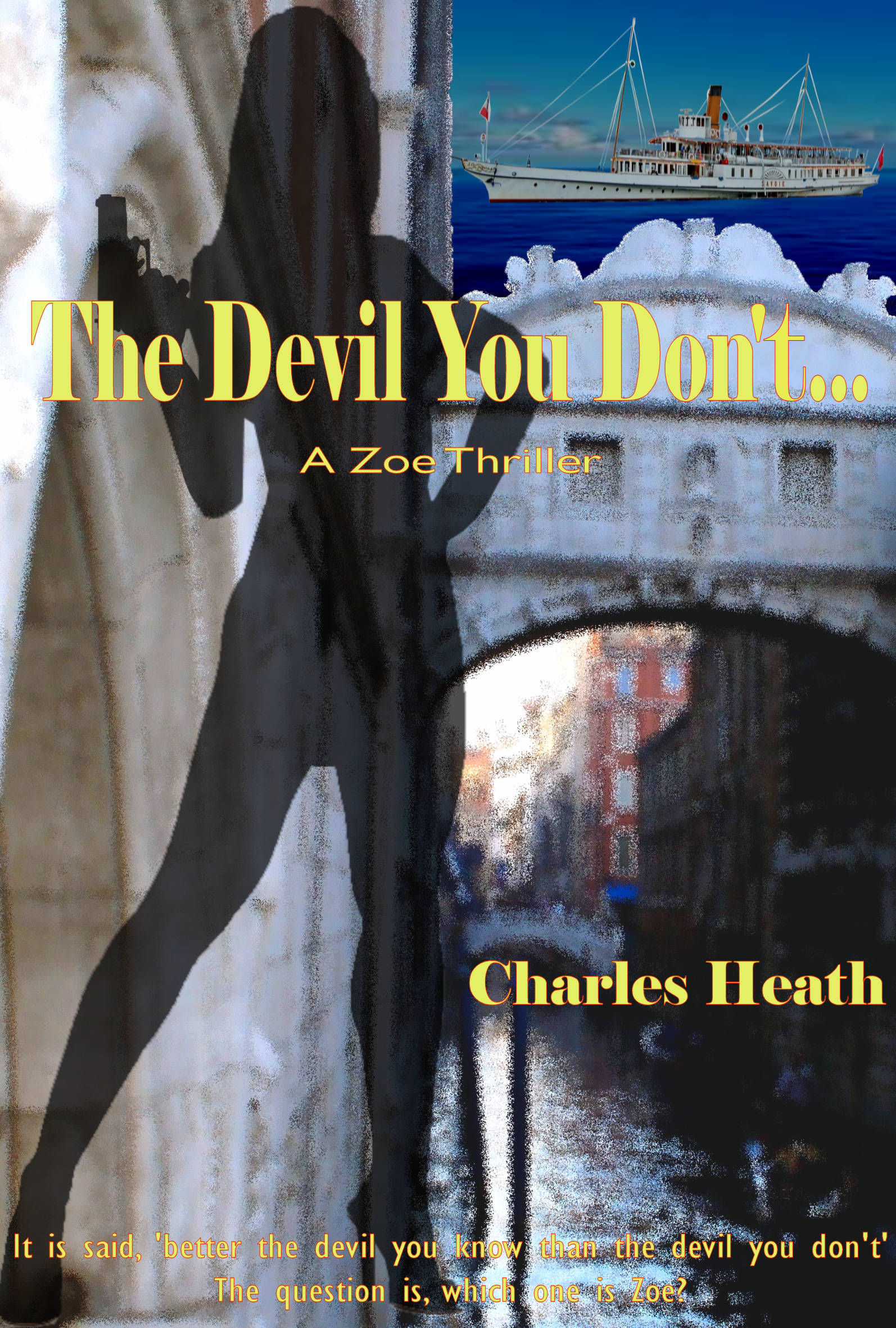
An excerpt from “One Last Look”: Charlotte is no ordinary girl

This is currently available at Amazon herehttp://amzn.to/2CqUBcz

I’d read about out-of-body experiences, and like everyone else, thought it was nonsense.  Some people claimed to see themselves in the operating theatre, medical staff frantically trying to revive them, and being surrounded by white light.

I was definitely looking down, but it wasn’t me I was looking at.

It was two children, a boy and a girl, with their parents, in a park.

The boy was Alan.  He was about six or seven.  The girl was Louise, and she was five years old.  She had long red hair and looked the image of her mother.

I remember it now, it was Louise’s birthday and we went down to Bournemouth to visit our Grandmother, and it was the last time we were all together as a family.

We were flying homemade kites our father had made for us, and after we lay there looking up at the sky, making animals out of the clouds.  I saw an elephant, Louise saw a giraffe.

We were so happy then.

Before the tragedy.

When I looked again ten years had passed and we were living in hell.  Louise and I had become very adept at survival in a world we really didn’t understand, surrounded by people who wanted to crush our souls.

It was not a life a normal child had, our foster parents never quite the sort of people who were adequately equipped for two broken-hearted children.  They tried their best, but their best was not good enough.

Every day it was a battle, to avoid the Bannister’s and Archie in particular, every day he made advances towards Louise and every day she fended him off.

Until one day she couldn’t.

Now I was sitting in the hospital, holding Louise’s hand.  She was in a coma, and the doctors didn’t think she would wake from it.  The damage done to her was too severe.

The doctors were wrong.

She woke, briefly, to name her five assailants.  It was enough to have them arrested.  It was not enough to have them convicted.

Justice would have to be served by other means.

I was outside the Bannister’s home.

I’d made my way there without really thinking, after watching Louise die.  It was like being on autopilot, and I had no control over what I was doing.  I had murder in mind.  It was why I was holding an iron bar.

Skulking in the shadows.  It was not very different from the way the Bannister’s operated.

I waited till Archie came out.  I knew he eventually would.  The police had taken him to the station for questioning, and then let him go.  I didn’t understand why, nor did I care.

I followed him up the towpath, waiting till he stopped to light a cigarette, then came out of the shadows.

“Wotcha got there Alan?” he asked when he saw me.  He knew what it was, and what it was for.

It was the first time I’d seen the fear in his eyes.  He was alone.

“Justice.”

“For that slut of a sister of yours.  I had nuffing to do with it.”

“She said otherwise, Archie.”

“She never said nuffing, you just made it up.”  An attempt at bluster, but there was no confidence in his voice.

I held up the pipe.  It had blood on it.  Willy’s blood.  “She may or may not have Archie, but Willy didn’t make it up.  He sang like a bird.  That’s his blood, probably brains on the pipe too, Archie, and yours will be there soon enough.”

“He dunnit, not me.  Lyin’ bastard would say anything to save his own skin.”  Definitely scared now, he was looking to run away.

“No, Archie.  He didn’t.  I’m coming for you.  All of you Bannisters.  And everyone who touched my sister.”

It was the recurring nightmare I had for years afterwards.

I closed my eyes and tried to shut out the thoughts, the images of Louise, the phone call, the visit to the hospital and being there when she succumbed to her injuries.  Those were the very worst few hours of my life.

She had asked me to come to the railway station and walk home with her, and I was running late.  If I had left when I was supposed to, it would never have happened and for years afterwards, I blamed myself for her death.

If only I’d not been late…

When the police finally caught the rapists, I’d known all along who they’d be; antagonists from school, the ring leader, Archie Bannister, a spurned boyfriend, a boy whose parents, ubiquitously known to all as ‘the Bannister’s, dealt in violence and crime and who owned the neighbourhood.  The sins of the father had been very definitely passed onto the son.

At school, I used to be the whipping boy, Archie, a few grades ahead of me, made a point of belting me and a few of the other boys, to make sure the rest did as they were told.  He liked Louise, but she had no time for a bully like him, even when he promised he would ‘protect’ me.

I knew the gang members, the boys who tow-kowed to save getting beaten up, and after the police couldn’t get enough information to prosecute them because everyone was too afraid to speak out, I went after Willy.  There was always a weak link in a group, and he was it.

He worked in a factory, did long hours on a Wednesday and came home after dark alone.  It was a half mile walk, through a park.  The night I approached him, I smashed the lights and left it in darkness.  He nearly changed his mind and went the long way home.

He didn’t.

It took an hour and a half to get the names.  At first, when he saw me, he laughed.  He said I would be next, and that was four words more than he knew he should have said.

When I found him alone the next morning I showed him the iron bar and told him he was on the list.  I didn’t kill him then, he could wait his turn, and worry about what was going to happen to him.

When the police came to visit me shortly after that encounter, no doubt at the behest of the Bannister’s, the neighbourhood closed ranks and gave me an ironclad alibi.  The Bannister’s then came to visit me and threatened me.  I told them their days were numbered and showed them the door.

At the trial, he and his friends got off on a technicality.  The police had failed to do their job properly, but it was not the police, but a single policeman, corrupted by the Bannisters.

Archie could help but rub it in my face.  He was invincible.

Joe Collins took 12 bullets and six hours to bleed out.  He apologized, he pleaded, he cried, he begged.  I didn’t care.

Barry Mills, a strong lad with a mind to hurting people, Archie’s enforcer, almost got the better of me.  I had to hit him more times than I wanted to, and in the end, I had to be satisfied that he died a short but agonizing death.

I revisited Willy in the hospital.  He’d recovered enough to recognize me, and why I’d come.  Suffocation was too good for him.

David Williams, second in command of the gang, was as tough and nasty as the Bannisters.  His family were forging a partnership with the Bannister’s to make them even more powerful.  Outwardly David was a pleasant sort of chap, affable, polite, and well mannered.  A lot of people didn’t believe he could be like, or working with, the Bannisters.

He and I met in the pub.  We got along like old friends.  He said Willy had just named anyone he could think of, and that he was innocent of any charges.  We shook hands and parted as friends.

Three hours later he was sitting in a chair in the middle of a disused factory, blindfolded and scared.  I sat and watched him, listened to him, first threatening me, and then finally pleading with me.  He’d guessed who it was that had kidnapped him.

When it was dark, I took the blindfold off and shone a very bright light in his eyes.  I asked him if the violence he had visited upon my sister was worth it.  He told me he was just a spectator.

I’d read the coroner’s report.  They all had a turn.  He was a liar.

He took nineteen bullets to die.

Then came Archie.

The same factory only this time there were four seats.  Anna Bannister, brothel owner, Spike Bannister, head of the family, Emily Bannister, sister, and who had nothing to do with their criminal activities.  She just had the misfortune of sharing their name.

Archie’s father told me how he was going to destroy me, and everyone I knew.

A well-placed bullet between the eyes shut him up.

Archie’s mother cursed me.  I let her suffer for an hour before I put her out of her misery.

Archie remained stony-faced until I came to Emily.  The death of his parents meant he would become head of the family.  I guess their deaths meant as little to him as they did me.

He was a little more worried about his sister.

I told him it was confession time.

He told her it was little more than a forced confession and he had done nothing to deserve my retribution.

I shrugged and shot her, and we both watched her fall to the ground screaming in agony.  I told him if he wanted her to live, he had to genuinely confess to his crimes.  This time he did, it all poured out of him.

I went over to Emily.  He watched in horror as I untied her bindings and pulled her up off the floor, suffering only from a small wound in her arm.  Without saying a word she took the gun and walked over to stand behind him.

“Louise was my friend, Archie.  My friend.”

Then she shot him.  Six times.

To me, after saying what looked like a prayer, she said, “Killing them all will not bring her back, Alan, and I doubt she would approve of any of this.  May God have mercy on your soul.”

Now I was in jail.  I’d spent three hours detailing the deaths of the five boys, everything I’d done; a full confession.  Without my sister, my life was nothing.  I didn’t want to go back to the foster parents; I doubt they’d take back a murderer.

They were not allowed to.

For a month I lived in a small cell, in solitary, no visitors.  I believed I was in the queue to be executed, and I had mentally prepared myself for the end.

Then I was told I had a visitor, and I was expecting a priest.

Instead, it was a man called McTavish. Short, wiry, and with an accent that I could barely understand.

“You’ve been a bad boy, Alan.”

When I saw it was not the priest I told the jailers not to let him in, I didn’t want to speak to anyone.  They ignored me.  I’d expected he was a psychiatrist, come to see whether I should be shipped off to the asylum.

I was beginning to think I was going mad.

I ignored him.

“I am the difference between you living or dying Alan, it’s as simple as that.  You’d be a wise man to listen to what I have to offer.”

Death sounded good.  I told him to go away.

He didn’t.  Persistent bugger.

I was handcuffed to the table.  The prison officers thought I was dangerous.  Five, plus two, murders, I guess they had a right to think that.  McTavish sat opposite me, ignoring my request to leave.

“Why’d you do it?”

“You know why.”  Maybe if I spoke he’d go away.

“Your sister.  By all accounts, the scum that did for her deserved what they got.”

“It was murder just the same.  No difference between scum and proper people.”

“You like killing?”

“No-one does.”

“No, I dare say you’re right.  But you’re different, Alan.  As clean and merciless killing I’ve ever seen.  We can use a man like you.”

“We?”

“A group of individuals who clean up the scum.”

I looked up to see his expression, one of benevolence, totally out of character for a man like him.  It looked like I didn’t have a choice.

Trained, cleared, and ready to go.

I hadn’t realized there were so many people who were, for all intents and purposes, invisible.  People that came and went, in malls, in hotels, trains, buses, airports, everywhere, people no one gave a second glance.

People like me.

In a mall, I became a shopper.

In a hotel, I was just another guest heading to his room.

On a bus or a train, I was just another commuter.

At the airport, I became a pilot.  I didn’t need to know how to fly; everyone just accepted a pilot in a pilot suit was just what he looked like.

I had a passkey.

I had the correct documents to get me onto the plane.

That walk down the air bridge was the longest of my life.  Waiting for the call from the gate, waiting for one of the air bridge staff to challenge me, stepping onto the plane.

Two pilots and a steward.  A team.  On the plane early before the rest of the crew.  A group that was committing a crime, had committed a number of crimes and thought they’d got away with it.

Until the judge, the jury and their executioner arrived.

Me.

Quick, clean, merciless.  Done.

I was now an operational field agent.

I was older now, and I could see in the mirror I was starting to go grey at the sides.  It was far too early in my life for this, but I expect it had something to do with my employment.

I didn’t recognize the man who looked back at me.

It was certainly not Alan McKenzie, nor was there any part of that fifteen-year-old who had made the decision to exact revenge.

Given a choice; I would not have gone down this path.

Or so I kept telling myself each time a little more of my soul was sold to the devil.

I was Barry Gamble.

I was Lenny Buckman.

I was Jimmy Hosen.

I was anyone but the person I wanted to be.

That’s what I told Louise, standing in front of her grave, and trying to apologize for all the harm, all the people I’d killed for that one rash decision.  If she was still alive she would be horrified, and ashamed.

Head bowed, tears streamed down my face.

God had gone on holiday and wasn’t there to hand out any forgiveness.  Not that day.  Not any day.

New York, New Years Eve.

I was at the end of a long tour, dragged out of a holiday and back into the fray, chasing down another scumbag.  They were scumbags, and I’d become an automaton hunting them down and dispatching them to what McTavish called a better place.

This time I failed.

A few drinks to blot out the failure, a blonde woman who pushed my buttons, a room in a hotel, any hotel, it was like being on the merry-go-round, round and round and round…

Her name was Silvia or Sandra, or someone I’d met before, but couldn’t quite place her.  It could be an enemy agent for all I knew or all I cared right then.

I was done.

I’d had enough.

I gave her the gun.

I begged her to kill me.

She didn’t.

Instead, I simply cried, letting the pent up emotion loose after being suppressed for so long, and she stayed with me, holding me close, and saying I was safe, that she knew exactly how I felt.

How could she?  No one could know what I’d been through.

I remembered her name after she had gone.

Amanda.

I remembered she had an imperfection in her right eye.

Someone else had the same imperfection.

I couldn’t remember who that was.

Not then.

I had a dingy flat in Kensington, a place that I rarely stayed in if I could help it.  After five-star hotel rooms, it made me feel shabby.

The end of another mission, I was on my way home, the underground, a bus, and then a walk.

It was late.

People were spilling out of the pub after the last drinks.  Most in good spirits, others slightly more boisterous.

A loud-mouthed chap bumped into me, the sort who had one too many, and was ready to take on all comers.

He turned on me, “Watch where you’re going, you fool.”

Two of his friends dragged him away.  He shrugged them off, squared up.

I punched him hard, in the stomach, and he fell backwards onto the ground.  I looked at his two friends.  “Take him home before someone makes mincemeat out of him.”

They grabbed his arms, lifted him off the ground and took him away.

Out of the corner of my eye, I could see a woman, early thirties, quite attractive, but very, very drunk.  She staggered from the bar, bumped into me, and finished up sitting on the side of the road.

I looked around to see where her friends were.  The exodus from the pub was over and the few nearby were leaving to go home.

She was alone, drunk, and by the look of her, unable to move.

I sat beside her.  “Where are your friends?”

“Dunno.”

“You need help?”

She looked up, and sideways at me.  She didn’t look the sort who would get in this state.  Or maybe she was, I was a terrible judge of women.

“Who are you?” she asked.

“Nobody.”  I was exactly how I felt.

“Well Mr Nobody, I’m drunk, and I don’t care.  Just leave me here to rot.”

She put her head back between her knees, and it looked to me she was trying to stop the spinning sensation in her head.

Been there before, and it’s not a good feeling.

“Where are your friends?” I asked again.

“Got none.”

“Perhaps I should take you home.”

“I have no home.”

“You don’t look like a homeless person.  If I’m not mistaken, those shoes are worth more than my weekly salary.”  I’d seen them advertised, in the airline magazine, don’t ask me why the ad caught my attention.

She lifted her head and looked at me again.  “You a smart fucking arse are you?”

“I have my moments.”

“Have them somewhere else.”

She rested her head against my shoulder.  We were the only two left in the street, and suddenly in darkness when the proprietor turned off the outside lights.

“Take me home,” she said suddenly.

“Where is your place?”

“Don’t have one.  Take me to your place.”

“You won’t like it.”

“I’m drunk.  What’s not to like until tomorrow.”

I helped her to her feet.  “You have a name?”

“Charlotte.”

The wedding was in a small church.  We had been away for a weekend in the country, somewhere in the Cotswolds, and found this idyllic spot.  Graves going back to the dawn of time, a beautiful garden tended by the vicar and his wife, an astonishing vista over hills and down dales.

On a spring afternoon with the sun, the flowers, and the peacefulness of the country.

I had two people at the wedding, the best man, Bradley, and my boss, Watkins.

Charlotte had her sisters Melissa and Isobel, and Isobel’s husband Giovanni, and their daughter Felicity.

And one more person who was as mysterious as she was attractive, a rather interesting combination as she was well over retirement age.  She arrived late and left early.

Aunt Agatha.

She looked me up and down with what I’d call a withering look.  “There’s more to you than meets the eye,” she said enigmatically.

“Likewise I’m sure,” I said.  It earned me an elbow in the ribs from Charlotte.  It was clear she feared this woman.

“Why did you come,” Charlotte asked.

“You know why.”

Agatha looked at me.  “I like you.  Take care of my granddaughter.  You do not want me for an enemy.”

OK, now she officially scared me.

She thrust a cheque into my hand, smiled, and left.

“Who is she,” I asked after we watched her depart.

“Certainly not my fairy godmother.”

Charlotte never mentioned her again.

Zurich in summer, not exactly my favourite place.

Instead of going to visit her sister Isobel, we stayed at a hotel in Beethovenstrasse and Isobel and Felicity came to us.  Her husband was not with her this time.

Felicity was three or four and looked very much like her mother.  She also looked very much like Charlotte, and I’d remarked on it once before and it received a sharp rebuke.

We’d been twice before, and rather than talk to her sister, Charlotte spent her time with Felicity, and they were, together, like old friends.  For so few visits they had a remarkable rapport.

I had not broached the subject of children with Charlotte, not after one such discussion where she had said she had no desire to be a mother.  It had not been a subject before and wasn’t once since.

Perhaps like all Aunts, she liked the idea of playing with a child for a while and then give it back.

Felicity was curious as to who I was, but never ventured too close.  I believed a child could sense the evil in adults and had seen through my facade of friendliness.  We were never close.

But…

This time, when observing the two together, something quite out of left field popped into my head.  It was not possible, not by any stretch of the imagination, but I thought she looked like my mother.

And Charlotte had seen me looking in their direction.  “You seem distracted,” she said.

“I was just remembering my mother.  Odd moment, haven’t done so for a very long time.”

“Why now?”  I think she had a look of concern on her face.

“Her birthday, I guess,” I said, the first excuse I could think of.

Another look and I was wrong.  She looked like Isobel or Charlotte, or if I wanted to believe it possible, Melissa too.

I was crying, tears streaming down my face.

I was in pain, searing pain from my lower back stretching down into my legs, and I was barely able to breathe.

It was like coming up for air.

It was like Snow White bringing Prince Charming back to life.  I could feel what I thought was a gentle kiss and tears dropping on my cheeks, and when I opened my eyes, I saw Charlotte slowly lifting her head, a hand gently stroking the hair off my forehead.

And in a very soft voice, she said, “Hi.”

I could not speak, but I think I smiled.  It was the girl with the imperfection in her right eye.  Everything fell into place, and I knew, in that instant that we were irrevocably meant to be together.

“Welcome back.”

© Charles Heath 2016-2019

onelastlookcoverfinal2

“What Sets Us Apart”, a mystery with a twist

David is a man troubled by a past he is trying to forget.

Susan is rebelling against a life of privilege and an exasperated mother who holds a secret that will determine her daughter’s destiny.

They are two people brought together by chance. Or was it?

When Susan discovers her mother’s secret, she goes in search of the truth that has been hidden from her since the day she was born.

When David realizes her absence is more than the usual cooling off after another heated argument, he finds himself being slowly drawn back into his former world of deceit and lies.

Then, back with his former employers, David quickly discovers nothing is what it seems as he embarks on a dangerous mission to find Susan before he loses her forever.

Find the kindle version on Amazon here:  http://amzn.to/2Eryfth

whatsetscover

The cinema of my dreams – I always wanted to write a war story – Episode 40

For a story that was conceived during those long boring hours flying in a steel cocoon, striving to keep away the thoughts that the plane and everyone in it could just simply disappear as planes have in the past, it has come a long way.

Whilst I have always had a fascination with what happened during the second world war, not the battles or fighting, but in the more obscure events that took place, I decided to pen my own little sidebar to what was a long and bitter war.

And, so, it continues…

I had to almost restrain Carlo from going up to the castle and singlehandedly kill everyone in it.  I didn’t doubt he could do it, for a short time at least, until they realized what was going on.  There were too many of them to take on alone.

It would need a careful plan, and knowledge of the layout of the castle, and the likely spots where the soldiers were located.  It was a plan that had been slowly formulating in the back of my mind, especially after Carlo’s help with an internal map of the castle, some parts of which I hadn’t got to see in my brief stay.

I forgot that being built back in the middle ages, and the history of cities fighting against each other, there were ways in, out, and around, both inside and in the walls, so that soldiers could travel from one part of the castle to another without being seen, and not having to go inside the castle itself.

There were, also, tunnels, one of which I had inadvertently found, but there were more, and it seems only Carlo knew of those.  Some were useful, others would lead to an early confrontation, and give early notice of our intentions.  Those we would avoid, or use to escape.

We had set up a command center at the church ruins, having found several rooms off the cellar that had two exits.  I didn’t like the idea of being trapped, nor waiting in a location that Fernando was familiar with and was likely to return to.

Which, in a sense, I was hoping he would because we had set a trap and he and his men would be caught in the crossfire.  He was not going to get a chance to explain, nor would I ask any questions, or show him any mercy.

Especially when I found out what he had done to Martina.  If it was as bad as Chiara, he would be repaid in kind, if the opportunity arose.  I tentatively agreed to give Carlo five minutes in the room alone with him, but he knew that expediency might not give him that luxury.  Blinky was not happy about it, but he hadn’t been here long enough to know what the man or his people were like.

We’d also worked out the surveillance system so that we would know when anyone turned up in the village, particularly our prized defector Meyer, and whether anyone left the castle to come down to the village because it was possible there would be more defectors passing through, and they needed to be warned.

What was particularly useful was finding the radio that Martina had been using.  It was in the church grounds, which was not entirely unexpected, but one of Blink’s men had stumbled over it when looking to set up a latrine.

Blinky had brought a radioman, but his radio had been damaged in the parachute landing.  Now he had a new toy to tinker with, and got a connection back to Thompson, after some initial difficulty in translation.  That I could help him with, my Italian was marginally better than a schoolboy.

Thompson was relieved to hear from me, as I was to talk to him.

“It’s been difficult to get a clear picture with Martina, but I got the impression you had to be precise with your questions.”

“A case of getting lost in translation, perhaps.”  I had not had similar problems, but Thompson was from the aristocracy, and his version of English was sometimes quaint.

“The situation is bad, I understand.”

“It is.  The castle is over-run with British-German double agents.  The three you sent out, and reinforcements that followed.  I get the impression we have about 20 odd dead soldiers languishing in shallow graves somewhere on the Italian countryside.”

It hadn’t been hard to realize that while the officers were known British officers, the soldiers were substituted Germans whose English language and mannerisms were impeccable.  I had no doubt once they’d reeled in Meyer, they would move on, integrating into invasion forces and creating havoc from within, unless of course, we stopped them.

A sigh at the other end, perhaps a lamentation of such needless loss of life.  This war was getting tiresome for both of us.

“How close is Meyer?  We last heard he was in Gaole, waiting for a courier to take him to the village.  His arrival is anticipated to be any time from tomorrow onwards.”

“We’ve got men out keeping tabs on everyone.”

“Blinky arrive with his team?”

“All bar the radio, but as you can hear, we have access to one do it will not be a problem.  I think we might finish this and talk again tomorrow.  Don’t want the Germans tracking the radio waves.”

“Good.  Tomorrow, and hour before today.”

I’d almost forgotten that the Germans were good at tracking radio signals, especially when they thought the enemy was using them, as those at the castle would.  That radio unit could also be used to trace other radio signals, and no doubt they had picked up the signal.  Hopefully, we had not been on long enough for them to run the trace.

That was not going to be a problem.  One of Blinky’s soldiers on village reconnaissance was waiting for us as we approached the church ruins.”

“What is it, man?”

“There are four people at the village, looking for someone or something.”

“More defectors,” I said.  “We’d better get to them before Leonardo and his men get to them first.”

© Charles Heath 2020-2021

A photograph from the inspirational bin – 4

This is

A rainy day.

Not much of a revelation when it’s winter, but why is it when you have to go somewhere in a hurry, the universe knows, and tries to throw everything at you so you don’t get there on time?

I like to be punctual.

I’m one of those people who leave home to get to the airport hours before I have to because I know, from past experience, that if you leave at the time where you’d make it with an hour to spare, you would get stuck in the mother of all traffic jams.

I know this to be true.  It’s happened more than once to me,

If you’re not in a hurry, you get the best run you’ve ever had.  I know that’s true too, because that’s what happens most times.

It’s like when at work you’re in a hurry to get a photocopy.  The machine knows if you’re stressed and picks that particular moment to break down.  That use to happen to me more times that I’d had hot dinners.

Sorry, I needed to use that expression, which generally means a lot.  That photocopy machine, back in the days when they were huge and almost a new fad, my task every Tuesday was to copy a 3 page shipping report, 300 odd times.  Not once did I get a clean run, not in the two years it was my job.

But…

Back to the weather.

My day to pick up one of the grandchildren from the railway station.  It’s not far from our house, on any other day it would take about ten minutes, but since this is after 3 pm, I have the other school traffic to contend with, the tradies going home, and late afternoon shoppers getting dinner.

It never used to be like that.  The road was a single lane that used to be blocked by floods when it rained, there was no shopping centre, and no new estates.  In 30 years everything has arrived, the road expanded to two lanes either side, and almost continual traffic jams.

There’s a story there somewhere, but for the moment I have to take on the traffic.  Maybe once I get to the station I might have time to consider it.

The cinema of my dreams – Was it just another surveillance job – Episode 23

I’m back home and this story has been sitting on a back burner for a few months, waiting for some more to be written.

The trouble is, there are also other stories to write, and I’m not very good at prioritizing.

But, here we are, a few minutes opened up and it didn’t take long to get back into the groove.

An unlikely ally?


The bar in the hotel was tucked away in a small area behind the dining room, or perhaps it was part of the dining room, I wasn’t quite sure.  There were indoor shrubs blocking the view from the front entrance, so we could feel safe enough, and less strenuous in watching the continuous comings and goings of the hotel’s guests and their friends.

For a small hotel, it was quite busy.

We were lucky it was not yet dinner time, so the restaurant was still being set up for the evening dinner service.  I had a look at one of the menus, and the Shepherd’s Pie looked good.  It was mostly hearty British staples like Bangers and Mask and Toad in the Hole.  I guess by calling sausages by their real name sausages, no one really wanted them.

Three drinks down, and looking for the restroom, it ended up an exploration of the passage that led to a rear door, one that could be used by guests, but was mostly used by smoking staff.  When I went outside, there were two housekeepers and a concierge boy talking about the couple in 506.  I hope Jan and I were not labeled an ‘interesting couple’.

“Let’s go outside and make some calls.”  She finished her drink and slid off the barstool.  

I joined her and we went out the back entrance, along an alley to the next main street, then along the busy road to an underground station.  There were two other hotels I noticed along the way, so we would not be making it easy for them if they could track us.

I called Nobbin first using the card he left under the name Wilson, leaving the phone on speaker.

“Yes.”  There was no ring on the other end of the line.

“Wilson?”

“Yes.  Who is this?”

“Sam Jackson.  You said to call you if anything happened.  I have managed to track down an address for O’Connell.  I went there and found two women, one named Josephine, who was definitely not a resident or his friend as she claimed.  Then I met another, whose name I can’t remember, but I suspect she’s not who she said she was, nor a friend.”

“Were they looking for the USB?”

“I don’t know.  One was on the floor when I arrived, and I assumed she had been rendered unconscious by someone else.  I roused her, but she had nothing conclusive to say.  I think she was one of your operatives.”

Silence, then, “Why would you say that?”

“I followed her out onto the street.”

More silence, then, “She was asked to search the flat.”

“For what?”

“Anything that would be useful in telling us what he was doing.”

“I’m sure I told you that Severin was after a USB, so I thoroughly searched O’Connell’s flat and didn’t find it, or anything else.”

“Neither did she, which is unfortunate, but not unexpected.  O’Connell must have been worried about the information he’d uncovered, enough to not be carrying it with him.”

“Well, I don’t think it was his primary residence.  Still too many price tags on the furniture.  He had somewhere else to go, and that might be where the USB is.  I’m surprised you don’t seem to know very much about him or what he was doing given he was one of your operatives.  Unless, of course, he went off-book.”

“I assure you that isn’t the case, and O’Connell’s activities were on a need to know basis.  All I can say is that he was using a Journalist cover, investigating cyber currency being used to purchase weapons.  We were scheduled to meet for a report on his progress late afternoon on the day he was killed.  Are you sure there was no one else near the alley where he was killed?”

“It was empty except for Severin and Maury.

“And you.”

“Are you implying that I took it?”

“No, but there’s a compelling case that might fit you in the frame.  Do you know who the other woman was in O’Connell’s flat?”

“No.  Like I said, she gave me a name, but I don’t think it was real.  She claimed to be his neighbor, but so did Josephine, so it’s likely she wasn’t.  Other than that, she could be anyone.  If he had another place, you might want to try and find out where it was.  I’m going to take up the search tomorrow morning.”

“Are you sure there was nothing to point you in that direction lying around in the flat?”

“The man was a neatness freak.  I doubt it.  And now he’s dead.  The only possibility I can see is that he found out what Severin and Maury are about to do, and by now they will be far more desperate to find it.  We need to get to it first, so perhaps if you have some analysts looking for something to do, see if they can find that second residence.  I’m sure you can get a hold of any CCTV there is.  You might be able to find him that way.  If you do and you get an address, let me know and I’ll go straight there.”

“Yes, of course.  Keep in touch.”

The line went dead.

“Interesting man,” Jan said, “but not a trustworthy one.  You listen to the modulation of his voice.  That’s a man who wouldn’t know the truth even if he fell over it.  And if he does find that address, you will not be the first person he calls.”

I shrugged.  “Probably not.  As for Nobbin, isn’t that the very nature of our business, to tell endless lies in order to get to the truth?”

“Remind me, one day, to tell you about pathological liars.”

© Charles Heath 2019-2020

365 Days of writing, 2026 – My second story 3

More about my second story

The Female Assassin: Breaking Stereotypes and Forging a Unique Path

As a writer, creating a compelling and complex female character can be a daunting task, especially when venturing into the realm of assassins. With a plethora of male-dominated stories in the genre, it’s essential to differentiate our female protagonist from her counterparts while maintaining the essence of the profession. In this blog post, we’ll explore ways to set our female assassin apart, infuse her with a conscience or unique rationale, and introduce a captivating on-again, off-again romance that will keep readers enthralled.

Setting Her Apart: Beyond the Typical Traits

To avoid clichés, let’s move beyond the usual characteristics associated with female assassins, such as:

  • The seductress: using charm and beauty to lure targets
  • The revenge seeker: driven by a personal vendetta
  • The stoic killer: emotionless and devoid of empathy

Instead, consider the following traits to make your female assassin stand out:

  • Unconventional skills: Perhaps she’s an expert in a unique area, such as cryptology, toxicology, or engineering, which she leverages to carry out her missions.
  • Moral ambiguity: She operates in a gray area, questioning the true nature of her targets and the motivations behind her contracts.
  • Vulnerability: She has a weakness, such as a chronic illness, a troubled past, or a personal loss, that makes her more relatable and human.

A Conscience or Rationale: Adding Depth to Her Character

Giving your female assassin a conscience or a well-defined rationale for her actions can elevate her from a one-dimensional killer to a complex, multidimensional character. Some possible approaches:

  • A personal code: She adheres to a strict set of rules, such as only targeting those who have committed heinous crimes or refusing to harm innocent bystanders.
  • A larger purpose: She believes her work serves a greater good, such as taking down a corrupt organisation or protecting a specific community.
  • A conflicted past: Her experiences have led her to question the morality of her profession, and she grapples with the consequences of her actions.

The On-Again, Off-Again Romance: A Complicated Dance

A romance can add an exciting layer to your story, but it’s essential to avoid clichés and make the relationship an integral part of the narrative. Consider the following:

  • A complicated history: The love interest has a past with the assassin, making their interactions fraught with tension and unresolved emotions.
  • A forbidden love: Their relationship is taboo, either due to the assassin’s profession or the love interest’s connections to her targets.
  • A cat-and-mouse game: The love interest is also a skilled operative, leading to a thrilling game of espionage and one-upmanship.

To keep the romance engaging, make sure to:

  • Develop the love interest: Give them their own backstory, motivations, and conflicts to create a well-rounded character.
  • Balance action and romance: Ensure that the romance doesn’t overshadow the main plot or the assassin’s character development.
  • Keep it unpredictable: Avoid predictable tropes and surprising twists to keep readers invested in the relationship.

By incorporating these elements, you’ll create a female assassin who defies stereotypes and captivates readers with her complexity and depth. Remember to stay true to your character’s voice and agency, and don’t be afraid to push boundaries and explore new themes. With a richly nuanced protagonist and a gripping narrative, your story will stand out in the world of assassin fiction.

If I only had one day to stop over in – London – what would I do?

One Day in London: Making the Most of Your Stopover

Are you lucky enough to have a one-day stopover in the vibrant city of London? With so much to see and do, it can be overwhelming to decide how to spend your limited time. As a seasoned traveller and blogger, I’m here to share with you the one place to visit that will make your day in London truly unforgettable: The British Museum.

Located in the heart of the city, the British Museum is one of the world’s greatest museums, housing a vast collection of artifacts from ancient civilisations. With a history spanning over 250 years, this iconic institution has something for everyone, from history buffs to curious travellers.

Why The British Museum?

  1. Unparalleled Collection: With over 8 million objects on display, the British Museum boasts an incredible collection of artifacts from around the globe, including the Rosetta Stone, the Elgin Marbles, and the mummies in the Ancient Egypt gallery.
  2. Iconic Landmark: The museum’s stunning Greek Revival architecture is a work of art in itself, with its grand entrance, sweeping staircases, and beautiful courtyards.
  3. Free Admission: The British Museum offers free admission to all its permanent collections, making it an accessible and budget-friendly option for travellers.
  4. Central Location: The museum is conveniently located in Bloomsbury, within walking distance of several major tube stations, including Holborn, Russell Square, and Tottenham Court Road.

Must-See Exhibits

  1. The Rosetta Stone: This ancient Egyptian artifact is one of the museum’s most famous objects, and for good reason. The stone’s intricate hieroglyphics and Greek inscriptions helped scholars decipher the secrets of ancient Egyptian language.
  2. The Mummies: The British Museum’s Ancient Egypt gallery is home to an impressive collection of mummies, including the famous Gebelein Man, who is over 5,500 years old.
  3. The Elgin Marbles: These stunning marble sculptures from the Parthenon in Athens are a highlight of the museum’s Greek collection.

Tips for Visiting The British Museum

  1. Plan Your Visit: With so much to see, it’s essential to plan your visit in advance. Consider purchasing a guided tour or using the museum’s mobile app to navigate the collections.
  2. Arrive Early: Beat the crowds by arriving early, and take advantage of the museum’s peaceful morning atmosphere.
  3. Take a Break: The British Museum has several cafes and restaurants on site, offering a range of refreshments and meals. Take a break and recharge before continuing your exploration.

Conclusion

If you only have one day in London, make the most of it by visiting The British Museum. This world-class institution offers a unique and unforgettable experience, with its incredible collections, stunning architecture, and rich history. Whether you’re a history enthusiast, a curious traveller, or simply looking for a memorable experience, The British Museum is the perfect destination for your one-day stopover in London.

So, what are you waiting for? Book your ticket, grab your camera, and get ready to discover the wonders of The British Museum!

What I learned about writing – Use the non-fiction writer’s playbook

How to Nail the Start of Your Novel by Borrowing from Nonfiction’s Playbook

Every novelist knows the pressure of a great opening.

You’ve got one page—sometimes one paragraph—to hook your reader, introduce your world, and set the story in motion. Too much exposition, and you risk losing momentum. Too little context, and your reader is left confused. So how do you strike the perfect balance?

Turns out, the answer might not come from fiction at all.

Surprisingly, one of the most effective strategies for launching a novel comes not from bestselling thrillers or Pulitzer-winning literary works, but from the disciplined clarity of nonfiction writing.

Nonfiction writers live and breathe the six fundamental questions:
Who? What? Why? When? Where? How?

These aren’t just journalistic tools—they’re storytelling essentials. And by applying them to your novel’s opening, you can craft a start that’s both compelling and crystal clear.

Let’s break it down.


1. Who?

Establish your protagonist (or POV character) quickly.

Readers need someone to anchor to—fast. Within the first few paragraphs, you should introduce the person whose journey matters most. You don’t need a full backstory, but give us a sense of who they are: their name, role, emotional state, or core desire.

Example:
“My name is June Kim, and I hadn’t spoken to my mother in three years when the call came about her hospitalization.”
— Already, we have a who (June), a relationship (with her mother), and emotional weight.

Even in ensemble casts or complex narratives, the opening should clarify whose perspective we’re experiencing.


2. What?

What is happening right now?

This isn’t about the entire plot—just the immediate situation. What action, event, or decision kicks off the story?

Are they receiving a mysterious letter? Boarding a train to a new city? Discovering a body in the woods? The “what” grounds the reader in the present moment.

Tip: Start mid-action when possible. Avoid long internal monologues or backstory dumps. Let the “what” drive momentum.


3. Why?

Why should we care? Why does this matter to the character (and reader)?

This is where emotional stakes enter. A character running through a forest is intriguing—but if we know why they’re running (a child is missing, they’re being hunted, they’re fleeing guilt), the scene gains urgency.

The “why” doesn’t need to be fully explained upfront, but it should be implied. Let readers sense a deeper meaning, a hidden pain, or an impending threat.

Example:
Instead of: “She walked down the street.”
Try: “She walked down the street, rehearsing the apology she knew her sister wouldn’t accept.”
Now we have context, history, and emotional tension.


4. When?

Establish the timeline—past, present, future, or era.

Is this story set in modern-day Brooklyn, 18th-century France, or a post-apocalyptic 2150? Is it unfolding in real time or being told in retrospect?

Even subtle cues—technology, clothing, language—can signal time period without heavy exposition.

Pro Tip: If your novel spans multiple timelines, make the “when” of the opening scene unmistakable. Clarity prevents confusion.


5. Where?

Anchor the reader in a vivid setting.

Every story lives in a world—real or imagined. Use concrete sensory details (sights, sounds, smells) to immerse the reader instantly.

Don’t just say “a small town.” Say: “A town where every porch light flickered the same shade of yellow and everyone knew whose dog barked at 3 a.m.”

Strong setting doesn’t just describe—it enhances mood and theme.


6. How?

How does this opening scene set the tone and mechanics of the story to come?

This is your narrative engine. How is the story being told? First person? Third limited? With humour? Urgency? Mystery?

The “how” includes voice, pace, and structure. It answers: What kind of book have I just opened?

If your novel is a fast-paced thriller, the how might be short, punchy sentences and cliffhanger pacing. If it’s a quiet literary drama, the how could be lyrical introspection?

Your narrative technique should match your genre and intent.


Putting It All Together: A Fictional Example

Let’s apply all six questions to a strong novel opening:

“When the subway doors hissed open at 1:17 a.m., Leo Chen was the only one waiting on the platform—but he wasn’t the man I’d agreed to meet. I’d come to trade a stolen hard drive for $50,000 and my sister’s freedom. Now, standing in the flickering fluorescent light, I realized I was already too late.”

  • Who? The narrator (unnamed, but clearly involved) and Leo Chen.
  • What? A clandestine exchange on a subway platform.
  • Why? The narrator’s sister is being held; the stakes are sky-high.
  • When? 1:17 a.m.—late, isolated, dangerous.
  • Where? A nearly empty subway station, dimly lit and tense.
  • How? Immediate tension, first-person urgency, and mystery—hinting at a thriller’s pace.

All six questions answered—in under 70 words.


Final Thoughts: Clarity is Not the Enemy of Creativity

Some writers fear that answering these questions upfront will make the opening feel “formulaic.” But clarity isn’t the opposite of artistry—it’s its foundation.

Nonfiction writers use these questions to inform, yes—but novelists can use them to seduce. To intrigue. To deliver just enough truth so the reader can’t stop turning pages.

So before you write (or revise) your novel’s first chapter, ask yourself:

  • Who is the reader meeting?
  • What’s happening now?
  • Why does it matter?
  • When is this taking place?
  • Where are we, exactly?
  • How is this story being told—and why this way?

Answer those with precision and purpose, and you won’t just start your novel.
You’ll launch it.

The story behind the story: A Case of Working With the Jones Brothers

To write a private detective serial has always been one of the items at the top of my to-do list, though trying to write novels and a serial, as well as a blog, and maintain a social media presence, well, you get the idea.

But I made it happen, from a bunch of episodes I wrote a long, long time ago, used these to start it, and then continue on, then as now, never having much of an idea where it was going to end up, or how long it would take to tell the story.

That, I think is the joy of ad hoc writing, even you, as the author, have as much idea of where it’s going as the reader does.

It’s basically been in the mill since 1990, and although I finished it last year, it looks like the beginning to end will have taken exactly 30 years.  Had you asked me 30 years ago if I’d ever get it finished, the answer would be maybe?

My private detective, Harry Walthenson

I’d like to say he’s from that great literary mold of Sam Spade, or Mickey Spillane, or Phillip Marlow, but he’s not.

But, I’ve watched Humphrey Bogart play Sam Spade with much interest, and modelled Harry and his office on it.  Similarly, I’ve watched Robert Micham play Phillip Marlow with great panache, if not detachment, and added a bit of him to the mix.

Other characters come into play, and all of them, no matter what period they’re from, always seem larger than life.  I’m not above stealing a little of Mary Astor, Peter Lorre or Sidney Greenstreet, to breathe life into beguiling women and dangerous men alike.

Then there’s the title, like

The Case of the Unintentional Mummy – this has so many meanings in so many contexts, though I imagine that back in Hollywood in the ’30s and ’40s, this would be excellent fodder for Abbott and Costello

The Case of the Three-Legged Dog – Yes, I suspect there may be a few real-life dogs with three legs, but this plot would involve something more sinister.  And if made out of plaster, yes, they’re always something else inside.

But for mine, to begin with, it was “The Case of the …”, because I had no idea what the case was going to be about, well, I did, but not specifically.

Then I liked the idea of calling it “The Case of the Brother’s Revenge” because I began to have a notion there was a brother no one knew about, but that’s stuff for other stories, not mine, so then went the way of the others.

Now it’s called ‘A Case of Working With the Jones Brothers’, finished the first three drafts, and at the editor for the last.

I have high hopes of publishing it in early 2021.  It even has a cover.

PIWalthJones1

If I only had one day to stop over in – New York – what would I do?

A One-Day Stopover in New York: Making Memories at the Unforgettable High Line

Travelling, by its very nature, is about discovery. But what do you do when time is truly limited? Imagine this: You’re sitting on a transatlantic flight, mid-Atlantic, with a layover in New York City. Your window seat offers a bird’s-eye view of the East River, and the next 24 hours are yours to craft a moment you’ll remember. One place. One day. One memory. What do you choose?

If you’re like me, you’ll go where the past and present dance together, where nature defies urban grit, and where art whispers to the soul—The High Line.

Why the High Line?

The High Line is a 1.45-mile-long elevated linear park built on a disused railway track. Converted from an industrial relic to a lush, living mosaic of wildflowers, art, and urban soul, it’s the epitome of New York’s reinvention. Unlike museums that demand hours or skyscrapers that require reservations, the High Line is free, open-air, and designed for the kind of slow, sensory experience that sticks with you long after the plane takes off.

What to Do (and See) in One Day

1. Walk the Wild Path
Start at the southernmost point near Gansevoort Street, where the park blends with the Meatpacking District. The path is a tapestry of native plants and grasses, curated to feel like a meadow in the sky. As you stroll, pause at Spur—a small extension of the park with a glass-walled café and breathtaking views of the Hudson Yards and the Hudson River. It’s like watching the city from a secret balcony.

2. Encounter Living Art
The High Line isn’t just a garden; it’s an art gallery in motion. Over a dozen open-air installations line the route, from Marcel Duchamp’s Bicycle Wheel to the whimsical Curl by Sarah Sze. The programming changes seasonally, so even if you’ve been before, there’s always something new. Pro tip: Keep an eye out for the Chambers Street Poetry Spots—poems etched into the paving stones, blending literature with the cityscape.

3. Marvel at the City’s Skyline
The park’s vantage points are priceless. At the Hudson Yards Terminal, look down into the massive Vessel structure and the glowing facades of the area’s towers. At the Diller–vonn Imhoff Courtyard, see the juxtaposition of modern art with the Lower West Side. And when the sun sets, don’t miss the Standard High Line rooftop—order a cocktail and watch the Empire State Building glisten in the distance.

4. Sip and Savour
Post-walk, refuel with a coffee at The Porch, the Spur’s airy café, or enjoy a globally inspired snack from The High Line’s food kiosks (they rotate seasonal vendors). For a deeper dive, venture to nearby Chelsea Market across the 10th Avenue Connector for soups, sushi, or sweet treats.

5. End with a Ferry Ride
Time your exit at the northern end near 34th Street. Take the Hudson River Ferry (free with a MetroCard) for a 20-minute voyage past the Statue of Liberty, the Vessel, and the glittering East River. It’s the perfect finale—a different perspective of the city, one that feels like a hidden New York only insiders know.

Why This Day Stands Out

The High Line isn’t just a place; it’s an experience of contrasts. It’s the crunch of gravel underfoot versus the silence of a hidden garden. It’s a city that breathes, where art and ecology thrive in harmony. Unlike ticking off landmarks, this stopover invites you to feel the pulse of New York, not just observe it.

When your time runs out, and you’re back in the airport, you’ll leave with more than photos: You’ll have memories of the way the sunlight filtered through the willows, the scent of wild thyme in the air, and the realisation that even in the most crowded city in America, there’s a place to find peace.

A one-day stopover in New York should be memorable. With the High Line, it will be.