Inspiration, maybe – Volume 1

50 photographs, 50 stories, of which there is one of the 50 below.

They all start with –

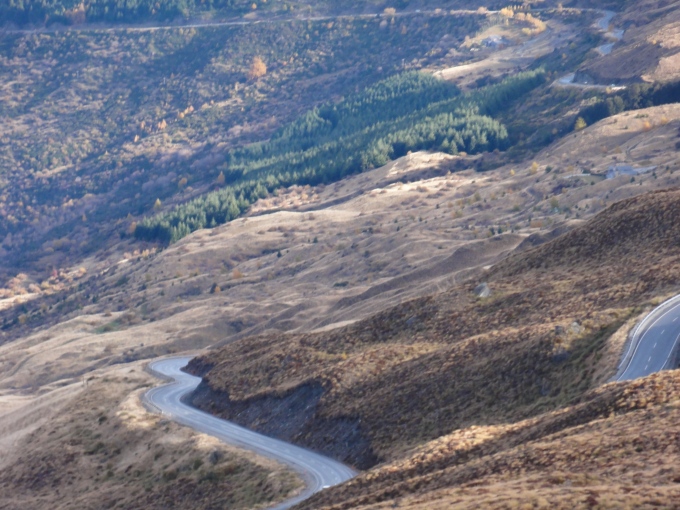
A picture paints … well, as many words as you like.  For instance:

lookingdownfromcoronetpeak

And the story:

It was once said that a desperate man has everything to lose.

The man I was chasing was desperate, but I, on the other hand, was more desperate to catch him.

He’d left a trail of dead people from one end of the island to the other.

The team had put in a lot of effort to locate him, and now his capture was imminent.  We were following the car he was in, from a discrete distance, and, at the appropriate time, we would catch up, pull him over, and make the arrest.

There was nowhere for him to go.

The road led to a dead-end, and the only way off the mountain was back down the road were now on.  Which was why I was somewhat surprised when we discovered where he was.

Where was he going?

“Damn,” I heard Alan mutter.  He was driving, being careful not to get too close, but not far enough away to lose sight of him.

“What?”

“I think he’s made us.”

“How?”

“Dumb bad luck, I’m guessing.  Or he expected we’d follow him up the mountain.  He’s just sped up.”

“How far away?”

“A half-mile.  We should see him higher up when we turn the next corner.”

It took an eternity to get there, and when we did, Alan was right, only he was further on than we thought.”

“Step on it.  Let’s catch him up before he gets to the top.”

Easy to say, not so easy to do.  The road was treacherous, and in places just gravel, and there were no guard rails to stop a three thousand footfall down the mountainside.

Good thing then I had the foresight to have three agents on the hill for just such a scenario.

Ten minutes later, we were in sight of the car, still moving quickly, but we were going slightly faster.  We’d catch up just short of the summit car park.

Or so we thought.

Coming quickly around another corner we almost slammed into the car we’d been chasing.

“What the hell…” Aland muttered.

I was out of the car, and over to see if he was in it, but I knew that it was only a slender possibility.  The car was empty, and no indication where he went.

Certainly not up the road.  It was relatively straightforward for the next mile, at which we would have reached the summit.  Up the mountainside from here, or down.

I looked up.  Nothing.

Alan yelled out, “He’s not going down, not that I can see, but if he did, there’s hardly a foothold and that’s a long fall.”

Then where did he go?

Then a man looking very much like our quarry came out from behind a rock embedded just a short distance up the hill.

“Sorry,” he said quite calmly.  “Had to go if you know what I mean.”

I’d lost him.

It was as simple as that.

I had been led a merry chase up the hill, and all the time he was getting away in a different direction.

I’d fallen for the oldest trick in the book, letting my desperation blind me to the disguise that anyone else would see through in an instant.

It was a lonely sight, looking down that road, knowing that I had to go all that way down again, only this time, without having to throw caution to the wind.

“Maybe next time,” Alan said.

“We’ll get him.  It’s just a matter of time.”

© Charles Heath 2019-2021

Find this and other stories in “Inspiration, maybe”  available soon.

InspirationMaybe1v1

In a word: bark

Yes, this is exactly what a dog does, sometimes annoyingly all night, that sharp explosive cry of a dog or, believe it or not, a seal

Much better if the dog is a guard dog, because then you need it to bark when there is intruders

Then there’s another form of bark, that which grows on a tree, and makes excelled burning material, if not a little smoky, for a BBQ.

Ot that the bark of some trees can be used as material for carving, and of others, like the paperbark, to make was seems like paper to write on.

Then there are expressions that start to make you think, concerning this word, such as:

He was a boss that liked to bark orders.  I had one like that, almost looked like a dog too.  Never could ask someone kindly.

He was barking up the wrong tree.  Never seen a dog do this, but many people gave so the literal meaning is to waste your time looking in the wrong place

Then there’s bark or barque, the name of a certain type of boat or masted ship with three or more masts, dating back to sailing days

And then, just top it all off, someone goes and says your barking mad.  Probably just after you were barking up the wrong tree, looking for the barking dog on a barque.

First Dig Two Graves

A sequel to “The Devil You Don’t”

Revenge is a dish best served cold – or preferably so when everything goes right

Of course, it rarely does, as Alistair, Zoe’s handler, discovers to his peril. Enter a wildcard, John, and whatever Alistair’s plan for dealing with Zoe was dies with him.

It leaves Zoe in completely unfamiliar territory.

John’s idyllic romance with a woman who is utterly out of his comfort zone is on borrowed time. She is still trying to reconcile her ambivalence, after being so indifferent for so long.

They agree to take a break, during which she disappears. John, thinking she has left without saying goodbye, refuses to accept the inevitable, calls on an old friend for help in finding her.

After the mayhem and being briefly reunited, she recognises an inevitable truth: there is a price to pay for taking out Alistair; she must leave and find them first, and he would be wise to keep a low profile.

But keeping a low profile just isn’t possible, and enlisting another friend, a private detective and his sister, a deft computer hacker, they track her to the border between Austria and Hungary.

What John doesn’t realise is that another enemy is tracking him to find her too. It could have been a grand tour of Europe. Instead, it becomes a race against time before enemies old and new converge for what will be an inevitable showdown.

The cinema of my dreams – I always wanted to write a war story – Episode 53

For a story that was conceived during those long boring hours flying in a steel cocoon, striving to keep away the thoughts that the plane and everyone in it could just simply disappear as planes have in the past, it has come a long way.

Whilst I have always had a fascination with what happened during the Second world war, not the battles or fighting, but in the more obscure events that took place, I decided to pen my own little sidebar to what was a long and bitter war.

And, so, it continues…

War is hell. 

I remembered an old Sargeant Major was telling us that going to war was not fun, that the very real possibility of getting killed should be the only thing on our minds.

Along with keeping your head down and being very aware of your surroundings.

Apparently, he had been at a place called Gallipoli, and from what I had read, that was a special kind of hell.

He had also said fifty per cent of us wouldn’t return.  I hoped to be in the fifty per cent that did.  Just to spite the old bastard.

I knew it was going to get problematical sooner than we thought, I could smell the aroma of burning bush on the air, and as we got closer to the castle, the smoke got denser.

Wallace had a cunning plan, he’d used flame throwers to set the bush on fire so we couldn’t get to the castle under the cover of the forest.  It was a plan he hadn’t me about.

Carlo had stopped, also understanding what Wallace had done.  Would this interfere with us getting to the external entrances, or if the other three were unattainable, could we get to the secret entrance?

I caught up to him.  “Not exactly what we envisaged.  I had no idea Wallace was planning this?”

“It is a logical move.  He can’t leave the castle, and as it was, he knew the forest would give us cover until the very last moment.”

“And now?”

“Now we use another entrance.  Take longer, but we’ll get there.  Only problem, they will be expecting us, and waiting.”

The others joined me, just as Carlo did an about-face and started going back the way we came.

“Where is he going?” Blinky asked.

“Another way.  Wallace is burning our cover.”

He shrugged.  “I suppose it would be too much to ask for some rain?”

“Sadly no.  Fine and clear with a touch of fog, well, smoke maybe.”

He didn’t think it was funny.  War I guess could do that to you.

When Thompson and company were planning the operation that was set up primarily to get defecting Germans out of the country, there was only so much research that could be done.

It was one of the reasons I got a seat at the table, my exploits in Italy looking at ancient buildings suddenly became a red-hot reason to be included.  The war had all but petered out in that part of the country, the Germans were shoring up the Italians, and the Allies had bigger plans to invade via Sicily, or one of those islands.

Someone mentioned something hush-hush about Italy and the road back to peace, but at that point in time, the end of the war was not in sight.

The point was, the castle was in a strategic location, it was only being held by a small garrison, according to the resistance, ideal for what Thompson wanted.  Approvals gained, he sent in a team of German-speaking soldiers to replace those there, as if nothing had happened and then set up the pipeline.

It worked.

For a while anyway.  Several months after the new team had set themselves up and the personnel was moving through, it all stopped.

First thought was the Germans had discovered what was going on and switched the team again.  Until Thompson noted we were still getting reports from Wallace, one of his men on the ground.

That’s when Thompson decided to send me.

And. No, it was not just a matter of saying, great, I always wanted to holiday in Italy, and particularly Tuscany.  My excuse, I was not trained to be a commando or a secret agent.

Of course, I made that one fatal mistake, I had enlisted to fight in the war, and it was not my decision where they sent me.

So, I was on the next plane to Tuscany.

The trouble was, Thompson and I both agreed that it was more likely the men we selected had not changed their allegiances, they just went back to what they were before.  Wallace, Johannesen and Jackerby had all been extricated from blown missions, and Thompson had been left scratching his head as to who the mole was in his office.

Too many coincidences proved it wasn’t.

Except coincidentally, Thompson had teamed up all the traitors in one place.

So, my mission was twofold, first to ascertain if they were traitors, and, if they were, to execute them.

The next problem, the mission was almost over before it started, because even though Thompson had told Wallace the wrong pick-up point where my plane would be landing, cloud cover made it impossible to guarantee I’d be jumping at the correct spot.

As it turned out, the resistance had planned a huge ambush in exactly the same place my plane landed, and I was in the middle of it.  The rest as they say is history.

The thing is, ever since I landed, I had the benefit of a huge amount of good luck.

That couldn’t last.

Carlo seemed unfazed about the fire, perhaps he had expected it, but his only concern was time.  We had to be in the castle just as the explosions started.

With 23 minutes to go, Carlo stepped up the pace.  For a big man, he didn’t make much noise.  I wished I could say the same for myself.

© Charles Heath 2021-2023

A photograph from the inspirational bin – 17

I was poking around on the gallery on my phone and found this

It was the rear of the club house for a golf course that was adjacent to the resort we were staying at before COVID shut down the country and all travel.

It was a bleak day with rain falling from drizzle to a heavy shower, and I had to wonder what it would be like on a fine summer’s day.

The club house also had space for conventions and weddings, and I could imaging having the wedding in the rotunda as the the sun departed leaving behind shades of yellow, orange and red.

Having a fountain in the wedding photo would be so hard to take either.

Perhaps we could renew our vows one day in just such a location.

It’s a thought.

But as for a story…

It’s a bleak day with constant drizzle, the sort of day to fuel introspection.

A day to spend in front of a fire with a good book instead of chasing a white ball. The thing is, you never quite know when the weather is going to interfere with the best laid plans.

A week before, the forecast was for clear skies, and perfect blue skies.

Jake was going to meet up with some very influential people on the golf course to discuss business. It was not the sort of business that was conducted indoors, in a conference room, or an office.

But the weather was not going to play ball.

As the murky darkness dawned into a grey soggy morning with constant irritating drizzle, Jake was looking out the window of his room that overlooked the parkland when there was a knock on the door.

There was no way anyone was playing golf in this weather, so he was hoping it was his assistant with the alternate arrangements.

It was the assistant, but with a look of disappointment on her face.

“What news?” he asked.

“McDonald’s PA just called. He had a heart attack last night, and just died.”

Is this the beginning of the end?

The cinema of my dreams – Was it just another surveillance job – Episode 36

I’m back home and this story has been sitting on a back burner for a few months, waiting for some more to be written.

The trouble is, there are also other stories to write, and I’m not very good at prioritizing.

But, here we are, a few minutes opened up and it didn’t take long to get back into the groove.

Chasing leads, maybe


I’m glad she didn’t ask me about Nobbin, or the fact a woman by the name of Josephine was working for him.  That went ditto for Severin, and Jan, who was working for him.

It was a tangled web.  Now, apparently, I was working for her.

I had another idea, and went back to the computer room to do another search, this time for the names of those who had been on my training course, and who was also assigned to the surveillance job.

I checked the name Jack Temple, and his file was marked closed, with a stark, red, deceased across the first page.

I checked the name Adam Alwin, and it was the same, deceased.

I checked the name Jennifer Underwood, and it had the label inactive, on medical leave.  She had been injured and was recovering.  There was no reference to her being in a hospital, or a recovery facility so I presumed she was at home.

It was another address to remember, this time what I assumed was a flat in Putney.  It was not something she had mentioned in all the time we have been together.  She had spoken of a house in Scotland.

But, then, who really told the truth when we were trained and continually told to lie about everything.  In the end I don’t think we quite knew who we were.  I knew her as Jennifer, but I doubted that was her real name.

Maybe I’d find out when I went to see her.  I needed help and from someone I could trust.  It was logical to select her.  We had, for at least six months, relying on each other to get through.


I cam out into the daylight and it hurt my eyes.  The artificial light, not that it was very bright, had queered my sight briefly.  No good, because for a minute at least I was vulnerable to an attack.

Good thing it didn’t happen.

But something else did.  A car pulled up on the side of the road, one I instantly recognised as the same Nobbin had used when he collected Josephine.

He wound down the rear kerbside window and said, “Sam.  Just the man I want to see.  Get in.”

I saw him slide over.  I opened the door, got in, and the driver drove off.

He seemed pleased with himself.

“How is the hunt?”

“How do you think it’s going?”

He looked quizzically at me.  “Why would I ask if I knew the answer?”

“I think you do.  I was at O’Connell’s flat when one of your assistants was there.  She discovered the same as I did, nothing.”

“What assistant?”  He tried to sound surprised.

“We’re not going to be very good friends if you are going to lie to me.  She called herself Josephine.  I wouldn’t be much of an agent if I didn’t have a few tricks up my sleeve.  And, lets be clear about one thing, if nothing else, you want to play games, fine.  So will I.”

“What did Monica want?”

“What everyone wants.  There appear to be secret documents on the loose.  Everyone thinks they’re on a USB, and that O’Connell has hidden them somewhere.  They’re not in his flat, and the cat wasn’t talking.”

“Just remember that O’Connell was working for me, and he was getting the documents for me.”

“So you know what these documents are about?”

“No.  He didn’t tell me because he didn’t look at them.  He couldn’t.  They’re encrypted, and he doesn’t have the code.”

Which wouldn’t do much good for me if I tried to see what the fuss was about.  Perhaps the best idea would be to destroy the USB so no one had these documents, given the trouble they’d caused so far.

“Anyone check O’Connell’s body properly for the USB?  He may have had it hidden in his clothing somewhere.”  I knew I didn’t have sufficient time to thoroughly check myself.

“No one knows where the body is.”

“I saw the cleaners arrive to process the scene.”

“Well, if they did, the job never reached the books.  According to the cleaners, no one was dispatched to take care of anything at the location.”

Which meant Severin had the body, had checked as I would if I had the time, and it was not on him.  Otherwise, he would not have paid me a visit.  It was back to Peaslake then, the next step in the investigation.

“Recovery of these documents is time-sensitive Sam.  You need to double your effort.”

“A lack of clues is not helping.  Nor is everyone working on their own agenda.”

“Then don’t lose focus.”

I saw him motion to the driver to pull over and let me out.

I waved as the car pulled back out into the traffic.


© Charles Heath 2020

365 Days of writing, 2026 – 30

Day 30 – When is it time

The Never-Ending Research Cycle: What’s Holding You Back from Starting to Write?

As a writer, I’ve been there too many times. You start researching a topic, excited to dive into the world of knowledge and uncover new insights. But as the days turn into weeks, and the weeks turn into months, you find yourself stuck in a cycle of research, with no end in sight. The paper is mounting, the notes are piling up, and the excuses are starting to sound all too familiar.

“I just need to find one more source to support my argument.” “There’s a piece missing here, and I need to fill in the gap.” “I just stumbled upon something new, and I need to incorporate it into my plan.”

Sound familiar? You’re not alone. Many of us have been trapped in this never-ending cycle of research, where the pursuit of perfection becomes an excuse for not starting to write. But the truth is, perfection is the enemy of progress. And if you don’t start writing soon, you’ll never make progress on your project.

So, what’s holding you back from starting to write? Is it fear of not knowing enough? Fear of not being able to articulate your thoughts clearly? Or is it simply the fear of taking that first step into the unknown?

The Paralysis of Analysis

When you’re researching, it’s easy to get caught up in the excitement of discovery. You’re learning new things, uncovering new insights, and making connections between seemingly unrelated ideas. But as the research piles up, it can be overwhelming. You start to feel like you need to know everything about the topic before you can start writing. And that’s just not possible.

The truth is, you’ll never know everything about a topic. There’s always more to learn, more to discover, and more to explore. But that doesn’t mean you can’t start writing. In fact, starting to write is often the best way to clarify your thoughts, identify gaps in your knowledge, and develop a deeper understanding of the topic.

The Power of Imperfection

So, what’s the solution? How do you break free from the cycle of research and start writing? The answer is simple: give yourself permission to be imperfect. Recognise that your first draft won’t be perfect, and that’s okay. In fact, it’s more than okay – it’s necessary.

When you start writing, you’ll quickly realise that your ideas are not as fully formed as you thought they were. You’ll encounter gaps in your knowledge, inconsistencies in your argument, and areas where you need more research. But that’s all part of the process.

The First Step is the Hardest

So, what will convince you to start writing? For me, it’s the realisation that the first step is the hardest. Once you start writing, you’ll build momentum, develop a rhythm, and find your voice. You’ll start to see your ideas take shape, and your arguments will become clearer.

It’s time to stop researching and start writing. Give yourself a deadline, set a word count, and start typing. Don’t worry about perfection – worry about progress. Remember, the only way to get better at writing is to write. And the only way to finish your project is to start.

So, take a deep breath, put aside your excuses, and start writing. You got this!

If I only had one day to stop over in – Athens – what would I do?

The One Place You Must Visit on a One-Day Stopover in Athens

So, you’ve landed in Athens with just 24 hours to spare—a layover that’s more than just a waiting game. Between the bustling airport and your next flight, you have a golden opportunity to step into the cradle of Western civilisation. But with so much to see—the ancient ruins, vibrant markets, and stunning coastline—how do you choose just one spot to make your short visit unforgettable?

The answer is clear: the Acropolis.

Yes, it might seem like the obvious choice, but there’s a reason it’s stood the test of time—both literally and figuratively. Here’s why dedicating your day to this iconic landmark will give you a memory to last a lifetime.

Why the Acropolis?

Perched high above Athens, the Acropolis is more than just a collection of ancient ruins. It’s a symbol of human achievement, a monument to artistry, democracy, and mythology all in one breathtaking site. In just a few hours here, you’ll walk in the footsteps of philosophers, stand before architectural marvels, and soak in panoramic views that stretch across the entire city.

What Makes It Special for a Short Visit?

  • Concentrated Wonder: Within the Acropolis complex, you’ll encounter the Parthenon, the Erechtheion, the Temple of Athena Nike, and the Odeon of Herodes Atticus—all within a walkable area. It’s like stepping into an open-air museum of ancient history.
  • Iconic Photo Opportunities: That postcard-perfect view of the Parthenon against the Athenian sky? You’ll capture it here. Whether you’re a photography enthusiast or just want a keepsake, the visuals are unbeatable.
  • Easy Access: The Acropolis is centrally located and well-connected by metro (the Acropoli station is a short walk away). With limited time, convenience is key.

How to Make the Most of Your Visit

Morning Start: Arrive early—right at opening time (usually 8 AM). You’ll beat the crowds and the midday heat. The morning light also casts a magical glow over the marble structures, perfect for photos.

Guided Insight: Consider a short guided tour or an audio guide. Hearing the stories behind the Parthenon’s construction or the myths tied to the Erechtheion’s Caryatids adds depth to what you’re seeing.

Don’t Miss the Acropolis Museum: Just a short walk downhill, this modern museum houses artifacts from the site. Its top-floor gallery, with views straight up to the Parthenon, is a breathtaking way to contextualise your visit.

Pause at the Areopagus Hill: On your way down, stop at this rocky outcrop near the Acropolis entrance. It offers stunning vistas of Athens and is steeped in history—the site where the apostle Paul is said to have preached.

A Taste of Athens on the Go

After your Acropolis exploration, wander into the nearby Plaka neighbourhood. Its cobblestone streets are lined with tavernas where you can grab a quick, authentic Greek lunch. Think souvlaki, fresh Greek salad, and a slice of baklava—because no stopover is complete without a taste of local flavour.

Practical Tips for a Smooth Layover

  • Storage: Athens International Airport has luggage storage facilities, so you can explore hands-free.
  • Transport: Take the metro Blue Line directly from the airport to the city centre (about 40-45 minutes). A day pass is affordable and efficient.
  • Timing: Allow at least 3-4 hours for the Acropolis and museum, plus transit time. Always keep your onward flight in mind!

Why This Day Will Stay With You

Athens is a city where history isn’t confined to textbooks—it’s etched into every stone and echoed in every horizon. By choosing the Acropolis, you’re not just checking off a landmark; you’re connecting with a legacy that has inspired millennia. As you watch the sunset paint the ancient marble in hues of gold (if your timing allows), you’ll carry with you more than just photos—you’ll take home a piece of timeless wonder.

So, on your next one-day Athens stopover, look up. The Acropolis awaits, ready to turn a few hours into a story you’ll tell for years.

Safe travels, and may your layover be nothing short of epic!

What I learned about writing – Republishing public domain novels

Republishing Public Domain Books: A Modern Renaissance in Classic Literature

Introduction: The Resurgence of Public Domain Books
In an age dominated by streaming and digital content, curiosity in classic literature is experiencing a quiet revival. Public domain books—works whose copyrights have expired and are free for all to use—offer an untapped goldmine for publishers, authors, and creatives. From Pride and Prejudice to The Metamorphosis, these timeless tales are fertile ground for innovation. But is there a market for republishing them? How can you make your version stand out—and what pitfalls should you avoid? Let’s dive in.


Is There a Market in Republishing Public Domain Books?

Yes—especially when reimagined. While these books are freely available online, many readers seek curated, accessible, and enhanced editions tailored to modern tastes or niche audiences.

  • Digital Demand: E-books and audiobooks of public domain classics are thriving. Platforms like Project Gutenberg and LibriVox offer free versions, but readers are willing to pay for quality. For example, Dracula by Bram Stoker consistently ranks high on Amazon, with enhanced editions selling well.
  • Print Niche: Print-on-demand services (e.g., CreateSpace, Ingram Spark) enable affordable physical copies. Unique editions—like illustrated or annotated versions—cater to collectors, educators, and design-conscious readers.
  • Niche Opportunities: Focus on underrated authors or genres. A curated series of 19th-century adventure novels or a feminist reframe of Jane Eyre can attract specific audiences.

Example Success: Michael Crichton’s The Andromeda Strain (originally published in 1969) remains a bestseller in rebranded editions. Similarly, modern “Poe-etry” collections with contemporary themes show how timeless stories can be revitalised.


Adding Value to Stand Out: How to Make Your Edition Unique

Republishing isn’t just about printing a 200-year-old text. To justify a sale, you must add value that differentiates your version from the 20 free copies already online.

  1. Modern Illustrations & Design
    • Pairing classics with fresh artwork or period-accurate visuals can transform the experience. For instance, a version of Alice’s Adventures in Wonderland with Art Nouveau illustrations appeals to design lovers.
    • Invest in high-quality formatting, typography, and layouts that reflect modern reading standards.
  2. New Introductions and Annotations
    • Invite contemporary authors or scholars to write introductions. A feminist take on The Yellow Wallpaper or a sci-fi angle on Frankenstein can draw new readers.
    • Add footnotes explaining archaic language, historical context, or cultural relevance.
  3. Enhanced Formatting for Accessibility
    • Use dyslexia-friendly fonts, large print, or clean margins. For digital versions, include interactive elements like clickable footnotes or embedded multimedia.
  4. Audio and Multimedia Editions
    • Audiobooks narrated by skilled voice actors (e.g., a noir-style The Tell-Tale Heart) can attract new demographics.
    • Combine texts with QR codes linking to curated playlists, podcast interviews, or historical photographs.
  5. Themed Anthologies
    • Compile related works. A “Victorian Mystery Bundle” with The Hound of the BaskervillesDracula, and lesser-known tales creates value for genre fans.
    • Create study guides for students or discussion packs for book clubs.

Pro Tip: Offer multiple formats (e-book, print, audio) for broader reach, and consider subscription models for curated content.


Common Mistakes to Avoid

Even with a great idea, missteps can sink your project. Here’s what to watch for:

  1. Copyright Missteps
    • Verify the public domain status: A book’s copyright may vary by country. Use resources like Google Books’ public domain catalogue or HathiTrust.
    • Check for derivatives: Translations, specific editions, or forewords may still be copyrighted. Don’t reuse someone else’s work without permission.
  2. Neglecting Quality
    • Poor formatting and OCR errors: Use proofreaders and professional typesetting software. A shoddy version reflects poorly on your brand.
    • Inferior illustrations or design: Invest in artists or use free high-quality image sources like Unsplash.
  3. Pricing Errors
    • Overpriced editions: If your version costs $20 when a free PDF exists, you’ll lose sales. Research competitors and price accordingly (e.g., $10 for a paperback with added value).
    • Undervaluing premium editions: Limited editions with illustrations or signed copies can command higher prices if marketed right.
  4. Poor Marketing & Audience Ignorance
    • Assuming an audience exists: Market your unique angle! Promote your feminist Jane Austen edition to bookstagrammers or indie bookstore owners.
    • Ignoring keywords: For digital sales, optimise titles and descriptions with terms like “annotated,” “illustrated,” or “new introduction.”
  5. Underestimating Niche Markets
    • Don’t target “literature lovers” broadly. Instead, position Moby Dick as a “Guide for Entrepreneurs on Overcoming Ambition” or 1984 as a “Guide to Modern Privacy Risks.”

Case Study: A common error is releasing a bland replica of Hamlet. A successful version, however, might pair it with a modern psychological analysis, targeting mental health readers.


Conclusion: The Future of Public Domain Publishing

Republishing public domain books is more than a business—it’s a chance to rekindle classics for new generations. With the right blend of innovation, quality, and marketing, you can tap into a growing market while honouring literary history. Just remember: the key is to offer something no free version can—a version that sparks joy, curiosity, or insight in its readers.

Final Thoughts:

  • Research your audience and tailor value.
  • Proofread rigorously—quality is non-negotiable.
  • Be creative: Add illustrations, annotations, or modern twists.
  • Avoid copyright landmines—verify everything upfront.

Whether you’re a self-published author, a small press, or a literary enthusiast, the world of public domain publishing is yours to reimagine. Pick a book, add your magic, and bring its story to life in a fresh, unforgettable way.

What timeless tale will you revive next?


 💡📚

An excerpt from “Strangers We’ve Become” – Coming Soon

I wandered back to my villa.

It was in darkness.  I was sure I had left several lights on, especially over the door so I could see to unlock it.

I looked up and saw the globe was broken.

Instant alert.

I went to the first hiding spot for the gun, and it wasn’t there.  I went to the backup and it wasn’t there either.  Someone had found my carefully hidden stash of weapons and removed them.

Who?

There were four hiding spots and all were empty.  Someone had removed the weapons.  That could only mean one possibility.

I had a visitor, not necessarily here for a social call.

But, of course, being the well-trained agent I’d once been and not one to be caught unawares, I crossed over to my neighbor and relieved him of a weapon that, if found, would require a lot of explaining.

Suitably armed, it was time to return the surprise.

There were three entrances to the villa, the front door, the back door, and a rather strange escape hatch.  One of the more interesting attractions of the villa I’d rented was its heritage.  It was built in the late 1700s, by a man who was, by all accounts, a thief.  It had a hidden underground room which had been in the past a vault but was now a wine cellar, and it had an escape hatch by which the man could come and go undetected, particularly if there was a mob outside the door baying for his blood.

It now gave me the means to enter the villa without my visitors being alerted, unless, of course, they were near the vicinity of the doorway inside the villa, but that possibility was unlikely.  It was not where anyone could anticipate or expect a doorway to be.

The secret entrance was at the rear of the villa behind a large copse, two camouflaged wooden doors built into the ground.  I move aside some of the branches that covered them and lifted one side.  After I’d discovered the doors and rusty hinges, I’d oiled and cleaned them, and cleared the passageway of cobwebs and fallen rocks.  It had a mildew smell, but nothing would get rid of that.  I’d left torches at either end so I could see.

I closed the door after me, and went quietly down the steps, enveloped in darkness till I switched on the torch.  I traversed the short passage which turned ninety degrees about halfway to the door at the other end.  I carried the key to this door on the keyring, found it and opened the door.  It too had been oiled and swung open soundlessly.

I stepped in the darkness and closed the door.

I was on the lower level under the kitchen, now the wine cellar, the ‘door’ doubling as a set of shelves which had very little on them, less to fall and alert anyone in the villa.

Silence, an eerie silence.

I took the steps up to the kitchen, stopping when my head was level with the floor, checking to see if anyone was waiting.  There wasn’t.  It seemed to me to be an unlikely spot for an ambush.

I’d already considered the possibility of someone coming after me, especially because it had been Bespalov I’d killed, and I was sure he had friends, all equally as mad as he was.  Equally, I’d also considered it nigh on impossible for anyone to find out it was me who killed him because the only people who knew that were Prendergast, Alisha, a few others in the Department, and Susan.

That raised the question of who told them where I was.

If I was the man I used to be, my first suspect would be Susan.  The departure this morning, and now this was too coincidental.  But I was not that man.

Or was I?

I reached the start of the passageway that led from the kitchen to the front door and peered into the semi-darkness.  My eyes had got used to the dark, and it was no longer an inky void.  Fragments of light leaked in around the door from outside and through the edge of the window curtains where they didn’t fit properly.  A bone of contention upstairs in the morning, when first light shone and invariably woke me up hours before I wanted to.

Still nothing.

I took a moment to consider how I would approach the visitor’s job.  I would get a plan of the villa in my head, all entrances, where a target could be led to or attacked where there would be no escape.

Coming in the front door.  If I was not expecting anything, I’d just open the door and walk-in.  One shot would be all that was required.

Contract complete.

I sidled quietly up the passage staying close to the wall, edging closer to the front door.  There was an alcove where the shooter could be waiting.  It was an ideal spot to wait.

Crunch.

I stepped on some nutshells.

Not my nutshells.

I felt it before I heard it.  The bullet with my name on it.

And how the shooter missed, from point-blank range, and hit me in the arm, I had no idea.  I fired off two shots before a second shot from the shooter went wide and hit the door with a loud thwack.

I saw a red dot wavering as it honed in on me and I fell to the floor, stretching out, looking up where the origin of the light was coming and pulled the trigger three times, evenly spaced, and a second later I heard the sound of a body falling down the stairs and stopping at the bottom, not very far from me.

Two assassins.

I’d not expected that.

The assassin by the door was dead, a lucky shot on my part.  The second was still breathing.

I checked the body for any weapons and found a second gun and two knives.  Armed to the teeth!

I pulled off the balaclava; a man, early thirties, definitely Italian.  I was expecting a Russian.

I slapped his face, waking him up.  Blood was leaking from several slashes on his face when his head had hit the stairs on the way down.  The awkward angle of his arms and legs told me there were broken bones, probably a lot worse internally.  He was not long for this earth.

“Who employed you?”

He looked at me with dead eyes, a pursed mouth, perhaps a smile.  “Not today my friend.  You have made a very bad enemy.”  He coughed and blood poured out of his mouth.  “There will be more …”

Friends of Bespalov, no doubt.

I would have to leave.  Two unexplainable bodies, I’d have a hard time explaining my way out of this mess.  I dragged the two bodies into the lounge, clearing the passageway just in case someone had heard anything.

Just in case anyone was outside at the time, I sat in the dark, at the foot of the stairs, and tried to breathe normally.  I was trying not to connect dots that led back to Susan, but the coincidence was worrying me.

A half-hour passed and I hadn’t moved.  Deep in thought, I’d forgotten about being shot, unaware that blood was running down my arm and dripping onto the floor.

Until I heard a knock on my front door.

Two thoughts, it was either the police, alerted by the neighbors, or it was the second wave, though why would they be knocking on the door?

I stood, and immediately felt a stabbing pain in my arm.  I took out a handkerchief and turned it into a makeshift tourniquet, then wrapped a kitchen towel around the wound.

If it was the police, this was going to be a difficult situation.  Holding the gun behind my back, I opened the door a fraction and looked out.

No police, just Maria.  I hoped she was not part of the next ‘wave’.

“You left your phone behind on the table.  I thought you might be looking for it.”  She held it out in front of her.

When I didn’t open the door any further, she looked at me quizzically, and then asked, “Is anything wrong?”

I was going to thank her for returning the phone, but I heard her breathe in sharply, and add, breathlessly, “You’re bleeding.”

I looked at my arm and realized it was visible through the door, and not only that, the towel was soaked in blood.

“You need to go away now.”

Should I tell her the truth?  It was probably too late, and if she was any sort of law-abiding citizen she would go straight to the police.

She showed no signs of leaving, just an unnerving curiosity.  “What happened?”

I ran through several explanations, but none seemed plausible.  I went with the truth.  “My past caught up with me.”

“You need someone to fix that before you pass out from blood loss.  It doesn’t look good.”

“I can fix it.  You need to leave.  It is not safe to be here with me.”

The pain in my arm was not getting any better, and the blood was starting to run down my arm again as the tourniquet loosened.  She was right, I needed it fixed sooner rather than later.

I opened the door and let her in.  It was a mistake, a huge mistake, and I would have to deal with the consequences.  Once inside, she turned on the light and saw the pool of blood just inside the door and the trail leading to the lounge.  She followed the trail and turned into the lounge, turned on the light, and no doubt saw the two dead men.

I expected her to scream.  She didn’t.

She gave me a good hard look, perhaps trying to see if I was dangerous.  Killing people wasn’t something you looked the other way about.  She would have to go to the police.

“What happened here?”

“I came home from the cafe and two men were waiting for me.  I used to work for the Government, but no longer.  I suspect these men were here to repay a debt.  I was lucky.”

“Not so much, looking at your arm.”

She came closer and inspected it.

“Sit down.”

She found another towel and wrapped it around the wound, retightening the tourniquet to stem the bleeding.

“Do you have medical supplies?”

I nodded.  “Upstairs.”  I had a medical kit, and on the road, I usually made my own running repairs.  Another old habit I hadn’t quite shaken off yet.

She went upstairs, rummaged, and then came back.  I wondered briefly what she would think of the unmade bed though I was not sure why it might interest her.

She helped me remove my shirt, and then cleaned the wound.  Fortunately, she didn’t have to remove a bullet.  It was a clean wound but it would require stitches.

When she’d finished she said, “Your friend said one day this might happen.”

No prizes for guessing who that friend was, and it didn’t please me that she had involved Maria.

“Alisha?”

“She didn’t tell me her name, but I think she cares a lot about you.  She said trouble has a way of finding you, gave me a phone and said to call her if something like this happened.”

“That was wrong of her to do that.”

“Perhaps, perhaps not.  Will you call her?”

“Yes.  I can’t stay here now.  You should go now.  Hopefully, by the time I leave in the morning, no one will ever know what happened here, especially you.”

She smiled.  “As you say, I was never here.”

© Charles Heath 2018-2022

strangerscover9