The story behind the story: A Case of Working With the Jones Brothers

To write a private detective serial has always been one of the items at the top of my to-do list, though trying to write novels and a serial, as well as a blog, and maintain a social media presence, well, you get the idea.

But I made it happen, from a bunch of episodes I wrote a long, long time ago, used these to start it, and then continue on, then as now, never having much of an idea where it was going to end up, or how long it would take to tell the story.

That, I think is the joy of ad hoc writing, even you, as the author, have as much idea of where it’s going as the reader does.

It’s basically been in the mill since 1990, and although I finished it last year, it looks like the beginning to end will have taken exactly 30 years.  Had you asked me 30 years ago if I’d ever get it finished, the answer would be maybe?

My private detective, Harry Walthenson

I’d like to say he’s from that great literary mold of Sam Spade, or Mickey Spillane, or Phillip Marlow, but he’s not.

But, I’ve watched Humphrey Bogart play Sam Spade with much interest, and modelled Harry and his office on it.  Similarly, I’ve watched Robert Micham play Phillip Marlow with great panache, if not detachment, and added a bit of him to the mix.

Other characters come into play, and all of them, no matter what period they’re from, always seem larger than life.  I’m not above stealing a little of Mary Astor, Peter Lorre or Sidney Greenstreet, to breathe life into beguiling women and dangerous men alike.

Then there’s the title, like

The Case of the Unintentional Mummy – this has so many meanings in so many contexts, though I imagine that back in Hollywood in the ’30s and ’40s, this would be excellent fodder for Abbott and Costello

The Case of the Three-Legged Dog – Yes, I suspect there may be a few real-life dogs with three legs, but this plot would involve something more sinister.  And if made out of plaster, yes, they’re always something else inside.

But for mine, to begin with, it was “The Case of the …”, because I had no idea what the case was going to be about, well, I did, but not specifically.

Then I liked the idea of calling it “The Case of the Brother’s Revenge” because I began to have a notion there was a brother no one knew about, but that’s stuff for other stories, not mine, so then went the way of the others.

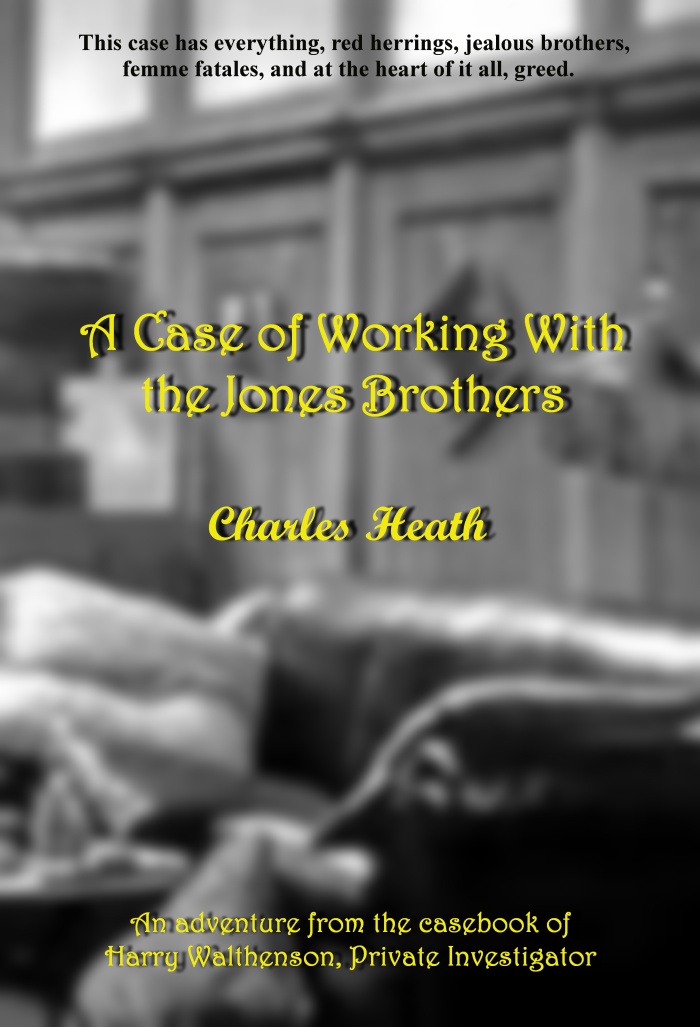
Now it’s called ‘A Case of Working With the Jones Brothers’, finished the first three drafts, and at the editor for the last.

I have high hopes of publishing it in early 2021.  It even has a cover.

PIWalthJones1

The cinema of my dreams – It continued in London – Episode 23

What’s the Opera got to do with it?

…

I had hoped never to see Rodby again, and yet here I was in that oppressively warm wood polish-smelling office of his, sitting uncomfortably opposite him, a very large and clear desk between us.

In all the time I’d known him, and those visits to his office, there had never been anything on it.  Not even a phone.

The last time I was in this position, to inform him of my retirement, I’d been reluctant to put the resignation envelope on the pristine surface.

Significantly, it was a month to the day after I left Larry’s mother’s house in Sorrento.

The day after I went with Cecilia to her audition, and she smashed it, getting the role from a rather astonished casting director, and director.  He was calling it a possible break-out performance, in a whole different language that I didn’t understand.

That same night I found Juliet dining alone in the hotel restaurant and told her the good news, but her brother had already called her.  We had dinner, and it could have been more, but there was that Cecilia thing in the back of her mind so we parted as friends.

And at a loose end, Venice no longer hold any significance for me, I moved back to London.

I should have gone to Paris.  There, it would have been harder for Alfie to find me.

He had been giving me the ‘come back’ look, one that I had taken a long time to learn how to ignore.

Seeing he wasn’t making any impact, he said, “They found Larry.”

An enigmatic statement.  Who found Larry?

“The Italian police recovered the body, in a little-used area of Lake Como.  No signs of physical damage, not shot or stabbed, but apparently, he died of natural causes.  We’re still waiting for a definitive coroner’s report.  You never really elaborated on what happened at his mother’s house.”

My report was short and lacked detail, more notable for what I didn’t say rather than what I did.

“Nothing to tell.  Brenda just told him his days of running the organization were over, she and Jaime Meyers had collaboratively taken over, and things would be different.  I notice several other hard-line criminals have been taken off the streets since, so Inspector Crowley’s arrangement with her is working.  A win-win situation.  And you don’t have to deal with Larry anymore.”

“That’s the problem.  If something is too good to be true, it generally is. I have to wonder what has replaced him.”

“I’m retired sir.  No longer interested.  Why am I here?”

I could see he had more, possibly to pique my interest, but just shrugged.

“Nothing of any importance.  I thought you might want to know what happened to Larry.  And Martha wants me to go to the opera tonight and she specifically asked me to ask you, and as you know she does not take no for an answer.”

I shrugged.  He was right about his wife, a force of nature to be reckoned with.  I had met her several times, and she had been intrigued with Violetta and had been devastated when she learned of her death.

“Then I guess I’d better dust off the monkey suit.”

“Good.  I’ll text you where and when and send a driver to pick you up.”

© Charles Heath 2022

Sayings: Irons in the fire

There is an expression you hear a lot, here, there, and everywhere when referring to someone who is very busy, ‘oh, he has a lot of irons in the fire’.

These days we use it as an analogy not to have too many things on the go at the same time, and, in the end, none of them will be finished properly, or finished at all.

There are two old-time literal meanings that can apply to this analogy, the first being that in laundries, they used to have their irons in the fire, warming so that clothes could be ironed. Having too many meant sometimes one would be left too long, and end up scorching the clothes being ironed.

Hopefully, that didn’t happen to a very expensive dress!

The second meaning came from a blacksmith’s foundry where he had iron bars in the fire, heating up so that they could be worked on. Having too many in the fire at once sometimes meant that one became overheated, and ruined.

Conversely, having too many pieces of iron in the fire might cause the fire to be too cool to heat any of the metal bars.

These days, a lot of people need to have a lot of projects on the go at once, in the hope that one or more might suddenly become a winner.

Sadly, that doesn’t happen very often.

And, no, buying a lot of lottery tickets hoping one will win, that is not very likely either.

The cinema of my dreams – Was it just another surveillance job – Episode 9

I’m back home and this story has been sitting on a back burner for a few months, waiting for some more to be written.

The trouble is, there are also other stories to write, and I’m not very good at prioritising.

But, here we are, a few minutes opened up and it didn’t take long to get back into the groove.

An interrogation and a revelation.

…

I think I just about reached that same conclusion just seconds before she uttered it.  But, I didn’t think this was the time to air my own thoughts on the matter.

The question I did ask was, “It appears our service has been compromised.”

She glanced at me almost condescendingly.  “It appears so.  Have you got your cell phone?”

I had it with me and gave it to her.  I had it ready because I knew they would ask for it.  It had a record of orders given, and phone conversations made, before, during, and after the operation.

For a review, or in this case, a search for the guilty.

I watched her put in the passcode, and go to the messages, and bring up the one sent to me, to attend the briefing.  It was all in order, no different to the previous five, with all the right designations and protocols.

“There was no reason to suspect it was anything but a real callout.”

Another glance at the screen, she put it on the desk next to the file.  “No, it looks real enough.”

Thought best kept to myself; how the hell did someone outside our organisation, know so well our inner workings?  I wanted to ask the question but refrained from doing so.

It also explained, now that I thought about it, the reason why the target had said he was one of us.  We had been hunting him so someone else, and enemy organisation perhaps, so they could kill him.  The question was, why?  Had he made a discovery, the evidence he was referring to that a certain Alfred Nobbin might have.

Perhaps a good idea, for the time being, to keep that snippet of information to myself.  After all, this new person in front of me could be one of Severin’s people.

Where I was sitting was not a familiar place to me, though I had been to the building before, which is why I knew where to go for this interview.  AS for the people, everyone I’d met so far, other than the other team members, bar one, I’d known from training.

So, now another expected question from me, or at least, if I was on the other side of the table, it’s one I’d expect to be asked.  “Just who was I working for, if it was not for us?”

Assuming she was one of us.

“That’s what we intend to find out.  Who was the target?”

I gave her the description we’d been given, and a copy of his photograph that had been circulated at the briefing.  I’d kept one of them, and luckily no one noticed it missing.  It was fortuitous that’s I’d copied the photo before I had to give it to her, which was right then.

There was not a flicker of recognition in her eyes.

“So, not one of us?” I asked.

For an interrogation, she wasn’t asking many relevant questions.

She looked up.  “Why would you say that, if your mission was to keep him under surveillance?”

“Which we now know was not sanctioned, so we have to assume that we had been persuaded to find and track one of our own agents.  You look as though you didn’t recognise him?”

“I don’t try to remember every agent we have in the field, here and overseas.  There a few too many for that.  But I’ve got a request out for his identity.  He didn’t say who he was?”

“No.”

“Anything at all that might be useful?”

“That he was one of us, who’d made a mistake, and feared we’d set the dogs on him.”

“Yes.  Someone definitely did that.”

© Charles Heath 2019

“The Document” – the editor’s Final draft – Day 5

This book has been sitting in the ‘to-be-done’ tray, so this month it is going to get the final revision.

And so it begins…

…

It might be a little pedantic, but I have to pay more attention to the word count and make sure the revision is spaced correctly over the thirty days.

Today, day 5, the count is 1,862 words, making a total of 8,943 words so far.

What I have to be careful about is not to let the pressure get to me. I mean, I have to revise about 1,700 words a day to maintain the target. It seems a small amount, but remember this is supposed to produce a reasonably polished manuscript that an editor will not throw back at me.

If I miss a day, or the creative juices stop flowing…

OK, not something we need to think about.

Just a minor issue, though, I left a section out the first time around to be written, because I was not sure what I wanted to write. Perhaps what is coming may give some insight.

In the meantime, yet another yellow post-it note. Or I could just get it done.

People do do overtime don’t they?

I’m thinking of getting a new colour for the post-it notes, perhaps a more soothing pale green.

Where do you write?

Here’s an interesting question, where do you find the most comfortable place to write?  Is it in an office, in a room overlooking the ocean, and basement where you can make it dark and creepy for atmosphere, is it at a train station, at work, which could end up presenting you with problems, or somewhere else.

Some people have an office, mine is a converted garage, and the walls are lined with books.  It isn’t the greatest place though.  There’s a smart alec cat always on my case.

There’s a couch in the living room where, late at night, I sometimes sit and ponder over about a thousand words of whatever the current story is in my head.  Cat withstanding.

It could be a cafe or restaurant, where it starts out as notes on the ambiance, the food, the people, then a little more, and gets me into trouble with my dining companions.

They should not have created writing programs for mobile phones.  Or for that matter, allow the phones to get smarter than their users.

But…

That’s a whole other story.

So having found that special or nonspecial spot in the house, or out there in the universe, how do you become creative?

Is it you’ve been carrying the ideas around in your head for a while and you just need somewhere neutral to get them on paper, or in that pesky smartphone?

Is it sitting by the window with a cup of coffee and a mice cream-filled cake, when something catches your eye, and instantly the words begin forming?

Are you with someone, a muse, a partner, a spouse, a friend, a secret friend, or just a stranger, and you start getting the wrong ideas?  Or the right ideas if it’s a different sort of book.

Sometimes I move seats and sit opposite the writer’s chair to take a good long hard look at the person, the so-called writer, conjuring up in my mind, if I was someone I’d just dragged in off the street, what would I ask?

They, no doubt would be cynical.

Why bother when there are a million others out there trying to do the same thing?

That’s the easy question.  Every story is different.  Why?  Because every writer has a different point of view, a different set of experiences, a different personality, different friends, this could go on forever…

Here’s a test, outline a story and give that outline to ten different writers.  You’d get ten different stories.

Where do you get the motivation?

Don’t know.  Some days I don’t want to get out of bed, others, I can’t go to sleep until the words have stopped.  Go figure.

What do you do for inspiration?

Inside, outside, upside down, everywhere and anywhere.

Just remember, always have a notebook and pencil on hand.  Why pencil, I never have any luck with pens.

An excerpt from “Mistaken Identity” – a work in progress

The odds of any one of us having a doppelganger are quite high. Whether or not you got to meet him or her, or be confronted by them was significantly lower. Except of course, unless you are a celebrity.

It was a phenomenon remarkable only for the fact, at times, certain high-profile people, notorious or not, had doubles if only to put off enemies or the general public. Sometimes we see people in the street, people who look like someone we knew, and made the mistake of approaching them like a long lost friend, only to discover an embarrassed individual desperately trying to get away for what they perceive is a stalker or worse.

And then sometimes it is a picture that looms up on a TV screen, an almost exact likeness of you. At first, you are fascinated, and then according to the circumstances, and narrative that is attached to that picture, either flattered or horrified.

For me one turned to the other when I saw an almost likeness of me flash up on the screen when I turned the TV on in my room. What looked to be my photo, with only minor differences, was in the corner of the screen, the newsreader speaking in rapid Italian, so fast I could only translate every second or third word.

But the one word I did recognize was murder. The photo of the man up on the screen was the subject of an extensive manhunt. The crime, the murder of a woman in the very same hotel I was staying, and it was being played out live several floors above me. The gist of the story, the woman had been seen with, and staying with the man who was my double, and, less than an hour ago, the body had been discovered by a chambermaid.

The killer, the announcer said, was believed to be still in the hotel because the woman had died shortly before she had been discovered.

I watched, at first fascinated at what I was seeing. I guess I should have been horrified, but at that moment it didn’t register that I might be mistaken for that man.

Not until another five minutes had passed, and I was watching the police in full riot gear, with a camera crew following behind, coming up a passage towards a room. Live action of the arrest of the suspected killer the breathless commentator said.

Then, suddenly, there was a pounding on the door. On the TV screen, plain to see, was the number of my room.
I looked through the peephole and saw an army of police officers. It didn’t take much to realize what had happened. The hotel staff identified me as the man in the photograph on the TV and called the police.

Horrified wasn’t what I was feeling right then.

It was fear.

My last memory was the door crashing open, the wood splintering, and men rushing into the room, screaming at me, waving guns, and when I put my hands up to defend myself, I heard a gunshot.

And in one very confused and probably near-death experience, I thought I saw my mother and thought what was she doing in Rome?

…

I was the archetypal nobody.

I lived in a small flat, I drove a nondescript car, had an average job in a low profile travel agency, was single, and currently not involved in a relationship, no children, and according to my workmates, no life.

They were wrong. I was one of those people who preferred their own company, I had a cat, and travelled whenever I could. And I did have a ‘thing’ for Rosalie, one of the reasons why I stayed at the travel agency. I didn’t expect anything to come of it, but one could always hope.

I was both pleased and excited to be going to the conference. It was my first, and the glimpse I had seen of it had whetted my appetite for more information about the nuances of my profession.

Some would say that a travel agent wasn’t much of a job, but to me, it was every bit as demanding as being an accountant or a lawyer. You were providing a customer with a service, and arguably more people needed a travel agent than a lawyer. At least that was what I told myself, as I watched more and more people start using the internet, and our relevance slowly dissipating.

This conference was about countering that trend.

The trip over had been uneventful. I was met at the airport and taken to the hotel where the conference was being held with a number of other delegates who had arrived on the same plane. I had mingled with a number of other delegates at the pre conference get together, including one whose name was Maryanne.

She was an unusual young woman, not the sort that I usually met, because she was the one who was usually surrounded by all the boys, the life of the party. In normal circumstances, I would not have introduced myself to her, but she had approached me. Why did I think that may have been significant? All of this ran through my mind, culminating in the last event on the highlight reel, the door bursting open, men rushing into my room, and then one of the policemen opened fire.

I replayed that last scene again, trying to see the face of my assailant, but it was just a sea of men in battle dress, bullet proof vests and helmets, accompanied by screaming and yelling, some of which I identified as “Get on the floor”.

Then came the shot.

Why ask me to get on the floor if all they were going to do was shoot me. I was putting my hands up at the time, in surrender, not reaching for a weapon.

Then I saw the face again, hovering in the background like a ghost. My mother. Only the hair was different, and her clothes, and then the image was going, perhaps a figment of my imagination brought on by pain killing drugs. I tried to imagine the scene again, but this time it played out, without the image of my mother.

I opened my eyes took stock of my surroundings. What I felt in that exact moment couldn’t be described. I should most likely be dead, the result of a gunshot wound. I guess I should be thankful the shooter hadn’t aimed at anything vital, but that was the only item on the plus side.

I was in a hospital room with a policeman by the door. He was reading a newspaper, and sitting uncomfortably on a small chair. He gave me a quick glance when he heard me move slightly, but didn’t acknowledge me with either a nod, or a greeting, just went back to the paper.

If I still had a police guard, then I was still considered a suspect. What was interesting was that I was not handcuffed to the bed. Perhaps that only happened in TV shows. Or maybe they knew I couldn’t run because my injuries were too serious. Or the guard would shoot me long before my feet hit the floor. I knew the police well enough now to know they would shoot first and ask questions later.

On the physical side, I had a large bandage over the top left corner of my chest, extending over my shoulder. A little poking and prodding determined the bullet had hit somewhere between the top of my rib cage and my shoulder. Nothing vital there, but my arm might be somewhat useless for a while, depending on what the bullet hit on the way in, or through.

It didn’t feel like there were any broken or damaged bones.

That was the good news.

On the other side of the ledger, my mental state, there was only one word that could describe it. Terrified. I was looking at a murder charge and jail time, a lot of it. Murder usually had a long time in jail attached to it.

Whatever had happened, I didn’t do it. I know I didn’t do it, but I had to try and explain this to people who had already made up their minds. I searched my mind for evidence. It was there, but in the confused state brought on by the medication, all I could think about was jail, and the sort of company I was going to have.

I think death would have been preferable.

…

Half an hour later, maybe longer, I was drifting in an out of consciousness, a nurse, or what I thought was a nurse, came into the room. The guard stood, checked her ID card, and then stood by the door.

She came over and stood beside the bed. “How are you?” she asked, first in Italian, and when I pretended I didn’t understand, she asked the same question in accented English.

“Alive, I guess,” I said. “No one has come and told what my condition is yet. You are my first visitor. Can you tell me?”

“Of course. You are very lucky to be alive. You will be fine and make a full recovery. The doctors here are excellent at their work.”

“What happens now?”

“I check you, and then you have a another visitor. He is from the British Embassy I think. But he will have to wait until I have finished my examination.”

I realized then she was a doctor, not a nurse.

…

My second visitor was a man, dressed in a suit the sort of which I associated with the British Civil Service.  He was not very old which told me he was probably a recent graduate on his first posting, the junior officer who drew the short straw.

The guard checked his ID but again did not leave the room, sitting back down and going back to his newspaper.

My visitor introduced himself as Alex Jordan from the British Embassy in Rome and that he had been asked by the Ambassador to sort out what he labelled a tricky mess.

For starters, it was good to see that someone cared about what happened to me.  But, equally, I knew the mantra, get into trouble overseas, and there is not much we can do to help you.  So, after that lengthy introduction, I had to wonder why he was here.

I said, “They think I am an international criminal by the name of Jacob Westerbury, whose picture looks just like me, and apparently for them it is an open and shut case.”  I could still hear the fragments of the yelling as the police burst through the door, at the same time telling me to get on the floor with my hands over my head.

“It’s not.  They know they’ve got the wrong man, which is why I’m here.  There is the issue of what had been described as excessive force, and the fact you were shot had made it an all-round embarrassment for them.”

“Then why are you here?  Shouldn’t they be here apologizing?”

“That is why you have another visitor.  I only took precedence because I insisted I speak with you first.  I have come, basically to ask you for a favour.  This situation has afforded us with an opportunity.  We would like you to sign the official document which basically indemnifies them against any legal proceedings.”

Curious.  What sort of opportunity was he talking about?  Was this a matter than could get difficult and I could be charged by the Italian Government, even if I wasn’t guilty, or was it one of those hush hush type deals, you do this for us, we’ll help you out with that.  “What sort of opportunity?”

“We want to get our hands on Jacob Westerbury as much as they do.  They’ve made a mistake, and we’d like to use that to get custody of him if or when he is arrested in this country.  I’m sure you would also like this man brought into custody as soon as possible so you will stop being confused with him.  I can only imagine what it was like to be arrested in the manner you were.  And I would not blame you if you wanted to get some compensation for what they’ve done.  But.  There are bigger issues in play here, and you would be doing this for your country.”

I wondered what would happen if I didn’t agree to his proposal.  I had to ask, “What if I don’t?”

His expression didn’t change.  “I’m sure you are a sensible man Mr Pargeter, who is more than willing to help his country whenever he can.  They have agreed to take care of all your hospital expenses, and refund the cost of the Conference, and travel.  I’m sure I could also get them to pay for a few days at Capri, or Sorrento if you like, before you go home.  What do you say?”

There was only one thing I could say.  Wasn’t it treason if you went against your country’s wishes?

“I’m not an unreasonable man, Alex.  Go do your deal, and I’ll sign the papers.”

“Good man.”

…

After Alex left, the doctor came back to announce the arrival of a woman, by the way she had announced herself, the publicity officer from the Italian police. When she came into the room, she was not dressed in a uniform.

The doctor left after giving a brief report to the civilian at the door. I understood the gist of it, “The patient has recovered excellently and the wounds are healing as expected. There is no cause for concern.”

That was a relief.

While the doctor was speaking to the civilian, I speculated on who she might be. She was young, not more than thirty, conservatively dressed so an official of some kind, but not necessarily with the police. Did they have prosecutors? I was unfamiliar with the Italian legal system.

She had long wavy black hair and the sort of sultry looks of an Italian movie star, and her presence made me more curious than fearful though I couldn’t say why.

The woman then spoke to the guard, and he reluctantly got up and left the room, closing the door behind him.
She checked the door, and then came back towards me, standing at the end of the bed. Now alone, she said, “A few questions before we begin.” Her English was only slightly accented. “Your name is Jack Pargeter?”

I nodded. “Yes.”

“You are in Rome to attend the Travel Agents Conference at the Hilton Hotel?”

“Yes.”

“You attended a preconference introduction on the evening of the 25th, after arriving from London at approximately 4:25 pm.”

“About that time, yes. I know it was about five when the bus came to collect me, and several others, to take us to the hotel.”

She smiled. It was then I noticed she was reading from a small notepad.

“It was ten past five to be precise. The driver had been held up in traffic. We have a number of witnesses who saw you on the plane, on the bus, at the hotel, and with the aid of closed circuit TV we have established you are not the criminal Jacob Westerbury.”

She put her note book back in her bag and then said, “My name is Vicenza Andretti and I am with the prosecutor’s office. I am here to formally apologize for the situation that can only be described as a case of mistaken identity. I assure you it is not the habit of our police officers to shoot people unless they have a very strong reason for doing so. I understand that in the confusion of the arrest one of our officers accidentally discharged his weapon. We are undergoing a very thorough investigation into the circumstances of this event.”

I was not sure why, but between the time I had spoken to the embassy official and now, something about letting them off so easily was bugging me. I could see why they had sent her. It would be difficult to be angry or annoyed with her.

But I was annoyed.

“Do you often send a whole squad of trigger happy riot police to arrest a single man?” It came out harsher than I intended.

“My men believed they were dealing with a dangerous criminal.”

“Do I look like a dangerous criminal?” And then I realized if it was mistaken identity, the answer would be yes.

She saw the look on my face, and said quietly, “I think you know the answer to that question, Mr. Pargeter.”

“Well, it was overkill.”

“As I said, we are very sorry for the circumstances you now find yourself in. You must understand that we honestly believed we were dealing with an armed and dangerous murderer, and we were acting within our mandate. My department will cover your medical expenses, and any other amounts for the inconvenience this has caused you. I believe you were attending a conference at your hotel. I am very sorry but given the medical circumstances you have, you will have to remain here for a few more days.”

“I guess, then, I should thank you for not killing me.”

Her expression told me that was not the best thing I could have said in the circumstances.

“I mean, I should thank you for the hospital and the care. But a question or two of my own. May I?”

She nodded.

“Did you catch this Jacob Westerbury character?”

“No. In the confusion created by your arrest he escaped. Once we realized we had made a mistake and reviewed the close circuit TV, we tracked him leaving by a rear exit.”

“Are you sure it was one of your men who shot me?”

I watched as her expression changed, to one of surprise.

“You don’t think it was one of my men?”

“Oddly enough no. But don’t ask me why.”

“It is very interesting that you should say that, because in our initial investigation, it appeared none of our officer’s weapons had been discharged. A forensic investigation into the bullet tells us it was one that is used in our weapons, but…”

I could see their dilemma.

“Have you any enemies that would want to shoot you Mr Pargeter?”

That was absurd because I had no enemies, at least none that I knew of, much less anyone who would want me dead.

“Not that I’m aware of.”

“Then it is strange, and will perhaps remain a mystery. I will let you know if anything more is revealed in our investigation.”

She took an envelope out of her briefcase and opened it, pulling out several sheets of paper.

I knew what it was. A verbal apology was one thing, but a signed waiver would cover them legally. They had sent a pretty girl to charm me. Perhaps using anyone else it would not have worked. There was potential for a huge litigation payout here, and someone more ruthless would jump at the chance of making a few million out of the Italian Government.

“We need a signature on this document,” she said.

“Absolving you of any wrong doing?”

“I have apologized. We will take whatever measures are required for your comfort after this event. We are accepting responsibility for our actions, and are being reasonable.”

They were. I took the pen from her and signed the documents.

“You couldn’t add dinner with you on that list of benefits?” No harm in asking.

“I am unfortunately unavailable.”

I smiled. “It wasn’t a request for a date, just dinner. You can tell me about Rome, as only a resident can. Please.”

She looked me up and down, searching for the ulterior motive. When she couldn’t find one, she said, “We shall see once the hospital discharges you in a few days.”

“Then I’ll pencil you in?”

She looked at me quizzically. “What is this pencil me in?”

“It’s an English colloquialism. It means maybe. As when you write something in pencil, it is easy to erase it.”

A momentary frown, then recognition and a smile. “I shall remember that. Thank-you for your time and co-operation Mr. Pargeter. Good morning.”

…

© Charles Heath 2015-2021
“The Document” – the editor’s final draft – Day 4

This book has been sitting in the ‘to-be-done’ tray, so this month it is going to get the final revision.

And so it begins…

…

Those pesky characters seem to be always getting in the way

…

And no matter how much you think you have that character down, they always find a new way to surprise you. But, here’s the thing…

In those heady moments when you are first writing the story and working with the characters, they don’t necessarily have those little annoying traits, to begin with.

Those traits come now, in the revision, where they cease to be two-dimensional.

Of course, these people are mostly an amalgam of characteristics that you’ve observed over a long period of time.

I used to sit at the railway station at busy times to observe people and filled a dozen notebooks with both characteristics and eccentricities.

A little backpedalling is required.

I know there isn’t a lot of time for revisions this early on, but there are ‘glaring’ mistakes, even for a first draft, even if it is not meant to be perfect.

As they say, moving on…

The story behind the story – Echoes from the Past

The novel ‘Echoes from the past’ started out as a short story I wrote about 30 years ago, titled ‘The birthday’.

My idea was to take a normal person out of their comfort zone and led on a short but very frightening journey to a place where a surprise birthday party had been arranged.

Thus the very large man with a scar and a red tie was created.

So was the friend with the limousine who worked as a pilot.

So were the two women, Wendy and Angelina, who were Flight Attendants that the pilot friend asked to join the conspiracy.

I was going to rework the short story, then about ten pages long, into something a little more.

And like all re-writes, especially those I have anything to do with, it turned into a novel.

There was motivation.  I had told some colleagues at the place where I worked at the time that I liked writing, and they wanted a sample.  I was going to give them the re-worked short story.  Instead, I gave them ‘Echoes from the past’

Originally it was not set anywhere in particular.

But when considering a location, I had, at the time, recently been to New York in December, and visited Brooklyn and Queens, as well as a lot of New York itself.  We were there for New Years, and it was an experience I’ll never forget.

One evening we were out late, and finished up in Brooklyn Heights, near the waterfront, and there was rain and snow, it was cold and wet, and there were apartment buildings shimmering in the street light, and I thought, this is the place where my main character will live.

It had a very spooky atmosphere, the sort where ghosts would not be unexpected.  I felt more than one shiver go up and down my spine in the few minutes I was there.

I had taken notes, as I always do, of everywhere we went so I had a ready supply of locations I could use, changing the names in some cases.

Fifth Avenue near the Rockefeller center is amazing at first light, and late at night with the Seasonal decorations and lights.

The original main character was a shy and man of few friends, hence not expecting the surprise party.  I enhanced that shyness into purposely lonely because of an issue from his past that leaves him always looking over his shoulder and ready to move on at the slightest hint of trouble.  No friends, no relationships, just a very low profile.

Then I thought, what if he breaks the cardinal rule, and begins a relationship?

But it is also as much an exploration of a damaged soul, as it is the search for a normal life, without having any idea what normal was, and how the understanding of one person can sometimes make all the difference in what we may think or feel.

And, of course, I wanted a happy ending.

Except for the bad guys.

Get it here:  https://amzn.to/2CYKxu4

newechocover5rs

In a Word: Egg


This is another of those words that can be used for manly different situations.

But…

What happened to it being just an egg, you know the sort you can have for breakfast, fried, scrambled or boiled.  Or eggs Benedict.

Or…

We can go down that path where the discussion is about what came first, the chicken or the egg?  Don’t ask me, it could be both.

So, now it seems egg has a few other meanings that could be considered somewhat obscure, such as,

He is a good egg.

Wow, comparing someone to an egg?  I guess I’d hate to be compared to a rotten egg.


What about, the crowd egged the man on to start a fight.

Well, perhaps a couple of rowdy schoolboys looking for some action behind the shelter shed, or at least that’s what we called it when I went to school (when I’m told, dinosaurs walked the earth)


Then,

If you do something embarrassing, then you are said to finish up with egg on your face.

Oh dear, been there a few times.


Or…

If you were to put all your money into that match tree forest in Ecuador, that’s the equivalent to putting all your eggs in one basket.

In other words, when you discover that the match tree forest in Ecuador was really your financial advisor’s private bank account and he’s now living in a non-extradition country, you understand just what that expression means.

In other words, diversify.

And lastly, if the above happens to you, then it’s time to go on an expedition, to find the goose that laid the golden egg.