‘Sunday in New York’ – A beta reader’s view

I’m not a fan of romance novels but …

There was something about this one that resonated with me.

This is a novel about a world generally ruled by perception, and how people perceive what they see, what they are told, and what they want to believe.

I’ve been guilty of it myself as I’m sure we all have at one time or another.

For the main characters Harry and Alison there are other issues driving their relationship.

For Alison, it is a loss of self-worth through losing her job and from losing her mother and, in a sense, her sister.

For Harry, it is the fact he has a beautiful and desirable wife, and his belief she is the object of other men’s desires, and one in particular, his immediate superior.

Between observation, the less than honest motives of his friends, a lot of jumping to conclusions based on very little fact, and you have the basis of one very interesting story.

When it all comes to a head, Alison finds herself in a desperate situation, she realises only the truth will save their marriage.

But is it all the truth?

What would we do in similar circumstances?

Rarely does a book have me so enthralled that I could not put it down until I knew the result. They might be considered two people who should have known better, but as is often the case, they had to get past what they both thought was the truth.

And the moral of this story, if it could be said there is one, nothing is ever what it seems.

Available on Amazon here: amzn.to/2H7ALs8

In a word: Hail

Yes, you know what it is, and it can be very unpleasant when it hits – hail.

Hailstones as big as golf balls, hailstones that make small or large dents in your car, smash windows, wreck trees, and, sometimes, give the appearance that snow has just fallen.

And hail with snow equals sleet, and it’s not very pleasant to be caught in it.

Of course, there’s a different sort of hail, one that you might also not want to be subject to, that from someone across the street trying to get your attention.

Or a hail that you do want someone or something to stop; a taxi, or cab

Or a ship across the water… though I’m not sure why you, personally would want to hail a ship

Perhaps you could be praised in some way, like, he hailed from London – no, not yelled so loudly he could be heard in New York

And no, we do not go around saying, Hail Minister, or Hail Friend!  Not unless we’ve used a time machine and gone back to ancient Roman days

This is not to be confused with the word hale

Yes, it can be something you eat, and I hear it’s very good for you

Or that man is hale and hearty, which means in good health – and I have to say I’m envious because I’m anything but hale


An excerpt from “Echoes from the Past”

Available on Amazon Kindle here:  https://amzn.to/2CYKxu4

With my attention elsewhere, I walked into a man who was hurrying in the opposite direction.  He was a big man with a scar running down the left side of his face from eye socket to mouth, and who was also wearing a black shirt with a red tie.

That was all I remembered as my heart almost stopped.

He apologized as he stepped to one side, the same way I stepped, as I also muttered an apology.

I kept my eyes down.  He was not the sort of man I wanted to recognize later in a lineup.  I stepped to the other side and so did he.  It was one of those situations.  Finally getting out of sync, he kept going in his direction, and I towards the bus, which was now pulling away from the curb.

Getting my breath back, I just stood riveted to the spot watching it join the traffic.  I looked back over my shoulder, but the man I’d run into had gone.  I shrugged and looked at my watch.  It would be a few minutes before the next bus arrived.

Wait, or walk?  I could also go by subway, but it was a long walk to the station.  What the hell, I needed the exercise.

At the first intersection, the ‘Walk’ sign had just flashed to ‘Don’t Walk’.  I thought I’d save a few minutes by not waiting for the next green light.  As I stepped onto the road, I heard the screeching of tires.

A yellow car stopped inches from me.

It was a high powered sports car, perhaps a Lamborghini.  I knew what they looked like because Marcus Bartleby owned one, as did every other junior executive in the city with a rich father.

Everyone stopped to look at me, then the car.  It was that sort of car.  I could see the driver through the windscreen shaking his fist, and I could see he was yelling too, but I couldn’t hear him.  I stepped back onto the sidewalk, and he drove on.  The moment had passed and everyone went back to their business.

My heart rate hadn’t come down from the last encounter.   Now it was approaching cardiac arrest, so I took a few minutes and several sets of lights to regain composure.

At the next intersection, I waited for the green light, and then a few seconds more, just to be sure.  I was no longer in a hurry.

At the next, I heard what sounded like a gunshot.  A few people looked around, worried expressions on their faces, but when it happened again, I saw it was an old car backfiring.  I also saw another yellow car, much the same as the one before, stopped on the side of the road.  I thought nothing of it, other than it was the second yellow car I’d seen.

At the next intersection, I realized I was subconsciously heading towards Harry’s new bar.   It was somewhere on 6th Avenue, so I continued walking in what I thought was the right direction.

I don’t know why I looked behind me at the next intersection, but I did.  There was another yellow car on the side of the road, not far from me.  It, too, looked the same as the original Lamborghini, and I was starting to think it was not a coincidence.

Moments after crossing the road, I heard the roar of a sports car engine and saw the yellow car accelerate past me.  As it passed by, I saw there were two people in it, and the blurry image of the passenger; a large man with a red tie.

Now my imagination was playing tricks.

It could not be the same man.  He was going in a different direction.

In the few minutes I’d been standing on the pavement, it had started to snow; early for this time of year, and marking the start of what could be a long cold winter.  I shuddered, and it was not necessarily because of the temperature.

I looked up and saw a neon light advertising a bar, coincidentally the one Harry had ‘found’ and, looking once in the direction of the departing yellow car, I decided to go in.  I would have a few drinks and then leave by the back door if it had one.

Just in case.

© Charles Heath 2015-2020

newechocover5rs

NANOWRIMO – November 2025 – Day 27

The Third Son of a Duke

By now, the idea of finding Louise is but a distant memory.

A week in the second and third lines, after coordinating with the Air Corps and going on several observation runs, taking photos, ironically with a German camera, and getting shot at from the ground by the enemy, a meeting with the artillery group and a plan hatched, one that could not be guaranteed to work, everything is set in place.

It is close to Christmas of 1916, and in the two years since he parted with Penelope, his life had changed so much that he had become a totally different person.  Would that have happened if he had stayed home?  No.

Would that have happened if he had not met Rose, or Louise, or Margaret, to name a few, on the ship?  No.

Had there not been a war, well, he would still be rotting away in those musty chambers with the cobweb-covered cadavers called senior partners.

Hunched into a corner of a trench with several others, waiting for the inevitable whistle, listening to the artillery fire going over their heads, and the odd returning fire exploding nearby, it was remarkable how quickly one became accustomed to what was business as usual.

A stalemate.

Waiting for the moment when a theory would be tested.

And cheat death.

2155 words, for a total of 45270 words.

Writing about writing a book – Day 31

I’ve been toiling away in the attic putting the pieces together and continuing to get the story written.

This means I’ve almost got Chapter 2 somewhere near the first draft, or maybe the second. I didn’t expect it would take this long, but most authors, I suppose, take a year, or more, to write a book.

It’s been hot in the attic and making it hard to think let alone write, but it is a good background for the steamy jungles of Southeast Asia, and it has given me a few more ideas for the background sequences.

I’ll share one or two of those next.

In the meantime, so far so good.

The following is the first musings of what Chapter 2 might read like:

The first sign of anything amiss was the three police cars outside the building, parked awkwardly on the plaza in front of the building. Their lights were still flashing, and several policemen were standing near them, talking.

As I went through the front revolving door I could see several uniformed and plainclothes police in the lobby. Two were by the door, perhaps to prevent someone from leaving, one on the desk with two of the building security guards, and another near the elevator lobby.

Temporary barriers had been erected, funnelling everyone through a narrow gap, where building security was checking ID cards and building passes, both of which I handed to one of the guards. These men were new, I hadn’t seen them before, and, when I took a closer look, saw they were from a different security company.

I guess with the shooting of Richardson, our management had decided the existing building security was not good enough. These new men looked a lot tougher if the number of visible tattoos on each was anything to go by, the sort of men I’d call mercenaries or ex-soldiers.

One of them gave me a good look, at my face to see if it was the same as that looking back at him on the ID card. It was not a good photo of me, and it was no surprise he was having difficulty. I’d cut my hair, I was wearing glasses, and I have the makings of a three-day beard.

I had not intended to shave while I was on holiday, and, given the urgent nature of the recall, had no time to do so before coming into the office. Benton could have warned me of the new security arrangements, but it did not surprise me he didn’t.

He called over a friend, not by turning and motioning to him, but by talking into his collar communication device. It was rather pointless, the man he spoke to was no more than 20 feet away. He checked me versus the ID photo and let me pass. Perhaps his eyesight was better.

In the elevator heading up to my floor, 18, I had a few moments to consider the implications. New security meant trouble. It had happened once before, and it caused all manner of trouble for me and my staff. We had been locked out of the server room then.

The elevator jerked to a stop, and the doors opened. Everything looked quiet. I could not see any police or security personnel. But waiting for me in the lobby was Benton’s personal assistant, waiting to tell me that Benton had been dragged off to an emergency meeting, one, she said, that involved share prices or stock exchange announcements. I could not make sense of what she was saying, because his hysteria had become hers. The events of the morning so far had traumatized both of them.

I smiled, trying to be my usual charming self, and then wrote a message on a scrap of paper, and gave it to her to give to him when he returned from wherever he had gone. I was quite sure it was not a meeting. She reminded me Aitchison was still waiting to see me, and then walked off.

I turned and pressed the ‘up’ button, and the doors to the elevator car I’d stepped out of opened.  I stepped in, pressed the button for 59, and the doors closed.  Once again I was alone with my thoughts in an elevator.  I had just enough time to realize that the investigation into Richardson must be more serious than I first thought if the police were still here in numbers.

I thought I might visit the 17th floor after seeing Aitchison, and see what was happening. A decision was still pending when the doors opened, and I stepped out into ‘Fantasyland’.

It was the unofficial nickname we mortals from the lower floors called the Executive levels. They were the top three in the 60-story building. The mortals lived on levels 17 through 22.

This level housed all the Assistant General Managers. We had six. Aitchison was the AGM – Security. Goldstein, who was waiting in the lobby for an elevator, was the AGM – Administration. He was a surly chap near the age of retirement and spent more time on holiday than in the office. Preparing for retirement some said. Others were less charitable.

He nodded in my direction as we passed, I came out of the elevator car, and he went in. The doors closed behind me and I let the silence envelop me.

© Charles Heath 2016-2025

A 2am Rant: Don’t do today what you can do tomorrow?

It’s a common mantra, where people honestly believe that they will live long enough to get everything done.

That is, until you go to a funeral for a person who died long before they should.

Funerals are by definition sad occasions. It is a time to reflect on the life of the deceased, a time when everyone who knew them comes together to celebrate their life, a lifetime spread over many, many years.

It is also a time when the whole family comes together, like births and weddings, where we discover the changes to those we haven’t seen in a long time, particularly when the family is spread out all over the country. And, sometimes, surprise new members, young and old.

I’ve certainly had a few of those.

It can also be a moment in time when you begin to reflect on your own mortality, especially when the deceased was in their 40s.

The fact is, death can strike you down at any time. While trying not to be morbid, with the threat of COVID hanging around, and the fact it does not discriminate age-wise, it’s not possible to discount the possibility that it might happen to you.

And, sitting in the back row, listening to the eulogy, you can’t help but think about how much or how little time you have left, and, quite possibly, what it is you have or haven’t done with your life.

Perhaps the question should be, are you going to put off till tomorrow what you can do today.

The sad fact is, we all do. We all believe we will have plenty of time to get things done. We live by a number of rather interesting mantras,

  • old enough to know better and young enough not to care
  • don’t do today what you can do tomorrow
  • there’s plenty of time to go on that overseas trip

How many people have died young, and done nothing of what they had planned to do later in life?

I know that I was one of those people, who thought if I worked hard, by the time I reached retirement everything would be paid off, the children would have moved on, and we would have enough money to live out our days in relative comfort, and we would have the time to see the world in leisure.

Then, something changed.

For our 30th wedding anniversary, we were going to go on that once-in-a-lifetime holiday, before all those goals had been reached. Perhaps we had an inkling that we might not be able to travel when older, that if we didn’t do it then, it would never happen.

It was perhaps fortuitous that we did.

Now past retirement, older but not necessarily wiser, travelling anywhere is difficult, and our financial situation is not what we had planned, and all of those dreams would have been shattered had we not moved everything forward by about 20 years.

And with the global pandemic starting about the same time we originally planned to start our worldly travels, had we stuck to the plan, it would never have eventuated.

Was it good management, foresight, or just good luck?

We’ll never know.

But something I do know, and is the best advice I can give anyone.

Don’t put off today what you can do tomorrow.

Why?

No one realises tomorrow never comes.

Writing a book in 365 days – 314

Day 314

The happy ending debate

The Happy Ending Debate: Is It All About Where You Stop the Story?

We’ve all been there. Lost in a book, glued to a screen, investing our emotions in characters and their journeys. As the story nears its end, a quiet hope stirs within us: Please, let them be happy. We crave resolution, comfort, and the satisfaction of knowing that, in this fictional world at least, good triumphs and love prevails.

But should every story culminate in a neat, tidy, and unequivocally happy ending? And more profoundly, is the ‘happiness’ of an ending simply a matter of where the author chooses to draw the final curtain?

The Allure of the Sunny Conclusion

There’s no denying the power and appeal of a happy ending. They offer:

  • Escapism: Life is often messy and unpredictable. Stories with joyous resolutions provide a much-needed mental break, a reminder that things can turn out well.
  • Hope: They validate our belief in perseverance, the triumph of good over evil, and the idea that our own struggles might eventually lead to brighter days.
  • Satisfaction: A happy ending can feel like a reward for the emotional investment we’ve made, a pleasant closure to a captivating experience.

From classic fairy tales to blockbuster rom-coms, these endings serve a vital purpose, leaving us with a warm feeling and a sense that balance has been restored.

The Unflinching Gaze of Reality

However, limiting all narratives to happy conclusions would be a disservice to the vast spectrum of human experience. Sometimes, stories need to:

  • Reflect Reality: Life isn’t always fair, and not every conflict resolves harmoniously. Stories that acknowledge pain, loss, and unresolved tension can be incredibly powerful and resonant.
  • Provoke Thought: Tragic or ambiguous endings often linger longer in the mind, prompting deeper reflection on themes, choices, and consequences.
  • Offer Catharsis: Witnessing a character’s journey through suffering, even if it doesn’t end happily, can be a form of emotional release and understanding for the audience.
  • Teach and Warn: Some stories serve as cautionary tales or explorations of the darker sides of humanity, and a happy ending would undermine their core message.

Think of literary classics, historical dramas, or poignant independent films – their power often lies in their refusal to sugarcoat the human condition.

The Art of the Final Frame: Where Do You Stop?

This brings us to the most intriguing part of the debate: Is a happy ending simply a matter of narrative framing?

Consider this: Is a character’s failure truly the end, or is it merely the lowest point before a potential rise? Is a bittersweet goodbye truly sad, or is it a necessary step towards individual growth and new beginnings?

  • Life is Continuous: In reality, our stories don’t stop. A “happy ending” might just be a moment of respite before the next challenge, and a “tragic ending” could be the catalyst for profound change in others.
  • The Power of Hope: An ending doesn’t have to be happy to be hopeful. A character might face immense loss, but the final scene could show them finding a glimmer of purpose, taking a first step towards healing, or inspiring others to carry on. This isn’t happiness in the traditional sense, but it offers forward momentum.
  • The Reader’s Imagination: Sometimes, an author intentionally leaves an ending open, trusting the audience to imagine what comes next. What feels unresolved to one person might feel like an invitation for possibility to another. The “end” of the story is merely where the author stops narrating; the characters’ lives, in our minds, continue.
  • Satisfying vs. Happy: A story can have a satisfying ending without being strictly happy. It can be satisfying because it feels earned, logical, and true to the characters and themes, even if it’s painful or melancholic.

Crafting the Right Conclusion

Ultimately, whether a story should have a happy ending isn’t a universal rule, but a deliberate choice. It depends on:

  • The Genre: Rom-coms and fairytales thrive on happiness; noir and tragedies demand a different tone.
  • The Story’s Purpose: Is it meant to uplift, entertain, challenge, or reflect?
  • The Characters’ Journeys: Does a happy ending feel organic and earned, or forced and unrealistic, given what the characters have endured and become?

So, should every story have a happy ending? Probably not. But should every story offer some form of resolution, be it hopeful, cathartic, or thought-provoking? Absolutely.

The true magic lies in the storyteller’s ability to know precisely where to stop, leaving us not necessarily with boundless joy, but with a feeling that the journey was complete, meaningful, and true – even if the sun isn’t shining quite so brightly in that final frame.


What do you think? Do you prefer happy endings, or do you find more satisfaction in realistic or even tragic conclusions? Share your thoughts in the comments below!

Top 5 sights on the road less travelled – Brussels

Experiential Counter-Mapping: Identifying the Next Five Nodes of Authentic Discovery in Brussels, Beyond the Touristic Saturation

Abstract

Traditional tourism models often lead to the homogenization of urban experience, obscuring authentic local narratives in favour of standardised, high-volume attractions. This paper critiques this phenomenon within the context of Brussels, a city frequently reduced to political (EU) and monumental (Grand-Place) iconography. Employing a methodology rooted in spatial critique and experiential archaeology, this study identifies five critical nodes of engagement that constitute the ‘road less travelled.’ These locations—the Cauchie House, the Abattoir Market of Anderlecht, the Cemetery of Laeken, the Riches Claires Quarter, and the Museum of the Fantastic—are analysed for their capacity to foster a deeper ‘sense of place’ and provide counter-narratives to the dominant tourist script. The findings offer a functional counter-map for niche tourism research, urban cultural policy, and the traveller seeking genuine phenomenological immersion in Brussels’ complex identity.


1. Introduction: The Cartography of Obfuscation

The concept of the ‘road less travelled’ is a critical response to the spatial saturation characterising contemporary mass tourism (MacCannell, 1976). In major European capitals, the concentration of tourist movement inevitably produces an urban palimpsest where local life is marginalised by visitor infrastructure. Brussels, the de facto capital of the European Union, suffers from a duality: it is simultaneously intensely global and deeply localised, yet tourist flows rarely penetrate beyond the central polygon.

This paper addresses the gap between the celebrated icons of Brussels and its myriad authentic micro-environments. Our objective is to delineate five specific, non-obvious attractions that serve as points of resistance to touristic homogenization. These selections are chosen not merely for their novelty, but for their structural capacity to reveal historical, social, and architectural layers often invisible to the transient visitor. This research posits that true urban discovery requires an intentional shift from the consumption of spectacle to the immersion in marginal and historical spaces.

2. Theoretical Framework and Methodology

2.1 The Authentic and the Anti-Spectacle

The theoretical underpinning of this analysis draws heavily from the concepts of the Flâneur (Baudelaire; Benjamin, 1982), who navigates the urban space with deliberate aimlessness, and the pursuit of ‘authenticity’ (Wang, 1199). Authenticity here is defined not as an untouched, pristine state, but as a space where local residents predominantly shape the environment and narrative, minimising the performative elements designed solely for the external gaze.

Furthermore, the paper utilises the concept of heterotopia (Foucault, 1986)—spaces that function as counter-sites, mirroring and yet contesting the spaces around them. The identified locations are heterotopic in nature, offering temporary escapes from the normative routes of the city.

2.2 Selection Criteria

The five locations were chosen based on a qualitative multi-criteria assessment designed to prioritise genuine local context and historical depth over ease of access or mainstream popularity:

  1. Low Visibility Index (LVI): Minimal mention in standard commercial guidebooks (LVI > 0.8).
  2. High Local Density (HLD): Spaces primarily utilised by residents for daily life, commerce, or reflection (HLD > 0.7).
  3. Architectural or Historical Singularity: Possessing a unique, specific lineage or design that deviates from generic European norms.
  4. Sensory Richness: Providing diverse inputs (smell, sound, social texture) is essential for embodied urban phenomenology.

3. Findings: The Five Nodes of Brussel’s Counter-Map

The following five destinations represent significant departures from the conventional Brussels itinerary, offering profound opportunities for experiential engagement.

3.1 Node 1: The Cauchie House (Maison Cauchie) – Art Nouveau/Déco Transition

Located in the Etterbeek municipality, the Cauchie House stands as a monument to the Belgian Art Nouveau and nascent Art Déco movements, yet remains largely unknown outside specialized architectural circles. Designed and inhabited by architect Paul Cauchie in 1905, the façade is a sophisticated canvas of allegorical sgraffito, a technique where a surface layer is scratched away to reveal colored layers beneath.

Unlike the readily accessible works of Victor Horta, the Cauchie House is characterised by its domestic scale and the intimate, often ephemeral, nature of its public access (typically open only one weekend per month). This forced scarcity elevates the site from mere attraction to an object of deliberate visitation, rewarding the traveller who pursues genuine architectural pilgrimage. It illuminates Brussels’ lesser-known role as a laboratory for early 20th-century design innovation, transcending the city’s medieval core narrative.

3.2 Node 2: The Anderlecht Abattoir Market (Marché des Abattoirs) – Economic Geography and Sensory Immersion

The Abattoir market, situated in the working-class Cureghem district of Anderlecht, is arguably the most visceral and powerful example of Brussels’ economic and cultural diversity. Operating chiefly on Friday, Saturday, and Sunday, it functions as a critical nexus of commerce, history, and community life. The site encompasses the historical abattoir complex, protected by stunning 19th-century metalwork market halls.

This location presents a sharp contrast to the sanitised tourism of the centre. Researchers engaging with this space encounter a complex sensory environment characterised by multilingual chatter (often Arabic, Turkish, and French), and the raw economic exchange of food, livestock, and goods. It offers a vital counterpoint to the EU narrative, grounding the visitor in the immediate realities of contemporary urban provisioning and immigration-driven cultural shifts. Its exploration is a direct engagement with Brussels’ socio-economic periphery.

3.3 Node 3: The Cemetery of Laeken (Cimetière de Laeken) – Historical Reflection and Necropolis Art

While major cities possess cemeteries of note, the Cimetière de Laeken is distinct due to its historical connection to the Belgian monarchy (located adjacent to the Royal Domain) and its remarkable collection of funerary art, particularly the covered galleries and crypts. Often overshadowed by the better-known Père Lachaise in Paris, Laeken offers a serene, elevated space that synthesises social history and landscape architecture.

The centrepiece is the unique complex of underground galleries and the “Grotto of the Statue of the Dying Christ.” Visiting Laeken is a contemplative experience, offering panoramic views of the city that place the Royal Palace and Atomium in context. As a necropolis, it serves as a powerful historical archive, detailing the fortunes and failures of Brussels’ 19th and early 20th-century elite, away from the bustling urban center.

3.4 Node 4: The Riches Claires Quarter and the Béguinage Church – Urban Contradiction

The Riches Claires quarter (“Rijke Klaren”) lies just west of the Bourse, a micro-district often traversed but rarely explored. This area represents a complex urban palimpsest, juxtaposing historic poverty, bohemian chic, and architectural remnants. The focal point is the magnificent Église Saint-Jean-Baptiste au Béguinage (St. John the Baptist at the Beguinage).

This Baroque masterpiece, with its unusual triple-gable façade, stands hidden amongst highly dense, often gritty urban blocks. The Beguinage itself speaks to the historical organisation of religious and social life in Brussels, tracing a timeline from medieval seclusion to modern urban integration. Exploring this node highlights the abrupt shifts in Brussels’ social geography—walking from the highly polished central streets into the narrow, often shadowed alleys reveals the city’s inherent contradictions and layered history of settlement and displacement.

3.5 Node 5: The Museum of the Fantastic (Musée du Fantastique) – Niche Culture and Surrealism

Brussels is globally known for its embrace of surrealism (Magritte) and fantasy (comic art). However, the small, privately run Musée du Fantastique in the Saint-Gilles municipality offers an eccentric, curated deep dive into the world of fantastic art, myth, and the unusual. Its collection, housed in a modest residential building, focuses on the ephemeral, the folkloric, and the grotesque.

As a high-LVI, high-specificity institution, it provides a crucial counter-narrative to officially sanctioned cultural narratives. The museum’s scale and personal curation immerse the visitor in a space of concentrated imagination, reflecting the enduring local cultural appreciation for the bizarre and the slightly macabre—a tradition that extends from the Flemish Masters to post-war Belgian comics.

4. Conclusion: Implications for Experiential Urbanism

The identification of these five non-obvious destinations in Brussels provides empirical support for the theoretical assertion that authentic urban experience resides at the periphery of mainstream tourist infrastructure. The Cauchie House offers architectural intimacy; the Abattoir Market provides socio-economic immersion; Laeken offers historical reflection; the Riches Claires quarter reveals spatial contradiction; and the Museum of the Fantastic provides niche cultural insight.

For urban planners and tourism researchers, these findings underscore the need to promote distributed visitation models that leverage the cultural assets of diverse municipal districts (Etterbeek, Anderlecht, Laeken, Saint-Gilles). By intentionally decentralising experience, cities like Brussels can mitigate the pressures of overtourism in their historical centres while enriching the visitor’s perception of the city’s multifaceted identity. Ultimately, traversing the ‘road less travelled’ is not just a matter of finding new locations, but of adopting a methodological posture aligned with deep, contextual engagement.

What I Learned about writing – That our education does not define us

It’s the early hours of the morning here, and I’m feeling philosophical, instead of being sleepy and going to bed.

It’s probably the problem most writers face when working on a novel, short story, blog post, or other writing project.

The other day, a thought ran through my mind: whether my first school was still standing and, if so, would it remember me?

Probably not.  I went there in 1958, I think, when I was five.  I stayed there till I finished Grade six and then moved on to secondary school.

In those days, we could stay at secondary school till Form four and then, if we were 15 or over, we could leave.  I went to a technical school, i.e. one that taught a trade, rather than going to a High School, which was for the more academically minded and who would go on to University.

But in my day, you had to have rich parents to get into a University, and we were decidedly poor.  It was a technical trade for me, and becoming a builder was to be my lot in life.

I wasn’t very good and sheet metal, the precursor to plumbing, or machine shop practice, the forerunner to being a mechanic, or technical drawing, the forerunner to being a draughtsman

I could have just as easily been a farmer or gardener; it too was on the curriculum.

Where is this going?

Oh, yes.  My old primary school.  Yes, it’s still there, and it still looks like the gothic nightmare it used to be.  Gothic or not, I guess those years in that school were good, and I don’t seem to have any bad memories, except. of course, of the teachers, but that’s only natural.

secondary school, that was a nightmare, so different, and much like going to university, with different classes, different teachers, different rooms, and a lot of other kids who were older, larger, meaner, and made the navigation of early teens an annabilus horribilis four times over.

So the question did my education define me?

No.  I was a builder for a while, but my aspirations led me towards office work, the sort where you start at the bottom and languish there till you’re noticed.

Failing that, you work for a relative, then get headhunted, watch that opportunity slip away, and become an IT teacher who leads to computer programming.

But, as they say, always have a backup plan.

Yep!  Writing.  Been doing it since I was fifteen.

Now, those years I was at school have provided me with a diverse collection of people who have become characters in my stories, and I’m still waiting for the knock on the door from the process server to tell me one of them finally recognised him or herself and didn’t like my impression of them.

Hasn’t happened yet.

Inspiration, maybe – Volume 1

50 photographs, 50 stories, of which there is one of the 50 below.

They all start with –

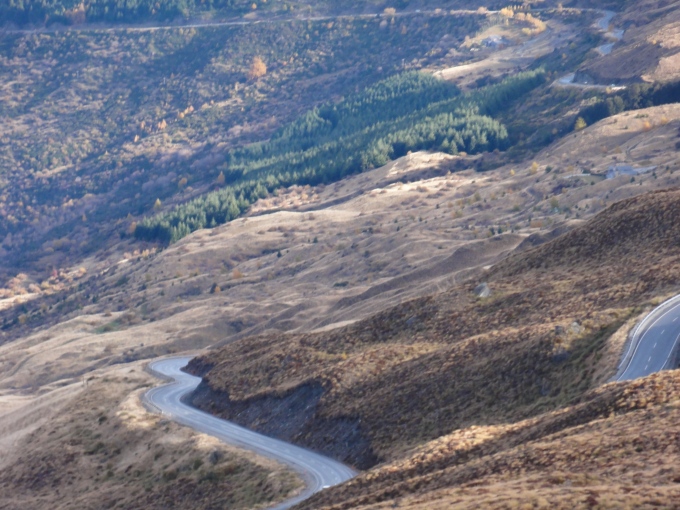
A picture paints … well, as many words as you like.  For instance:

lookingdownfromcoronetpeak

And the story:

It was once said that a desperate man has everything to lose.

The man I was chasing was desperate, but I, on the other hand, was more desperate to catch him.

He’d left a trail of dead people from one end of the island to the other.

The team had put in a lot of effort to locate him, and now his capture was imminent.  We were following the car he was in, from a discrete distance, and, at the appropriate time, we would catch up, pull him over, and make the arrest.

There was nowhere for him to go.

The road led to a dead-end, and the only way off the mountain was back down the road were now on.  Which was why I was somewhat surprised when we discovered where he was.

Where was he going?

“Damn,” I heard Alan mutter.  He was driving, being careful not to get too close, but not far enough away to lose sight of him.

“What?”

“I think he’s made us.”

“How?”

“Dumb bad luck, I’m guessing.  Or he expected we’d follow him up the mountain.  He’s just sped up.”

“How far away?”

“A half-mile.  We should see him higher up when we turn the next corner.”

It took an eternity to get there, and when we did, Alan was right, only he was further on than we thought.”

“Step on it.  Let’s catch him up before he gets to the top.”

Easy to say, not so easy to do.  The road was treacherous, and in places just gravel, and there were no guard rails to stop a three thousand footfall down the mountainside.

Good thing then I had the foresight to have three agents on the hill for just such a scenario.

Ten minutes later, we were in sight of the car, still moving quickly, but we were going slightly faster.  We’d catch up just short of the summit car park.

Or so we thought.

Coming quickly around another corner we almost slammed into the car we’d been chasing.

“What the hell…” Aland muttered.

I was out of the car, and over to see if he was in it, but I knew that it was only a slender possibility.  The car was empty, and no indication where he went.

Certainly not up the road.  It was relatively straightforward for the next mile, at which we would have reached the summit.  Up the mountainside from here, or down.

I looked up.  Nothing.

Alan yelled out, “He’s not going down, not that I can see, but if he did, there’s hardly a foothold and that’s a long fall.”

Then where did he go?

Then a man looking very much like our quarry came out from behind a rock embedded just a short distance up the hill.

“Sorry,” he said quite calmly.  “Had to go if you know what I mean.”

I’d lost him.

It was as simple as that.

I had been led a merry chase up the hill, and all the time he was getting away in a different direction.

I’d fallen for the oldest trick in the book, letting my desperation blind me to the disguise that anyone else would see through in an instant.

It was a lonely sight, looking down that road, knowing that I had to go all that way down again, only this time, without having to throw caution to the wind.

“Maybe next time,” Alan said.

“We’ll get him.  It’s just a matter of time.”

© Charles Heath 2019-2021

Find this and other stories in “Inspiration, maybe”  available soon.

InspirationMaybe1v1