Over the years, I have traveled extensively and kept journals, with the idea that one day all of those places would become locations in books. Notebooks filled with odd characters, people and incidents observed, and whole tracts of stories written when the on the spot inspiration has been a driving force.
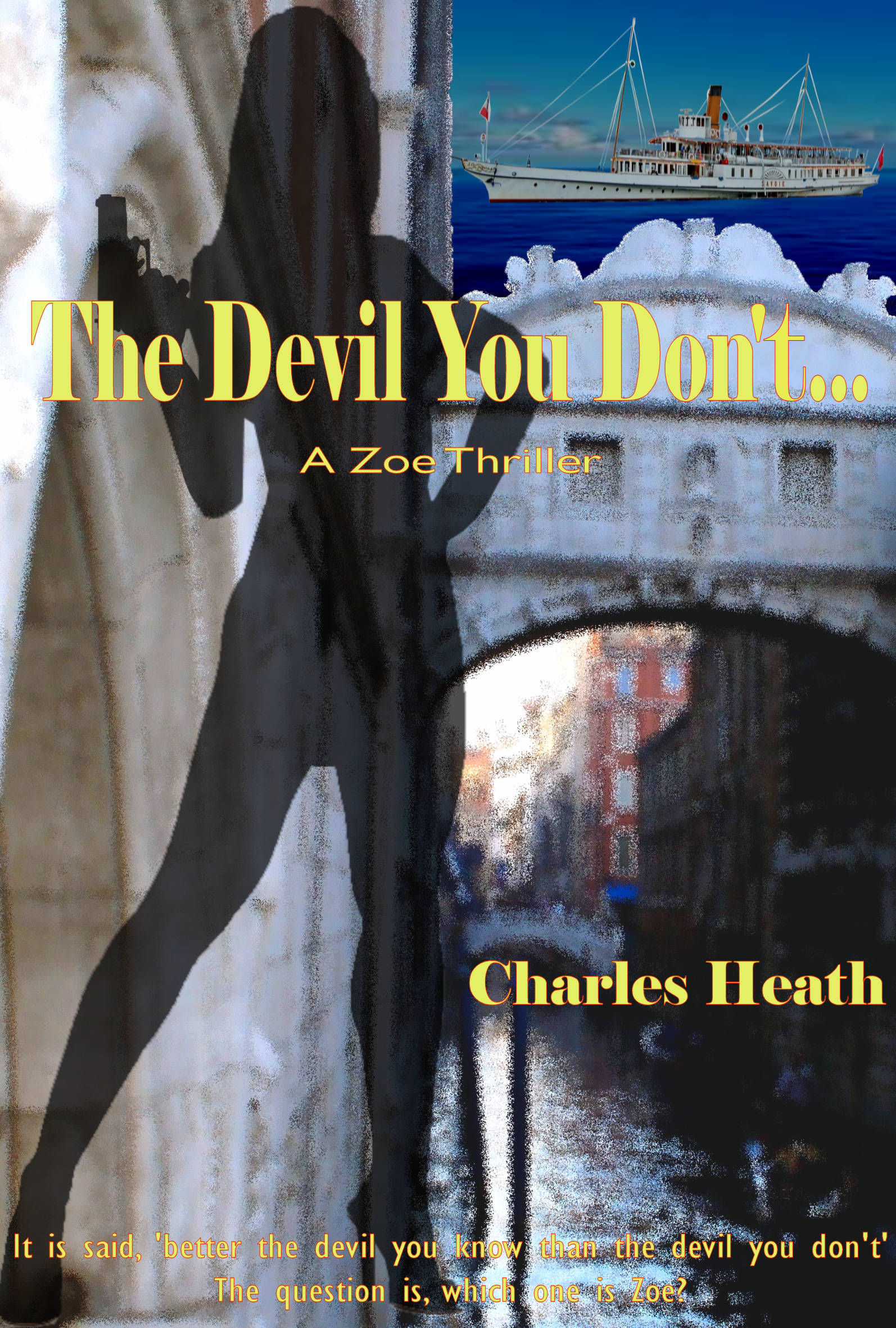
All of this is the basis of the first three novels, Sunday In New York, set, of course, in New York, probably my favorite city in the world, “Echoes From The Past’ equally set in New York, Brooklyn Heights and Philadelphia. The third, The Devil You Don’t, travels through Europe, starting in Geneva, moving to Rome, then Sorrento, and then to Venice.
Now, my passion to write is fuelled by travel and fine dining. When I take a break from these, I get to torment my three wonderful grandchildren whom I actively encourage to read as much as they can, and more recently to also write.
As for almost every other writer, I would not be able to do any of this without my wife who has put up with my moodiness, the times when I'm locked away in a room trying to push out another 2,000 words, and yet despite everything still puts up with me.
I wish I could say the same for our cat. Alas, I am still trying to work out how to be his friend!
When I first saw it I thought it was an old country estate, converted and expanded into a golf clubhouse.
It wasn’t. It is a purpose-built clubhouse and function center for corporate seminars and wedding receptions, as well as catering to the golfer, and golf tournaments.
It also has a very good outlook over the golf course.
But, in my writer’s mind, this will provide inspiration for a story that could be set in a large country house, with the central tower and lookout featuring in what might be a grisly death, and a group of guests who have gathered together to enact a mock murder that turns out to be very real.
Yes, the idea has been done to death over many many years, but I have a few new twists in mind.
I’m back home and this story has been sitting on the back burner for a few months, waiting for some more to be written.
The trouble is, there are also other stories to write, and I’m not very good at prioritizing.
But, here we are, a few minutes opened up and it didn’t take long to get back into the groove.
Chasing leads, maybe
—–
“You left a paper trail, a car registration form at the flat in Bromley.”
I saw him shake his head. “I thought I’d removed any evidence.”
“Good thing then, that I found it, and not Severin who was next through the door.”
He nodded towards Jennifer. “What’s she doing here, she was one of your surveillance team.”
“She came with me. The department threw her out, I found her and asked her if she wanted to find out what was going on. Apparently, she did. Everyone can put their guns down now. We are, believe it or not, all friends here.”
Jennifer put her gun back in a pocket I hadn’t seen before.
Adam lowered his, but it was still ready to shoot if either of us made the wrong move. The old woman’s aim hadn’t changed; she was still intent on shooting me if I moved.
“Mother, give it up.”
A few seconds later she lowered the weapon, but it was still ready. To fire if I moved.
“Can we sit,” I asked. Having a gun aimed at you tended to make you feel week in the knees. I was.
There were three chairs in front of the fireplace, this room also having a fire ready but not lit, and one chair by the writing-table. We sat in the three chairs, the old woman over by the table. She put the rifle down on the desktop, within easy reach.
“My first question,” I said, “has to be, how are you still alive?”
“You left when Severin’s crew arrived to clean up. He left at the same time. Luckily. Then two of Dobbin’s agents arrived and cleaned up the cleaners, as it were, and took me to a safe place where it was discovered my injuries were not fatal.”
“You were hit by a sniper, that’s hard to believe he, or she, aimed to miss.”
“They didn’t. I think I moved slightly because of you, so I have you to thank for my life. Something else to remember, Dobbin doesn’t know I’m here, and I think the only link was that registration certificate. No one actually knows me by Adam Quigley, except, of course, my mother.
“And the USB everyone is after?”
A few seconds of silence, then, “It’s missing.”
“Were you the only one who knew where it was?”
“No, but as far as I’m aware, that person is dead, killed by the explosion you witnessed. We were due to meet there, just before the explosion which is why I was heading there.”
“You walked past it, as I recall.”
“Standard procedure. I walk past, check to see if the contact is there, then come back a few minutes later. I was running late, just got past when it went up. We would have both been in there, and dead.”
“And the USB gone with it?”
“Yes. My friend had it with him at the time. I was going there to pick it up.”
“No copies?” It was too much to expect there would be, even if it was worth more than life itself.
“No. That sort of information needs to be in as few places as possible.”
“You knew what it was about?”
“Yes.”
“And…”
“It’s above all our pay grades. But something I can tell you; I know why your Severin and Maury wanted it back.”
“It was theirs?”
“Yes. They originally stole it. I stole it from them and trying to return it to whom it belonged.”
“Nobbin?”
“God, no. I’ve since discovered he’s as crooked as all the rest. But now that it’s gone, it doesn’t matter who the owner of the information is. Just staying one step ahead of the jackals, that’s the job in hand.”
Day 37 – Do writers need to be interested in everything
…
Is the Accomplished Writer Someone Who Is Interested in Everything?
Introduction
When you flip through the pages of a novel that feels almost cinematic, or when a nonfiction essay makes you see the world in a new light, you’re often witnessing the work of a writer who seems to know everything. From the delicate anatomy of a hummingbird’s wing to the gritty economics of a 19th‑century railway boom, the writer’s knowledge appears boundless.
That impression fuels a common myth: “If you want to be an accomplished writer, you must be interested in everything.”
Is this hyper‑curiosity a prerequisite for literary greatness, or merely a romantic exaggeration? In this post, we’ll unpack the myth, explore the real relationship between curiosity and craft, and give you practical takeaways for your own writing journey.
1. The Appeal of the “Jack‑of‑All‑Trades” Writer
1.1. Breadth as a Narrative Engine
A wide knowledge base gives a writer an arsenal of storytelling tools. When you can weave together disparate subjects—say, a scientist’s obsession with quantum entanglement and a chef’s pursuit of umami—you create surprising juxtapositions that keep readers hooked.
Example: Don DeLillo’s novels are peppered with references to pop culture, physics, and corporate jargon, turning his prose into a kaleidoscope of modern life.
Result: Readers feel that the author “gets” the world, and they trust the narrative to transport them across it.
1.2. Credibility and Authority
When a writer can cite accurate details, it builds legitimacy. In nonfiction, especially, expertise (or the appearance of it) can be the difference between a bestseller and a footnote.
Example: Malcolm Gladwell isn’t a psychologist, sociologist, or historian, yet he commands authority because he consistently digests research from each field and reframes it in accessible stories.
2. Why “Everything” Is a Misleading Goal
2.1. The Curse of the “Polymath‑Trap”
Trying to master everything leads to shallow knowledge, which can manifest as:
Superficiality: Dropping jargon without context, leaving readers confused.
Inconsistent Voice: Switching tones every time you switch subjects erodes narrative cohesion.
“A writer who knows a little about many things is often less effective than a writer who knows a lot about one thing.” – Haruki Murakami (paraphrased)
2.2. Depth Trumps Breadth in Most Genres
Literary Fiction: The emotional truth of a character’s inner life often outweighs how many facts you can slip in.
Genre Writing (e.g., mystery, sci‑fi): World‑building thrives on focused expertise. A detective novel benefits more from a deep dive into police procedure than from an encyclopedic survey of kitchen appliances.
2.3. The Opportunity Cost of Over‑Curiosity
Every hour you spend chasing a new hobby is an hour you could be honing your prose, revising drafts, or reading the works that inspired you. The best writers allocate their curiosity strategically, not indiscriminately.
3. What Successful Writers Actually Do
Writer
Primary Interests
How They Leverage Curiosity
Toni Morrison
African‑American history, music, mythology
Integrated cultural memory into layered narratives.
Neil Gaiman
Folklore, comics, film
Cross‑medium storytelling, creating a mythic voice.
J.K. Rowling
Classical mythology, alchemy, education
Built a richly detailed magical world anchored in real‑world concepts.
Rebecca Solnit
Geography, politics, art history
Combines seemingly unrelated topics to reveal hidden connections.
George R.R. Martin
Medieval history, anthropology, linguistics
Constructs a believable fantasy realm through meticulous research in specific fields.
Key Takeaway: Each writer has a core constellation of interests that they explore deeply, while allowing peripheral curiosities to spark fresh ideas.
4. The Science of Curiosity and Creativity
Neuroscience: Studies show that divergent thinking—the ability to generate many possible solutions—strengthens when the brain forms connections across unrelated concepts.
Psychology: The “Broaden‑and‑Build” theory (Barbara Fredrickson) posits that positive emotions, often triggered by curiosity, expand our mental repertoire, giving us more raw material for creative work.
In plain terms: Being curious does help you write better—but you don’t need to be curious about everything. You just need enough variety to keep the mental pathways open.
5. How to Cultivate a Productive Curiosity (Without Going Overboard)
Identify Your “Anchor Interests.”
List 3–5 subjects you love (e.g., vintage photography, urban gardening, Renaissance art).
Make a habit of reading news, books, or podcasts in these areas weekly.
Adopt a “Research‑First” Mindset for Projects.
Before you start a story, ask: What knowledge does the world need?
Set a research budget (e.g., 5 hours) and focus on depth, not breadth.
Cross‑Pollinate Intentionally.
Pair two unrelated interests (e.g., marine biology + corporate law) and brainstorm story premises.
Use the “Random Prompt” method: Write a one‑sentence logline that forces you to combine the two.
Limit Consumption, Amplify Production.
For every hour spent watching a documentary, write at least 300 words.
This “ratio rule” ensures curiosity fuels output rather than replaces it.
Maintain a “Curiosity Journal.”
Jot down fleeting questions (“Why do some birds migrate at night?”).
Review monthly; pick one that resonates and research it thoroughly.
6. Frequently Asked Questions
Question
Short Answer
Do I need a formal education in every field I write about?
No. A disciplined research process and a willingness to ask experts can substitute for a degree.
Can I become a bestselling author by focusing on a single niche?
Absolutely. Ernest Hemingway famously limited his subject matter to war, hunting, and love, yet his work is timeless.
Is it okay to write about topics I’m not an expert in?
Yes, if you do thorough research, credit your sources, and avoid misrepresentation.
How do I avoid “information overload” when I’m curious?
Set clear limits on research time per project, and prioritize depth over quantity.
Should I read only within my genre to stay “focused”?
No. Reading outside your genre fuels innovation, but keep a balance so you don’t lose sight of genre conventions.
7. Bottom Line: Curiosity, Not Everything, Makes the Accomplished Writer
Curiosity is the engine. It drives you to ask questions, seek stories, and discover connections.
Depth is the fuel. Master a few subjects enough to write with authority and nuance.
Focus is the map. Align your curiosity with the story you’re telling, rather than letting it wander aimlessly.
An accomplished writer is not a person who knows everything, but a person who knows how to learn what they need, when they need it, and then transform that knowledge into compelling prose.
Action Plan: 3 Steps to Start Today
Pick Your Anchor: Write down three topics you could talk about for hours.
Schedule a Research Sprint: Allocate a 2‑hour block this week to dig deep into one of those topics—read a scholarly article, watch a documentary, or interview an expert.
Write a Mini‑Story: Using the new knowledge, craft a 500‑word piece that integrates the information organically.
Repeat the cycle, and watch your writing evolve from “interesting” to illuminating.
Closing Thought
The next time you admire a writer who seems to have woven the universe into their pages, remember: they didn’t achieve that by trying to master everything. They mastered the art of selective curiosity—knowing what to explore, how deep to go, and, most importantly, how to turn that exploration into a story that matters.
If you adopt that mindset, you’ll be well on your way to joining the ranks of accomplished writers—without ever having to become a walking encyclopedia.
Happy writing!
If you found this post helpful, share it with fellow word‑smiths and subscribe for more insights on crafting great prose.
One‑Day Stopover in Ankara? Make It Unforgettable With a Single Stop at Anıtkabir
If your flight itinerary or a road‑trip detour leaves you with just 24 hours in Turkey’s capital, you’ll quickly realise that Ankara isn’t a “quick‑look‑and‑leave” city. Its blend of modern governance, Ottoman‑era streets, and ancient history can feel overwhelming when the clock is ticking.
So, what’s the one place you must visit to turn a fleeting layover into a lasting memory?
The answer: Anıtkabir – the Mausoleum of Mustafa Kemal Atatürk
The monumental complex dedicated to Turkey’s founding father is more than a tomb; it’s a masterclass in architecture, a museum of the Republic’s birth, and a panoramic viewpoint over the city’s heart. In a single, well‑planned visit, you’ll:
Feel the pulse of modern Turkish identity – Atatürk’s legacy is woven into every corner of contemporary Turkey, and Anıtkabir is the physical embodiment of that narrative.
Enjoy a compact, self‑contained experience – The site fits comfortably into a 2‑hour window, leaving you time to sip Turkish tea, wander a nearby market, or catch a late‑night flight.
Capture iconic photographs – From the grand staircases to the sprawling lawn framed by the Bosphorus‑blue sky, every angle screams “travel‑worthy.”
Below is a practical guide to make that single stop truly unforgettable.
Where Is Anıtkabir?
Address: Anıtkabir, Çankaya, 06570 Ankara, Turkey
Coordinates: 39.9250° N, 32.8624° E
Getting There:
By Taxi / Ride‑Share: 15‑20 min from Ankara Airport (ESB) or the city centre; cost ≈ 30‑40 TL.
By Public Transport: Take the EGO bus 301 from the airport to Ulus and then a short 10‑minute walk. The Metro (M1 line) to Kızılay, followed by a 20‑minute bus ride (bus 302) also works.
Pro tip: Purchase a “Anıtkabir 1‑Day Pass” (≈ 25 TL) which includes entry to the mausoleum, the museum, and the Atatürk and War of Independence Hall—all in one ticket.
When to Go?
Season
Weather
Best Time of Day
Spring (Mar‑May)
Mild, blossoms in the nearby Gençlik Park
Early morning – fewer crowds, sunrise light on the columns
Summer (Jun‑Aug)
Hot, but the lawns are shaded by large trees
Late afternoon – cooler temps, dramatic sunset silhouettes
Autumn (Sep‑Nov)
Crisp, golden foliage
Mid‑day – perfect for museum photography
Winter (Dec‑Feb)
Cold, occasional snow – magical on the staircase
Late morning – sunlight hits the marble beautifully
The site opens at 9:00 AM and closes at 7:00 PM (last entry at 6:30 PM). Plan to arrive early to beat the peak tourist wave (typically 11:00 AM‑1:00 PM).
What You’ll See – A Quick Walk‑Through
Section
Highlights
Time Needed
Ceremonial Plaza
33‑meter high towers representing the 33 years of the Turkish War of Independence.
15 min
Road of Lions
A marble avenue lined with 24 lion statues, each symbolising virtues like courage and justice.
10 min
Mausoleum Hall
The sarcophagus of Atatürk rests under a 19-metre-high copper dome; a solemn, reverent atmosphere.
10 min
Museum of Atatürk
Personal items, letters, photographs, and a timeline of his life.
30 min
War of Independence Hall
Weapons, maps, and flags displayed in a dramatic, dim‑lit space.
20 min
Terrace & Views
Panoramic sweep of Ankara’s skyline and the verdant Gençlik Park beyond.
15 min
Total: Roughly 1.5‑2 hours. Add a short coffee break at the on‑site café for a traditional Turkish tea and a bite of simit (sesame‑seed bagel).
Why Anıtkabir Beats All Other Options for a One‑Day Stop
Factor
Anıtkabir
Other Popular Spots (e.g., Museum of Anatolian Civilizations, Ankara Castle)
Time Efficiency
All‑in‑one complex; minimal transit between sections
Requires separate trips, more walking, and potentially longer queues
Cultural Significance
Central to modern Turkish identity; revered national monument
Important, but more niche to archaeology or medieval history
Scenic Value
Grand architecture + sweeping city views
Scenic, but generally lower‑profile backdrops
Accessibility
Wheelchair‑friendly ramps, audio guides in multiple languages
Some areas (castle walls) are steep and less wheelchair‑friendly
Memorability
Iconic photo‑ops (dome, lion road, burial chamber) that instantly signal “Ankara”
Beautiful, yet less instantly recognizable to a global audience
In short, Anıtkabir delivers history, architecture, and visual impact in a compact, visitor‑friendly package—exactly what a short stopover demands.
Snap‑Shot Checklist
“The Lions” Walk – Capture the line of stone lions with the sunrise or sunset casting long shadows.
Dome Detail – A low‑angle shot of the copper dome framed by the marble columns.
Atatürk’s Sarcophagus – Respectful close‑up (no flash) of the simple, dignified stone coffin.
Panorama from the Terrace – Use a wide‑angle lens for the cityscape; the park in the foreground adds depth.
Museum Artifact – A candid of you (or your travel companion) reading Atatürk’s handwritten note.
Tip: Free Wi‑Fi is available in the museum—upload instantly to your travel blog or social feed!
Practical Tips for a Smooth Visit
Tip
Details
Dress Code
Modest attire is required (no shorts, miniskirts, or sleeveless tops). A light scarf can be useful.
Security
Expect metal detectors; large bags are not allowed inside the mausoleum.
Audio Guide
Available in English, Arabic, Russian, and French; rent for 10 TL.
Photography
Allowed in the exterior areas; flash prohibited inside the mausoleum hall.
Food & Drink
No eating inside the complex; there’s a small café just outside offering tea, fresh juice, and light snacks.
Nearby Quick Bite
Walk 5 minutes to Beypazarı Şarküteri for a traditional Turkish kebab or Baklava if you have extra time.
After Your Visit – Making the Most of the Rest of the Day
If you have a few hours left: Stroll through Gençlik Park (just south of Anıtkabir). The lake, flower beds, and mini‑cable car offer a pleasant breather.
For a taste of local life: Head to Kızılay Square (the city’s bustling hub) for a quick coffee at Café Diyar, then browse the nearby boutiques for souvenirs.
Last‑minute transport: Return to the airport via the EGO bus 302 (direct to Esenboğa). The ride takes about 30 minutes and runs every 20‑30 minutes.
Wrap‑Up: One Stop, One Memory
When the clock is ticking, you need a destination that summarises the soul of the city while staying logistically friendly. Anıtkabir does exactly that. It offers a profound glimpse into Turkey’s modern birth, striking architectural grandeur, and photo‑ready vistas—all within a compact venue that respects your limited schedule.
So next time your itinerary hands you a single day in Ankara, skip the maze of museums and head straight for the lion‑lined road. Walk the steps, stand beneath the dome, and let the spirit of Atatürk’s vision linger long after you’ve boarded your next flight.
Enjoy the journey, and may your stopover become a story you’ll share for years to come!
By any and all means possible, because if you are using the English language, then you’re going to be tripped up.
For instance, just the use of simple words like then, and than, there, and their, and many others. Just the very simplest of words have many meanings, some of them obscure, some of them, well, you get my drift.
ESL students often tear what little hair they have left out over the words. We English users, we are different again, being American English, English English, and a dozen other variations.
There’s centre and centre, just to name one, when it comes to American and English.
It depends on what spell checker you use to check the spelling, and what grammar checker you use, and generally not 100 per cent effective.
I let Microsoft Editor have fun with my writing, and then tend to ignore a lot of the suggestions. They just sound weird.
I have a basic Grammarly, but it doesn’t do a whole lot, and it costs a lot of money to get the so-called good one.
You have to decide the way you want to go, but you will have to have your work checked for grammar, spelling and facts.
And probably read a dozen grammar texts to get the best way to write your sentences. Mine often start out somewhat strange, but we get there in the end.
…
As a case in point: the word Line
The English language has some marvellous words that can be used to have any number of meanings
For instance,
Draw a line in the sand
We would all like to do this with our children, our jobs, and our relationships, but for some reason, the idea sounds really good in our heads, yet it never quite works out. What does it mean, whatever it is, this I’d where it ends or changes because it can’t keep going the way it is.
Inevitably, it leads to,
You’ve crossed the line
Which, at some point in our lives, and particularly when we were children, we all do a few times until, if we’re lucky, we learn where that line is. It’s usually considered 8n tandem with pushing boundaries.
Of course, there is
A line you should never cross
And I like to think we all know where that is. Unfortunately, some do not and often find their seemingly idyllic life totally shattered beyond repair. An affair from either side of a marriage or relationship can do that.
You couldn’t walk a straight line if you tried
While we might debate what straight might mean in this context, for this adaptation, it means staying on the right side of legality. Some people find a life of crime more appealing than doing honest day’s work.
This goes hand in hand with,
You’re spinning me a line
This means you are being somewhat loose with the truth, perhaps in explaining where you’ve been and what you’ve been doing. I think sometimes liars forget they need to have good memories.
Then there are the more practical uses of the word, such as
I have a new line of products
Is that a new fishing line?
Those, I think, most of us get, but it’s the more ambiguous ones that we have trouble with. Still, ambiguity is a writer’s best friend, and we can make up a lot of stuff from just using one word.
Known only to a few, there is a legend that a ship named the ‘Flying Dutchman’ left Nazi Germany in the last weeks of the war and set sail for America, escorted by U-boats, under a different name. Aboard was a trove of treasure and gold worth a ‘king’s ransom’.
It was said that it had been sent to a group of American Nazis to create the Fourth Reich at an appropriate time. Over the years since many expeditions off the coast had searched, but found no trace of the vessel or the treasure.
In other words, it was just a legend created to boost tourism.
…
Fast forward to 2024. Our intrepid private detective, Harry Walthenson, overhears a conversation at Grand Central Station. It was the oddness of the message that caught his attention. An investigation turned up nothing out of the ordinary, and he thinks no more about it.
Then Harry is kidnapped, interrogated, and asked questions over and over about a date and a place, why he went there, and when he could not give satisfactory answers, he was beaten half to death and left for dead on a rubbish heap. He was lucky that it was a living space for homeless men; otherwise, he would have died.
In the aftermath, he once again gives it no more thought.
…
After resolving his first case successfully, there’s no rest. Harry’s angry mother comes to his office and demands that he find out where his father has gone. She believes he has run off with a mistress, not for the first time.
Perhaps it was not the wisest decision she has made, because Harry promises to investigate, and adds that she might not like what he finds.
He soon discovered he does not like what he finds, that his father’s friends, a cabal formed at University, have two who are his mother’s current lovers, and another, a criminal blackmailing his father.
Felicity, now his partner, working on a different case, and trying to get answers, uncovers a crime family involved in guarding a disused warehouse on the docks, where she believes Harry had been taken for interrogation, and subsequently dumped nearby to die.
Why are they up to? What is so important that the empty warehouse needs guarding? Who is employing them?
Harry, following up on the death of the blackmailer, traces his death back to an enforcer employed by his grandfather. His mother’s grandfather was a pre-war industrialist who made his fortune in war munitions and shipbuilding.
He was also a member of the American Nazi party.
When Harry also discovers a logbook belonging to a so-called wartime Liberty ship the “Paul Revere” in brackets ‘Freiheitskämpfer’, hidden by his father, and written in a code that is not readily identifiable.
It is no longer a matter of a father who has run off with his mistress; it is a very frightened man in fear of his life, running from a group who will stop at nothing to get the logbook back. And when Harry discovers a family connection to the group, it becomes a race against time to decode the log and find his father before his grandfather does.
…
Coming soon: Harry Walthenson’s new adventure – A case of finding the ‘Flying Dutchman’
One Day in Stockholm: The One Place You Must Visit for an Unforgettable Day
Stockholm is a city of islands, innovation, and timeless beauty—but what if you only have one day? Whether you’re en route to another destination or squeezing in a whirlwind visit, a short stopover in Sweden’s capital can still be magical. With limited time, the key is to focus on one standout experience rather than rushing between sights.
So, if you have just one day in Stockholm, make it memorable by visiting:
Gamla Stan – The Beating Heart of Stockholm
Gamla Stan, Stockholm’s Old Town, isn’t just a historic district—it’s a living storybook. Founded in the 13th century, this island neighbourhood weaves together medieval charm, royal history, and vibrant culture in a way that captures the essence of Sweden.
Why Gamla Stan?
Timeless Atmosphere: Wander through narrow cobblestone lanes, past buildings in shades of gold and rust, under lantern-lit passages that feel frozen in time.
Compact & Walkable: Perfect for a day visit, you can explore key highlights on foot without feeling rushed.
History at Every Turn: From the Royal Palace to Stortorget square (home to the iconic colorful merchant houses), history isn’t behind glass here—it’s all around you.
Must-Do in Gamla Stan
Stortorget Square – Snap a photo by the iconic row of old merchant houses, and soak in the atmosphere of the oldest square in Stockholm.
The Royal Palace – Even if you don’t go inside, witnessing the daily Changing of the Guard (at 12:15 PM on weekdays, 1:15 PM on Sundays) is a spectacle of tradition.
Mårten Trotzigs Gränd – Walk down Stockholm’s narrowest street (just 90 cm wide) and feel the medieval pulse of the city.
Fika like a Local – Pop into a classic café like Chokladkoppen on the square for coffee and a cinnamon bun—fika is a ritual here.
Make It Memorable
Get Lost on Purpose: Put away the map for an hour. Discover hidden courtyards, antique shops, and artisan boutiques.
Listen to Stories: Join a short walking tour—many are free or tip-based—and hear tales of kings, legends, and Stockholm’s rise from the water.
Sunset Views: End your day by walking to the water’s edge for views of the surrounding islands. In summer, the golden light over Gamla Stan is pure magic.
Practical Tips for Your Stopover
Transport: From Arlanda Airport, take the Arlanda Express (20 minutes) to Central Station, then it’s just a short walk or metro ride to Gamla Stan.
Luggage: Use left-luggage services at the airport or Central Station to travel light.
Timing: Arrive early to beat crowds, especially in summer. Even with just 5–6 hours, you can experience Gamla Stan fully.
One day in Stockholm doesn’t have to be a checklist. By choosing Gamla Stan, you immerse yourself in the soul of the city—where every corner whispers a story, and a single afternoon can feel like a journey through centuries.
So, on your next stopover, step into the charm of the Old Town. Sometimes the most memorable travels aren’t about seeing everything—but about fully experiencing one perfect place. Hej då and happy travels!
50 photographs, 50 stories, of which there is one of the 50 below.
They all start with –
A picture paints … well, as many words as you like. For instance:
And, the story:
Have you ever watched your hopes and dreams simply just fly away?
Everything I thought I wanted and needed had just left in an aeroplane, and although I said I was not going to, i came to the airport to see the plane leave. Not the person on it, that would have been far too difficult and emotional, but perhaps it was symbolic, the end of one life and the start of another.
But no matter what I thought or felt, we had both come to the right decision. She needed the opportunity to spread her wings. It was probably not the best idea for her to apply for the job without telling me, but I understood her reasons.
She was in a rut. Though her job was a very good one, it was not as demanding as she had expected, particularly after the last promotion, but with it came resentment from others on her level, that she, the youngest of the group would get the position.
It was something that had been weighing down of her for the last three months, and if noticed it, the late nights, the moodiness, sometimes a flash of temper. I knew she had one, no one could have such red hair and not, but she had always kept it in check.
And, then there was us, together, and after seven years, it felt like we were going nowhere. Perhaps that was down to my lack of ambition, and though she never said it, lack of sophistication. It hadn’t been an issue, well, not until her last promotion, and the fact she had to entertain more, and frankly I felt like an embarrassment to her.
So, there it was, three days ago, the beginning of the weekend, and we had planned to go away for a few days and take stock. We both acknowledged we needed to talk, but it never seemed the right time.
It was then she said she had quit her job and found a new one. Starting the following Monday.
Ok, that took me by surprise, not so much that it something I sort of guessed might happen, but that she would just blurt it out.
I think that right then, at that moment, I could feel her frustration with everything around her.
What surprised her was my reaction. None.
I simply asked where who, and when.
A world-class newspaper, in New York, and she had to be there in a week.
A week.
It was all the time I had left with her.
I remember I just shrugged and asked if the planned weekend away was off.
She stood on the other side of the kitchen counter, hands around a cup of coffee she had just poured, and that one thing I remembered was the lone tear that ran down her cheek.
Is that all you want to know?
I did, yes, but we had lost that intimacy we used to have when she would have told me what was happening, and we would have brainstormed solutions. I might be a cabinet maker but I still had a brain, was what I overheard her tell a friend once.
There’s not much to ask, I said. You’ve been desperately unhappy and haven’t been able to hide it all that well, you have been under a lot of pressure trying to deal with a group of troglodytes, and you’ve been leaning on Bentley’s shoulder instead of mine, and I get it, he’s got more experience in that place, and the politics that go with it, and is still an ally.
Her immediate superior and instrumental in her getting the position, but unlike some men in his position he had not taken advantage of a situation like some men would. And even if she had made a move, which I doubted, that was not the sort of woman she was, he would have politely declined.
One of the very few happily married men in that organisation, so I heard.
So, she said, you’re not just a pretty face.
Par for the course for a cabinet maker whose university degree is in psychology. It doesn’t take rocket science to see what was happening to you. I just didn’t think it was my place to jump in unless you asked me, and when you didn’t, well, that told me everything I needed to know.
Yes, our relationship had a use by date, and it was in the next few days.
I was thinking, she said, that you might come with me, you can make cabinets anywhere.
I could, but I think the real problem wasn’t just the job. It was everything around her and going with her, that would just be a constant reminder of what had been holding her back. I didn’t want that for her and said so.
Then the only question left was, what do we do now?
Go shopping for suitcases. Bags to pack, and places to go.
Getting on the roller coaster is easy. On the beginning, it’s a slow easy ride, followed by the slow climb to the top. It’s much like some relationships, they start out easy, they require a little work to get to the next level, follows by the adrenaline rush when it all comes together.
What most people forget is that what comes down must go back up, and life is pretty much a roller coaster with highs and lows.
Our roller coaster had just come or of the final turn and we were braking so that it stops at the station.
There was no question of going with her to New York. Yes, I promised I’d come over and visit her, but that was a promise with crossed fingers behind my back. After a few months in t the new job the last thing shed want was a reminder of what she left behind. New friends new life.
We packed her bags, three out everything she didn’t want, a free trips to the op shop with stiff she knew others would like to have, and basically, by the time she was ready to go, there was nothing left of her in the apartment, or anywhere.
Her friends would be seeing her off at the airport, and that’s when I told her I was not coming, that moment the taxi arrived to take her away forever. I remember standing there, watching the taxi go. It was going to be, and was, as hard as it was to watch the plane leave.
So, there I was, finally staring at the blank sky, around me a dozen other plane spotters, a rather motley crew of plane enthusiasts.
Already that morning there’s been 6 different types of plane depart, and I could hear another winding up its engines for take-off.
People coming, people going.
Maybe I would go to New York in a couple of months, not to see her, but just see what the attraction was. Or maybe I would drop in, just to see how she was.
As one of my friends told me when I gave him the news, the future is never written in stone, and it’s about time you broadened your horizons.
Day 37 – Do writers need to be interested in everything
…
Is the Accomplished Writer Someone Who Is Interested in Everything?
Introduction
When you flip through the pages of a novel that feels almost cinematic, or when a nonfiction essay makes you see the world in a new light, you’re often witnessing the work of a writer who seems to know everything. From the delicate anatomy of a hummingbird’s wing to the gritty economics of a 19th‑century railway boom, the writer’s knowledge appears boundless.
That impression fuels a common myth: “If you want to be an accomplished writer, you must be interested in everything.”
Is this hyper‑curiosity a prerequisite for literary greatness, or merely a romantic exaggeration? In this post, we’ll unpack the myth, explore the real relationship between curiosity and craft, and give you practical takeaways for your own writing journey.
1. The Appeal of the “Jack‑of‑All‑Trades” Writer
1.1. Breadth as a Narrative Engine
A wide knowledge base gives a writer an arsenal of storytelling tools. When you can weave together disparate subjects—say, a scientist’s obsession with quantum entanglement and a chef’s pursuit of umami—you create surprising juxtapositions that keep readers hooked.
Example: Don DeLillo’s novels are peppered with references to pop culture, physics, and corporate jargon, turning his prose into a kaleidoscope of modern life.
Result: Readers feel that the author “gets” the world, and they trust the narrative to transport them across it.
1.2. Credibility and Authority
When a writer can cite accurate details, it builds legitimacy. In nonfiction, especially, expertise (or the appearance of it) can be the difference between a bestseller and a footnote.
Example: Malcolm Gladwell isn’t a psychologist, sociologist, or historian, yet he commands authority because he consistently digests research from each field and reframes it in accessible stories.
2. Why “Everything” Is a Misleading Goal
2.1. The Curse of the “Polymath‑Trap”
Trying to master everything leads to shallow knowledge, which can manifest as:
Superficiality: Dropping jargon without context, leaving readers confused.
Inconsistent Voice: Switching tones every time you switch subjects erodes narrative cohesion.
“A writer who knows a little about many things is often less effective than a writer who knows a lot about one thing.” – Haruki Murakami (paraphrased)
2.2. Depth Trumps Breadth in Most Genres
Literary Fiction: The emotional truth of a character’s inner life often outweighs how many facts you can slip in.
Genre Writing (e.g., mystery, sci‑fi): World‑building thrives on focused expertise. A detective novel benefits more from a deep dive into police procedure than from an encyclopedic survey of kitchen appliances.
2.3. The Opportunity Cost of Over‑Curiosity
Every hour you spend chasing a new hobby is an hour you could be honing your prose, revising drafts, or reading the works that inspired you. The best writers allocate their curiosity strategically, not indiscriminately.
3. What Successful Writers Actually Do
Writer
Primary Interests
How They Leverage Curiosity
Toni Morrison
African‑American history, music, mythology
Integrated cultural memory into layered narratives.
Neil Gaiman
Folklore, comics, film
Cross‑medium storytelling, creating a mythic voice.
J.K. Rowling
Classical mythology, alchemy, education
Built a richly detailed magical world anchored in real‑world concepts.
Rebecca Solnit
Geography, politics, art history
Combines seemingly unrelated topics to reveal hidden connections.
George R.R. Martin
Medieval history, anthropology, linguistics
Constructs a believable fantasy realm through meticulous research in specific fields.
Key Takeaway: Each writer has a core constellation of interests that they explore deeply, while allowing peripheral curiosities to spark fresh ideas.
4. The Science of Curiosity and Creativity
Neuroscience: Studies show that divergent thinking—the ability to generate many possible solutions—strengthens when the brain forms connections across unrelated concepts.
Psychology: The “Broaden‑and‑Build” theory (Barbara Fredrickson) posits that positive emotions, often triggered by curiosity, expand our mental repertoire, giving us more raw material for creative work.
In plain terms: Being curious does help you write better—but you don’t need to be curious about everything. You just need enough variety to keep the mental pathways open.
5. How to Cultivate a Productive Curiosity (Without Going Overboard)
Identify Your “Anchor Interests.”
List 3–5 subjects you love (e.g., vintage photography, urban gardening, Renaissance art).
Make a habit of reading news, books, or podcasts in these areas weekly.
Adopt a “Research‑First” Mindset for Projects.
Before you start a story, ask: What knowledge does the world need?
Set a research budget (e.g., 5 hours) and focus on depth, not breadth.
Cross‑Pollinate Intentionally.
Pair two unrelated interests (e.g., marine biology + corporate law) and brainstorm story premises.
Use the “Random Prompt” method: Write a one‑sentence logline that forces you to combine the two.
Limit Consumption, Amplify Production.
For every hour spent watching a documentary, write at least 300 words.
This “ratio rule” ensures curiosity fuels output rather than replaces it.
Maintain a “Curiosity Journal.”
Jot down fleeting questions (“Why do some birds migrate at night?”).
Review monthly; pick one that resonates and research it thoroughly.
6. Frequently Asked Questions
Question
Short Answer
Do I need a formal education in every field I write about?
No. A disciplined research process and a willingness to ask experts can substitute for a degree.
Can I become a bestselling author by focusing on a single niche?
Absolutely. Ernest Hemingway famously limited his subject matter to war, hunting, and love, yet his work is timeless.
Is it okay to write about topics I’m not an expert in?
Yes, if you do thorough research, credit your sources, and avoid misrepresentation.
How do I avoid “information overload” when I’m curious?
Set clear limits on research time per project, and prioritize depth over quantity.
Should I read only within my genre to stay “focused”?
No. Reading outside your genre fuels innovation, but keep a balance so you don’t lose sight of genre conventions.
7. Bottom Line: Curiosity, Not Everything, Makes the Accomplished Writer
Curiosity is the engine. It drives you to ask questions, seek stories, and discover connections.
Depth is the fuel. Master a few subjects enough to write with authority and nuance.
Focus is the map. Align your curiosity with the story you’re telling, rather than letting it wander aimlessly.
An accomplished writer is not a person who knows everything, but a person who knows how to learn what they need, when they need it, and then transform that knowledge into compelling prose.
Action Plan: 3 Steps to Start Today
Pick Your Anchor: Write down three topics you could talk about for hours.
Schedule a Research Sprint: Allocate a 2‑hour block this week to dig deep into one of those topics—read a scholarly article, watch a documentary, or interview an expert.
Write a Mini‑Story: Using the new knowledge, craft a 500‑word piece that integrates the information organically.
Repeat the cycle, and watch your writing evolve from “interesting” to illuminating.
Closing Thought
The next time you admire a writer who seems to have woven the universe into their pages, remember: they didn’t achieve that by trying to master everything. They mastered the art of selective curiosity—knowing what to explore, how deep to go, and, most importantly, how to turn that exploration into a story that matters.
If you adopt that mindset, you’ll be well on your way to joining the ranks of accomplished writers—without ever having to become a walking encyclopedia.
Happy writing!
If you found this post helpful, share it with fellow word‑smiths and subscribe for more insights on crafting great prose.
It could be said that of all the women one could meet, whether contrived or by sheer luck, what are the odds it would turn out to be the woman who was being paid a very large sum to kill you.
John Pennington is a man who may be lucky in business, but not so lucky in love. He has just broken up with Phillipa Sternhaven, the woman he thought was the one, but relatives and circumstances, and perhaps because she was a ‘princess’, may also have contributed to the end result.
So, what do you do when you are heartbroken?
That is a story that slowly unfolds, from the first meeting with his nemesis on Lake Geneva, all the way to a hotel room in Sorrento, where he learns the shattering truth.
What should have been solace after disappointment, turns out to be something else entirely, and from that point, everything goes to hell in a handbasket.
He suddenly realizes his so-called friend Sebastian has not exactly told him the truth about a small job he asked him to do, the woman he is falling in love with is not quite who she says she is, and he is caught in the middle of a war between two men who consider people becoming collateral damage as part of their business.
The story paints the characters cleverly displaying all their flaws and weaknesses. The locations add to the story at times taking me back down memory lane, especially to Venice where, in those back streets I confess it’s not all that hard to get lost.
All in all a thoroughly entertaining story with, for once, a satisfying end.

 Where Is Anıtkabir?
 When to Go?
 What You’ll See – A Quick Walk‑Through
 Why Anıtkabir Beats All Other Options for a One‑Day Stop
 Snap‑Shot Checklist
 Practical Tips for a Smooth Visit
 After Your Visit – Making the Most of the Rest of the Day
 Wrap‑Up: One Stop, One Memory


 Thrills, Spills, and just a dash of Romance