An excerpt from “If Only” – a work in progress

Investigation of crimes doesn’t always go according to plan, nor does the perpetrator get either found or punished.

That was particularly true in my case.  The murderer was incredibly careful in not leaving any evidence behind, to the extent that the police could not rule out whether it was a male or a female.

At one stage, the police thought I had murdered my own wife, though how I could be on a train at the time of the murder was beyond me.  I had witnesses and a cast-iron alibi.

The officer in charge was Detective First Grade Gabrielle Walters.  She came to me on the day after the murder seeking answers to the usual questions like, when was the last time you saw your wife, did you argue, the neighbours reckon there were heated discussions the day before.

Routine was the word she used.

Her fellow detective was a surly piece of work whose intention was to get answers or, more likely, a confession by any or all means possible.  I could sense the raging violence within him.  Fortunately, common sense prevailed.

Over the course of the next few weeks, once I’d been cleared of committing the crime, Gabrielle made a point of keeping me informed of the progress.

After three months, the updates were more sporadic, and when, for lack of progress, it became a cold case, communication ceased.

But it was not the last time I saw Gabrielle.

The shock of finding Vanessa was more devastating than the fact that she was now gone, and those images lived on in the same nightmare that came to visit me every night when I closed my eyes.

For months, I was barely functioning, to the extent that I had all but lost my job and quite a few friends, particularly those who were more attached to Vanessa rather than me.

They didn’t understand how it could affect me so much, and since it had not happened to them, my tart replies of ‘you wouldn’t understand’ were met with equally short retorts.  Some questioned my sanity, even, for a time, so did I.

No one, it seemed, could understand what it was like, no one except Gabrielle.

She was by her own admission, damaged goods, having been the victim of a similar incident, a boyfriend who turned out to be an awfully bad boy.  Her story varied only in that she had been made to witness his execution.  Her nightmare, in reliving that moment in time, was how she was still alive and, to this day, had no idea why she’d been spared.

It was a story she told me one night, some months after the investigation had been scaled down.  I was still looking for the bottom of a bottle and an emotional mess.  Perhaps it struck a resonance with her; she’d been there and managed to come out the other side.

What happened became our secret, a once-only night together that meant a great deal to me, and by mutual agreement, it was not spoken of again.  It was as if she knew exactly what was required to set me on the path to recovery.

And it had.

Since then, we saw each other about once a month in a cafe.   I had been surprised to hear from her again shortly after that eventful night when she called to set it up, ostensibly for her to provide me with any updates on the case, but perhaps we had, after that unspoken night, formed a closer bond than either of us wanted to admit.

We generally talked for hours over wine, then dinner and coffee.  It took a while for me to realise that all she had was her work; personal relationships were nigh on impossible in a job that left little or no spare time for anything else.

She’d always said that if I had any questions or problems about the case, or if there was anything that might come to me that might be relevant, even after all this time, all I had to do was call her.

I wondered if this text message was in that category.  I was certain it would interest the police, and I had no doubt they could trace the message’s origin, but there was that tiny degree of doubt about whether or not I could trust her to tell me what the message meant.

I reached for the phone, then put it back down again.  I’d think about it and decide tomorrow.

© Charles Heath 2018-2020

365 Days of writing, 2026 – 84

Day 84 – Writing and Legends

What Turns a “So‑So” Writer Into a Literary Legend?

There’s a thin line between anonymity and immortality. One moment, an author is tucked away on a dusty shelf, the next they’re quoted in classrooms, memes, and midnight conversations. What actually triggers that quantum leap?

Below, we’ll dissect the anatomy of the “legendary moment” and list the kinds of events that can catapult an ordinary writer into the pantheon of literary greatness.


1. The Mythic Turning Point: From “Good Enough” to “Unforgettable”

Every legend has a pivot—a moment that rewrites the narrative of their career. It’s rarely a single, tidy episode; rather, it’s a convergence of several forces that together reshape public perception:

ElementHow It WorksWhy It Matters
A breakthrough workA novel, essay, or collection that suddenly resonates on a massive scale.Gives the author a concrete artifact that people can point to and discuss.
Cultural timingThe book arrives at a moment when society is hungry for its themes (e.g., civil‑rights, tech anxiety, climate dread).The work becomes a cultural reference point rather than just a story.
Critical avalancheA cascade of rave reviews, prize nominations, and academic attention.Legitimises the work beyond commercial success.
Public intrigueScandal, mystery, or a charismatic author persona that fuels media buzz.Turns the writer into a character in their own story, feeding the legend mythos.
Longevity testThe book stays in print, is taught in schools, or sees resurgence decades later.Proves the work isn’t a flash‑in‑the‑pan but a lasting contribution.

When at least three of these elements line up, the ordinary writer steps into the legendary arena.


2. Classic Catalysts: Events That Spark Legend Status

Below are the most common—and most powerful—catalysts that have launched writers from obscurity to legend.

#EventReal‑World ExampleWhat Made It Legendary
1Winning a Major Award (Pulitzer, Booker, Nobel, etc.)Gabriel García Márquez – Nobel Prize 1982The award validated his magical realism and turned “One Hundred Years of Solitude” into a global textbook.
2Adaptation to Film/TVMargaret Atwood – The Handmaid’s Tale (TV series)The visual medium re‑introduced her work to a new generation, cementing her as a cultural touchstone.
3Cultural Resonance During a CrisisErnest Hemingway – “The Old Man and the Sea” (post‑WWII)The stoic hero mirrored the world’s desire for resilience after war.
4Controversial Public PersonaOscar Wilde – Trials for “gross indecency”The scandal amplified his wit and epigrams, making him a martyr for artistic freedom.
5Academic AdoptionJames Baldwin – “Notes of a Native Son” (college curricula)Institutional endorsement turned his essays into essential reading, ensuring perpetual relevance.
6Rediscovery/ReissueZora Neale Hurston – “Their Eyes Were Watching God” (1970s Black feminist revival)A lost masterpiece resurfaced, granting Hurston posthumous fame.
7Viral Social Media MomentMegan Rapinoe – “The Captain” (poem shared on TikTok)A short excerpt exploded online, turning a niche poet into a household name overnight.
8Cross‑Genre MasteryNeil Gaiman – From comics (“Sandman”) to novels (“American Gods”)Mastery across mediums broadened his audience and cemented his mythic status.
9Personal Tragedy that Inspires ArtJoan Didion – “The Year of Magical Thinking” (after husband’s death)The raw honesty forged a bond with readers, converting personal grief into collective catharsis.
10Institutional MilestoneHarper Lee – “To Kill a Mockingbird” becoming the most‑borrowed book in librariesA measurable metric that demonstrates pervasive cultural impact.

Takeaway: The path to legend is rarely linear. It often blends personal triumphs, societal currents, and institutional endorsement.


3. The “Legend Blueprint” – How Emerging Writers Can Spot Their Turning Point

StepActionWhy It Helps
1. Identify the Core “Why”Pinpoint the universal truth or emotional core of your work.Legends tap into something timeless that transcends trends.
2. Align with the ZeitgeistResearch current cultural conversations (e.g., climate change, digital identity).Timing can amplify your message dramatically.
3. Build a Platform EarlyCultivate a readership on blogs, newsletters, or podcasts.When the breakthrough arrives, you already have ears listening.
4. Court Critical AttentionSend ARC copies to reviewers, participate in literary festivals.Early buzz can snowball into a critical avalanche.
5. Leverage AdaptationsPitch your work for stage, film, or audio formats.Visual/aural adaptations broaden exposure beyond the book market.
6. Embrace the NarrativeOwn your story—whether it’s a scandal, a humble background, or a unique writing process.The author’s life becomes part of the myth, attracting curiosity.
7. Plan for LongevityWrite with themes that can be re‑examined in future eras; consider translation rights.Longevity cements a legend’s place in the canon.

4. The Dark Side: When Legend Attempts Backfire

Not every turning point leads to a sustainable legend. Some events—overexposure, mismanaged fame, or a single “hit” that overshadows the rest of an author’s oeuvre—can trap a writer in a “one‑hit‑wonder” status.

Red flags to watch:

  • The “Cult Classic” Trap: A book gains a fervent fanbase but never crosses into the mainstream.
  • Scandal Fatigue: Public controversy eclipses the work itself, leaving the author remembered for drama rather than craft.
  • Award Dependency: A writer whose reputation hinges solely on a prize may fade once the award cycle moves on.

Solution: Keep creating. A legend is built on a body of work, not just a single event.


5. A Quick Checklist for “Is My Legend in the Making?”

  •  Breakthrough Work – Do you have a piece that feels right for the moment?
  •  Cultural Alignment – Does it touch on a conversation people are already having?
  •  Critical Echo – Have reviewers, scholars, or influencers started talking about you?
  •  Public Narrative – Is there a compelling story about you that the media can latch onto?
  •  Longevity Signals – Are libraries, schools, or translation houses showing interest?

If you’re checking at least three boxes, you’re probably standing on the threshold of legend.


Closing Thought: Legends Are Made, Not Born

The transformation from “so‑so” writer to literary legend is rarely a single spark. It’s a confluence—a breakthrough work that arrives at the right cultural moment, amplified by critical praise, media intrigue, and lasting relevance.

While we can’t control every variable, we can prepare—write with honesty, stay attuned to the world’s pulse, and nurture the ecosystems (readers, critics, adapters) that will carry our words forward.

When the turning point finally arrives, it will feel less like a sudden lightning strike and more like a door opening that you’ve been quietly building all along.

Your next chapter? Start mapping the catalysts that resonate with your voice today. The legend you’ll become may just be a single, well‑timed event away.

Happy writing, and may your story become the story people tell for generations.


If you found this post useful, share it with fellow writers, and let’s keep the conversation alive in the comments below. What turning point do you think defines a legend today?

An excerpt from “One Last Look”: Charlotte is no ordinary girl

This is currently available at Amazon herehttp://amzn.to/2CqUBcz

I’d read about out-of-body experiences, and like everyone else, thought it was nonsense.  Some people claimed to see themselves in the operating theatre, medical staff frantically trying to revive them, and being surrounded by white light.

I was definitely looking down, but it wasn’t me I was looking at.

It was two children, a boy and a girl, with their parents, in a park.

The boy was Alan.  He was about six or seven.  The girl was Louise, and she was five years old.  She had long red hair and looked the image of her mother.

I remember it now, it was Louise’s birthday and we went down to Bournemouth to visit our Grandmother, and it was the last time we were all together as a family.

We were flying homemade kites our father had made for us, and after we lay there looking up at the sky, making animals out of the clouds.  I saw an elephant, Louise saw a giraffe.

We were so happy then.

Before the tragedy.

When I looked again ten years had passed and we were living in hell.  Louise and I had become very adept at survival in a world we really didn’t understand, surrounded by people who wanted to crush our souls.

It was not a life a normal child had, our foster parents never quite the sort of people who were adequately equipped for two broken-hearted children.  They tried their best, but their best was not good enough.

Every day it was a battle, to avoid the Bannister’s and Archie in particular, every day he made advances towards Louise and every day she fended him off.

Until one day she couldn’t.

Now I was sitting in the hospital, holding Louise’s hand.  She was in a coma, and the doctors didn’t think she would wake from it.  The damage done to her was too severe.

The doctors were wrong.

She woke, briefly, to name her five assailants.  It was enough to have them arrested.  It was not enough to have them convicted.

Justice would have to be served by other means.

I was outside the Bannister’s home.

I’d made my way there without really thinking, after watching Louise die.  It was like being on autopilot, and I had no control over what I was doing.  I had murder in mind.  It was why I was holding an iron bar.

Skulking in the shadows.  It was not very different from the way the Bannister’s operated.

I waited till Archie came out.  I knew he eventually would.  The police had taken him to the station for questioning, and then let him go.  I didn’t understand why, nor did I care.

I followed him up the towpath, waiting till he stopped to light a cigarette, then came out of the shadows.

“Wotcha got there Alan?” he asked when he saw me.  He knew what it was, and what it was for.

It was the first time I’d seen the fear in his eyes.  He was alone.

“Justice.”

“For that slut of a sister of yours.  I had nuffing to do with it.”

“She said otherwise, Archie.”

“She never said nuffing, you just made it up.”  An attempt at bluster, but there was no confidence in his voice.

I held up the pipe.  It had blood on it.  Willy’s blood.  “She may or may not have Archie, but Willy didn’t make it up.  He sang like a bird.  That’s his blood, probably brains on the pipe too, Archie, and yours will be there soon enough.”

“He dunnit, not me.  Lyin’ bastard would say anything to save his own skin.”  Definitely scared now, he was looking to run away.

“No, Archie.  He didn’t.  I’m coming for you.  All of you Bannisters.  And everyone who touched my sister.”

It was the recurring nightmare I had for years afterwards.

I closed my eyes and tried to shut out the thoughts, the images of Louise, the phone call, the visit to the hospital and being there when she succumbed to her injuries.  Those were the very worst few hours of my life.

She had asked me to come to the railway station and walk home with her, and I was running late.  If I had left when I was supposed to, it would never have happened and for years afterwards, I blamed myself for her death.

If only I’d not been late…

When the police finally caught the rapists, I’d known all along who they’d be; antagonists from school, the ring leader, Archie Bannister, a spurned boyfriend, a boy whose parents, ubiquitously known to all as ‘the Bannister’s, dealt in violence and crime and who owned the neighbourhood.  The sins of the father had been very definitely passed onto the son.

At school, I used to be the whipping boy, Archie, a few grades ahead of me, made a point of belting me and a few of the other boys, to make sure the rest did as they were told.  He liked Louise, but she had no time for a bully like him, even when he promised he would ‘protect’ me.

I knew the gang members, the boys who tow-kowed to save getting beaten up, and after the police couldn’t get enough information to prosecute them because everyone was too afraid to speak out, I went after Willy.  There was always a weak link in a group, and he was it.

He worked in a factory, did long hours on a Wednesday and came home after dark alone.  It was a half mile walk, through a park.  The night I approached him, I smashed the lights and left it in darkness.  He nearly changed his mind and went the long way home.

He didn’t.

It took an hour and a half to get the names.  At first, when he saw me, he laughed.  He said I would be next, and that was four words more than he knew he should have said.

When I found him alone the next morning I showed him the iron bar and told him he was on the list.  I didn’t kill him then, he could wait his turn, and worry about what was going to happen to him.

When the police came to visit me shortly after that encounter, no doubt at the behest of the Bannister’s, the neighbourhood closed ranks and gave me an ironclad alibi.  The Bannister’s then came to visit me and threatened me.  I told them their days were numbered and showed them the door.

At the trial, he and his friends got off on a technicality.  The police had failed to do their job properly, but it was not the police, but a single policeman, corrupted by the Bannisters.

Archie could help but rub it in my face.  He was invincible.

Joe Collins took 12 bullets and six hours to bleed out.  He apologized, he pleaded, he cried, he begged.  I didn’t care.

Barry Mills, a strong lad with a mind to hurting people, Archie’s enforcer, almost got the better of me.  I had to hit him more times than I wanted to, and in the end, I had to be satisfied that he died a short but agonizing death.

I revisited Willy in the hospital.  He’d recovered enough to recognize me, and why I’d come.  Suffocation was too good for him.

David Williams, second in command of the gang, was as tough and nasty as the Bannisters.  His family were forging a partnership with the Bannister’s to make them even more powerful.  Outwardly David was a pleasant sort of chap, affable, polite, and well mannered.  A lot of people didn’t believe he could be like, or working with, the Bannisters.

He and I met in the pub.  We got along like old friends.  He said Willy had just named anyone he could think of, and that he was innocent of any charges.  We shook hands and parted as friends.

Three hours later he was sitting in a chair in the middle of a disused factory, blindfolded and scared.  I sat and watched him, listened to him, first threatening me, and then finally pleading with me.  He’d guessed who it was that had kidnapped him.

When it was dark, I took the blindfold off and shone a very bright light in his eyes.  I asked him if the violence he had visited upon my sister was worth it.  He told me he was just a spectator.

I’d read the coroner’s report.  They all had a turn.  He was a liar.

He took nineteen bullets to die.

Then came Archie.

The same factory only this time there were four seats.  Anna Bannister, brothel owner, Spike Bannister, head of the family, Emily Bannister, sister, and who had nothing to do with their criminal activities.  She just had the misfortune of sharing their name.

Archie’s father told me how he was going to destroy me, and everyone I knew.

A well-placed bullet between the eyes shut him up.

Archie’s mother cursed me.  I let her suffer for an hour before I put her out of her misery.

Archie remained stony-faced until I came to Emily.  The death of his parents meant he would become head of the family.  I guess their deaths meant as little to him as they did me.

He was a little more worried about his sister.

I told him it was confession time.

He told her it was little more than a forced confession and he had done nothing to deserve my retribution.

I shrugged and shot her, and we both watched her fall to the ground screaming in agony.  I told him if he wanted her to live, he had to genuinely confess to his crimes.  This time he did, it all poured out of him.

I went over to Emily.  He watched in horror as I untied her bindings and pulled her up off the floor, suffering only from a small wound in her arm.  Without saying a word she took the gun and walked over to stand behind him.

“Louise was my friend, Archie.  My friend.”

Then she shot him.  Six times.

To me, after saying what looked like a prayer, she said, “Killing them all will not bring her back, Alan, and I doubt she would approve of any of this.  May God have mercy on your soul.”

Now I was in jail.  I’d spent three hours detailing the deaths of the five boys, everything I’d done; a full confession.  Without my sister, my life was nothing.  I didn’t want to go back to the foster parents; I doubt they’d take back a murderer.

They were not allowed to.

For a month I lived in a small cell, in solitary, no visitors.  I believed I was in the queue to be executed, and I had mentally prepared myself for the end.

Then I was told I had a visitor, and I was expecting a priest.

Instead, it was a man called McTavish. Short, wiry, and with an accent that I could barely understand.

“You’ve been a bad boy, Alan.”

When I saw it was not the priest I told the jailers not to let him in, I didn’t want to speak to anyone.  They ignored me.  I’d expected he was a psychiatrist, come to see whether I should be shipped off to the asylum.

I was beginning to think I was going mad.

I ignored him.

“I am the difference between you living or dying Alan, it’s as simple as that.  You’d be a wise man to listen to what I have to offer.”

Death sounded good.  I told him to go away.

He didn’t.  Persistent bugger.

I was handcuffed to the table.  The prison officers thought I was dangerous.  Five, plus two, murders, I guess they had a right to think that.  McTavish sat opposite me, ignoring my request to leave.

“Why’d you do it?”

“You know why.”  Maybe if I spoke he’d go away.

“Your sister.  By all accounts, the scum that did for her deserved what they got.”

“It was murder just the same.  No difference between scum and proper people.”

“You like killing?”

“No-one does.”

“No, I dare say you’re right.  But you’re different, Alan.  As clean and merciless killing I’ve ever seen.  We can use a man like you.”

“We?”

“A group of individuals who clean up the scum.”

I looked up to see his expression, one of benevolence, totally out of character for a man like him.  It looked like I didn’t have a choice.

Trained, cleared, and ready to go.

I hadn’t realized there were so many people who were, for all intents and purposes, invisible.  People that came and went, in malls, in hotels, trains, buses, airports, everywhere, people no one gave a second glance.

People like me.

In a mall, I became a shopper.

In a hotel, I was just another guest heading to his room.

On a bus or a train, I was just another commuter.

At the airport, I became a pilot.  I didn’t need to know how to fly; everyone just accepted a pilot in a pilot suit was just what he looked like.

I had a passkey.

I had the correct documents to get me onto the plane.

That walk down the air bridge was the longest of my life.  Waiting for the call from the gate, waiting for one of the air bridge staff to challenge me, stepping onto the plane.

Two pilots and a steward.  A team.  On the plane early before the rest of the crew.  A group that was committing a crime, had committed a number of crimes and thought they’d got away with it.

Until the judge, the jury and their executioner arrived.

Me.

Quick, clean, merciless.  Done.

I was now an operational field agent.

I was older now, and I could see in the mirror I was starting to go grey at the sides.  It was far too early in my life for this, but I expect it had something to do with my employment.

I didn’t recognize the man who looked back at me.

It was certainly not Alan McKenzie, nor was there any part of that fifteen-year-old who had made the decision to exact revenge.

Given a choice; I would not have gone down this path.

Or so I kept telling myself each time a little more of my soul was sold to the devil.

I was Barry Gamble.

I was Lenny Buckman.

I was Jimmy Hosen.

I was anyone but the person I wanted to be.

That’s what I told Louise, standing in front of her grave, and trying to apologize for all the harm, all the people I’d killed for that one rash decision.  If she was still alive she would be horrified, and ashamed.

Head bowed, tears streamed down my face.

God had gone on holiday and wasn’t there to hand out any forgiveness.  Not that day.  Not any day.

New York, New Years Eve.

I was at the end of a long tour, dragged out of a holiday and back into the fray, chasing down another scumbag.  They were scumbags, and I’d become an automaton hunting them down and dispatching them to what McTavish called a better place.

This time I failed.

A few drinks to blot out the failure, a blonde woman who pushed my buttons, a room in a hotel, any hotel, it was like being on the merry-go-round, round and round and round…

Her name was Silvia or Sandra, or someone I’d met before, but couldn’t quite place her.  It could be an enemy agent for all I knew or all I cared right then.

I was done.

I’d had enough.

I gave her the gun.

I begged her to kill me.

She didn’t.

Instead, I simply cried, letting the pent up emotion loose after being suppressed for so long, and she stayed with me, holding me close, and saying I was safe, that she knew exactly how I felt.

How could she?  No one could know what I’d been through.

I remembered her name after she had gone.

Amanda.

I remembered she had an imperfection in her right eye.

Someone else had the same imperfection.

I couldn’t remember who that was.

Not then.

I had a dingy flat in Kensington, a place that I rarely stayed in if I could help it.  After five-star hotel rooms, it made me feel shabby.

The end of another mission, I was on my way home, the underground, a bus, and then a walk.

It was late.

People were spilling out of the pub after the last drinks.  Most in good spirits, others slightly more boisterous.

A loud-mouthed chap bumped into me, the sort who had one too many, and was ready to take on all comers.

He turned on me, “Watch where you’re going, you fool.”

Two of his friends dragged him away.  He shrugged them off, squared up.

I punched him hard, in the stomach, and he fell backwards onto the ground.  I looked at his two friends.  “Take him home before someone makes mincemeat out of him.”

They grabbed his arms, lifted him off the ground and took him away.

Out of the corner of my eye, I could see a woman, early thirties, quite attractive, but very, very drunk.  She staggered from the bar, bumped into me, and finished up sitting on the side of the road.

I looked around to see where her friends were.  The exodus from the pub was over and the few nearby were leaving to go home.

She was alone, drunk, and by the look of her, unable to move.

I sat beside her.  “Where are your friends?”

“Dunno.”

“You need help?”

She looked up, and sideways at me.  She didn’t look the sort who would get in this state.  Or maybe she was, I was a terrible judge of women.

“Who are you?” she asked.

“Nobody.”  I was exactly how I felt.

“Well Mr Nobody, I’m drunk, and I don’t care.  Just leave me here to rot.”

She put her head back between her knees, and it looked to me she was trying to stop the spinning sensation in her head.

Been there before, and it’s not a good feeling.

“Where are your friends?” I asked again.

“Got none.”

“Perhaps I should take you home.”

“I have no home.”

“You don’t look like a homeless person.  If I’m not mistaken, those shoes are worth more than my weekly salary.”  I’d seen them advertised, in the airline magazine, don’t ask me why the ad caught my attention.

She lifted her head and looked at me again.  “You a smart fucking arse are you?”

“I have my moments.”

“Have them somewhere else.”

She rested her head against my shoulder.  We were the only two left in the street, and suddenly in darkness when the proprietor turned off the outside lights.

“Take me home,” she said suddenly.

“Where is your place?”

“Don’t have one.  Take me to your place.”

“You won’t like it.”

“I’m drunk.  What’s not to like until tomorrow.”

I helped her to her feet.  “You have a name?”

“Charlotte.”

The wedding was in a small church.  We had been away for a weekend in the country, somewhere in the Cotswolds, and found this idyllic spot.  Graves going back to the dawn of time, a beautiful garden tended by the vicar and his wife, an astonishing vista over hills and down dales.

On a spring afternoon with the sun, the flowers, and the peacefulness of the country.

I had two people at the wedding, the best man, Bradley, and my boss, Watkins.

Charlotte had her sisters Melissa and Isobel, and Isobel’s husband Giovanni, and their daughter Felicity.

And one more person who was as mysterious as she was attractive, a rather interesting combination as she was well over retirement age.  She arrived late and left early.

Aunt Agatha.

She looked me up and down with what I’d call a withering look.  “There’s more to you than meets the eye,” she said enigmatically.

“Likewise I’m sure,” I said.  It earned me an elbow in the ribs from Charlotte.  It was clear she feared this woman.

“Why did you come,” Charlotte asked.

“You know why.”

Agatha looked at me.  “I like you.  Take care of my granddaughter.  You do not want me for an enemy.”

OK, now she officially scared me.

She thrust a cheque into my hand, smiled, and left.

“Who is she,” I asked after we watched her depart.

“Certainly not my fairy godmother.”

Charlotte never mentioned her again.

Zurich in summer, not exactly my favourite place.

Instead of going to visit her sister Isobel, we stayed at a hotel in Beethovenstrasse and Isobel and Felicity came to us.  Her husband was not with her this time.

Felicity was three or four and looked very much like her mother.  She also looked very much like Charlotte, and I’d remarked on it once before and it received a sharp rebuke.

We’d been twice before, and rather than talk to her sister, Charlotte spent her time with Felicity, and they were, together, like old friends.  For so few visits they had a remarkable rapport.

I had not broached the subject of children with Charlotte, not after one such discussion where she had said she had no desire to be a mother.  It had not been a subject before and wasn’t once since.

Perhaps like all Aunts, she liked the idea of playing with a child for a while and then give it back.

Felicity was curious as to who I was, but never ventured too close.  I believed a child could sense the evil in adults and had seen through my facade of friendliness.  We were never close.

But…

This time, when observing the two together, something quite out of left field popped into my head.  It was not possible, not by any stretch of the imagination, but I thought she looked like my mother.

And Charlotte had seen me looking in their direction.  “You seem distracted,” she said.

“I was just remembering my mother.  Odd moment, haven’t done so for a very long time.”

“Why now?”  I think she had a look of concern on her face.

“Her birthday, I guess,” I said, the first excuse I could think of.

Another look and I was wrong.  She looked like Isobel or Charlotte, or if I wanted to believe it possible, Melissa too.

I was crying, tears streaming down my face.

I was in pain, searing pain from my lower back stretching down into my legs, and I was barely able to breathe.

It was like coming up for air.

It was like Snow White bringing Prince Charming back to life.  I could feel what I thought was a gentle kiss and tears dropping on my cheeks, and when I opened my eyes, I saw Charlotte slowly lifting her head, a hand gently stroking the hair off my forehead.

And in a very soft voice, she said, “Hi.”

I could not speak, but I think I smiled.  It was the girl with the imperfection in her right eye.  Everything fell into place, and I knew, in that instant that we were irrevocably meant to be together.

“Welcome back.”

© Charles Heath 2016-2019

onelastlookcoverfinal2

NaNoWriMo – April – 2026 – Day 11

Like yesterday, the Maple Leafs are playing again, and as much as I want to forsake it and get on with the story, the fact that we are down by a large margin at the end of the first period has allowed me to turn it off, or watch the stage a comeback.

Damn.

I stick with it.

Then, we made a decision to go and see a movie, Last Christmas, because it looked interesting when we saw the preview a few weeks ago.

That means missing half of the third period of ice hockey if we’re going there. Well, there’s always the live broadcast via the phone.

It is not easy driving a car and listening to a brilliant comeback by the Leafs, and the excitement in the car is almost at the same fever pitch as the commentators.

Alas, we lose.

As for the movie, it was everything we hoped for. Two delightful leads who didn’t overact, Emma Thompson as a Yugoslav, and Michelle Yeoh in a restrained performance that I’m unused to seeing her in. Perhaps Star Trek Discovery kick-arse was not needed here.

Christmas, no swearing, no killing sprees, a few songs, and a lesson hidden between the lines. What more could one ask for?

As for the story, I’m having a coffee, and then it’ll be time to get back into the groove.

Or watch Jack Ryan series 3…

“What Sets Us Apart”, a mystery with a twist

David is a man troubled by a past he is trying to forget.

Susan is rebelling against a life of privilege and an exasperated mother who holds a secret that will determine her daughter’s destiny.

They are two people brought together by chance. Or was it?

When Susan discovers her mother’s secret, she goes in search of the truth that has been hidden from her since the day she was born.

When David realizes her absence is more than the usual cooling off after another heated argument, he finds himself being slowly drawn back into his former world of deceit and lies.

Then, back with his former employers, David quickly discovers nothing is what it seems as he embarks on a dangerous mission to find Susan before he loses her forever.

Find the Kindle version on Amazon here:  http://amzn.to/2Eryfth

whatsetscover

The cinema of my dreams – I always wanted to see the planets – Episode 53

A tempting offer

It was a resolution, though it begged the question of how far the others, on either side, would go to extract the Princess.  She was in an invidious situation, one that I wouldn’t like to be in.

I could see how staying on the ship would be the most viable for her, now.

And it was not that the ship couldn’t do with a diplomat with experience in other worlds and it was a tempting offer.

But the current threat wasn’t going away.

“That’ll be our plan B, but for now, do you have any idea why they would be out here to meet you?”

“Not greet, but refuse entry.  I represent the old way, representative of a time when there was peace but when our world was divided into classes, basically the leaders and the led.  It worked, but over the years a growing number of young people questioned why it had to be so.  It took a generation before the first uprising, and another before the internal wars started in earnest, particularly after we achieved space travel, and the new leadership all but destroyed our home world.  We had to seek new worlds to live, and, sadly, conquer.”

Was that not the history of everywhere?  We’d basically done the same and at that point where we were seeking new horizons.  They’d done it all before, and it had not been a success.

“I can see how personally you alone could start a revolution.”

“It’s the idea of what I could represent.  If I am a threat, then it means the current leaders are holding onto a very tenuous leadership.  It might be that the people are finally tired of the new ways.  You also I believe have an expression, things were better in the old days.”

I was not so sure they were because I could not remember a time when we were not facing one or two calamities at a time.  Now, life on earth was difficult, the climate had changed so much.  We could have staved off the impending disaster but inaction by governments, greedy corporations, and confused people misled by mixed messages had destroyed any chance of survival.

It was why nearly three-quarters of the population now lived in space stations and planetary outposts, and why our ship was the first of many in the new exploration program, looking for a new earth.

“My old days were bad days I’d not want to go back to.”

“You are young, as I said.  100, 200 of your years perhaps things were better.  You had not got to the point where you could destroy your environment.  But it is, as you would say, all academic.  I liked my time on your planet, it was so peaceful and the people so simple in their needs and desires.”

Why didn’t it surprise me to learn she had been there.  We seemed to be the only people who knew little or nothing about the galaxy and its inhabitants.

“The fodder of another conversation I would like to have when there’s more time.  But you think they’re here to keep you from going home?”

“That would be my best guess, though I can’t see what influence my coming back would have.  Like I said, I’ve been away too long and the political landscape has changed many times since then.”

That told me she had been keeping up an interest in what was happening on her home world clandestinely or otherwise.  The question was whether she had kept up communications with anyone, and where they were in the political spectrum.

Perhaps there was more she wasn’t telling me.

“It’s not going to get you to leave though, is it?”

“We came here to bring you home which I believed was what you wanted.”

“It’s not an imperative.”

“Then what would you want to do as an alternative”?

“That would be up to you.  But if those ships out there belong to the people I think they do, then it’s not going to be as easy an encounter as your last.”

If she was trying to paint a bleak picture, it was working.

To underline that scenario, she added, “Do you have a death wish?”

“Not that I’m aware of, but I don’t react well to bullies.  You can’t convince me these people would attack us simply because you are on board.”

“And, as I said, you are relatively young, and very galactically naive, but to answer your question directly, yes, they would, and it would not be the first time.”

I shrugged.  Right then, it couldn’t get any worse.  “You wouldn’t happen to know what sort of weapons they have.”

“I’m not a weapons expert so I have no idea.  But weapons are basically the same everywhere so whatever you have, theirs will be bigger and better, or it could be possible you are better armed than they are.  Sometimes, though, it’s not about the person with the biggest gun.”

A voice came over the comms system.  “Captain?”

Number one again.

“Yes.”

‘We have a new problem, two more ships just appeared on the rear scanner, and I don’t believe they will be coming to protect us.”

Just when the situation couldn’t get any worse.  “I’m on my way.”  I looked at the princess.  “Any idea what this is about?”

“No.  There’s no reason to send five ships on my account.  They might belong to one of the other home worlds seeking to take advantage of a situation.”

“Exactly how many space travel capable planets are in this galaxy, and how many of them might have an interest in your situation?”

“About eight, and three that might remember my family, but I’ve been away too long for anyone to care or remember what our world was like back then.”

She had that inscrutable look of what might have been an android, but I got a distinct feeling there was something she was not telling us.

“Well, stay here if you want to stay safe.  You can’t be transported off the ship from this cabin.”

© Charles Heath 2021-2022

NaNoWriMo – April – 2026 – Day 10

I didn’t take very long to finish my word quota today, and with my spare time, I decided to go back over the plan and see how the second half of the book is holding up against it.

Despite my misgivings about becoming a planner for this exercise, it proved to be a good idea, particularly when you have to write a certain number of words a day to reach the target.

Last year, it was a pantser effort, and I know, at times, I struggled with continuity and found myself having to backtrack when plot changes required earlier intervention.

Writing as a pantzer is much more viable when you have a much longer time to write the story, like a whole year, because I find I sometimes get only so far, and I need to think about the next step.

Today I’ve taken the time to translate all of the notes for the forthcoming chapters into a bound notebook, with several pages for each of the chapters, allowing for a number of possible later changes.

I now feel I’m in a better place to continue.

A to Z – April – 2026 – I

I is for – Indecision

So, there she is, standing on the corner of the street, under a flickering streetlamp, smoking a cigarette. You’re watching the tendrils of smoke drift upwards until a burst of air blasts them away, and then the whole process starts over again.

The burning question in your mind: Will I go up to her and ask if she’s free for a drink?

She might be waiting for someone, or she might be waiting for someone like me to go up and ask her. What have you got to lose?

That voice of the devil sitting on your shoulder chimes in, perhaps she is waiting for a chump like you so she can fulfil an order for a kidney or liver.

And that face, all the innocence of Mata Hari rolled into the epitome of the girl next door.

The thing is, I’d never seen the typical girl next door to know what one looked like.

What am I looking for, a whirlwind romance, a walk in the park, or a quick and painless death?

I took two steps in her direction, determined to make the move, and stopped as a car pulled up beside her. A flick of the butt, a smile, she gets in the car, and it drives off.

Oh, well, I guess I’ll be drinking on my own. Again.

©  Charles Heath  2025-2026

365 Days of writing, 2026 – 83

Day 83 – Writing exercise

It was a mistake.

I knew the moment I walked back into the office and found my key card didn’t work.

The security guards, in fact, were all new, and treated me like I was trying to break in.

The reception staff had also changed.  Uniforms and dour expressions.

The woman I was standing in front of knew who I was, and was pretending not to.

And the moment she mentioned Mr Ainsbury, I knew exactly what had happened.  He had manoeuvred me into being sent to the London office for two weeks while he made his ‘rearrangements’.

The first was to have me shifted from the Executive level.  When I refused to hand over the corner office, he didn’t make a fuss; just a face.

His father would not tread on my toes or be as presumptuous, but I’m sure Ainsbury the elder was shunted somewhere while the son played king of the castle.

This was the result.

I was watching her pretending to look me up on the computer.  It was sad. After all, I could see my new access card sitting on the table, with an older photo of me on it, because I had not been there when the card was made.

A violation of security right there.

I shrugged.

“Don’t bother.  I’m going off to the cafe up the road and have a coffee. Call me when you figure out whether I should be allowed in.”

“I’m sure. ..”

“That you like playing games.  Please, carry on.  Call me.”

I walked off, heading to the door.  I came straight from the airport, such was my dedication to the job.  Now I doubted that dedication was worth a tinkers’ damn.

“Mr Collins.”

Halfway across the door, she called out.  I’m not sure why.  Maybe she had stretched the joke too far.

I turned around and glared at her, then shook my head.  I was no longer in the mood to talk to her, or anyone.

….

There was a small Cafe not far from the building, a place I hadn’t known existed until Dorothy, my invisible but amazingly competent personal assistant, took me there the day before I left for London.  

A heads up, she called it.

A memo was sent to all of Ainsbury’s allies, and her name, being the same as one of them, got the memo by accident.  She printed it, then deleted her copy, completely so Ainsbury would never know.

It basically said Ainsbury would be assuming my role when I left the next day, and that major changes were being instituted.  I was being moved to some eloquent but meaningless titled role and sent downstairs, and Dorothy was being made redundant.

I couldn’t fight it because I had to go.  Ainsbury had created such a mess that if I didn’t fix it, I would get the blame.  He’d been working in tandem with several disillusioned employees I had demoted for incompetence, and now he had struck back.

I could have simply resigned.  I wanted to, but Dorothy said that I should wait until I got back to see the extent of the disaster.  As for her job, she would work for me from home. 

She had set up her office there ages ago when her mother was ill, and IT had never rescinded her access.  I wouldn’t have given similar access, not after the demotion.

She didn’t use that access while I was gone.  These things were monitored, and it was best no one knew.

Now I was back.

And the game was afoot.

The coffee was excellent, and the hustle and bustle brought me back to why I loved this city and everything about it.

I used to love the job too, but in the last year, after Ainsbury the elder had three heart attacks and had to start stepping away, the only child got the nod to come in and start learning the ropes.

Ainsbury had never promised me the CEO job, but he did say he would look after me.  It was a handshake, and I believed him.  I sacrificed a lot, and it reflected in the status and worth of the company.  I had shares. I was comfortable, but the trip to London highlighted one very basic issue.

I had no one to come home to.

Or take with me.

For a long time, I convinced myself that I didn’t need anyone, and for formal occasions when I needed a plus one, Dorothy stepped in. 

It was not as if we were romantically attached; she just enjoyed playing a part, and she did it so well that most people thought I was taken.

Now, sitting by myself, I felt something I hadn’t for a long time.  Loneliness.

The waitress delivered the coffee with a smile.  The reception staff in my building could take lessons in politeness from her.

Then my cell phone rang.

I looked at the screen.  Ainsbury.

I shrugged, let it ring until the last moment and then answered by first accidentally dropping it on the metal table with a loud clank, and then taking a second to answer.

“Yes?”

It wasn’t the way to answer the phone, but I wasn’t feeling charitable.

“Where are you?”

Demanding and impolite.

“Ask the front desk staff.”

“What have they got to do with anything?”

“If you don’t know that, then we have a serious problem.  Call me back when you work it out.”

I disconnected the call.

He knew exactly what was going on.

The cell phone rang again.

I ignored it.

He needed to sweat a little.  I’d momentarily forgotten the meeting with one of our biggest clients, the people who had requested the audit in London, and I was supposed to report back to them.

It was a bit difficult when Ainsbury revoked my access.

My cell phone rang again, this time a different number.  The CIO.  He had a similar opinion of Ainsbury, but only shared that with me. 

The walls, he said, had ears.

He was also at the briefing.

“Teddy.”

“Michael.  You’re missing the show.”

“Walter or Susannah?”

“Susannah just handed his ass to him in a sling.  And didn’t raise her voice once.  When she asked him where you were, he told her you’d probably forgotten the meeting, and she then asked him why you were down in the foyer trying to get an access card.  She wanted to know if he had fired you.  The poor bastard had nowhere to hide.  What happened?”

“Changed my access.  He got a belligerent reception clerk to play funny buggers.  I went to the cafe instead.  Now he’s trying to get me.”

The phone was telling me there was another call.

“He’s got the corner office in a reshuffle.”

“He’s got the job too, so he’s the front man for the problems.  I think I’m now head of Janitorial.”

“A promotion then.”

“I’ll be dealing with a better class of people.  I guess I’d better answer the call.”

“Later.”

I waited for the next call, let it ring and then answered almost on the last ring.

“Yes.”

“It’s fixed.  Get up here.”

“No.”

“What?”

“You have the title, Gerald.  That means you’re the man in charge of sorting out the problems.  I sent you the report before I left London, so go do your job.”

“They didn’t want me.”

“Well, that’s not how this works, Gerald.  Now, stop thinking, and go do the job.  You wanted it, and now you’ve got it.”

“I’ll fire you.”

“I’d go see legal first, Gerald.”

Then I hung up.  I caught the waitress’s attention and ordered another cup of coffee and a bagel. 

Ten minutes later, the dour front desk security officer came to the cafe and found me.

She was supposed to call. 

She had the look of someone who had got caught in the middle of a turf war and just realised she’d picked the wrong side.

“Sir.  I was asked to deliver your access card personally.”

“That’s all?’

She looked at me oddly.  “There wasn’t anything else.”

I took it, and she left.  I was hoping for an apology, but that was never going to happen.

I looked at it, shrugged, and put it in my pocket. 

My phone rang again.

Busy morning.

Susannah.

“Michael?”

“We’re you hoping for someone else?”

“Given what that crazy fool has done in the last fortnight, it was not beyond the realms of possibility he’d give your phone to one of his sycophants.  How are you, anyway?”

“On the outside looking in.  You’re not happy?”

“What’s going on?”

“Gerald thinks he’s king of the castle.  Probably is now.  His father is not well.  All work, well, you know.”

“I do, unfortunately.  It’s time for us to run away and find something less stressful.”

“Together?”

“Given the morning I’m having, I couldn’t think of anything better, but sadly, there are things to do.  I can’t get any sense out of Gerald, so what can you tell me?  The report from London was cryptic to say the least.”

I could feel her frustration.

“It’s a case of about a dozen conflicting miscommunications, mostly not from my office, nor me.  I haven’t been there.  The breakdown was caused by inferior spare parts, and I’ve instituted an investigation as to how that happened.”

“I heard you have a new title.”

“Part of the new broom and new directives.  I’m no longer in charge or with any authority without a rubber stamp.  I just got an email with my new responsibilities.  It won’t work.”

“Good luck then.  We’ll talk again in a day or so, if not before.  Ainsbury is back, so it’ll be interesting to hear what he has to say.”

So would I.

It seemed completely out of character to be sitting at a table with a cup of coffee, now half drunk and cold, watching people walking past purposefully.

Until two weeks ago, I was one of them.

Until two weeks ago, when Finsbury junior came in and told me, ‘As a courtesy, there will be some changes by the time I get back from London, and despite what I might hear, my role was not part of the restructure.

Good to know.  I left for London thinking that Ainsbury junior was just flexing his muscles, and that everything would be fine.

Only it wasn’t.  I’ll give the lad his due; he had completely undefended the whole office, transplanting his cronies into positions of power, and used everyone’s NDA to stop them from spreading the news.

Really, it was just to stop them from telling me.

Thus, when I returned the transformation complete, my access was stopped, my office was gone, and my personal assistant was banished.

Fait accompli…

I guess in that very specific moment when my access card failed, I knew the extent of the damage, and it was going to be irreparable.

Ainsbury junior had just steered the ship straight onto the rocks.  He had already proven twice he had no idea about the business.  It had to be learned from the ground up.  Years of training, years working through the issues, the breakdowns, the troubleshooting, and understanding what was behind customer complaints.  Really listen.

Ainsbury didn’t have the patience. He wanted to be the loudest voice in the room, the one telling everyone what to.  From what I heard while I was away, he had the record of losing the most customers in a day.

That wasn’t a record anyone else wanted.

….

I stayed at the cafe for another half hour, half expecting Gerald to come and get me.  He didn’t, so I went home.

I chose not to look at my phone; in fact, before I left the cafe, I had turned it off.  It was not as if I had to work for a while, and I needed a vacation.  I hadn’t had one for a while, and there were weeks owing.

When I walked in the door, I called HR and told them I was applying for leave, and they told me which forms to use.  After making a tea, Earl Grey, I sat down, filled it out, and sent it to the person I  spoke to.

Next, I looked at the seventeen calls and thirty-two messages Gerald had left me, the messages angry at first, then pleading.

I had a shower and sat out on the balcony with a bottle of beer, watching the ice hockey replay, relaxing while I considered what I was going to do.  I had a resignation letter written, and I had written it on the plane over to London, thinking how much nicer it would be in the Cotswolds.

Dorothy had put the idea in my head, and if I ever did get a cottage there, she would be straight over.  When she said it, the way she said it sent a tingle up my spine.  Now, she was just inside the periphery of my thoughts.

That thought of Dorothy in an awful Christmas sweater made up my mind for me.

I waited until Gerald called me.

“I can’t fire you, but I can make your life hell.”  That was his opening gambit.  The fellow had a lot to learn if he was going to have a position of power within the company.

I didn’t care.

“You do that, Gerald.  When I come back from Vacation.”

“You have no vacation requests.”

“It’s down in HR.”

“It’s denied.”

“Read my contract, Gerald, or better still, get Legal to simplify it so you can understand.”

“What are you talking about?  This isn’t a negotiation.”

“As of now, it is.  What are you offering me to stay?”

“What are you talking about?” 

Obviously, no one else talked back to him or asked questions.

I disconnected the call.  If he stopped to listen just once instead of trying to shout people down, he might realise just how vulnerable a position he was in.

Just the supply of faulty parts was a criminal act and a lawsuit in the making. That, in turn, if it materialised, would hurt the company’s reputation, and in turn, I would be tarred with the same brush.

At the moment, I could see no upside to staying there.  Especially if that was Gerald’s bottom line, getting me to leave of my own volition.  It would be less expensive for him, at least.  That was the inference behind making life hard for me.

One thing it appeared he wasn’t quite across was the fact that my contract specified I would only deal with his father.

It took Gerald ten minutes to call back.  Perhaps he decided to read my contract.

“Gerald.”

“What do you want?”  It came out as if it were a question and a sigh of defeat at the same time.

I’d thought about that in those ten minutes.  I came to the conclusion that my time at the company was done.  No matter what I wanted, I was never going to be in an autonomous position, the sort of authority needed to get problems resolved.

“Nothing, Gerald.”

“Good.  Then I can expect you back in the office after this vacation thing is done.”

“No.  I’m not interested in being the Director of Sanitation.”

“It’s not Sanitation, it’s just a title change, nothing else has changed.  You just report to me for approvals.”

“Someone might, Gerald.  I won’t.”

“The board approved it.  You don’t get to pick and choose.”

I had my laptop sitting on the table.  I switched from the ice hockey to the resignation letter, attached to an email ready to send.  I pressed the send button.

Let the chips fall where they may.

“Actually, Gerald, I do.”

I disconnected the call again and waited.

Seven minutes this time.

“Gerald.”

“You can’t resign.”

“I just did.  I also sent the resignation to your father with a covering letter.  In case you are not fully across what your role entails, it’s not you who has the authority to accept or deny anything to do with me.”

The line went dead.

I could see him frantically dialling his father to plead his case, but it was too late.  I had a receipt notice that Ainsbury the elder had opened the email.

I sincerely hoped it didn’t give him another heart attack.

Dinner with Savannah’s was everything I expected it would be.  It was an engagement to test the waters, if we might take things to another level.

We had danced around the proposition a few times, but there was always a measure of reluctance, on both sides.

It was no surprise that after she sat down and got her first or second glass of champagne, she said, “I heard a rumour that you are now a free agent.”

She had an unrivalled network of spies everywhere.

“I haven’t had confirmation from old man Ainsbury, but it doesn’t really matter.  He made two promises, and family will come first.  I had a good run, but it was never going to end well for me.”

“Come and work for us?”

“Are you making an offer, knowing what it would mean?”

She knew my views on dating fellow employees.  Her views were the same.  Perhaps that was the reason for the slight aloofness that hadn’t been there before.

“I am.  And I do.  I have been thinking about it, Michael, very hard.  We’re two of a kind.  We can work together, but we just can’t live together.  It is something I think might have worked while we things were the way they were, but not now.”

“And if I turned down the offer?”

“You’d be a fool, and I know you’re not a fool, Michael.  Besides, I know a certain someone who’s been waiting with bated breath for you to say all those sweet little nothing’s us girls love to hear.”

Dorothy.  We had been together for so long, Susannah had said once, we were like an old married couple.  Perhaps we were, because my first thought the moment I considered accepting the offer was of Dorothy.

I shrugged.

“I’ll let you know.  But, no more talk of work.  Let’s enjoy the ambience, the food and the company.”

I woke late the next morning after a relaxing evening and night.  Savannah was everything I had expected she would be, and it was clear she was on a trajectory that I could neither match nor keep up with.

I didn’t want to.

In that same assessment came the realisation she was not looking for a permanent partner; she just wanted to go with the flow, until she had completed her mission.

I didn’t ask what that was, only that by the time she got there, she would own a conglomerate, be the first female President of the United States, or God. 

She still did her own cooking, cleaning, and washing when she was at home.  She was proud of the fact that she could look after herself.

My cell phone woke me.  I’d forgotten to turn it off, or perhaps I still hadn’t broken the work regimen set many, many years ago.

An email from Dorothy with an attachment.

Ainsbury the elder, memo to all staff.  My resignation as of immediately, and the replacement of Gerald, who was stepping down from all roles in the company, has been replaced by Ophelia, his daughter.

Ophelia had shadowed me for a year, almost invisible, but was sharp, keen, and insightful.  I had told him in the email with my resignation that she would more than adequately replace me, and that Gerald needed to be taught a lesson.

Perhaps in saying that didn’t exactly earn me any kudos, but at least he listened.

I called her and congratulated her.  It was well deserved.

Then I called Dorothy.

“You resigned.”

“There was nowhere else to go.”

“You tell him to promote Ophelia?”

“A gentle nudge.”

“What are you going to do?”

“I bought a cottage in the Cotswolds?”

I heard the knock on the door, which was odd because you had to get through the security on the ground floor.  It had to be someone in the building.

“Hang on a sec, there’s someone at the door.”

I pulled on a dressing gown and opened the door.

Dorothy.

“You just said the magic words.”

“How?”

“The same as the last umpteen times.  You gave me a passkey.  You said it was the key to everything.”

I stepped to one side, and she passed through, pulling a small travel case.

“I forgot to ask if you were free.”

“Is it permanent, or just a whim?”

“What would you like it to be?”

“May I be candid?”

“Of course.”

“Then, I would like to spend a few months in the English countryside with the man of my dreams, after which we would get married in a beautiful little village church, and spend a month or so cruising the Greek Islands.”

“And who would this mysterious man of your dreams be?”

She put her arms around my neck and looked into my eyes.  “The same man who is about to ask me a single question.”

Then waited.

“Oh, you mean me?  Dorothy Bain, would you do me the honour of marrying me?  Oh, should I have asked your father’s permission first?”

“That’s three questions.  The first, yes, you.  The second, yes, yes, and a thousand times yes, and the third, you can’t unless you can see and talk to dead people.  God, you’re going to make everything complicated, aren’t you?”

“Me?”

“Oh, forget it.  Just kiss me before I change my mind.”

©  Charles Heath  2026

Searching for locations: Auckland, New Zealand, a rare day for the port

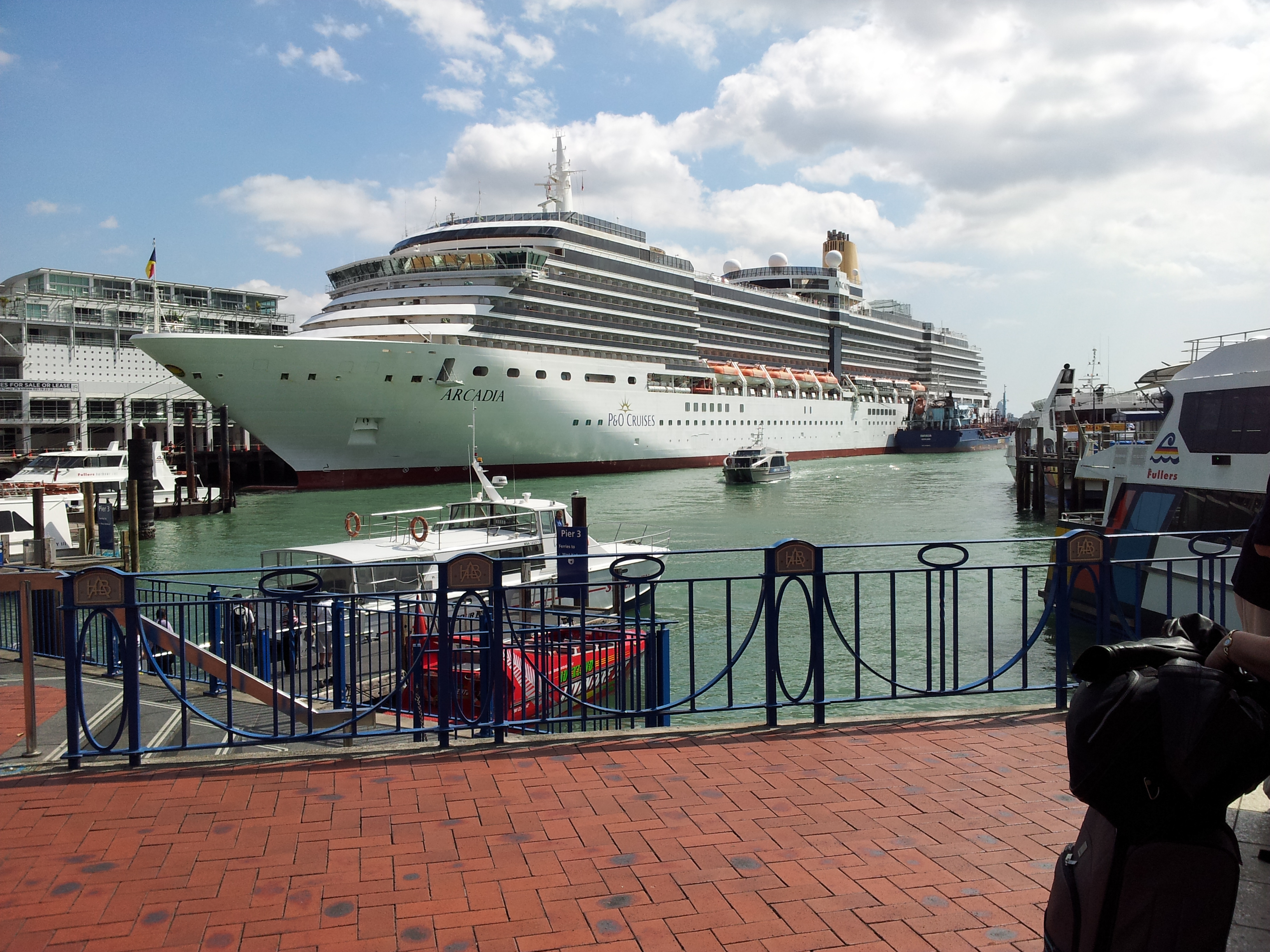
We were staying at the Hilton and advised there would be a large cruise liner berthing next to the hotel.  There was the Arcadia.

2013-03-08 11.51.48

This is the view from the other side of the hotel.  Where our room was, we could almost walk onto the aft end of the ship.

We were also told this was a rather extraordinary day because there were two cruise ships in the port. particularly because it was near the end of the cruising season.

The other ship was two berths along, the Sun Princess.

2013-03-08 11.56.17

Not as big as the Arcadia, up close it was still very impressive.