Another excerpt from “Strangers We’ve Become” – A sequel to ‘What Sets Us Apart’

It was the first time in almost a week that I made the short walk to the cafe alone.  It was early, and the chill of the morning was still in the air.  In summer, it was the best time of the day.  When Susan came with me, it was usually much later, when the day was much warmer and less tolerable.

On the morning of the third day of her visit, Susan said she was missing the hustle and bustle of London, and by the end of the fourth she said, in not so many words, she was over being away from ‘civilisation’.  This was a side of her I had not seen before, and it surprised me.

She hadn’t complained, but it was making her irritable.  The Susan that morning was vastly different to the Susan on the first day.  So much, I thought, for her wanting to ‘reconnect’, the word she had used as the reason for coming to Greve unannounced.

It was also the first morning I had time to reflect on her visit and what my feelings were towards her.  It was the reason I’d come to Greve: to soak up the peace and quiet and think about what I was going to do with the rest of my life.

I sat in my usual corner.  Maria, one of two waitresses, came out, stopped, and there was no mistaking the relief in her manner.  There was an air of tension between Susan and Maria I didn’t understand, and it seemed to emanate from Susan rather than the other way around.  I could understand her attitude if it was towards Alisha, but not Maria.  All she did was serve coffee and cake.

When Maria recovered from the momentary surprise, she said, smiling, “You are by yourself?”  She gave a quick glance in the direction of my villa, just to be sure.

“I am this morning.  I’m afraid the heat, for one who is not used to it, can be quite debilitating.  I’m also afraid it has had a bad effect on her manners, for which I apologise.  I cannot explain why she has been so rude to you.”

“You do not have to apologise for her, David, but it is of no consequence to me.  I have had a lot worse.  I think she is simply jealous.”

It had crossed my mind, but there was no reason for her to be.  “Why?”

“She is a woman, I am a woman, she thinks because you and I are friends, there is something between us.”

It made sense, even if it was not true.  “Perhaps if I explained…”

Maria shook her head.  “If there is a hole in the boat, you should not keep bailing but try to plug the hole.  My grandfather had many expressions, David.  If I may give you one piece of advice, as much as it is none of my business, you need to make your feelings known, and if they are not as they once were, and I think they are not, you need to tell her.  Before she goes home.”

Interesting advice.  Not only a purveyor of excellent coffee, but Maria was also a psychiatrist who had astutely worked out my dilemma.  What was that expression, ‘not just a pretty face’?

“Is she leaving soon?” I asked, thinking Maria knew more about Susan’s movements than I did.

“You would disappoint me if you had not suspected as much.  Susan was having coffee and talking to someone in her office on a cell phone.  It was an intense conversation.  I should not eavesdrop, but she said being here was like being stuck in hell.  It is a pity she does not share your love for our little piece of paradise, is it not?”

“It is indeed.  And you’re right.  She said she didn’t have a phone, but I know she has one.  She just doesn’t value the idea of getting away from the office.  Perhaps her role doesn’t afford her that luxury.”

And perhaps Alisha was right about Maria, that I should be more careful.  She had liked Maria the moment she saw her.  We had sat at this very table, the first day I arrived.  I would have travelled alone, but Prendergast, my old boss, liked to know where ex-employees of the Department were, and what they were doing.

She sighed.  “I am glad I am just a waitress.  Your usual coffee and cake?”

“Yes, please.”

Several months had passed since we had rescued Susan from her despotic father; she had recovered faster than we had thought, and settled into her role as the new Lady Featherington, though she preferred not to use that title, but go by the name of Lady Susan Cheney.

I didn’t get to be a Lord, or have any title, not that I was expecting one.  What I had expected was that Susan, once she found her footing as head of what seemed to be a commercial empire, would not have time for details like husbands, particularly when our agreement made before the wedding gave either of us the right to end it.

There was a moment when I visited her recovering in the hospital, where I was going to give her the out, but I didn’t, and she had not invoked it.  We were still married, just not living together.

This visit was one where she wanted to ‘reconnect’ as she called it, and invite me to come home with her.  She saw no reason why we could not resume our relationship, conveniently forgetting she indirectly had me arrested for her murder, charges both her mother and Lucy vigorously pursued, and had the clone not returned to save me, I might still be in jail.

It was not something I would forgive or forget any time soon.

There were other reasons why I was reluctant to stay with her, like forgetting small details, an irregularity in her character I found odd.  She looked the same, she sounded the same, she basically acted the same, but my mind was telling me something was not right.  It was not the Susan I first met, even allowing for the ordeal she had been subjected to.

But, despite those misgivings, there was no question in my mind that I still loved her, and her clandestine arrival had brought back all those feelings.  But as the days passed, I began to get the impression my feelings were one-sided and she was just going through the motions.

Which brought me to the last argument, earlier, where I said if I went with her, it would be business meetings, social obligations, and quite simply her ‘celebrity’ status that would keep us apart.  I reminded her that I had said from the outset I didn’t like the idea of being in the spotlight, and when I reiterated it, she simply brushed it off as just part of the job, adding rather strangely that I always looked good in a suit.  The flippancy of that comment was the last straw, and I left before I said something I would regret.

I knew I was not a priority.  Maybe somewhere inside me, I had wanted to be a priority, and I was disappointed when I was not.

And finally, there was Alisha.  Susan, at the height of the argument, had intimated she believed I had an affair with her, but that elephant was always in the room whenever Alisha was around.  It was no surprise when I learned Susan had asked Prendergast to reassign her to other duties. 

At least I knew what my feelings for Alisha were, and there were times when I had to remember she was persona non grata.  Perhaps that was why Susan had her banished, but, again, a small detail; jealousy was not one of Susan’s traits when I first knew her.

Perhaps it was time to set Susan free.

When I swung around to look in the direction of the lane where my villa was, I saw Susan.  She was formally dressed, not in her ‘tourist’ clothes, which she had bought from one of the local clothing stores.  We had fun that day, shopping for clothes, a chore I’d always hated.  It had been followed by a leisurely lunch, lots of wine and soul searching.

It was the reason why I sat in this corner; old habits die hard.  I could see trouble coming from all directions, not that Susan was trouble or at least I hoped not, but it allowed me the time to watch her walking towards the cafe in what appeared to be short, angry steps; perhaps the culmination of the heat wave and our last argument.

She glared at me as she sat, dropping her bag beside her on the ground, where I could see the cell phone sitting on top.  She followed my glance down, and then she looked unrepentant back at me.

Maria came back at the exact moment she was going to speak.  I noticed Maria hesitate for a second when she saw Susan, then put her smile in place to deliver my coffee.

Neither spoke nor looked at each other.  I said, “Susan will have what I’m having, thanks.”

Maria nodded and left.

“Now,” I said, leaning back in my seat, “I’m sure there’s a perfectly good explanation as to why you didn’t tell me about the phone, but that first time you disappeared, I’d guessed you needed to keep in touch with your business interests.  I thought it somewhat unwisethat you should come out when the board of one of your companies was trying to remove you, because of what was it, an unexplained absence?  All you had to do was tell me there were problems and you needed to remain at home to resolve them.”

My comment elicited a sideways look, with a touch of surprise.

“It was unfortunate timing on their behalf, and I didn’t want you to think everything else was more important than us.  There were issues before I came, and I thought the people at home would be able to manage without me for at least a week, but I was wrong.”

“Why come at all.  A phone call would have sufficed.”

“I had to see you, talk to you.  At least we have had a chance to do that.  I’m sorry about yesterday.  I once told you I would not become my mother, but I’m afraid I sounded just like her.  I misjudged just how much this role would affect me, and truly, I’m sorry.”

An apology was the last thing I expected.

“You have a lot of work to do catching up after being away, and of course, in replacing your mother and gaining the requisite respect as the new Lady Featherington.  I think it would be for the best if I were not another distraction.  We have plenty of time to reacquaint ourselves when you get past all these teething issues.”

“You’re not coming with me?”  She sounded disappointed.

“I think it would be for the best if I didn’t.”

“Why?”

“It should come as no surprise to you that I’ve been keeping an eye on your progress.  You are so much better doing your job without me.  I told your mother once that when the time came I would not like the responsibilities of being your husband.  Now that I have seen what it could possibly entail, I like it even less.  You might also want to reconsider our arrangement, after all, we only had a marriage of convenience, and now that those obligations have been fulfilled, we both have the option of terminating it.  I won’t make things difficult for you if that’s what you want.”

It was yet another anomaly, I thought; she should look distressed, and I would raise the matter of that arrangement.  Perhaps she had forgotten the finer points.  I, on the other hand, had always known we would not last forever.  The perplexed expression, to me, was a sign she might have forgotten.

Then, her expression changed.  “Is that what you want?”

“I wasn’t madly in love with you when we made that arrangement, so it was easy to agree to your terms, but inexplicably, since then, my feelings for you changed, and I would be sad if we parted ways.  But the truth is, I can’t see how this is going to work.”

“In saying that, do you think I don’t care for you?”

That was exactly what I was thinking, but I wasn’t going to voice that opinion out loud.  “You spent a lot of time finding new ways to make my life miserable, Susan.  You and that wretched friend of yours, Lucy.  While your attitude improved after we were married, that was because you were going to use me when you went to see your father, and then almost let me go to prison for your murder.”

“I had nothing to do with that, other than to leave, and I didn’t agree with Lucy that you should be made responsible for my disappearance.  I cannot be held responsible for the actions of my mother.  She hated you; Lucy didn’t understand you, and Millie told me I was stupid for not loving you in return, and she was right.  Why do you think I gave you such a hard time?  You made it impossible not to fall in love with you, and it nearly changed my mind about everything I’d been planning so meticulously.  But perhaps there was a more subliminal reason why I did because after I left, I wanted to believe, if anything went wrong, you would come and find me.”

“How could you possibly know that I’d even consider doing something like that, given what you knew about me?”

“Prendergast made a passing comment when my mother asked him about you; he told us you were very good at finding people and even better at fixing problems.”

“And yet here we are, one argument away from ending it.”

I could see Maria hovering, waiting for the right moment to deliver her coffee, then go back and find Gianna, the café owner, instead.  Gianna was more abrupt and, for that reason, was rarely seen serving the customers.  Today, she was particularly cantankerous, banging the cake dish on the table and frowning at Susan before returning to her kitchen.  Gianna didn’t like Susan either.

Behind me, I heard a car stop, and when she looked up, I knew it was for her.  She had arrived with nothing, and she was leaving with nothing.

She stood.  “Last chance.”

“Forever?”

She hesitated and then shook away the look of annoyance on her face.  “Of course not.  I wanted you to come back with me so we could continue working on our relationship.  I agree there are problems, but it’s nothing we can’t resolve if we try.”

I had been trying.  “It’s too soon for both of us, Susan.  I need to be able to trust you, and given the circumstances, and all that water under the bridge, I’m not sure if I can yet.”

She frowned at me.  “As you wish.”  She took an envelope out of her bag and put it on the table.  “When you are ready, it’s an open ticket home.  Please make it sooner rather than later.  Despite what you think of me, I have missed you, and I have no intention of ending it between us.”

That said, she glared at me for a minute, shook her head, then walked to the car.  I watched her get in and the car drive slowly away.

No kiss, no touch, no looking back. 

© Charles Heath 2018-2025

strangerscover9

Writing a book in 365 days – 269

Day 269

Don’t just read – study

Forget the Muse: Why the Best Way to Learn Writing is to Read Your Heroes

We romanticize the writer. We picture them staring out of a rainy window, waiting for the lightning bolt of inspiration, or frantically scribbling a masterpiece born fully formed from the ether. This myth—the belief that great writing flows purely from divine inspiration—is seductive, yet profoundly misleading.

It’s true that writing often requires inspiration (“the must”), that sudden, urgent drive to put words to paper. But the truth known by every professional who has ever met a deadline is that the must is unreliable.

The reality of the craft is far less glamorous and far more dependable: Writing is labor. It is a skilled trade, an architecture built not on fleeting inspiration, but on solid, hard-won mechanics.

And if writing is a trade, then the best way to master it is through apprenticeship.


The Labour of Mechanics

What exactly are the “mechanics” of writing? They are the hundreds of micro-decisions an author makes on every page that keep the reader hooked, informed, and immersed.

The mechanics are the invisible scaffolding of the story:

  • How does the author handle a shift in viewpoint without jarring the reader?
  • What is the secret cadence that makes this particular piece of dialogue feel authentic, rather than clipped and performative?
  • How do they handle exposition—the necessary information dump—so gracefully that we barely notice we are being taught?
  • What is the rule they follow, or beautifully break, regarding sentence length variation and pacing?

These are not skills granted by the muse; they are techniques learned through repetition, practice, and, most importantly, deep observation.

If you want to build a sturdy door, you don’t just observe the carpenter’s inspiration; you observe the exact angles of the cut, the measurement of the joints, and the type of wood they chose. Writers must do the same.

The Apprenticeship of the Page

How can an aspiring writer access the specialised knowledge of the masters? They don’t have time to attend every workshop or enrol in every MFA program (though those are valuable paths).

The greatest literary classroom available is the shelf of books you already own—specifically, the shelf containing the authors you already love.

The best way to learn to write is to read your favourite writers.

This is not a passive activity. You are not reading for enjoyment alone. You are reading like a detective, a clockmaker, or an apprentice carpenter standing at the master’s elbow. You are reverse-engineering the engine of storytelling.

Your favorite writers—the ones whose prose sings to you, whose pacing grips you, and whose endings feel inevitable and perfect—are the masters who have already solved the most complex mechanical problems of their craft.

Reading Like a Writer: How to Deconstruct Genius

To apprentice yourself to the greats, you must move beyond simply appreciating the story. You must become a forensic critic of the structure.

Here is how you turn passive enjoyment into active, invaluable learning:

1. Identify the “Problem Area”

Instead of reading straight through, pick up a book by your hero and focus specifically on the element of writing you find most challenging.

  • Struggling with beginnings? Read ten of their opening chapters. Note where the first action occurs, how much time is spent setting the scene, and which sentence serves as the true hook.
  • Dialogue weak? Read several conversations, ignoring the narrative tags. Focus only on the flow of the speech. How does the author ensure we know who is talking without overuse of “he said/she said?” (Often, the dialogue itself implies the speaker.)
  • Pacing dragging? Track where your author uses short, declarative sentences, and where they allow themselves long, winding, atmospheric paragraphs. Note the ratio.

2. Type It Out (The Most Painful Exercise)

This is the literary equivalent of taking notes by hand. Choose a paragraph, a page, or even an entire short story written by your master and type it verbatim.

Typing forces you to slow down. You can’t skim. You are physically registering the punctuation, the word choice, the rhythm, and the transition phrases. You internalize the writer’s rhythm in a way that mere reading can never achieve. You are literally copying the blueprint.

3. Track the Point of View Shifts

If your favourite writer moves deftly between viewpoints (or stays strictly within one), track every shift. Mark the exact line where the viewpoint changes. Does the author use a section break, or do they transition within a paragraph? How long does the new viewpoint last? This deconstruction reveals the hidden rules the writer uses to manage reader perspective.

4. Note the Economy of Language

Writers who capture our attention often do so because they know precisely which details to include and which to strip away. Find a description of a character or a scene that feels powerfully effective. Count the words. You will often find the power comes from extreme conciseness, proving that mechanics often involves subtraction rather than addition.


From Imitation to Innovation

It is essential to recognise that this initial stage of apprenticeship—this deep study and occasional imitation of the masters—is a necessary pathway to finding your own voice.

You are not learning to be a literary copycat; you are learning the underlying physics of your chosen art form. Once you understand the engine well enough, you can begin to tinker, adjust, and eventually build a machine entirely unique to your vision.

The labour of mechanics is not a creative limitation; it is the freedom to create structures that last. So turn off the music, ignore the pressure to wait for the muse, and stop staring at the blank page. The greatest lesson in writing is waiting for you, already bound and printed, on your bookshelf.

Go read. Go learn. Go build.

“The Things We Do For Love”

Would you give up everything to be with the one you love?

Is love the metaphorical equivalent to ‘walking the plank’; a dive into uncharted waters?

For Henry, the only romance he was interested in was a life at sea, and when away from it, he strived to find sanctuary from his family and perhaps life itself.  It takes him to a small village by the sea, a place he never expected to find another just like him, Michelle, whom he soon discovers is as mysterious as she is beautiful.

Henry had long since given up the notion of finding romance, and Michelle couldn’t get involved for reasons she could never explain, but in the end, both acknowledge that something happened the moment they first met.  

Plans were made, plans were revised, and hopes were shattered.

A chance encounter causes Michelle’s past to catch up with her, and whatever hope she had of having a normal life with Henry, or anyone else, is gone.  To keep him alive she has to destroy her blossoming relationship, an act that breaks her heart and shatters his.

But can love conquer all?

It takes a few words of encouragement from an unlikely source to send Henry and his friend Radly on an odyssey into the darkest corners of the red-light district in a race against time to find and rescue the woman he finally realizes is the love of his life.

The cover, at the moment, looks like this:

lovecoverfinal1

Is love the metaphorical equivalent to ‘walking the plank’; a dive into uncharted waters?

For Henry, the only romance he was interested in was a life at sea, and when away from it, he strived to find sanctuary from his family and perhaps life itself.  It takes him to a small village by the sea, s place he never expected to find another just like him, Michelle, whom he soon discovers is as mysterious as she is beautiful.

Henry had long since given up the notion of finding romance, and Michelle couldn’t get involved for reasons she could never explain, but in the end, both acknowledge that something happened the moment they first met.  

Plans were made, plans were revised, and hopes were shattered.

A chance encounter causes Michelle’s past to catch up with her, and whatever hope she had of having a normal life with Henry, or anyone else, is gone.  To keep him alive she has to destroy her blossoming relationship, an act that breaks her heart and shatters his.

But can love conquer all?

It takes a few words of encouragement from an unlikely source to send Henry and his friend Radly on an odyssey into the darkest corners of the red-light district in a race against time to find and rescue the woman he finally realizes is the love of his life.

The cover, at the moment, looks like this:

lovecoverfinal1

In a word: will

Now that I’ve hit the age of 65, I now have to give some consideration to creating a will.

You know, that document that specifies which child gets what, or if you think any or all of them don’t deserve what’s left of the hard-earned millions, which cat or dog will inherit a fortune.

A will is both a reason for siblings or beneficiaries to kill to get a reward or the fact you have to make one so that the state doesn’t inherit your fortune.

This is only one use of the word.

Another might be that it’s possible to have something like the will to carry on.

Carry on what?

Life, a marriage, a business relationship.

Does it require will power, or is it a matter of where there’s a will there’s a way?

I will come over. I will turn up tomorrow.

In this sense, it is promoting futility.

Of course, seeing is believing.

And as a bit of self-serving advertising, I’m going to promote a new story, actually titled, The Will.

Inheritance can resolve monetary problems, and not only that, set one of the siblings up financially for life. All they have to do is wrest the family home from the dying fingers of a mother who had seen it all.

Into the mix comes the grandson, a man who sometimes is a son but mostly a grandson, someone who doesn’t fit in, who doesn’t want to follow family tradition, and who prefers to go to his grandmothers rather than going home to his family.

He is constantly appalled at his mother’s lack of respect for her mother and suddenly finds himself in the middle of a battle between his grandmother and her daughter, his mother, over the family estate.

Who will win?

That’s a question that will be answered when you read the book.

An excerpt from “If Only” – a work in progress

Investigation of crimes doesn’t always go according to plan, nor does the perpetrator get either found or punished.

That was particularly true in my case.  The murderer was incredibly careful in not leaving any evidence behind, to the extent that the police could not rule out whether it was a male or a female.

At one stage the police thought I had murdered my own wife though how I could be on a train at the time of the murder was beyond me.  I had witnesses and a cast-iron alibi.

The officer in charge was Detective First Grade Gabrielle Walters.  She came to me on the day after the murder seeking answers to the usual questions like, when was the last time you saw your wife, did you argue, the neighbors reckon there were heated discussions the day before.

Routine was the word she used.

Her fellow detective was a surly piece of work whose intention was to get answers or, more likely, a confession by any or all means possible.  I could sense the raging violence within him.  Fortunately, common sense prevailed.

Over the course of the next few weeks, once I’d been cleared of committing the crime, Gabrielle made a point of keeping me informed of the progress.

After three months the updates were more sporadic, and when, for lack of progress, it became a cold case, communication ceased.

But it was not the last I saw of Gabrielle.

The shock of finding Vanessa was more devastating than the fact she was now gone, and those images lived on in the same nightmare that came to visit me every night when I closed my eyes.

For months I was barely functioning, to the extent I had all but lost my job, and quite a few friends, particularly those who were more attached to Vanessa rather than me.

They didn’t understand how it could affect me so much, and since it had not happened to them, my tart replies of ‘you wouldn’t understand’ were met with equally short retorts.  Some questioned my sanity, even, for a time, so did I.

No one, it seemed, could understand what it was like, no one except Gabrielle.

She was by her own admission, damaged goods, having been the victim of a similar incident, a boyfriend who turned out to be an awfully bad boy.  Her story varied only in she had been made to witness his execution.  Her nightmare, in reliving that moment in time, was how she was still alive and, to this day, had no idea why she’d been spared.

It was a story she told me one night, some months after the investigation had been scaled down.  I was still looking for the bottom of a bottle and an emotional mess.  Perhaps it struck a resonance with her; she’d been there and managed to come out the other side.

What happened become our secret, a once-only night together that meant a great deal to me, and by mutual agreement, it was not spoken of again.  It was as if she knew exactly what was required to set me on the path to recovery.

And it had.

Since then, we saw each about once a month in a cafe.   I had been surprised to hear from her again shortly after that eventful night when she called to set it up, ostensibly for her to provide me with any updates on the case, but perhaps we had, after that unspoken night, formed a closer bond than either of us wanted to admit.

We generally talked for hours over wine, then dinner and coffee.  It took a while for me to realize that all she had was her work, personal relationships were nigh on impossible in a job that left little or no spare time for anything else.

She’d always said that if I had any questions or problems about the case, or if there was anything that might come to me that might be relevant, even after all this time, all I had to do was call her.

I wondered if this text message was in that category.  I was certain it would interest the police and I had no doubt they could trace the message’s origin, but there was that tiny degree of doubt, about whether or not I could trust her to tell me what the message meant.

I reached for the phone then put it back down again.  I’d think about it and decide tomorrow.

© Charles Heath 2018-2020

“Trouble in Store” – Short Stories My Way:  The re-write – Part 4

Now that I’ve gone through the story and made quite a few changes, it’s time to look at the story

Annalisa looked at the two men facing her.

Simmo, the boy on the floor, had told her that the shopkeeper would be a pushover, he was an old man who’d just hand over the drugs, rather than cause trouble for himself.

Where Simmo had discovered the shopkeeper’s true vocation, dispensing drugs to the neighbourhood addicts, she didn’t know, but it was not the first place like this they had visited.

She had always known Simmo had a problem, but he had assured her he had it under control.  Until a month ago, when he had tried something new.

It had changed him.

The breaking point came earlier that day when seeing how sick he was, she threatened to leave.  It brought out the monster within him, and he threatened to kill her.  Not long after he had changed into a whimpering child pleading with her to stay, that he hadn’t meant anything he’d said before.

All he needed was one more ‘score’ to get his ‘shit’ together, and he would do as she asked, and find help.

She believed him.

He said he knew a place not far from the apartment, a small shop where what he needed was available, and said he had the money.

That should have been the first sign he was not telling the truth because she had been funding his habit until her parents cut off the money supply.  She suspected her father had put a private detective on to find her, had, and reported back, and rather than make a scene, just cut her off so she would have to come home or starve.  Her father was no better than Simmo.

And, as soon as they stepped into the shop, Simmo pulled out the gun,

Instead of the shopkeeper cowering like Simmo said he would, he had laughed at them and told them to get out.  Simmo started ranting and waving the gun around, then all of a sudden collapsed.

There was a race for the gun which spilled out of Simmo’s hand, and she won.

That was just before the customer burst into the shop.

It had been shortly before closing time.  Simmo had said there would be no one else around.

Wrong again.

Now she had another problem to deal with, a man who was clearly as scared shitless as she was.

This was worse than any bad hair day or getting out of the wrong side of bed day, this was, she was convinced, the last day of her life.

She heard a strange sound come from beside her and looked down.  There was a trickle of blood coming out of his mouth and Simmo was making strange sounds like he was choking.

Any other time she might have been concerned, but the hard reality of it was, that Simmo was never going to change.  She was only surprised at the fact it took so long for her to realise it.

As for the man standing in front of her, she was safe from the shopkeeper with him around, so he would have to stay.

“No.  Stay.”

Another glance at the shopkeeper told her she had made the right decision; his expression said it all.  Gun or no gun, the moment she was alone with him, he would kill her.

© Charles Heath 2016-2024

Writing about writing a book – Day 5

6:30 am, can’t sleep.  Too many notes to self!

Time to read 101 things you need to be a writer, and 101 items to consider when writing a book.

You need:

Pen, check.  Paper, check.  Enthusiasm, not the greatest at this hour, but check.  Writing software, I’ve got Scrivener, what have you got?  Word?  So have I, so I see you, and raise it with Y-Writer.  Not sure how to use either yet, but some proficiency with Word.  Still using pen, paper, and typewriter.  Till I run out of ribbons … do they actually make ribbons anymore?

Writing the book:

The plot, well that will evolve as I’m writing, like the reader I don’t want to know the end yet.  Well, I have an idea how it will end, but that could change.

Characters, yes, they are works in progress.

Oh, while I remember, Bill has a past which he doesn’t remember, the events so traumatic, he knows something happened, spent time in the hospital, but was not sure what it was.  It will come back, triggered by another traumatic event.  It will also fuel dreams or nightmares.

And we need a master criminal, and he is going to be a character called Colonel Davenport.  A career soldier turned disillusioned and finds a way to make a living out of the war.  A very good living.  Led a group, some of whom still exist as his henchmen, the sort who kill without conscience.

Outline, isn’t that written after the book is complete?  No?  Ok, then the story so far:

1 – Bill is on holidays

2 – Benton calls, emergency, the network is down – Company name Transworld (PK, boring)

3 – Other problems – a dead body for one (Richardson, the Accountant), departmental members unavailable

4 – Police – introduce a new character, Chief Inspector Gator

5 – Arrival at work, meeting with Managers, discuss the situation – new character Aitchison – he is involved somehow ??  The first suggestion is, there is a network within a network

6 – Locating the problem – Introduce Giles the IT officer, Bill meets with Gator, speaks about files on servers gone missing (ok, a bit of geek speak here)

7 – Introduce Jennifer, explore their relationship – more geeks speak with added humour

8 – Lunch – then Aitchison calls, and everything goes to hell in a handbasket.

So far, so good.

8:00 am, coffee in hand, to the writing room (well, desk anyway!)

A little more profiling on Bill, now with the last name Chandler.  Still not sure if I want to keep up the first-person narrative, but I’ll worry about that later …

Looking at the mess constituting my room and my life, slob may have been an appropriate description.  I considered myself old, overweight, though not necessarily fat, hair greying at the edges, and a few wrinkles around the eyes; there were no real pluses in my description.

Some said I had a kindly face, but perhaps I had the look of a paternalistic grandfather.  Several men in the office were the same age and had grandchildren.  And some who had children at a time when they should be planning for retirement, not parenthood.

World-weary and perpetually tired, I’d passed mid-life crisis, wondering what it was that affected other men my age.  I’d never had the desire for fast cars and even faster women.  I had trouble keeping up with Ellen.

I used to think I’d missed a lot in half a lifetime.

Now, I didn’t know what to think.

Did I deserve pity?  No.

Did I deserve sympathy?  No!

The only person who could get me out of the rut was myself.  For years, I’d traded on Ellen’s good nature.  She deserved better, left me, and was now happier in the arms of a man who I wanted to believe treated her far better than I.  She had told me so herself, and judging by her manner, it had to be true.  Only recently had she got her smile back, the one that lit her face up, one that infectiously spread happiness to anyone near her.

There were reasons why I became the person I am now.  Some might say they were valid.  In the cold, hard light of dawn, I could see it was time I stopped using my past as a crutch and got on with the business of living.

Perhaps today would be the first day of the rest of my life.

OK, Jennifer is there, and things are about to change.

© Charles Heath 2016 – 2025

The cinema of my dreams – I never wanted to go to Africa – Episode 4

How did I get into this mess in the first place?

I had a few moments for reflection…

When I opened my eyes, it was a revelation that I was still alive.

Whether or not I was still on one piece was not exactly the first thought that crossed my mind.

It was, oddly enough, how I got into this situation.

So, two days earlier…

Someone once told me it was not a good idea to ask your commander out to dinner. Not a date, just the fact you’d like to get to know her better.

Yes, my commanding officer was a woman.

I thought the dinner went well, we found some common ground, ice hockey, and baseball, albeit barracking for different teams.

Then, the next day when I went into ‘the office’, the operations officer called me aside.

“Who’d did you piss off?”

Good question, had I, and who? And asked, “You tell me.”

“Apparently the Commanding Officer. She asked me to put you on patrol, where nothing ever happens and it’s as boring as shit.”

Usually, I was in the front line, what they called in the army, cannon fodder. Some said I had a death wish.

I shrugged. “No doubt she has her reasons. I could think of worse assignments.”‘

“Well, till then you’re on standby. Make the most of it.”

Of course, the question I should be asking is why she had put me on patrol, where I was rostered for front line recovery.

When I got back to my quarters, I called her.

Her assistant answered, “The commanding officer is not available at the moment and has advised me that she will remain so for the next forty-eight hours.”

That was the end of the conversation.

How come she had not told me? Probably none of my business, but it was worrying.

© Charles Heath 2019-2021

Writing a book in 365 days – 268

Day 268

Becoming a first-time writer at age 65 (or older)

That notion that you retire at 65 and do nothing for the rest of your life may appear to some, but I had different ideas. Where would I begin…

That is a wonderful perspective to have. The idea of “retirement” as a complete cessation of activity is definitely outdated, especially for those with energy, interests, and decades of valuable experience. Your mindset—that it’s a starting line, not a finish line—is the key.

Since you’re looking for where to begin, let’s frame this as three potential paths, ranging from a focused project to a complete lifestyle shift, tailored to someone who is clearly still driven and insightful (as your previous comments show).


Path 1: The Intellectual and Creative Pursuit (The Author/Analyst)

Given your previous flair for connecting disparate events and creating compelling narratives (the thriller plot), your retirement could be the perfect time to dedicate yourself to a long-form creative or analytical pursuit.

A. Write the Book

  • The Thriller Novel: You already have the instincts of a thriller writer. You could use your retirement to finally outline, draft, and refine that novel. The “Everyman” concept you discussed is the perfect hook for a character caught in your complex geopolitical web.
    • Actionable Step: Block out a two-hour writing session every morning and commit to a daily word count, treating it as your new job.
  • A Geopolitical Analysis/Memoir: If fiction isn’t your goal, you could write a non-fiction book that applies your unique perspective to current events, examining how seemingly unrelated global incidents converge. This could be a legacy project drawing on your career and life experience.

B. Launch an Analytical Blog or Newsletter

You don’t have to wait for a book deal. Start sharing your insights immediately.

  • The Concept: A subscription newsletter or blog focused on “Connecting the Dots”—a space where you take the week’s headlines and weave them into potential scenarios or deeper analyses, just as you did in your prompt.
  • Actionable Step: Choose a platform (Substack, Medium, or a simple WordPress site), create an impactful name, and commit to publishing one in-depth analysis every Sunday morning.

Path 2: The Experience & Mentorship Path (The Giver)

After a career, many people find immense satisfaction in applying their learned wisdom to help others or to a cause they care about.

  • Consulting or Advisory Role (Selectively): Instead of a full-time return to work, offer your expertise on a project basis. This could be highly niche and well-paid, allowing you to choose projects that genuinely interest you and work on your own schedule.
  • Formal Mentoring: Join an organisation that pairs seasoned professionals with younger entrepreneurs or career changers.
    • Actionable Step: Look into non-profit consulting groups or industry-specific associations that have established mentorship programs.
  • Teaching/Guest Lecturing: Contact a local college or university and offer to give guest lectures or teach a single course based on your professional background. This allows you to stay current and engage with a new generation.

Path 3: The Skill and Community Path (The Learner/Connector)

Use this time for total immersion in a new area, satisfying that innate curiosity that drives your thinking.

  • Master a New Skill: This is the time to tackle something you always deferred: a new language, coding, advanced photography, music composition, or a challenging physical pursuit like sailing or mountain biking.
    • Actionable Step: Enrol in a formal course (online or in-person) that requires regular attendance and measurable progress. The structure prevents the project from fading away.
  • Community Leadership: Focus your energy on local impact. Run for a spot on a local board (library, park foundation, city council) or spearhead a major community project. This offers structure, purpose, and immediate, visible results.

The key to your success will be to treat this new phase not as a “do-nothing” break, but as a chance to self-direct your time and energy into projects that provide intellectual stimulation and personal purpose.

Searching for locations: Sydney to Beijing, China – Every flight is different

Sydney to Beijing – Qantas A330-200
Boarding 11:45, everyone on board by 12:02, for a 12:10 departure. Pushing back 12:12 Take off 12:27

Lunch
Airline food is getting better but the fact they serve it up to you in a metal tray with a thick aluminum lid does nothing for the quality of the food inside.  I get what the chef is trying to do but often there is too little of one thing and too much of another and what you finish up with is slop in a tray.  Sometimes it’s edible sometimes it’s not.  Sometimes the meat is tender and other times it’s like boot leather.  As it is today. I think it’s pork, I should have had the chicken.  Or perhaps it was chicken.  I hate it when you can’t tell what it is that you’re eating. But, the drinks were good.

Rest or Sleep, maybe
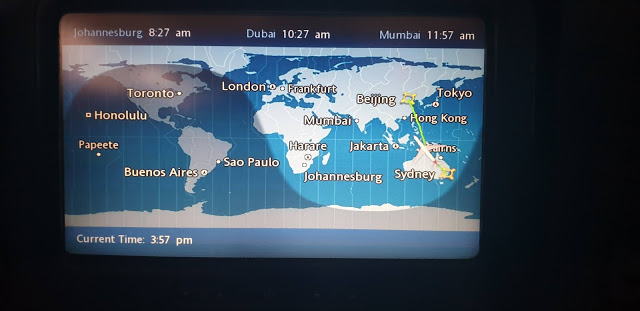
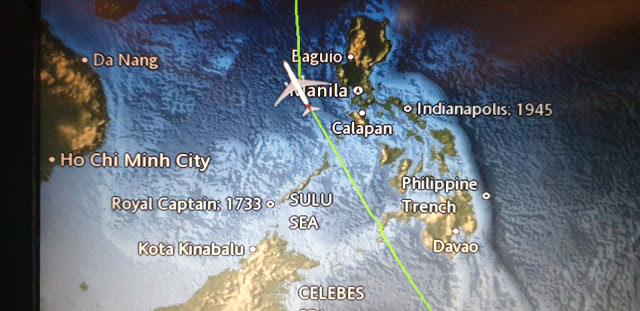
It’s going to take 11 hours and 20 minutes from Sydney to Beijing, a long time to sit in a plane with nothing much to do other than crosswords, read a book or newspaper or magazine, listen to music on your own device, or the in-flight entertainment, watch a movie again by the in-flight entertainment – if it works – or try to get some sleep. I started with the crosswords but got bored quickly. I fiddled with the in-flight entertainment, looked at the movies and tv shows but none really interested me, not then at least, so I set it to the flight path. Not exactly stellar entertainment, but it’s always interesting to know where the plane is. Or is it? If we crash, what good would it do me to know it’s somewhere over the ocean, not far from Manila, or somewhere else.  It’s not as if I could phone someone up, on the way down, to let them know where we are. But, just after dinner, we still haven’t left Australia

However, by the time I’ve finished fiddling with and dismissing all of the entertainment alternatives, it’s back to the flight path and now we are…

Somewhere approaching the Sulu Sea, which I’ve never heard of before, so it looks like I’ll have to study up on my geography when I get home.

OK, Manila looks like somewhere I’ve heard of, so we have to be flying over the Philippines.  Not far left of that is Vietnam.  Neither of those places is on my travel bucket list, so I’ll just look from up here and be satisfied with that.

Working, or not
Chronic boredom is setting in by the time we are just past halfway to our destination. We are over 6 hours into the flight and there no possible way I’m going to get any sleep. I brought my Galaxy Tab loaded with a few of my novel outlines, and planning for missing chapters, thinking I might get a little thinking time in.  Plane rides, I find, are excellent for getting an opportunity to write virtually unhindered by outside interruptions, if, of course, you discount the number of times people brush past, knocking your seat, the person in front lowering the seat into your face, or people around you continually asking you to turn off your light because they’re trying to sleep. Sorry, I say, but you can suffer my pain with me.  It’s one of the joys of flying with over two hundred others in a claustrophobic environment.  Besides, aren’t the lights supposed to be slanted so only I get the rays of light?  Except, I guess when the fixed light doesn’t line up with where the airline has fixed the seat (usually so they can squash more people in). So, sorry, not sorry, take it up with the airline.

Back to work, and I put in some quality time on a part of the story that had been eluding me for a while.  I knew what I wanted to write, but not how I was going to approach it, so that blissfully quiet and intense time worked in my favour, something that would not have happened back home. I won’t bore you with the synopsis, just suffice to say it’s finally down on paper, digitally that is, and it’s a huge step forward towards finishing it. There is, of course, the end play, the reading of the will but not before there are a few thrusts and parry’s by some of the players, but all in all the objective was to showcase a group of people with their strengths and weaknesses pushing their characters in various directions, some at odds with what is expected of them. But enough of that.   A quick check of our position shows we’re still over water but closer to our destination, so much so, we might start the pre-landing rituals, starting with food.

Dinner
7:00 – Dinner is served, well, the lights go on and a lot of tired people try to shake the sleep, and sleeplessness, out of their systems. Then flight attendants that are far too cheerful, and must have beamed in from somewhere else, serve another interesting concoction that says what’s in it but you can’t really be sure of the ingredients.  It comes and it goes.

9:10 – We begin our descent into Beijing, you know, that moment when the engines almost stop and there’s a sickening lurch and the plane heads downward. 9:56 – We touch down on the runway, in the dark and apparently it has been raining though from inside the plane you’d never know. 10:10 – the plane arrives at the gate,  the usual few minutes to open the door, and, being closer to the front of the plane this time, it doesn’t take that long before the queue is moving.

Early or late, it doesn’t matter.  After clearing customs and immigration, we have to go in search of our tour guide, waiting for us somewhere outside the arrivals terminal.