In a word: Nobody

This is sometimes how we must feel when overlooked or ignored, like a nobody.

And some people will treat you like a nobody, i.e. someone who is just not important.

That’s just one use of the word.

Another might be…

Who did that to your room?

‘Nobody’ is the plaintiff’s reply.  The infamous Mr Nobody.  We’ve never met him, but he’s always there.  And, what’s more, he seems to be able to be in more than one place at a time.

Then there’s that time when there’s nobody in the room, nobody agreed with me, hell, that happens all the time, and when I rang your phone nobody answered.

Nobody?  Was I expecting Mr Nobody to answer?  Surely the response should have been, ‘and you didn’t answer’.

Of course, let’s not delve too deep here, lest we might find out something we didn’t want to know.

I went to your house last night, but nobody was home.

How is it we refer to the people whom we know live in that house as ‘nobody’.  Shouldn’t we be saying, ‘none of you was at home’?

It seems nobody is one of those words we often use in vain.

An excerpt from “Amnesia”, a work in progress

I remembered a bang.

I remembered the car slewing sideways.

I remember another bang, and then it was lights out.

When I opened my eyes again, I saw the sky.

Or I could be underwater.

Everything was blurred.

I tried to focus but I couldn’t. My eyes were full of water.

What happened?

Why was I lying down?

Where was I?

I cast my mind back, trying to remember.

It was a blank.

What, when, who, why and where, are questions I should easily be able to answer. These are questions any normal person could answer.

I tried to move. Bad, bad mistake.

I did not realise the scream I heard was my own. Just before my body shut down.

“My God! What happened?”

I could hear, not see. I was moving, lying down, looking up.

I was blind. Everything was black.

“Car accident; hit a tree, sent the passenger flying through the windscreen. Pity to poor bastard didn’t get the message that seat belts save lives.”

Was I that poor bastard?

“Report?” A new voice, male, authoritative.

“Multiple lacerations, broken collar bone, broken arm in three places, both legs broken below the knees, one badly. We are not sure of internal injuries, but ruptured spleen, cracked ribs and pierced right lung are fairly evident, x-rays will confirm that and anything else.”

“What isn’t broken?”

“His neck.”

“Then I would have to say we are looking at the luckiest man on the planet.”

I heard the shuffling of pages.

“OR1 ready?”

“Yes. On standby since we were first advised.”

“Good. Let’s see if we can weave some magic.”

Magic.

It was the first word that popped into my head when I surfaced from the bottom of the lake. That first breath, after holding it for so long, was sublime, and, in reality, agonising.

Magic, because it seemed like I’d spent a long time underwater.

Or somewhere.

I tried to speak but couldn’t. The words were just in my head.

Was it night or was it day?

Was it hot, or was it cold?

Where was I?

Around me, it felt cool.

It was incredibly quiet. No noise except for the hissing of air through an air-conditioning vent. Or that was the sound of pure silence.  And with it the revelation that silence was not silent. It was noisy.

I didn’t try to move.

Instinctively, somehow, I knew not to.

A previous unpleasant experience?

I heard what sounded like a door opening, and noticeably quiet footsteps slowly came into the room. They stopped. I could hear breathing, slightly laboured, a sound I’d heard before.

My grandfather.

He had smoked all his life until he was diagnosed with lung cancer. But for years before that he had emphysema. The person in the room was on their way, down the same path. I could smell the smoke.

I wanted to tell whoever it was the hazards of smoking.

I couldn’t.

I heard a metallic clanging sound from the end of the bed. A moment later the clicking of a pen, then writing.

“You are in a hospital.” A female voice suddenly said. “You’ve been in a bad accident. You cannot talk, or move, all you can do, for the moment, is listen to me. I am a nurse. You have been here for 45 days and just came out of a medically induced coma. There is nothing to be afraid of.”

She had a very soothing voice.

Her fingers stroked the back of my hand.

“Everything is fine.”

Define fine, I thought. I wanted to ask her what ‘fine’ meant.

“Just count backwards from 10.”

Why?

I didn’t reach seven.

Over the next ten days, that voice became my lifeline to sanity. Every morning, I longed to hear it, if only for the few moments she was in the room, those few waking moments when I believed she, and someone else who never spoke, were doing tests. I knew it had to be someone else because I could smell the essence of lavender. My grandmother had worn a similar scent.

It rose above the disinfectant.

She was another doctor, not the one who had been there the day I arrived. Not the one who had used some ‘magic’ and kept me alive.

It was then, in those moments before she put me under again, that I thought, what if I was paralysed? It would explain a lot. A chill went through me.

The next morning, she was back.

“My name is Winifred. We don’t know what your name is, not yet. In a few days, you will be better, and you will be able to ask us questions. You were in an accident, and you were very severely injured, but I can assure you there will be no lasting damage.”

More tests, and then when I expected the lights to go out, they didn’t. Not for a few minutes more. This was how I would be integrated back into the world. A little bit at a time.

The next morning, she came later than usual, and I’d been awake for a few minutes. “You have bandages over your eyes and face. You had bad lacerations to your face, and glass in your eyes. We will know more when the bandages come off in a few days. Your face will take longer to heal. It was necessary to do some plastic surgery.”

Lacerations, glass in my eyes, car accidents, plastic surgery. By logical deduction, I knew I was the poor bastard thrown through the windscreen. It was a fleeting memory from the day I was admitted.

How could that happen?

That was the first of many startling revelations. The second was the fact I could not remember the crash. Equally shocking, in that same moment was the fact I could not remember before the crash either, or only vague memories after.

But the most shattering of all these revelations was the one where I realised, I could not remember my name.

I tried to calm down, sensing a rising panic.

I was just disoriented, I told myself. After 45 days in an induced coma, it had messed with my mind, and it was only a temporary lapse. Yes, that’s what it was, a temporary lapse. I will remember tomorrow. Or the next day.

Sleep was a blessed relief.

The next day I didn’t wake up feeling nauseous. I think they’d lowered the pain medication. I’d heard that morphine could have that effect. Then, how could I know that but not who I am?

Now I knew Winifred the nurse was preparing me for something unbelievably bad. She was upbeat, and soothing, giving me a new piece of information each morning. This morning, “You do not need to be afraid. Everything is going to be fine. The doctor tells me you are going to recover with little scarring. You will need some physiotherapy to recover from your physical injuries, but that’s in the future. We need to let you mend a little bit more before then.”

So, I was not going to be able to leap out of bed and walk out of the hospital any time soon. I don’t suppose I’d ever leapt out of bed, except as a young boy. I suspect I’d sustained a few broken bones. I guess learning to walk again was the least of my problems.

But there was something else. I picked it up in the timbre of her voice, a hesitation, or reluctance. It sent another chill through me.

This time I was left awake for an hour before she returned.

This time sleep was restless.

Scenes were playing in my mind, nothing I recognised, and nothing lasting longer than a glimpse. Me. Others, people I didn’t know. Or I knew them and couldn’t remember them.

Until they disappeared, slowly like the glowing dot in the centre of the computer screen, before finally fading to black.

The morning the bandages were to come off she came in early and woke me. I had another restless night, the images becoming clearer, but nothing recognisable.

“This morning the doctor will be removing the bandages over your eyes. Don’t expect an immediate effect. Your sight may come back quickly, or it may come back slowly, but we believe it will come back.”

I wanted to believe I was not expecting anything, but I was. It was human nature. I did not want to be blind as well as paralysed. I had to have at least one reason to live.

I dozed again until I felt a gentle hand on my shoulder. I could smell the lavender; the other doctor was back. And I knew the hand on my shoulder was Winifred’s. She told me not to be frightened.

I was amazed to realise at that moment, I wasn’t.

I heard the scissors cutting the bandages.

I felt the bandage being removed, and the pressure coming off my eyes. I could feel the pads covering both eyes.

Then a moment when nothing happened.

Then the pads are gently lifted and removed.

Nothing.

I blinked my eyes, once, twice. Nothing.

“Just hold on a moment,” Winifred said. A few seconds later I could feel a cool towel wiping my face, and then gently wiping my eyes. There was ointment or something else in them.

Then a flash. Well, not a flash, but like when a light is turned on and off. A moment later, it was brighter, not the inky blackness of before, but a shade of grey.

She wiped my eyes again.

I blinked a few more times, and then the light returned, and it was like looking through water, at distorted and blurry objects in the distance.

I blinked again, and she wiped my eyes again.

Blurry objects took shape. A face looking down on me, an elderly lady with a kindly face, surely Winifred, who was smiling. And on the opposite side of the bed, the doctor, a Chinese woman of indescribable beauty.

I nodded.

“You can see?”

I nodded again.

“Clearly?”

I nodded.

“Very good. We will just draw the curtains now. We don’t want to overdo it. Tomorrow we will be taking off the bandages on your face. Then, it will be the next milestone. Talking.”

I couldn’t wait.

When morning came, I found myself afraid. Winifred had mentioned scarring, there were bandages on my face. I knew, but wasn’t quite sure how I knew, I wasn’t the most handsome of men before the accident, so this might be an improvement.

I was not sure why I didn’t think it would be the case.

They came at mid-morning, the nurse, Winifred, and the doctor, the exquisite Chinese. She was the distraction, taking my mind off the reality of what I was about to see.

Another doctor came into the room before the bandages were removed, and he was introduced as the plastic surgeon who had ‘repaired’ the ravages of the accident. It had been no easy job, but, with a degree of egotism, he did say he was one of the best in the world.

I found it hard to believe, if he were, that he would be at a small country hospital.

“Now just remember, what you might see now is not how you will look in a few months.”

Warning enough.

The Chinese doctor started removing the bandages. She did it slowly and made sure it did not hurt. My skin was very tender, and I suspect still bruised, either from the accident or the surgery, I didn’t know.

Then it was done.

The plastic surgeon gave his work a thorough examination and seemed pleased with his work. “Coming along nicely,” he said to the other doctor. He issued some instructions on how to manage the skin, nodded to me, and I thanked him before he left.

I noticed Winifred had a mirror in her hand and was reticent in using it. “As I said,” she said noticing me looking at the mirror, “what you see now will not be the result. The doctor said it was going to heal with little scarring. You have been extremely fortunate he was available. Are you ready?”

I nodded.

She showed me.

I tried not to be reviled at the red and purple mess that used to be my face. At a guess, I would have to say he had to put it all back together again, but not knowing what I looked like before, I had no benchmark. All I had was a snippet of memory that told me I was not the tall, dark, and handsome type.

And I still could not talk. There was a reason, he had worked in that area too. Just breathing hurt. I think I would save up anything I had to say for another day. I could not even smile. Or frown. Or grimace.

“We’ll leave you for a while. Everyone needs a little time to get used to the change. I suspect you are not sure if there has been an improvement in last year’s model. Well, time will tell.”

A new face?

I could not remember the old one.

My memory still hadn’t returned.

©  Charles Heath  2024

“Trouble in Store” – Short Stories My Way:  The re-write – Part 5

Now that I’ve gone through the story and made quite a few changes, it’s time to look at the story

Alphonse, the shopkeeper, had stayed too long missing his opportunity to sell up and retire.

By the time he had been ready to call it a day, his wife had got sick with cancer, and it had taken all their retirement funds to keep her alive for another six months, when despite the doctor’s best efforts, she died.

There was nothing left, and unable to find a buyer for the business he could not just close the door and leave.

There were complications.

Like right now.

The sideline he’d basically forced his way into was always going to come back and bite him.  Selling a little weed on the side to the upper classes forced them to downsize after the global meltdown had turned into a range of products, the worst of which was ice, the result of taking too much very evident by the boy on the floor.

It was only a matter of time when one of the more edgy clients came in and started making demands with threats.  He was asked to sell low to get the customers hooked then forced to raise the price and stop supplying those who couldn’t pay.

It might be a good plan from their perspective but from his, at the coalface, it meant nothing but trouble.

Which is why he was now looking down the barrel of a gun.

This wasn’t the shopkeeper’s first hold-up.  In fact, over the years there had been a dozen.  But only one got reported to the police, and that was only because the robber was shot and killed.

He’d taken a bullet that night, too, which, from the police point of view, made him a concerned citizen simply defending himself.

The rest had been scared off by the double-barrel shotgun he kept under the counter for just such emergencies.

The young punk who came into the shop with his girlfriend had pulled out the pistol and told him if he reached for the shotgun he’d shoot him.  The kid looked unstable, and he’d backed away.

When the kid collapsed, he should have gone for the shotgun, but instead, he thought he could get to the gun before the girl realised what had happened.  She wasn’t an addict and clearly looked like she was only along for the ride.  Her look when the kid pulled out the gun told him she’d known nothing about her partner’s true intentions.

But, he wasn’t fast enough, and she had the gun pointing at him before he’d got past the counter.

From one pair of unpredictable hands to another.

Like the girl, he was just as surprised when the customer burst in the door, just before closing time.

The situation might have been salvageable before the customer came in the door, getting the girl to go along with the robbery being about money, but there was no denying what the kid on the floor’s problem was.

Damn.

He had to try and salvage the situation simply because there was a lot of money involved, and other people depending on him.  He looked at the boy, on the floor, then the girl.

“Listen to me, young lady, you would be well advised to let this man go as he suggests.  And, please put the gun down before someone gets hurt.  Your friend needs medical help, and I can call an ambulance.”

The girl switched her attention back to him.  “No one’s going anywhere, so just shut the hell up and let me think.”

The storekeeper glanced over at the customer.

He’d seen him come into the shop once or twice, probably lived in the neighbourhood, the sort who’d make a reliable witness, either a lawyer or an accountant.  Not like most of the residents just beyond the fringe of respectability.

If only he hadn’t burst into the shop when he did.

© Charles Heath 2016-2024

Writing about writing a book – Day 5 continues – Those annoying people called characters

Whilst it is always an idea to sit down and write and keep going, not worrying too much about the narrative, there’s always the problem of ideas about characters, and relationships that come back and need to be addressed.

I have issues with Jennifer in that we will need to know something about her, and need a little backstory.

Jennifer is the second most important character in this novel and one that has more talents than what my main character, or anyone else for that matter, thinks she has.  Of course, that is deliberate on her part for a number of reasons that will be introduced at the appropriate time.

But, at the start, all we will have to work with, is the introduction provided by the narrator.

It may go something like this:

Jennifer Pennington Smythe was, as you might expect, very English, very reserved, and very private.  She was the definitive ‘don’t judge a book by its cover’, and I was guilty, at first, of suspecting she had once been a schoolmistress due to the severity of dress, demeanour, and expression.

HR had sent her to me when I’d requested an IT Specialist, though of what particular discipline it was never divulged, neither by HR nor by her.  She arrived one morning, told me she was to ‘help resolve our technical difficulties’, moved into an office that had been used as a storeroom, and worked hard to prove her worthiness in the role.

My first attempt at conversation was rebuffed, and the second met with a very cold stare.  Everyone, including me, learned very quickly any other topic of conversation than work would be ignored.  At the time, it suited me; there was trouble in paradise, and I didn’t want anything more on my plate to deal with.

 …

So, what is this trouble?

There are three distinct stages of this relationship between the two most important characters, and it is the actions of one of the protagonists that bring them together.  This particular protagonist, of course, is the main character’s wife, a woman who is on the periphery for the period the novel covers, but a little background will be needed at some point before we reach this part of the narrative.

This now means that I will have to put together a backstory for Bill and his ex-wife, Ellen, not too much yet, but enough to explain the next part of the evolving relationship between Bill and Jennifer.

I’m sure this topic is going to raise its head again and again…


The cinema of my dreams – I never wanted to go to Africa – Episode 5

It a ‘Houston, we have a problem’ moment

Our hero has survived the crash, now he’s stuck in enemy territory.

This was supposed to be a milk run.  There had been no reported activity in our zone and the pilot had decided to go up just the log some more air time.

He was hoping after reaching a 1,000 hours so he might be able to move to fixed wing aircraft and then move on to becoming an airline pilot.  Unfortunately, he was not going become anything now.

That didn’t explain why we encountered a convoy out in the desert, especially one with a rocket launcher and English speaking soldier types.

Did we stumble across another outfit running a secret operation and mistook us for the enemy?  It didn’t seem the case, our helicopter was distinctively marked just so we wouldn’t be mistaken, and then there was the fact the man knew my name.

How could that happen?  It would need someone back at the base to tell someone of the fact the helicopter was going up and who was in it, and there weren’t too many people who knew that information.

And only one who knew exactly when and where we would be.  Unless, of course, the pilot had strayed into a no-fly zone.  There was only one that I knew of and it was nowhere near our flight path.  Of course, it wouldn’t take much to bamboozle me in the air because I had no sense of direction.

Unless the pilot had another agenda.  I could hardly tell where we were because desert all looked the same to me, and navigation wasn’t my strongest point.

After the first few miles of very bumpy road, I managed to get into a sitting position and look in the direction we were heading.

More desert.

Ten minutes later I could see an encampment in the distance, literally an oasis in the middle of nowhere.  A secret base camp or something else?

As we got closer I could see it was mostly covered by camouflage so it couldn’t be seen from above. Clever.  Chances were we had no idea this place was in the desert.

Who or what is waiting for him?

© Charles Heath 2019-2021

Writing a book in 365 days – 269

Day 269

Don’t just read – study

Forget the Muse: Why the Best Way to Learn Writing is to Read Your Heroes

We romanticize the writer. We picture them staring out of a rainy window, waiting for the lightning bolt of inspiration, or frantically scribbling a masterpiece born fully formed from the ether. This myth—the belief that great writing flows purely from divine inspiration—is seductive, yet profoundly misleading.

It’s true that writing often requires inspiration (“the must”), that sudden, urgent drive to put words to paper. But the truth known by every professional who has ever met a deadline is that the must is unreliable.

The reality of the craft is far less glamorous and far more dependable: Writing is labor. It is a skilled trade, an architecture built not on fleeting inspiration, but on solid, hard-won mechanics.

And if writing is a trade, then the best way to master it is through apprenticeship.


The Labour of Mechanics

What exactly are the “mechanics” of writing? They are the hundreds of micro-decisions an author makes on every page that keep the reader hooked, informed, and immersed.

The mechanics are the invisible scaffolding of the story:

  • How does the author handle a shift in viewpoint without jarring the reader?
  • What is the secret cadence that makes this particular piece of dialogue feel authentic, rather than clipped and performative?
  • How do they handle exposition—the necessary information dump—so gracefully that we barely notice we are being taught?
  • What is the rule they follow, or beautifully break, regarding sentence length variation and pacing?

These are not skills granted by the muse; they are techniques learned through repetition, practice, and, most importantly, deep observation.

If you want to build a sturdy door, you don’t just observe the carpenter’s inspiration; you observe the exact angles of the cut, the measurement of the joints, and the type of wood they chose. Writers must do the same.

The Apprenticeship of the Page

How can an aspiring writer access the specialised knowledge of the masters? They don’t have time to attend every workshop or enrol in every MFA program (though those are valuable paths).

The greatest literary classroom available is the shelf of books you already own—specifically, the shelf containing the authors you already love.

The best way to learn to write is to read your favourite writers.

This is not a passive activity. You are not reading for enjoyment alone. You are reading like a detective, a clockmaker, or an apprentice carpenter standing at the master’s elbow. You are reverse-engineering the engine of storytelling.

Your favorite writers—the ones whose prose sings to you, whose pacing grips you, and whose endings feel inevitable and perfect—are the masters who have already solved the most complex mechanical problems of their craft.

Reading Like a Writer: How to Deconstruct Genius

To apprentice yourself to the greats, you must move beyond simply appreciating the story. You must become a forensic critic of the structure.

Here is how you turn passive enjoyment into active, invaluable learning:

1. Identify the “Problem Area”

Instead of reading straight through, pick up a book by your hero and focus specifically on the element of writing you find most challenging.

  • Struggling with beginnings? Read ten of their opening chapters. Note where the first action occurs, how much time is spent setting the scene, and which sentence serves as the true hook.
  • Dialogue weak? Read several conversations, ignoring the narrative tags. Focus only on the flow of the speech. How does the author ensure we know who is talking without overuse of “he said/she said?” (Often, the dialogue itself implies the speaker.)
  • Pacing dragging? Track where your author uses short, declarative sentences, and where they allow themselves long, winding, atmospheric paragraphs. Note the ratio.

2. Type It Out (The Most Painful Exercise)

This is the literary equivalent of taking notes by hand. Choose a paragraph, a page, or even an entire short story written by your master and type it verbatim.

Typing forces you to slow down. You can’t skim. You are physically registering the punctuation, the word choice, the rhythm, and the transition phrases. You internalize the writer’s rhythm in a way that mere reading can never achieve. You are literally copying the blueprint.

3. Track the Point of View Shifts

If your favourite writer moves deftly between viewpoints (or stays strictly within one), track every shift. Mark the exact line where the viewpoint changes. Does the author use a section break, or do they transition within a paragraph? How long does the new viewpoint last? This deconstruction reveals the hidden rules the writer uses to manage reader perspective.

4. Note the Economy of Language

Writers who capture our attention often do so because they know precisely which details to include and which to strip away. Find a description of a character or a scene that feels powerfully effective. Count the words. You will often find the power comes from extreme conciseness, proving that mechanics often involves subtraction rather than addition.


From Imitation to Innovation

It is essential to recognise that this initial stage of apprenticeship—this deep study and occasional imitation of the masters—is a necessary pathway to finding your own voice.

You are not learning to be a literary copycat; you are learning the underlying physics of your chosen art form. Once you understand the engine well enough, you can begin to tinker, adjust, and eventually build a machine entirely unique to your vision.

The labour of mechanics is not a creative limitation; it is the freedom to create structures that last. So turn off the music, ignore the pressure to wait for the muse, and stop staring at the blank page. The greatest lesson in writing is waiting for you, already bound and printed, on your bookshelf.

Go read. Go learn. Go build.

Searching for locations: We’ve just arrived in Beijing International Airport, China

Instead of making a grand entrance, arriving in style and being greeted by important dignitaries, we are slinking in via an airplane, late at night. It’s hardly the entrance I’d envisaged. At 9:56 the plane touches down on the runway.  Outside the plane, it is dark and gloomy and from what I could see, it had been raining.  That could, of course, simply be condensation.

Once on the ground, everyone was frantically gathering together everything from seat pockets and sending pillows and blankets to the floor.  A few were turning their mobile phones back on, and checking for a signal, and, perhaps, looking for messages sent to them during the last 12 hours. Or perhaps they were just suffering from mobile phone deprivation.

It took 10 minutes for the plane to arrive at the gate. That’s when everyone moves into overdrive, unbuckling belts, some before the seatbelt sign goes off, and are first out of their seats and into the overhead lockers.  Most are not taking care that their luggage may have moved, but fortunately, no bags fall out onto someone’s head. The flight had been relatively turbulence-free.

When as many people and bags have squeezed into that impossibly small aisle space, we wait for the door to open, and then the privileged few business and first-class passengers to depart before we can begin to leave. As we are somewhere near the middle of the plane, our wait will not be as long as it usually is.  This time we avoided being at the back of the plane.  Perhaps that privilege awaits us on the return trip.

Once off the plane, it is a matter of following the signs, some of which are not as clear as they could be.  It’s why it took another 30 odd minutes to get through immigration, but that was not necessarily without a few hiccups along the way. We got sidetracked at the fingerprint machines, which seemed to have a problem if your fingers were not straight, not in the center of the glass, and then if it was generally cranky, which ours were, continue to tell you to try again, and again, and again, and again…That took 10 to 15 minutes before we joined an incredibly long queue of other arrivals.

A glance at the time, and suddenly it’s nearly an hour from the moment we left the plane.

And…

That’s when we got to the immigration officer, and it became apparent we were going to have to do the fingerprints yet again.  Fortunately, this time, it didn’t take as long.  Once that was done, we collected our bags, cleared customs by putting our bags through a huge X-ray machine, and it was off to find our tour guide.


We found several tour guides with their trip-a-deal flags waiting for us to come out of the arrivals hall.  It wasn’t a difficult process in the end.  We were in the blue group.  Other people we had met on the plane were in the red group or the yellow group.  The tour guide found, or as it turned out, she found us; it was simply a matter of waiting for the rest of the group, of which there were eventually 28. Gathered, we were told we would be taking the bags to one place and then ourselves to the bus in another.  A glance in the direction of the bus park, there were a lot of buses.

Here’s a thought: imagine being told your bus is the white one with blue writing on the side.

Yes, yours is, and 25 others, because all of the tourist coaches are the same.  An early reminder, so that you do not get lost, or, God forbid, get on the wrong bus, for the three days in Beijing, is to get the last five numbers of the bus registration plate and commit them to memory.  It’s important.  Failing that, the guide’s name is in the front passenger window.

Also, don’t be alarmed if your baggage goes in one direction, and you go in another. In a rather peculiar setup, the bags are taken to the hotel by what the guide called the baggage porter.  It is an opportunity to see how baggage handlers treat your luggage; much better than the airlines, it appears.


That said, if you’re staying at the Beijing Friendship Hotel, be prepared for a long drive from the airport.  It took us nearly an hour, and bear in mind that it was very late on a Sunday night.

Climbing out of the bus after what seemed a convoluted drive through a park with buildings, we arrive at the building that will be our hotel for the next three days.  From the outside, it looks quite good, and once inside the foyer, that first impression is good.  Lots of space, marble, and glass.  If you are not already exhausted by the time you arrive, the next task is to get your room key, find your bags, get to your room, and try to get ready the next morning at a reasonable hour.

Sorry, that boat has sailed.

We were lucky, we were told, that our plane arrived on time, and we still arrived at the hotel at 12:52.  Imagine if the incoming plane is late.

This was taken the following morning.  It didn’t look half as bland late at night.

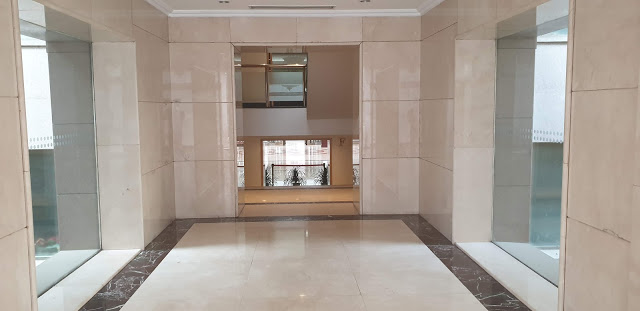
This is the back entrance to Building No. 4, but is quite representative of the whole foyer, made completely of marble and glass.  It all looked very impressive under the artificial lights, but not so much in the cold, hard light of early morning.

This is the foyer of the floor where our room was.  Marble with interesting carpet designs.  Those first impressions of it being a plush hotel were slowly dissipating as we got nearer and nearer to the room.  From the elevator, it was a long, long walk.

So…Did I tell you about the bathroom in our room?

The shower and the toilet both share the same space with no divide, and the shower curtain doesn’t reach the floor.  Water pressure is phenomenal.  Having a shower floods the whole shower plus toilet area, so when you go to the toilet, you’re basically underwater.

Don’t leave your book or magazine on the floor, or it will end up a watery mess.

And the water pressure is so hard that it could cut you in half.  Only a small turn of the tap is required to get that tingling sensation going.

It’s after 1:30 before we finally get to sleep.

As for the bed, well, that’s a whole other story.

What I learned about writing – Have a deadline, you need a plan

Unfortunately, I’m not one of those people who work well with timelines, so the very thought of using something like Microsoft Project to get my writing into some sort of timeframe, with deadlines, seemed, to me, to be a bit extreme.

Say for instance the major deadlines for a writing project are

  1.  Write an outline, with as much detail as possible, with an overarching plot, characters, and key points in the novel, and scout for locations
  2. Writing.  This could be broken down into chapters, but more practicable would be sectioned, each consisting of a number of chapters.
  3. Editing, planning for one, two or three, or more edits
  4. Proofreading
  5. Send to editor

Clearly if I was going to take this approach, then I would have to allocate hours of the day specifically for writing and doing all those other writer chores in less time, and with fewer distractions.

And, it might work for a more dedicated author.

But…

I did make a new years resolution that I would try and do things differently this year.

Except…

I set a goal to restart editing my next novel on 1st Feb. I thought, setting it so far into the year would be easy.

It would give me the time to clear up all the outstanding, get in the way, distractions, and be free to finally finish it.

But there’s always something else to do, other than what we’re supposed to be doing.

For me it used to be going away, spending long, sleepless hours flying from one side of the world to the other had fuelled my imagination more than I expected and where this used to be the impetus to write more stories that had not happened yet this year.

I have other stories of course, all in various stages of writing, but if only I could focus on one story at a time.

So…

I’ve tried to set some new, more realistic goals to finish playing with these other stories as soon as I can, so come the first of April, I can resume work on the next book to be published.

Or not.

“The Devil You Don’t”, she was the girl you would not take home to your mother!

Now only $0.99 at https://amzn.to/2Xyh1ow

John Pennington’s life is in the doldrums. Looking for new opportunities, and prevaricating about getting married, the only joy on the horizon was an upcoming visit to his grandmother in Sorrento, Italy.

Suddenly he is left at the check-in counter with a message on his phone telling him the marriage is off, and the relationship is over.

If only he hadn’t promised a friend he would do a favour for him in Rome.

At the first stop, Geneva, he has a chance encounter with Zoe, an intriguing woman who captures his imagination from the moment she boards the Savoire, and his life ventures into uncharted territory in more ways than one.

That ‘favour’ for his friend suddenly becomes a life-changing event, and when Zoe, the woman who he knows is too good to be true, reappears, danger and death follow.

Shot at, lied to, seduced, and drawn into a world where nothing is what it seems, John is dragged into an adrenaline-charged undertaking, where he may have been wiser to stay with the ‘devil you know’ rather than opt for the ‘devil you don’t’.

newdevilcvr6

Searching for locations: Sydney to Beijing, China – Every flight is different

Sydney to Beijing – Qantas A330-200
Boarding 11:45, everyone on board by 12:02, for a 12:10 departure. Pushing back 12:12 Take off 12:27

Lunch
Airline food is getting better but the fact they serve it up to you in a metal tray with a thick aluminum lid does nothing for the quality of the food inside.  I get what the chef is trying to do but often there is too little of one thing and too much of another and what you finish up with is slop in a tray.  Sometimes it’s edible sometimes it’s not.  Sometimes the meat is tender and other times it’s like boot leather.  As it is today. I think it’s pork, I should have had the chicken.  Or perhaps it was chicken.  I hate it when you can’t tell what it is that you’re eating. But, the drinks were good.

Rest or Sleep, maybe
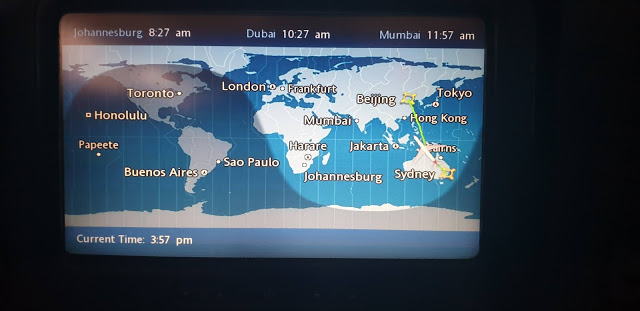
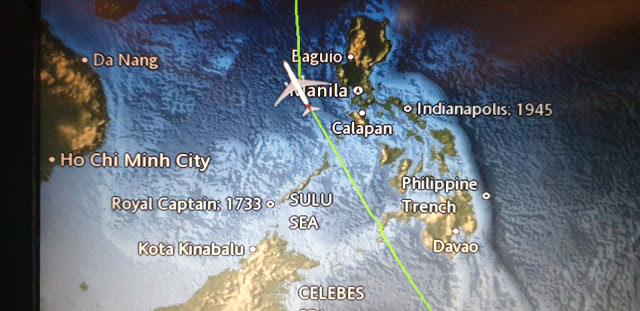
It’s going to take 11 hours and 20 minutes from Sydney to Beijing, a long time to sit in a plane with nothing much to do other than crosswords, read a book or newspaper or magazine, listen to music on your own device, or the in-flight entertainment, watch a movie again by the in-flight entertainment – if it works – or try to get some sleep. I started with the crosswords but got bored quickly. I fiddled with the in-flight entertainment, looked at the movies and tv shows but none really interested me, not then at least, so I set it to the flight path. Not exactly stellar entertainment, but it’s always interesting to know where the plane is. Or is it? If we crash, what good would it do me to know it’s somewhere over the ocean, not far from Manila, or somewhere else.  It’s not as if I could phone someone up, on the way down, to let them know where we are. But, just after dinner, we still haven’t left Australia

However, by the time I’ve finished fiddling with and dismissing all of the entertainment alternatives, it’s back to the flight path and now we are…

Somewhere approaching the Sulu Sea, which I’ve never heard of before, so it looks like I’ll have to study up on my geography when I get home.

OK, Manila looks like somewhere I’ve heard of, so we have to be flying over the Philippines.  Not far left of that is Vietnam.  Neither of those places is on my travel bucket list, so I’ll just look from up here and be satisfied with that.

Working, or not
Chronic boredom is setting in by the time we are just past halfway to our destination. We are over 6 hours into the flight and there no possible way I’m going to get any sleep. I brought my Galaxy Tab loaded with a few of my novel outlines, and planning for missing chapters, thinking I might get a little thinking time in.  Plane rides, I find, are excellent for getting an opportunity to write virtually unhindered by outside interruptions, if, of course, you discount the number of times people brush past, knocking your seat, the person in front lowering the seat into your face, or people around you continually asking you to turn off your light because they’re trying to sleep. Sorry, I say, but you can suffer my pain with me.  It’s one of the joys of flying with over two hundred others in a claustrophobic environment.  Besides, aren’t the lights supposed to be slanted so only I get the rays of light?  Except, I guess when the fixed light doesn’t line up with where the airline has fixed the seat (usually so they can squash more people in). So, sorry, not sorry, take it up with the airline.

Back to work, and I put in some quality time on a part of the story that had been eluding me for a while.  I knew what I wanted to write, but not how I was going to approach it, so that blissfully quiet and intense time worked in my favour, something that would not have happened back home. I won’t bore you with the synopsis, just suffice to say it’s finally down on paper, digitally that is, and it’s a huge step forward towards finishing it. There is, of course, the end play, the reading of the will but not before there are a few thrusts and parry’s by some of the players, but all in all the objective was to showcase a group of people with their strengths and weaknesses pushing their characters in various directions, some at odds with what is expected of them. But enough of that.   A quick check of our position shows we’re still over water but closer to our destination, so much so, we might start the pre-landing rituals, starting with food.

Dinner
7:00 – Dinner is served, well, the lights go on and a lot of tired people try to shake the sleep, and sleeplessness, out of their systems. Then flight attendants that are far too cheerful, and must have beamed in from somewhere else, serve another interesting concoction that says what’s in it but you can’t really be sure of the ingredients.  It comes and it goes.

9:10 – We begin our descent into Beijing, you know, that moment when the engines almost stop and there’s a sickening lurch and the plane heads downward. 9:56 – We touch down on the runway, in the dark and apparently it has been raining though from inside the plane you’d never know. 10:10 – the plane arrives at the gate,  the usual few minutes to open the door, and, being closer to the front of the plane this time, it doesn’t take that long before the queue is moving.

Early or late, it doesn’t matter.  After clearing customs and immigration, we have to go in search of our tour guide, waiting for us somewhere outside the arrivals terminal.