Over the years, I have traveled extensively and kept journals, with the idea that one day all of those places would become locations in books. Notebooks filled with odd characters, people and incidents observed, and whole tracts of stories written when the on the spot inspiration has been a driving force.
All of this is the basis of the first three novels, Sunday In New York, set, of course, in New York, probably my favorite city in the world, “Echoes From The Past’ equally set in New York, Brooklyn Heights and Philadelphia. The third, The Devil You Don’t, travels through Europe, starting in Geneva, moving to Rome, then Sorrento, and then to Venice.
Now, my passion to write is fuelled by travel and fine dining. When I take a break from these, I get to torment my three wonderful grandchildren whom I actively encourage to read as much as they can, and more recently to also write.
As for almost every other writer, I would not be able to do any of this without my wife who has put up with my moodiness, the times when I'm locked away in a room trying to push out another 2,000 words, and yet despite everything still puts up with me.
I wish I could say the same for our cat. Alas, I am still trying to work out how to be his friend!
One the first things you notice when driving around Beijing, other than the roads are congested with traffic, is the number of trees and flowers that have been planted, in the median strip as well as along the edges of the road.
What you also notice is the large number of multi-story apartment blocks, which are needed to house the millions of Beijing residents. What we have, so far, rarely seen, is single-story houses. These continuous areas of trees and rose bushes are, every now and then, broken up by very colorful garden beds:
Nearer to the square we are able to get up close to the flowers. These, we are told, are a variation on the rose, one that flowers for nine months of the year.
They come in a variety of colors.
And they are literally everywhere you go, on the side of the roadway, often blotting out the concrete jungle behind them.
I think that most authors are their own worst enemies!
Just when you think that the story is done, and you’re on the third re-read, just to make sure…
Damn!
I don’t like the way that chapter reads, and what’s worse, it’s about the tenth time I’ve looked at it.
It doesn’t matter the last three times you read it, it was just fine, or the editor has read it, and the chapter passed without any major comment.
I think the main problem I have is letting go. For some odd reason, certain parts of a story sometimes seem to me as though they are not complete, or may be missing a vital clue or connection for the story’s continuity.
That, of course, happens when you rewrite a section that is earlier in the story, and then have to make ongoing changes.
Yes, I hear the stern warnings that I should have made a comprehensive outline at the beginning, but the trouble is, I can change the ending as I’m writing it and then must go back and add the hooks earlier on. Not the best method, but isn’t that what an editor is for, to pick up the missed connections and out-of-the-blue events that happen for no reason?
I find that often after leaving a finished story for a month before the next reading, the whole picture must formulate itself in my head, so when I re-read, there was always a problem, one I didn’t want to think about until the re-read.
Even then, it might survive a second pass.
I know the scene is in trouble when I get to it, and alarm bells are going off. I find anything else to do but look at it.
So, here I am, making major changes.
But at least now I am satisfied with where it’s going.
Known only to a few, there is a legend that a ship named the ‘Flying Dutchman’ left Nazi Germany in the last weeks of the war and set sail for America, escorted by U-boats, under a different name. Aboard was a trove of treasure and gold worth a ‘king’s ransom’.
It was said that it had been sent to a group of American Nazis to create the Fourth Reich at an appropriate time. Over the years since many expeditions off the coast had searched, but found no trace of the vessel or the treasure.
In other words, it was just a legend created to boost tourism.
…
Fast forward to 2024. Our intrepid private detective, Harry Walthenson, overhears a conversation at Grand Central Station. It was the oddness of the message that caught his attention. An investigation turned up nothing out of the ordinary, and he thinks no more about it.
Then Harry is kidnapped, interrogated, and asked questions over and over about a date and a place, why he went there, and when he could not give satisfactory answers, he was beaten half to death and left for dead on a rubbish heap. He was lucky that it was a living space for homeless men; otherwise, he would have died.
In the aftermath, he once again gives it no more thought.
…
After resolving his first case successfully, there’s no rest. Harry’s angry mother comes to his office and demands that he find out where his father has gone. She believes he has run off with a mistress, not for the first time.
Perhaps it was not the wisest decision she has made, because Harry promises to investigate, and adds that she might not like what he finds.
He soon discovered he does not like what he finds, that his father’s friends, a cabal formed at University, have two who are his mother’s current lovers, and another, a criminal blackmailing his father.
Felicity, now his partner, working on a different case, and trying to get answers, uncovers a crime family involved in guarding a disused warehouse on the docks, where she believes Harry had been taken for interrogation, and subsequently dumped nearby to die.
Why are they up to? What is so important that the empty warehouse needs guarding? Who is employing them?
Harry, following up on the death of the blackmailer, traces his death back to an enforcer employed by his grandfather. His mother’s grandfather was a pre-war industrialist who made his fortune in war munitions and shipbuilding.
He was also a member of the American Nazi party.
When Harry also discovers a logbook belonging to a so-called wartime Liberty ship the “Paul Revere” in brackets ‘Freiheitskämpfer’, hidden by his father, and written in a code that is not readily identifiable.
It is no longer a matter of a father who has run off with his mistress; it is a very frightened man in fear of his life, running from a group who will stop at nothing to get the logbook back. And when Harry discovers a family connection to the group, it becomes a race against time to decode the log and find his father before his grandfather does.
…
Coming soon: Harry Walthenson’s new adventure – A case of finding the ‘Flying Dutchman’
Beijing Zoo Founded in 1906 during the late Qing dynasty, it is the oldest Zoo in China. It also has an aquarium and has 450 land-based species, some of which are rare and endemic to China like the Giant Panda, and 500 marine-based species. Other rare animals to be seen are the Red Panda, the Golden Snub-nosed Monkey, the South China Tiger, the White Lipped deer, the Chinese alligator, the Yak, and the Snow Leopard.
Most of the original animals were bought in 1908 from Germany by the viceroy of Liangjiang Duanfang. The Zoo first opened on June 16th, 1908. Currently, the Zoo grounds resemble classical Chinese gardens, and among the attractions are a number of Qing dynasty buildings to view, as well as an Elephant hall, a Lion and tiger hall, a Monkey hall, and a Panda hall. In all, there are 30 halls. The Zoo is located at 137 Xizhimen WaiDajie in Xicheng district, near the 2nd ring road.
We are primarily at the Zoo to see the Pandas, and there is a specific hall devoted to them, and by the way, it costs extra to see them. Everyone in our group is particularly interested in seeing them because it’s rare that any can be found anywhere else in the world. Perhaps if there had been more time, another hour, maybe, it might have made all the difference, but I think that extra time might have clashed with the pearl factory, and that, for obvious reasons, was deemed to be more important.
Our first stop is in the Panda hall.
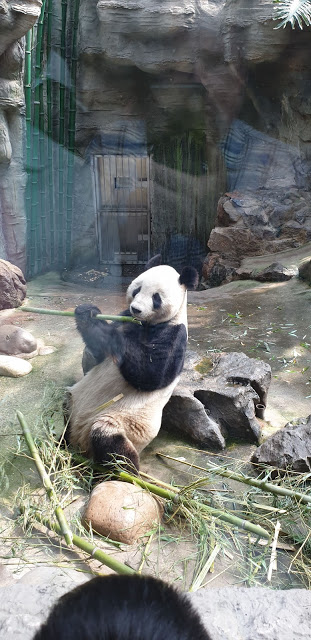
There are two pandas that we can see, one of whom is a little camera shy, and the other, above, who is demonstrating how pandas eat bamboo. They are behind a large glass wall, and you have to wait for the opportunity to get a good photo, and sometimes, only enough to include the top of the head of the person in front of you. Unfortunately, the Chinese visitors don’t understand the polite excuse me in English and can, at times, be rude enough to shove their way to the front.
What is also a problem is the uncooperativeness of the pandas to pose for photos. I guess there’s no surprise there, given the thousands of visitors every day with only one purpose in mind. We counted ourselves lucky to get the photos we did.
The hall itself is built onto the external enclosure, where there are several giant pandas, some of whom were on show, and were relatively lethargic, as though they had a big weekend, and we’re sleeping it off, like this panda below:
Then, remarkably, we came across one that decided to be a little more energetic and did a walk in front of hundreds of Chinese who had undoubtedly come to show their children the animals.
This Panda was also easier to photograph, whereas the other panda, one chewing on a morning feast of bamboo, saw a lot of pushing and shoving by the spectators to get the best spot to take his photograph. Having manners just doesn’t cut it here, so do what you have to get that photograph.
We also saw a couple of monkeys that were in the panda enclosure, but they were not much of a side benefit. They may have been there to use the Panda’s exercise equipment, though it was not quite like what we use. There was no time really to wander off to see much else, but apparently, there were also red pandas, and surprisingly, a category called Australian animals. But who goes to another country to view their own animals? The cutest animals were the stuffed pandas, and they were quite reasonably priced.
50 photographs, 50 stories, of which there is one of the 50 below.
They all start with –
A picture paints … well, as many words as you like. For instance:
And, the story:
Have you ever watched your hopes and dreams simply just fly away?
Everything I thought I wanted and needed had just left in an aeroplane, and although I said I was not going to, i came to the airport to see the plane leave. Not the person on it, that would have been far too difficult and emotional, but perhaps it was symbolic, the end of one life and the start of another.
But no matter what I thought or felt, we had both come to the right decision. She needed the opportunity to spread her wings. It was probably not the best idea for her to apply for the job without telling me, but I understood her reasons.
She was in a rut. Though her job was a very good one, it was not as demanding as she had expected, particularly after the last promotion, but with it came resentment from others on her level, that she, the youngest of the group would get the position.
It was something that had been weighing down of her for the last three months, and if noticed it, the late nights, the moodiness, sometimes a flash of temper. I knew she had one, no one could have such red hair and not, but she had always kept it in check.
And, then there was us, together, and after seven years, it felt like we were going nowhere. Perhaps that was down to my lack of ambition, and though she never said it, lack of sophistication. It hadn’t been an issue, well, not until her last promotion, and the fact she had to entertain more, and frankly I felt like an embarrassment to her.
So, there it was, three days ago, the beginning of the weekend, and we had planned to go away for a few days and take stock. We both acknowledged we needed to talk, but it never seemed the right time.
It was then she said she had quit her job and found a new one. Starting the following Monday.
Ok, that took me by surprise, not so much that it something I sort of guessed might happen, but that she would just blurt it out.
I think that right then, at that moment, I could feel her frustration with everything around her.
What surprised her was my reaction. None.
I simply asked where who, and when.
A world-class newspaper, in New York, and she had to be there in a week.
A week.
It was all the time I had left with her.
I remember I just shrugged and asked if the planned weekend away was off.
She stood on the other side of the kitchen counter, hands around a cup of coffee she had just poured, and that one thing I remembered was the lone tear that ran down her cheek.
Is that all you want to know?
I did, yes, but we had lost that intimacy we used to have when she would have told me what was happening, and we would have brainstormed solutions. I might be a cabinet maker but I still had a brain, was what I overheard her tell a friend once.
There’s not much to ask, I said. You’ve been desperately unhappy and haven’t been able to hide it all that well, you have been under a lot of pressure trying to deal with a group of troglodytes, and you’ve been leaning on Bentley’s shoulder instead of mine, and I get it, he’s got more experience in that place, and the politics that go with it, and is still an ally.
Her immediate superior and instrumental in her getting the position, but unlike some men in his position he had not taken advantage of a situation like some men would. And even if she had made a move, which I doubted, that was not the sort of woman she was, he would have politely declined.
One of the very few happily married men in that organisation, so I heard.
So, she said, you’re not just a pretty face.
Par for the course for a cabinet maker whose university degree is in psychology. It doesn’t take rocket science to see what was happening to you. I just didn’t think it was my place to jump in unless you asked me, and when you didn’t, well, that told me everything I needed to know.
Yes, our relationship had a use by date, and it was in the next few days.
I was thinking, she said, that you might come with me, you can make cabinets anywhere.
I could, but I think the real problem wasn’t just the job. It was everything around her and going with her, that would just be a constant reminder of what had been holding her back. I didn’t want that for her and said so.
Then the only question left was, what do we do now?
Go shopping for suitcases. Bags to pack, and places to go.
Getting on the roller coaster is easy. On the beginning, it’s a slow easy ride, followed by the slow climb to the top. It’s much like some relationships, they start out easy, they require a little work to get to the next level, follows by the adrenaline rush when it all comes together.
What most people forget is that what comes down must go back up, and life is pretty much a roller coaster with highs and lows.
Our roller coaster had just come or of the final turn and we were braking so that it stops at the station.
There was no question of going with her to New York. Yes, I promised I’d come over and visit her, but that was a promise with crossed fingers behind my back. After a few months in t the new job the last thing shed want was a reminder of what she left behind. New friends new life.
We packed her bags, three out everything she didn’t want, a free trips to the op shop with stiff she knew others would like to have, and basically, by the time she was ready to go, there was nothing left of her in the apartment, or anywhere.
Her friends would be seeing her off at the airport, and that’s when I told her I was not coming, that moment the taxi arrived to take her away forever. I remember standing there, watching the taxi go. It was going to be, and was, as hard as it was to watch the plane leave.
So, there I was, finally staring at the blank sky, around me a dozen other plane spotters, a rather motley crew of plane enthusiasts.
Already that morning there’s been 6 different types of plane depart, and I could hear another winding up its engines for take-off.
People coming, people going.
Maybe I would go to New York in a couple of months, not to see her, but just see what the attraction was. Or maybe I would drop in, just to see how she was.
As one of my friends told me when I gave him the news, the future is never written in stone, and it’s about time you broadened your horizons.
It may have been amusing back when I was a child, stepping through a broken mirror and imagining i had gone back in time, to an age when the house was a beautiful old mansion.
Once it was a landmark, a place with many rooms and a sprawling, manicured garden surrounding it, with a maze and a lake with fish.
Now it was a frightening outline against a dark, lightning-filled sky, surrounded by townsfolk who wanted the eyesore demolished.
The city authorities had issued a repair order on the house and gardens, and failure to comply would see it declared unfit for habitation and a demolition order.
The thing is, my grandmother, a very sprightly 90-year-old, was determined to fight them and everyone else, often brandishing her trusty old blunderbuss at anyone who dared to breach the front gates.
The mayor’s brother wanted the land so he could finish his condominium conversion and fulfil his promise to the other condo holders that the noise would be gone and a golf course and swimming pool, along with a clubhouse and cinema, would be built.
She was fighting a losing battle.
She didn’t have the money to do the repairs or to fight any more court battles.
My mother didn’t see the point. The developer had offered five million, enough to get a new house somewhere else. Gran wanted twenty million, what it was worth. The authorities were going to resume it for one million.
Such machinations were beyond my comprehension. I might be older now, but it was still a fairytale castle. Just the duel curved staircase from the foyer to the first floor was magic.
I had seen my sister descend that staircase in her prom dress like a princess, and could imagine all who came before her.
Standing in the middle of the ballroom, it was not hard to imagine the dances held there, the people doing a synchronised waltz as I had done once when learning it for my prom, the school orchestra playing, and all the boys and girls dancing.
And the parties it once hosted.
Now dusty, abandoned, silent except for the odd creaking of purported ghosts.
There were eighty rooms, sixty of them bedrooms, in two wings over three floors. Fifteen families were living in the house: my grandmother, each of her eight children, of which my mother was one, twenty-three grandchildren, and seven great-grandchildren.
None of the family left the city where they were born, lived, and most likely would die. None had ever seen the need to leave.
Until now.
I was sitting on the bottom step of the elegant but decrepit staircase, contemplating whether it would be safe to slide down the banister, when Aunt Ruby skipped down the stairs and plonked herself down next to me.
Aunt Ruby was always in Halloween costumes, or so I thought. She kept saying she was a Goth, but I had no idea what that meant.
She was also a computer hacker, and I knew what that was. Every day, we were waiting for the FBI or the CIA to turn up at the front door.
“Guess what?”
“The cops are coming to take you away?”
It was a running joke.
“No. Cracked it. We’re rich.”
Until the cops came and took her away.
“I’ll believe it when I see it.”
She handed me a piece of paper. It had the name of a bank that I had never heard of in the Cayman Islands, in the name of some corporation no one could pronounce.
The sum of money $22,176,328.76.
“You are this corporation?”
“After it slushes through forty-three shell companies that will keep whoever it is used for a year. It’s on its way to a Swiss numbered account, then Cloverville will be born.”
“Cloverville?”
“My money, my name.” She jumped up and ran off to tell Granny.
…
Of course, having the money and deciding what to do were two very different things. Everyone had a very different idea.
My parents wanted their room, already palatial, to be even more so. I wanted my room to be bigger with my own bathroom, now very tired of being last in line. Maybe if I got up earlier…
Everyone wanted a cafeteria and kitchen separate, modelled on the dining room at the Savoy, but my grandmother liked the current kitchen with a wooden stove that kept us all warm in winter and boiling in summer, and we were all together around a large table.
It also meant that we all wanted servants, but as Aunt Ruby said, people didn’t have servants these days, and we had to do our dirty work, like cooking and cleaning, and she would not be employing servants. Gran could remember the day when there were servants, and she said they had never been treated very well or taken for granted.
People were doing it now, so people could keep doing it after the renovations.
Everyone wanted their own TV, and of course, it was going to be like a motel. A TV in every bedroom. Maybe. Aunt Ruby said the children were not getting a TV; they would get an iPad, and that was it. Parents could go to the Cinema Room.
What Cinema Room?
The basement was being cleared out of 200 years of clutter, and it was going to be a cinema, holding about 100 or so people.
I was surprised Aunt Ruby didn’t want to take over the bedroom that my parents were in. That’s when I learned she was taking up residence in the north tower.
It could be said that of all the women one could meet, whether contrived or by sheer luck, what are the odds it would turn out to be the woman who was being paid a very large sum to kill you.
John Pennington is a man who may be lucky in business, but not so lucky in love. He has just broken up with Phillipa Sternhaven, the woman he thought was the one, but relatives and circumstances, and perhaps because she was a ‘princess’, may also have contributed to the end result.
So, what do you do when you are heartbroken?
That is a story that slowly unfolds, from the first meeting with his nemesis on Lake Geneva, all the way to a hotel room in Sorrento, where he learns the shattering truth.
What should have been solace after disappointment, turns out to be something else entirely, and from that point, everything goes to hell in a handbasket.
He suddenly realizes his so-called friend Sebastian has not exactly told him the truth about a small job he asked him to do, the woman he is falling in love with is not quite who she says she is, and he is caught in the middle of a war between two men who consider people becoming collateral damage as part of their business.
The story paints the characters cleverly displaying all their flaws and weaknesses. The locations add to the story at times taking me back down memory lane, especially to Venice where, in those back streets I confess it’s not all that hard to get lost.
All in all a thoroughly entertaining story with, for once, a satisfying end.
The most common use of the word, giving birth to a child, is perhaps one of the more miraculous and inspiring events ever to be witnessed.
But it can be used similarly in giving birth to an idea. More generally it could be said that it is the coming into existence of something, animate or inanimate.
It can be used to state lineage or descent, i.e. he was Italian by birth, or he was a Duke by birth, but a politician by trade.
You could use birth pain in other expressions like trying to get a club or team together, those initial stages where everything goes wrong.
And that old favourite, wanted by every man and his dog, what is your date of birth?
…
On the other hand, a berth is a place where a ship or boat ties up after a long or short voyage.
It’s also a bed on a ship, not necessarily in a stateroom, but could be in one of those shared cabins below the waterline that do not cost a lot, and only a place to sleep, or for some, to recuperate. It doesn’t necessarily have to be on a ship, it could be on a train.
It could be the distance between two ships or the shore.
You could also use it to describe your job or position in the company.
Then, you could say you gave the enemy’s camp a wide berth, or just a group of people we don’t want to pass in the street.
It could have been anywhere in the world, she thought, but it wasn’t. It was in a city where if anything were to go wrong…
She sighed and came away from the window and looked around the room. It was quite large and expensively furnished. It was one of several she had been visiting in the last three months.
Quite elegant too, as the hotel had its origins dating back to before the revolution in 1917. At least, currently, there would not be a team of KGB agents somewhere in the basement monitoring everything that happened in the room.
There was no such thing as the KGB anymore, though there was an FSB, but such organisations were of no interest to her.
She was here to meet with Vladimir.
She smiled to herself when she thought of him, such an interesting man whose command of English was as good as her command of Russian, though she had not told him of that ability.
All he knew of her was that she was American, worked in the Embassy as a clerk, nothing important, whose life both at work and at home was boring. Not that she had blurted that out the first they met, or even the second.
That first time, at a function in the Embassy, was a chance meeting, a catching of his eye as he looked around the room, looking, as he had told her later, for someone who might not be as boring as the function itself.
It was a celebration, honouring one of the Embassy officials on his service in Moscow, and the fact he was returning home after 10 years. She had been there once, and still hadn’t met all the staff.
They had talked, Vladimir knew a great deal about England, having been stationed there for a year or two, and had politely asked questions about where she lived, her family, and of course what her role was, all questions she fended off with an air of disinterested interest.
It fascinated him, as she knew it would, a sort of mental sparring as one would do with swords if this was a fencing match.
They had said they might or might not meet again when the party was over, but she suspected there would be another opportunity. She knew the signs of a man who was interested in her, and Vladimir was interested.
The second time came in the form of an invitation to an art gallery, and a viewing of the works of a prominent Russian artist, an invitation she politely declined. After all, invitations issued to Embassy staff held all sorts of connotations, or so she was told by the Security officer when she told him.
Then, it went quiet for a month. There was a party at the American embassy and along with several other staff members, she was invited. She had not expected to meet Vladimir, but it was a pleasant surprise when she saw him, on the other side of the room, talking to several military men.
A pleasant afternoon ensued.
And it was no surprise that they kept running into each other at the various events on the diplomatic schedule.
By the fifth meeting, they were like old friends. She had broached the subject of being involved in a plutonic relationship with him with the head of security at the embassy. Normally for a member of her rank, it would not be allowed, but in this instance it was.
She did not work in any sensitive areas, and, as the security officer had said, she might just happen upon something that might be useful. In that regard, she was to keep her eyes and ears open and file a report each time she met him.
After that discussion, she got the impression her superiors considered Vladimir more than just a casual visitor on the diplomatic circuit. She also formed the impression that he might consider her an ‘asset’, a word that had been used at the meeting with security and the ambassador.
It was where the word ‘spy’ popped into her head and sent a tingle down her spine. She was not a spy, but the thought of it, well, it would be fascinating to see what happened.
A Russian friend. That’s what she would call him.
And over time, that relationship blossomed, until, after a visit to the ballet, late and snowing, he invited her to his apartment not far from the ballet venue. It was like treading on thin ice, but after champagne and an introduction to caviar, she felt like a giddy schoolgirl.
Even so, she had made him promise that he remain on his best behaviour. It could have been very easy to fall under the spell of a perfect evening, but he promised, showed her to a separate bedroom, and after a brief kiss, their first, she did not see him until the next morning.
So, it began.
It was an interesting report she filed after that encounter, one where she had expected to be reprimanded.
She wasn’t.
It wasn’t until six weeks had passed when he asked her if she would like to take a trip to the country. It would involve staying in a hotel, that they would have separate rooms. When she reported the invitation, no objection was raised, only a caution; keep her wits about her.
Perhaps, she had thought, they were looking forward to a more extensive report. After all, her reports on the places, and the people, and the conversations she overheard, were no doubt entertaining reading for some.
But this visit was where the nature of the relationship changed, and it was one that she did not immediately report. She had realised at some point before the weekend away, that she had feelings for him, and it was not that he was pushing her in that direction or manipulating her in any way.
It was just one of those moments where, after a grand dinner, a lot of champagne, and delightful company, things happen. Standing at the door to her room, a lingering kiss, not intentional on her part, and it just happened.
And for not one moment did she believe she had been compromised, but for some reason she had not reported that subtle change in the relationship to the powers that be, and so far, no one had any inkling.
She took off her coat and placed it carefully of the back of one of the ornate chairs in the room. She stopped for a moment to look at a framed photograph on the wall, one representing Red Square.
Then, after a minute or two, she went to the mini bar and took out the bottle of champagne that had been left there for them, a treat arranged by Vladimir for each encounter.
There were two champagne flutes set aside on the bar, next to a bowl of fruit. She picked up the apple and thought how Eve must have felt in the garden of Eden, and the temptation.
Later perhaps, after…
She smiled at the thought and put the apple back.
A glance at her watch told her it was time for his arrival. It was if anything, the one trait she didn’t like, and that was his punctuality. A glance at the clock on the room wall was a minute slow.
The doorbell to the room rang, right on the appointed time.
She put the bottle down and walked over to the door.
Now that I’ve gone through the story and made quite a few changes, it’s time to look at the story
…
It had been another long day at the office for Officer Margaret O’Donnell, or, out in the streets, coping with people who either didn’t know or didn’t care about the law.
People who couldn’t cross the road where there were crossings and lights to protect them, silly girls shoplifting on a dare, and boys who thought they were men and could walk on water.
The one they scraped off the road would never get to grow up, and his mother, well, she was not doing another call on a family to give them bad news for a while. Someone else could deal with the problem next time.
That was her day.
So far.
At the end of the day, she was glad to be getting home, putting her feet up, and forgetting about everything until the next morning when it would start all over again.
Coming around that last corner, the home stretch she called it, she was directly opposite the corner shop, usually closed at this hour of the night.
It was not. The lights were still on.
She looked at her watch and saw it was ten minutes to midnight and long past closing time. She looked through the window, but from the other side of the street, she could only see three heads and little else.
Damn, she thought, I’m going to have to check it out.
She was aware of the rumours, from her co-residents and also her colleagues down at the station, rumours she hoped were not true.








 Thrills, Spills, and just a dash of Romance