Writing a book in 365 days – 283

Day 283

Should I use a pseudonym

Beyond the Secret Agent: 7 Strategic Reasons to Use a Pseudonym

For centuries, the pseudonym—or nom de plume—has occupied a curious space between secrecy and strategy. We often associate pen names with historical figures hiding from censure, or writers protecting their reputation while exploring controversial themes.

But the role of the adopted name in the modern creative world is far more complex than simple disguise. Whether you are a writer, an artist, a musician, or a content creator, a pseudonym can be one of the most powerful strategic tools in your professional arsenal.

If you’ve ever considered stepping out from behind your birth name, here are seven compelling reasons why embracing a strategic alter ego might be the right move for your career.


1. Safety, Security, and Professional Separation

This is often the most critical and practical reason. If your creative work involves sensitive topics, controversial political commentary, or highly personal memoirs that might expose others, a pseudonym is an essential shield.

Practical Applications:

  • Protecting Your Day Job: If your employer (especially in fields like education, medicine, or government) might disapprove of your side hustle—say, writing steamy romance or true crime—a pseudonym provides necessary separation.
  • Personal Privacy: Limiting the access strangers have to your private life, family history, and home address is crucial in the digital age, especially when dealing with online criticism or harassment.
  • Sensitive Content: When tackling subjects that invite extreme reactions (politics, social justice, whistleblowing), a pen name allows the message to be heard without putting the messenger at personal risk.

2. Establishing a Clear Genre Brand

Imagine an author named Beatrice Bell. Beatrice writes heartwarming children’s books and, under her birth name, publishes historical non-fiction about the French Revolution. This creates a massive problem for readers and marketers.

Readers of historical non-fiction are unlikely to pick up a book advertised next to a picture of a cuddly bunny, and vice versa.

A pseudonym allows you to compartmentalize your audience. Many prolific authors use multiple names to dominate separate niches:

  • Name A: For literary fiction.
  • Name B: For fast-paced thrillers.
  • Name C: For specialized technical guides.

This ensures your marketing efforts are targeted and your readers know exactly what to expect when they pick up your book.

3. Escaping Bias and Preconception

Historically, women often adopted male pseudonyms (like George Eliot or George Sand) to ensure their work was taken seriously in a male-dominated literary establishment. While the landscape has shifted, bias remains.

A strategically chosen pseudonym can help the work stand on its own merits, regardless of the creator’s background:

  • Gender Neutrality: Using initials (J.K. Rowling, P.D. James) or an androgynous name can allow a writer to appeal to the widest possible audience, particularly in genres where gender bias persists (like military sci-fi or hardboiled crime).
  • Combating Ageism: For creators who are very young or very old, a pseudonym can neutralize preconceptions about their experience level.
  • Neutralizing Geographic Bias: If your real name suggests a specific cultural background that might pigeonhole your work in certain markets, a neutral name can broaden your appeal.

4. Addressing a Difficult or Common Name

A good pseudonym is memorable, easy to pronounce, and unique. If your birth name poses a challenge, a pen name can simplify your entire career:

  • Too Hard to Spell/Pronounce: If readers struggle to pronounce your name, they won’t remember or recommend it easily. Creating a simpler, phonetically clean name is smart branding.
  • Too Common: Being “John Smith” in a crowded marketplace can make it impossible for readers or search engines to find your specific work. A unique pseudonym makes you discoverable.
  • Inappropriate Connotations: Sometimes a name simply doesn’t fit the brand. If you write dark, gothic fantasy, a name like “Sunny Meadows” sends the wrong signal.

5. Starting Fresh After a Misstep

The internet doesn’t forget. If you launched a creative endeavor that didn’t go well, received significant critical backlash, or involved content you no longer stand by, moving forward under a new name provides a clean slate.

A fresh identity allows you to:

  • Separate from Past Failures: Shed the baggage of a debut novel that flopped or a previous artistic identity that didn’t resonate.
  • Signal a Major Change: If you are transitioning from one highly specific field to an entirely different one (e.g., from journalism to poetry), a new name signals to the market that this is a distinct, new phase of your career.

6. Managing Prolific Output (The Publishing Powerhouse)

Certain genres, particularly romance, thrillers, and highly niche non-fiction, require writers to publish multiple works per year to maintain engagement.

A single author can only release so many books before they flood the market and confuse retailers. Publishing under multiple pseudonyms allows the author to maintain high productivity without undermining their own sales.

This strategy is often employed by ghostwriters or writers working under specific contractual obligations who need to publish more than their primary contract allows.

7. Creating an Intentional Persona or Mythology

The pseudonym isn’t always about hiding; sometimes, it’s about performing.

Authors like Lemony Snicket (Daniel Handler) or street artists like Banksy don’t just use a name; they use a persona that adds texture and intrigue to their work.

  • Enhanced Mysteriousness: An intentionally obscure or unusual name can generate interest and fuel discussion around the identity of the creator.
  • Building a Character: The pen name acts as a character in itself—a brand ambassador who may have a slightly different voice or temperament than the person behind the keyboard. This allows the creator to take creative risks that they might be too inhibited to take under their own name.

The Power is in the Choice

Choosing a pseudonym is not an exercise in subterfuge; it is a profound act of creative self-determination. It gives you the power to define your brand, manage your privacy, and ensure your creative work is judged precisely how you intend it to be.

Whether you seek protection, separation, or simply a name that sounds better on the bestseller list, the strategic use of a pseudonym can be the key to unlocking the next level of your professional journey.


Do you work under a pseudonym? What was the primary reason you decided to adopt an alter ego? Share your story in the comments below!

Searching for locations: The Henan Museum, Zhengzhou, Henan Province, China

The Henan Museum is one of the oldest museums in China.  In June 1927, General Feng Yuxiang proposed that a museum be built, and it was completed the next year.  In 1961, along with the move of the provincial capital, Henan Museum moved from Kaifeng to Zhengzhou.

It currently holds about 130,000 individual pieces, more of which are mostly cultural relics, bronze vessels of the Shang and Zhou Dynasties, and pottery and porcelain wares of the various dynasties.

Eventually, we arrive at the museum and get off the bus adjacent to a scooter track and despite the efforts of the guide, there’s no stopping them from nearly running us over.

We arrive to find the museum has been moved to a different and somewhat smaller building nearby as the existing, and rather distinctively designed, building is being renovated.

While we are waiting for the tickets to enter, we are given another view of industrial life in that there is nothing that resembles proper health and safety on worksites in this country, and the workers are basically standing on what looks to be a flimsy bamboo ladder with nothing to stop them from falling off.

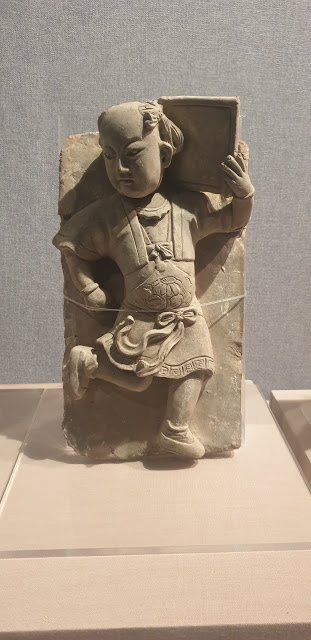
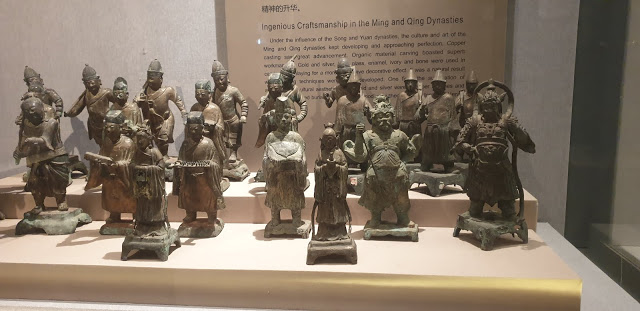
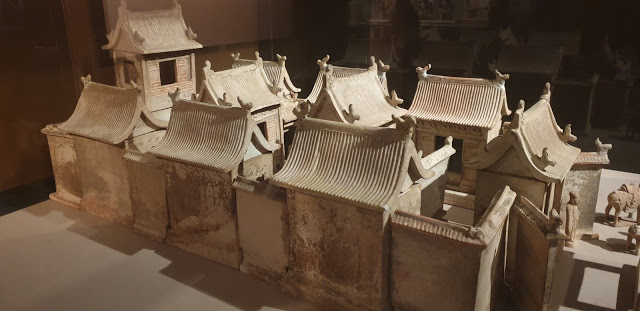
The museum itself has exhibits dating back a few thousand years and consist of bronze and ceramic items.  One of the highlights was a tortoiseshell with reportedly the oldest know writing ever found.

Other than that it was a series of cooking utensils, a table, and ceramic pots, some in very good condition considering their age.


There were also small sculptures

an array of small figures

and a model of a settlement

20 minutes was long enough.

What I learned about writing – There’s going there, and then there’s Google Maps

A lot of locations for stories are based on places that I’ve visited. So, any time I’m on holiday, I’m also discreetly observing and noting the places with an ulterior motive.

At some point in time, they’ll finish up in a story.

Places like Florence, London, Paris, New York and Venice have all been used in recent stories.

Of course, places change, and there are some that I can’t get to, so it’s useful having Google Maps and Street View. These can either make up for a lack of memory or be a refresher.

Especially if you need to visit Africa. Parts of several stories are set in Nigeria, not exactly a place I would go, no matter how much I wanted to get the lay of the land, nor would I go to the Democratic Republic of Congo.

Rwanda, maybe, but in investigating locations, it is interesting to discover that places like Kenya and Rwanda are reasonably safe. Uganda is more or less the same, but whether I’d visit, as inviting as it might be to see the wildlife (animals that is) I’m thinking Google Maps will do for now.

I have always had a fascination for other places, from way back when I was in school and we did a subject called geography. Back then, nearly 60 years ago, we had school atlases that had all of the British colonies, even if they had become independent, coloured red on the maps, and there were a lot of them.

Places like London, of which we also studied in history, always held a fascination for me, and, in particular, the royal family. Oddly enough, I knew all of the kings and queens from 1066 onwards, and yet had no idea who our Prime Ministers in Australia were.

It wasn’t until much later that we learned about Australian history.

But seeing places foreign is only part of the story. I have had time during the pandemic, when we were not allowed to leave home, to delve into the historical side of Australia, and it has created a fascination for writing a story that has a basis in fact.

This was unwittingly pushed along when my granddaughter came home from school with the assignment of writing a story about a character who was affected by a historical event. Thus, Eliza at the Eureka Stockade was created.

I remember back in university days when working on the narrative part of my literature stream, we were set an assignment based on pictures from a certain period, and a series of written documents to put together a story. Mine was about a passenger on a ship from Melbourne to Geelong in the days before rail, around the time of the gold rush.

I’m guessing that’s what is called historical fiction.

Well, it’s time to get back to the mists of time…


“One Last Look”, nothing is what it seems

A single event can have enormous consequences.

A single event driven by fate, after Ben told his wife Charlotte he would be late home one night, he left early, and by chance discovers his wife having dinner in their favourite restaurant with another man.

A single event where it could be said Ben was in the wrong place at the wrong time.

Who was this man? Why was she having dinner with him?

A simple truth to explain the single event was all Ben required. Instead, Charlotte told him a lie.

A single event that forces Ben to question everything he thought he knew about his wife, and the people who are around her.

After a near-death experience and forced retirement into a world he is unfamiliar with, Ben finds himself once again drawn back into that life of lies, violence, and intrigue.

From London to a small village in Tuscany, little by little Ben discovers who the woman he married is, and the real reason why fate had brought them together.

It is available on Amazon here:  http://amzn.to/2CqUBcz

Searching for locations: The Glory Grand Hotel, Zhengzhou, China

Like all the hotels we’re staying in, it has an impressive foyer.  You walk in and you think on appearances it’s going to be 5 stars, and not the 3 and a half rating on trip advisor.

Pity then that it all goes downhill from there.

We have a corner room and no bathroom.

Have you ever stayed in a hotel that has rooms with no bathroom?  Yes, it’s a first for us too.  Still, this is China and I suspect if you complain there’s always a worse room to put you in.

For us, it’s just going to be an amusing situation we’d bear and give it a one-star rating on TripAdvisor for the hotel.

And just a word of warning, if you decide to book the hotel directly make sure you don’t get a corner room.

At least everything else was reasonably ok.  Ok, not so much, the safe doesn’t work.

This doesn’t augur well for the rest of the tour in this particular place.

Before we leave, some photos of our room, and the lack of a bathroom.

Separate doors for shower and toilet, and on the other side of the passage, the washbasin

Feng Shui seems to have been forgotten when planning this room.

The next morning we discover that other rooms do have bathrooms but they’re small.  Some have neither tissues or toilet paper, another has a faulty power socket and cannot recharge the phone, and I’m sure there are other problems.

All in all, it seemed very odd to have the toilet and shower on one side, and the wash basin on the other side of the passage.

Harry Walthenson, Private Detective – the second case – A case of finding the “Flying Dutchman”

What starts as a search for a missing husband soon develops into an unbelievable story of treachery, lies, and incredible riches.

It was meant to remain buried long enough for the dust to settle on what was once an unpalatable truth, when enough time had passed, and those who had been willing to wait could reap the rewards.

The problem was, no one knew where that treasure was hidden or the location of the logbook that held the secret.

At stake, billions of dollars’ worth of stolen Nazi loot brought to the United States in an anonymous tramp steamer and hidden in a specially constructed vault under a specifically owned plot of land on the once docklands of New York.

It may have remained hidden and unknown to only a few, if it had not been for a mere obscure detail being overheard …

… by our intrepid, newly minted private detective, Harry Walthenson …

… and it would have remained buried.

Now, through a series of unrelated events, or are they, that well-kept secret is out there, and Harry will not stop until the whole truth is uncovered.

Even if it almost costs him his life.  Again.

Writing a book in 365 days – 283

Day 283

Should I use a pseudonym

Beyond the Secret Agent: 7 Strategic Reasons to Use a Pseudonym

For centuries, the pseudonym—or nom de plume—has occupied a curious space between secrecy and strategy. We often associate pen names with historical figures hiding from censure, or writers protecting their reputation while exploring controversial themes.

But the role of the adopted name in the modern creative world is far more complex than simple disguise. Whether you are a writer, an artist, a musician, or a content creator, a pseudonym can be one of the most powerful strategic tools in your professional arsenal.

If you’ve ever considered stepping out from behind your birth name, here are seven compelling reasons why embracing a strategic alter ego might be the right move for your career.


1. Safety, Security, and Professional Separation

This is often the most critical and practical reason. If your creative work involves sensitive topics, controversial political commentary, or highly personal memoirs that might expose others, a pseudonym is an essential shield.

Practical Applications:

  • Protecting Your Day Job: If your employer (especially in fields like education, medicine, or government) might disapprove of your side hustle—say, writing steamy romance or true crime—a pseudonym provides necessary separation.
  • Personal Privacy: Limiting the access strangers have to your private life, family history, and home address is crucial in the digital age, especially when dealing with online criticism or harassment.
  • Sensitive Content: When tackling subjects that invite extreme reactions (politics, social justice, whistleblowing), a pen name allows the message to be heard without putting the messenger at personal risk.

2. Establishing a Clear Genre Brand

Imagine an author named Beatrice Bell. Beatrice writes heartwarming children’s books and, under her birth name, publishes historical non-fiction about the French Revolution. This creates a massive problem for readers and marketers.

Readers of historical non-fiction are unlikely to pick up a book advertised next to a picture of a cuddly bunny, and vice versa.

A pseudonym allows you to compartmentalize your audience. Many prolific authors use multiple names to dominate separate niches:

  • Name A: For literary fiction.
  • Name B: For fast-paced thrillers.
  • Name C: For specialized technical guides.

This ensures your marketing efforts are targeted and your readers know exactly what to expect when they pick up your book.

3. Escaping Bias and Preconception

Historically, women often adopted male pseudonyms (like George Eliot or George Sand) to ensure their work was taken seriously in a male-dominated literary establishment. While the landscape has shifted, bias remains.

A strategically chosen pseudonym can help the work stand on its own merits, regardless of the creator’s background:

  • Gender Neutrality: Using initials (J.K. Rowling, P.D. James) or an androgynous name can allow a writer to appeal to the widest possible audience, particularly in genres where gender bias persists (like military sci-fi or hardboiled crime).
  • Combating Ageism: For creators who are very young or very old, a pseudonym can neutralize preconceptions about their experience level.
  • Neutralizing Geographic Bias: If your real name suggests a specific cultural background that might pigeonhole your work in certain markets, a neutral name can broaden your appeal.

4. Addressing a Difficult or Common Name

A good pseudonym is memorable, easy to pronounce, and unique. If your birth name poses a challenge, a pen name can simplify your entire career:

  • Too Hard to Spell/Pronounce: If readers struggle to pronounce your name, they won’t remember or recommend it easily. Creating a simpler, phonetically clean name is smart branding.
  • Too Common: Being “John Smith” in a crowded marketplace can make it impossible for readers or search engines to find your specific work. A unique pseudonym makes you discoverable.
  • Inappropriate Connotations: Sometimes a name simply doesn’t fit the brand. If you write dark, gothic fantasy, a name like “Sunny Meadows” sends the wrong signal.

5. Starting Fresh After a Misstep

The internet doesn’t forget. If you launched a creative endeavor that didn’t go well, received significant critical backlash, or involved content you no longer stand by, moving forward under a new name provides a clean slate.

A fresh identity allows you to:

  • Separate from Past Failures: Shed the baggage of a debut novel that flopped or a previous artistic identity that didn’t resonate.
  • Signal a Major Change: If you are transitioning from one highly specific field to an entirely different one (e.g., from journalism to poetry), a new name signals to the market that this is a distinct, new phase of your career.

6. Managing Prolific Output (The Publishing Powerhouse)

Certain genres, particularly romance, thrillers, and highly niche non-fiction, require writers to publish multiple works per year to maintain engagement.

A single author can only release so many books before they flood the market and confuse retailers. Publishing under multiple pseudonyms allows the author to maintain high productivity without undermining their own sales.

This strategy is often employed by ghostwriters or writers working under specific contractual obligations who need to publish more than their primary contract allows.

7. Creating an Intentional Persona or Mythology

The pseudonym isn’t always about hiding; sometimes, it’s about performing.

Authors like Lemony Snicket (Daniel Handler) or street artists like Banksy don’t just use a name; they use a persona that adds texture and intrigue to their work.

  • Enhanced Mysteriousness: An intentionally obscure or unusual name can generate interest and fuel discussion around the identity of the creator.
  • Building a Character: The pen name acts as a character in itself—a brand ambassador who may have a slightly different voice or temperament than the person behind the keyboard. This allows the creator to take creative risks that they might be too inhibited to take under their own name.

The Power is in the Choice

Choosing a pseudonym is not an exercise in subterfuge; it is a profound act of creative self-determination. It gives you the power to define your brand, manage your privacy, and ensure your creative work is judged precisely how you intend it to be.

Whether you seek protection, separation, or simply a name that sounds better on the bestseller list, the strategic use of a pseudonym can be the key to unlocking the next level of your professional journey.


Do you work under a pseudonym? What was the primary reason you decided to adopt an alter ego? Share your story in the comments below!

An excerpt from “Mistaken Identity” – a work in progress

The odds of any one of us having a doppelganger are quite high. Whether or not you got to meet him or her, or be confronted by them was significantly lower. Except of course, unless you are a celebrity.

It was a phenomenon remarkable only for the fact, at times, certain high-profile people, notorious or not, had doubles if only to put off enemies or the general public. Sometimes we see people in the street, people who look like someone we knew, and made the mistake of approaching them like a long lost friend, only to discover an embarrassed individual desperately trying to get away for what they perceive is a stalker or worse.

And then sometimes it is a picture that looms up on a TV screen, an almost exact likeness of you. At first, you are fascinated, and then according to the circumstances, and narrative that is attached to that picture, either flattered or horrified.

For me one turned to the other when I saw an almost likeness of me flash up on the screen when I turned the TV on in my room. What looked to be my photo, with only minor differences, was in the corner of the screen, the newsreader speaking in rapid Italian, so fast I could only translate every second or third word.

But the one word I did recognize was murder. The photo of the man up on the screen was the subject of an extensive manhunt. The crime, the murder of a woman in the very same hotel I was staying, and it was being played out live several floors above me. The gist of the story, the woman had been seen with, and staying with the man who was my double, and, less than an hour ago, the body had been discovered by a chambermaid.

The killer, the announcer said, was believed to be still in the hotel because the woman had died shortly before she had been discovered.

I watched, at first fascinated at what I was seeing. I guess I should have been horrified, but at that moment it didn’t register that I might be mistaken for that man.

Not until another five minutes had passed, and I was watching the police in full riot gear, with a camera crew following behind, coming up a passage towards a room. Live action of the arrest of the suspected killer the breathless commentator said.

Then, suddenly, there was a pounding on the door. On the TV screen, plain to see, was the number of my room.
I looked through the peephole and saw an army of police officers. It didn’t take much to realize what had happened. The hotel staff identified me as the man in the photograph on the TV and called the police.

Horrified wasn’t what I was feeling right then.

It was fear.

My last memory was the door crashing open, the wood splintering, and men rushing into the room, screaming at me, waving guns, and when I put my hands up to defend myself, I heard a gunshot.

And in one very confused and probably near-death experience, I thought I saw my mother and thought what was she doing in Rome?

I was the archetypal nobody.

I lived in a small flat, I drove a nondescript car, had an average job in a low profile travel agency, was single, and currently not involved in a relationship, no children, and according to my workmates, no life.

They were wrong. I was one of those people who preferred their own company, I had a cat, and travelled whenever I could. And I did have a ‘thing’ for Rosalie, one of the reasons why I stayed at the travel agency. I didn’t expect anything to come of it, but one could always hope.

I was both pleased and excited to be going to the conference. It was my first, and the glimpse I had seen of it had whetted my appetite for more information about the nuances of my profession.

Some would say that a travel agent wasn’t much of a job, but to me, it was every bit as demanding as being an accountant or a lawyer. You were providing a customer with a service, and arguably more people needed a travel agent than a lawyer. At least that was what I told myself, as I watched more and more people start using the internet, and our relevance slowly dissipating.

This conference was about countering that trend.

The trip over had been uneventful. I was met at the airport and taken to the hotel where the conference was being held with a number of other delegates who had arrived on the same plane. I had mingled with a number of other delegates at the pre conference get together, including one whose name was Maryanne.

She was an unusual young woman, not the sort that I usually met, because she was the one who was usually surrounded by all the boys, the life of the party. In normal circumstances, I would not have introduced myself to her, but she had approached me. Why did I think that may have been significant? All of this ran through my mind, culminating in the last event on the highlight reel, the door bursting open, men rushing into my room, and then one of the policemen opened fire.

I replayed that last scene again, trying to see the face of my assailant, but it was just a sea of men in battle dress, bullet proof vests and helmets, accompanied by screaming and yelling, some of which I identified as “Get on the floor”.

Then came the shot.

Why ask me to get on the floor if all they were going to do was shoot me. I was putting my hands up at the time, in surrender, not reaching for a weapon.

Then I saw the face again, hovering in the background like a ghost. My mother. Only the hair was different, and her clothes, and then the image was going, perhaps a figment of my imagination brought on by pain killing drugs. I tried to imagine the scene again, but this time it played out, without the image of my mother.

I opened my eyes took stock of my surroundings. What I felt in that exact moment couldn’t be described. I should most likely be dead, the result of a gunshot wound. I guess I should be thankful the shooter hadn’t aimed at anything vital, but that was the only item on the plus side.

I was in a hospital room with a policeman by the door. He was reading a newspaper, and sitting uncomfortably on a small chair. He gave me a quick glance when he heard me move slightly, but didn’t acknowledge me with either a nod, or a greeting, just went back to the paper.

If I still had a police guard, then I was still considered a suspect. What was interesting was that I was not handcuffed to the bed. Perhaps that only happened in TV shows. Or maybe they knew I couldn’t run because my injuries were too serious. Or the guard would shoot me long before my feet hit the floor. I knew the police well enough now to know they would shoot first and ask questions later.

On the physical side, I had a large bandage over the top left corner of my chest, extending over my shoulder. A little poking and prodding determined the bullet had hit somewhere between the top of my rib cage and my shoulder. Nothing vital there, but my arm might be somewhat useless for a while, depending on what the bullet hit on the way in, or through.

It didn’t feel like there were any broken or damaged bones.

That was the good news.

On the other side of the ledger, my mental state, there was only one word that could describe it. Terrified. I was looking at a murder charge and jail time, a lot of it. Murder usually had a long time in jail attached to it.

Whatever had happened, I didn’t do it. I know I didn’t do it, but I had to try and explain this to people who had already made up their minds. I searched my mind for evidence. It was there, but in the confused state brought on by the medication, all I could think about was jail, and the sort of company I was going to have.

I think death would have been preferable.

Half an hour later, maybe longer, I was drifting in an out of consciousness, a nurse, or what I thought was a nurse, came into the room. The guard stood, checked her ID card, and then stood by the door.

She came over and stood beside the bed. “How are you?” she asked, first in Italian, and when I pretended I didn’t understand, she asked the same question in accented English.

“Alive, I guess,” I said. “No one has come and told what my condition is yet. You are my first visitor. Can you tell me?”

“Of course. You are very lucky to be alive. You will be fine and make a full recovery. The doctors here are excellent at their work.”

“What happens now?”

“I check you, and then you have a another visitor. He is from the British Embassy I think. But he will have to wait until I have finished my examination.”

I realized then she was a doctor, not a nurse.

My second visitor was a man, dressed in a suit the sort of which I associated with the British Civil Service.  He was not very old which told me he was probably a recent graduate on his first posting, the junior officer who drew the short straw.

The guard checked his ID but again did not leave the room, sitting back down and going back to his newspaper.

My visitor introduced himself as Alex Jordan from the British Embassy in Rome and that he had been asked by the Ambassador to sort out what he labelled a tricky mess.

For starters, it was good to see that someone cared about what happened to me.  But, equally, I knew the mantra, get into trouble overseas, and there is not much we can do to help you.  So, after that lengthy introduction, I had to wonder why he was here.

I said, “They think I am an international criminal by the name of Jacob Westerbury, whose picture looks just like me, and apparently for them it is an open and shut case.”  I could still hear the fragments of the yelling as the police burst through the door, at the same time telling me to get on the floor with my hands over my head.

“It’s not.  They know they’ve got the wrong man, which is why I’m here.  There is the issue of what had been described as excessive force, and the fact you were shot had made it an all-round embarrassment for them.”

“Then why are you here?  Shouldn’t they be here apologizing?”

“That is why you have another visitor.  I only took precedence because I insisted I speak with you first.  I have come, basically to ask you for a favour.  This situation has afforded us with an opportunity.  We would like you to sign the official document which basically indemnifies them against any legal proceedings.”

Curious.  What sort of opportunity was he talking about?  Was this a matter than could get difficult and I could be charged by the Italian Government, even if I wasn’t guilty, or was it one of those hush hush type deals, you do this for us, we’ll help you out with that.  “What sort of opportunity?”

“We want to get our hands on Jacob Westerbury as much as they do.  They’ve made a mistake, and we’d like to use that to get custody of him if or when he is arrested in this country.  I’m sure you would also like this man brought into custody as soon as possible so you will stop being confused with him.  I can only imagine what it was like to be arrested in the manner you were.  And I would not blame you if you wanted to get some compensation for what they’ve done.  But.  There are bigger issues in play here, and you would be doing this for your country.”

I wondered what would happen if I didn’t agree to his proposal.  I had to ask, “What if I don’t?”

His expression didn’t change.  “I’m sure you are a sensible man Mr Pargeter, who is more than willing to help his country whenever he can.  They have agreed to take care of all your hospital expenses, and refund the cost of the Conference, and travel.  I’m sure I could also get them to pay for a few days at Capri, or Sorrento if you like, before you go home.  What do you say?”

There was only one thing I could say.  Wasn’t it treason if you went against your country’s wishes?

“I’m not an unreasonable man, Alex.  Go do your deal, and I’ll sign the papers.”

“Good man.”

After Alex left, the doctor came back to announce the arrival of a woman, by the way she had announced herself, the publicity officer from the Italian police. When she came into the room, she was not dressed in a uniform.

The doctor left after giving a brief report to the civilian at the door. I understood the gist of it, “The patient has recovered excellently and the wounds are healing as expected. There is no cause for concern.”

That was a relief.

While the doctor was speaking to the civilian, I speculated on who she might be. She was young, not more than thirty, conservatively dressed so an official of some kind, but not necessarily with the police. Did they have prosecutors? I was unfamiliar with the Italian legal system.

She had long wavy black hair and the sort of sultry looks of an Italian movie star, and her presence made me more curious than fearful though I couldn’t say why.

The woman then spoke to the guard, and he reluctantly got up and left the room, closing the door behind him.
She checked the door, and then came back towards me, standing at the end of the bed. Now alone, she said, “A few questions before we begin.” Her English was only slightly accented. “Your name is Jack Pargeter?”

I nodded. “Yes.”

“You are in Rome to attend the Travel Agents Conference at the Hilton Hotel?”

“Yes.”

“You attended a preconference introduction on the evening of the 25th, after arriving from London at approximately 4:25 pm.”

“About that time, yes. I know it was about five when the bus came to collect me, and several others, to take us to the hotel.”

She smiled. It was then I noticed she was reading from a small notepad.

“It was ten past five to be precise. The driver had been held up in traffic. We have a number of witnesses who saw you on the plane, on the bus, at the hotel, and with the aid of closed circuit TV we have established you are not the criminal Jacob Westerbury.”

She put her note book back in her bag and then said, “My name is Vicenza Andretti and I am with the prosecutor’s office. I am here to formally apologize for the situation that can only be described as a case of mistaken identity. I assure you it is not the habit of our police officers to shoot people unless they have a very strong reason for doing so. I understand that in the confusion of the arrest one of our officers accidentally discharged his weapon. We are undergoing a very thorough investigation into the circumstances of this event.”

I was not sure why, but between the time I had spoken to the embassy official and now, something about letting them off so easily was bugging me. I could see why they had sent her. It would be difficult to be angry or annoyed with her.

But I was annoyed.

“Do you often send a whole squad of trigger happy riot police to arrest a single man?” It came out harsher than I intended.

“My men believed they were dealing with a dangerous criminal.”

“Do I look like a dangerous criminal?” And then I realized if it was mistaken identity, the answer would be yes.

She saw the look on my face, and said quietly, “I think you know the answer to that question, Mr. Pargeter.”

“Well, it was overkill.”

“As I said, we are very sorry for the circumstances you now find yourself in. You must understand that we honestly believed we were dealing with an armed and dangerous murderer, and we were acting within our mandate. My department will cover your medical expenses, and any other amounts for the inconvenience this has caused you. I believe you were attending a conference at your hotel. I am very sorry but given the medical circumstances you have, you will have to remain here for a few more days.”

“I guess, then, I should thank you for not killing me.”

Her expression told me that was not the best thing I could have said in the circumstances.

“I mean, I should thank you for the hospital and the care. But a question or two of my own. May I?”

She nodded.

“Did you catch this Jacob Westerbury character?”

“No. In the confusion created by your arrest he escaped. Once we realized we had made a mistake and reviewed the close circuit TV, we tracked him leaving by a rear exit.”

“Are you sure it was one of your men who shot me?”

I watched as her expression changed, to one of surprise.

“You don’t think it was one of my men?”

“Oddly enough no. But don’t ask me why.”

“It is very interesting that you should say that, because in our initial investigation, it appeared none of our officer’s weapons had been discharged. A forensic investigation into the bullet tells us it was one that is used in our weapons, but…”

I could see their dilemma.

“Have you any enemies that would want to shoot you Mr Pargeter?”

That was absurd because I had no enemies, at least none that I knew of, much less anyone who would want me dead.

“Not that I’m aware of.”

“Then it is strange, and will perhaps remain a mystery. I will let you know if anything more is revealed in our investigation.”

She took an envelope out of her briefcase and opened it, pulling out several sheets of paper.

I knew what it was. A verbal apology was one thing, but a signed waiver would cover them legally. They had sent a pretty girl to charm me. Perhaps using anyone else it would not have worked. There was potential for a huge litigation payout here, and someone more ruthless would jump at the chance of making a few million out of the Italian Government.

“We need a signature on this document,” she said.

“Absolving you of any wrong doing?”

“I have apologized. We will take whatever measures are required for your comfort after this event. We are accepting responsibility for our actions, and are being reasonable.”

They were. I took the pen from her and signed the documents.

“You couldn’t add dinner with you on that list of benefits?” No harm in asking.

“I am unfortunately unavailable.”

I smiled. “It wasn’t a request for a date, just dinner. You can tell me about Rome, as only a resident can. Please.”

She looked me up and down, searching for the ulterior motive. When she couldn’t find one, she said, “We shall see once the hospital discharges you in a few days.”

“Then I’ll pencil you in?”

She looked at me quizzically. “What is this pencil me in?”

“It’s an English colloquialism. It means maybe. As when you write something in pencil, it is easy to erase it.”

A momentary frown, then recognition and a smile. “I shall remember that. Thank-you for your time and co-operation Mr. Pargeter. Good morning.”

© Charles Heath 2015-2021

In a word: play

I’m going to play a game. 

Is that a video game on the computer, or I’d that a board game with friends?

In reality, I didn’t play games with friends because I’m a poor loser.  Especially monopoly.

But to play a game often means you take on a persona or a role, as one, or one of many.

Personally, I like role-playing games like dungeons and dragons.

I’m going to a play

This is a stage production of a scripted story with various people in roles.

A play can have a star, a lead actor in a pivotal role to draw in the viewers

I’ve been to good plays and bad ones with great actors and some not-so-great ones.

A play can be hard to understand, it can be a musical with singing and dancing, or it can be rollicking good fun where the audience dances in their seats.

The worst play I ever saw was Dr Zhivago, it never seemed to end.

The best play, The Pyjama Game, with John Inman from Are You Being Served, a British comedy TV show.

I’m going to play the game

There’s a slight difference between this and the first example because it means instead of doing something your own way, you’re going to do eat everyone else does, prompting the analogy, you’re going to fight fire with fire.

Yep, even the explanations can be confusing.  You have to love the English language for being that.

I’m going to play a role

So many connotations to this one.  For instance, I’m going to be someone I’m not.  If I’m a kind person, then I’m going to pretend I’m mean.

I’m going to join a group of like-minded people and help further their cause, that is to say, together we changed the course of history, and I had a role in that.

Let’s hope it was for the betterment of mankind and not a leap towards infamy.

And of course, if you play a part in a play, it means you are pretending to be someone else.  I like the idea of playing God, but that’s usually the lead actor, I’m usually the janitor, servant, or just plain dogsbody.

Coming soon – “Strangers We’ve Become”, the sequel to “What Sets Us Apart”

Stranger’s We’ve Become, a sequel to What Sets Us Apart.

The blurb:

Is she or isn’t she, that is the question!

Susan has returned to David, but he is having difficulty dealing with the changes. Her time in captivity has changed her markedly, so much so that David decides to give her some time and space to re-adjust back into normal life.

But doubts about whether he chose the real Susan remain.

In the meantime, David has to deal with Susan’s new security chief, the discovery of her rebuilding a palace in Russia, evidence of an affair, and several attempts on his life. And, once again, David is drawn into another of Predergast’s games, one that could ultimately prove fatal.

From being reunited with the enigmatic Alisha, a strange visit to Susan’s country estate, to Russia and back, to a rescue mission in Nigeria, David soon discovers those whom he thought he could trust each has their own agenda, one that apparently doesn’t include him.

The Cover:

strangerscover9

Coming soon