The cinema of my dreams – I never wanted to go to Africa – Episode 22

Our hero knows he’s in serious trouble.

The problem is, there are familiar faces and the question of who is a friend and who is a foe is made all the more difficult because of the enemy, if it was the enemy, simply because it didn’t look or sound or act like the enemy.

Now, it appears, his problems stem from another operation he participated in.

Lallo was gone ten minutes, perhaps a specific amount of time that was supposed to make me sweat.  It was warm in the ward so it wasn’t his presence or the questions that made me feel uncomfortable.

It was fear of the unknown.

If anything, it was more likely I’d be going to a black site rather than rest and recuperation in Germany.  And apparently, over an operation, I had little or no knowledge of its inception or execution beyond being used for target practice.

Unless the army in its infinite wisdom was looking for a scapegoat, they’d tried pinning it on Treen, but he didn’t play ball, so now it was my turn.  However, just to complicate that thought, why didn’t they just kill me on the ground when they had the chance?

Because they needed me alive.

My mind went back to that fateful operation.

I went over as many of the crew as I could remember.  Ledgeman, Sergeant, explosives expert, he was with me until he was shot, caught in the crossfire, which now made me consider my first assessment of what has happened to him, that it might have been one of us who shot him, was the likely outcome.

Willies, a Corporal, also an explosives expert, sent with Mason, Gunnery Sergeant like me, who was providing cover for Willies.

Breen, Lieutenant, Leader, although it didn’t exactly appear to be the case, the more I thought about it, there seemed an undertone of indifference from the team towards its leader, one I should have picked up on.  Informal command never worked when push came to shove.

Andrews, Cathcar, Edwards and Sycamore, regular soldiers with combat experience along for protection, Andrews and Sycamore were with us and had worked together before, their camaraderie didn’t extend to me, but they were professional soldiers.

Of all the people in that entire group, why did Treen survive?  In putting the pieces together now in my mind, and if what I remembered was right, he should have been the first to die.

I mean, drugs and paranoia aside, that was the one single damning conclusion I could draw from events.  If he had, then a lot of the others might have survived.

But time was up; Lallo was back, squirming in his seat, and armed with a different coloured notebook.

First question, “What was your opinion of Treen?”

Relevance?  “Competent, but perhaps not truly in charge of his men.”

“How so?”

“I got the impression it was a case of familiarity breeds contempt.”

“You question his ability to command?”

“Just his style.”

Groups who worked together in close combat as a unit, from the top to the bottom, acquired a level of camaraderie that transcended rank.  It was not supposed to, but it did.  It was built on mutual respect and got to a point where everyone knew what they were doing without being asked, or ordered.  I got the impression that had been the case for Treen and his team up till that operation.  Perhaps the loss of one of the team had changed the dynamic.

“He’s there to lead, not be liked.”

“Then why ask me what I thought?  You’d know what I meant by that if you were out on the front line and your life depended on your team.  Something was not right.”

“How did you fit in,” he asked, with an emphasis on the word ‘fit’.

I didn’t, but I was not going to tell him that.  In the end, I just didn’t trust them.  You can get a measure of a man in that first meeting with or speaking with them, and they closed me out from the start.

“I had a job to do and I did it.”

And, it was probably the reason why I walked away.

© Charles Heath 2019-2023

Writing a book in 365 days – 286

Day 286

Writing a novel is not a sprint but a marathon

Navigating the Darkness: Sprinting Through Your Marathon Novel

E.L. Doctorow, a titan of American literature, once famously described the writing process as akin to “driving a car at night – you can only see as far as the headlight go.” This beautifully encapsulates the inherent uncertainty, the step-by-step progression, and the reliance on instinct that comes with crafting a narrative.

Then there’s the other, equally valid, piece of advice: writing a book isn’t a sprint, it’s a marathon. This speaks to the endurance, the discipline, and the long-haul commitment required to bring a sprawling story from conception to completion.

On the surface, these two nuggets of wisdom feel contradictory. How can you sprint through a marathon? How can you navigate the darkness with pinpoint precision if you’re also settling in for a long, grueling race?

The truth is, they aren’t contradictions at all. They are two essential facets of successful authorship, and the key to achieving the best of both worlds lies in understanding how they can and should work together.

Embrace the Headlight: The Power of the Present

Doctorow’s metaphor is a powerful reminder to ground ourselves in the immediate. When you’re staring at a blank page or a daunting plot point, the sheer magnitude of the “marathon” can be paralyzing. This is where the headlight comes in.

  • Focus on the Next Scene: Don’t worry about how you’re going to end the book. Just focus on writing the next scene, the next chapter, the next conversation. What needs to happen right now to move the story forward?
  • Trust Your Intuition: The headlight illuminates the path immediately ahead. This is where your creative impulse, your gut feeling about character motivation, or your instinct for dialogue takes over. Allow yourself to explore without needing to see the entire roadmap.
  • Embrace the Unknown: Sometimes, the best stories emerge from the unexpected detours revealed by the headlight. Don’t be afraid to go where the light takes you, even if it wasn’t part of your original plan. This is how discovery happens.

Pace Yourself for the Long Haul: The Marathon Mindset

While the headlight keeps you moving forward, the marathon mindset provides the structure and resilience to keep going. Without it, you’ll burn out before you even hit the halfway point.

  • Establish a Routine: Whether it’s a daily word count, a dedicated writing time, or a weekly goal, consistency is your marathon fuel. It’s about showing up, even when the inspiration feels dim.
  • Break Down the Giant Task: The marathon is made up of many miles. Similarly, your book is made up of chapters, plot arcs, and character development. Break down the larger goal into smaller, manageable chunks. This makes the journey less daunting.
  • Cultivate Patience and Persistence: There will be days, weeks, even months where the writing feels like wading through molasses. This is normal. Understanding that this is part of the marathon allows you to persevere through the tough patches without losing sight of the finish line.
  • The Long Game of Revision: The marathon isn’t over when you type “The End.” The real work of refining, shaping, and polishing is a crucial part of the longer journey. Trust that the initial draft, guided by the headlight, will be the raw material for a more polished creation.

Achieving the Best of Both Worlds: The Dynamic Duo

The magic happens when you stop seeing these as opposing forces and start integrating them.

  1. Start with the Headlight, Build with the Marathon: Begin by focusing on the immediate scene, letting your creativity flow. As you complete sections, start to see the broader strokes, the emerging patterns that define your marathon.
  2. Use the Marathon Structure to Guide the Headlight: Have a general outline or a compelling premise? This “marathon vision” can act as your distant parklights, giving direction to your immediate headlight-led explorations.
  3. Allow for Detours, But Keep Moving: The headlight might reveal an exciting side road, but the marathon’s awareness of the destination ensures you don’t get lost indefinitely. You can explore, but always with a sense of returning to the main path.
  4. Celebrate Small Victories (Headlight Moments) on the Long Journey (Marathon): Finishing a chapter is a milestone in the marathon. A particularly brilliant piece of dialogue is a shining moment in the headlight’s beam. Acknowledge and appreciate both.

In essence, writing a book is about learning to be both a navigator of the immediate journey and a seasoned long-distance runner. You need the courage to step into the darkness, guided by the light you have, and the wisdom to understand that this is a race that requires stamina, strategy, and unwavering dedication. By embracing the power of the present while respecting the demands of the long haul, you can indeed achieve the best of both worlds, and bring your story magnificently to life.

Searching for locations: The Silk Factory, Suzhou, China

China is renowned for its exquisite silk, so naturally, a visit to the Silk Spinning Factory is part of today’s tour.

After that, we will be heading downtown to an unspecified location where we’re getting a boat ride, walk through a typical Chinese shopping experience, and coffee at a coffee shop that is doubling as the meeting place, after we soak up the local atmosphere.

The problem with that is that if the entire collective trip a deal tourists take this route then the savvy shopkeepers will jack up their prices tenfold because we’re tourists with money.  It’ll be interesting to see how expensive everything is.

So…

Before we reach the silk factory, we are told that Suzhou is the main silk area of China, and we will be visiting a nearly 100 years old, Suzhou No 1 Silk Mill, established in 1926.  Suzhou has a 4,700-year history of making silk products.  It is located at No. 94, Nanmen Road, Suzhou, Jiangsu, China.

Then we arrive at the Silk Factory, another government-owned establishment with a castiron guarantee of quality and satisfaction.

The look and feel of the doona cover certainly backs up that claim

And the colors and variety is amazing (as is the cost of those exquisite sets)

We get to see the silk cocoon stretched beyond imagination, and see how the silk thread is extracted, then off to the showroom for the sales pitch.

It isn’t a hard sell, and the sheets, doonas, pillows, and pillowcases, are reasonably priced, and come with their own suitcase (for free) so you can take them with you, or free shipping, by slow boat, if you prefer not to take the goods with you.

We opt for the second choice, as there’s no room left in our baggage after packing the Chinese Medicine.

What I learned about writing – When computers and memory fails

It’s late at night, and twenty other story ideas are currently running around in my head, instead of the story I should be working on.

These ideas are impinging on the current story and somehow are finding their way onto the page.

Writing, cursing, deleting, re-writing, deleting, cursing.

I’m working on the latest book, and it is not going well.  I don’t have writer’s block; I think it is more a case of self-doubt.  It’s why I can’t concentrate.

It’s why I’m thinking about the next story and not staying on track.  And that pesky outline, or synopsis, or whatever it wants to be called, has gone missing under a pile of paper.

Next resolution, clean up this goddam mess!

This leads me to be overly critical of what I have written and to press the delete key more often.  Only to realise that an action taken in haste can be regrettable and makes me feel even more depressed when I realise the deletions are irrecoverable.

Damn.  Whatever happened to ‘undo’?

I think I’d be happier in a garret somewhere channelling van Gogh’s rage.

Lesson learned – don’t delete, save it to a text file so it can be retrieved when sanity returns.

If it returns…

I was not happy with the previous start.  Funny about that, because until a few weeks ago I thought the start was perfect.

What a difference a week makes, or is that politics?

Perhaps I should consider adding some political satire.

But I digress…

It seems it’s been like that for a few weeks now, not being able to stick to the job in hand, doing anything but what I’m supposed to be doing.  I recognise the restlessness. I’m not happy with the story as it stands, so rather than moving forward, I find myself writing words just for the sake of writing words.

Any words are better than none, right?

So, I rewrote the start, added about a hundred pages, and now I have to do a mass of rewriting of what was basically the whole book.

But here’s the thing.

This morning, I woke up and looked at the new start, and it has inspired me.

Perhaps all I needed was several weeks of teeth gnashing and self-doubt to get myself back on track.

Skeletons in the closet, and doppelgangers

A story called “Mistaken Identity”

How many of us have skeletons in the closet that we know nothing about? The skeletons we know about generally stay there, but those we do not, well, they have a habit of coming out of left field when we least expect it.

In this case, when you see your photo on a TV screen with the accompanying text that says you are wanted by every law enforcement agency in Europe, you’re in a state of shock, only to be compounded by those same police, armed and menacing, kicking the door down.

I’d been thinking about this premise for a while after I discovered my mother had a boyfriend before she married my father, a boyfriend who was, by all accounts, the man who was the love of her life.

Then, in terms of coming up with an idea for a story, what if she had a child by him that we didn’t know about, which might mean I had a half brother or sister I knew nothing about. It’s not an uncommon occurrence from what I’ve been researching.

There are many ways of putting a spin on this story.

Then, in the back of my mind, I remembered a story an acquaintance at work was once telling us over morning tea, that a friend of a friend had a mother who had a twin sister and that each of the sisters had a son by the same father, without each knowing of the father’s actions, both growing up without the other having any knowledge of their half brother, only to meet by accident on the other side of the world.

It was an encounter that in the scheme of things might never have happened, and each would have remained oblivious of the other.

For one sister, the relationship was over before she discovered she was pregnant, and therefore had not told the man he was a father. It was no surprise the relationship foundered when she discovered he was also having a relationship with her sister, a discovery that caused her to cut all ties with both of them and never speak to either from that day.

It’s a story with more twists and turns than a country lane!

And a great idea for a story.

That story is called ‘Mistaken Identity’.

Searching for locations: From Zhengzhou to Suzhou by train, and the Snowy Sea Hotel, Suzhou, China

For the first time on this trip, we encounter problems with Chinese officialdom at the railway station, though we were warned that this might occur.

We had a major problem with the security staff when they pulled everyone over with aerosols and confiscated them. We lost styling mousse, others lost hair spray, and the men, their shaving cream.  But, to her credit, the tour guide did warn us they were stricter here, but her suggestion to be angry they were taking our stuff was probably not the right thing to do.

As with previous train bookings, the Chinese method of placing people in seats didn’t quite manage to keep couples traveling together, together on the train.  It was an odd peculiarity which few of the passengers understood, nor did they conform, swapping seat allocations.

This train ride did not seem the same as the last two and I don’t think we had the same type of high-speed train type that we had for the last two.  The carriages were different, there was only one toilet per carriage, and I don’t think we were going as fast.

But aside from that, we had 753 kilometers to travel with six stops before ours, two of which were very large cities, and then our stop, about four and a half hours later.  With two minutes this time, to get the baggage off the team managed it in 40 seconds, a new record.

After slight disorientation getting off the train, we locate our guide, easily found by looking for the Trip-A-Deal flag.  From there it’s a matter of getting into our respective groups and finding the bus.

As usual, the trip to the hotel was a long one, but we were traveling through a much brighter, and well lit, city.

As for our guide, we have him from now until the end of the tour.  There are no more train rides, we will be taking the bus from city to city until we reach Shanghai.  Good thing then that the bus is brand new, with that new car smell.  Only issue, no USB charging point.

The Snowy Sea hotel.  

It is finally a joy to get a room that is nothing short of great.  It has a bathroom and thus privacy.

Everyone had to go find a supermarket to purchase replacements for the confiscated items.  Luckily there was a huge supermarket just up from the hotel that had everything but the kitchen sink.

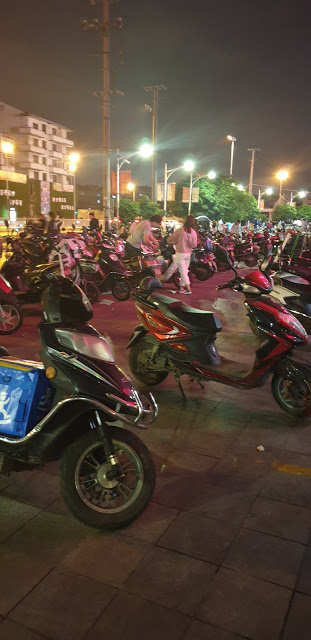
But, unlike where we live, the carpark is more of a scooter park!

It is also a small microcosm of Chinese life for the new more capitalistic oriented Chinese.

The next morning we get some idea of the scope of high-density living, though here, the buildings are not 30 stories tall, but still just as impressive.

These look like the medium density houses, but to the right of these are much larger buildings

The remarkable thing about this is those buildings stretch as far as the eye can see.

An excerpt from “Amnesia”, a work in progress

I remembered a bang.

I remembered the car slewing sideways.

I remember another bang, and then it was lights out.

When I opened my eyes again, I saw the sky.

Or I could be underwater.

Everything was blurred.

I tried to focus but I couldn’t. My eyes were full of water.

What happened?

Why was I lying down?

Where was I?

I cast my mind back, trying to remember.

It was a blank.

What, when, who, why and where, are questions I should easily be able to answer. These are questions any normal person could answer.

I tried to move. Bad, bad mistake.

I did not realise the scream I heard was my own. Just before my body shut down.

“My God! What happened?”

I could hear, not see. I was moving, lying down, looking up.

I was blind. Everything was black.

“Car accident; hit a tree, sent the passenger flying through the windscreen. Pity to poor bastard didn’t get the message that seat belts save lives.”

Was I that poor bastard?

“Report?” A new voice, male, authoritative.

“Multiple lacerations, broken collar bone, broken arm in three places, both legs broken below the knees, one badly. We are not sure of internal injuries, but ruptured spleen, cracked ribs and pierced right lung are fairly evident, x-rays will confirm that and anything else.”

“What isn’t broken?”

“His neck.”

“Then I would have to say we are looking at the luckiest man on the planet.”

I heard the shuffling of pages.

“OR1 ready?”

“Yes. On standby since we were first advised.”

“Good. Let’s see if we can weave some magic.”

Magic.

It was the first word that popped into my head when I surfaced from the bottom of the lake. That first breath, after holding it for so long, was sublime, and, in reality, agonising.

Magic, because it seemed like I’d spent a long time underwater.

Or somewhere.

I tried to speak but couldn’t. The words were just in my head.

Was it night or was it day?

Was it hot, or was it cold?

Where was I?

Around me, it felt cool.

It was incredibly quiet. No noise except for the hissing of air through an air-conditioning vent. Or that was the sound of pure silence.  And with it the revelation that silence was not silent. It was noisy.

I didn’t try to move.

Instinctively, somehow, I knew not to.

A previous unpleasant experience?

I heard what sounded like a door opening, and noticeably quiet footsteps slowly came into the room. They stopped. I could hear breathing, slightly laboured, a sound I’d heard before.

My grandfather.

He had smoked all his life until he was diagnosed with lung cancer. But for years before that he had emphysema. The person in the room was on their way, down the same path. I could smell the smoke.

I wanted to tell whoever it was the hazards of smoking.

I couldn’t.

I heard a metallic clanging sound from the end of the bed. A moment later the clicking of a pen, then writing.

“You are in a hospital.” A female voice suddenly said. “You’ve been in a bad accident. You cannot talk, or move, all you can do, for the moment, is listen to me. I am a nurse. You have been here for 45 days and just came out of a medically induced coma. There is nothing to be afraid of.”

She had a very soothing voice.

Her fingers stroked the back of my hand.

“Everything is fine.”

Define fine, I thought. I wanted to ask her what ‘fine’ meant.

“Just count backwards from 10.”

Why?

I didn’t reach seven.

Over the next ten days, that voice became my lifeline to sanity. Every morning, I longed to hear it, if only for the few moments she was in the room, those few waking moments when I believed she, and someone else who never spoke, were doing tests. I knew it had to be someone else because I could smell the essence of lavender. My grandmother had worn a similar scent.

It rose above the disinfectant.

She was another doctor, not the one who had been there the day I arrived. Not the one who had used some ‘magic’ and kept me alive.

It was then, in those moments before she put me under again, that I thought, what if I was paralysed? It would explain a lot. A chill went through me.

The next morning, she was back.

“My name is Winifred. We don’t know what your name is, not yet. In a few days, you will be better, and you will be able to ask us questions. You were in an accident, and you were very severely injured, but I can assure you there will be no lasting damage.”

More tests, and then when I expected the lights to go out, they didn’t. Not for a few minutes more. This was how I would be integrated back into the world. A little bit at a time.

The next morning, she came later than usual, and I’d been awake for a few minutes. “You have bandages over your eyes and face. You had bad lacerations to your face, and glass in your eyes. We will know more when the bandages come off in a few days. Your face will take longer to heal. It was necessary to do some plastic surgery.”

Lacerations, glass in my eyes, car accidents, plastic surgery. By logical deduction, I knew I was the poor bastard thrown through the windscreen. It was a fleeting memory from the day I was admitted.

How could that happen?

That was the first of many startling revelations. The second was the fact I could not remember the crash. Equally shocking, in that same moment was the fact I could not remember before the crash either, or only vague memories after.

But the most shattering of all these revelations was the one where I realised, I could not remember my name.

I tried to calm down, sensing a rising panic.

I was just disoriented, I told myself. After 45 days in an induced coma, it had messed with my mind, and it was only a temporary lapse. Yes, that’s what it was, a temporary lapse. I will remember tomorrow. Or the next day.

Sleep was a blessed relief.

The next day I didn’t wake up feeling nauseous. I think they’d lowered the pain medication. I’d heard that morphine could have that effect. Then, how could I know that but not who I am?

Now I knew Winifred the nurse was preparing me for something unbelievably bad. She was upbeat, and soothing, giving me a new piece of information each morning. This morning, “You do not need to be afraid. Everything is going to be fine. The doctor tells me you are going to recover with little scarring. You will need some physiotherapy to recover from your physical injuries, but that’s in the future. We need to let you mend a little bit more before then.”

So, I was not going to be able to leap out of bed and walk out of the hospital any time soon. I don’t suppose I’d ever leapt out of bed, except as a young boy. I suspect I’d sustained a few broken bones. I guess learning to walk again was the least of my problems.

But there was something else. I picked it up in the timbre of her voice, a hesitation, or reluctance. It sent another chill through me.

This time I was left awake for an hour before she returned.

This time sleep was restless.

Scenes were playing in my mind, nothing I recognised, and nothing lasting longer than a glimpse. Me. Others, people I didn’t know. Or I knew them and couldn’t remember them.

Until they disappeared, slowly like the glowing dot in the centre of the computer screen, before finally fading to black.

The morning the bandages were to come off she came in early and woke me. I had another restless night, the images becoming clearer, but nothing recognisable.

“This morning the doctor will be removing the bandages over your eyes. Don’t expect an immediate effect. Your sight may come back quickly, or it may come back slowly, but we believe it will come back.”

I wanted to believe I was not expecting anything, but I was. It was human nature. I did not want to be blind as well as paralysed. I had to have at least one reason to live.

I dozed again until I felt a gentle hand on my shoulder. I could smell the lavender; the other doctor was back. And I knew the hand on my shoulder was Winifred’s. She told me not to be frightened.

I was amazed to realise at that moment, I wasn’t.

I heard the scissors cutting the bandages.

I felt the bandage being removed, and the pressure coming off my eyes. I could feel the pads covering both eyes.

Then a moment when nothing happened.

Then the pads are gently lifted and removed.

Nothing.

I blinked my eyes, once, twice. Nothing.

“Just hold on a moment,” Winifred said. A few seconds later I could feel a cool towel wiping my face, and then gently wiping my eyes. There was ointment or something else in them.

Then a flash. Well, not a flash, but like when a light is turned on and off. A moment later, it was brighter, not the inky blackness of before, but a shade of grey.

She wiped my eyes again.

I blinked a few more times, and then the light returned, and it was like looking through water, at distorted and blurry objects in the distance.

I blinked again, and she wiped my eyes again.

Blurry objects took shape. A face looking down on me, an elderly lady with a kindly face, surely Winifred, who was smiling. And on the opposite side of the bed, the doctor, a Chinese woman of indescribable beauty.

I nodded.

“You can see?”

I nodded again.

“Clearly?”

I nodded.

“Very good. We will just draw the curtains now. We don’t want to overdo it. Tomorrow we will be taking off the bandages on your face. Then, it will be the next milestone. Talking.”

I couldn’t wait.

When morning came, I found myself afraid. Winifred had mentioned scarring, there were bandages on my face. I knew, but wasn’t quite sure how I knew, I wasn’t the most handsome of men before the accident, so this might be an improvement.

I was not sure why I didn’t think it would be the case.

They came at mid-morning, the nurse, Winifred, and the doctor, the exquisite Chinese. She was the distraction, taking my mind off the reality of what I was about to see.

Another doctor came into the room before the bandages were removed, and he was introduced as the plastic surgeon who had ‘repaired’ the ravages of the accident. It had been no easy job, but, with a degree of egotism, he did say he was one of the best in the world.

I found it hard to believe, if he were, that he would be at a small country hospital.

“Now just remember, what you might see now is not how you will look in a few months.”

Warning enough.

The Chinese doctor started removing the bandages. She did it slowly and made sure it did not hurt. My skin was very tender, and I suspect still bruised, either from the accident or the surgery, I didn’t know.

Then it was done.

The plastic surgeon gave his work a thorough examination and seemed pleased with his work. “Coming along nicely,” he said to the other doctor. He issued some instructions on how to manage the skin, nodded to me, and I thanked him before he left.

I noticed Winifred had a mirror in her hand and was reticent in using it. “As I said,” she said noticing me looking at the mirror, “what you see now will not be the result. The doctor said it was going to heal with little scarring. You have been extremely fortunate he was available. Are you ready?”

I nodded.

She showed me.

I tried not to be reviled at the red and purple mess that used to be my face. At a guess, I would have to say he had to put it all back together again, but not knowing what I looked like before, I had no benchmark. All I had was a snippet of memory that told me I was not the tall, dark, and handsome type.

And I still could not talk. There was a reason, he had worked in that area too. Just breathing hurt. I think I would save up anything I had to say for another day. I could not even smile. Or frown. Or grimace.

“We’ll leave you for a while. Everyone needs a little time to get used to the change. I suspect you are not sure if there has been an improvement in last year’s model. Well, time will tell.”

A new face?

I could not remember the old one.

My memory still hadn’t returned.

©  Charles Heath  2024

Writing a book in 365 days – 286

Day 286

Writing a novel is not a sprint but a marathon

Navigating the Darkness: Sprinting Through Your Marathon Novel

E.L. Doctorow, a titan of American literature, once famously described the writing process as akin to “driving a car at night – you can only see as far as the headlight go.” This beautifully encapsulates the inherent uncertainty, the step-by-step progression, and the reliance on instinct that comes with crafting a narrative.

Then there’s the other, equally valid, piece of advice: writing a book isn’t a sprint, it’s a marathon. This speaks to the endurance, the discipline, and the long-haul commitment required to bring a sprawling story from conception to completion.

On the surface, these two nuggets of wisdom feel contradictory. How can you sprint through a marathon? How can you navigate the darkness with pinpoint precision if you’re also settling in for a long, grueling race?

The truth is, they aren’t contradictions at all. They are two essential facets of successful authorship, and the key to achieving the best of both worlds lies in understanding how they can and should work together.

Embrace the Headlight: The Power of the Present

Doctorow’s metaphor is a powerful reminder to ground ourselves in the immediate. When you’re staring at a blank page or a daunting plot point, the sheer magnitude of the “marathon” can be paralyzing. This is where the headlight comes in.

  • Focus on the Next Scene: Don’t worry about how you’re going to end the book. Just focus on writing the next scene, the next chapter, the next conversation. What needs to happen right now to move the story forward?
  • Trust Your Intuition: The headlight illuminates the path immediately ahead. This is where your creative impulse, your gut feeling about character motivation, or your instinct for dialogue takes over. Allow yourself to explore without needing to see the entire roadmap.
  • Embrace the Unknown: Sometimes, the best stories emerge from the unexpected detours revealed by the headlight. Don’t be afraid to go where the light takes you, even if it wasn’t part of your original plan. This is how discovery happens.

Pace Yourself for the Long Haul: The Marathon Mindset

While the headlight keeps you moving forward, the marathon mindset provides the structure and resilience to keep going. Without it, you’ll burn out before you even hit the halfway point.

  • Establish a Routine: Whether it’s a daily word count, a dedicated writing time, or a weekly goal, consistency is your marathon fuel. It’s about showing up, even when the inspiration feels dim.
  • Break Down the Giant Task: The marathon is made up of many miles. Similarly, your book is made up of chapters, plot arcs, and character development. Break down the larger goal into smaller, manageable chunks. This makes the journey less daunting.
  • Cultivate Patience and Persistence: There will be days, weeks, even months where the writing feels like wading through molasses. This is normal. Understanding that this is part of the marathon allows you to persevere through the tough patches without losing sight of the finish line.
  • The Long Game of Revision: The marathon isn’t over when you type “The End.” The real work of refining, shaping, and polishing is a crucial part of the longer journey. Trust that the initial draft, guided by the headlight, will be the raw material for a more polished creation.

Achieving the Best of Both Worlds: The Dynamic Duo

The magic happens when you stop seeing these as opposing forces and start integrating them.

  1. Start with the Headlight, Build with the Marathon: Begin by focusing on the immediate scene, letting your creativity flow. As you complete sections, start to see the broader strokes, the emerging patterns that define your marathon.
  2. Use the Marathon Structure to Guide the Headlight: Have a general outline or a compelling premise? This “marathon vision” can act as your distant parklights, giving direction to your immediate headlight-led explorations.
  3. Allow for Detours, But Keep Moving: The headlight might reveal an exciting side road, but the marathon’s awareness of the destination ensures you don’t get lost indefinitely. You can explore, but always with a sense of returning to the main path.
  4. Celebrate Small Victories (Headlight Moments) on the Long Journey (Marathon): Finishing a chapter is a milestone in the marathon. A particularly brilliant piece of dialogue is a shining moment in the headlight’s beam. Acknowledge and appreciate both.

In essence, writing a book is about learning to be both a navigator of the immediate journey and a seasoned long-distance runner. You need the courage to step into the darkness, guided by the light you have, and the wisdom to understand that this is a race that requires stamina, strategy, and unwavering dedication. By embracing the power of the present while respecting the demands of the long haul, you can indeed achieve the best of both worlds, and bring your story magnificently to life.

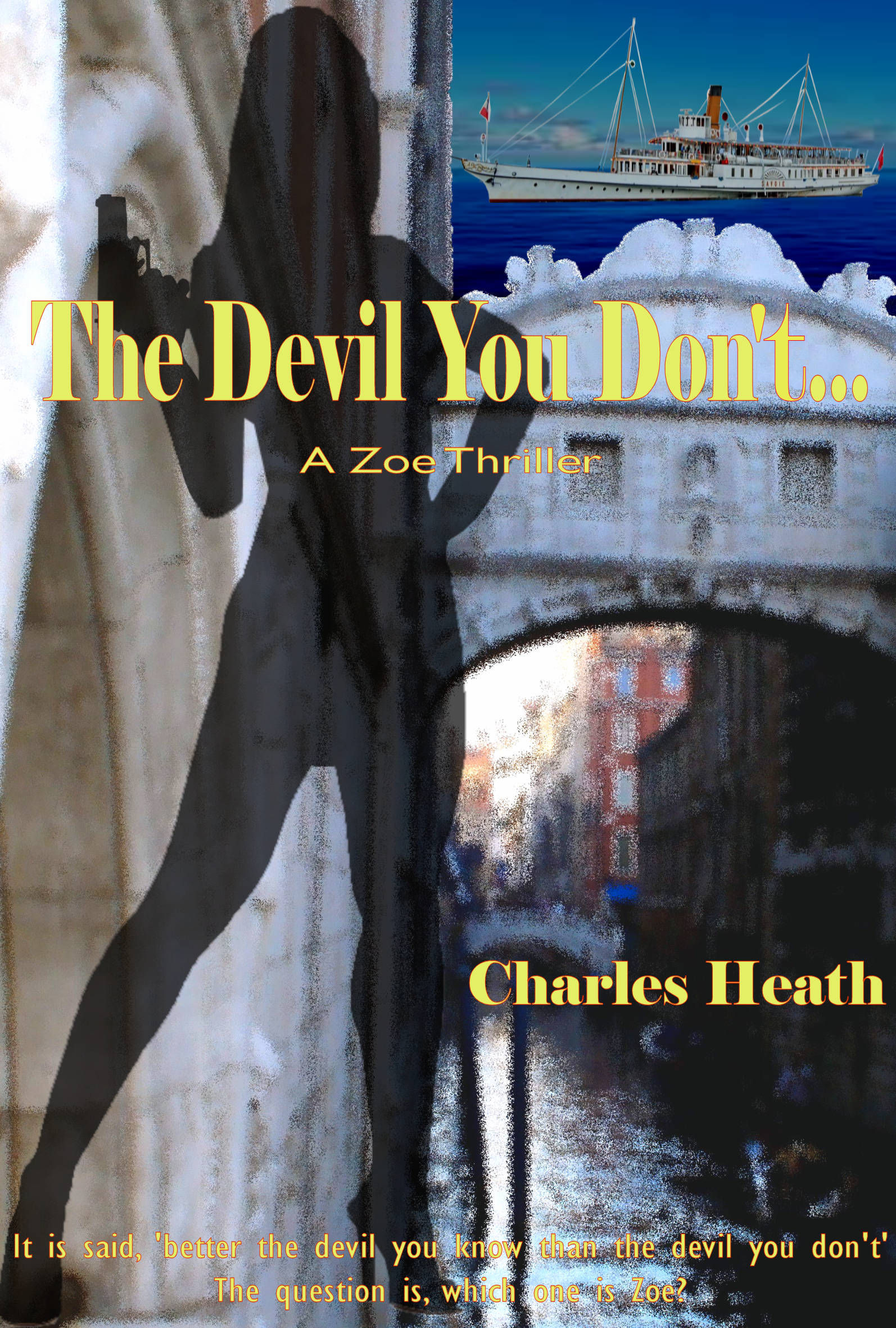
“The Devil You Don’t”, she was the girl you would not take home to your mother!

Now only $0.99 at https://amzn.to/2Xyh1ow

John Pennington’s life is in the doldrums. Looking for new opportunities, and prevaricating about getting married, the only joy on the horizon was an upcoming visit to his grandmother in Sorrento, Italy.

Suddenly he is left at the check-in counter with a message on his phone telling him the marriage is off, and the relationship is over.

If only he hadn’t promised a friend he would do a favour for him in Rome.

At the first stop, Geneva, he has a chance encounter with Zoe, an intriguing woman who captures his imagination from the moment she boards the Savoire, and his life ventures into uncharted territory in more ways than one.

That ‘favour’ for his friend suddenly becomes a life-changing event, and when Zoe, the woman who he knows is too good to be true, reappears, danger and death follow.

Shot at, lied to, seduced, and drawn into a world where nothing is what it seems, John is dragged into an adrenaline-charged undertaking, where he may have been wiser to stay with the ‘devil you know’ rather than opt for the ‘devil you don’t’.

newdevilcvr6

In a word: Bar

There’s more than one way … er, perhaps it’s better to say, there are many ways to use the word bar, which is not bad for a three-letter word.

Bar, the one you associate with drinks, in hotels, restaurants and we’ll, just bars.

Probably the best type of bar you might find me in is a Sports Bar, where you can snack on buffalo wings a tall glass of beer and watch with ice hockey in winter or baseball in summer.

It’s one I use from time to time when asked, what will we do, and the reply is often let’s go to a bar.  The best bars are underground, dark and dingy, full of eclectic people, with a band playing almost passable music or better still jazz

Bar, as in the legal variety

There are so many legal references to using bar, that the one that I am most familiar with is being admitted to the bar which means that you can now practice law.

Raising the bar, if that’s possible, where the bar is that imaginary level which offers sinks very low.  When someone says they’re going to try and raise the bar, you may be assured there will be a long battle ahead, simply because people generally find it hard to change.

Bar, as in we are not going to let you in here.  Yes, this is the irksome one where you find yourself, often for reasons unknown, barred from somewhere or something.  This may also be referred to by saying everyone may enter bar you.  

Bar, as in an iron bar, the sort that is sometimes used as a blunt force object by villains to remind the victim they owe any one of a loan shark, bookie or the mafia.  God help you if it is all three.

There are also iron bars of a different sort, those that are set in concrete outside a window most likely in a prison where the objective is to prevent escape.

It gives rise to an old expression, that person should be behind bars.

Then there is just a bar, such as a bar of gold, which I’m sure we’d all like to have stashed away, but not necessarily in the mattress, or the more common variety, a chocolate bar, which I have one now.  What’s your favorite?

And just to add to the list of meanings you can always refer to sashes or stripes as bars.

Confused?  Well, there’s still music, and the bane of yachtsmen, sand bars but I think we’ll leave it there.

Welcome to the English language