Writing a book in 365 days – 288

Day 288

The call of the weird…

The Call of the Weird: When an Oddball Writing Offer Knocks

As professional writers, we tend to operate within established lanes. Maybe you dominate B2B white papers, or you’re the wizard of lifestyle blogs, or perhaps your niche is technical documentation for the aerospace industry.

Then, one day, it happens.

The email arrives that makes your eyebrow twitch. It’s an offer to write something completely outside your experience—a script for a puppet show about quantum physics, a historical fiction piece told entirely from the perspective of moss, or maybe the manifesto for a highly niche, possibly fictitious, startup focused on sustainable moon mining.

This is the Oddball Offer. It’s wildly different, maybe a little intimidating, and possibly way “out there.”

The critical question immediately surfaces: What do you do? Do you politely decline and stick to what you know, or do you take the leap into the creative unknown?

Before you hit ‘archive’ or ‘accept,’ here is your professional roadmap for assessing and navigating those delightfully bizarre writing briefs.


1. Defining “Oddball”: The Initial Assessment

The first step is to categorize the offer. Not all unusual requests are equal.

A. The Niche Stretch

This type of offer is bizarre in subject matter but standard in format. (Example: Writing case studies about specialized farming equipment.) This is usually a safe bet. You apply your existing writing skill set to new content.

B. The Format Fluke

This is an offer that requires a totally new skill or output. (Example: You’re a blogger, and they want you to write a 12-act stage play.) This requires significant new learning and a pricing adjustment.

C. The Truly Out There (The “What Is This?”)

This is the offer that carries a real whiff of the bizarre, potentially involving questionable ethics, unknown legal territory, or simply a concept that seems too fringe to be real.

When you receive the email, strip away the novelty and ask yourself three key questions:

  1. Is the client legitimate? (Look up their company. Does it exist? Do they have a clear mission, even if that mission is strange?)
  2. Is the request morally or legally sound? (If the material is hateful, deceitful, or involves breaking laws, the answer is an immediate, firm “no.”)
  3. Does it require a time commitment I can afford to risk? (If it’s a massive project, the risk is higher.)

2. Addressing the Elephant: Is the Client Just Fishing for Ideas?

This is the most common fear when dealing with vague or highly creative briefs: the client wants free brainstorming, hoping you’ll deliver the “Aha!” concept they can then execute in-house or give to a cheaper writer.

If the client is vague, overly enthusiastic about “vision,” and hesitant to talk budget or milestones, this risk is high.

Strategy 1: Institute a Paid Discovery Phase

Never, under any circumstance, provide detailed concepts, outlines, or proprietary strategies for free. If the project requires heavy ideation, frame the initial engagement as a Paid Discovery Phase.

This might look like a single, fixed-rate consultation that includes:

  • A 60-minute strategy call.
  • One brief, non-transferable conceptual outline (200 words max).
  • A formal pricing structure for the full project.

If they won’t pay for the idea stage, they were almost certainly just fishing. If they balk, you’ve saved yourself hours of unpaid labor.

Strategy 2: Get an NDA Signed Immediately

If the project involves genuinely novel or proprietary concepts, protect yourself. Request a simple, standard Non-Disclosure Agreement (NDA) before you start sharing specific ideas on execution.

A serious client with a serious idea will not hesitate to sign an NDA. A client wary of intellectual property protection is likely trying to gather free resources.


3. The Professional Reckoning: Weighing the Risk vs. Reward

Assuming the offer is legitimate and you have protective measures in place, the decision comes down to the upside.

The Arguments FOR Taking the Oddball Offer

1. Portfolio Differentiation

This is perhaps the biggest win. A truly unique project provides “secret sauce” for your portfolio. If you’re trying to pivot or stand out from a crowded market, having a sample that no one else has—like a successful, funded Kickstarter campaign narrative for a wearable tech startup that monitors pigeon health—will get attention.

2. Higher Rates

Weird work often commands premium rates. Clients who need highly specialized or conceptual work know they can’t get it from a generalist. Their need is high, and your unusual ability to step up is valuable. Price the novelty, the complexity, and the risk appropriately.

3. Creative Expansion

Getting outside your comfort zone is good for your professional brain. It breaks up routine and prevents burnout. If you feel stale writing the same three types of articles, tackling the manifesto for a collective of subterranean mycologists might be the recharge you need.

The Arguments AGAINST Taking the Oddball Offer

1. Scope Creep and Ambiguity

Oddball projects, by their nature, lack standard precedents. The client may not know what they want, leading to endless revisions and a constantly shifting goalpost (Scope Creep). Before accepting, demand an ironclad Scope of Work (SOW) that clearly defines the deliverables, rounds of revision, and what “success” looks like.

2. Reputation Risk

If the project is deeply unconventional or touches on controversial elements (even if legitimate), consider if it could negatively impact your appeal to your core client base. If you primarily write for reputable financial institutions, perhaps writing the text for a speculative cryptocurrency art project might need careful consideration.

3. The Time Sink

Unique projects often require disproportionate research time. You may need to learn a new lexicon, a new industry, or a new format from scratch. Factor this extra research time into your pricing model.


4. Securing the Deal: Practical Steps for Proceeding

If you decide the reward outweighs the risk, proceed professionally and firmly:

  1. Define the SOW (Again, and in Detail): List exactly what you are writing (e.g., “5 blog posts, 800 words each, 2 rounds of revisions”). State what you are not doing (e.g., “Not responsible for graphic design or legal compliance review”).
  2. Demand a Deposit: For unique or speculative projects, a 50% upfront deposit is standard and non-negotiable. This protects you against the client disappearing after the first conceptual submission.
  3. Set Clear Boundaries: Communicate your communication style and availability clearly. Because the project is already unusual, managing expectations on process is vital.
  4. Embrace the Learning: Treat the research and concept generation as professional development. Even if the project fails, the knowledge you gain (e.g., how to format a technical comic book script) is now part of your toolkit.

Conclusion: Strategic Risk-Taking is the Writer’s Edge

The oddball offer is often not a distraction; it’s a test. It asks if you are adaptable, creatively courageous, and professional enough to manage complexity.

Don’t dismiss the weird simply because it’s unfamiliar. Instead, screen rigorously, protect your intellectual property fiercely, and if the client and concept pass the professional sniff test, take the leap.

Stepping way ‘out there’ is sometimes the only way to find your next, most lucrative, and most fascinating niche. Happy writing!

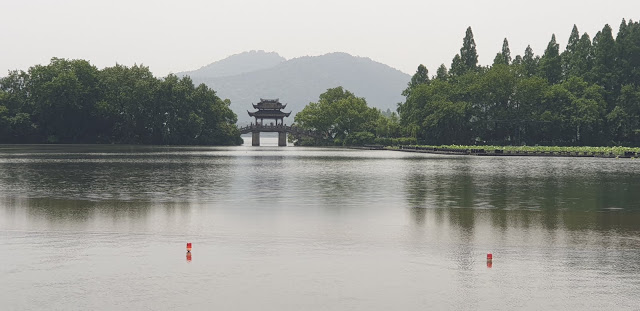
Searching for locations: West Lake, Hangzhou, China

West Lake is a freshwater lake in Hangzhou, China. It is divided into five sections by three causeways. There are numerous temples, pagodas, gardens, and artificial islands within the lake.

Measuring 3.2 kilometers (2 miles) in length, 2.8 kilometers (1.7 miles) in width, and 2.3 meters (7.5 feet) in average depth, the lake spreads itself in an area totaling 6.5 square kilometers (2.5 square miles).

The earliest recorded name for West Lake was the “Wu Forest River”, but over time it changed to two distinct names.  One is “Qiantang Lake”, due to the fact that Hangzhou was called “Qiantang” in ancient times.  The other, “West Lake”, due to the lake being west of the city

It’s about to get busy, with a number of activities planned, and the warmth of the day is starting to make an impact.

The tour starts in the car park about a kilometer away, but the moment we left the car park we were getting a taste of the park walking along a tree-lined avenue.

When we cross the road, once again dicing with death with the silent assassins on motor scooters.

We are in the park proper, and it is magnificent, with flowers, mostly at the start hydrangeas and then any number of other trees and shrubs, some carved into other flower shapes like a lotus.

Then there was the lake and the backdrop of bridges and walkways.

.

And if you can tune out the background white noise the place would be great for serenity and relaxation.

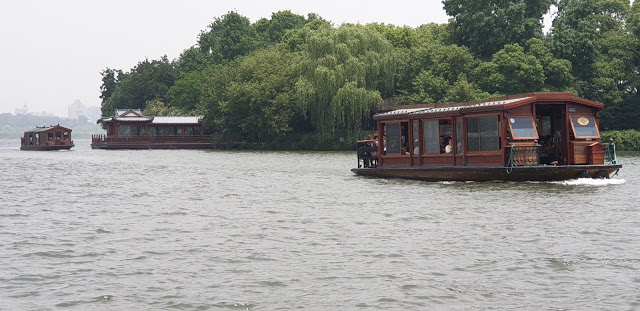
That, in fact, was how the boat ride panned out, about half an hour or more gliding across the lake in an almost silent boat, by an open window, with the air and the majestic scenery.

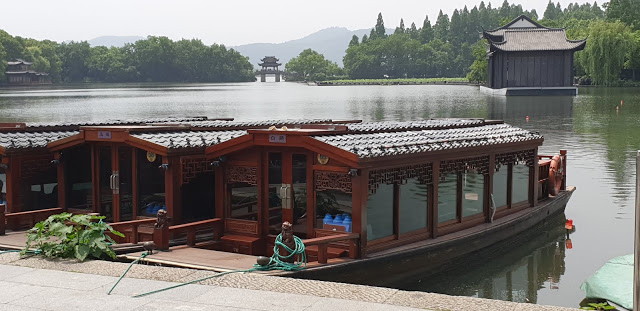
No, not that boat, which would be great to have lunch on while cruising, but the boat below:

Not quite in the same class, but all the same, very easy to tune out and soak it in.

It was peaceful, amazingly quiet, on a summery day

A pagoda in the hazy distance, an island we were about to circumnavigate.

Of all the legends, the most touching one is the love story between Bai Suzhen and Xu Xi’an. Bai Suzhen was a white snake spirit and Xu Xi’an was a mortal man.

They fell in love when they first met on a boat on the West Lake, and got married very soon after.

However, the evil monk Fa Hai attempted to separate the couple by imprisoning Xu Xi’an. Bai Suzhen fought against Fa Hai and tried her best to rescue her husband, but she failed and was imprisoned under the Leifeng Pagoda by the lake.

Years later the couple was rescued by Xiao Qing, the sister of Baisuzhen, and from then on, Bai Suzhen and Xu Xi’an lived together happily.

The retelling of the story varied between tour guides, and on the cruise boat, we had two.  Our guide kept to the legend, the other tour guide had a different ending.

Suffice to say it had relevance to the two pagodas on the far side of the lake.

There was a cafe or restaurant on the island, but that was not our lunch destination.

Nor were the buildings further along from where we disembarked.

All in all the whole cruise took about 45 minutes and was an interesting break from the hectic nature of the tour.

Oh yes, and the boat captain had postcards for sale.  We didn’t buy any.

Lunch

At the disembarkation point there was a mall that sold souvenirs and had a few ‘fast food’ shops, and a KFC, not exactly what we came to China for, but it seemed like the only place in town a food cautious Australian could eat at.

And when tried to get in the door, that’s where at least 3 busloads were, if they were not in the local Starbucks.  Apparently, these were the places of first choice wherever we went.

The chicken supply by the time we got to the head of the line amounted to pieces at 22.5 RMB a piece and nuggets.  Everything else had run out, and for me, there were only 5 pieces left.  Good thing there were chips.

And Starbucks with coffee and cheesecake.

At least the setting for what could have been a picnic lunch was idyllic.

What I learned about writing – History was a very useful subject

The Unexpected Power of the Past: Why I Wish I’d Paid More Attention to History

Remember those days in school? The ones where you’d stare out the window, convinced that the dates, names, and dusty battles of history held absolutely no relevance to your future life? Yeah, me too. I vaguely recall thinking of history as one of the most… well, let’s be honest, frankly boring subjects. It felt like a relentless parade of facts, disconnected from the vibrant, fast-paced world I was eager to dive into.

Oh, how wrong I was.

It’s a sentiment that echoes in my mind with surprising frequency now: “If only I knew that history would be very useful later on!” It’s a wistful sigh, a gentle kick to the past-self who was too busy dreaming of the future to appreciate the profound wisdom etched into the past.

We often dismiss history as something purely academic, confined to textbooks and the occasional documentary. But what if we’d approached it differently? What if, instead of passively absorbing dates, we’d actively engaged with it? What if we’d decided that we were going to write historical fiction?

Imagine that classroom. Instead of rote memorization, we’re crafting narratives. We’re stepping into the shoes of a Roman centurion, feeling the grit of the battlefield. We’re whispering secrets in the court of Queen Elizabeth I, navigating the treacherous currents of power. We’re experiencing the roaring twenties, the anxieties of the Cold War, the seismic shifts of revolutions not as abstract concepts, but as lived human experiences.

This shift in perspective would have been transformative. Historical fiction isn’t just about “what happened.” It’s about why it happened. It’s about the motivations, the fears, the hopes, and the inherent humanity of people who lived in vastly different circumstances. When you build a story, you have to understand the context – the social norms, the technological limitations, the prevailing ideologies, the everyday struggles. You have to delve into the human condition across time.

And that, my friends, is where the true usefulness of history lies. It’s a masterclass in human behavior. It’s a vast repository of triumphs and failures, of brilliant innovations and tragic missteps. It’s a constant reminder that while the technology and the fashion may change, the fundamental drivers of human action – love, greed, ambition, loyalty, fear – remain remarkably consistent.

If we had approached history with the intention of building compelling stories, we would have been forced to:

  • Develop Empathy: Understanding a character from a different era requires stepping outside our modern biases and trying to see the world through their eyes.
  • Hone Research Skills: Crafting believable historical fiction demands digging deep, verifying details, and understanding the nuances of a period.
  • Grasp Cause and Effect: Every event in history has a chain reaction. Writing fiction forces you to understand these connections and how actions ripple through time.
  • Appreciate Complexity: History is rarely black and white. Fiction demands exploring ethical dilemmas and the grey areas of human decision-making.
  • See Patterns: Recognizing recurring themes and patterns in human history helps us understand the present and anticipate potential futures.

Looking back, it feels like a missed opportunity. We were given the tools to understand so much about ourselves and our world, but perhaps we lacked the imagination to see their true potential. “If only we were smarter then than now!” This isn’t about regret, but about a newfound appreciation. It’s about recognizing that the seemingly dry facts of history are the building blocks of understanding, the raw material for compelling narratives, and a profound guide to navigating the complexities of human existence.

So, if you’re still in school, or even if you’re looking for a new way to engage with the past, consider this: don’t just learn history, feel it. Imagine the stories waiting to be uncovered. Because you never know when that forgotten historical tidbit might just unlock a crucial insight, or inspire your next great idea. The past isn’t dead; it’s just waiting for us to tell its story.

“Echoes From The Past”, the past doesn’t necessarily stay there


What happens when your past finally catches up with you?

Christmas is just around the corner, a time to be with family. For Will Mason, an orphan since he was fourteen, it is a time for reflection on what his life could have been, and what it could be.

Until a chance encounter brings back to life the reasons for his twenty years of self-imposed exile from a life only normal people could have. From that moment Will’s life slowly starts to unravel and it’s obvious to him it’s time to move on.

This time, however, there is more at stake.

Will has broken his number one rule, don’t get involved.

With his nemesis, Eddie Jamieson, suddenly within reach, and a blossoming relationship with an office colleague, Maria, about to change everything, Will has to make a choice. Quietly leave, or finally, make a stand.

But as Will soon discovers, when other people are involved there is going to be terrible consequences no matter what choice he makes.

https://amzn.to/2CYKxu4

newechocover5rs

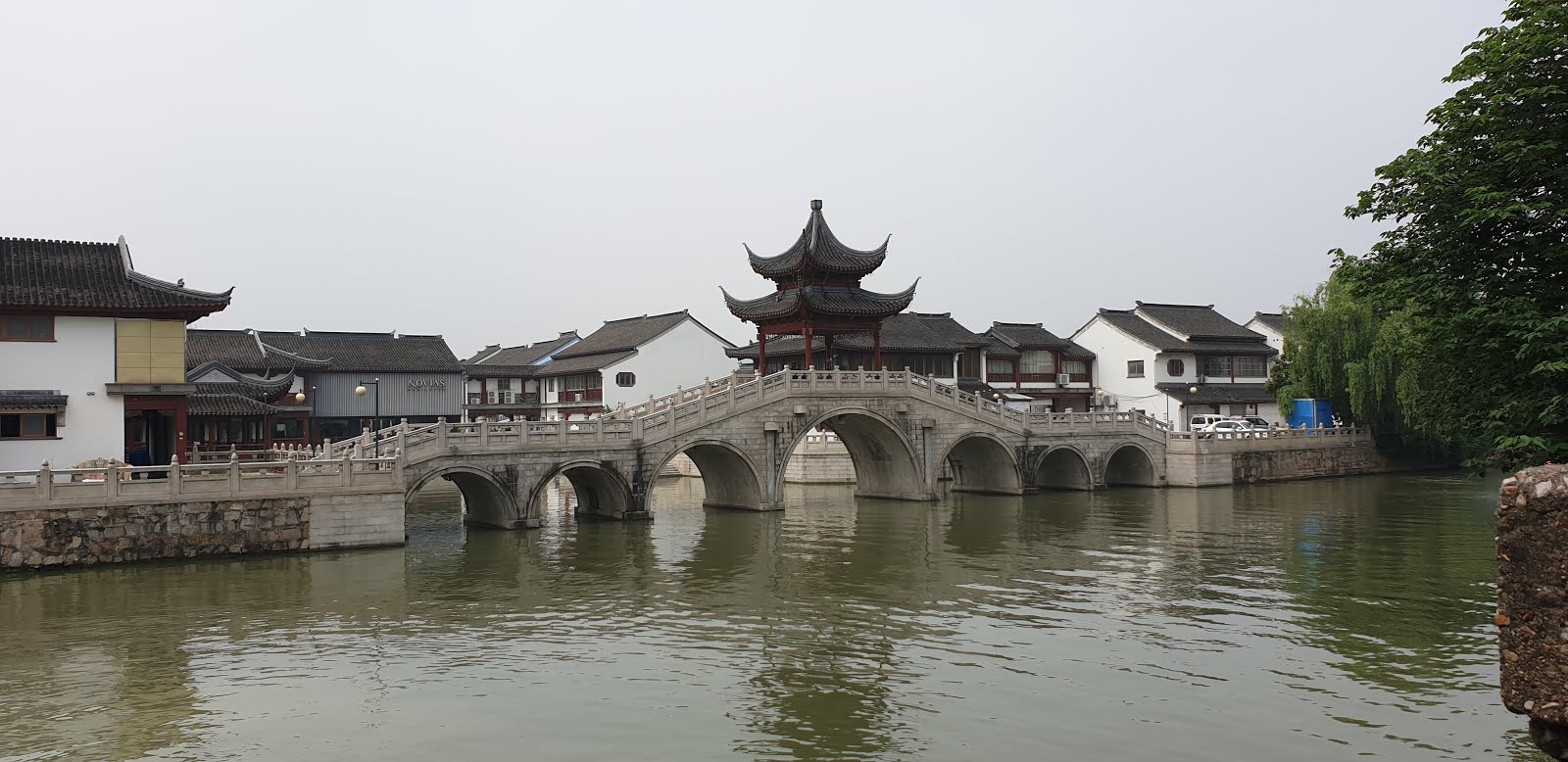
Searching for locations: The canals of Suzhou, China

This morning is a boat ride that will take us along a small portion of the main canal, and we head through a number of back streets, to a landing where there are a number of boats all vying with each other to get us passengers on boats.

But…

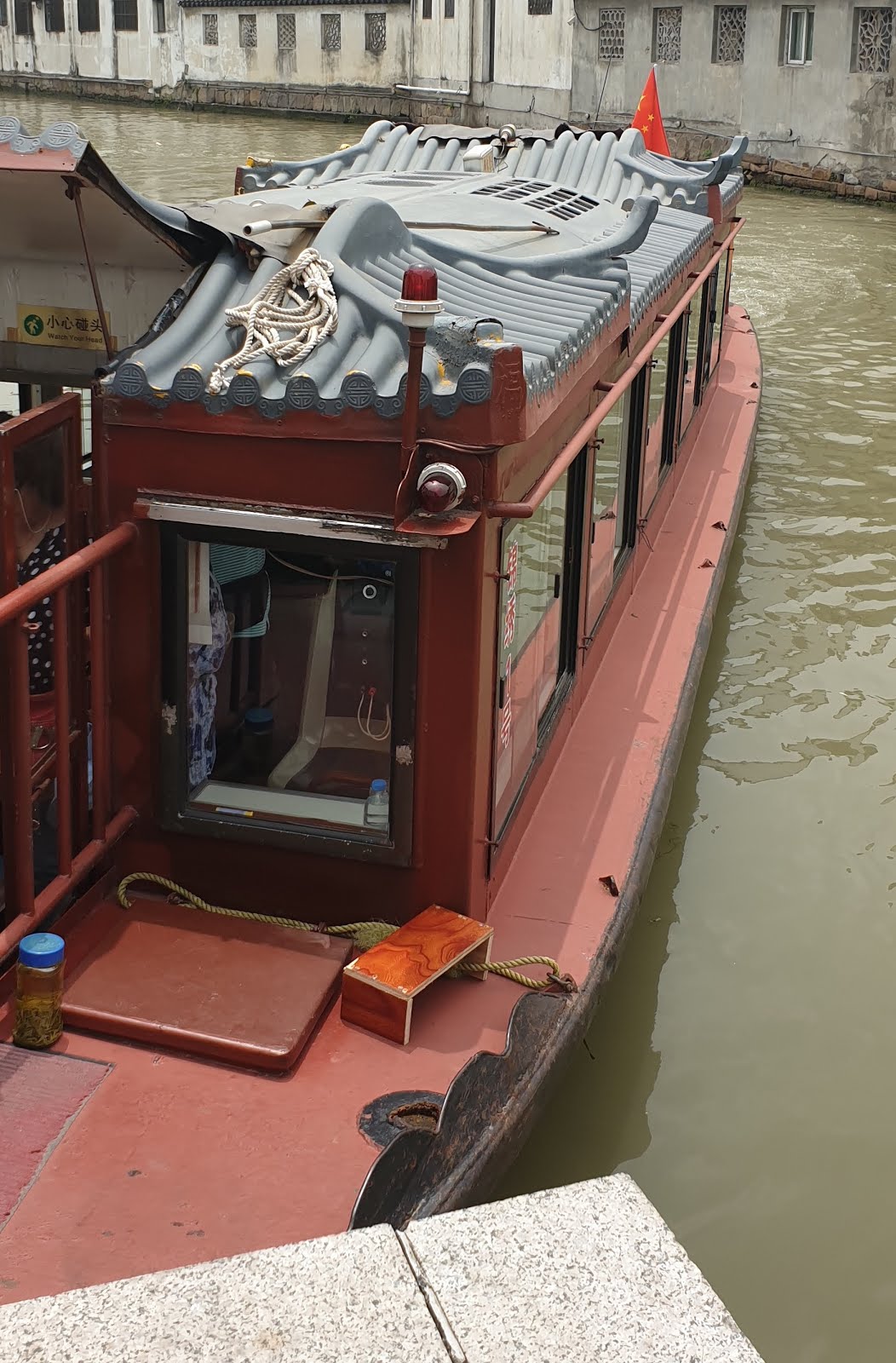
These boats don’t have a wharf to tie up to and then put out a stable gangplank.  No.  They just more into a concrete step and you take your life in your hands getting on.  One wrong step and you’re in the canal.  And not a very clean one at that.

That’s if another boat doesn’t come along and bumps you, knocking you off balance.  We managed not to lose anyone in boarding the vessel.

This is where we get on the boat

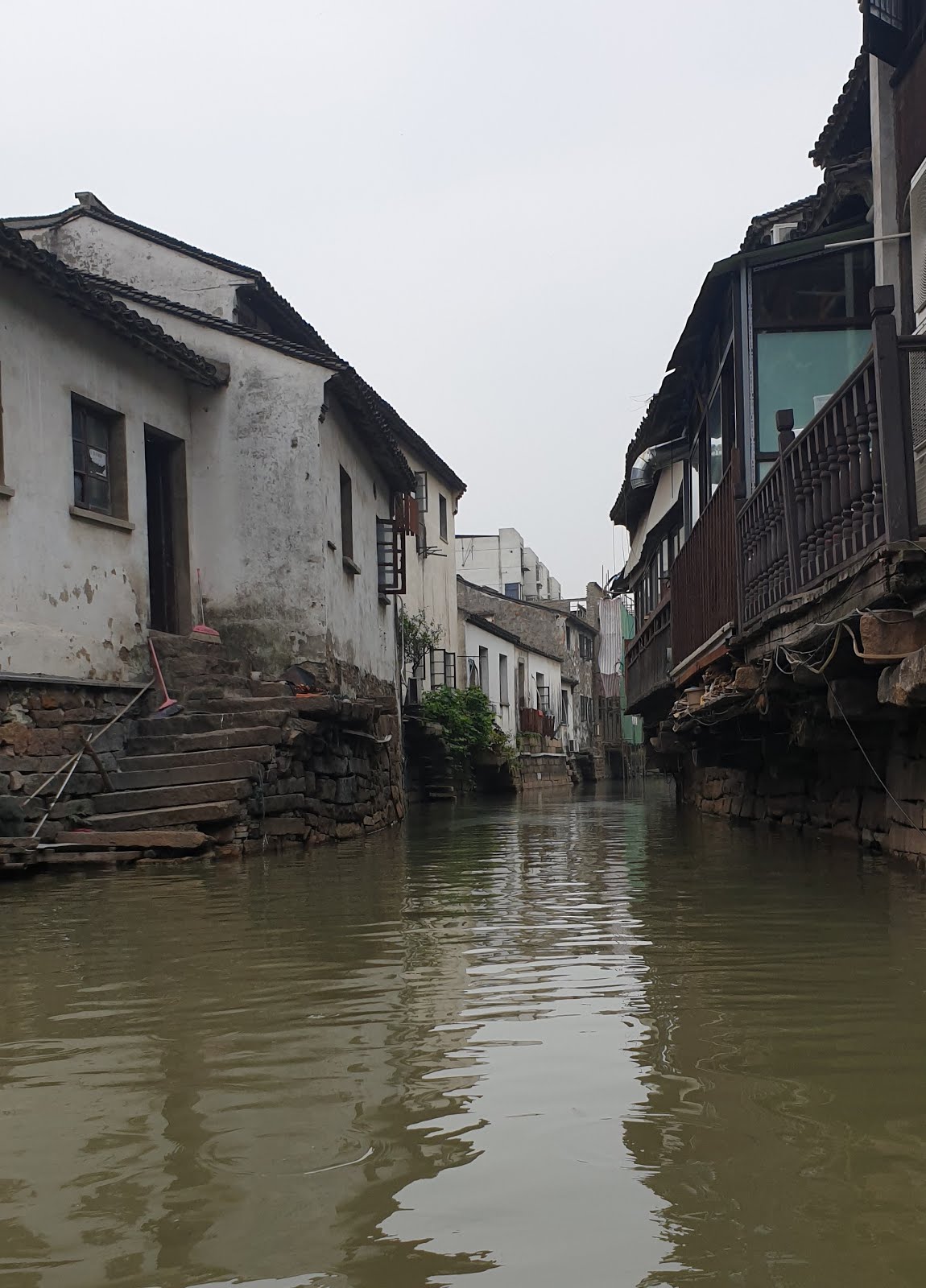
We go along what appears to be downstream towards another larger canal, past tree-lined streets until the canal narrows and we’re looking at the backs of houses, which look very dilapidated.

And the canals?  Well, it’s not quite like it is in Venice

Though some parts of the canal look better than others

What doesn’t bear thinking about is the electrical wiring which is a nightmarish spider web of cables going off in all directions.  How anyone could troubleshoot problems is beyond me.

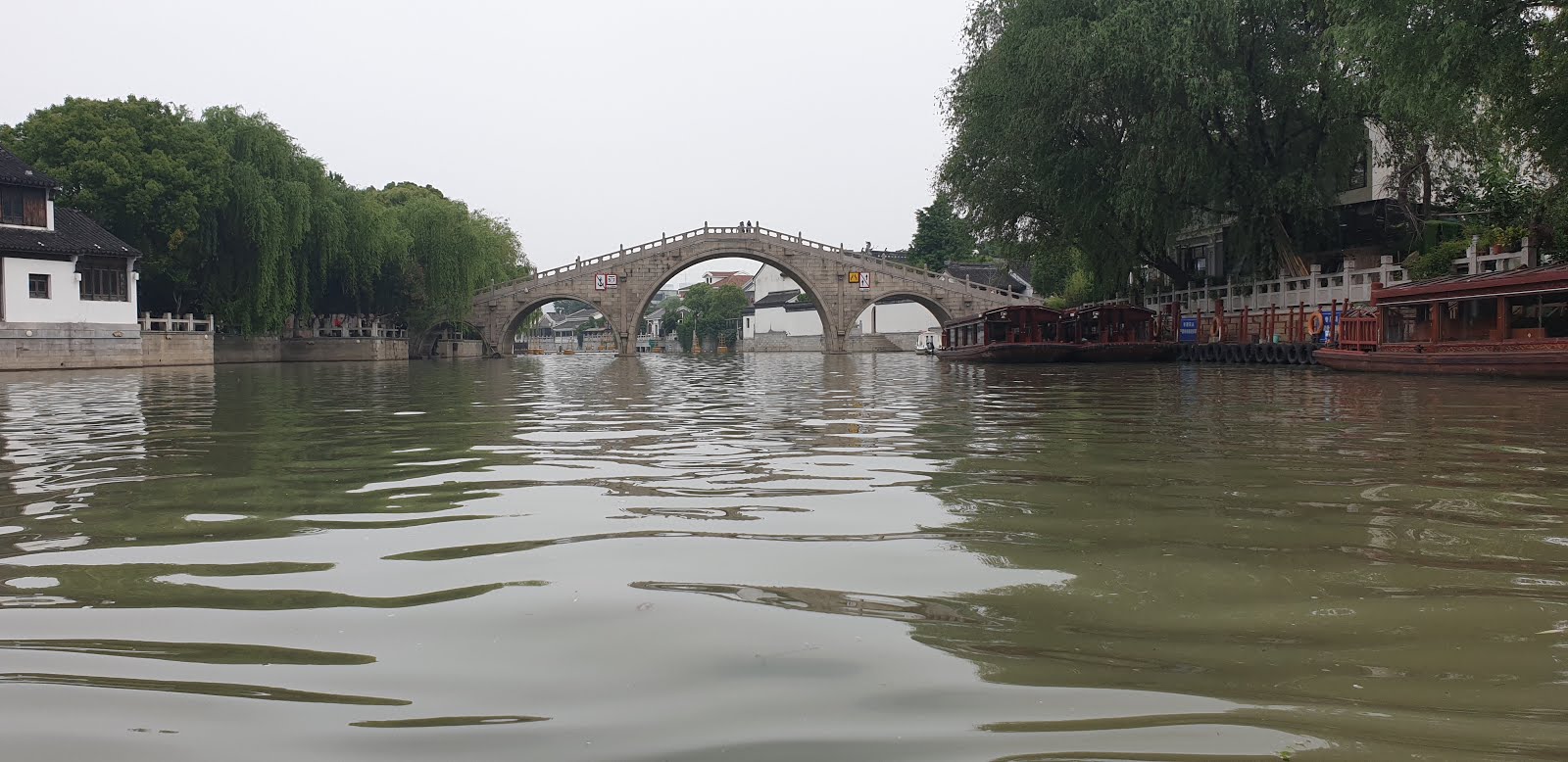
We pass under a number of bridges, and then, about 30 minutes after leaving, we reach a larger canal and do a 180-degree turn, and head back to a drop off point the will enable us to walk through a typical everyday Chinese market for food and the other items.

This drop off point is much the same as the starting point, a concrete step which is as hazardous as the first.  At least we don’t have to compete with other boats for the landing spot.

We take a leisurely stroll down a small section of Pingjiang Road with small shops on either side, selling all manner of goods

but my interest is in the food and the prices, which at times seem quite expensive for so-called local people, so maybe because the tourists go down this street every day, the prices have been inflated accordingly.

I find it rather disappointing.

We walk to the bridge, go under to the other side crossing the canal and find the coffee shop which is also the meeting place.

So…

When is a coffee shop not a coffee shop, when it takes an eternity to make a cup of coffee, we waited 25 minutes?

We also ordered beef black pepper rice and it took 20 minutes before it arrived, but it was well worth the wait.  Strands of perfectly cooked beef with onion, carrot, and capsicum, with a very peppery and spicy sauce, with a side of boiled rice.

A pizza was ordered too but it did not arrive at all before we left.

An excerpt from “What Sets Us Apart”, a mystery with a twist

See the excerpt from the story below, just a taste of what’s in store…

http://amzn.to/2Eryfth

whatsetscover

McCallister was old school, a man who would most likely fit in perfectly campaigning on the battlefields of Europe during the Second World War. He’d been like a fish out of water in the army, post-Falklands, and while he retired a hero, he still felt he’d more to give.

He’d applied and was accepted as head of a SWAT team, and, watching him now as he and his men disembarked from the truck in almost military precision, a look passed between Annette, the police liaison officer, and I that said she’d seen it all before. I know I had.

There was a one in four chance his team would be selected for this operation, and she had been hoping it would be one of the other three. While waiting for them to arrive she filled me in on the various teams. His was the least co-operative, and the more likely to make ad-hoc decisions rather than adhere to the plan, or any orders that may come from the officer in charge.

This, she said quite bluntly, was going to end badly.

I still had no idea why Prendergast instructed me to attend the scene of what looked to be a normal domestic operation, but as the nominated expert in the field in these types of situations, it was fairly clear he wasn’t taking any chances. It was always a matter of opinion between us, and generally I lost.

In this case, it was an anonymous report identifying what the authorities believed were explosives in one of the dockside sheds where explosives were not supposed to be.

The only reason why the report was given any credence was the man, while not identifying himself by name, said he’d been an explosive expert once and recognized the boxes. That could mean anything, but the Chief Constable was a cautious man.

With his men settled and preparing their weapons, McCallister came over to the command post, not much more than the SUV my liaison and I arrived in, with weapons, bulletproof vests, and rolls of tape to cordon off the area afterward. We both had coffee, steaming in the cold early morning air. Dawn was slowly approaching and although rain had been forecast it had yet to arrive.

A man by the name of Benson was in charge. He too had groaned when he saw McCallister.

“A fine morning for it.” McCallister was the only enthusiastic one here.

He didn’t say what ‘it’ was, but I thought it might eventually be mayhem.

“Let’s hope the rain stays away. It’s going to be difficult enough without it,” Benson said, rubbing his hands together. We had been waiting for the SWAT team to arrive, and another team to take up their position under the wharf, and who was in the final stages of securing their position.

While we were waiting we drew up the plan. I’d go in first to check on what we were dealing with, and what type of explosives. The SWAT team, in the meantime, were to ensure all the exits to the shed were covered. When I gave the signal, they were to enter and secure the building. We were not expecting anyone inside or out, and no movement had been detected in the last hour since our arrival and deployment.

“What’s the current situation?”

“I’ve got eyes on the building, and a team coming in from the waterside, underneath. Its slow progress, but they’re nearly there. Once they’re in place, we’re sending McKenzie in.”

He looked in my direction.

“With due respect sir, shouldn’t it be one of us?” McCallister glared at me with the contempt that only a decorated military officer could.

“No. I have orders from above, much higher than I care to argue with, so, McCallister, no gung-ho heroics for the moment. Just be ready to move on my command, and make sure you have three teams at the exit points, ready to secure the building.”

McCallister opened his mouth, no doubt to question those orders, but instead closed it again. “Yes sir,” he muttered and turned away heading back to his men.

“You’re not going to have much time before he storms the battlements,” Benson quietly said to me, a hint of exasperation in his tone. “I’m dreading the paperwork.”

It was exactly what my liaison officer said when she saw McCallister arriving.

The water team sent their ‘in position’ signal, and we were ready to go.

In the hour or so we’d been on site nothing had stirred, no arrivals, no departures, and no sign anyone was inside, but that didn’t mean we were alone. Nor did it mean I was going to walk in and see immediately what was going on. If it was a cache of explosives then it was possible the building was booby-trapped in any number of ways, there could be sentries or guards, and they had eyes on us, or it might be a false alarm.

I was hoping for the latter.

I put on the bulletproof vest, thinking it was a poor substitute for full battle armor against an exploding bomb, but we were still treating this as a ‘suspected’ case. I noticed my liaison officer was pulling on her bulletproof vest too.

“You don’t have to go. This is my party, not yours,” I said.

“The Chief Constable told me to stick to you like glue, sir.”

I looked at Benson. “Talk some sense into her please, this is not a kindergarten outing.”

He shrugged. Seeing McCallister had taken all the fight out of him. “Orders are orders. If that’s what the Chief Constable requested …”

Madness. I glared at her, and she gave me a wan smile. “Stay behind me then, and don’t do anything stupid.”

“Believe me, I won’t be.” She pulled out and checked her weapon, chambering the first round. It made a reassuring sound.

Suited up, weapons readied, a last sip of the coffee in a stomach that was already churning from nerves and tension, I looked at the target, one hundred yards distant and thought it was going to be the longest hundred yards I’d ever traversed. At least for this week.

A swirling mist rolled in and caused a slight change in plans.

Because the front of the buildings was constantly illuminated by large overhead arc lamps, my intention had been to approach the building from the rear where there was less light and more cover. Despite the lack of movement, if there were explosives in that building, there’d be ‘enemy’ surveillance somewhere, and, after making that assumption, I believed it was going to be easier and less noticeable to use the darkness as a cover.

It was a result of the consultation, and studying the plans of the warehouse, plans that showed three entrances, the main front hangar type doors, a side entrance for truck entry and exit and a small door in the rear, at the end of an internal passage leading to several offices. I also assumed it was the exit used when smokers needed a break. Our entry would be by the rear door or failing that, the side entrance where a door was built into the larger sliding doors. In both cases, the locks would not present a problem.

The change in the weather made the approach shorter, and given the density of the mist now turning into a fog, we were able to approach by the front, hugging the walls, and moving quickly while there was cover. I could feel the dampness of the mist and shivered more than once.

It was nerves more than the cold.

I could also feel rather than see the presence of Annette behind me, and once felt her breath on my neck when we stopped for a quick reconnaissance.

It was the same for McCallister’s men. I could feel them following us, quickly and quietly, and expected, if I turned around, to see him breathing down my neck too.

It added to the tension.

My plan was still to enter by the back door.

We slipped up the alley between the two sheds to the rear corner and stopped. I heard a noise coming from the rear of the building, and the light tap on the shoulder told me Annette had heard it too. I put my hand up to signal her to wait, and as a swirl of mist rolled in, I slipped around the corner heading towards where I’d last seen the glow of a cigarette.

The mist cleared, and we saw each other at the same time. He was a bearded man in battle fatigues, not the average dockside security guard.

He was quick, but my slight element of surprise was his undoing, and he was down and unconscious in less than a few seconds with barely a sound beyond the body hitting the ground. Zip ties secured his hands and legs, and tape his mouth. Annette joined me a minute after securing him.

A glance at the body then me, “I can see why they, whoever they are, sent you.”

She’d asked who I worked for, and I didn’t answer. It was best she didn’t know.

“Stay behind me,” I said, more urgency in my tone. If there was one, there’d be another.

Luck was with us so far. A man outside smoking meant no booby traps on the back door, and quite possibly there’d be none inside. But it indicated there were more men inside, and if so, it appeared they were very well trained. If that were the case, they would be formidable opponents.

The fear factor increased exponentially.

I slowly opened the door and looked in. A pale light shone from within the warehouse itself, one that was not bright enough to be detected from outside. None of the offices had lights on, so it was possible they were vacant. I realized then they had blacked out the windows. Why hadn’t someone checked this?

Once inside, the door closed behind us, progress was slow and careful. She remained directly behind me, gun ready to shoot anything that moved. I had a momentary thought for McCallister and his men, securing the perimeter.

At the end of the corridor, the extent of the warehouse stretched before us. The pale lighting made it seem like a vast empty cavern, except for a long trestle table along one side, and, behind it, stacks of wooden crates, some opened. It looked like a production line.

To get to the table from where we were was a ten-yard walk in the open. There was no cover. If we stuck to the walls, there was equally no cover and a longer walk.

We needed a distraction.

As if on cue, the two main entrances disintegrated into flying shrapnel accompanied by a deafening explosion that momentarily disoriented both Annette and I. Through the smoke and dust kicked up I saw three men appear from behind the wooden crates, each with what looked like machine guns, spraying bullets in the direction of the incoming SWAT members.

They never had a chance, cut down before they made ten steps into the building.

By the time I’d recovered, my head heavy, eyes watering and ears still ringing, I took several steps towards them, managing to take down two of the gunmen but not the third.

I heard a voice, Annette’s I think, yell out, “Oh, God, he’s got a trigger,” just before another explosion, though all I remember in that split second was a bright flash, the intense heat, something very heavy smashing into my chest knocking the wind out of me, and then the sensation of flying, just before I hit the wall.

I spent four weeks in an induced coma, three months being stitched back together and another six learning to do all those basic actions everyone took for granted. It was twelve months almost to the day when I was released from the hospital, physically, except for a few alterations required after being hit by shrapnel, looking the same as I always had.

But mentally? The document I’d signed on release said it all, ‘not fit for active duty; discharged’.

It was in the name of David Cheney. For all intents and purposes, Alistair McKenzie was killed in that warehouse, and for the first time ever, an agent left the Department, the first to retire alive.

I was not sure I liked the idea of making history.

© Charles Heath 2016-2020

Writing a book in 365 days – 288

Day 288

The call of the weird…

The Call of the Weird: When an Oddball Writing Offer Knocks

As professional writers, we tend to operate within established lanes. Maybe you dominate B2B white papers, or you’re the wizard of lifestyle blogs, or perhaps your niche is technical documentation for the aerospace industry.

Then, one day, it happens.

The email arrives that makes your eyebrow twitch. It’s an offer to write something completely outside your experience—a script for a puppet show about quantum physics, a historical fiction piece told entirely from the perspective of moss, or maybe the manifesto for a highly niche, possibly fictitious, startup focused on sustainable moon mining.

This is the Oddball Offer. It’s wildly different, maybe a little intimidating, and possibly way “out there.”

The critical question immediately surfaces: What do you do? Do you politely decline and stick to what you know, or do you take the leap into the creative unknown?

Before you hit ‘archive’ or ‘accept,’ here is your professional roadmap for assessing and navigating those delightfully bizarre writing briefs.


1. Defining “Oddball”: The Initial Assessment

The first step is to categorize the offer. Not all unusual requests are equal.

A. The Niche Stretch

This type of offer is bizarre in subject matter but standard in format. (Example: Writing case studies about specialized farming equipment.) This is usually a safe bet. You apply your existing writing skill set to new content.

B. The Format Fluke

This is an offer that requires a totally new skill or output. (Example: You’re a blogger, and they want you to write a 12-act stage play.) This requires significant new learning and a pricing adjustment.

C. The Truly Out There (The “What Is This?”)

This is the offer that carries a real whiff of the bizarre, potentially involving questionable ethics, unknown legal territory, or simply a concept that seems too fringe to be real.

When you receive the email, strip away the novelty and ask yourself three key questions:

  1. Is the client legitimate? (Look up their company. Does it exist? Do they have a clear mission, even if that mission is strange?)
  2. Is the request morally or legally sound? (If the material is hateful, deceitful, or involves breaking laws, the answer is an immediate, firm “no.”)
  3. Does it require a time commitment I can afford to risk? (If it’s a massive project, the risk is higher.)

2. Addressing the Elephant: Is the Client Just Fishing for Ideas?

This is the most common fear when dealing with vague or highly creative briefs: the client wants free brainstorming, hoping you’ll deliver the “Aha!” concept they can then execute in-house or give to a cheaper writer.

If the client is vague, overly enthusiastic about “vision,” and hesitant to talk budget or milestones, this risk is high.

Strategy 1: Institute a Paid Discovery Phase

Never, under any circumstance, provide detailed concepts, outlines, or proprietary strategies for free. If the project requires heavy ideation, frame the initial engagement as a Paid Discovery Phase.

This might look like a single, fixed-rate consultation that includes:

  • A 60-minute strategy call.
  • One brief, non-transferable conceptual outline (200 words max).
  • A formal pricing structure for the full project.

If they won’t pay for the idea stage, they were almost certainly just fishing. If they balk, you’ve saved yourself hours of unpaid labor.

Strategy 2: Get an NDA Signed Immediately

If the project involves genuinely novel or proprietary concepts, protect yourself. Request a simple, standard Non-Disclosure Agreement (NDA) before you start sharing specific ideas on execution.

A serious client with a serious idea will not hesitate to sign an NDA. A client wary of intellectual property protection is likely trying to gather free resources.


3. The Professional Reckoning: Weighing the Risk vs. Reward

Assuming the offer is legitimate and you have protective measures in place, the decision comes down to the upside.

The Arguments FOR Taking the Oddball Offer

1. Portfolio Differentiation

This is perhaps the biggest win. A truly unique project provides “secret sauce” for your portfolio. If you’re trying to pivot or stand out from a crowded market, having a sample that no one else has—like a successful, funded Kickstarter campaign narrative for a wearable tech startup that monitors pigeon health—will get attention.

2. Higher Rates

Weird work often commands premium rates. Clients who need highly specialized or conceptual work know they can’t get it from a generalist. Their need is high, and your unusual ability to step up is valuable. Price the novelty, the complexity, and the risk appropriately.

3. Creative Expansion

Getting outside your comfort zone is good for your professional brain. It breaks up routine and prevents burnout. If you feel stale writing the same three types of articles, tackling the manifesto for a collective of subterranean mycologists might be the recharge you need.

The Arguments AGAINST Taking the Oddball Offer

1. Scope Creep and Ambiguity

Oddball projects, by their nature, lack standard precedents. The client may not know what they want, leading to endless revisions and a constantly shifting goalpost (Scope Creep). Before accepting, demand an ironclad Scope of Work (SOW) that clearly defines the deliverables, rounds of revision, and what “success” looks like.

2. Reputation Risk

If the project is deeply unconventional or touches on controversial elements (even if legitimate), consider if it could negatively impact your appeal to your core client base. If you primarily write for reputable financial institutions, perhaps writing the text for a speculative cryptocurrency art project might need careful consideration.

3. The Time Sink

Unique projects often require disproportionate research time. You may need to learn a new lexicon, a new industry, or a new format from scratch. Factor this extra research time into your pricing model.


4. Securing the Deal: Practical Steps for Proceeding

If you decide the reward outweighs the risk, proceed professionally and firmly:

  1. Define the SOW (Again, and in Detail): List exactly what you are writing (e.g., “5 blog posts, 800 words each, 2 rounds of revisions”). State what you are not doing (e.g., “Not responsible for graphic design or legal compliance review”).
  2. Demand a Deposit: For unique or speculative projects, a 50% upfront deposit is standard and non-negotiable. This protects you against the client disappearing after the first conceptual submission.
  3. Set Clear Boundaries: Communicate your communication style and availability clearly. Because the project is already unusual, managing expectations on process is vital.
  4. Embrace the Learning: Treat the research and concept generation as professional development. Even if the project fails, the knowledge you gain (e.g., how to format a technical comic book script) is now part of your toolkit.

Conclusion: Strategic Risk-Taking is the Writer’s Edge

The oddball offer is often not a distraction; it’s a test. It asks if you are adaptable, creatively courageous, and professional enough to manage complexity.

Don’t dismiss the weird simply because it’s unfamiliar. Instead, screen rigorously, protect your intellectual property fiercely, and if the client and concept pass the professional sniff test, take the leap.

Stepping way ‘out there’ is sometimes the only way to find your next, most lucrative, and most fascinating niche. Happy writing!

PI Walthenson’s second case – A case of finding the ‘Flying Dutchman’.

Known only to a few, there is a legend that a ship named the ‘Flying Dutchman’ left Nazi Germany in the last weeks of the war and set sail for America, escorted by U-boats, under a different name. Aboard was a trove of treasure and gold worth a ‘king’s ransom’.

It was said that it had been sent to a group of American Nazis to create the Fourth Reich at an appropriate time. Over the years since many expeditions off the coast had searched, but found no trace of the vessel or the treasure.

In other words, it was just a legend created to boost tourism.

Fast forward to 2024. Our intrepid private detective, Harry Walthenson, overhears a conversation at Grand Central Station. It was the oddness of the message that caught his attention. An investigation turned up nothing out of the ordinary, and he thinks no more about it.

Then Harry is kidnapped, interrogated, and asked questions over and over about a date and a place, why he went there, and when he could not give satisfactory answers, he was beaten half to death and left for dead on a rubbish heap. He was lucky that it was a living space for homeless men; otherwise, he would have died.

In the aftermath, he once again gives it no more thought.

After resolving his first case successfully, there’s no rest. Harry’s angry mother comes to his office and demands that he find out where his father has gone. She believes he has run off with a mistress, not for the first time.

Perhaps it was not the wisest decision she has made, because Harry promises to investigate, and adds that she might not like what he finds.

He soon discovered he does not like what he finds, that his father’s friends, a cabal formed at University, have two who are his mother’s current lovers, and another, a criminal blackmailing his father.

Felicity, now his partner, working on a different case, and trying to get answers, uncovers a crime family involved in guarding a disused warehouse on the docks, where she believes Harry had been taken for interrogation, and subsequently dumped nearby to die.

Why are they up to? What is so important that the empty warehouse needs guarding? Who is employing them?

Harry, following up on the death of the blackmailer, traces his death back to an enforcer employed by his grandfather. His mother’s grandfather was a pre-war industrialist who made his fortune in war munitions and shipbuilding.

He was also a member of the American Nazi party.

When Harry also discovers a logbook belonging to a so-called wartime Liberty ship the “Paul Revere” in brackets ‘Freiheitskämpfer’, hidden by his father, and written in a code that is not readily identifiable.

It is no longer a matter of a father who has run off with his mistress; it is a very frightened man in fear of his life, running from a group who will stop at nothing to get the logbook back. And when Harry discovers a family connection to the group, it becomes a race against time to decode the log and find his father before his grandfather does.

Coming soon: Harry Walthenson’s new adventure – A case of finding the ‘Flying Dutchman’

In a word: Port

So, I wonder if it’s true, any port in a storm, except perhaps Marseilles.

Or, if you are a lothario-type sailor, you would have a girl in every port.

Yes, the most common definition of a port is a place where ships dock.

And, while talking of ships we don’t call the sides left and right, we call them port and starboard.  Just in case you didn’t know, port is on the left side of the ship when facing forward.

And of course, ships have portholes, i.e. windows, traditionally round and rather small.

It could be an alcoholic drink, imbibed mostly after dinner with coffee and cigars, though no one seems to smoke cigars anymore.

There is still coffee, for now.  No doubt sometime in the future someone will link it to death and dying, and it will fall out of favour, like sugar, weedkillers and asbestos.

The best port seems to come from Portugal, strange about that.

You can port a program (app in phone speak) from one platform to another, which basically means from Android to Apple IOS, but not without a reasonable amount of work.

It can also be an outlet plug on a computer that accepts cables from other devices (USB) and many years ago, a printer port, and a serial port.

In certain places in the world a port is a child’s schoolbag, a definition I was not aware of until we moved to a different state.

I’m still having a problem with it 30 years on.

Inspiration, Maybe – Volume 2

50 photographs, 50 stories, of which there is one of the 50 below.

They all start with –

A picture paints … well, as many words as you like.  For instance:

And, the story:

Have you ever watched your hopes and dreams simply just fly away?

Everything I thought I wanted and needed had just left in an aeroplane, and although I said I was not going to, i came to the airport to see the plane leave.  Not the person on it, that would have been far too difficult and emotional, but perhaps it was symbolic, the end of one life and the start of another.

But no matter what I thought or felt, we had both come to the right decision.  She needed the opportunity to spread her wings.  It was probably not the best idea for her to apply for the job without telling me, but I understood her reasons.

She was in a rut.  Though her job was a very good one, it was not as demanding as she had expected, particularly after the last promotion, but with it came resentment from others on her level, that she, the youngest of the group would get the position.

It was something that had been weighing down of her for the last three months, and if noticed it, the late nights, the moodiness, sometimes a flash of temper.  I knew she had one, no one could have such red hair and not, but she had always kept it in check.

And, then there was us, together, and after seven years, it felt like we were going nowhere.  Perhaps that was down to my lack of ambition, and though she never said it, lack of sophistication.  It hadn’t been an issue, well, not until her last promotion, and the fact she had to entertain more, and frankly I felt like an embarrassment to her.

So, there it was, three days ago, the beginning of the weekend, and we had planned to go away for a few days and take stock.  We both acknowledged we needed to talk, but it never seemed the right time.

It was then she said she had quit her job and found a new one.  Starting the following Monday.

Ok, that took me by surprise, not so much that it something I sort of guessed might happen, but that she would just blurt it out.

I think that right then, at that moment, I could feel her frustration with everything around her.

What surprised her was my reaction.  None.

I simply asked where who, and when.

A world-class newspaper, in New York, and she had to be there in a week.

A week.

It was all the time I had left with her.

I remember I just shrugged and asked if the planned weekend away was off.

She stood on the other side of the kitchen counter, hands around a cup of coffee she had just poured, and that one thing I remembered was the lone tear that ran down her cheek.

Is that all you want to know?

I did, yes, but we had lost that intimacy we used to have when she would have told me what was happening, and we would have brainstormed solutions. I might be a cabinet maker but I still had a brain, was what I overheard her tell a friend once.

There’s not much to ask, I said.  You’ve been desperately unhappy and haven’t been able to hide it all that well, you have been under a lot of pressure trying to deal with a group of troglodytes, and you’ve been leaning on Bentley’s shoulder instead of mine, and I get it, he’s got more experience in that place,  and the politics that go with it, and is still an ally.

Her immediate superior and instrumental in her getting the position, but unlike some men in his position he had not taken advantage of a situation like some men would.  And even if she had made a move, which I doubted, that was not the sort of woman she was, he would have politely declined.

One of the very few happily married men in that organisation, so I heard.

So, she said, you’re not just a pretty face.

Par for the course for a cabinet maker whose university degree is in psychology.  It doesn’t take rocket science to see what was happening to you.  I just didn’t think it was my place to jump in unless you asked me, and when you didn’t, well, that told me everything I needed to know.

Yes, our relationship had a use by date, and it was in the next few days.

I was thinking, she said, that you might come with me,  you can make cabinets anywhere.

I could, but I think the real problem wasn’t just the job.  It was everything around her and going with her, that would just be a constant reminder of what had been holding her back. I didn’t want that for her and said so.

Then the only question left was, what do we do now?

Go shopping for suitcases.  Bags to pack, and places to go.

Getting on the roller coaster is easy.  On the beginning, it’s a slow easy ride, followed by the slow climb to the top.  It’s much like some relationships, they start out easy, they require a little work to get to the next level, follows by the adrenaline rush when it all comes together.

What most people forget is that what comes down must go back up, and life is pretty much a roller coaster with highs and lows.

Our roller coaster had just come or of the final turn and we were braking so that it stops at the station.

There was no question of going with her to New York.  Yes, I promised I’d come over and visit her, but that was a promise with crossed fingers behind my back.  After a few months in t the new job the last thing shed want was a reminder of what she left behind.  New friends new life.

We packed her bags, three out everything she didn’t want, a free trips to the op shop with stiff she knew others would like to have, and basically, by the time she was ready to go, there was nothing left of her in the apartment, or anywhere.

Her friends would be seeing her off at the airport, and that’s when I told her I was not coming, that moment the taxi arrived to take her away forever.  I remember standing there, watching the taxi go.  It was going to be, and was, as hard as it was to watch the plane leave.

So, there I was, finally staring at the blank sky, around me a dozen other plane spotters, a rather motley crew of plane enthusiasts.

Already that morning there’s been 6 different types of plane depart, and I could hear another winding up its engines for take-off.

People coming, people going.

Maybe I would go to New York in a couple of months, not to see her, but just see what the attraction was.  Or maybe I would drop in, just to see how she was.

As one of my friends told me when I gave him the news, the future is never written in stone, and it’s about time you broadened your horizons.

Perhaps it was.


© Charles Heath 2020-2021

Coming soon.  Find the above story and 49 others like it in: