Skeletons in the closet, and doppelgangers

A story called “Mistaken Identity”

How many of us have skeletons in the closet that we know nothing about? The skeletons we know about generally stay there, but those we do not, well, they have a habit of coming out of left field when we least expect it.

In this case, when you see your photo on a TV screen with the accompanying text that says you are wanted by every law enforcement agency in Europe, you’re in a state of shock, only to be compounded by those same police, armed and menacing, kicking the door down.

I’d been thinking about this premise for a while after I discovered my mother had a boyfriend before she married my father, a boyfriend who was, by all accounts, the man who was the love of her life.

Then, in terms of coming up with an idea for a story, what if she had a child by him that we didn’t know about, which might mean I had a half brother or sister I knew nothing about. It’s not an uncommon occurrence from what I’ve been researching.

There are many ways of putting a spin on this story.

Then, in the back of my mind, I remembered a story an acquaintance at work was once telling us over morning tea, that a friend of a friend had a mother who had a twin sister and that each of the sisters had a son by the same father, without each knowing of the father’s actions, both growing up without the other having any knowledge of their half brother, only to meet by accident on the other side of the world.

It was an encounter that in the scheme of things might never have happened, and each would have remained oblivious of the other.

For one sister, the relationship was over before she discovered she was pregnant, and therefore had not told the man he was a father. It was no surprise the relationship foundered when she discovered he was also having a relationship with her sister, a discovery that caused her to cut all ties with both of them and never speak to either from that day.

It’s a story with more twists and turns than a country lane!

And a great idea for a story.

That story is called ‘Mistaken Identity’.

NANOWRIMO – November 2025 – Day 7

The Third Son of a Duke

It was never my intention that my grandmother would become the main protagonist.  No, that is the boy who is the third son of a Duke, the title of the book.

He is being packed off the Australia to work on his uncle’s cattle station in outback Queensland.

So, off we go to the archives to dig into Queensland, in 1915, and where cattle stations might be, and how to get there from Brisbane once the ship arrives.  This turns up information on the port of Brisbane, with the dock being at Pinkenba, a tin shed on a wharf that was far shorter than the length of the ship.  Just beside the shed is a railway station, the way the passengers get into Brisbane itself.

Passengers arriving from overseas have to wonder where it was they were.

But before that, we have a long way to go.  The ship does not allow passengers to get off at Gibraltar, it just anchors in the harbour and takes passengers off, and new passengers aboard, and the main, and then leaves.  A few hours at best, time enough for the town folk to come alongside and sell their wares.

Next stop, Marseilles, then Toulon, where passengers will be allowed to go ashore for a few hours.

Toulon is a home port for the French Navy.  War is approaching; one can only imagine just how many warships there are.

2115 words, for a total of 11735 words.

Writing about writing a book – Day 21

I’m back to writing Bill’s backstory, and how he got mixed up in the war, and a few other details which will play out later on.

This will be some of it, in his own words:

I think I volunteered for active duty in Vietnam.

It was either that, or I had been volunteered by my prospective father-in-law.  I was serving under his command in an Army Camp for some time, and unbeknownst to me, I had been dating his daughter.

The daughter of a General.  It was like that adage, ‘marrying the boss’s daughter’.  Only this boss was the bastard of all bastards.  When he found out, my life became hell.  As a Corporal, he told me I was far beneath his expectations of the right man for his daughter.  He thought she would be better off with a Colonel.

Then I got my orders.  I was to join the latest batch of nashos on their way to the latest theatre of war.  But before that, Ellen, a woman with a mind of her own, and sometimes daring enough to defy her father, said we should get married, and I being the young fool I did, in a registry office, the day before I left for the war.

I promised to be faithful, as all newly married men did, and that I would come back to her.  We had all heard the stories coming out of Southeast Asia, where the war was not going so well, for us, or the Americans, and that this was a final effort.

When we landed, we were greeted by the men leaving.  They were glad to be going home.  And I chose not to believe some of the stories.  Nothing could be as bad as they painted it.

Could it?


I’d been trained for war.  I could handle a weapon, several actually, and or I could if I had to kill the enemy.  After all, it was my job.  I was defending Queen and country.

I was a regular soldier, not a nasho.  Not one of the mostly terrified boys who’d hardly reached anything approaching manhood, some all gung-ho, others frightened out of their minds.  As a regular soldier, this was where I was supposed to be.

But being sent to a war to fight, and having to fight, I soon discovered were two very different things.  On the training ground, even training with live ammunition, being shot at, mortared, and chased through the jungles of North Queensland, it was not the same, on the ground in Saigon.

It was relentlessly hot, steamy, raining, and fine.  Or dry and dusty.  But in any of the conditions, it was uncomfortable being hot all the time.  During the day, and during the night.

Then we were sent out to join various units.  Mine was north, where, I wasn’t quite sure, where the motley remains of the group were bolstered by us, new people.  Morale was not good, as we arrived in the torrential rain in an air transport that had seen better days, and notable for two events, the fact we were shot at several times and taking out the first casualty before we arrived, and the near-crash landing when we did.

I soon learned the value of the statement, ‘any landing you walk away from is a good one’.

 …

Yes, seems like a good start to a bad end.  More on this tomorrow while I’m in the mood.

© Charles Heath 2016-2024

The cinema of my dreams – I never wanted to go to Africa – Episode 30

Our hero knows he’s in serious trouble.

The problem is, there are familiar faces and the question of who is a friend and who is a foe is made all the more difficult because of the enemy, if it was the enemy, simply because it didn’t look or sound or act like the enemy.

Now, it appears, his problems stem from another operation he participated in.

At the end of the discussion, which began to get quite heated, I was escorted from the room and taken to another interrogation room.

Fresh from his intimidatory success with Jacobi, Lallo was, no doubt, going to try and press on his advantage with me though I was not quite sure what it was he thought I could help him with, other than to dissuade him from his current plan.

I had to wait an hour in that small, stuffy room considering the possibilities.  Surely he wasn’t expecting me to join his band of merry men.

When he finally came, he arrived with a folder and two bottles of cold water, one of which he gave to me before he sat down.

I took a sip of water out of the bottle, after checking the seal hadn’t been broken.  I still didn’t trust him, and with good reason considering the trick he’d played on me.

“Now, I’m sure you saw and heard everything that happened with Jacobi.”

I nodded.

“He’s the reason your mission failed.  He met the other team on the ground and was supposed to lead them to the building where the targets were hiding.  Instead, he told the Government forces, Bahti, the plan for their rescue and their location.  It was a double-cross brought on by greed.”

“It always is.  But he’s more than likely right about the fate of the two prisoners.”

“Half dead, yes, pressed into working on a prison farm, but neither has been cracked yet.  After the last attempt at rescuing them, we cultivated new agents on the ground.  Their advice has led to us being able to formulate a new attempt to rescue them.”

Had they asked my opinion long before the first attempt, I would have told them to have more than one source, particularly if they were paying handsomely for information.  It was always an opportunity for double-crossing.

There still was, but I don’t think that eventuality was factored into Lallo’s thinking.

“Who’s the fool you have in mind to lead this disaster.”

“You.”

Good thing I’d braced myself for the bad news, and it came as no surprise.  In that hour of considering possibilities, they all seemed to come back to one person.  I was the only one left who’d been there, if only for a few hours.

It had also given me time to work on an excuse not to go.

“I don’t think so…”

Lallo put his hand up to stop me.  My protestations might have worked on a reasonable man, but Lallo wasn’t reasonable.

“Well, you, too, have a choice.  Stay and be court marshalled for your failure to follow orders in the last attempt or redeem yourself and volunteer to lead the next.”

“I did nothing wrong the last time.”

“Not according to the investigation I’ve just completed, the one that I intend to submit to the JAG if you are unwilling to follow orders.”

And there it was.  All the time I’d been in Lallo’s hands he had been compiling a feasible case against me, just so that I could be induced to do his bidding.  I was stupid not to connect the dots long before this and shut my mouth.  Everything I had denied, was the same evidence he could use against me.

n typical military style, someone had to shoulder the blame for the previous mess.

And to be given a choice, one that made me as expendable as Jacobi, was, as far as Lallo was concerned, a masterstroke.

If I went and was killed in action, he would have a scapegoat he needed.  If I didn’t go, I would be court marshalled and thrown in a cell for the rest of my life.  And if I went, and succeeded, he would become the golden boy in the intelligence services, and the same fate as any other scenario would befall me.  It was a lose-lose.

“You’re not throwing out any bones?”

“Don’t have to.  But you get to pick the team you want to go with you.”  He tossed a file across the table to me, and I opened it.  Several pages, with photos attached.

A who’s who of the military types that spent more time in the stockade than on the battlefield.  Men who would do anything to stay out, men who had nothing to lose.  Men who were expendable.

“You’re kidding?”  I looked up at him, but his expression told me he wasn’t.

“Are you sure any of these will obey orders?”

“You have my assurance they will.  We’re sending an observer, just to make sure everyone stays on mission.  You have three days to pick a team of four men, establish command, and prepare to leave.”

Something else I thought about in that hour, other than it was probably the last time I would have for reflection, was that it would have been better to die in the helicopter crash.

I waited until he left the room before I reopen the file.

© Charles Heath 2019-2023

Writing a book in 365 days – 294

Day 294

Writing Exercise

My brother was horrible. Aside from being the favoured son, he made sure both my sister and I got nothing from our parents. When they were alive and even when they were dead.

He knew that I wanted the family house. He didn’t care about those things, just what it was worth, and when my father left it to him, he decided to keep it. Not live in it. Just keep it because he could, all the while just doing enough to keep it from being condemned by the local authorities.

Then, twenty years down the track, he called me. We hadn’t spoken in years. And I wouldn’t have if he hadn’t called. He’d decided to sell me the house.

If…

I agreed to three demands.

First, I had to get back together with my first girlfriend, Jennifer Williams, whom I had parted with after she had admitted cheating on me with my brother. He did that to nearly every girl I met, whether they cheated or not. They thought our whole family was rotten, and given his actions, I had to agree with them. That would be impossible; she had moved to Canada.

Second, I had to secure a letter of apology from my friend Jacob over some perceived slight twenty years ago that had cost him a job. It hadn’t been Jacob, per se, who did it; he had done it because I asked him. It would stretch the friendship, but he would do it if I asked.

Third, and the one that would ruin everything I had ever worked for, was to give him 51 per cent control of my companies. He had always been jealous and had always wanted to be a shareholder, but I had blocked him at every turn. He was a monster, and 51 per cent would ruin a lot of innocent lives; he would destroy them simply out of spite. I’d still be rich beyond averice, but I would never recover from it.

So, the point was, did I want the house that much?

As you can imagine, he had to believe that there was something in or about the house that made it possible for him to use the leverage he thought he had.

Ever since the house had been built in the late 1700s by a man who had been believed to be a notorious pirate, and coincidentally, an ancestor of ours, rumours abounded of a huge treasure hidden either in the house or the grounds, and somewhere in the house was the treasure map to tell where it was hidden.

That was the story my father used to tell us when we were children, and my brother lapped it up. Three generations of my father’s family had almost gone mad looking for it, including my father, and I had no doubt Jeremy had spent the last 20 years looking for the treasure and the map. 20 years on, I would have known if he found either. I think I knew what the inside of the house would look like, completely ripped to pieces. The surrounding land now looked like a WW2 bomb site.

He hadn’t found it, so he was going with the notion I knew where it was.

Of course, I didn’t, but he would never accept that. And if I gave him what he asked, he would instantly boast that my success was really his success and that somehow I had stolen it from him.

I would be better off taking a contract out on his life and then admitting it to the police.

I took his letter of demands and went to visit him in his trailer park caravan, which, if it was the one our parents owned, would be in very bad shape now. I drove down to Brighton in the oldest, worst-looking car I could find. Showing signs of wealth would simply be a red rag to a bull.

He met me on the specially built verandah in shorts and a singlet, three months away from dying a terrible death. I’d only just found out: Cancer. Stage 4.

He gave me the standard sullen look, the one he used to give when he had stolen something from me. I stayed at the bottom of the stairs.

“Took your time. Where are the documents?” He could see the envelope I had.

“There are no documents, Jeremy. It’s three flyers from Funeral Homes for you to choose from before you go. I’m happy to pay for it.”

“That’s not part of the deal.”

“There is no deal. I don’t want the house. I don’t want anything from you.”

He sighed. “I knew you’d be like this. No matter. We just have to move to Plan B.”

“What Plan B?”

“You need an incentive. Remember Jennifer Williams? I sent her a message that you wanted to see her, did it in your name. Offered her a million bucks. People are stupid when it comes to money. Didn’t even check to see if it really came from you.”

This didn’t sound very good. What had he done?

“So?”

“She’s kind of tied up at the house, and the house is rigged with explosives. You know, the sort that go boom.” his gesturing didn’t make it sound any better, but he smirked at the thought of the house going boom.

“You’re mad.”

“No. I was cheated. By you, and by everyone. If you had cut me in on your company, we’d both be rich and no skin off your nose.”

“You would have run it into the ground like everything else you did. You wouldn’t have taken a subordinate role. I don’t need you ruining everything.”

“Whatever. You have three hours to come back with the documents. If you go near the house, it will go boom; if you do anything I don’t like, the house will go boom, and her death is on you. She told everyone she was coming back for you.”

I shook my head, speechless.

“Two hours and fifty-eight minutes, don’t be late.”

My mind was just about in full meltdown. Jeremy had gone way past the fringe lunatic and was well on the way to a psychopathic murderer.

Whatever way I looked at it, I was up the proverbial creek.

Unless…

It took half an hour to get back to my office and drag out the seven boxes of papers my father had left with me. It was the detailed notes of his exploration of the property for the location of the treasure map and the treasure, neither of which he had found a trace of.

But there had to be something about the house in there I could use to get in and save Jennifer.

Or die trying. My life would not be worth anything if she were harmed.

And, my mind told me that even if I signed over everything, he would simply blow up the house anyway, just to implicate me in her murder, so basically, I was in a no-win situation.

Box 1, nothing, box 2, equally nothing, and time was ticking away.

Box 3, Box 4, Box 5. Papers were scattered everywhere, on desks and on the floor. Nothing. Half an hour gone, time was relentlessly moving forward.

Box 6. A map. Old. Contours. The English called these maps ordnance surveys. There was an X, a dotted line, and another X.

X marks the spot? What spot?

There was a tracing of a street map that overlaid the survey, and the X marked a building. I wrote down the address, 15 minutes away, and literally ran to the car.

An hour and a half, about, gone. I stopped outside a two-story run-down residence. It was clear by the height of the overgrowth that no one lived there. It took a few minutes to get to the front door, then try it. I was expecting it to be locked. It wasn’t.

Once inside, I turned on the flashlight and looked around. Remarkably clean for a house that hadn’t been used in recent years. I walked up the passage to the rear of the building and into the kitchen. A door was open, perhaps a pantry, and I looked in. There was a trap door in the floor.

I tried it and it swung open. Steps going down. Was it the wine cellar? This house backed onto a hill, so it was likely that there was an underground cellar. I went down slowly; the wooden steps might have decayed. There was a strong odour of wine and damp.

A flash of light in the direction I thought was towards the hill, and I could see the brick arches where the wine had been stored. There were a few broken and empty bottles in the arches, but no usable wine. What was this place, and how did my father know about it?

I went to the rear of the cellar, counting 24 arches, and then between two an iron gate, rusting, but showing signs of recent use. I opened it, and another flask of light showed it was a tunnel.

X to X. Did it go from the street to the old house? Was this an escape tunnel built by our forefathers to escape the British during the fight for independence? That was another story my father used to tell us, that we were among the original patriots. I thought he was joking.

I followed it to the end, where there was another gate, half ajar, as if whoever used it last didn’t bother closing it. It was another wine cellar. I never knew our old house had one. I don’t think my brother did either, unless he found it in his search for the treasure.

And then, playing the light around the walls, I stopped at a tarpaulin, relatively new, covering something. I pulled it off, and there was a figure lying on the ground inside a cage.

Jennifer Williams.

She moved when I aimed the light at her, then lifted her head. “Oliver?”

“It is.” I looked at the cage, and saw there was a lock keeping the door closed, so she couldn;t escape.

“What the hell is going on?” She was still groggy from being drugged.

“My brother is playing one of his games. I’m sorry you had to get mixed up in it.”

“Jeremy? He doesn’t look well.”

“Dying. Stage four cancer. This is his last play to destroy me before he dies.”

I looked around and found an iron bar, one of a dozen or so in a pile in one of the wine arches. It took several minutes to break the lock off the cage and get her out. The drugs were still affecting her mobility, though she seemed more alert now.

“There are bombs somewhere down here. I remember him telling me that if you didn’t pay up, he was going to blow the house up.”

“No surprises there.”

“He also said that you buried a body down here. Edgar something or other. A school prank gone wrong. I don’t remember any Edgar from school days.”

“Come, this way. We don’t have much time.” I led her back down the tunnel to the house.

Halfway, she stopped, blocking the way.

“Did you?”

“Did I what?”

“Kill someone and hide the body under the house?”

Then it dawned on me. He had a dozen plan B’s in place just in case I did manage to find and save her. A story of malfeasance, told with just enough sincerity to make her believe it. After all, the filthy rich always manage to get away with everything, including murder.

“No.”

“Oliver, Oliver, Oliver…” A crackly voice that sounded like someone was strangling Jeremy filled the tunnel. “Always trying to be the hero. You do remember what I told you if you tried to rescue Jennifer or go near the house.”

“Jeremy, is that you?”

“Of course. Welcome to my little brother’s nightmare.”

“You said he killed someone and buried them under the house.”

“Oh, slight mistake. I did that. Little shit was too nosy, so I hit him with a brick. Killed him. Sorry state of affairs. Had to make him disappear. It’s why the house has to go boom. Even if Oliver saved you, he wouldn’t save you. I knew you wouldn’t pay up, Oliver, so you can die too.”

“This is between you and your brother, not me. I’m leaving.”

“Can’t. The gate is locked. Better lock than the cage. Iron bars won’t help you now. You have five minutes to say your goodbyes. Then … boom.” The laughter lasted until the volume died.

Five minutes.

I looked for the camera, because he had to be watching us squirm. A minute to find two, another minute to smash the lights that he had turned on, obviously to watch us.

“Follow me.”

By the time I reached the gate, another minute, I tried it, and it was shut.

“Next idea.”

I reached down and tried pulling on the lock. It was a desperate and useless thing to do, but…

It opened. It felt wet and corroded. I opened the gate, dragged her through, shut it again and holding her hand, pulled her towards an arch structure as far away from the gate as possible, acting as a wall between us and possible rubble from an explosion.

There was no time to try and get upstairs into the house. I had to hope the cellar wasn’t rigged too, and that the arch structure would withstand the explosion.

I’d set the timer on my watch, and it was nearly time. Five … four … three … two … one … Boom. We could both feel the percussive aftereffect of the explosions; there were about ten in all, followed by a blast of air, dust, and debris as far as the gate, but not much into the cellar. But it had destroyed the tunnel, and had we been in it, we would have been suffocated in the collapse.

I had been holding her very close, protecting her with my body. If we were going to suffer a collapse, at least one of us should walk away from it. I let her go, and she stumbled back, trying to brush the dust off her clothes. The effects of the drugs had worn off, and I think she had just realised just how close we had been to death.

All because she had once been my friend. Now, I’m not so sure she would want to stay any longer than she had to.

“You’re safe now. We should get out of here in case he comes to check.”

“I doubt we’ll ever be safe while he still breathes. We have to go to the police.”

“Of course. The moment we get out of here.”

We went back up to the pantry and then back outside. It was cool and clear, and it was good to breathe clean air again. There were people in the street, looking in the direction of where they thought the explosion came from.

A police car, sirens blaring and lights flashing, came around the corner just up from the house and screeched to a halt not far from us. Two police officers got out, and from behind the doors, with guns pointing at us, screamed for us to get down on the ground with our hands behind our heads.

Or else.

It was stating the obvious to say that things were about to go from bad to worse.

We were arrested on suspicion of using explosives in a suburban setting and destroying a house that had a heritage listing, as well as the alleged murder of Edgar Bruinski, whose body was also allegedly in the house I just blew up. With my accomplice.

Now the mad bomber and his accomplice were sitting in an interview room at a police station, awaiting interrogation. It had a camera, and the light was blinking, meaning it was recording us. Perhaps they were waiting for us to turn on each other.

“From one small hole to another,” Jennifer sighed. “I knew I should have worn my worst clothes, but there was that prospect it might have been you, after all these years.” She shook her head. “i should have guessed it was Jeremy all along. You would not have made the offer of money to get me here.”

“Why did you then?”

“People are stupid when it comes to money, and I haven’t had the best of luck over the last few years, money or men for that matter. I thought I would find out if leaving you all those years ago was a mistake.”

“Was it?”

“A mistake? No. Not at the time, but I’ve had a lot of time to think about it, and when I pieced together the events, I realised it couldn’t have been you, but your brother and those horrid friends of his.”

That was the moment a detective came into the room. I could feel Jennifer stiffen beside me in fear, or something else, but it was definite she knew who he was.

He sat down and introduced himself. I saw Jennifer shake her head. “No. That’s not who you are, and we both know it.”

He looked at her, a very dark expression on his face. “I think you are mistaken …” He opened a file, and there was a photo of Jennifer. “Miss Williams.”

“Mistaken or not, Detective, I am entitled to a lawyer and I’d like to call one now.”

“Soon. Just a few preliminary questions.”

I looked up at the camera. “Whoever is watching this, if this circus persists for a moment longer, there will be serious repercussions.” Then it came to me why she was afraid. I knew who the man was across the table.

A long time ago, when Jeremy had got into trouble, he had been rescued by a policeman who had been first on the crime scene. He had been an acquaintance of my father’s, and back then, he was in a situation where Jeremy’s troubles would have reflected back on him and ruined a deal he was about to make. Money changed hands, and of course, the gentle threats people with an advantage make. Across the table was his son, and one of the delinquents that Jeremy used to run with.

Another of Jeremy’s fallback plans.

I felt her squeeze my hand. I was right.

“So, Tolliver. Back to helping the scum of this city? Like father, like son.”

He was out of his chair and almost on me by the time two officers got into the room to restrain him. Just in time.

After they dragged him out, a more senior detective came in. He didn’t sit. “I’m sorry, but that was necessary. He’s been under surveillance for a while, and he’s been very careful. Your brother Jeremy is in custody, but it will only be short-lived. I think you know his circumstances.” He looked at Jennifer. “I’m sorry we didn’t live up to your expectations over protecting you, but thank you for the recording of Jeremy’s confession.” He looked at me. “Your father didn’t help matters by handing out bribes when he should have allowed the police to do their job. Not your fault, but those are the facts. At least now we can give Edgar’s family some closure. Don’t leave the city, we might have some more questions. As for now, you’re free to go.”

Once outside again, we walked a short distance to a small park area and sat on one of the benches. I needed time just to breathe. And consider what the detective had said.

“What just happened?” I had to ask.

“When you, or as it were, Jeremy called, I called the detective who was originally investigating the disappearance of Edgar. I had been with Edgar that day, and he had told me that he had a special party to go to, but wouldn’t tell me where or with whom. Of course, I suspected it was Jeremy and his friends and their so-called initiation they put chaps like Edgar through, leading them to believe they would gain admission to his circle of friends, but the reality was just a pile of humiliation and little else.”

I knew about Jeremy and his friends, and the process. He had done it to me, too, and I dared to fight back. Three of his friends got more than just bloody noses, but they didn’t come near me again.

“That was the trouble that would have caused your father a lot more. Tolliver was there, too, and he got his father to get them out of trouble, and there’s always a price to pay. Edgar gets no justice, and the Tolliver family profited handsomely. When I got the call, I told him there was a chance we could get either of you to tell the truth. I didn’t think you might know anything about it, but Jeremy was a chance. When I arrived, I went to see him. I knew straight away it wasn’t you who had asked me to come back. He drugged me and the rest you know.”

“The recording of the confession?”

“Cell phone in the tunnel. Up until then, nothing. He must have thought we were going to die. He was one of the two officers in that first car that arrested us. A little lax in protecting me, but it was worth it in the end.”

“Nearly dying?”

“My life hasn’t been that great, Oliver. I spent what little money I had coming back here, half hoping to see you again. And, here we are. Not under the best of circumstances, but we share a common bond, survivors. I didn’t thank you for trying to protect me back there in the cellar. If those bricks had fallen on us, well…” She suddered, then put her hand on mine. “Perhaps you could take me to dinner, after I get a change of clothes, and I can thank you properly.”

“I’m surprised you would want anything to do with my family.”

“He was the bad apple, Oliver, not you. I’ve seen what you’ve done with your life. Is your sister still alive?”

“She left as soon as she could escape. She said I should have gone with her, but I couldn’t leave my mother with my father and Jeremy, even though there wasn’t much I could do. When she died, I left the day after the funeral. My father wasn’t inherently bad, but it seems Jeremy inherited all the worst traits of his.”

“And you got all the good traits. Now…” She stood and held out her hand. “Let us not dwell on the past, or Jeremy, or what just happened. Food, wine, conversation, and whatever happens after that, that is up to you.” She smiled, and it changed her, almost back to the girl I used to know a long time ago.

I took her hand and stood. I was not sure what was supposed to happen, but it turned into a hug and perhaps the beginning of the rest of my life.

©  Charles Heath  2025

Top 5 sights on the road less travelled – London

London’s Secret Charms: 5 Uncrowded Gems with Unforgettable Features

London. The very name conjures images of iconic landmarks, bustling streets, and a vibrant energy that pulses through its historic veins. But let’s be honest, that energy often translates into crowds – a beautiful, diverse, fascinating crowd, but a crowd nonetheless.

What if you yearn for a different rhythm? A London where you can connect with history, art, and nature without constantly jostling for a view? A London where distinctive features truly shine, allowing you to savour every unique detail?

Fear not, intrepid explorer! I’ve curated a list of five phenomenal London attractions that deliver on distinctive character without the typical tourist throngs. These are the places where you can breathe, ponder, and truly absorb the magic of this incredible city.


1. Sir John Soane’s Museum: A Collector’s Labyrinth of Wonders

What makes it distinctive? Imagine stepping into the mind of an eccentric 19th-century architect, where every surface, every nook, and every cranny is crammed with art, antiquities, and architectural fragments. Sir John Soane’s Museum is not a typical museum; it’s a meticulously preserved house that he designed to display his vast and eclectic collection exactly as he wanted it. Expect a fascinating, almost overwhelming, visual feast. Highlights include an Egyptian sarcophagus, a room of hidden paintings on hinged panels, and ceilings adorned with fragments of Roman sculpture.

Why it’s uncrowded: Its very nature – a house packed to the rafters – means visitor numbers are carefully controlled. It’s a small, intimate space, encouraging quiet contemplation rather than rapid sightseeing. You’ll often find yourself with plenty of room to explore.

Insider Tip: Look out for the “picture rooms” where walls literally open up to reveal more art behind them. It’s a delightful, theatrical surprise!


2. The Wallace Collection: Opulence and Masterpieces in a Grand Mansion

What makes it distinctive? Housed in Hertford House, a magnificent stately home in Marylebone, The Wallace Collection offers a truly unique experience: a peerless collection of 18th-century French art, furniture, porcelain, and old master paintings, all displayed in the sumptuous setting of a historic private residence. It feels less like a public gallery and more like you’ve been invited into a wealthy collector’s home. From rococo masterpieces like Fragonard’s “The Swing” to an impressive armoury, the sheer quality and variety are astonishing.

Why it’s uncrowded: While well-known, it often gets overlooked in favour of the larger, more public museums. Its location, slightly off the main tourist drag, also helps keep numbers manageable. Plus, it’s completely free to enter!

Insider Tip: Don’t miss the stunning central courtyard, which has been beautifully enclosed to create a light-filled restaurant – perfect for a refined coffee or lunch break.


3. Chelsea Physic Garden: London’s Oldest Botanic Oasis

What makes it distinctive? Tucked away behind high walls near the Thames, the Chelsea Physic Garden is a living museum of plants with a fascinating history. Established in 1673 by the Worshipful Society of Apothecaries, it was created specifically for the study of medicinal plants. Today, it’s a tranquil four-acre oasis showcasing around 5,000 different species, including the largest fruiting olive tree in Britain and the world’s most northerly grapefruit tree. It’s a place where history, science, and nature intertwine beautifully.

Why it’s uncrowded: It charges a modest entrance fee and isn’t on the primary tourist routes, ensuring a peaceful atmosphere. It’s a favourite among locals seeking serenity, rather than a must-see for first-time visitors ticking off landmarks.

Insider Tip: Check their website for workshops, talks, and guided tours which offer deeper insights into the garden’s extensive collections and history.


4. St. Dunstan in the East Church Garden: A Ruined Beauty Reclaimed by Nature

What makes it distinctive? This is perhaps one of London’s most visually stunning “hidden” gems. What once was a grand medieval church, later rebuilt by Sir Christopher Wren, was largely destroyed during the Blitz in 1941. Instead of rebuilding, the ruins were transformed into a public garden. Ivy-clad walls, elegant Gothic arches, and a Wren tower now frame a vibrant collection of trees and plants. It’s an ethereal, almost magical space that perfectly blends history with nature’s resilience.

Why it’s uncrowded: Despite its proximity to the Tower of London and Monument, it’s tucked away down a side street, making it easy to miss if you don’t know it’s there. It’s a favourite spot for city workers on their lunch break and photographers, but rarely overwhelmed by tourists.

Insider Tip: Visit on a sunny day when the light filters through the archways and foliage, creating a truly enchanting atmosphere. Find a bench and simply soak in the tranquility.


5. Leighton House: An Artist’s Victorian Fantasy

What makes it distinctive? Step into the fantastical home and studio of Victorian artist Frederic, Lord Leighton, and prepare to be mesmerised. The crowning glory is the “Arab Hall,” a breathtaking space inspired by Leighton’s travels to the Middle East. Adorned with over 1,000 iridescent Islamic tiles, a golden dome, and a tranquil fountain, it’s like stepping into a dream. Beyond this, the house offers beautiful period rooms, Leighton’s grand studio, and a collection of his and his contemporaries’ art. It’s a truly unique architectural and artistic vision.

Why it’s uncrowded: Located in Holland Park, West London, it’s a little further out than central attractions, which naturally reduces footfall. It also requires a timed ticket, ensuring a pleasant visitor experience.

Insider Tip: Look closely at the tiles in the Arab Hall – many are original 16th and 17th-century pieces, carefully acquired by Leighton himself.


So, the next time you find yourself in the magnificent city of London, consider taking a detour from the main thoroughfares. These five distinctive, uncrowded attractions offer a chance to connect with a different side of the capital – one that’s rich in history, beauty, and quiet wonder. Happy exploring!

Have you discovered any other uncrowded London treasures? Share them in the comments below!

What I learned about writing – Time Management is very, very important

Do you have days when you feel like you’ve achieved nothing, even after getting through what might appear to be a lot?  It’s the ancillary stuff that’s the bugbear of anyone who simply wants to get on with what’s important, and that’s writing.

You know, sit down in front of a blank page on the computer, on your writing desk, if you have one, ready for the words to come.

Except there’s the email to check.

Then there are ads to be sent out on Twitter and the general Twitter feed to look at just to keep up with what’s happening out there.

Then there’s the news usually that arrives on my desktop computer, the feed from the major papers around the world, for me, the New York Times, in the US, the Times in The UK and the Australian, in my country.

And, dammit, each has a challenging crossword that I really don’t have time to do, well, not in the morning.

Then there’s the stuff that has to be done around the house. I’m home, but my wife still works, so there’s washing, cooking, and domestic tasks to be done, which eats into the day.

Sometimes it’s not until mid-morning before I get to sit down with a cup of tea.

The point is, it’s not conducive to writing during the day because you can’t get a run at it, time enough to think about what you’re going to write before committing it to paper.

That is, before the phone rings with another scammer and breaks your concentration.  Right, I hear you, cut the phone off.

So, three phone calls later, I’m about to give up.  It’s time to get dinner on with family coming.  Perhaps I’ll have a few bottles of beer instead.

This is why I write at night, sometimes after ten.  No phone calls, no distractions.  Well, that’s not necessarily true because what you didn’t get done earlier has a way of backing up if you don’t get through it promptly.

Perhaps I’ll get a blog post or two done, another episode of the trip to China, upload another photo to Instagram and look at the current novel I’m in the middle of editing.

By that time, it will be two am, way past anyone’s decent time to go to bed.  In fact, it’s ten past two, and I’ve got an early morning.

An excerpt from “Amnesia”, a work in progress

I remembered a bang.

I remembered the car slewing sideways.

I remember another bang, and then it was lights out.

When I opened my eyes again, I saw the sky.

Or I could be underwater.

Everything was blurred.

I tried to focus but I couldn’t. My eyes were full of water.

What happened?

Why was I lying down?

Where was I?

I cast my mind back, trying to remember.

It was a blank.

What, when, who, why and where, are questions I should easily be able to answer. These are questions any normal person could answer.

I tried to move. Bad, bad mistake.

I did not realise the scream I heard was my own. Just before my body shut down.

“My God! What happened?”

I could hear, not see. I was moving, lying down, looking up.

I was blind. Everything was black.

“Car accident; hit a tree, sent the passenger flying through the windscreen. Pity to poor bastard didn’t get the message that seat belts save lives.”

Was I that poor bastard?

“Report?” A new voice, male, authoritative.

“Multiple lacerations, broken collar bone, broken arm in three places, both legs broken below the knees, one badly. We are not sure of internal injuries, but ruptured spleen, cracked ribs and pierced right lung are fairly evident, x-rays will confirm that and anything else.”

“What isn’t broken?”

“His neck.”

“Then I would have to say we are looking at the luckiest man on the planet.”

I heard the shuffling of pages.

“OR1 ready?”

“Yes. On standby since we were first advised.”

“Good. Let’s see if we can weave some magic.”

Magic.

It was the first word that popped into my head when I surfaced from the bottom of the lake. That first breath, after holding it for so long, was sublime, and, in reality, agonising.

Magic, because it seemed like I’d spent a long time underwater.

Or somewhere.

I tried to speak but couldn’t. The words were just in my head.

Was it night or was it day?

Was it hot, or was it cold?

Where was I?

Around me, it felt cool.

It was incredibly quiet. No noise except for the hissing of air through an air-conditioning vent. Or that was the sound of pure silence.  And with it the revelation that silence was not silent. It was noisy.

I didn’t try to move.

Instinctively, somehow, I knew not to.

A previous unpleasant experience?

I heard what sounded like a door opening, and noticeably quiet footsteps slowly came into the room. They stopped. I could hear breathing, slightly laboured, a sound I’d heard before.

My grandfather.

He had smoked all his life until he was diagnosed with lung cancer. But for years before that he had emphysema. The person in the room was on their way, down the same path. I could smell the smoke.

I wanted to tell whoever it was the hazards of smoking.

I couldn’t.

I heard a metallic clanging sound from the end of the bed. A moment later the clicking of a pen, then writing.

“You are in a hospital.” A female voice suddenly said. “You’ve been in a bad accident. You cannot talk, or move, all you can do, for the moment, is listen to me. I am a nurse. You have been here for 45 days and just came out of a medically induced coma. There is nothing to be afraid of.”

She had a very soothing voice.

Her fingers stroked the back of my hand.

“Everything is fine.”

Define fine, I thought. I wanted to ask her what ‘fine’ meant.

“Just count backwards from 10.”

Why?

I didn’t reach seven.

Over the next ten days, that voice became my lifeline to sanity. Every morning, I longed to hear it, if only for the few moments she was in the room, those few waking moments when I believed she, and someone else who never spoke, were doing tests. I knew it had to be someone else because I could smell the essence of lavender. My grandmother had worn a similar scent.

It rose above the disinfectant.

She was another doctor, not the one who had been there the day I arrived. Not the one who had used some ‘magic’ and kept me alive.

It was then, in those moments before she put me under again, that I thought, what if I was paralysed? It would explain a lot. A chill went through me.

The next morning, she was back.

“My name is Winifred. We don’t know what your name is, not yet. In a few days, you will be better, and you will be able to ask us questions. You were in an accident, and you were very severely injured, but I can assure you there will be no lasting damage.”

More tests, and then when I expected the lights to go out, they didn’t. Not for a few minutes more. This was how I would be integrated back into the world. A little bit at a time.

The next morning, she came later than usual, and I’d been awake for a few minutes. “You have bandages over your eyes and face. You had bad lacerations to your face, and glass in your eyes. We will know more when the bandages come off in a few days. Your face will take longer to heal. It was necessary to do some plastic surgery.”

Lacerations, glass in my eyes, car accidents, plastic surgery. By logical deduction, I knew I was the poor bastard thrown through the windscreen. It was a fleeting memory from the day I was admitted.

How could that happen?

That was the first of many startling revelations. The second was the fact I could not remember the crash. Equally shocking, in that same moment was the fact I could not remember before the crash either, or only vague memories after.

But the most shattering of all these revelations was the one where I realised, I could not remember my name.

I tried to calm down, sensing a rising panic.

I was just disoriented, I told myself. After 45 days in an induced coma, it had messed with my mind, and it was only a temporary lapse. Yes, that’s what it was, a temporary lapse. I will remember tomorrow. Or the next day.

Sleep was a blessed relief.

The next day I didn’t wake up feeling nauseous. I think they’d lowered the pain medication. I’d heard that morphine could have that effect. Then, how could I know that but not who I am?

Now I knew Winifred the nurse was preparing me for something unbelievably bad. She was upbeat, and soothing, giving me a new piece of information each morning. This morning, “You do not need to be afraid. Everything is going to be fine. The doctor tells me you are going to recover with little scarring. You will need some physiotherapy to recover from your physical injuries, but that’s in the future. We need to let you mend a little bit more before then.”

So, I was not going to be able to leap out of bed and walk out of the hospital any time soon. I don’t suppose I’d ever leapt out of bed, except as a young boy. I suspect I’d sustained a few broken bones. I guess learning to walk again was the least of my problems.

But there was something else. I picked it up in the timbre of her voice, a hesitation, or reluctance. It sent another chill through me.

This time I was left awake for an hour before she returned.

This time sleep was restless.

Scenes were playing in my mind, nothing I recognised, and nothing lasting longer than a glimpse. Me. Others, people I didn’t know. Or I knew them and couldn’t remember them.

Until they disappeared, slowly like the glowing dot in the centre of the computer screen, before finally fading to black.

The morning the bandages were to come off she came in early and woke me. I had another restless night, the images becoming clearer, but nothing recognisable.

“This morning the doctor will be removing the bandages over your eyes. Don’t expect an immediate effect. Your sight may come back quickly, or it may come back slowly, but we believe it will come back.”

I wanted to believe I was not expecting anything, but I was. It was human nature. I did not want to be blind as well as paralysed. I had to have at least one reason to live.

I dozed again until I felt a gentle hand on my shoulder. I could smell the lavender; the other doctor was back. And I knew the hand on my shoulder was Winifred’s. She told me not to be frightened.

I was amazed to realise at that moment, I wasn’t.

I heard the scissors cutting the bandages.

I felt the bandage being removed, and the pressure coming off my eyes. I could feel the pads covering both eyes.

Then a moment when nothing happened.

Then the pads are gently lifted and removed.

Nothing.

I blinked my eyes, once, twice. Nothing.

“Just hold on a moment,” Winifred said. A few seconds later I could feel a cool towel wiping my face, and then gently wiping my eyes. There was ointment or something else in them.

Then a flash. Well, not a flash, but like when a light is turned on and off. A moment later, it was brighter, not the inky blackness of before, but a shade of grey.

She wiped my eyes again.

I blinked a few more times, and then the light returned, and it was like looking through water, at distorted and blurry objects in the distance.

I blinked again, and she wiped my eyes again.

Blurry objects took shape. A face looking down on me, an elderly lady with a kindly face, surely Winifred, who was smiling. And on the opposite side of the bed, the doctor, a Chinese woman of indescribable beauty.

I nodded.

“You can see?”

I nodded again.

“Clearly?”

I nodded.

“Very good. We will just draw the curtains now. We don’t want to overdo it. Tomorrow we will be taking off the bandages on your face. Then, it will be the next milestone. Talking.”

I couldn’t wait.

When morning came, I found myself afraid. Winifred had mentioned scarring, there were bandages on my face. I knew, but wasn’t quite sure how I knew, I wasn’t the most handsome of men before the accident, so this might be an improvement.

I was not sure why I didn’t think it would be the case.

They came at mid-morning, the nurse, Winifred, and the doctor, the exquisite Chinese. She was the distraction, taking my mind off the reality of what I was about to see.

Another doctor came into the room before the bandages were removed, and he was introduced as the plastic surgeon who had ‘repaired’ the ravages of the accident. It had been no easy job, but, with a degree of egotism, he did say he was one of the best in the world.

I found it hard to believe, if he were, that he would be at a small country hospital.

“Now just remember, what you might see now is not how you will look in a few months.”

Warning enough.

The Chinese doctor started removing the bandages. She did it slowly and made sure it did not hurt. My skin was very tender, and I suspect still bruised, either from the accident or the surgery, I didn’t know.

Then it was done.

The plastic surgeon gave his work a thorough examination and seemed pleased with his work. “Coming along nicely,” he said to the other doctor. He issued some instructions on how to manage the skin, nodded to me, and I thanked him before he left.

I noticed Winifred had a mirror in her hand and was reticent in using it. “As I said,” she said noticing me looking at the mirror, “what you see now will not be the result. The doctor said it was going to heal with little scarring. You have been extremely fortunate he was available. Are you ready?”

I nodded.

She showed me.

I tried not to be reviled at the red and purple mess that used to be my face. At a guess, I would have to say he had to put it all back together again, but not knowing what I looked like before, I had no benchmark. All I had was a snippet of memory that told me I was not the tall, dark, and handsome type.

And I still could not talk. There was a reason, he had worked in that area too. Just breathing hurt. I think I would save up anything I had to say for another day. I could not even smile. Or frown. Or grimace.

“We’ll leave you for a while. Everyone needs a little time to get used to the change. I suspect you are not sure if there has been an improvement in last year’s model. Well, time will tell.”

A new face?

I could not remember the old one.

My memory still hadn’t returned.

©  Charles Heath  2024

Searching for locations: The Maglev (Magnetic Levitation) Train, Shanghai, China

So, the first treat for the day is the high-speed magnetic train, something we only learned about after arriving in China and was not on any of the pre-tour documentation.

The train line connects Shanghai Pudong International Airport and Longyang Road Station (in the outskirts of central Pudong).  It is the oldest commercial maglev still in operation, and the first commercial high-speed maglev with cruising speed of 431 km/h (268 mph).  At full speed, the journey takes 7 minutes and 20 seconds to complete the distance of about 30 km.

Construction of the line began on March 1, 2001 and public services commenced on 1 January 2004.  It was built by a joint venture of Siemens and ThyssenKrupp from Kassel, Germany.

But, like visiting anything from a hotel, first we have to drive to the station and because we are leaving at 8, its peak hour traffic, and it takes 1 hour 10 minutes to get there.

The train also has a practical use and that is to take passengers from Shanghai to Pudong international airport as well as for those train enthusiasts, which is what we are.

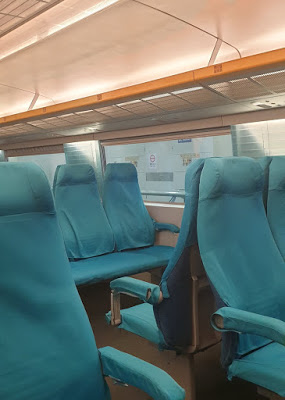
On the train, it has the same sleek look as the bullet trains, but it is completely different, and you are able to see from the front of the train to the back.

Reputed to travel at 431 kph we take a seat and it is not long before the doors shut, and a loud humming noise is soon replaced by what sounds like an engine, then we start moving.  It sounds just like a normal train, and is a lot noisier than a normal bullet train.

Seating on the train was nothing special, as one might expect

It didn’t take long before it hits the advertised speed of 431 kph.  This is not sustained for very long, because the distance is on 40 odd kilometers, and the whole trip takes about 7 minutes.

We go to the airport, and then we come back.  Is it worth the price, yes.  If you are a train enthusiast.

“The Devil You Don’t”, she was the girl you would not take home to your mother!

Now only $0.99 at https://amzn.to/2Xyh1ow

John Pennington’s life is in the doldrums. Looking for new opportunities, and prevaricating about getting married, the only joy on the horizon was an upcoming visit to his grandmother in Sorrento, Italy.

Suddenly he is left at the check-in counter with a message on his phone telling him the marriage is off, and the relationship is over.

If only he hadn’t promised a friend he would do a favour for him in Rome.

At the first stop, Geneva, he has a chance encounter with Zoe, an intriguing woman who captures his imagination from the moment she boards the Savoire, and his life ventures into uncharted territory in more ways than one.

That ‘favour’ for his friend suddenly becomes a life-changing event, and when Zoe, the woman who he knows is too good to be true, reappears, danger and death follow.

Shot at, lied to, seduced, and drawn into a world where nothing is what it seems, John is dragged into an adrenaline-charged undertaking, where he may have been wiser to stay with the ‘devil you know’ rather than opt for the ‘devil you don’t’.

newdevilcvr6