What I learned about writing – Book Reviews

The Review Ripple Effect: How to Capture Those Elusive Reads That Drive Sales

Let’s be honest. As authors, we pour our hearts and souls into crafting our stories. We agonize over plot twists, perfect our prose, and dream of our books finding their way into the hands of eager readers. But once that book is out in the world, there’s a crucial element that can make or break its success: book reviews.

We all know the power they hold. A string of glowing reviews acts like a beacon, drawing in new readers and reassuring them that your book is worth their precious time and money. It’s the “social proof” that whispers, “This is good! Other people liked it, so you probably will too!” And this, my friends, is where the magic of the review ripple effect begins: more sales lead to more reviews, which in turn lead to even more sales. It’s a virtuous cycle, and one that every author should be focused on cultivating.

But here’s the rub: getting those reviews can feel like trying to catch lightning in a bottle. Readers are busy. They might love your book, but the thought of actually sitting down and writing a review can slip their minds. So, how do we bridge that gap? How do we encourage our readers to become our most valuable marketing asset?

The good news is, it’s not rocket science. There are fundamental, actionable steps you can take to significantly increase your chances of receiving those coveted reviews. It’s about building a system, being proactive, and making it as easy as possible for your readers to share their thoughts.

Here are the fundamental steps to getting those essential book reviews:

1. Make Your Book a Review-Worthy Experience from Page One

This might seem obvious, but it’s the absolute bedrock. You can’t expect reviews if the book itself isn’t a positive experience. This means:

  • Exceptional Storytelling: A compelling plot, well-developed characters, and a satisfying resolution are non-negotiable.
  • Professional Editing: Typos, grammatical errors, and awkward phrasing are review killers. Invest in professional editing – it shows you respect your readers and your craft.
  • Polished Formatting: Whether it’s an e-book or a print book, clean and easy-to-read formatting is essential for a smooth reading experience.

2. Explicitly Ask for Reviews (At the Right Time and Place)

Don’t be shy! Readers often need a gentle nudge.

  • The “Thank You” Page: This is the most common and effective place. At the end of your book, after the story is concluded, include a dedicated page thanking your readers and politely asking them to consider leaving a review on their preferred platform (e.g., Amazon, Goodreads, etc.).
  • Author Website/Blog: Have a dedicated page or section on your website that links to your book’s reviews pages on various retailers and Goodreads. You can also include a call to action in blog posts or newsletters.
  • Email Newsletter: This is gold! When you send out newsletters, don’t just talk about your new releases. Remind your subscribers about your existing books and include a direct link to where they can leave a review.

Pro-Tip: Frame your request positively. Instead of “If you didn’t hate my book, please leave a review,” try something like, “If you enjoyed [Book Title], I would be so grateful if you could take a moment to leave a review. Your feedback helps other readers discover the story.”

3. Leverage Your Existing Audience

Your biggest fans are often your most willing reviewers.

  • Beta Readers and ARC Teams: Before your book is officially launched, send Advanced Reader Copies (ARCs) to a select group of loyal readers, fellow authors, or book bloggers. Clearly communicate your needs – that you’re hoping for honest reviews upon release.
  • Street Teams: For more dedicated fans, consider forming a “street team” who are enthusiastic about promoting your book. This can involve sharing on social media, leaving early reviews, and spreading the word.

4. Make It Easy: Provide Direct Links

This is a crucial step many authors overlook. Don’t just tell people to “leave a review on Amazon.” Provide direct, clickable links to the review sections of the platforms where you want reviews.

  • On your “Thank You” page: Include links for Amazon, Goodreads, etc.
  • In your newsletter: Ensure your review links are prominent and easy to click.
  • On your website: Have a dedicated “Review Us” page with all the relevant links.

The less friction there is, the more likely people are to follow through.

5. Engage With Reviewers (Thoughtfully)

When readers take the time to leave a review, acknowledge their effort.

  • Thank you on social media: If a reader posts about leaving a review or shares a particularly insightful review, thank them publicly (if appropriate).
  • Respond to comments (where possible): On platforms like Goodreads, you might be able to “like” or respond to certain comments.

Important Note: Be cautious about directly engaging with negative reviews. It’s often best to let them stand unless they contain factual inaccuracies or are outright abusive. Focus your energy on celebrating the positive feedback.

The Ongoing Cycle

Building a robust review profile is not a one-time task. It’s an ongoing effort that complements your writing and marketing. As you release new books, you’ll repeat these steps. For your existing books, periodically remind your audience about them and the value of reviews.

By implementing these fundamental steps, you’re not just asking for reviews; you’re building a system that fosters reader engagement and ultimately drives the review ripple effect. And that, dear authors, is the key to unlocking greater readership and, yes, more sales.

What are your biggest challenges when it comes to getting book reviews? Share in the comments below!

An excerpt from “What Sets Us Apart”, a mystery with a twist

See the excerpt from the story below, just a taste of what’s in store…

http://amzn.to/2Eryfth

whatsetscover

McCallister was old school, a man who would most likely fit in perfectly campaigning on the battlefields of Europe during the Second World War. He’d been like a fish out of water in the army, post-Falklands, and while he retired a hero, he still felt he’d more to give.

He’d applied and was accepted as head of a SWAT team, and, watching him now as he and his men disembarked from the truck in almost military precision, a look passed between Annette, the police liaison officer, and I that said she’d seen it all before. I know I had.

There was a one in four chance his team would be selected for this operation, and she had been hoping it would be one of the other three. While waiting for them to arrive she filled me in on the various teams. His was the least co-operative, and the more likely to make ad-hoc decisions rather than adhere to the plan, or any orders that may come from the officer in charge.

This, she said quite bluntly, was going to end badly.

I still had no idea why Prendergast instructed me to attend the scene of what looked to be a normal domestic operation, but as the nominated expert in the field in these types of situations, it was fairly clear he wasn’t taking any chances. It was always a matter of opinion between us, and generally I lost.

In this case, it was an anonymous report identifying what the authorities believed were explosives in one of the dockside sheds where explosives were not supposed to be.

The only reason why the report was given any credence was the man, while not identifying himself by name, said he’d been an explosive expert once and recognized the boxes. That could mean anything, but the Chief Constable was a cautious man.

With his men settled and preparing their weapons, McCallister came over to the command post, not much more than the SUV my liaison and I arrived in, with weapons, bulletproof vests, and rolls of tape to cordon off the area afterward. We both had coffee, steaming in the cold early morning air. Dawn was slowly approaching and although rain had been forecast it had yet to arrive.

A man by the name of Benson was in charge. He too had groaned when he saw McCallister.

“A fine morning for it.” McCallister was the only enthusiastic one here.

He didn’t say what ‘it’ was, but I thought it might eventually be mayhem.

“Let’s hope the rain stays away. It’s going to be difficult enough without it,” Benson said, rubbing his hands together. We had been waiting for the SWAT team to arrive, and another team to take up their position under the wharf, and who was in the final stages of securing their position.

While we were waiting we drew up the plan. I’d go in first to check on what we were dealing with, and what type of explosives. The SWAT team, in the meantime, were to ensure all the exits to the shed were covered. When I gave the signal, they were to enter and secure the building. We were not expecting anyone inside or out, and no movement had been detected in the last hour since our arrival and deployment.

“What’s the current situation?”

“I’ve got eyes on the building, and a team coming in from the waterside, underneath. Its slow progress, but they’re nearly there. Once they’re in place, we’re sending McKenzie in.”

He looked in my direction.

“With due respect sir, shouldn’t it be one of us?” McCallister glared at me with the contempt that only a decorated military officer could.

“No. I have orders from above, much higher than I care to argue with, so, McCallister, no gung-ho heroics for the moment. Just be ready to move on my command, and make sure you have three teams at the exit points, ready to secure the building.”

McCallister opened his mouth, no doubt to question those orders, but instead closed it again. “Yes sir,” he muttered and turned away heading back to his men.

“You’re not going to have much time before he storms the battlements,” Benson quietly said to me, a hint of exasperation in his tone. “I’m dreading the paperwork.”

It was exactly what my liaison officer said when she saw McCallister arriving.

The water team sent their ‘in position’ signal, and we were ready to go.

In the hour or so we’d been on site nothing had stirred, no arrivals, no departures, and no sign anyone was inside, but that didn’t mean we were alone. Nor did it mean I was going to walk in and see immediately what was going on. If it was a cache of explosives then it was possible the building was booby-trapped in any number of ways, there could be sentries or guards, and they had eyes on us, or it might be a false alarm.

I was hoping for the latter.

I put on the bulletproof vest, thinking it was a poor substitute for full battle armor against an exploding bomb, but we were still treating this as a ‘suspected’ case. I noticed my liaison officer was pulling on her bulletproof vest too.

“You don’t have to go. This is my party, not yours,” I said.

“The Chief Constable told me to stick to you like glue, sir.”

I looked at Benson. “Talk some sense into her please, this is not a kindergarten outing.”

He shrugged. Seeing McCallister had taken all the fight out of him. “Orders are orders. If that’s what the Chief Constable requested …”

Madness. I glared at her, and she gave me a wan smile. “Stay behind me then, and don’t do anything stupid.”

“Believe me, I won’t be.” She pulled out and checked her weapon, chambering the first round. It made a reassuring sound.

Suited up, weapons readied, a last sip of the coffee in a stomach that was already churning from nerves and tension, I looked at the target, one hundred yards distant and thought it was going to be the longest hundred yards I’d ever traversed. At least for this week.

A swirling mist rolled in and caused a slight change in plans.

Because the front of the buildings was constantly illuminated by large overhead arc lamps, my intention had been to approach the building from the rear where there was less light and more cover. Despite the lack of movement, if there were explosives in that building, there’d be ‘enemy’ surveillance somewhere, and, after making that assumption, I believed it was going to be easier and less noticeable to use the darkness as a cover.

It was a result of the consultation, and studying the plans of the warehouse, plans that showed three entrances, the main front hangar type doors, a side entrance for truck entry and exit and a small door in the rear, at the end of an internal passage leading to several offices. I also assumed it was the exit used when smokers needed a break. Our entry would be by the rear door or failing that, the side entrance where a door was built into the larger sliding doors. In both cases, the locks would not present a problem.

The change in the weather made the approach shorter, and given the density of the mist now turning into a fog, we were able to approach by the front, hugging the walls, and moving quickly while there was cover. I could feel the dampness of the mist and shivered more than once.

It was nerves more than the cold.

I could also feel rather than see the presence of Annette behind me, and once felt her breath on my neck when we stopped for a quick reconnaissance.

It was the same for McCallister’s men. I could feel them following us, quickly and quietly, and expected, if I turned around, to see him breathing down my neck too.

It added to the tension.

My plan was still to enter by the back door.

We slipped up the alley between the two sheds to the rear corner and stopped. I heard a noise coming from the rear of the building, and the light tap on the shoulder told me Annette had heard it too. I put my hand up to signal her to wait, and as a swirl of mist rolled in, I slipped around the corner heading towards where I’d last seen the glow of a cigarette.

The mist cleared, and we saw each other at the same time. He was a bearded man in battle fatigues, not the average dockside security guard.

He was quick, but my slight element of surprise was his undoing, and he was down and unconscious in less than a few seconds with barely a sound beyond the body hitting the ground. Zip ties secured his hands and legs, and tape his mouth. Annette joined me a minute after securing him.

A glance at the body then me, “I can see why they, whoever they are, sent you.”

She’d asked who I worked for, and I didn’t answer. It was best she didn’t know.

“Stay behind me,” I said, more urgency in my tone. If there was one, there’d be another.

Luck was with us so far. A man outside smoking meant no booby traps on the back door, and quite possibly there’d be none inside. But it indicated there were more men inside, and if so, it appeared they were very well trained. If that were the case, they would be formidable opponents.

The fear factor increased exponentially.

I slowly opened the door and looked in. A pale light shone from within the warehouse itself, one that was not bright enough to be detected from outside. None of the offices had lights on, so it was possible they were vacant. I realized then they had blacked out the windows. Why hadn’t someone checked this?

Once inside, the door closed behind us, progress was slow and careful. She remained directly behind me, gun ready to shoot anything that moved. I had a momentary thought for McCallister and his men, securing the perimeter.

At the end of the corridor, the extent of the warehouse stretched before us. The pale lighting made it seem like a vast empty cavern, except for a long trestle table along one side, and, behind it, stacks of wooden crates, some opened. It looked like a production line.

To get to the table from where we were was a ten-yard walk in the open. There was no cover. If we stuck to the walls, there was equally no cover and a longer walk.

We needed a distraction.

As if on cue, the two main entrances disintegrated into flying shrapnel accompanied by a deafening explosion that momentarily disoriented both Annette and I. Through the smoke and dust kicked up I saw three men appear from behind the wooden crates, each with what looked like machine guns, spraying bullets in the direction of the incoming SWAT members.

They never had a chance, cut down before they made ten steps into the building.

By the time I’d recovered, my head heavy, eyes watering and ears still ringing, I took several steps towards them, managing to take down two of the gunmen but not the third.

I heard a voice, Annette’s I think, yell out, “Oh, God, he’s got a trigger,” just before another explosion, though all I remember in that split second was a bright flash, the intense heat, something very heavy smashing into my chest knocking the wind out of me, and then the sensation of flying, just before I hit the wall.

I spent four weeks in an induced coma, three months being stitched back together and another six learning to do all those basic actions everyone took for granted. It was twelve months almost to the day when I was released from the hospital, physically, except for a few alterations required after being hit by shrapnel, looking the same as I always had.

But mentally? The document I’d signed on release said it all, ‘not fit for active duty; discharged’.

It was in the name of David Cheney. For all intents and purposes, Alistair McKenzie was killed in that warehouse, and for the first time ever, an agent left the Department, the first to retire alive.

I was not sure I liked the idea of making history.

© Charles Heath 2016-2020

Top 5 sights on the road less travelled – Paris

Escape the Crowds: Paris’s Top 5 Hidden Gems (That Deserve Your Visit)

Paris. The City of Lights, romance, and… endless queues? While the Eiffel Tower and the Louvre are undoubtedly must-sees, experiencing the best of Paris doesn’t have to mean battling shoulder-to-shoulder with thousands of fellow tourists.

If you’re looking to explore distinctive Parisian culture and history without the notorious bottlenecks, we’ve uncovered five incredible visitor attractions. These spots boast unique charm, fascinating features, and best of all: relative tranquility.

Pack your walking shoes, grab your camera, and prepare to discover a side of Paris few tourists ever see.


1. Musée Rodin (The Gardens)

While the Musée Rodin itself—home to iconic works like The Thinker and The Kiss—is popular, the vast, sculpted gardens surrounding the mansion are often overlooked as a place to linger, making them a true, peaceful escape.

Distinctive Features:

  • Sculpture Meets Serenity: The three-hectare garden is an open-air gallery, where Rodin’s profound bronze figures are set against lush lawns, rose bushes, and towering hedges. It creates one of the most sublime atmospheres in Paris.
  • The Reflection Pool: A large, tranquil pool reflects the 18th-century Hôtel Biron (the main museum building), providing stunning photographic opportunities and a space for quiet contemplation.
  • The Workshop: You can catch glimpses of the former studio spaces, helping you connect directly with the creative process of one of history’s greatest sculptors.

Why It’s Worth the Trip: You get world-class art without the crush of a major museum, allowing the beauty of the artwork and the landscape to truly sink in.

2. Butte-aux-Cailles

Forget the tourist trap boutiques of Montmartre; head instead to the Butte-aux-Cailles in the 13th arrondissement. This small, elevated neighborhood feels like a secret village preserved within the modern city, rarely appearing on mainstream tourist itineraries.

Distinctive Features:

  • Village Atmosphere: The area escaped the sweeping renovations of Baron Haussmann in the 19th century, leaving behind narrow, cobbled streets (like Rue des Cinq Diamants) lined with low, charming houses and hidden courtyards.
  • Art Nouveau Architecture: Look out for beautiful examples of brick and stone façades and original lampposts.
  • Street Art Hub: While peaceful, the Butte-aux-Cailles is also a discreet, vibrant center for Parisian street art, featuring colorful, high-quality murals and stencils often tucked away on small side streets.
  • The Artesian Wells: The area is famous for its natural hot springs, and you can still find the historic communal swimming pool—Piscine de la Butte-aux-Cailles—fed by underground water.

Why It’s Worth the Trip: It offers an authentic glimpse into local Parisian life, complete with wonderful traditional bistros and quiet cafés, far removed from the noise of the center.

3. Parc des Buttes-Chaumont

When most visitors think of Parisian parks, they picture the Tuileries or the Luxembourg Gardens. But for truly dramatic landscapes and peaceful seclusion, the Parc des Buttes-Chaumont in the 19th arrondissement is unbeatable.

Distinctive Features:

  • Dramatic Topography: Built on a former gypsum quarry and landfill, the park features steep cliffs, grottoes, artificial waterfalls, and a large central lake.
  • The Temple de la Sibylle: Perched atop a sheer, 50-meter-high cliff (known as the Belvédère Island) is a miniature Roman-style temple offering one of the most spectacular, yet uncrowded, panoramic views of Paris, including Sacré-Cœur in the distance.
  • Rustic Charm: Unlike the manicured symmetry of other parks, Buttes-Chaumont embraces a rugged, romantic English garden style, complete with a charming suspension bridge designed by Gustave Eiffel’s company.

Why It’s Worth the Trip: It is a breathtaking feat of landscape architecture, providing dramatic views and quiet walking paths that make you forget you are in a major European capital.

4. The Archives Nationales (Hôtel de Soubise)

Tucked away in the historic Marais district, the Archives Nationales houses France’s national historical archives. While the documents themselves are fascinating, the primary draw is the opportunity to wander through one of the most beautiful and best-preserved 18th-century aristocratic residences in Paris, the Hôtel de Soubise.

Distinctive Features:

  • Rococo Masterpieces: The most stunning features are the magnificent state rooms, particularly the oval salons, which are considered peerless examples of French Rococo interior design. The intricate gilded woodwork, ceiling frescoes, and elaborate ornamentation are breathtaking.
  • Courtyard Grandeur: The cour d’honneur (main courtyard) immediately transports you back to the age of Louis XV, showcasing the sheer scale and opulence of Parisian high society.
  • Historical Significance: Visitors can tour selected exhibits showcasing pivotal documents from French history, offering a deep dive into the nation’s past within a spectacular setting.

Why It’s Worth the Trip: You get to explore hidden architectural gems that rival the palace interiors of Versailles, but without the mandatory entry lines and huge tour groups.

5. Musée de la Vie Romantique (Museum of Romantic Life)

The name truly says it all. Located in the residential Nouvelle Athènes neighborhood (near Pigalle), this delightful museum occupies two charming small buildings and a lush garden courtyard that celebrate the artistic and literary life of the 19th-century Romantic era.

Distinctive Features:

  • Intimate Scale: Housed in the former home of painter Ary Scheffer, the museum is dedicated to the works of George Sand, Ernest Renan, and other Romantic figures. It feels more like visiting a well-preserved family home than a traditional museum.
  • Literary History: Artifacts include portraits, jewelry, and personal items associated with the writer George Sand, offering a deeply personal look at her life and times.
  • The Best Tearoom in Paris: The garden courtyard transforms into a glorious, ivy-covered tearoom (operated by Café Renoir) during the warmer months. It is hands-down one of the most idyllic spots in Paris for a restorative coffee or lunch.

Why It’s Worth the Trip: It offers a deeply atmospheric and gentle cultural experience. It is the perfect antidote to the high-intensity visit of a major museum, wrapped up in Parisian charm and elegance.


The magic of Paris extends far beyond the well-trodden paths. By seeking out these distinctive, less-crowded attractions, you can enjoy the city’s profound history, stunning architecture, and unparalleled beauty at your own pace. Happy exploring!

PI Walthenson’s second case – A case of finding the ‘Flying Dutchman’.

Known only to a few, there is a legend that a ship named the ‘Flying Dutchman’ left Nazi Germany in the last weeks of the war and set sail for America, escorted by U-boats, under a different name. Aboard was a trove of treasure and gold worth a ‘king’s ransom’.

It was said that it had been sent to a group of American Nazis to create the Fourth Reich at an appropriate time. Over the years since many expeditions off the coast had searched, but found no trace of the vessel or the treasure.

In other words, it was just a legend created to boost tourism.

Fast forward to 2024. Our intrepid private detective, Harry Walthenson, overhears a conversation at Grand Central Station. It was the oddness of the message that caught his attention. An investigation turned up nothing out of the ordinary, and he thinks no more about it.

Then Harry is kidnapped, interrogated, and asked questions over and over about a date and a place, why he went there, and when he could not give satisfactory answers, he was beaten half to death and left for dead on a rubbish heap. He was lucky that it was a living space for homeless men; otherwise, he would have died.

In the aftermath, he once again gives it no more thought.

After resolving his first case successfully, there’s no rest. Harry’s angry mother comes to his office and demands that he find out where his father has gone. She believes he has run off with a mistress, not for the first time.

Perhaps it was not the wisest decision she has made, because Harry promises to investigate, and adds that she might not like what he finds.

He soon discovered he does not like what he finds, that his father’s friends, a cabal formed at University, have two who are his mother’s current lovers, and another, a criminal blackmailing his father.

Felicity, now his partner, working on a different case, and trying to get answers, uncovers a crime family involved in guarding a disused warehouse on the docks, where she believes Harry had been taken for interrogation, and subsequently dumped nearby to die.

Why are they up to? What is so important that the empty warehouse needs guarding? Who is employing them?

Harry, following up on the death of the blackmailer, traces his death back to an enforcer employed by his grandfather. His mother’s grandfather was a pre-war industrialist who made his fortune in war munitions and shipbuilding.

He was also a member of the American Nazi party.

When Harry also discovers a logbook belonging to a so-called wartime Liberty ship the “Paul Revere” in brackets ‘Freiheitskämpfer’, hidden by his father, and written in a code that is not readily identifiable.

It is no longer a matter of a father who has run off with his mistress; it is a very frightened man in fear of his life, running from a group who will stop at nothing to get the logbook back. And when Harry discovers a family connection to the group, it becomes a race against time to decode the log and find his father before his grandfather does.

Coming soon: Harry Walthenson’s new adventure – A case of finding the ‘Flying Dutchman’

Writing a book in 365 days – 296

Day 296

How do we write a story with the characters playing particular roles, make it a story that by the end, the reader says, ‘wow, that gave me an insight I didn’t have before’

Beyond the Surface: Crafting Stories That Reveal Profound Insight

We’ve all been there. You finish a book, a short story, or even a compelling anecdote, and for a moment, the world looks a little different. A subtle shift has occurred in your understanding, a corner of your mind has been illuminated, and you find yourself thinking, “Wow. I never thought about it that way before.”

As writers, this is the Holy Grail. We don’t just want to entertain; we want to resonate. We want to leave our readers with more than just a memory of plot points, but with a genuine, lasting insight. And often, the key to unlocking this lies not just in the story itself, but in how we craft our characters and the “particular roles” they play.

The Power of “Particular Roles” – Beyond the Obvious

When we talk about characters playing “particular roles,” it’s easy to think of archetypes: the hero, the villain, the mentor, the damsel in distress. While these are foundational, to achieve that “wow” insight, we need to delve deeper.

A character’s “role” isn’t just their job title or their place in the narrative structure. It’s their societal function, their familial position, their self-perception, the expectations others place upon them, and even the masks they wear.

  • The Unyielding CEO: Is she truly ruthless, or is her iron facade a shield against a past vulnerability?
  • The Meek Assistant: Is his quiet compliance a sign of weakness, or a calculated strategy for survival in a cutthroat environment?
  • The Rebellious Teenager: Is her defiance simply adolescent angst, or a desperate cry for authenticity in a world that demands conformity?

These are the “particular roles” we define. But the magic happens not when the character plays the role, but when they interact with it, challenge it, or are ultimately defined by its unexpected complexities.

Unveiling the Unseen: The Art of Subversion and Empathy

The “wow” insight rarely comes from a character simply acting as expected. It emerges when we, the readers, witness the tension between a character’s assigned role and their true nature, their hidden motivations, or the profound impact that role has had on their soul.

Here’s how we achieve it:

  1. Establish the Role (and its Expectations): Introduce your character within a clearly defined role, even if it’s a stereotype. Let the reader settle into their preconceived notions. This sets the stage for the revelation.
    • Example: Introduce the gruff, solitary old man who seemingly hates children.
  2. Introduce Conflict That Challenges the Role: Place the character in a situation that forces them to act outside the confines of their established role, or reveals the cost of maintaining it. This conflict should expose a deeper layer of who they are.
    • Example: A lost child appears on the old man’s doorstep during a blizzard, forcing him to choose between his solitude and his humanity.
  3. Explore the “Why” Behind the Role: What experiences, fears, or desires molded them into this role? What sacrifices have they made, or what truths have they suppressed to maintain it? This is where empathy is forged.
    • Example: As the old man reluctantly cares for the child, flashbacks reveal he lost his own daughter years ago, and his gruffness is a defensive mechanism against further heartbreak. His solitude isn’t misanthropy; it’s grief.
  4. Show the Gradual Erosion or Unraveling: The insight isn’t usually a sudden, dramatic reveal (though it can be). More often, it’s a slow burn, a series of small moments where the reader pieces together the character’s true self, seeing past the initial role.
    • Example: The child’s innocent questions chip away at the old man’s defenses. He finds himself sharing stories, showing kindness, and slowly, painfully, re-engaging with the world he’d shut out.
  5. Connect to a Universal Truth: The character’s specific journey should illuminate a broader human experience. Their struggle with their “role” should reflect something we all grapple with: the masks we wear, the expectations we face, the hidden pains we carry, or the unexpected sources of strength we find.
    • Example: The reader realizes that true grief isn’t about avoiding pain, but about finding the courage to connect again. The “insight” here isn’t just about the old man, but about the nature of grief and resilience itself.

The “Aha!” Moment: When the Reader Connects the Dots

The true “wow” moment isn’t when you tell the reader something. It’s when they discover it, often feeling like they’ve connected dots that were always there but previously invisible.

It’s the realization that:

  • The “villain” isn’t evil, but a product of an unjust system, fighting for a warped version of good.
  • The “hero” carries immense personal baggage, and their strength comes from battling internal demons as much as external foes.
  • The seemingly “insignificant” background character holds the key to an entirely different perspective on the main conflict.

By meticulously crafting characters who embody specific roles, then showing the pressures, hypocrisies, sacrifices, or hidden depths that lie beneath those roles, we don’t just tell a story – we create an experience. We invite the reader into a deeper understanding of human nature, challenging their assumptions and expanding their worldview.

So, as you build your next story, think about the roles your characters play. Then, ask yourself: How can I use this role not just as a descriptor, but as a crucible in which a profound, unforgettable insight can be forged? That’s when your readers will close the book, pause, and say, “Wow.”

Inspiration, Maybe – Volume 2

50 photographs, 50 stories, of which there is one of the 50 below.

They all start with –

A picture paints … well, as many words as you like.  For instance:

And, the story:

Have you ever watched your hopes and dreams simply just fly away?

Everything I thought I wanted and needed had just left in an aeroplane, and although I said I was not going to, i came to the airport to see the plane leave.  Not the person on it, that would have been far too difficult and emotional, but perhaps it was symbolic, the end of one life and the start of another.

But no matter what I thought or felt, we had both come to the right decision.  She needed the opportunity to spread her wings.  It was probably not the best idea for her to apply for the job without telling me, but I understood her reasons.

She was in a rut.  Though her job was a very good one, it was not as demanding as she had expected, particularly after the last promotion, but with it came resentment from others on her level, that she, the youngest of the group would get the position.

It was something that had been weighing down of her for the last three months, and if noticed it, the late nights, the moodiness, sometimes a flash of temper.  I knew she had one, no one could have such red hair and not, but she had always kept it in check.

And, then there was us, together, and after seven years, it felt like we were going nowhere.  Perhaps that was down to my lack of ambition, and though she never said it, lack of sophistication.  It hadn’t been an issue, well, not until her last promotion, and the fact she had to entertain more, and frankly I felt like an embarrassment to her.

So, there it was, three days ago, the beginning of the weekend, and we had planned to go away for a few days and take stock.  We both acknowledged we needed to talk, but it never seemed the right time.

It was then she said she had quit her job and found a new one.  Starting the following Monday.

Ok, that took me by surprise, not so much that it something I sort of guessed might happen, but that she would just blurt it out.

I think that right then, at that moment, I could feel her frustration with everything around her.

What surprised her was my reaction.  None.

I simply asked where who, and when.

A world-class newspaper, in New York, and she had to be there in a week.

A week.

It was all the time I had left with her.

I remember I just shrugged and asked if the planned weekend away was off.

She stood on the other side of the kitchen counter, hands around a cup of coffee she had just poured, and that one thing I remembered was the lone tear that ran down her cheek.

Is that all you want to know?

I did, yes, but we had lost that intimacy we used to have when she would have told me what was happening, and we would have brainstormed solutions. I might be a cabinet maker but I still had a brain, was what I overheard her tell a friend once.

There’s not much to ask, I said.  You’ve been desperately unhappy and haven’t been able to hide it all that well, you have been under a lot of pressure trying to deal with a group of troglodytes, and you’ve been leaning on Bentley’s shoulder instead of mine, and I get it, he’s got more experience in that place,  and the politics that go with it, and is still an ally.

Her immediate superior and instrumental in her getting the position, but unlike some men in his position he had not taken advantage of a situation like some men would.  And even if she had made a move, which I doubted, that was not the sort of woman she was, he would have politely declined.

One of the very few happily married men in that organisation, so I heard.

So, she said, you’re not just a pretty face.

Par for the course for a cabinet maker whose university degree is in psychology.  It doesn’t take rocket science to see what was happening to you.  I just didn’t think it was my place to jump in unless you asked me, and when you didn’t, well, that told me everything I needed to know.

Yes, our relationship had a use by date, and it was in the next few days.

I was thinking, she said, that you might come with me,  you can make cabinets anywhere.

I could, but I think the real problem wasn’t just the job.  It was everything around her and going with her, that would just be a constant reminder of what had been holding her back. I didn’t want that for her and said so.

Then the only question left was, what do we do now?

Go shopping for suitcases.  Bags to pack, and places to go.

Getting on the roller coaster is easy.  On the beginning, it’s a slow easy ride, followed by the slow climb to the top.  It’s much like some relationships, they start out easy, they require a little work to get to the next level, follows by the adrenaline rush when it all comes together.

What most people forget is that what comes down must go back up, and life is pretty much a roller coaster with highs and lows.

Our roller coaster had just come or of the final turn and we were braking so that it stops at the station.

There was no question of going with her to New York.  Yes, I promised I’d come over and visit her, but that was a promise with crossed fingers behind my back.  After a few months in t the new job the last thing shed want was a reminder of what she left behind.  New friends new life.

We packed her bags, three out everything she didn’t want, a free trips to the op shop with stiff she knew others would like to have, and basically, by the time she was ready to go, there was nothing left of her in the apartment, or anywhere.

Her friends would be seeing her off at the airport, and that’s when I told her I was not coming, that moment the taxi arrived to take her away forever.  I remember standing there, watching the taxi go.  It was going to be, and was, as hard as it was to watch the plane leave.

So, there I was, finally staring at the blank sky, around me a dozen other plane spotters, a rather motley crew of plane enthusiasts.

Already that morning there’s been 6 different types of plane depart, and I could hear another winding up its engines for take-off.

People coming, people going.

Maybe I would go to New York in a couple of months, not to see her, but just see what the attraction was.  Or maybe I would drop in, just to see how she was.

As one of my friends told me when I gave him the news, the future is never written in stone, and it’s about time you broadened your horizons.

Perhaps it was.


© Charles Heath 2020-2021

Coming soon.  Find the above story and 49 others like it in:

In a word: Dog

Yes, it’s that little or big furry thing that’s also known as man’s best friend, a dog.

But the word has a number of other meanings, like a lot of three-letter words.

It can also mean to follow someone closely.

If you are going to the greyhound racing, you could say you’re going to the dogs, or it could mean something entirely different, like deteriorating in manner and ethics.

Then there are those employers who make their workers work very hard, and therefore could be described as making them work like a dog.

Some might even say that it is a dog of a thing, i.e. of poor quality.

There’s a dogleg, which could aptly name some of those monstrous golf course holes that sometimes present the challenge of going through the wood rather than around it.

Tried that and failed many times!

A dog man used to ride the crane load from the ground to the top, an occupation that would not stand the test of occupational health and safety anymore.

And of course, in a battle to the death, it’s really dog eat dog, isn’t it?

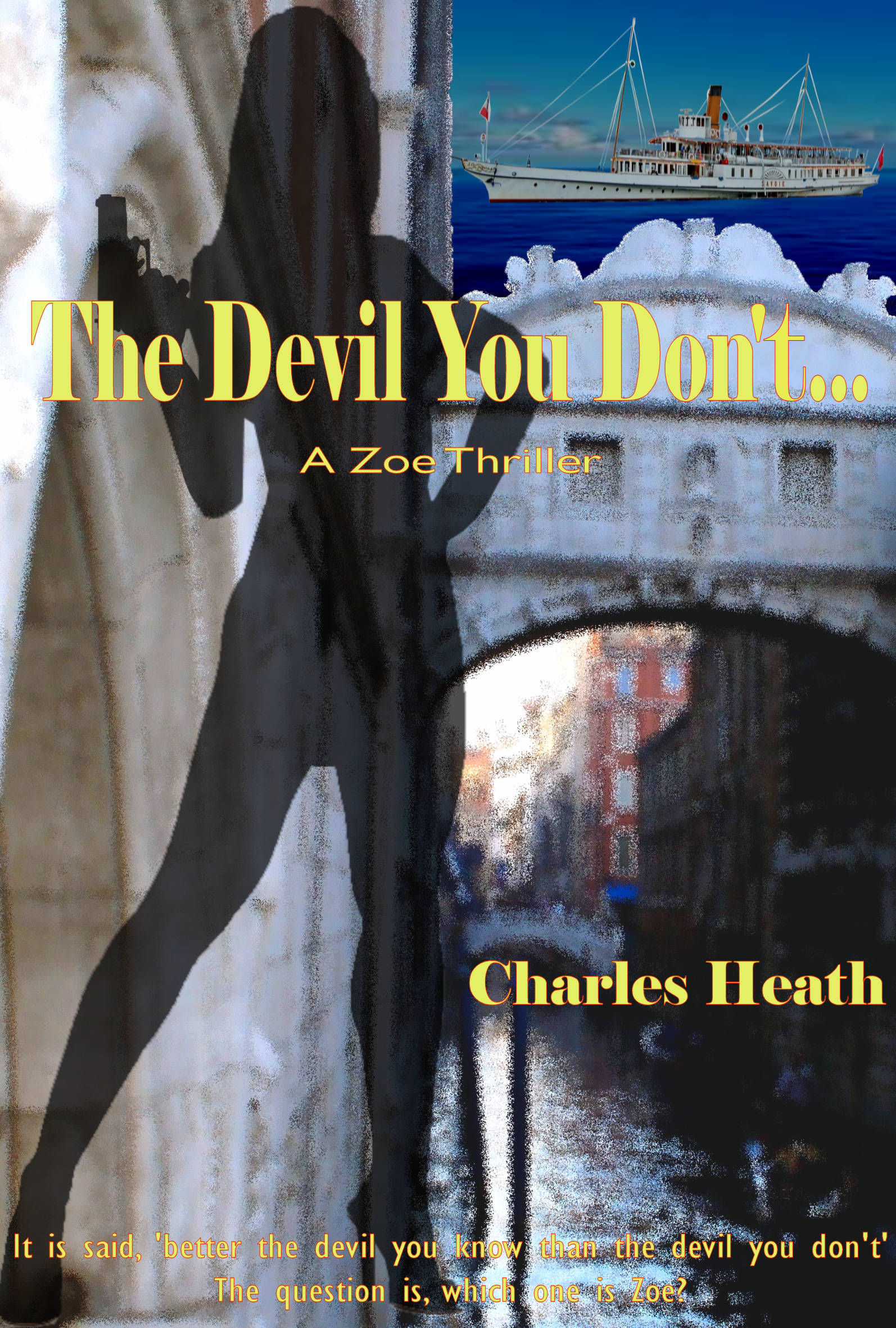
‘The Devil You Don’t’ – A beta reader’s view

It could be said that of all the women one could meet, whether contrived or by sheer luck, what are the odds it would turn out to be the woman who was being paid a very large sum to kill you.

John Pennington is a man who may be lucky in business, but not so lucky in love. He has just broken up with Phillipa Sternhaven, the woman he thought was the one, but relatives and circumstances, and perhaps because she was a ‘princess’, may also have contributed to the end result.

So, what do you do when you are heartbroken?

That is a story that slowly unfolds, from the first meeting with his nemesis on Lake Geneva, all the way to a hotel room in Sorrento, where he learns the shattering truth.

What should have been solace after disappointment, turns out to be something else entirely, and from that point, everything goes to hell in a handbasket.

He suddenly realizes his so-called friend Sebastian has not exactly told him the truth about a small job he asked him to do, the woman he is falling in love with is not quite who she says she is, and he is caught in the middle of a war between two men who consider people becoming collateral damage as part of their business.

The story paints the characters cleverly displaying all their flaws and weaknesses. The locations add to the story at times taking me back down memory lane, especially to Venice where, in those back streets I confess it’s not all that hard to get lost.

All in all a thoroughly entertaining story with, for once, a satisfying end.

Available on Amazon here: https://amzn.to/2Xyh1ow

NANOWRIMO – November 2025 – Day 8

The Third Son of a Duke

We have characters by the bucketful on this ship, after all, there are 1400 of them plus the crew.  In second class, knowing the classes don’t mix, there are 235, yes I have the name and age of everyone travelling, and it was a lot of single people, at least 67 young ladies between 18 and 30. 

And no, it was not like a modern-day cruise with people getting drunk, acting stupid or cabin hopping.  This was 1914, and there was a modicum of decorum observed.  This didn’t mean that people didn’t meet and talk, dine or do rounds of the promenade or shelter deck together.

There were families, there were people travelling to Australia and back, the forerunning of what might have been cruising, but that was mostly those travelling in first class.  There were about 360 of them, and they had the best of everything.

Still second class had its own lounge, dining room, music room, and smoking room.

Of course, the protagonist and my grandmother meet, talk, she is reserved and cautious, he is not the usual aristocratic arse that behaves like he is entitled, it’s more he’s travelling second class to keep a low profile and not have anyone guess who he is, and cause a fuss, or derision.

That lasts until he is boarding when the captain of the ship, and friend of his fathers, sends the second mate down to get him squared away and ship shape.  Damn, there goes his anonymity.

And it had to happen in front of the girl in the blue hat, and another, the other protagonist, only he doesn’t know it yet.

The girl in the blue hat is my grandmother.

The second protagonist, well, she’s going to shake the trees and see what falls out.

1930 words, for a total of 13665 words.

Writing about writing a book – Day 21 continues

I’m still working on Bill’s backstory, and how he got mixed up in the war, and as a general background to his situation, and life before Davenport.

This is still in his own words:

But whether we were stupid or naive, or completely mad, we were all eager to get into battle, filled with the sort of hate only Army propaganda films could fill you with.  They were our enemy, and they deserved to concede or die.

A fresh face in a hardened platoon, I was eager to get on with it.  They looked knowingly, having seen it all before.  No idea of the reality, and no time to tell us.  Have a few beers to celebrate, and then, the next morning, go out on patrol.  No problem.

There was camaraderie, but it was subdued.  We walked single file, the seasoned campaigners in front and at the rear, treading carefully, demanding quiet, and a general cautiousness.  In the middle of nowhere, where only the sound of rain, or the animals and birds for company, we were naive enough to think this was going to be a doddle.

Then it happened, six hours out, and just before we reached a small clearing.  I thought to myself it was odd there should be such a clear space with jungle all around it.  There must be a reason.

There was.

We had walked into an ambush, and everyone hit the ground.  I was bringing up the rear with another soldier, a veteran not much older than myself whose name was Scotty, a little farther back from the main group.  Bullets sprayed the undergrowth, pinging off trees and leaves.  I buried my face in the dirt, praying I would not die on my first patrol.

We became separated from the others, lying in a hollow, with no idea how far away help was.  He was muttering to himself.  “God, I hate this.  You can never see the bastards.  They’re out there, but you can never bloody well see them.”  Then he crawled up the embankment, gun first.

He let off a few rounds, causing a return of machine-gun fire, spattering the dirt at the top.  Next thing I knew he was sliding down the hill with half his face shot away.  Dead.  I threw up there and then.  What an initiation.

Then one of the enemy soldiers came over the hill to check on his ‘kill’.  I saw him at the same time he saw me and aimed my gun and shot.  It was instinct more than anything else, and I hadn’t stopped to think of the consequences.  He fell down, finishing up next to me, staring at me from black, lifeless eyes. 

Dead. 

I’ll never forget those lifeless eyes.  I just got up and ran, making it back to the rest of the group without getting hit.  No one could explain how I made it safely through the hail of gunfire, from our side and theirs.

Back in the camp later, the veterans remarked on how unlucky Scotty was and how lucky I was to shoot one of the enemies, and not be killed myself.  They all thought it was worth a celebration.

Before we went out the next day to do it all again.

I spent the night vomiting, unable to sleep, haunted look on his face, one I finally realized that reflected complete astonishment.

There will be more, as the story develops.

© Charles Heath 2016-2024