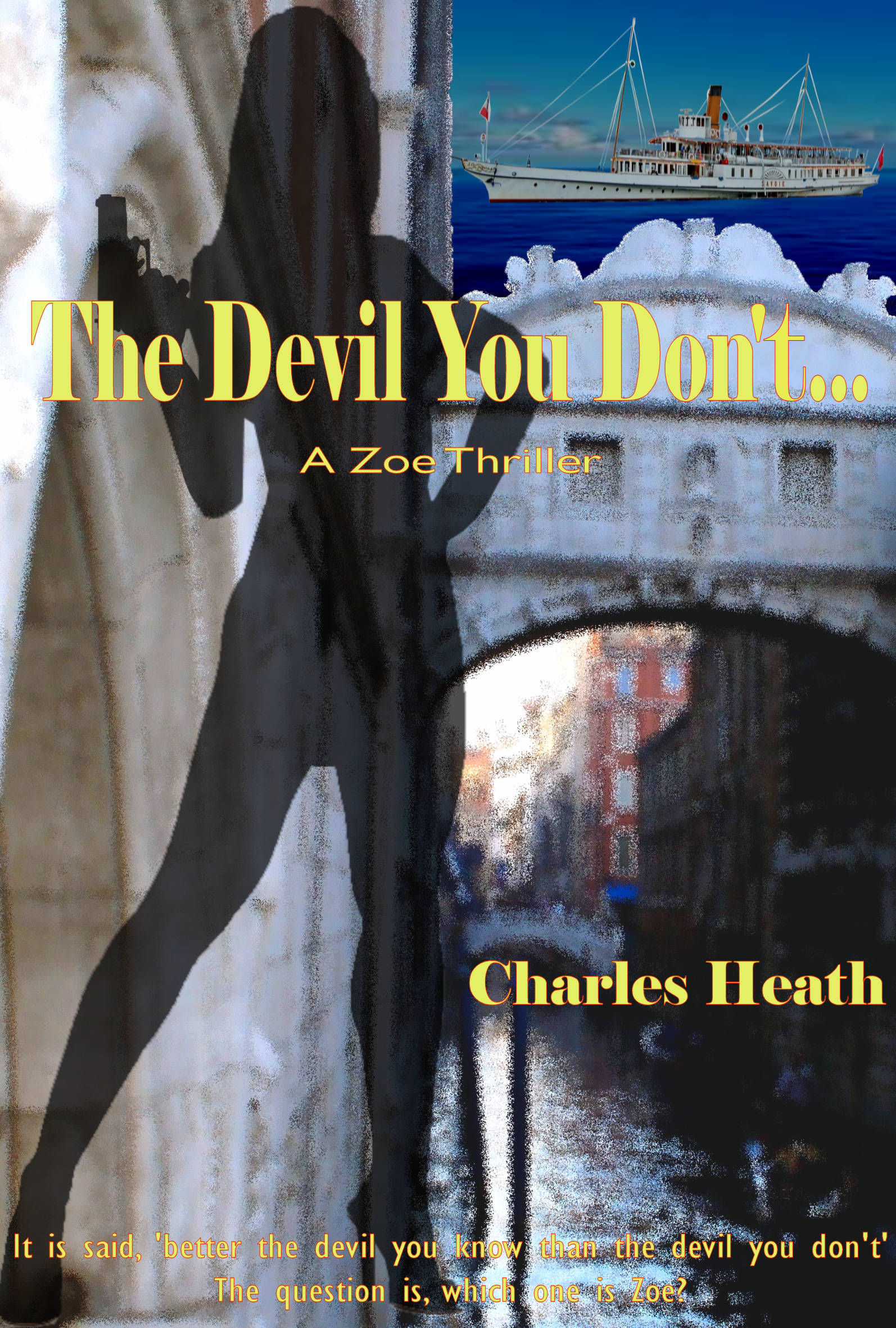
‘What Sets Us Apart’ – A beta reader’s view

There’s something to be said for a story that starts like a James Bond movie, throwing you straight in the deep end, a perfect way of getting to know the main character, David, or is that Alistair?

A retired spy, well, not so much a spy as a retired errand boy, David’s rather wry description of his talents, and a woman that most men would give their left arm for, not exactly the ideal couple, but there is a spark in a meeting that may or may not have been a setup.

But as the story progressed, the question I kept asking myself was why he’d bother.

And, page after unrelenting page, you find out.

Susan is exactly the sort of woman to pique his interest.  Then, inexplicably, she disappears.  That might have been the end of it, but Prendergast, that shadowy enigma, David’s ex-boss who loves playing games with real people, gives him an ultimatum: find her or come back to work.

Nothing like an offer that’s a double-edged sword!

A dragon for a mother, a sister he didn’t know about, Susan’s BFF who is not what she seems or a friend indeed, and Susan’s father, who, up till David meets her, couldn’t be less interested, his nemesis proves to be the impossible dream, and he’s always just that one step behind.

When the rollercoaster finally came to a halt, and I could start breathing again, it was an ending that was completely unexpected.

I’ve been told there’s a sequel in the works.

Bring it on!

The book can be purchased here:  http://amzn.to/2Eryfth

365 Days of writing, 2026 – 185/186

Days 185 and 186 – Writing exercise

Investigating death was a ‘thing” that some people took seriously, and others took as a challenge.

For them, it was about the numbers, the appearance of solving crimes, so the public could feel safe, to win that imaginary contest of who could solve the most crimes, and celebrate it on Friday night at the pub.

For others, like me, it was about justice.  It was about finding that person who committed the crime, not the most likely candidate buried under a trove of circumstantial evidence.

The pity of it was that our helicopter Detective Chief Superintendent was a numbers man, temporarily stopping in at our station on his way to bigger and better things.

He didn’t like to be thorough and methodical, and he definitely didn’t like me.  That’s why when he put his head out the door and saw that I was the only detective in the room, I could feel rather than see the sigh.

Or maybe that was because he should be down the pub with the rest of the team celebrating the extraordinary closure rate for this month.

“Burgess.”

I looked up.  “Sir.”

“Sending you a straightforward case.  The old man had apparently died in his sleep.  One of us to look in, dot the i’s.  I’ll send you the file.”

When the Chief Inspector says straightforward, there’s always an underlying suggestion not to make more out of it than there was.

The problem was that nothing in our line of work was straightforward.  Not if justice was to be served.

People die in their sleep all the time.  What’s unusual is that most of those who did were discovered in the morning, not at 5 pm.

I arrived at the house, one of twelve similar terrace houses, in a street of a hundred or so.  Most had been updated, and small manicured gardens.

Darkness had arrived on a cold, wet, wintry night where everyone would have preferred to be somewhere else, preferably warm.

The street seemed to be full of blue flashing lights and panda cars, but it was deceptive.  The house was cordoned off, and the crime scene crew were ready to go.

First responders had arrived at or near five, and checked the building, pulled the girl who discovered the body and the doctor she had called before she called the police.

Those were the people I would speak to first. 

The co-ordinator was at the door, an officer who had been doing the job for as long as I had been at the station, and was good at it.  He would have secured the scene and ensured that nothing had been touched since the first responder had arrived.

“Larry.”

He just finished the call and swivelled sideways.

“Detective Inspector Burgess.  If you’re here, your boss doesn’t think it’s open and shut.”

“The other detectives are busy, and I’m hoping it is.  Is it?”

“On appearances, yes, but we both know how it usually goes, winter, rain, freezing cold, and wanting to get out of it.”

“Privileges of rank, I’m afraid.  They’re off celebrating the crime numbers.”

Larry was as thrilled about it as I am.  “Hello, your assistant has arrived.”

I turned to look back the way I came.  It was not the Detective Sergeant I was expecting, but one of the Chief Superintendent’s ‘modern methods’ detectives, fast-tracking a new system.

It was the ‘achievement-based’ Superintendent’s way of keeping me on the straight and narrow.

“Buchanan.”

“Sir, Chief Super just gave me the highlights.  You’d think people would be more considerate.”

Yes, you would, but it was not something I would say within earshot of the girl who found him.  It was a typical Buchanan comment.

“I’m sure it wasn’t done to inconvenience you.”  I went back to Larry.  “What can you tell us?”

“The deceased is a man named Devlin McConnaughy, aged 75, living alone, and according to the doctor, was dead when the girl arrived.  The girl is Mr McConnaughy’s granddaughter.  She arrived about 5 pm, a routine stop by on her way out to meet her friends for dinner.  She had a key and visited three or four times a week.  When she found him and couldn’t rouse him, she called the doctor, then the police, when he said McConnaught was dead, about 5:15 pm.  The first responders got her about 5:29.   The teams have been notified and are standing by.”

“We can look at the scene?”

“Just about.  Just waiting on word that we won’t be trooping in like a herd of elephants.”

I’d heard about crime scenes being contaminated by people who were either not trained properly or didn’t care.  We still didn’t know if this was a crime scene.  The crime scene investigators’ preliminary run-through would determine that.  I’d seen a few getting dressed.  I’d be going in in one of those white suits myself.

Buchanan took that as a cue to get suits for us, and hopefully, there was a spot inside to put them on.  Outside was wet, and we didn’t need wet boots plodding through the house.”

“Your thoughts?  You’ve seen the body.”

“And the state of the house, but you’ll see what I mean soon enough.  It looks like he died in his sleep.  The girl had to move him slightly to check if he was still alive, but it looked to be a reasonable assumption based on appearances.  He’s very heavy, and she couldn’t move him far.  I’m hoping there’s nothing sinister otherwise; this is going to be a long night.”

A long night indeed.

….

We got the OK to go in, and the forensic teams followed us in.

This house was old, decrepit and overgrown.  The owner hadn’t bothered, or couldn’t maintain the place, and the outside gave an indication of the state of the inside.

A lifetime of hoarding.

It was difficult to get from the front door to the bedroom, trying not to knock over piles of books, boxes and newspapers.

The preliminary team had set a path to follow that would least impact on the scene.

Further into the house, at the end of the passage, was a kitchen and a rear exit.  On each side, there were rooms, a sitting room, bedrooms, a bathroom, and the old man’s room.

In the bedroom, equally piled up with books and boxes, there was a body on the bed and a paramedic standing to one side.

I looked at the body, scrunched up as though his last moments alive were very painful.  Death was never pretty. 

Larry nodded to the paramedics.

“Visually, there is no evidence of foul play.  There was a doctor in attendance when we arrived.  He advised us that the man was deceased, but did not have an explanation as to what killed him, other than it had been quick.  We sent him out after a short discussion about his actions on arrival.  The man’s granddaughter is with the doctor outside. She is the person who first discovered the body, called the doctor, then the emergency services.”

Larry looked at me.  “Any further questions?”

“No.  We’ll have to wait for the coroner and a post-mortem.”

“They should be here any moment.  It’s a busy night.”

“Good.  It’ll give me time to talk to the doctor and the granddaughter.”

I looked around the room, looking for obvious signs that someone else had been in the room, or that the killer, if there was one, had broken in to get to the man. 

It was beginning to look like a very big if.  The Superintendent might get his wish, that it was an open and shut case.

No obvious clues were lying around, and I was not seeing any obvious signs of murder, bruising, blunt force trauma or anything suspicious.  There were no bullet or knife wounds.

There was careless discarded pill sheets and a nasal spray on the bedside table, all of which forensics would sweep up and test.

Similarly, in the bathroom cabinet, there were more pills, about six different types, including one I knew to be heart medication.  He had high blood pressure.  A heart attack then might not be unexpected.  He also had other cold and influenza medications.  Perhaps he had recently been ill.  It was cold and miserable.

The coroner would have more to say on that.

I think I was disappointed.

There was just a contorted body with a lifeless expression and dead eyes.  It was rather creepy.

Dotting the i’s, Buchanan and I went outside and found the doctor and granddaughter waiting patiently. 

That was a first; most of the people detained by the first responders were very vocal about having to wait around, and in this weather, these two should have been more annoyed.

I know I would be.

Coming out the front door, I looked around at the few neighbours who had gathered to see what was happening.  The uniformed officers would have got statements from all of them.

Sometimes it is said that the killer would hang around after the murder as a bystander waiting for the police.  My assessment of everyone in the small groups was that none of them fitted the profile.

At the moment, it was a motiveless murder.  The only two with a possible opportunity were the granddaughter and the doctor.  An old man, living alone?  What did he have that others might covet?

The house.  Even in its current state in this neighbourhood, it had to be worth a lot.  Was there anything in the house?  If there was a will lying around, the forensic teams would find it.

But there was the granddaughter and the doctor. 

They were standing just up from the door, sheltering under a small verandah roof.  In that spot, there was protection from the elements, except the cold.

The rain had turned into a steady drizzle.

I shivered.  The ghost of the old man is finally leaving?

The two were expecting me.  I sent Buchanan off with the doctor.  I stayed with the girl.  The granddaughter was about 20ish and more conservative than a lot of 20-year-olds I’d seen, especially the daughters of my sister.

She had been crying, so it was safe to assume she had cared about the old man.

I introduced myself, “Detective Inspector Burgess.  You are?”

“Christine Davies, the man’s granddaughter.  I was looking in on my grandfather as I do most Fridays, and found him like that.  Dead.  It’s horrible.”

More tears flowed, and her grief was genuine.

It was horrible and for most a frightening experience.  I could imagine how she felt, and even having seen more than my share of dead people, it doesn’t make you immune to the horror of it.

“I’m sorry for your loss.  Just a couple of questions.  You have a key to the door?”

“Yes.  I come on average three times a week, sometimes more, to check on him.  No one else does, nor does it seem they care.  He was recently in the hospital for a few days, had his appendix removed.”

“The last time?”

“Two days ago.  He called and asked if I could drop in.  He said he misplaced a card and asked me to look for it.”

“A card?”

“Those cards the bank gives you to use rather than go to the branch.  He asked me to set up his internet banking account. He didn’t like the idea of a card replacing his money or the idea that he didn’t have to go to the bank, but I convinced him that the world was moving on and he had to catch up.  He reckoned it was the first step in them stealing your money.”

Or someone else, like a craft granddaughter. Ostensibly, she had access to his accounts if she set them up.  We had the computer and phone and would find out.

“Did you find the card?”

“No.  He got me to go back to the bank and sort them out.  He was feeling a little tired.  He didn’t look well, and I said I’d get the doctor to call.”

She gave me the details so I could check.

“Did you call the doctor?”

“Yes, but he was busy and couldn’t get here until today.  I called him first to make sure he was not still alive because I tried what they do on TV, you know, the pulse in the neck thing, but I got nothing.  He came quickly and confirmed he was dead.  That’s when I called the emergency services.”

“Did you check to see if anyone else had been there, or was there any sign of a break-in?”

“Everything looked the same, though, as you’ve no doubt seen, the place is a bit of a mess, but I’ve been trying to clean it up a bit.  I just went in the usual way, the front door, called out that it was me, and when he didn’t answer, went down the passage to his room.”

“Did anyone else have a key?”

“Just about everyone, I mean, his children.  There are five, including my mother.  Once my grandmother died, they all lost interest in visiting.  Or should I say when they realised there was no money in her will for any of them?  Not that there was much anyway.  He’s not rich.”

“He owns this house?”

“It’s a dump.  It can’t be worth that much.  I tried to convince him that he would be better off in an old folks home with other people and be cared for, but he said it would be like being in jail.”

“Did he tell you you might benefit from a will?”

She made a face when she realised the implications of that seemingly innocent question.

“Or did I coerce him into leaving me this place, and then kill him for it?  I mean, seriously.  I was the only one who cared what happened to him. You think I wanted it for the so-called pot of gold at the end of the rainbow?  I told him to leave whatever he had for cancer research.  A couple of years back, he was diagnosed with cancer, but they got it in time, and he has been free of it, although I feared it might have come back.  He said he was fine, but you can’t tell.”

I didn’t know much about it.  She seemed honest, but then, in my experience, some people have that knack of coming across exactly the opposite of what they are.  Perhaps the cancer had come back and killed him.

She gave her details on how to contact her for any follow-up questions and then let her go.

By that time, Buchanan had finished with the doctor and confirmed the recent cancer diagnosis, the coroner had arrived and could not shed any more light on the body until after the post-mortem, and I  left, leaving Buchanan to clean up.

At that point, it was the proverbial open and shut case.

The call from the Chief Superintendent was not unexpected because Buchanan would have reported to him the moment I left the scene.

He asked, and I told him that it seemed like a death by natural causes, because no one at the scene had made a different determination.

That would only come after a post-mortem and blood work. That would be available the next day.  He did question whether either was necessary in such circumstances, and I said we were dotting the i’s just as had requested.

It did not earn me any brownie points.

The fact that the granddaughter said that any of his family members might have killed him for his money was a very familiar story.  Sex and money were the two most popular reasons for killing someone, and neither seemed likely.

Unless the will and he’d been secreting millions away somewhere.  The granddaughter did think he had, but she would not be the first person, seemingly innocent, to lie to me

At the moment, it was sitting on the benefit of the doubt.  That might change in the next day or so.

Until then, rest was not going to come easily.  Something was nagging at the back of my neck.  A detail I should know and couldn’t remember. Perhaps I was making more of it than I should.

I went back to the office and did an internet dive into all things Devlin McConnaughy, and found very little.  It could wait until the next day.

….

Buchanan was in before I was, which to me was unusual.  I could smell the hand of the Superintendent’s in this new work ethic.

The other detectives followed me in slowly, some of them worse for wear.  None bothered to ask me why I hadn’t turned up; I had ceased talking to most of them over the last six months.

The feeling of hatred was mutual.

My desk had an analysis of Devlin’s phone and computer.  The sum total of nothing except a portal to the bank, and internet searches for holidays.

Given the nature of the holidays, it seemed they were more likely made by the granddaughter. 

We agreed to disagree

The interviews were typed up and put in a file sitting on mt desk.  Still no autopsy report or of the blood work, so we were still waiting for results.

Real policing was not a nine-to-five job, and there was no such thing as weekends.  Truth be told, you really couldn’t have a life, not in the early years of a detective’s career.

I had devoted early on that it wouldn’t be fair to subject someone else to the sacrifices that had to be made.  It was why my older comrades found it difficult to get a decent work-life balance, and the divorce rate was much higher than for any other occupation.

Or at least it seemed that way to me.

But, given my choices, it was not unusual to find me in at the office or volunteering on workdays when others wished to be at home with their families.

This day was no exception.

There was a report on the laptop? The phone, the neighbourhood interviews and I had the notes to write up the one I had conducted.

There was no post-mortem yet, which would arrive soon. 

Was I expecting anything?

There was very little evidence collected at the house.  They had found a copy of the will, and I was going to check with the solicitor.  It left a substantial amount to the granddaughter and reasonable amounts to the children.  A clause said that if any of them contested it, it would be held over until it was adjudicated by the courts.

The value of the house as an inheritance was a viable motive.  If it were a suspicious death. 

I had copies of his bank accounts, three, one a working account, one a savings account and one an investment account.  There was not enough in any of them to warrant killing the man for his money.

The house was owned by him, and we would have to talk to a real estate agent to get an approximate value.

I looked in my email and found a preliminary toxicology report with nothing unusual.  So, no drug overdosing, self-inflicted or otherwise.  Suicide was always on the list, and had to be ticked off.

An hour later, the post mortem came in, and it confirmed that Devlin had a heart attack and had been on painkiller medication for what looked to be a recent accident that scarred his leg.

It had nothing to do with his death.

The phone rang. 

Burgess.  “The body last night.  Verdict?”

There was only one verdict he wanted to hear.

“Nothing points to murder.  Heart attack and died.”

“Good.  Wrap it up.”

“Yes, sir.”

End of the discussion.  I put all the papers back in the file and left it in my in tray.  It could wait until Monday morning.  I would interview the solicitor, meet the granddaughter’s parents, and talk to the granddaughter again.

There was something not right.  Something about this case resonated with something I had read about, a few years ago, on the tail end of the COVID pandemic.

I was going for a walk in the park to clear my head.  I had a lot of searching and reading to do.

The trouble with quick clearance rates is that sometimes justice is not served.  The Devlin McCannaughy case was one.

But over the next few days, listening to all of the members of that family argue and squabble over the spoils, and furious that the granddaughter got nearly everything, the accusations were just that, accusations.

The lawyer knew all about the will and the reasons behind it.  So apparently did all those in line time inherit.  There was no motive for any of them other than the main beneficiary.

The trouble was, I could find no evidence to support my theory, and solid evidence was required before there would be any prosecution.

Did I think the granddaughter was guilty of murdering her grandfather for the money?  She didn’t steal from him, not like the children did; it was her mother who had stolen her father’s card and taken money out of the account.

We could prosecute her for theft, but the amount was almost irrelevant and not worth the court’s time.

How did the granddaughter do it?

By the nasal spray.  I had read about a case, one I had used in a paper I wrote about the perfect murder.  The thing is, she would need medical knowledge of what toxin to use and not leave a trace.  I had ordered another tox screen, but we didn’t know what we were looking for.

Motive and opportunity, but not the means.  Even though it was only her prints on the nasal spray beside the bed, one taken from the bathroom cabinet, there was a simple explanation, one given freely when I interviewed her.

She collected and gave him his medication. Yes, he had high blood pressure, and yes, he had minor heart problems, but nothing that would kill him.

When I gave the report to the Chief Superintendent, he just laughed and told me I was not working for MI5 and I should keep my conspiracy theories to myself.

Of course I did, but fate eventually intervened.  The Chief Superintendent was found dead in a sleazy motel, dead because of a heart attack.

Everyone drew the same conclusion.

©  Charles Heath  2026

PI Walthenson’s second case – A case of finding the ‘Flying Dutchman’.

Known only to a few, there is a legend that a ship named the ‘Flying Dutchman’ left Nazi Germany in the last weeks of the war and set sail for America, escorted by U-boats, under a different name. Aboard was a trove of treasure and gold worth a ‘king’s ransom’.

It was said that it had been sent to a group of American Nazis to create the Fourth Reich at an appropriate time. Over the years, many expeditions off the coast had searched, but found no trace of the vessel or the treasure.

In other words, it was just a legend created to boost tourism.

Fast forward to 2024. Our intrepid private detective, Harry Walthenson, overhears a conversation at Grand Central Station. It was the oddness of the message that caught his attention. An investigation turned up nothing out of the ordinary, and he thinks no more about it.

Then Harry is kidnapped, interrogated, and asked questions over and over about a date and a place, why he went there, and when he could not give satisfactory answers, he was beaten half to death and left for dead on a rubbish heap. He was lucky that it was a living space for homeless men; otherwise, he would have died.

In the aftermath, he once again gives it no more thought.

After resolving his first case successfully, there’s no rest. Harry’s angry mother comes to his office and demands that he find out where his father has gone. She believes he has run off with a mistress, not for the first time.

Perhaps it was not the wisest decision she has made, because Harry promises to investigate, and adds that she might not like what he finds.

He soon discovered he does not like what he finds, that his father’s friends, a cabal formed at University, have two who are his mother’s current lovers, and another, a criminal blackmailing his father.

Felicity, now his partner, working on a different case, and trying to get answers, uncovers a crime family involved in guarding a disused warehouse on the docks, where she believes Harry had been taken for interrogation, and subsequently dumped nearby to die.

Why are they up to? What is so important that the empty warehouse needs guarding? Who is employing them?

Harry, following up on the death of the blackmailer, traces his death back to an enforcer employed by his grandfather. His mother’s grandfather was a pre-war industrialist who made his fortune in war munitions and shipbuilding.

He was also a member of the American Nazi party.

When Harry also discovers a logbook belonging to a so-called wartime Liberty ship the “Paul Revere” in brackets ‘Freiheitskämpfer’, hidden by his father, and written in a code that is not readily identifiable.

It is no longer a matter of a father who has run off with his mistress; it is a very frightened man in fear of his life, running from a group who will stop at nothing to get the logbook back. And when Harry discovers a family connection to the group, it becomes a race against time to decode the log and find his father before his grandfather does.

Coming soon: Harry Walthenson’s new adventure – A case of finding the ‘Flying Dutchman’

The cinema of my dreams – I always wanted to write a war story – Episode 30

It was a good plan.

Wallace, once he discovered his search team had gone missing would send another group to find them, and we would dispatch them in the same manner.

Each foray would reduce his group at the castle until it became, for us, a manageable size.  Currently, it was 35, with four already killed.  There was also the Leonardo factor, and his men, according to Martina, numbered seven.

If I was Wallace, who would realize once he discovered the body on the road to Chiara’s, that sending his own men out to be picked off was a bad idea, would eventually send Leonardo and his men as the first foray to resolve the problem.  

That, of course, would present the same problem as Wallace’s men, there would be deadly retribution.  The villages had all hated Leonardo, and he had dislike them for not selecting him as the local head of the resistance.  That had fallen to Martina, a more popular person, and one more capable.

It seemed to me, from what she had told me, Leonardo was more a mercenary, one who would work for the highest bidder, and that was the sort of man Wallace would have no trouble employing.

Martina was right to round up the villagers to keep them safe

But, for Carlo and I, we needed to pre-emp their strike, and the safest assumption was that they would return to Chiara’s, looking for her, and for answers.  

There was some discussion as to who would be in the attack group, and I agreed that the more we had the better chances we had of beating them, but in the end, we also needed people with the villagers, just in case the worst-case scenario happened, Leonardo knew of the underground wine storage facility and came there instead.

As far as Martina was concerned, he didn’t.  Very few people knew of its existence. 

In the end, it was decided that Carlo and I should go.  He had no doubt he could take Leonardo’s seven by himself, and I didn’t doubt him, so I went along just in case he needed some help.

I took the distant ground with the sniper rifle, and when I saw them, I was not to hesitate to shoot them.  Carlo would be closer and clean up what I missed.  We had enough ammunition to take out at least twenty.

And that’s where we were, from dusk until the following morning, waiting for the search team to arrive.  It did not occur to Carlo, or me, that there was a possibility they might not come, or that Leonardo might have something else in mind.


Alone, in the dark, and surrounded by what could only be described as an eerie stillness, it was hard to imagine that a deadly war was being waged.

In this part of the world, it was not so intense, that according to our intelligence, the Germans were getting stretched very thin on the ground, and were withdrawing soldiers from the extremities of Europe to bolster the fighting closer to home, and the imminent attack in France by the allies.

Of course, there was no way the Germans could know where and when, even I didn’t know that, but it was coming.  It seemed odd to me, by way of contrast, that the Germans high command had basically wasted a formidable and hitherto undetected group of double agents to rescue a rocket scientist which, in my mind, was hardly going to save or lose the war for them.

Perhaps that’s why it had not been up to me, and I hoped that our people knew exactly what they were doing.  Those that had been filtering through the castle were not exactly the sort of people Thompson had been expecting to defect, but once he learned of Meyer’s desire to leave, that assessment had changed.

It also caused a reassessment of the operation at the castle, which led to the discovery people were not making it beyond that point and became the reason for my mission.  The fact I’d been attacked before I reached my objective was coincidental, but it didn’t take long to realize why.

From that to here had been the proverbial hop, step, and jump.

I had not anticipated having to join the resistance, not be involved in becoming a guerrilla.

Not had I expected a dog for a companion.  Jack was lying on the ground next to me, and it looked like he was getting a well-earned rest.

Then he heard something, and lifted his head, ears pricked up.

Then I heard it.

The sound of an airplane passing overhead, but some distance away.

It was not the clearest night so all we could do was hear it, not see it.  A patrol?  A plane that had lost its way.  It was a bit south of where the action was, or where I’d expect the Germans to have either fighters or bombers.

Perhaps the allies then, but late at night surrounded by darkness, there would be little to see.

A minute later, nothing.

Jack put his head down, and I was struggling to keep my eyes open.  Something had better happen soon, or I would miss it.

© Charles Heath 2020

Inspiration, Maybe – Volume 2

50 photographs, 50 stories, of which there is one of the 50 below.

They all start with –

A picture paints … well, as many words as you like.  For instance:

And, the story:

Have you ever watched your hopes and dreams simply fly away?

Everything I thought I wanted and needed had just left in an aeroplane, and although I said I was not going to, I came to the airport to see the plane leave.  Not the person on it, that would have been far too difficult and emotional, but perhaps it was symbolic, the end of one life and the start of another.

But no matter what I thought or felt, we had both come to the right decision.  She needed the opportunity to spread her wings.  It was probably not the best idea for her to apply for the job without telling me, but I understood her reasons.

She was in a rut.  Though her job was a very good one, it was not as demanding as she had expected, particularly after the last promotion, but with it came resentment from others on her level that she, the youngest of the group, would get the position.

It was something that had been weighing her down for the last three months, and if she noticed it, the late nights, the moodiness, sometimes a flash of temper.  I knew she had one; no one could have such red hair and not, but she had always kept it in check.

And then there was us, together, and after seven years, it felt like we were going nowhere.  Perhaps that was down to my lack of ambition, and though she never said it, lack of sophistication.  It hadn’t been an issue, well, not until her last promotion, and the fact that she had to entertain more, and frankly, I felt like an embarrassment to her.

So, there it was, three days ago, the beginning of the weekend, and we had planned to go away for a few days and take stock.  We both acknowledged we needed to talk, but it never seemed the right time.

It was then that she said she had quit her job and found a new one.  Starting the following Monday.

Ok, that took me by surprise, not so much that it was something I sort of guessed might happen, but that she would just blurt it out.

I think that right then, at that moment, I could feel her frustration with everything around her.

What surprised her was my reaction.  None.

I simply asked who, where, and when.

A world-class newspaper in New York, and she had to be there in a week.

A week.

It was all the time I had left with her.

I remember just shrugging and asking if the planned weekend away was off.

She stood on the other side of the kitchen counter, hands around a cup of coffee she had just poured, and that one thing I remembered was the lone tear that ran down her cheek.

Is that all you want to know?

I did, yes, but we had lost the intimacy we used to have, where she would have told me what was happening, and we would have brainstormed solutions. I might be a cabinet maker, but I still had a brain, was what I overheard her tell a friend once.

There’s not much to ask, I said.  You’ve been desperately unhappy and haven’t been able to hide it all that well, you have been under a lot of pressure trying to deal with a group of troglodytes, and you’ve been leaning on Bentley’s shoulder instead of mine, and I get it, he’s got more experience in that place,  and the politics that go with it, and is still an ally.

Her immediate superior was instrumental in her getting the position, but unlike some men in his position, he had not taken advantage of the situation like some might.  And even if she had made a move, which I doubted, that was not the sort of woman she was, he would have politely declined.

One of the very few happily married men in that organisation, so I heard.

So, she said, you’re not just a pretty face.

Par for the course for a cabinet maker whose university degree is in psychology.  It doesn’t take rocket science to see what was happening to you.  I just didn’t think it was my place to jump in unless you asked me, and when you didn’t, well, that told me everything I needed to know.

Yes, our relationship had a use-by date, and it was in the next few days.

I was thinking, she said, that you might come with me; you can make cabinets anywhere.

I could, but I think the real problem wasn’t just the job.  It was everything around her and going with her that would just be a constant reminder of what had been holding her back. I didn’t want that for her and said so.

Then the only question left was, what do we do now?

Go shopping for suitcases.  Bags to pack, and places to go.

Getting on the roller coaster is easy.  At the beginning, it’s a slow, easy ride, followed by the slow climb to the top.  It’s much like some relationships; they start out easy, they require a little work to get to the next level, followed by the adrenaline rush when it all comes together.

What most people forget is that what comes down must go back up, and life is pretty much a roller coaster with highs and lows.

Our roller coaster had just come out of the final turn, and we were braking so that it would stop at the station.

There was no question of going with her to New York.  Yes, I promised I’d come over and visit her, but that was a promise with crossed fingers behind my back.  After a few months in the new job, the last thing she’d want was a reminder of what she left behind.  New friends, new life.

We packed her bags, threw out everything she didn’t want, a free trip to the op shop with stuff she knew others would like to have, and basically, by the time she was ready to go, there was nothing left of her in the apartment, or anywhere.

Her friends would be seeing her off at the airport, and that’s when I told her I was not coming; that moment, the taxi arrived to take her away forever.  I remember standing there, watching the taxi go.  It was going to be, and was, as hard as it was to watch the plane leave.

So, there I was, finally staring at the blank sky, around me a dozen other plane spotters, a rather motley crew of plane enthusiasts.

Already that morning, there had been 6 different types of planes departing, and I could hear another winding up its engines for take-off.

People coming, people going.

Maybe I would go to New York in a couple of months, not to see her, but just to see what the attraction was.  Or maybe I would drop in, just to see how she was.

As one of my friends told me when I gave him the news, the future is never written in stone, and it’s about time you broadened your horizons.

Perhaps it was.


© Charles Heath 2020-2026

Coming soon.  Find the above story and 49 others like it in:

The cinema of my dreams – I always wanted to go on a treasure hunt – Episode 31

Here’s the thing…

Every time I close my eyes, I see something different.

I’d like to think the cinema of my dreams is playing a double feature but it’s a bit like a comedy cartoon night on Fox.

But these dreams are nothing to laugh about.

Once again there’s a new instalment of an old feature, and we’re back on the treasure hunt.


Was she insinuating that Alex Benderby killed Jacob Stravinsky?

“Alex is a bully but he’s not a murderer,” I said, and wondering, at the same time, if he had finally graduated to a full-blown bad guy.

“He wouldn’t do it.  Like his old man, they get others to do their dirty work.  I’m sure the significance of Alex being out on his father’s boat was not lost on you.  You asked the questions, and now that I’ve thought about it, it’s possible those divers could have planted the body on Rico’s boat.”

It’s one thing to come up with theories, but it was entirely another to suddenly realize they might be true.  Until this point, I was happy to let Boggs have his dream that one day we might uncover a treasure trove, thinking that it was more fiction than the truth.  It made a good story, one of hope for a person who had had very little of it in the past.

Now, it was becoming horribly true.  What might amount to proof there might be treasure buried somewhere along this coast, an expert being interrogated and then killed, and a pair of what could only be described as gangsters about to start fighting over the spoils and not afraid of killing anyone who got in their way, these were omens, omens not to be ignored.

“Then don’t you think this is far too dangerous to get involved in?  Look what happened to Boggs and I.  We got off lightly if what you say is true.  I’m surprised if this Stravinsky is dead, then why isn’t Boggs?  He had the map, there’s no doubt Vice would assume he had made a copy.  What to stop him from doing the same to Boggs and Benderby did for Stravinsky?”

“Vince is not a clever as Alex.  Vince will never take over the Cossatino clan.  Alex, on the other hand, is the next generation of Benderby thugs.  But I suspect the older Benderby doesn’t know what’s going on.  Not yet anyway.”

My bottle of beer was empty.  Now I think I needed something stronger.  A lot stronger.

There was a knock on the door, which caught us both by surprise.

Are you expecting anyone?” I asked, and in the next second suspected it might be Vince, and I’d been led down the garden path to a place where I really didn’t want to be.

“No.”  She went over to the door and peered through the peephole.

“Damn,” she muttered.

Another, more demanding, knock.

She turned to look at me, “It’s Vince and my father.  I didn’t ask them to come here, and no, I didn’t tell them anything, whatever you might be thinking.”

All I was thinking right then was the coincidence of their arrival and being very afraid.

She opened the door.

Vince barged in almost pushing the door into his sister and stopped when he saw me.  At a more sedate speed, Giuliano Cossatino, Nadia’s father came into the room, and also stopped when he saw me.

There was no mistaking the malice on Vince’s face.   Nadia was right.  He was all muscle and no brain.

The older Cossatino spoke first.  “I see you have a new friend, though I would have thought you’d have better taste in men.”

“Your days of telling me what I can do and not do were over the moment you sent me away.”

“And yet you come back, slinking about like a thief in the night.  Your mother was most upset when you didn’t tell her.”

“The fact I have to, as you call it, slink back, should tell you a lot.”

“That you’re still the idiotic child you were before you went away.”

OK, now I was in the middle of a domestic family standoff.  I was waiting for the order for Vince to throw me out, quite possibly over the balcony for good measure.

“I should leave,” I said standing, “and let you two work it out.”

Vince took another step forward and was now only two paces away.  I’d have to go through him to leave.

“Stay,” Cossatino said.  “I have nothing against you.  Yet.”

“If you’re thinking this is anything but reminiscing about the old days, Mr Cossatino, then you’d be wrong.  There’s nothing between your daughter and I but air.  And,” mustering more bravado than I felt, “call your attack dog off.”

“Or what?”

“You don’t want to find out.”  Where was this coming from?  I was saying the words, but they were not my words.

“I hardly think…”

“That’s probably your biggest fault,” Nadia said, in a tone that suggested she was rapidly losing patience with her father.  

It was clear to me now, she had a hard time of it as a child, not unlike the rest of us, but for different reasons.  The bullying didn’t have to happen at school, but I could see why she had been like she was back then. 

“You never gave me any attention except to treat e like garbage, no, worse than garbage.  I can see nothing has changed.”  Then she switched her attention to Vince.  “And look at you, daddy’s little attack dog, as Sam says.  I’d start worrying Vince, because one day someone’s going to beat the crap out of you, and then you’ll be nothing, just like me.”

Vince only had one expression, so it was difficult to tell if he was worried or not.

Back to her father, “Why are you here?”

I doubt anyone had spoken to him like Nadia just did, and he looked angry.  If I hadn’t been there, I was not sure what would have happened to her.

“Your mother would like to see you.”

“You tell her to grow a backbone first, then when she does, I’ll think about it.  Now get out of my room, or I’ll call the sheriff.  At least he’s not in your back pocket.”

She picked up her phone and made ready to call.

A flick of his head got Vince to back up to the door and open it.

“You will regret this, young lady.”

“And don’t you forget I know where the skeletons are buried, so I’d leave now before some of them start rattling.”

A look of suffused anger flashed across his face, and he took a step forward.  I was not sure what to expect, but Nadia did take a step back.  She knew what he was capable of.

“We need to talk.  Don’t make me wait too long or there’ll be consequences.”

A glare at me, another for his daughter along with a shake of his head, then he left closing the door quietly after him.

I sat down before I fell down.  Nadia visibly wilted.

“I’m sorry about that.  You might have thought twice about threatening Vince.  You know he’ll come after you now.”

“Let him.  I always thought you were close to your father.”

“Daddy’s girl I was not.  Daddy’s biggest disappointment, maybe.”

“You didn’t ask him to come?”

“No.”

“But he didn’t come here to ask you to visit your mother.  It sounded like a last-minute invention.”

“It was.  My real mother is dead, and my stepmother was the reason why I was sent away.  Among other things.  No.  He was here to tell me to get closer to Alex.  It means only one thing.  This treasure hunt is about to get very, very ugly.”

 …

 © Charles Heath 2019-2026

© Charles Heath 2019

The 2am Rant: A blank look means you’re in another world

I can see how it is that a writer’s life can be a lonely one.  That’s why, I guess, so many writers have an animal as a pet, someone to talk to, or just feel as though you are not alone in this quest.

I’m often sitting in front of the computer screen, or in a large lounge chair with my trusty tablet computer, writing the words, or staring into space!

Sometimes the words don’t make any sense, sometimes the thoughts leading to those words don’t make any sense.

Sometimes the most sensible person in the room is the cat.

I’m sure his thoughts are not vague or scrambled, or wrestling with the ploys of several stories on the go, getting locations right, getting characters to think and do their thing with a fair degree of continuity.

The cat’s world is one of which chair to lie on, where is that elusive mouse be it real or otherwise, and is this fool going to feed me, and please, please, don’t let it be the lasagna.  I am not that cat!

Unlike other professions, there is no 9 to 5, no overtime, no point where you can switch off and move into leisure time.  Not while you are writing that next masterpiece.  It’s a steady sometimes frustrating slog where you can’t just walk away, have a great time, and come back and pick up where you left off.

Stories have to be written from beginning to end, not a bit here and a bit there.

It’s a bit like running a marathon.  You are in a zone, the first few miles are the hardest, the middle is just getting the rhythm and breathing under control, and then you hope you get to the end because it can seem that you’ve been going forever and the end is never in sight.

But, when you reach the end, oh, isn’t the feeling one of pure joy and relief.

And, yes, perhaps you’ve just created another masterpiece!

What I learned about writing – The unexpected detour

The Unexpected Detour: Trading Familiar Fame for Fresh Inspiration

We are creatures of habit, especially when those habits have led to success. When we find our niche—that specific genre, that particular skill set, that familiar market where our reputation is solid—we settle in. We build our brand around it, we become known for it, and we reap the rewards of what I like to call “pout fame”—the reputation we tirelessly poured ourselves into earning.

But what happens when the GPS suddenly recalculates? What happens when a project falls through, a client demands a skill you rarely use, or a personal experience shoves you, politely or otherwise, onto an entirely different path?

The detour is mandatory. The question is: do you treat it as a road bump or a reconnaissance mission?


The Comfort (and Constraint) of the Known Road

For a professional writer, artist, or entrepreneur, the familiarity of the known path is powerful. If you are the established authority on historical fiction, stepping sideways to write a children’s book feels like a monumental risk or, worse, a waste of time. If you’re a renowned brand strategist, taking a temporary gig managing a local community centre seems completely off-brand.

We cling to our niche because it represents safety, predictability, and income. We fear that if we take our focus off the main product, the audience will forget us, or worse, perceive us as unfocused.

The irony is that this commitment to the familiar eventually becomes the most fertile ground for creative drought. When you do the same thing in the same way for too long, the machine might keep moving, but the spark fades. You are solving the same problems, using the same mental muscles, and drawing from the same well of inspiration.

This is precisely why the unintentional interlude is a gift.

The Power of the Accidental Assignment

The unexpected detour forces you to use different muscles. It is a creative palette cleanser.

Perhaps you, known for gritty memoirs, suddenly find yourself ghostwriting a guide on sustainable gardening. Perhaps your expertise in complex data architecture leads you to a temporary volunteer role organising a major arts festival. These interludes are not your core business, so the pressure is different, the stakes feel lower, and that pressure release is key to unlocking new thought patterns.

When you are led down another path, two crucial things happen:

1. You Gain New Data Sets

Every experience, especially those outside our comfort zone, feeds the creative core. The language you learn while writing about gardening might provide the perfect metaphor for a struggling relationship in your next memoir. The logistical problem-solving required for the arts festival might provide a brilliant structural framework for your next white paper.

The inspiration you gain from the detour is often fuel for your established genre—just in a subtler, richer form. It’s not about abandoning your genre; it’s about making your genre deeper.

2. You Break the Creative Feedback Loop

Our brains love efficient pathways. When we write in a genre (or work in a field) for years, we develop grooves. The unintentional interlude yanks the needle out of the groove. It forces you to think like a beginner again, look up new terminology, and engage with a world that doesn’t operate by your established rules. This struggle is where innovation resides.

The Crossroad: Take It or Take a Holiday?

The core question remains: When this unexpected inspiration strikes, do you embrace it completely, or is the detour simply a sign that you need a vacation?

Often, we frame creative exploration as a necessary rest. We believe that if we aren’t focusing on our ‘main thing,’ we must be taking a holiday. But this is a false dichotomy.

The Creative Detour is a Form of Necessary Rest.

If the unexpected path genuinely energises you, if it sparks ideas and makes you feel excited about the act of creating again, take it.

This is not a distraction; it is an investment in creative renewal. The mistake is equating productive time only with the activities that directly generated your “pout fame.” The new path might not lead to immediate income in your usual stream, but it will prevent the greater cost: burnout and creative stagnation.

If the detour feels like a chore, if it drains you, or if the new inspiration feels thin and forced—then you need a holiday. You need genuine downtime, silence, and recovery.

The differentiator is always energy. Does this unexpected road drain your reserves or replenish them?

Permission to Deviate

The most successful creators rarely stay tethered to a single, narrow output. They allow themselves to be influenced by the tangential, the accidental, and the unfamiliar. They treat their career not as a single railway line, but as a vast, interconnected landscape.

So, the next time life or work pushes you onto an unpaved road—whether you were led willingly or otherwise—don’t resist the scenery. Don’t immediately try to navigate back to the familiar highway just because it’s faster.

Look out the window. Collect the data. Listen to the new language.

The greatest inspiration for your next masterpiece might not be found in the genre you dominate, but in the unintentional interlude that showed you the world through brand new eyes. Take the inspiration. The holiday can wait until the tank is actually empty.

365 Days of writing, 2026 – My Second Story 27

More about my second novel

It sounds like it’s a start on the blurb…

Like any book that is the second in a series, there is that inevitable question – What am I going to write about now?

You’re fighting off the, everyone had at least one book in them, and sitting down staring at that blank page because maybe your character has found the woman of his dreams, and there’s no need to chase anymore.

Who said Zoe had any interest in settling down?

She has missed getting out there and doing a job she is good at.

But rather than have her hunting people down, I thought it would be better if she were the one being hunted.

The thing is, she had managed to make more than one enemy over the years. And given the bounty, it brings old foes and fellow assassins out of the woodwork and into her path.

And a few people she had left behind, intentionally or otherwise.

But, the least expected, armed with a pair of dogged private detectives, is her newest friend, and want-to-be boyfriend.

She should have realised that he was not going to go away like he was supposed to.

But, here’s the thing…

People on both sides are looking for her, each with very different reasons, but all have the same intention…

Revenge.

Top 5 sights on the road less travelled – Crete

Crete is a large island with many stunning locations that are far from the main tourist crowds. To help you on your road less travelled, here are five “next best” places and activities offering unique and authentic Cretan experiences.


1. Loutro: The Car-Free Seaside Village

Loutro is one of Crete’s most idyllic hidden gems, tucked away on the southwest coast. It is famously accessible only by boat or on foot, ensuring its protected, tranquil, and car-free atmosphere.

  • What makes it “Road Less Travelled”: The inability to drive directly to the village makes it a natural barrier to mass tourism. It feels like a remote, car-free island escape.
  • Activity: Relax on the small pebble beach, swim in the turquoise waters of the Libyan Sea, or use it as a base to hike to nearby coastal attractions.

2. Sarakina Gorge: The Hidden Canyon

While Samaria Gorge is famous and crowded, the Sarakina Gorge (sometimes called Sarantapichos Gorge) offers a shorter, equally stunning, and much less-trafficked hiking adventure in southeastern Crete, near the village of Mithi.

  • What makes it “Road Less Travelled”: It’s often overlooked by tourists heading to the larger, better-known gorges, offering a raw, untouched hiking experience.
  • Activity: Hike through the narrow canyon. Be prepared for a challenging trek that involves crossing the riverbed and may require wading through water in some sections, depending on the season.

3. Xerokampos: The Unspoilt Beaches of the East

Located on the far eastern coast of Crete, Xerokampos is a small, quiet settlement known for its collection of unspoilt, undeveloped beaches. The drive there is winding and remote, contributing to its solitude.

  • What makes it “Road Less Travelled”: Its remote location requires a dedicated drive on mountain roads, meaning few constructions and a distinct lack of crowds, even during high season.
  • Activity: Enjoy pristine sand and crystal-clear waters on a truly secluded beach day. The landscape is unique, with mountains dropping down to the sea.

4. The Abandoned Village of Aradaina: An Atmospheric Ghost Town

Near the Sfakia region in western Crete, the village of Aradaina was deserted in 1948 following a tragic family vendetta. Today, it stands as an atmospheric ghost town overlooking the dramatic Aradena Gorge.

  • What makes it “Road Less Travelled”: It is a haunting historical site, not a resort or commercial centre, offering a quiet, slightly eerie, and historically rich stop.
  • Activity: Stroll through the narrow paths and empty stone houses to experience the region’s complex history. You can access it via a long metal bridge that spans the canyon.

5. Agrotouristic Village of Vamos: Authentic Cultural Immersion

The traditional village of Vamos, 25km southeast of Chania, is a pioneer in eco-tourism. A collective of locals has committed to preserving its authentic character and offering traditional experiences.

  • What makes it “Road Less Travelled”: This is a chance to move beyond sightseeing and participate in the local, daily life of the island.
  • Activity: Stay in a preserved old mansion, take part in local activities like making bread in a wood-fired oven, picking olives, or learning to prepare raki, the local pomace brandy.