Beyond the Castle: Unearthing Edinburgh’s Hidden Gems (The Road Less Travelled)
Edinburgh. The name alone conjures images of its majestic castle, the Royal Mile’s bustling crowds, and Arthur’s Seat’s iconic silhouette. And while these are undoubtedly must-sees for any visitor, what if you’re craving a taste of the city that goes deeper, a little off the well-trodden tourist path? If you’ve already ticked off the big hitters or simply fancy an Edinburgh experience that feels more personal and unique, then buckle up. We’re venturing down the road less travelled to uncover five fantastic, alternative experiences in this captivating Scottish capital.
1. Dive into the Artistic Depths of the Dean Village
Forget the galleries packed shoulder-to-shoulder. For a truly enchanting artistic escape, head to Dean Village. This picturesque oasis, nestled on the Water of Leith, feels like stepping back in time. Once a thriving milling community, it’s now a bohemian enclave dotted with stunning Victorian architecture, charming bridges, and lush greenery.
Why it’s off the beaten path: While it’s a beautiful spot for a stroll, many visitors overlook it in favour of more central attractions.
What to do: Wander along the river, admire the intricate buildings of Well Court and the former mills, and soak in the tranquil atmosphere. Keep an eye out for resident artists working in their studios (some even have open days!). It’s a photographer’s paradise and a balm for the soul.
2. Uncover Literary Secrets at the Writer’s Museum
Edinburgh is a UNESCO City of Literature, and while the National Library is impressive, the Writers’ Museum offers a more intimate and characterful glimpse into the lives of Scotland’s literary giants. Housed in a beautiful 17th-century tenement building off the Royal Mile, this museum is dedicated to the lives and works of Robert Burns, Sir Walter Scott, and Robert Louis Stevenson.
Why it’s off the beaten path: It’s tucked away on a side street, and its smaller scale means it’s often bypassed by those seeking grander institutions.
What to do: Explore the rooms filled with personal belongings, manuscripts, portraits, and furniture belonging to these iconic writers. You can almost feel their creative energy lingering in the air. It’s a deeply personal and inspiring experience for any book lover.
3. Explore the Fascinating Underbelly of the Real Mary King’s Close (Beyond the Main Entrance)
Okay, so “Real Mary King’s Close” is a popular attraction, but hear us out. Instead of booking a standard tour, seek out some of the specialist tours or historical reenactments that occasionally run. These often delve deeper into specific aspects of the Close’s history, focusing on social history, specific residents, or even ghost stories with more dramatic flair.
Why it’s off the beaten path: While the main tours are well-marketed, these niche offerings cater to a more dedicated historical interest and have limited availability.
What to do: Look for advertised events or inquire at local historical societies. These tours can offer a more immersive and less crowded experience, allowing you to truly connect with the stories of those who lived and died beneath the city.
4. Take a Tranquil Escape to the Hermitage of Braid Nature Reserve
Need a break from the urban buzz? The Hermitage of Braid Nature Reserve offers a surprisingly wild and peaceful escape within the city limits. This beautiful wooded glen, also along the Water of Leith, is a haven for wildlife and a perfect spot for a contemplative walk.
Why it’s off the beaten path: It’s further south from the city centre and less advertised than the more accessible parks.
What to do: Follow the winding paths through ancient woodlands, discover charming waterfalls, and enjoy the abundant birdlife. There’s a small, historic Hermitage building and a lovely walled garden to explore. It’s the ideal place to recharge your batteries and reconnect with nature.
5. Indulge Your Sweet Tooth (or Savoury Cravings) at the Stockbridge Market
While Edinburgh has plenty of great restaurants, for a truly local and vibrant food experience, head to the Stockbridge Market. Held every Sunday in the charming Stockbridge neighbourhood, this bustling market is a food lover’s paradise, showcasing a diverse array of local producers, artisanal bakers, and talented street food vendors.
Why it’s off the beaten path: It’s a local’s favourite and attracts a more discerning crowd than the typical tourist markets.
What to do: Sample delicious Scottish produce, from artisan cheeses and freshly baked bread to gourmet baked goods and international street food. Grab a coffee, enjoy the lively atmosphere, and perhaps pick up some unique souvenirs. It’s a fantastic way to experience the city’s culinary heart and support local businesses.
So, the next time you find yourself in Edinburgh, dare to stray from the familiar. These five hidden gems offer a different perspective, a chance to discover the soul of the city beyond the postcards. Happy exploring!
What are your favourite “off the beaten path” spots in Edinburgh? Share them in the comments below!
Yes, this is exactly what a dog does, sometimes annoyingly all night, that sharp explosive cry of a dog or, believe it or not, a seal
Much better if the dog is a guard dog, because then you need it to bark when there is intruders
Then there’s another form of bark, that which grows on a tree, and makes excelled burning material, if not a little smoky, for a BBQ.
Ot that the bark of some trees can be used as material for carving, and of others, like the paperbark, to make was seems like paper to write on.
Then there are expressions that start to make you think, concerning this word, such as:
He was a boss that liked to bark orders. I had one like that, almost looked like a dog too. Never could ask someone kindly.
He was barking up the wrong tree. Never seen a dog do this, but many people gave so the literal meaning is to waste your time looking in the wrong place
Then there’s bark or barque, the name of a certain type of boat or masted ship with three or more masts, dating back to sailing days
And then, just top it all off, someone goes and says your barking mad. Probably just after you were barking up the wrong tree, looking for the barking dog on a barque.
Williams’ Restaurant, East 65th Street, New York, Saturday, 8:00 p.m.
We met the Blaines at Williams’, a rather upmarket restaurant that the Blaines frequently visited and had recommended.
Of course, during the taxi ride there, Alison reminded me that with my new job, we would be able to go to many more places like Williams’. It was, at worst, more emotional blackmail, because as far as Alison was concerned, we were well on our way to posh restaurants, the Trump Tower Apartments, and the trappings of the ‘executive set’.
It would be a miracle if I didn’t strangle Elaine before the night was over. It was she who had filled Alison’s head with all this stuff and nonsense.
Aside from the half-frown, half-smile, Alison was looking stunning. It had been months since she had last dressed up, and she was especially wearing the dress I’d bought her for our 5th anniversary that cost a month’s salary. On her, it was worth it, and I would have paid more if I had to. She had adored it and me, for a week or so after.
For tonight, I think I was close to getting back on that pedestal.
She had the looks and figure to draw attention, the sort movie stars get on the red carpet, and when we walked into the restaurant, I swear there were at least five seconds of silence, and many more gasps.
I even had a sudden loss of breath earlier in the evening when she came out of the dressing room. Once more, I was reminded of how lucky I was that she had agreed to marry me. Amid all those self-doubts, I couldn’t believe she had loved me when there were so many others out there who were more appealing.
Elaine was out of her seat and came over just as the Head Waiter hovered into sight. She personally escorted Alison to the table, allowing me to follow like the Queen’s consort, while she and Alison basked in the admiring glances of the other patrons.
More than once, I heard the muted question, “Who is she?”
Jimmy stood, we shook hands, and then we sat together. It was not the usual boy, girl, boy, girl seating arrangement. Jimmy and I on one side and Elaine and Alison on the other.
The battle lines were drawn.
Jimmy was looking fashionable, with a permanent blade one beard, unkempt hair, and a designer dinner suit that looked like he’d slept in it. Alison insisted I wear a tuxedo, and I looked like the proverbial penguin or just a thinner version of Alfred Hitchcock.
The bow tie had been slightly crooked, but just before we stepped out, she had straightened it. And took the moment to look deeply into my soul. It was one of those moments when words were not necessary.
Then it was gone.
I relived it briefly as I sat and she looked at me. A penetrating look that told me to ‘behave’.
When we were settled, Elaine said, in that breathless, enthusiastic manner of hers when she was excited, “So, Harry, you are finally moving up.” It was not a question, but a statement.
I was not sure what she meant by ‘finally’, but I accepted it with good grace. Sometimes, Elaine was prone to using figures of speech I didn’t understand. I guessed she was talking about the new job. “It was supposed to be a secret.”
She smiled widely. “There are no secrets between Al and me, are there, Al?”
I looked at ‘Al’ and saw a brief look of consternation.
I was not sure Alison liked the idea of being called Al. I tried it once and was admonished. But it was interesting that her ‘best friend forever’ was allowed that distinction when I was not. It was, perhaps, another indicator of how far I’d slipped in her estimation.
Perhaps, I thought, it was a necessary evil. As I understood it, the Blaines were our mentors at the Trump Tower, because they didn’t just let ‘anyone’ in. I didn’t ask if the Blaines thought we were just ‘anyone’ before I got the job offer.
And then there was that look between Alison and Elaine, quickly stolen before Alison realised I was looking at both of them. I was out of my depth, in a place I didn’t belong, with people I didn’t understand. And yet, apparently, Alison did. I must have missed the memo.
“No,” Alison said softly, stealing a glance in my direction, “No secrets between friends.”
No secrets. Her look conveyed something else entirely.
The waiter brought champagne, Krug, and poured glasses for each of us. It was not the cheap stuff, and I was glad I brought a couple of thousand dollars with me. We were going to need it.
Then, a toast.
To a new job and a new life.
“When did you decide?” Elaine was effusive at the best of times, but with the champagne, it was worse.
Alison had a strange expression on her face. It was obvious she had told Elaine it was a done deal, even before I’d made up my mind. Perhaps she’d assumed I might be ‘refreshingly honest’ in front of Elaine, but it could also mean she didn’t really care what I might say or do.
Instead of consternation, she looked happy, and I realised it would be churlish, even silly, if I made a scene. I knew what I wanted to say. I also knew that it would serve little purpose provoking Elaine or upsetting Alison. This was not the time or the place. Alison had been looking forward to coming here, and I was not going to spoil it.
Instead, I said, smiling, “When I woke up this morning and found Alison missing. If she had been there, I would not have noticed the water stain on the roof above our bed, and decided there and then how much I hated the place.” I used my reassuring smile, the one I used with the customers when all hell was breaking loose, and the forest fire was out of control. “It’s the little things. They all add up until one day …” I shrugged. “I guess that one day was today.”
I saw an incredulous look pass between Elaine and Alison, a non-verbal question; perhaps, is he for real? Or, I told you he’d come around.
I had no idea the two were so close.
“How quaint,” Elaine said, which just about summed up her feelings towards me. I think, at that moment, I lost some brownie points. It was all I could come up with at short notice.
“Yes,” I added, with a little more emphasis than I wanted. “Alison was off to get some studying in with one of her friends.”
“Weren’t the two of you off to the Hamptons, a weekend with some friends?” Jimmy piped up and immediately got the ‘shut up, you fool’ look that cut that line of conversation dead. Someone forgot to feed Jimmy his lines.
It was followed by the condescending smile from Elaine, and “I need to powder my nose. Care to join me, Al?”
A frown, then a forced smile for her new best friend. “Yes.”
I watched them leave the table and head in the direction of the restroom, looking like they were in earnest conversation. I thought ‘Al’ looked annoyed, but I could be wrong.
I had to say Jimmy looked more surprised than I did.
There was that odd moment of silence between us, Jimmy still smarting from his death stare, and for me, the Alison and Elaine show. I was quite literally gob-smacked.
I drained my champagne glass, gathering some courage and turned to him. “By the way, we were going to have a weekend away, but this legal tutorial thing came up. You know Alison is doing her law degree.”
He looked startled when he realised I had spoken. He was looking intently at a woman several tables over from us, one who’d obviously forgotten some basic garments when getting dressed. Or perhaps it was deliberate. She’d definitely had some enhancements done.
He dragged his eyes back to me. “Yes. Elaine said something or other about it. But I thought she said the tutor was out of town and it had been postponed until next week. Perhaps I got it wrong. I usually do.”
“Perhaps I’ve got it wrong.” I shrugged as the dark thoughts started swirling in my head again. “This week or next, what does it matter?”
Of course, it mattered to me, and I digested what he said with a sinking heart. It showed there was another problem between Alison and me; she might have been telling me lies. If what he said was true and I had no reason to doubt him, where was she going tomorrow morning, and had she really been with a friend studying today?
We poured some more champagne, had a drink, then he asked, “This promotion thing, what’s it worth?”
“Trouble, I suspect. Definitely more money, but less time at home.”
“Oh,” raised eyebrows. Obviously, the women had not talked about the job in front of him, or, at least, not all the details. “You sure you want to do that?”
At last, the voice of reason. “Me? No.”
“Yet you accepted the job.”
I sucked in a breath or two while I considered whether I could trust him. Even if I couldn’t, I could see my ship was sinking, so it wouldn’t matter what I told him, or what Elaine might find out from him. “Jimmy, between you and me, I haven’t as yet decided one way or another. To be honest, I won’t know until I go up to Barclay’s office and he asks me the question.”
“Barclay?”
“My boss.”
“Elaine’s doing a job for a Barclay who recently moved into the tower a block down from us. I thought I recognised the name.”
“How did Elaine get the job?”
“Oh, Alison put him onto her.”
“When?”
“A couple of months ago. Why?”
I shrugged and tried to keep a straight face, while my insides were churning up like the wake of a supertanker. I felt sick, faint, and wanted to die all at the same moment. “Perhaps she said something about it, but it didn’t connect at the time. Too busy with work, I expect. I think I seriously need to get away for a while.”
I could hardly breathe, my throat was constricted, and I knew I had to keep it together. I could see Elaine and Alison coming back, so I had to calm down. I sucked in some deep breaths and put my ‘manage a complete and utter disaster’ look on my face.
And I had to change the subject, quickly, so I said, “Jimmy, Elaine told Alison, who told me, you were something of a guru of the cause and effects of the global economic meltdown. Now, I have a couple of friends who have been expounding this theory …”
Like flicking a switch, I launched into the well-worn practice of ‘running a distraction’, like at work when we needed to keep the customer from discovering the truth. It was one of the things I was good at, taking over a conversation and pushing it in a different direction. It was salvaging a good result from an utter disaster, and if ever there was a time that it was required, it was right here, right now.
When Alison sat down and looked at me, she knew something had happened between Jimmy and me. I might have looked pale or red-faced, or angry or disappointed, but it didn’t matter. If that didn’t seal the deal for her, the fact that I took over the dining engagement did. She knew well enough that the only time I did that was when everything was about to go to hell in a handbasket. She’d seen me in action before and had been suitably astonished.
But I got into gear, kept the champagne flowing and steered the conversation, as much as one could from a seasoned professional like Elaine, and, I think, in Jimmy’s eyes, he saw the battle lines and knew who took the crown on points. Neither Elaine nor Jimmy suspected anything, and if the truth be told, I had improved my stocks with Elaine. She was at times both surprised and interested, even willing to take a back seat.
Alison, on the other hand, tried poking around the edges, and, once when Elaine and Jimmy had got up to have a cigarette outside, questioned me directly. I chose to ignore her and pretend nothing had happened, rather than tell her how much I was enjoying the evening.
She had her ‘secrets’. I had mine.
At the end of the evening, when I got up to go to the bathroom, I was physically sick from the pent-up tension and the implications of what Jimmy had told me. It took a while for me to pull myself together; so long, in fact, that Jimmy came looking for me. I told him I’d drunk too much champagne, and he seemed satisfied with that excuse. When I returned, both Alison and Elaine noticed how pale I was, but neither made any comment.
It was a sad way to end what was supposed to be a delightful evening, which, to a large degree, it was for the other three. But I had achieved what I set out to do: to play them at their own game, watching the deception once I knew there was one, as warily as a cat watches its prey.
I had also discovered Jimmy’s real calling; a professor of economics at the same University Alison was doing her law degree. It was no surprise in the end, on a night where surprises abounded, that the world could really be that small.
We parted in the early hours of the morning, a taxi whisking us back to the Lower East Side, another taking the Blaines back to the Upper West Side. But, in our case, as Alison reminded me, it would not be for much longer. She showed concern for my health and asked me what was wrong. It took all the courage I could muster to tell her it was most likely something I ate and the champagne, and that I would be fine in the morning.
She could see quite plainly it was anything other than what I told her, but she didn’t pursue it. Perhaps she just didn’t care what I was playing at.
And yet, after everything that had happened, once inside our ‘palace’, the events of the evening were discarded, like her clothing, and she again reminded me of what we had together in the early years before the problems had set in.
It left me confused and lost.
I couldn’t sleep because my mind had now gone down that irreversible path that told me I was losing her, that she had found someone else, and that our marriage was in its last death throes.
And now I knew it had something to do with Barclay.
Lisbon Beyond the Postcard: 5 Things to Do When You’ve Already Mastered the Classics
You’ve done the pilgrimage. You’ve braved the crowds on Tram 28, queued for pastéis de nata in Belém, and navigated the steep, melancholic streets of Alfama. You’ve seen the sunset from a crowded miradouro, and you’ve felt the history radiating from the Jerónimos Monastery.
Congratulations. You’ve seen Lisbon.
But the true magic of the Portuguese capital doesn’t lie on the postcard; it thrives in the quiet corners, the industrial chic neighborhoods, and the views reserved only for those willing to wander a little further.
If you’re ready to move past the tourist checklist and dive into the real Lisboa, here are the next top five, road-less-travelled experiences waiting for you.
1. Get Lost in the Green Lungs: Parque Florestal de Monsanto
What it is: Lisbon’s massive, sprawling answer to Central Park, covering over 10 square kilometers of forest, trails, and panoramic views.
The moment tourists step off the plane, they head east toward the castle or south toward the river. They forget that the city is hugged by a surprisingly wild, untamed forest park to the west. Monsanto is where locals go to truly escape the urban bustle.
Forget the crowded views from São Jorge; Monsanto offers dozens of quiet, breathtaking overlooks. The ultimate gem here is the abandoned Panorâmico de Monsanto. Once a glamorous restaurant and viewing deck built in the 1960s, it now stands as a vast, graffiti-covered ruin.
While officially decommissioned, the views from this concrete shell are genuinely jaw-dropping, offering a 360-degree perspective of the entire city, the Tagus River, and the Atlantic beyond. It requires a bus or short taxi ride to reach, making it inconvenient enough to keep the crowds away.
Why it’s “Less Travelled”: It’s outside the central walking zone, requiring dedicated transport.
The Insider Tip: Go for sunrise or sunset. Bring good walking shoes and a tripod for unforgettable photos from the Panorâmico.
2. Sail Across the Tagus for Seafood Bliss at Cacilhas
What it is: A quick, inexpensive ferry ride across the Tagus River to the industrial-chic municipality of Almada, offering arguably the best views of the Lisbon skyline.
While the famous Vasco da Gama Bridge and the 25 de Abril Bridge dominate the skyline, taking a short trip on the iconic orange Cacilheiros ferry from Cais do Sodré is a true local experience. The destination, Cacilhas, feels a world away from the busy, boutique-lined streets of Chiado.
Instead of monuments, you find authentic, old-school Portugal. Head straight for Rua Cândido dos Reis, a street lined with incredible, reasonably priced seafood restaurants (marisqueiras). Dining here means indulging in freshly caught fish, grilled to perfection, and avoiding the tourist mark-up found in the city center.
Don’t miss the chance to walk a little further to the 110-meter-tall Cristo Rei statue. While Belem Tower is beautiful, viewing the city skyline with the entire Lisbon waterfront framed across the water is a perspective few tourists ever seek out.
Why it’s “Less Travelled”: Tourists rarely leave the Lisbon side of the river unless heading to the main beaches.
The Insider Tip: Try the restaurant Ponto Final for stunning riverside dining right on the water (reservations essential) or Solar dos Nunes for a cozier, highly authentic experience.
3. Explore Tile-Soaked History at the Museu Nacional do Azulejo
What it is: The National Tile Museum, housed in the magnificent former Convent of Madre de Deus, dedicated entirely to the history and artistry of Portugal’s defining cultural expression: the azulejo (painted ceramic tile).
While every street corner in Lisbon is adorned with beautiful tiles, few visitors dedicate the time to understand the profound history behind this art form. The Azulejo Museum may not sound as instantly thrilling as a castle, but it is essential to understanding the city’s identity.
Located slightly off the beaten track in the eastern suburbs (near Santa Apolónia), the museum showcases five centuries of ceramic evolution, from Moorish influence to Baroque grandeur. The real highlight is the stunning Great View of Lisbon—a 23-meter-long panel of tiles dating from 1738, depicting the city’s skyline before the devastating earthquake of 1755.
Walking through the ornate church and the quiet cloisters of the convent offers a peaceful, meditative experience far removed from the crush of the central museums.
Why it’s “Less Travelled”: Its location is slightly inconvenient, requiring a short taxi or specific bus route.
The Insider Tip: Take time to admire the stunning, gold-leaf-laden chapel inside the former convent—it rivals those in Belém.
4. Discover the Industrial Grit of Marvila (Lisbon’s Brooklyn)
What it is: A rapidly gentrifying, formerly industrial neighborhood east of the Parque das Nações, now home to warehouses converted into craft breweries, contemporary art spaces, and cutting-edge gastronomy.
If you’re looking for Lisbon’s hip, creative heartbeat—the neighborhood where young artists and entrepreneurs are truly setting up shop—it’s Marvila. It lacks the historic charm of Alfama but makes up for it with raw, industrial energy.
This is the perfect spot for the craft beer enthusiast. Marvila boasts a strip of excellent breweries operating out of converted warehouses, including Musa and Dois Corvos. Unlike the tourist taverns, these spots offer excellent local brews, complex menus, and a true sense of community.
Beyond the beer, Marvila is home to massive art galleries and unique cultural hubs that are constantly changing, reflecting a contemporary Lisbon that is dynamic and forward-looking.
Why it’s “Less Travelled”: It’s still transitioning and is primarily a local destination, far from the central tourist loop.
The Insider Tip: Visit on a weekend afternoon to enjoy the buzzing atmosphere at the breweries when they often have food trucks or live music.
5. Trade Sintra’s Fairytale Crowds for the Coastal Calm of Ericeira
What it is: A traditional fishing town located about 45 minutes north of Lisbon, designated as Europe’s only World Surfing Reserve.
Sintra is spectacular, but during peak season, it can feel more like an amusement park than a historical site. For a coastal day trip that delivers beauty, tradition, and relaxation, head to Ericeira.
While it’s internationally famous among surfers for its diverse reef and beach breaks, the town itself maintains an incredible, whitewashed village charm. Here, you’ll find narrow, winding streets, blue-and-white houses, and excellent local bakeries selling regional specialties (ouriços and tâmaras).
The atmosphere is noticeably slower and more authentic than that of the tourist hub of Cascais. Spend the day watching the surfers at Ribeira d’Ilhas, wander through the historic center, and enjoy a spectacular ocean-view meal featuring the freshest catch of the day.
Why it’s “Less Travelled”: It requires a dedicated bus journey (or car hire) and is often overlooked in favor of the more marketed Sintra or Cascais.
The Insider Tip: Have lunch at a traditional marisqueira near the fishing port to ensure the fish was caught that morning.
The Next Chapter of Your Lisbon Story
Lisbon is a city of layers. Once you peel back the vibrant, initial layer of historic landmarks and Fado-filled taverns, you discover a deeper, more rewarding experience.
These five spots are not just alternatives; they are invitations. They invite you to slow down, cross the river, explore the urban edge, and understand the real, living pulse of one of Europe’s most exciting capitals.
Have you explored any of these hidden Lisbon gems? Share your favourite road less travelled experience in the comments below!
How many of us have skeletons in the closet that we know nothing about? The skeletons we know about generally stay there, but those we do not, well, they have a habit of coming out of left field when we least expect them.
In this case, when you see your photo on a TV screen with the accompanying text that says you are wanted by every law enforcement agency in Europe, you’re in a state of shock, only to be compounded by those same police, armed and menacing, kicking the door down.
I’d been thinking about this premise for a while after I discovered my mother had a boyfriend before she married my father, a boyfriend who was, by all accounts, the man who was the love of her life.
Then, in terms of coming up with an idea for a story, what if she had a child by him that we didn’t know about, which might mean I had a half-brother or sister I knew nothing about. It’s not an uncommon occurrence from what I’ve been researching.
There are many ways of putting a spin on this story.
Then, in the back of my mind, I remembered a story an acquaintance at work was once telling us over morning tea, that a friend of a friend had a mother who had a twin sister and that each of the sisters had a son by the same father, without each knowing of the father’s actions, both growing up without the other having any knowledge of their half brother, only to meet by accident on the other side of the world.
It was an encounter that in the scheme of things might never have happened, and each would have remained oblivious of the other.
For one sister, the relationship was over before she discovered she was pregnant, and therefore had not told the man he was a father. It was no surprise the relationship foundered when she discovered he was also having a relationship with her sister, a discovery that caused her to cut all ties with both of them and never speak to either from that day.
It’s a story with more twists and turns than a country lane!
The Myth of the “Blocked” Writer: Why Terry Pratchett Was Right
“I’m just waiting for inspiration to strike.”
If you’ve spent any time around writers, you’ve heard it. It’s usually accompanied by a dramatic sigh, a stare out of a rain-streaked window, and a total lack of actual words on a page. We call it “writer’s block.” We treat it like a divine affliction—a spiritual wall that descends upon us, rendering us incapable of stringing a sentence together.
But what if the wall isn’t real?
The late, great Terry Pratchett once famously quipped: “There’s no such thing as writer’s block. That was invented by people in California who couldn’t write.”
It’s a brutal take, but it’s one that every professional should consider. If we strip away the romanticism of the “tortured artist,” what we’re left with is a simple truth: Writing is a job, not a mood.
The Comfort of the “Block”
Why do we cling to the idea of writer’s block? Because it’s an incredibly comfortable place to hide.
If I tell myself I have “writer’s block,” I am absolved of all responsibility. I’m not lazy; I’m “blocked.” I’m not failing to meet a deadline; I’m “waiting for the muse.” It transforms a technical failure—my inability to organize my thoughts or commit to a draft—into a mystical psychological condition.
The reality is that “writer’s block” is usually one of three things:
Fear: You’re afraid the words won’t be perfect. Perfectionism is a form of procrastination.
Lack of Preparation: If you don’t know what happens next in your story or your article, you haven’t done the heavy lifting of outlining or research.
Fatigue: You’re tired, and your brain is telling you to take a break. That’s not a block; that’s just biology.
Writing as a Blue-Collar Trade
Pratchett wasn’t belittling the difficulty of writing; he was elevating it to a craft. He treated writing like a plumber treats a leaky pipe or a carpenter treats a frame. When a plumber has a pipe to fix, they don’t sit in their van waiting for the “spirit of plumbing” to descend. They pick up a wrench and get to work.
If you sit down to write and the words aren’t coming, don’t call it a “block.” Call it “the hard part.”
The hard part is where you realise your opening paragraph is weak. The hard part is where the middle of the essay sags. The hard part is showing up at 8:00 AM, staring at a blinking cursor, and deciding to write a bad sentence just to get the gears moving.
How to “Unblock” (Without the Drama)
If you want to move past the myth, stop waiting for the lightning bolt. Try these, provided you’re willing to do the work:
Write garbage on purpose: Give yourself permission to write the worst first draft in history. You can’t edit a blank page, but you can fix a bad paragraph.
Lower the bar: Sometimes the block is just a result of trying to write a masterpiece in the first pass. Aim for “functional” instead of “brilliant.”
The 15-Minute Rule: Commit to writing for just 15 minutes. No distractions. Usually, the resistance vanishes once the momentum starts.
Break the outline: If you’re stuck, it’s likely because you’re trying to force the story in a direction that doesn’t make sense. Revisit your notes. The problem is usually structural, not spiritual.
The Bottom Line
There are days when writing feels like pulling teeth with a pair of rusty pliers. That’s not a block—that’s just the cost of doing business.
So, next time you feel that familiar resistance, don’t look for an excuse. Don’t blame your environment or your creative juices. Pour a cup of coffee, sit down, and accept that writing is labour. As Pratchett knew better than anyone, the only way to get through the “block” is to write your way out of it, one word at a time.
What do you think? Is “writer’s block” just a fancy excuse, or is it a genuine psychological barrier for you? Let me know in the comments.
I remember another bang, and then it was lights out.
When I opened my eyes again, I saw the sky.
Or I could be underwater.
Everything was blurred.
I tried to focus, but I couldn’t. My eyes were full of water.
What happened?
Why was I lying down?
Where was I?
I cast my mind back, trying to remember.
It was a blank.
What, when, who, why and where are questions I should easily be able to answer. These are questions any normal person could answer.
I tried to move. Bad, bad mistake.
I did not realise the scream I heard was my own. Just before my body shut down.
“My God! What happened?”
I could hear, not see. I was moving, lying down, looking up.
I was blind. Everything was black.
“Car accident; hit a tree, sent the passenger flying through the windscreen. Pity to poor bastard didn’t get the message that seat belts save lives.”
Was I that poor bastard?
“Report?” A new voice, male, authoritative.
“Multiple lacerations, broken collar bone, broken arm in three places, both legs broken below the knees, one badly. We are not sure of internal injuries, but ruptured spleen, cracked ribs and pierced right lung are fairly evident, x-rays will confirm that and anything else.”
“What isn’t broken?”
“His neck.”
“Then I would have to say we are looking at the luckiest man on the planet.”
I heard the shuffling of pages.
“OR1 ready?”
“Yes. On standby since we were first advised.”
“Good. Let’s see if we can weave some magic.”
Magic.
It was the first word that popped into my head when I surfaced from the bottom of the lake. That first breath, after holding it for so long, was sublime, and, in reality, agonising.
Magic, because it seemed like I’d spent a long time underwater.
Or somewhere.
I tried to speak but couldn’t. The words were just in my head.
Was it night or was it day?
Was it hot, or was it cold?
Where was I?
Around me, it felt cool.
It was incredibly quiet. No noise except for the hissing of air through an air-conditioning vent. Or that was the sound of pure silence. And with it the revelation that silence was not silent. It was noisy.
I didn’t try to move.
Instinctively, somehow, I knew not to.
A previous unpleasant experience?
I heard what sounded like a door opening, and noticeably quiet footsteps slowly came into the room. They stopped. I could hear breathing, slightly laboured, a sound I’d heard before.
My grandfather.
He had smoked all his life until he was diagnosed with lung cancer. But for years before that, he had emphysema. The person in the room was on their way down the same path. I could smell the smoke.
I wanted to tell whoever it was the hazards of smoking.
I couldn’t.
I heard a metallic clanging sound from the end of the bed. A moment later, the clicking of a pen, then writing.
“You are in a hospital.” A female voice suddenly said. “You’ve been in a bad accident. You cannot talk or move; all you can do, for the moment, is listen to me. I am a nurse. You have been here for 45 days and just came out of a medically induced coma. There is nothing to be afraid of.”
She had a very soothing voice.
Her fingers stroked the back of my hand.
“Everything is fine.”
Define fine, I thought. I wanted to ask her what ‘fine’ meant.
“Just count backwards from 10.”
Why?
I didn’t reach seven.
Over the next ten days, that voice became my lifeline to sanity. Every morning, I longed to hear it, if only for the few moments she was in the room, those few waking moments when I believed she, and someone else who never spoke, were doing tests. I knew it had to be someone else because I could smell the essence of lavender. My grandmother had worn a similar scent.
It rose above the disinfectant.
She was another doctor, not the one who had been there the day I arrived. Not the one who had used some ‘magic’ and kept me alive.
It was then, in those moments before she put me under again, that I thought, what if I was paralysed? It would explain a lot. A chill went through me.
The next morning, she was back.
“My name is Winifred. We don’t know what your name is, not yet. In a few days, you will be better, and you will be able to ask us questions. You were in an accident, and you were very severely injured, but I can assure you there will be no lasting damage.”
More tests, and then when I expected the lights to go out, they didn’t. Not for a few minutes more. This was how I would be integrated back into the world. A little bit at a time.
The next morning, she came later than usual, and I’d been awake for a few minutes. “You have bandages over your eyes and face. You had bad lacerations to your face and glass in your eyes. We will know more when the bandages come off in a few days. Your face will take longer to heal. It was necessary to do some plastic surgery.”
Lacerations, glass in my eyes, car accidents, plastic surgery. By logical deduction, I knew I was the poor bastard thrown through the windscreen. It was a fleeting memory from the day I was admitted.
How could that happen?
That was the first of many startling revelations. The second was the fact that I could not remember the crash. Equally shocking, in that same moment, was the fact that I could not remember before the crash either, or only vague memories after.
But the most shattering of all these revelations was the one where I realised I could not remember my name.
I tried to calm down, sensing a rising panic.
I was just disoriented, I told myself. After 45 days in an induced coma, it had messed with my mind, and it was only a temporary lapse. Yes, that’s what it was, a temporary lapse. I will remember tomorrow. Or the next day.
Sleep was a blessed relief.
The next day I didn’t wake up feeling nauseous. I think they’d lowered the pain medication. I’d heard that morphine could have that effect. Then, how could I know that but not who I am?
Now I knew Winifred, the nurse, was preparing me for something unbelievably bad. She was upbeat and soothing, giving me a new piece of information each morning. This morning, “You do not need to be afraid. Everything is going to be fine. The doctor tells me you are going to recover with little scarring. You will need some physiotherapy to recover from your physical injuries, but that’s in the future. We need to let you mend a little bit more before then.”
So, I was not going to be able to leap out of bed and walk out of the hospital any time soon. I don’t suppose I’d ever leapt out of bed, except as a young boy. I suspect I’d sustained a few broken bones. I guess learning to walk again was the least of my problems.
But there was something else. I picked it up in the timbre of her voice, a hesitation, or reluctance. It sent another chill through me.
This time, I was left awake for an hour before she returned.
This time, sleep was restless.
Scenes were playing in my mind, nothing I recognised, and nothing lasting longer than a glimpse. Me. Other people, I didn’t know. Or I knew them and couldn’t remember them.
Until they disappeared, slowly like the glowing dot in the centre of the computer screen, before finally fading to black.
The morning the bandages were to come off, she came in early and woke me. I had another restless night, the images becoming clearer, but nothing recognisable.
“This morning, the doctor will be removing the bandages over your eyes. Don’t expect an immediate effect. Your sight may come back quickly, or it may come back slowly, but we believe it will come back.”
I wanted to believe I was not expecting anything, but I was. It was human nature. I did not want to be blind as well as paralysed. I had to have at least one reason to live.
I dozed again until I felt a gentle hand on my shoulder. I could smell the lavender; the other doctor was back. And I knew the hand on my shoulder was Winifred’s. She told me not to be frightened.
I was amazed to realise at that moment, I wasn’t.
I heard the scissors cutting the bandages.
I felt the bandage being removed and the pressure coming off my eyes. I could feel the pads covering both eyes.
Then a moment when nothing happened.
Then the pads are gently lifted and removed.
Nothing.
I blinked my eyes, once, twice. Nothing.
“Just hold on a moment,” Winifred said. A few seconds later, I could feel a cool towel wiping my face, and then gently wiping my eyes. There was ointment or something else in them.
Then a flash. Well, not a flash, but like when a light is turned on and off. A moment later, it was brighter, not the inky blackness of before, but a shade of grey.
She wiped my eyes again.
I blinked a few more times, and then the light returned, and it was like looking through water, at distorted and blurry objects in the distance.
I blinked again, and she wiped my eyes again.
Blurry objects took shape. A face looking down on me, an elderly lady with a kindly face, surely Winifred, who was smiling. And on the opposite side of the bed, the doctor, a Chinese woman of indescribable beauty.
I nodded.
“You can see?”
I nodded again.
“Clearly?”
I nodded.
“Very good. We will just draw the curtains now. We don’t want to overdo it. Tomorrow we will be taking off the bandages on your face. Then, it will be the next milestone. Talking.”
I couldn’t wait.
When morning came, I found myself afraid. Winifred had mentioned scarring; there were bandages on my face. I knew, but wasn’t quite sure how I knew, I wasn’t the most handsome of men before the accident, so this might be an improvement.
I was not sure why I didn’t think it would be the case.
They came at mid-morning, the nurse, Winifred, and the doctor, the exquisite Chinese. She was the distraction, taking my mind off the reality of what I was about to see.
Another doctor came into the room before the bandages were removed, and he was introduced as the plastic surgeon who had ‘repaired’ the ravages of the accident. It had been no easy job, but, with a degree of egotism, he did say he was one of the best in the world.
I found it hard to believe that if he were, he would be at a small country hospital.
“Now just remember, what you might see now is not how you will look in a few months.”
Warning enough.
The Chinese doctor started removing the bandages. She did it slowly and made sure it did not hurt. My skin was very tender, and I suspect still bruised, either from the accident or the surgery, I didn’t know.
Then it was done.
The plastic surgeon gave his work a thorough examination and seemed pleased with it. “Coming along nicely,” he said to the other doctor. He issued some instructions on how to manage the skin, nodded to me, and I thanked him before he left.
I noticed Winifred had a mirror in her hand and was reticent in using it. “As I said,” she said, noticing me looking at the mirror, “what you see now will not be the result. The doctor said it was going to heal with little scarring. You have been extremely fortunate that he was available. Are you ready?”
I nodded.
She showed me.
I tried not to be reviled at the red and purple mess that used to be my face. At a guess, I would have to say he had to put it all back together again, but not knowing what I looked like before, I had no benchmark. All I had was a snippet of memory that told me I was not the tall, dark, and handsome type.
And I still could not talk. There was a reason; he had worked in that area too. Just breathing hurt. I think I would save up anything I had to say for another day. I could not even smile. Or frown. Or grimace.
“We’ll leave you for a while. Everyone needs a little time to get used to the change. I suspect you are not sure if there has been an improvement in last year’s model. Well, time will tell.”
For a story that was conceived during those long boring hours flying in a steel cocoon, striving to keep away the thoughts that the plane and everyone in it could just simply disappear as planes have in the past, it has come a long way.
Whilst I have always had a fascination in what happened during the second world war, not the battles or fighting, but in the more obscure events that took place, I decided to pen my own little sidebar to what was a long and bitter war.
And, so, it continues…
Wallace was furious, and despite his attempts to stay clear of his commanding officer, Thompson discovered he couldn’t hide forever.
“Where is Atherton?” Wallace asked the moment Johannsson walked into the room.
It was a question he couldn’t answer and had been equally as furious as Wallace when he learned of what had happened. It was not supposed to go the way it did. Atherton was to lead them to the remnants of the Resistance, and then Burke and Richardson had orders to kill them all.
The first part of the plan had worked as Burke had said it would. It was his idea to ‘break’ Atherton out and then he would lead them to the resistance. London would know where they were, and Atherton would also know, nay not exactly where they were, but how to contact them. There were only about six left, according to Leonardo.
But he had been wrong before. He’d labelled the remnants of the resistance as useless but to his chagrin discovered they were anything but. He had three dead men to prove it. And given the restraints on his current mission, he couldn’t go into the village and execute a like number of villagers for those men.
That would give away the fact they were not British, but Germans in disguise. Best, he had been told, to let the matter be until their current mission was completed. Then, Wallace told him, he could do what he liked with the villagers.
But like all plans, this one had gone awry. Burke had lost Atherton approaching the village, and a thorough search of every building hadn’t found him. Atherton, according to Burke, had completely disappeared.
Now Wallace was on the warpath because he didn’t like loose ends and not one as dangerous as Atherton.
“My men lost him by the time they reached the village. They did a thorough search but he wasn’t there.”
“And you believe that?”
“I trust my men. Atherton is a fully trained soldier with a few extra tricks up his sleeve, otherwise, London would not have sent him out. There is a positive in this if he’s out of the way he can’t stir up any trouble.”
“But those so
Called remnants of the resistance can, and I assure you, will. And more so now they know that we’re not exactly the British liberators they were hoping for.”
“You can’t believe that he found them. We’ve seen none of them since Leonardo defected. He told us he killed them all.”
“Well, he’s a liar. Here’s an idea, get him and tell him to take his men down the hill and find them. Promise him anything, as long he brings back Atherton and the rest of them dead or alive, preferably dead. Unless you think you can do a better job.”
“Sir…”
A soldier came running in, then stood to attention until Wallace addressed him. “What is it?”
“Carmichael hasn’t returned.”
“What do you mean, hasn’t returned. I thought everyone was confined to the castle?’ He turned around to look at Johannsson. “What the devil is going on?”
“Some men don’t exactly respond well to curfews. Carmichael was one of them.”
“Carmichael? Isn’t he the one who knows the Reich Marshall by sight?”
“Yes, sir.”
“And now he’s missing. You still don’t think there is resistance out there, and making us look like monkeys? This has Atherton written all over it. How much did he find out? I thought you had that situation covered.”
“I couldn’t exactly put him under house arrest, could I, not unless you wanted to hand out a sign that said German outpost.”
“Don’t get snippy with me Johannsson. Just get a team of five or six and find the bastard. And while you’re at it, find this Carmichael. Take those two fools that lost him, and if you accidentally shoot them, we’ll call them casualties of war.”
“Yes, sir.” And how long before I share their fate, he thought. Blame was transferable, so he’d kick it down the line. “Jackerby,” he yelled out. I’ve got a job for you.”
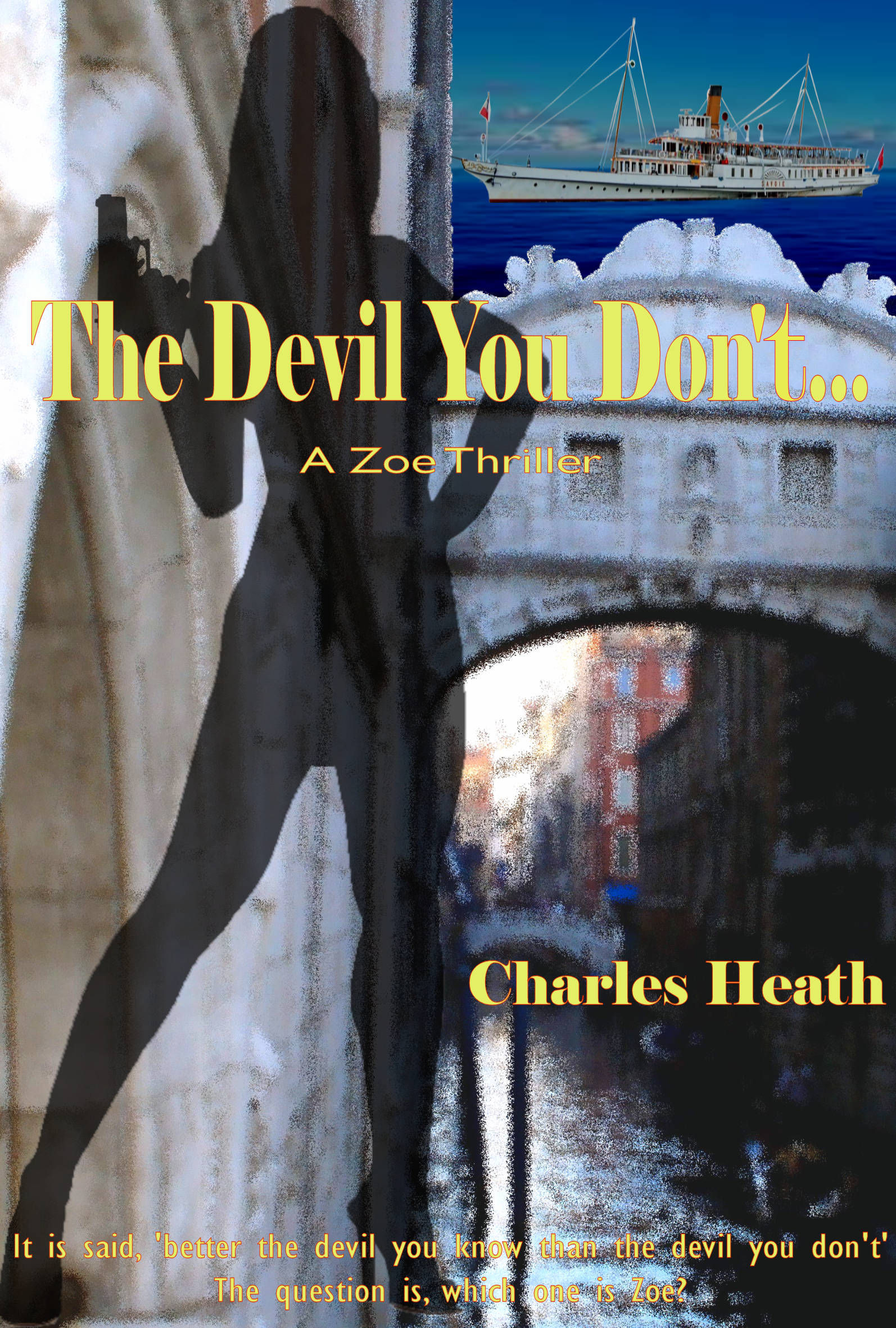
John Pennington’s life is in the doldrums. Looking for new opportunities and prevaricating about getting married, the only joy on the horizon was an upcoming visit to his grandmother in Sorrento, Italy.
Suddenly, he is left at the check-in counter with a message on his phone telling him the marriage is off, and the relationship is over.
If only he hadn’t promised a friend he would do a favour for him in Rome.
At the first stop, Geneva, he has a chance encounter with Zoe, an intriguing woman who captures his imagination from the moment she boards the Savoire, and his life ventures into uncharted territory in more ways than one.
That ‘favour’ for his friend suddenly becomes a life-changing event, and when Zoe, the woman who he knows is too good to be true, reappears, danger and death follow.
Shot at, lied to, seduced, and drawn into a world where nothing is what it seems, John is dragged into an adrenaline-charged undertaking, where he may have been wiser to stay with the ‘devil you know’ rather than opt for the ‘devil you don’t’.
Every time I close my eyes, I see something different.
I’d like to think the cinema of my dreams is playing a double feature but it’s a bit like a comedy cartoon night on Fox.
But these dreams are nothing to laugh about.
Once again there’s a new instalment of an old feature, and we’re back on the treasure hunt.
…
“Why are we still here,” Boggs asked.
A small crowd had gathered to watch the police, some vocal about them finally doing what they should have some time ago. Very few people liked Rico and rumours were rife about his alleged participation in trafficking drugs.
The fact the current Sherriff hadn’t arrested him before now was said to be because he was corrupt, but nobody would say so out loud. I felt sorry for the Sherriff because my mother said he had made it quite clear he was not working for anyone but the city that employed him, and that no one was above the law.
But I’d only heard one person question why he was not here, using the event as part of his campaign for re-election.
“Curiosity,” I said.
“About what. I thought the situation explained itself. Rico’s finally been caught red-handed.”
“I’m not so sure/it was him. Were you watching the boat the whole time when you were waiting for me?”
“What do you mean?”
“If you were, you would have seen him on the boat, join the others and leave. Did it look like they were killing a man below deck?”
How the hell should I know? As you said, it was below deck.”
“But the boat would have been moving, well, the mast really.”
“With the wash coming towards it from the fools who drive their boats too fast. Good luck with that. Do you want Rico to get off, and then come terrorize us. That’s what’s going to happen if they let him go.”
“I don’t think so.”
Despite his protestations, Boggs was as interested in what was unfolding as I was. Only I suspect he wanted to see Rico locked up, if possible, forever. Quite a few people would, and none more than the Benderby’s.
Boggs might not realise it, but his quest for the treasure was at the heart of this. Had Rico tried to double-cross the Benderby’s? He was trying to get Nadia to steal the map from Rico, and perhaps Rico had discovered Benderby was trying to cut him out of the deal.
Had Rico threatened them, and was this how they rep[aid disloyalty?
Or was it my original thought, that the Benderby’s were looking for an easy target?
“I’m going. Coming?” Boggs had lost interest.
“No. Not yet. I want to see what Alex is going to do.”
“Alex Benderby? What’s he doing here?”
“He just conveniently arrived on his father’s boat, which means he wasn’t very far away.”
“Of course not. They’ve been having engine troubles for the last month. They were probably out testing the repairs.”
“How do you know that?”
“Rico. He thinks it’s hilarious they spent so much money on that boat and haven’t got a full day of sailing out of it. More money than sense, that lot.”
I looked in the direction of Alex’s boat and he was coming ashore. So were the divers, now out of their suits and dressed casually, and for the sake of looking normal, with three women, one of whom looked like Nadia.
“Anyway, I’ve decided,” he said, “we’re doing this treasure hunt on our own. I don’t trust anyone but you. It was a mistake thinking Alex would help. Call me tomorrow when you’re free. We have to start planning.”
“OK.”
I didn’t see him leave. I was too busy watching the group with Alex. It was Nadia, and she was looking very cosy next to him.