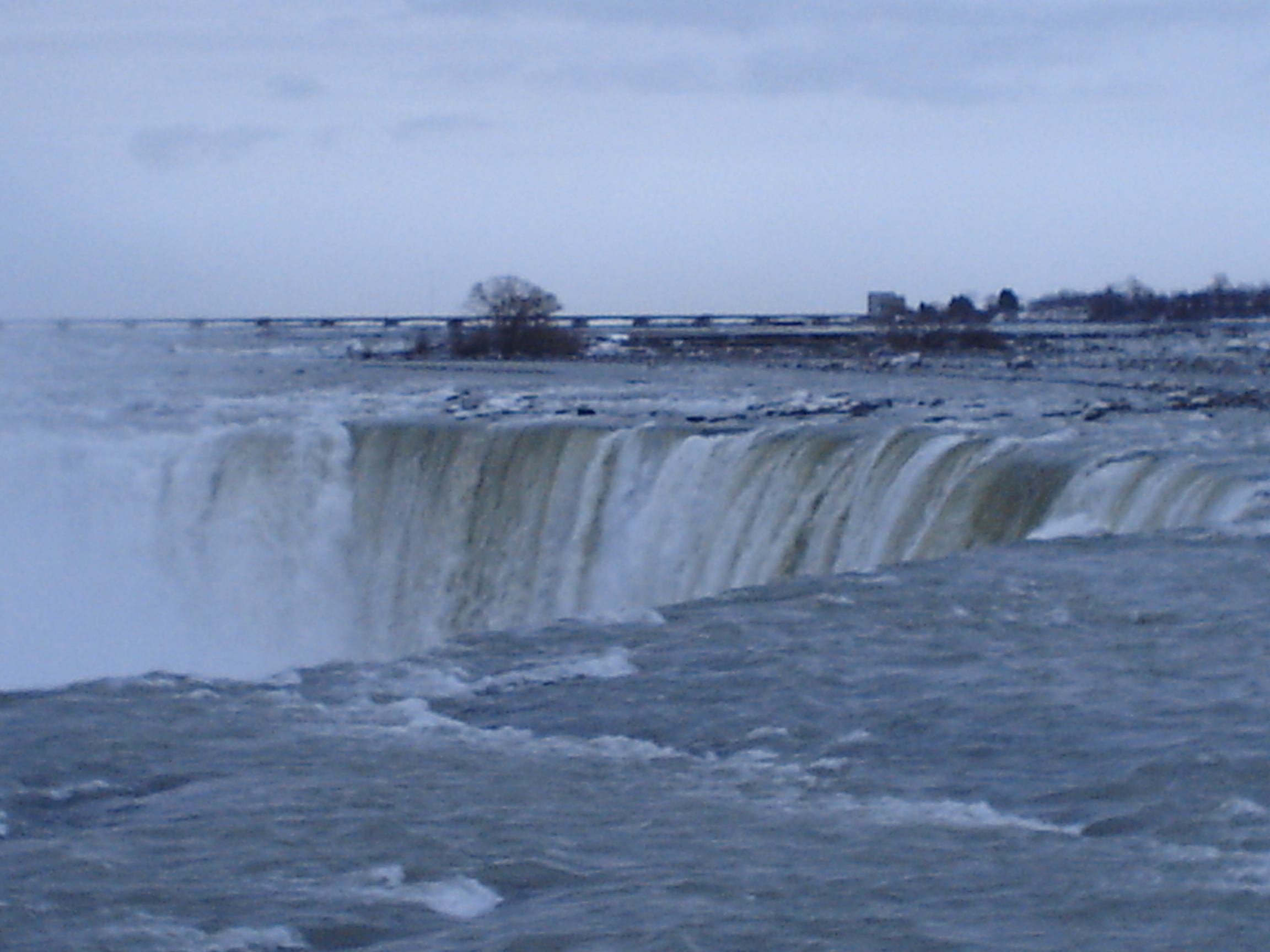
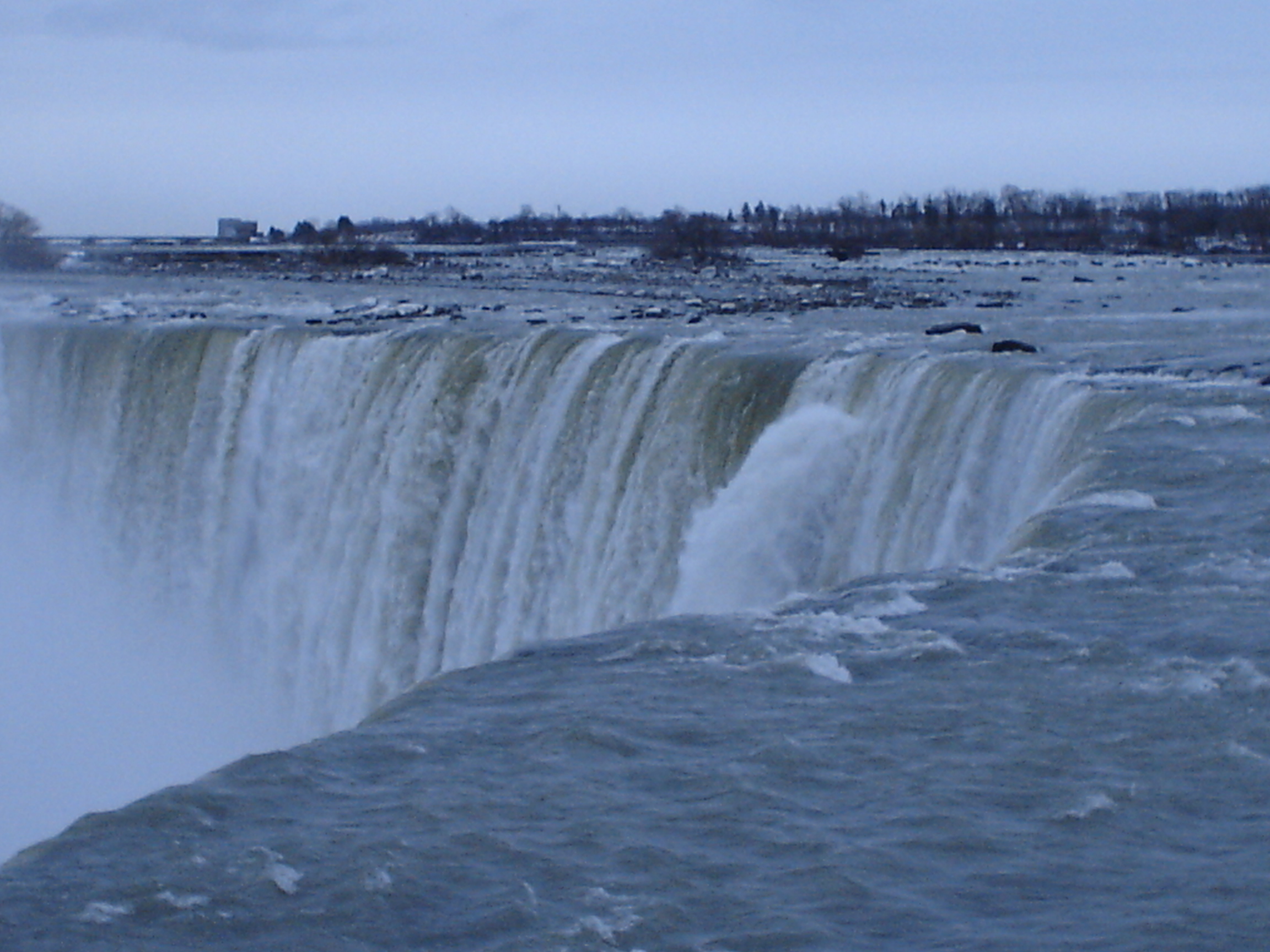
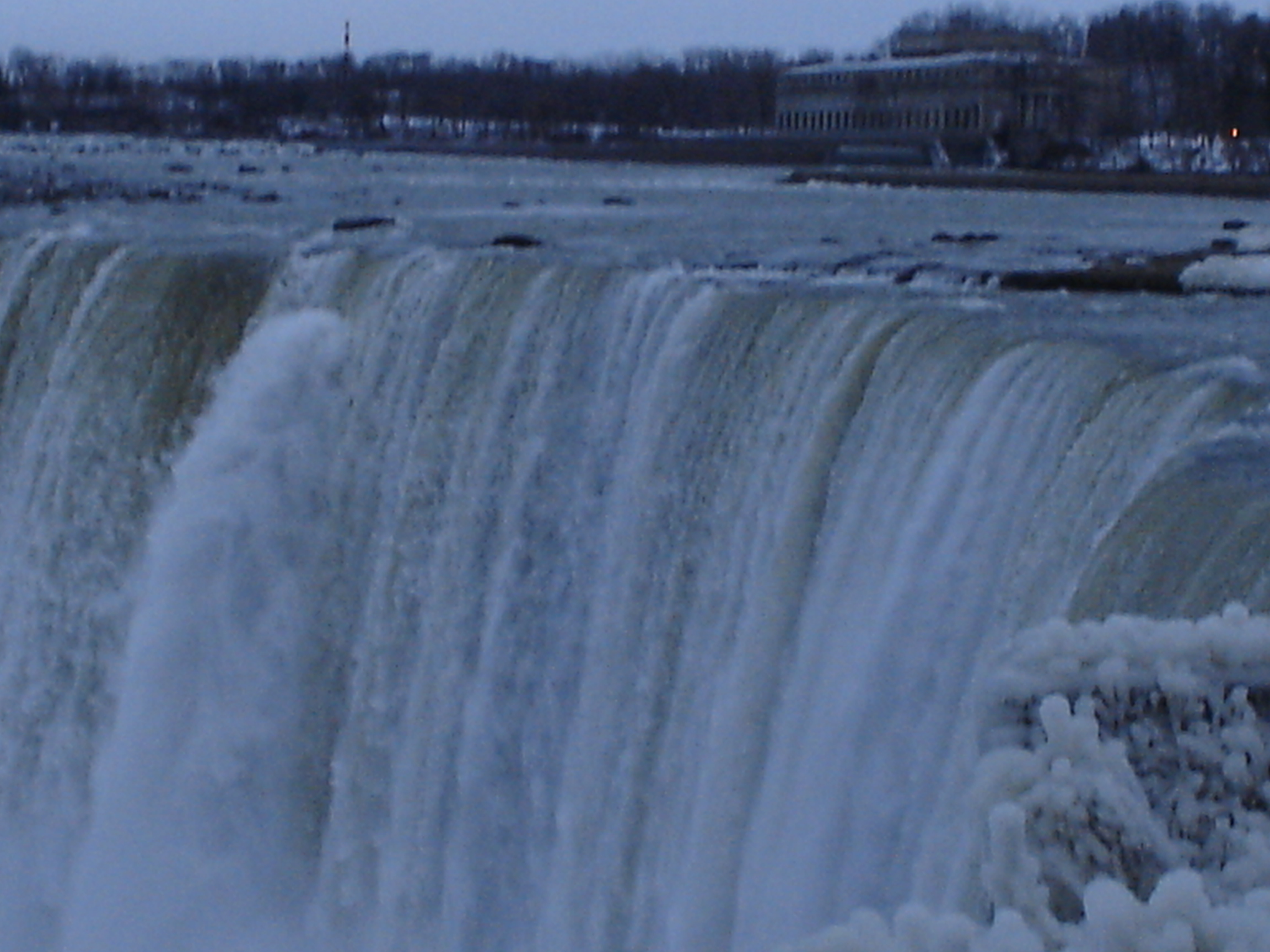
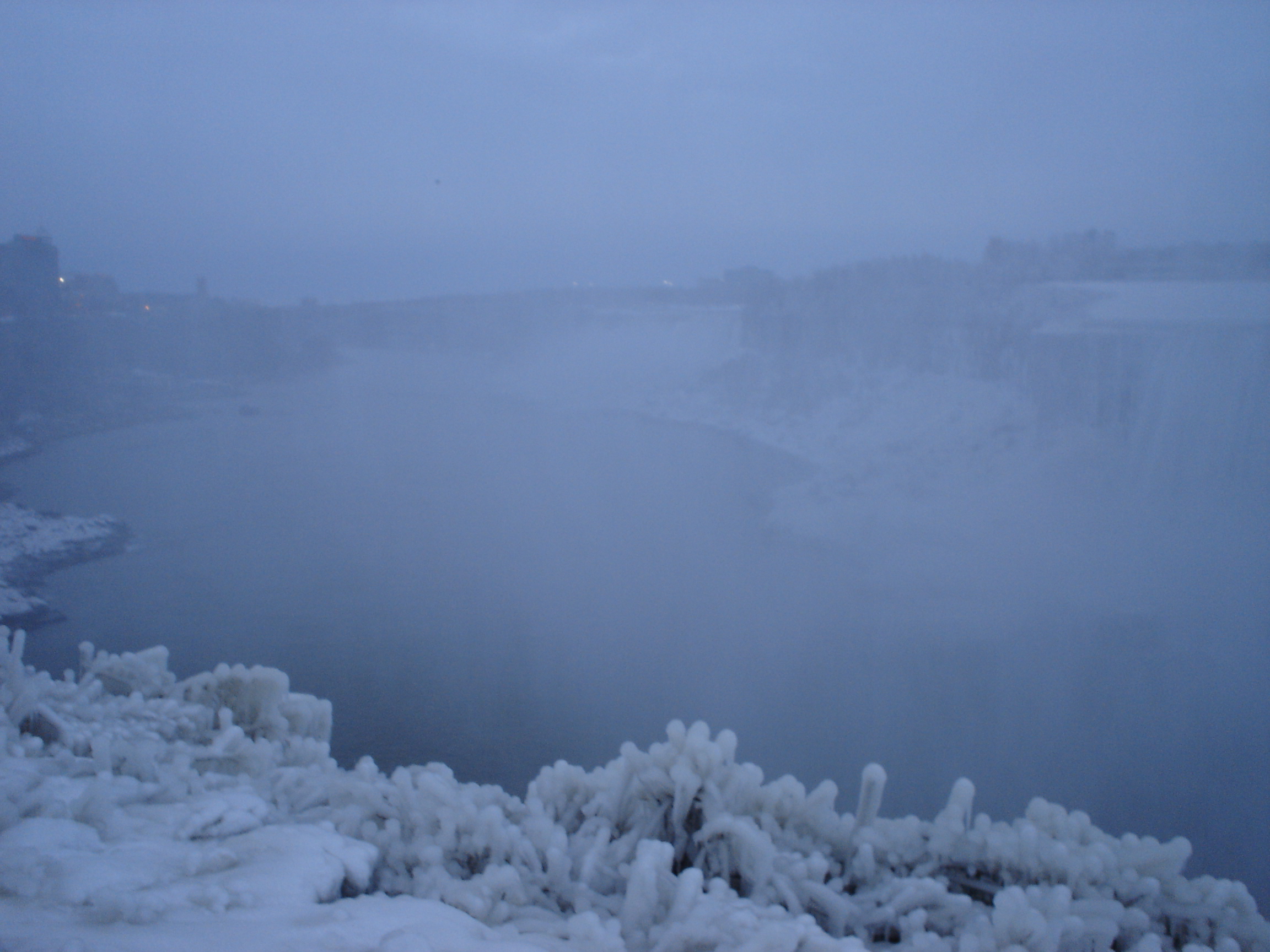
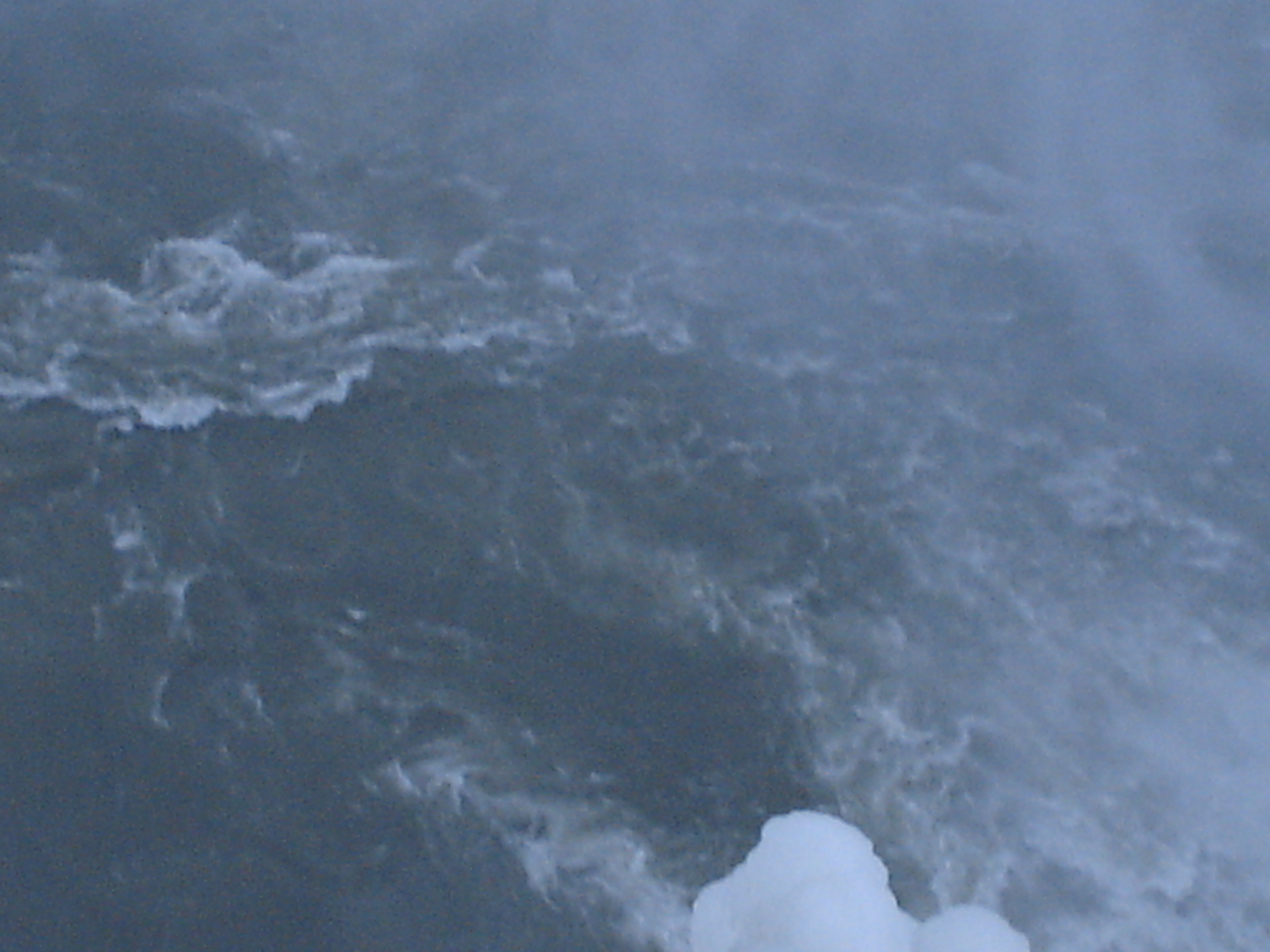
We visited the falls in winter, just after Christmas, when it was all but frozen.
The weather was freezing, it was snowing, and very icy to walk anywhere near the falls
Getting photos is a matter of how much you want to risk your safety.
I know I slipped and fell several times on the ice just below the snowy surface in pursuit of the perfect photograph. Alas, I don’t think I succeeded.
The mist was generated from both the waterfall and the low cloud. It was impossible not to get wet just watching the falls.
Of course, unlike the braver people, you could not get me into one of the boats that headed towards the falls. I suspect there might be icebergs and wasn’t going to tempt the fate of another Titanic, even on a lesser scale. The water would be freezing.
50 photographs, 50 stories, of which there is one of the 50 below.
They all start with –
A picture paints … well, as many words as you like. For instance:
And, the story:
Have you ever watched your hopes and dreams simply fly away?
Everything I thought I wanted and needed had just left in an aeroplane, and although I said I was not going to, I came to the airport to see the plane leave. Not the person on it, that would have been far too difficult and emotional, but perhaps it was symbolic, the end of one life and the start of another.
But no matter what I thought or felt, we had both come to the right decision. She needed the opportunity to spread her wings. It was probably not the best idea for her to apply for the job without telling me, but I understood her reasons.
She was in a rut. Though her job was a very good one, it was not as demanding as she had expected, particularly after the last promotion, but with it came resentment from others on her level that she, the youngest of the group, would get the position.
It was something that had been weighing her down for the last three months, and if she noticed it, the late nights, the moodiness, sometimes a flash of temper. I knew she had one; no one could have such red hair and not, but she had always kept it in check.
And then there was us, together, and after seven years, it felt like we were going nowhere. Perhaps that was down to my lack of ambition, and though she never said it, lack of sophistication. It hadn’t been an issue, well, not until her last promotion, and the fact that she had to entertain more, and frankly, I felt like an embarrassment to her.
So, there it was, three days ago, the beginning of the weekend, and we had planned to go away for a few days and take stock. We both acknowledged we needed to talk, but it never seemed the right time.
It was then that she said she had quit her job and found a new one. Starting the following Monday.
Ok, that took me by surprise, not so much that it was something I sort of guessed might happen, but that she would just blurt it out.
I think that right then, at that moment, I could feel her frustration with everything around her.
What surprised her was my reaction. None.
I simply asked who, where, and when.
A world-class newspaper in New York, and she had to be there in a week.
A week.
It was all the time I had left with her.
I remember just shrugging and asking if the planned weekend away was off.
She stood on the other side of the kitchen counter, hands around a cup of coffee she had just poured, and that one thing I remembered was the lone tear that ran down her cheek.
Is that all you want to know?
I did, yes, but we had lost the intimacy we used to have, where she would have told me what was happening, and we would have brainstormed solutions. I might be a cabinet maker, but I still had a brain, was what I overheard her tell a friend once.
There’s not much to ask, I said. You’ve been desperately unhappy and haven’t been able to hide it all that well, you have been under a lot of pressure trying to deal with a group of troglodytes, and you’ve been leaning on Bentley’s shoulder instead of mine, and I get it, he’s got more experience in that place, and the politics that go with it, and is still an ally.
Her immediate superior was instrumental in her getting the position, but unlike some men in his position, he had not taken advantage of the situation like some might. And even if she had made a move, which I doubted, that was not the sort of woman she was, he would have politely declined.
One of the very few happily married men in that organisation, so I heard.
So, she said, you’re not just a pretty face.
Par for the course for a cabinet maker whose university degree is in psychology. It doesn’t take rocket science to see what was happening to you. I just didn’t think it was my place to jump in unless you asked me, and when you didn’t, well, that told me everything I needed to know.
Yes, our relationship had a use-by date, and it was in the next few days.
I was thinking, she said, that you might come with me; you can make cabinets anywhere.
I could, but I think the real problem wasn’t just the job. It was everything around her and going with her that would just be a constant reminder of what had been holding her back. I didn’t want that for her and said so.
Then the only question left was, what do we do now?
Go shopping for suitcases. Bags to pack, and places to go.
Getting on the roller coaster is easy. At the beginning, it’s a slow, easy ride, followed by the slow climb to the top. It’s much like some relationships; they start out easy, they require a little work to get to the next level, followed by the adrenaline rush when it all comes together.
What most people forget is that what comes down must go back up, and life is pretty much a roller coaster with highs and lows.
Our roller coaster had just come out of the final turn, and we were braking so that it would stop at the station.
There was no question of going with her to New York. Yes, I promised I’d come over and visit her, but that was a promise with crossed fingers behind my back. After a few months in the new job, the last thing she’d want was a reminder of what she left behind. New friends, new life.
We packed her bags, threw out everything she didn’t want, a free trip to the op shop with stuff she knew others would like to have, and basically, by the time she was ready to go, there was nothing left of her in the apartment, or anywhere.
Her friends would be seeing her off at the airport, and that’s when I told her I was not coming; that moment, the taxi arrived to take her away forever. I remember standing there, watching the taxi go. It was going to be, and was, as hard as it was to watch the plane leave.
So, there I was, finally staring at the blank sky, around me a dozen other plane spotters, a rather motley crew of plane enthusiasts.
Already that morning, there had been 6 different types of planes departing, and I could hear another winding up its engines for take-off.
People coming, people going.
Maybe I would go to New York in a couple of months, not to see her, but just to see what the attraction was. Or maybe I would drop in, just to see how she was.
As one of my friends told me when I gave him the news, the future is never written in stone, and it’s about time you broadened your horizons.
Rupert follows Worthington and Arabella to and from the concert, and then observes them over dinner, wondering what it is that’s missing in his life until they go back to the room for the night.
To him, it seems like it’s just a sex weekend with cultural embellishments.
Until he spies Worthington on the move at two am, leaving the hotel on foot. It turns into a meeting between him and two other men in the park before Worthington returns to the hotel, business concluded.
It has to be something to do with John and Zoe; otherwise, the meeting would have been in the hotel, not the deep recesses of the park. Rupert has photographs and gives them to Sebastian for identification.
At least they now know the reason for Worthington being in Vienna. Arabella just makes it look more casual.
John breaks his plan to Zoe over breakfast, and she is surprised. It’s a good plan, and once she had dealt with the problems, it would be a go.
And, she added quite sombrely, if they all survive.
The bad news was that she would be leaving the next morning to visit an old friend, Dominica, who probably isn’t so friendly now, to get information. And, no, she was not sure what would happen after that, but if she could, she would call him.
With the two men identified and the danger they presented, Sebastian had to move to plan B and set it up. He deliberately doesn’t tell either of them because he knows they would strenuously object.
The plan: sniper to shoot them from a building across the road, not to kill, but to slow them down. It would be difficult to be out plotting when in the emergency ward of a hospital.
But, as usual, things don’t quite go to plan. Worthington is hit and wounded, though not severely as Sebastian had hoped, but Arabella moved slightly just before he pulled the trigger, and he couldn’t see what happened, but what he could see, it looked very, very bad.
It could be said that of all the women one could meet, whether contrived or by sheer luck, what are the odds it would turn out to be the woman who was being paid a very large sum to kill you?
John Pennington is a man who may be lucky in business, but not so lucky in love. He has just broken up with Phillipa Sternhaven, the woman he thought was the one, but relatives and circumstances, and perhaps because she was a ‘princess’, may also have contributed to the end result.
So, what do you do when you are heartbroken?
That is a story that slowly unfolds, from the first meeting with his nemesis on Lake Geneva, all the way to a hotel room in Sorrento, where he learns the shattering truth.
What should have been solace after disappointment turns out to be something else entirely, and from that point, everything goes to hell in a handbasket.
He suddenly realises his so-called friend Sebastian has not exactly told him the truth about a small job he asked him to do, the woman he is falling in love with is not quite who she says she is, and he is caught in the middle of a war between two men who consider people becoming collateral damage as part of their business.
The story paints the characters, cleverly displaying all their flaws and weaknesses. The locations add to the story at times, taking me back down memory lane, especially to Venice, where, in those back streets, I confess it’s not all that hard to get lost.
All in all, a thoroughly entertaining story with, for once, a satisfying end.
The problem is, there are familiar faces and a question of who is a friend and who is foe made all the more difficult because of the enemy, if it was the enemy, simply because it didn’t look or sound or act like the enemy.
Now, it appears, his problems stem from another operation he participated in.
It took almost an hour to recover. Monroe didn’t come looking for me, so I think they knew it would take some time for me to get my legs back.
And it felt good to stand under the hot shower for twenty-odd minutes, letting the warmth of the water sink into my bones and clear my head.
And think.
How long had Bamfield have an eye on me? It was a question that sprung to mind the moment I saw him in the desert camp. I’d heard if you were transferred to one of his commands, at some point, it was not because it was another posting, it was because he wanted you there.
I’d been specially selected by Bamfield personally, out of the preliminary training camp, to further my military career under his oversight. I’d made it very clear from the outset that I was not interested in a commission, that I preferred the lower ranks. Officers were a different breed, and I’d not been cut from that cloth. Bamfield had admitted as much when I was first interviewed by him, and several other’s on what I soon discovered was his selection panel.
They were charged by him to find the best of the best.
And at that first interview, I’d disagreed with his assessment. I’d been in trouble before, and the military was the only place I could go if I didn’t want to serve a stretch in jail. Perhaps it was that innate ability of mine to seek out and become embroiled in trouble that caught his attention.
Certainly over time he and his instructors had honed those skills to a more refined set that, in civilian life, would set me up for a long stay in prison. It begged the question of what I was going to do with myself after the military had finished with me, a question I hadn’t really thought about until I’d been shunted to my last post in a training school of sorts.
I realised now that it had been Bamfield sidelining me until an operation crying out for my particular talents came along.
That disastrous operation with Treen.
Was it his? Or was it someone else who pulled it together, and he just provided the manpower. It had been the first major active offshore operation I’d been on. There’d been a few skirmishes along the way, but that was the first, and in a zone where I don’t think we were meant to be operating.
That had, I thought, been the sole purview of the CIA, and if I looked back on what had happened, there was no doubt the two agents we were supposed to pull out were CIA operatives, it had got too hot for them to stay, and they had clandestinely called for help.
It begged another question, was Bamfield CIA or working with the CIA, with or without the military hierarchy knowing?
The thing is, if it had been pulled off, as expected, no one would be any the wiser in that country, but once they found out, by whatever means it happened, the proverbial had hit the fan. It goes hand in hand with trusting people on the ground who were purportedly working against their country’s regime, for better or worse.
That country had a ‘friendly’ government, that had been ‘supported’ and then been deposed in the usual coup by the military, and, afterwards, the new hardliners got the benefit of those times when the country was a friendly and had military hardware and knowledge to wage war clandestinely or otherwise with its neighbours, given willingly.
Lessons hadn’t been learned after a particular middle east debacle. Maybe lessons would never be learned. Just look at the number of times had relations turned sour after a coup and agents had to hastily withdraw. It seems that my visit had been at the end of another of those ‘diplomatic’ missions that had gone wrong.
It could have been anywhere in the world, she thought, but it wasn’t. It was in a city where if anything were to go wrong…
She sighed, came away from the window and looked around the room. It was quite large and expensively furnished. It was one of several she had been visiting in the last three months.
Quite elegant too, as the hotel had its origins dating back to before the revolution in 1917. At least, currently, there would not be a team of KGB agents somewhere in the basement monitoring everything that happened in the room.
There was no such thing as the KGB anymore, though there was an FSB, but such organisations were of no interest to her.
She was here to meet with Vladimir.
She smiled to herself when she thought of him, such an interesting man whose command of English was as good as her command of Russian, though she had not told him of that ability.
All he knew of her was that she was American, worked in the Embassy as a clerk, nothing important, whose life both at work and at home was boring. Not that she had blurted that out the first time they met, or even the second.
That first time, at a function in the Embassy, was a chance meeting, a catching of his eye as he looked around the room, looking, as he had told her later, for someone who might not be as boring as the function itself.
It was a celebration honouring one of the Embassy officials’ service in Moscow, soon to be returning home after 10 years. She had been there one and still hadn’t met all the staff.
They had talked; Vladimir knew a great deal about England, having been stationed there for a year or two, and had politely asked questions about where she lived, her family, and, of course, what her role was, all questions she fended off with an air of disinterested interest.
It fascinated him, as she knew it would, a sort of mental sparring as one would do with swords if this were a fencing match.
They had said they might or might not meet again when the party was over, but she suspected there would be another opportunity. She knew the signs of a man interested in her, and Vladimir was.
The second time came in the form of an invitation to an art gallery and a viewing of the works of a prominent Russian artist, an invitation she politely declined. After all, invitations issued to Embassy staff held all sorts of connotations, or so she was told by the Security officer when she told him.
Then, it went quiet for a month. There was a party at the American embassy, and along with several other staff members, she was invited. She had not expected to meet Vladimir, but it was a pleasant surprise when she saw him, on the other side of the room, talking to several military men.
A pleasant afternoon ensued.
And it was no surprise that they kept running into each other at the various events on the diplomatic schedule.
By the fifth meeting, they were like old friends. She had broached the subject of being involved in a platonic relationship with him with the head of security at the embassy. Normally, for a member of her rank, it would not be allowed, but in this instance, it was.
She did not work in any sensitive areas, and, as the security officer had said, she might just happen upon something useful. In that regard, she was to keep her eyes and ears open and file a report each time she met him.
After that discussion, she got the impression her superiors considered Vladimir more than just a casual visitor on the diplomatic circuit. She also formed the impression that he might consider her an ‘asset’, a word that had been used at the meeting with security and the ambassador.
It was where the word ‘spy’ popped into her head and sent a tingle down her spine. She was not a spy, but the thought of it, well, it would be fascinating to see what happened.
A Russian friend. That’s what she would call him.
And over time, that relationship blossomed, until, after a visit to the ballet, late and snowing, he invited her to his apartment not far from the ballet venue. It was like treading on thin ice, but after champagne and an introduction to caviar, she felt like a giddy schoolgirl.
Even so, she had made him promise that he would remain on his best behaviour. It could have been very easy to fall under the spell of a perfect evening, but he promised, showed her to a separate bedroom, and after a brief kiss, their first, she did not see him until the next morning.
So, it began.
It was an interesting report she filed after that encounter, one she had expected to be reprimanded.
She wasn’t.
It wasn’t until six weeks had passed that he asked her if she would like to take a trip to the country. It would involve staying in a hotel, as always, in separate rooms. When she reported the invitation, no objection was raised, only a caution: keep her wits about her.
Perhaps, she had thought, they were looking forward to a more extensive report. After all, her reports on the places, the people, and the conversations she overheard were no doubt entertaining reading for some.
But on this visit, the nature of the relationship changed, and it was one that she did not immediately report. She had realised at some point before the weekend away that she had feelings for him, and it was not that he was pushing her in that direction or manipulating her in any way.
It was just one of those moments where, after a grand dinner, a lot of champagne, and delightful company, things happen. Standing at the door to her room, a lingering kiss, not intentional on her part, just happened.
And for not one moment did she believe she had been compromised, but for some reason she had not reported that subtle change in the relationship to the powers that be, and so far, no one had any inkling.
She took off her coat and placed it carefully on the back of one of the ornate chairs in the room. She stopped for a moment to look at a framed photograph on the wall, one representing Red Square.
Then, after a minute or two, she went to the minibar and took out the bottle of champagne left there for them, a treat Vladimir arranged for each encounter.
There were two champagne flutes set aside on the bar, next to a bowl of fruit. She picked up the apple and thought about how Eve must have felt in the Garden of Eden, and the temptation.
Later perhaps, after…
She smiled at the thought and put the apple back.
A glance at her watch told her it was time for his arrival. It was, if anything, the one trait she didn’t like, and that was his punctuality. A glance at the clock on the room wall was a minute slow.
The doorbell rang, right on the appointed time.
She put the bottle down and walked over to the door.
The drive down to Sorrento was interesting, not only for the stilted conversation with Francesca but the fact we were being followed. I found it hard to believe they didn’t trust her.
Or, it might be something, or someone, else.
I didn’t tell her. I didn’t want to scare her.
Later, we could have branched off to go to Naples or Pompei, I would certainly want to go to the latter, but time was of the essence. Instead, I drove directly to Sorrento, and it took about three and a half hours, with one small stop on the way for more coffee. And to check out the person who was following us.
I would have liked to look at the scenery but couldn’t.
I had another go at small talk. “Where do you come from?”
She looked round at me with a frown. Was I interrupting her sightseeing? She blinked a lot, so I assumed she was nervous. She didn’t have the red spots on her cheeks now, but I wondered it that was a sign she was angrier.
Then having decided, on what I didn’t know, she said, “Milan. I wanted to be a model, but it didn’t work out.”
“What happened?”
“It’s a long story.”
“We’ve got time.”
“My mother thought it best I get married to a nice man and have children. It seems women, to her, are meant only to be dutiful wives. I had no such aspirations.”
“Then what stopped you?”
“The awful man I picked to be my agent. Wanted me to sleep with him before he took me on. I taught him a lesson he’ll never forget.”
“How did you get to be an art historian?”
“I liked going to art galleries and looking at paintings. I wanted to know more, got into university, and it was fun.”
“And working as a private detective?”
“A friend of my father heard I knew something about old paintings and asked me to come and look at some that had been recovered from a robbery. He thought they were fakes, which they were. Offered me a job, gave me the training, just in case I wanted some variety, and here I am.”
“You just need to work on your surveillance skills and maintaining a low profile.”
“For such a so-called good agent, you were easy to pick up at the airport.”
“I wasn’t trying to hide. There are two ways I could have arrived, the first is so that no one knew I was coming. The second, make a splash, identify the surveillance, and then remove it.”
“And if two men come up to you in the street, throw you into a white van, and drive off…”
“Always be aware of your surroundings.”
“Is that a hint that I should have been looking for anything unusual while on this road trip. If it is a subtle dig, then I would not be surprised if you have already picked up the man in the yellow Fiat three cars back. He;’s been there for a while.”
“Not one of yours?”
“No. Why would there be?”
“Your boss still thinks you’re not clever enough to outwit me.”
“Or I’m smarter than he thinks I am. I’m with you, you’re not considering me a problem, I get to see and do everything you do, that’s pretty smart don’t you think?”
I had to admit if you were to put that spin on what she was doing, it was. I hoped her boss wasn’t an ungrateful sod.
Conversation over, she went back to her phone and worked on a crossword. She changed the radio station to classical music, and I didn’t change it back. It was Ravel’s Bolero, and for some reason it made me think of Cecelia.
“Do you think we should play cat and mouse with our tail?”
“Why would you want to do that.” She gave me a sideways glance that I interpreted as ‘Are you stupid?’
“Just say I have a strange sense of humour.”
With that, I slowed down and pulled off onto the side of the road, and being such a sudden move, my tail didn’t have time to do likewise, and if he did, he would have given himself away.
I watched him drive by, noting that he glanced in our direction as he passed.
I pulled out from the side onto the road after several cars passed, then settled in to follow him. I expected him to pull over and stop, just to see what I would do, but he didn’t.
“What exactly did you achieve?” she said.
“Nothing yet, but the day is young. Once we get to Sorrento, I will not be letting him know where we’re going.”
Or that’s what I keep telling myself, struggling to stay awake and write the next sentence, then the next sentence, and the one after that.
Long after I should have gone to bed.
Does that sound like your life?
Of course, it doesn’t. The rest of the world is sane, goes to work, comes home, has dinner, watches a little television or plays with the children, or maybe not, then goes to bed.
None of this writing business, trying to finish the page, the scene, the chapter while the ideas are fresh in your mind.
Only your mind isn’t fresh, it’s been a long day, an argument with the significant other, a bigger argument with the cat, there’s the washing, the cooking, the cleaning…
When do I get five minutes for myself?
At the dead of night, when everyone else has gone to bed, getting their eight hours of sleep.
In the dark with only the screen to light the keyboard, I’m trying to find the way around the keyboard and turn out what has to be the next international best-selling thriller.
The dog next door barks; it means the cat got out and is terrorising it.
A door slams, it’s old Joe getting home late from the pub, probably drunk again.
Yep, right on target, the vitriol of a bitter woman, and I have to say, I don’t blame her.
Then I hear it, that voice from the deep, “Poppy.”
The youngest of the grandchildren was the very devil to get to sleep.
Writing for the night is over, time to read other people’s stories.
I was sitting down and wondering just what I could write that would create a sense of astonishment, or even shock the reader.
Then my news feed arced up and – well, I have to say I’m astonished.
At the state of American politics, and the lengths political parties will go to avoid getting caught, especially when they’ve been caught.
I utterly refuse to believe that the Democratic Party is to blame for absolutely everything in America. It takes a long time to completely stuff everything up, and both parties have a hand in all the problems.
It’s the same in Australia. We’ve got a lot of problems, but no one party has caused them; they are caused by both, and a lot to do with election cycles. No one wants to set in place the 10-year cycle it would take to fix things.
Then, I have to say it is the same everywhere.
The next thing that flashes up in the news cycle, pedophiles. OK, not the domain of one party, but everyone has a hand in this. And it is abhorrent, and we say we don’t tolerate it, but the fact is, politicians, judges, policemen, lawyers, doctors, priests and even presidents are complicit. The thing is, we all know they’re complicit, we want answers and arrests, and somehow it all gets buried.
Shock!
Or not.
It’s no surprise, no shock, and we are not even astonished when the politicians from the top down, and then the law enforcement officers, all lie, lie, lie, and then lie again.
And we let them.
There’s the shock, right there.
And the next shock? Nothing is going to happen. We’ll be talking about this in four years, and no one will be arrested. Someone might commit suicide (ha bloody ha), absolving the guilty.
If the Republicans are in power, it’s all the Democrats who are pedophiles, and if the Democrats are in power then it’s all the Republicans who are pedophiles, and when you can’t even believe in or trust your president, well, what hope is there for all those victims?
Oh, hang on, we seem to have forgotten about the victims. I was a victim. I know what it’s like to be abused. I know what it’s like not to get justice. I know what it’s like to listen to the lies of the perpetrator and watch him get away with it.
I cannot be shocked, surprised or astonished anymore.
What would shock me?
Just one of those turds being hung at noon in a public square as a reminder that it will not be tolerated.
The Starving Artist Myth: Why You Should Chase Paychecks, Not Just Prestige
In the writing community, there’s a persistent, romanticised image of the “struggling artist.” We’re told that if we just sacrifice enough comfort—if we skip enough meals and keep our bank accounts sufficiently drained—we will somehow be more “authentic.”
But let’s be real for a second: You cannot write a masterpiece on an empty stomach.
If you are looking to build a sustainable writing career, you need to be strategic about where you invest your energy. When it comes to writing contests and submission calls, it’s time to stop chasing prestige and start prioritising your survival.
The Problem with “Prestige”
There is no denying the allure of a prestigious award. Seeing a fancy logo next to your name or receiving a pat on the back from a renowned institution feels incredible. It validates your talent and strokes your ego.
But here is the hard truth: Prestige does not pay the rent.
When you spend your limited writing time crafting pieces specifically to chase awards that offer nothing but a digital badge or a line on your resume, you are essentially working for free. Worse, you are trading the precious hours you could be spending on your long-form projects for a fleeting moment of hollow validation.
Why You Need to Prioritise the Prize
Writing is work. It is intellectual labour, and like any other form of labour, it deserves compensation.
When you seek out contests with cash prizes, you aren’t being “sell-out.” You are being a professional. That prize money serves a dual purpose:
It keeps you fed: You need electricity, internet, and groceries to keep the creative engine running.
It buys you time: If you can win a prize that covers a month’s worth of expenses, that is one month you don’t have to spend at a soul-sucking day job. It’s one month where you can focus entirely on that novel—the one that lives in your head and needs your undivided attention to finally make it onto the page.
The “Later” Philosophy
Don’t get me wrong—prestige has its place. But that place is later.
Once you have established your footing, once you have mastered your craft, and once you have a body of work that has been funded by the very industry you are trying to enter, then you can afford the luxury of chasing accolades.
But right now? Right now, you are building your foundation. You are cultivating the experiences, the discipline, and the financial stability required to produce your best work. You cannot reach the peak of the mountain if you are too malnourished to climb the first few hundred feet.
How to Strategise Your Submissions
Next time you find yourself browsing Submittable or a contest directory, try applying these three rules:
The Bottom Line: Does this contest offer a cash prize that would meaningfully impact my life or support my writing time? If the answer is no, skip it.
The Time-to-Value Ratio: If the entry fee is high and the prize is obscure prestige, save your money. Invest that entry fee into a book on craft or a subscription to a platform that actually helps your writing process.
The Novel Priority: Is this contest helping you build toward your larger goal (your novel), or is it a distraction? If it doesn’t align with your long-term creative vision, don’t let it siphon your energy.
Final Thoughts
Your voice is valuable, and your time is a finite resource. Treat your writing like the profession it is. Stop waiting for the world to notice you through a gold-leafed certificate and start focusing on the work that sustains your life.
Feed yourself first. The masterpiece will come, but it will come when you are strong enough to carry it to the finish line.